The choice ofthe dosage form
1- Desired effect
2-Effect time
3- drug nature
4.
Routes of administrationand examples of dosage forms
• Oral route:
– solid oral dosage forms (tablets, capsules)
– liquid oral dosage forms (syrups, suspension)
• Topical route:
– transdermal drug delivery
– inhalation
– nasal, ophthalmic, and ear drops
–topical for skin disorders: creams, ointments, lotions, gel
5.
Routes of administrationand examples of dosage forms
• Parental route:
– intramuscular, subcutaneous, intravenous
• Rectal route:
– enemas, suppositories
• Vaginal route:
– pessaries, fluid solutions (douch), creams.
6.
Oral route
Advantages
• Simple,convenient (most common 75%)
• Self-administration possible.
Disadvantages
• Irregular absorption from GIT (e.g. due to food)
• Drugs destroyed by acid or enzymes in GIT
• Limitations when patient is unconscious, vomiting or
in pre-/post-operative patients.
7.
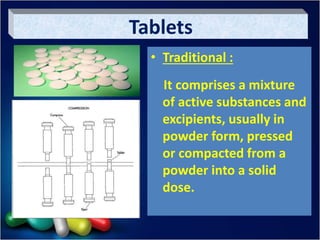
Tablets
• Traditional :
Itcomprises a mixture
of active substances and
excipients, usually in
powder form, pressed
or compacted from a
powder into a solid
dose.
8.
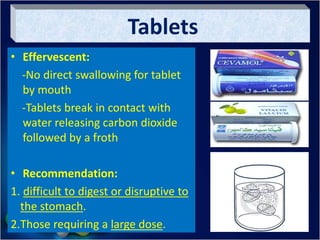
Tablets
• Effervescent:
-No directswallowing for tablet
by mouth
-Tablets break in contact with
water releasing carbon dioxide
followed by a froth
• Recommendation:
1. difficult to digest or disruptive to
the stomach.
2.Those requiring a large dose.
9.
Tablets
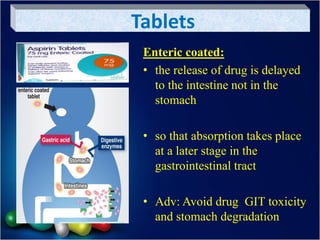
Enteric coated:
• therelease of drug is delayed
to the intestine not in the
stomach
• so that absorption takes place
at a later stage in the
gastrointestinal tract
• Adv: Avoid drug GIT toxicity
and stomach degradation
10.
Tablets
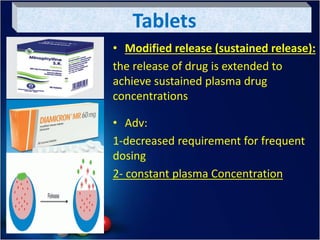
• Modified release(sustained release):
the release of drug is extended to
achieve sustained plasma drug
concentrations
• Adv:
1-decreased requirement for frequent
dosing
2- constant plasma Concentration
11.
Non-swallowing Tablets
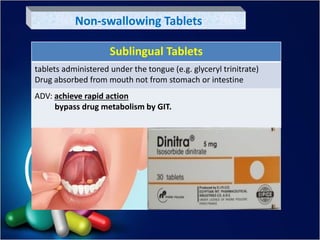
Sublingual Tablets
tabletsadministered under the tongue (e.g. glyceryl trinitrate)
Drug absorbed from mouth not from stomach or intestine
ADV: achieve rapid action
bypass drug metabolism by GIT.
12.
Capsules
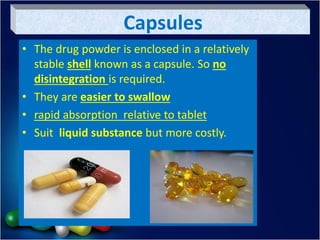
• The drugpowder is enclosed in a relatively
stable shell known as a capsule. So no
disintegration is required.
• They are easier to swallow
• rapid absorption relative to tablet
• Suit liquid substance but more costly.
13.
Capsules
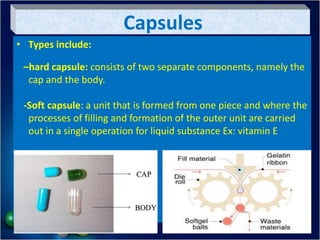
• Types include:
–hardcapsule: consists of two separate components, namely the
cap and the body.
-Soft capsule: a unit that is formed from one piece and where the
processes of filling and formation of the outer unit are carried
out in a single operation for liquid substance Ex: vitamin E
14.
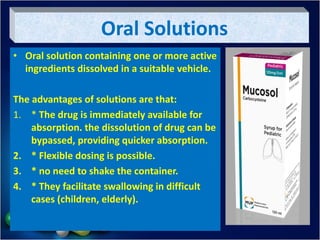
Oral Solutions
• Oralsolution containing one or more active
ingredients dissolved in a suitable vehicle.
The advantages of solutions are that:
1. * The drug is immediately available for
absorption. the dissolution of drug can be
bypassed, providing quicker absorption.
2. * Flexible dosing is possible.
3. * no need to shake the container.
4. * They facilitate swallowing in difficult
cases (children, elderly).
15.
The disadvantages ofsolutions
1-Drug stability is often reduced in solution by hydrolysis .
2-It is difficult to mask unpleasant tastes. Despite, the attempt to
mask any unpleasant tastes by the addition of a flavouring, but
this will not always be successful.
3-They are bulky, difficult to transport and prone to breakages.
4- A measuring device is needed for administration.
5-Some drugs are poorly soluble. So may be unsuitable for some
drugs.
16.
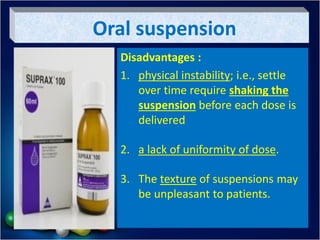
Oral suspension
Suspensions areliquid preparation of solid drug particle
dispersed in liquid system.
The advantages :
Suitable for insoluble drugs and for patients who have
difficulty swallowing tablets or capsules.
drugs in suspension are chemically more stable than in
solution. Ex: antibiotics
17.
Oral suspension
Disadvantages :
1.physical instability; i.e., settle
over time require shaking the
suspension before each dose is
delivered
2. a lack of uniformity of dose.
3. The texture of suspensions may
be unpleasant to patients.
18.
Topical route
Advantages
• Maybe adopted to provide a localized effect
• When routes for systemic effect is unavailable.
Disadvantages
• Some dosage forms require particular patient advice
(inhaler) to ensure safe and appropriate drug
administration
• Local reactions may occur as side-effects
19.
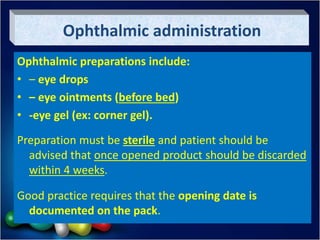
Ophthalmic administration
Ophthalmic preparationsinclude:
• – eye drops
• – eye ointments (before bed)
• -eye gel (ex: corner gel).
Preparation must be sterile and patient should be
advised that once opened product should be discarded
within 4 weeks.
Good practice requires that the opening date is
documented on the pack.
20.
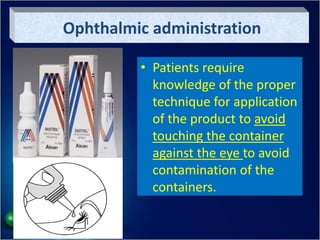
Ophthalmic administration
• Patientsrequire
knowledge of the proper
technique for application
of the product to avoid
touching the container
against the eye to avoid
contamination of the
containers.
21.
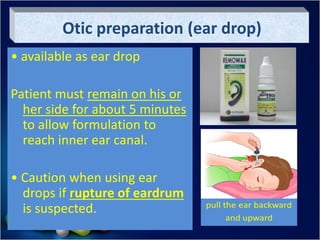
Otic preparation (eardrop)
• available as ear drop
Patient must remain on his or
her side for about 5 minutes
to allow formulation to
reach inner ear canal.
• Caution when using ear
drops if rupture of eardrum
is suspected.
22.
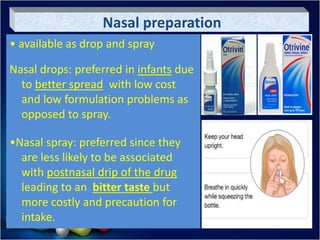
Nasal preparation
• availableas drop and spray
Nasal drops: preferred in infants due
to better spread with low cost
and low formulation problems as
opposed to spray.
•Nasal spray: preferred since they
are less likely to be associated
with postnasal drip of the drug
leading to an bitter taste but
more costly and precaution for
intake.
23.
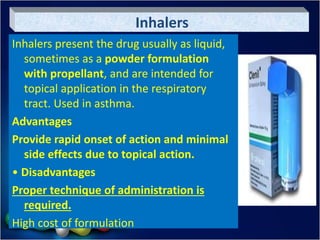
Inhalers
Inhalers present thedrug usually as liquid,
sometimes as a powder formulation
with propellant, and are intended for
topical application in the respiratory
tract. Used in asthma.
Advantages
Provide rapid onset of action and minimal
side effects due to topical action.
• Disadvantages
Proper technique of administration is
required.
High cost of formulation
24.
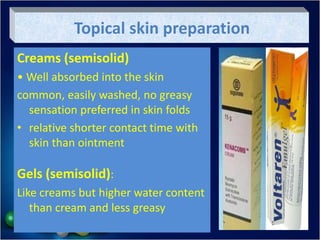
Topical skin preparation
Creams(semisolid)
• Well absorbed into the skin
common, easily washed, no greasy
sensation preferred in skin folds
• relative shorter contact time with
skin than ointment
Gels (semisolid):
Like creams but higher water content
than cream and less greasy
25.
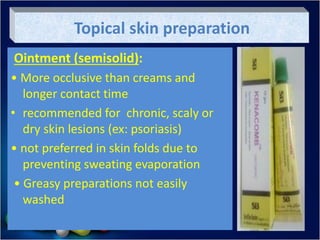
Topical skin preparation
Ointment(semisolid):
• More occlusive than creams and
longer contact time
• recommended for chronic, scaly or
dry skin lesions (ex: psoriasis)
• not preferred in skin folds due to
preventing sweating evaporation
• Greasy preparations not easily
washed
26.
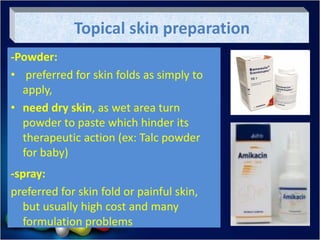
Topical skin preparation
-Powder:
•preferred for skin folds as simply to
apply,
• need dry skin, as wet area turn
powder to paste which hinder its
therapeutic action (ex: Talc powder
for baby)
-spray:
preferred for skin fold or painful skin,
but usually high cost and many
formulation problems
27.
Topical skin preparation
-Lotionsand Shampoo:
• preferred when the required application
of a drug is to hairy areas and scalp
mainly
- Solution for skin:
• less frequent, less preferred as more
difficult to apply.
• preferred in fungal infection to nail, ear
28.
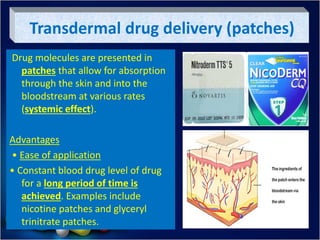
Transdermal drug delivery(patches)
Drug molecules are presented in
patches that allow for absorption
through the skin and into the
bloodstream at various rates
(systemic effect).
Advantages
• Ease of application
• Constant blood drug level of drug
for a long period of time is
achieved. Examples include
nicotine patches and glyceryl
trinitrate patches.
29.
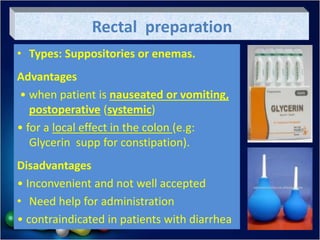
Rectal preparation
• Types:Suppositories or enemas.
Advantages
• when patient is nauseated or vomiting,
postoperative (systemic)
• for a local effect in the colon (e.g:
Glycerin supp for constipation).
Disadvantages
• Inconvenient and not well accepted
• Need help for administration
• contraindicated in patients with diarrhea
30.
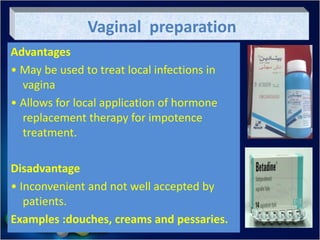
Vaginal preparation
Advantages
• Maybe used to treat local infections in
vagina
• Allows for local application of hormone
replacement therapy for impotence
treatment.
Disadvantage
• Inconvenient and not well accepted by
patients.
Examples :douches, creams and pessaries.
31.
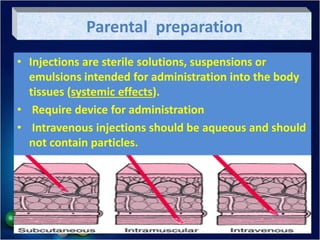
Parental preparation
• Injectionsare sterile solutions, suspensions or
emulsions intended for administration into the body
tissues (systemic effects).
• Require device for administration
• Intravenous injections should be aqueous and should
not contain particles.
32.
Parental preparation
Advantages
• veryrapid effects (for emergency)
• For drugs that have erratic absorption.
• Useful when patient is not cooperative.
Disadvantages
• Formulation has to be sterile and more expensive
• Usually requires administration by a professional person
• May not be well accepted by patients (painful).
33.
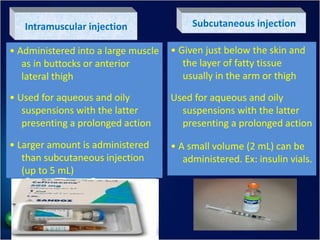
Intramuscular injection
• Administeredinto a large muscle
as in buttocks or anterior
lateral thigh
• Used for aqueous and oily
suspensions with the latter
presenting a prolonged action
• Larger amount is administered
than subcutaneous injection
(up to 5 mL)
Subcutaneous injection
• Given just below the skin and
the layer of fatty tissue
usually in the arm or thigh
Used for aqueous and oily
suspensions with the latter
presenting a prolonged action
• A small volume (2 mL) can be
administered. Ex: insulin vials.
34.
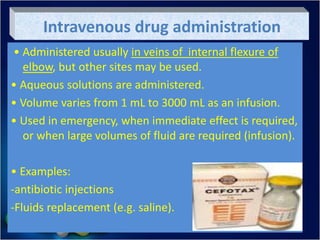
Intravenous drug administration
•Administered usually in veins of internal flexure of
elbow, but other sites may be used.
• Aqueous solutions are administered.
• Volume varies from 1 mL to 3000 mL as an infusion.
• Used in emergency, when immediate effect is required,
or when large volumes of fluid are required (infusion).
• Examples:
-antibiotic injections
-Fluids replacement (e.g. saline).
35.
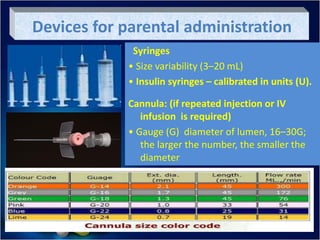
Devices for parentaladministration
Syringes
• Size variability (3–20 mL)
• Insulin syringes – calibrated in units (U).
Cannula: (if repeated injection or IV
infusion is required)
• Gauge (G) diameter of lumen, 16–30G;
the larger the number, the smaller the
diameter
36.
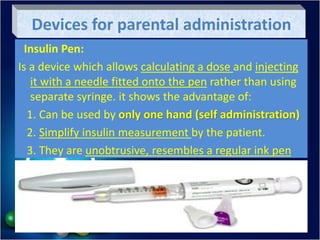
Insulin Pen:
Is adevice which allows calculating a dose and injecting
it with a needle fitted onto the pen rather than using
separate syringe. it shows the advantage of:
1. Can be used by only one hand (self administration)
2. Simplify insulin measurement by the patient.
3. They are unobtrusive, resembles a regular ink pen
Devices for parental administration
37.
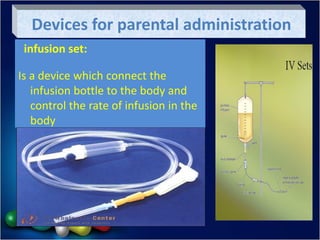
infusion set:
Is adevice which connect the
infusion bottle to the body and
control the rate of infusion in the
body
Devices for parental administration