DRUG ADMINISTRATION
DRUG DOSAGEFORMS
• This is a form in which a medicine is prescribed for use by the
patient such as injections, tablets, capsules or syrups.
• Dosage forms do not contain just the active ingredient but also
contain other components called excipients or additives.
• These make the dosage form suitable for handling, administration
and enable it to release the active medicaments in the appropriate
manner to make it efficacious for treatment of diseases or
conditions.
• Dosage forms can be in solid, semisolid, liquid or gaseous form.
3.
COMMON DOSAGE FORMSAND THEIR ROUTES OF
ADMINISTRATION
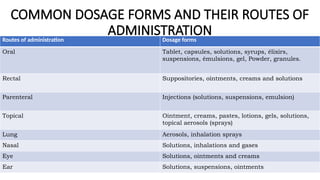
Routes of administration Dosage forms
Oral Tablet, capsules, solutions, syrups, élixirs,
suspensions, émulsions, gel, Powder, granules.
Rectal Suppositories, ointments, creams and solutions
Parenteral Injections (solutions, suspensions, emulsion)
Topical Ointment, creams, pastes, lotions, gels, solutions,
topical aerosols (sprays)
Lung Aerosols, inhalation sprays
Nasal Solutions, inhalations and gases
Eye Solutions, ointments and creams
Ear Solutions, suspensions, ointments
4.
DESCRIPTION OF COMMONDOSAGE FORMS
Tablets
• Tablets are solid dosage forms containing one or more dried
compressed active drug as well as binders.
Types of tablets
• Tablets are formulated as coated or uncoated.
• Coated tablets include enteric coated, sugar coated, film coated
and slow-release coated tablets.
Film coated tablets
• These tablets are covered with a very thin layer of coating material
5.
• Enteric coatedtablets: These tablets are covered with a special
coating which resists break down in the stomach but dissolves in
the alkaline environment in the small intestine where the drug is
absorbed.
• The coating is intended to avoid irritating the stomach.
Sugar coated tablets: These are formulated with a sugar coating to
disguise the bitter taste of the active ingredient.
• Slow-release tablets: These tablets are manufactured to provide a
continuous, sustained release of certain drugs. These tablets
names are accompanied by abbreviations such as S.R (slow
release)or L.A (long acting) e.g Nifelat R®, Olfen S.R ® orAdalat LA
®
• Scored tablets: These tablets have an indented line running
across the top of the tablet.
• Scored tablets can easily be broken down into 2 pieces
6.
Caplets.
• These areeasy-to-swallow coated tablets in forms of capsules e.g.
panadol®
• Effervescent tablets
• These are uncoated tablets containing acidic substances and
either carbonates or bicarbonates which react rapidly in the
presence of water to release carbon dioxide.
• They are intended to be dissolved in water before administration.
e.g.dispersible tablets
7.
CAPSULES
• Capsules arecylindrically shaped solid unit dosage form containing one or more
substance enclosed within a hard or soft gelatin shell.
Types of capsules:
• Slow-release capsules: These capsules contain pellets that dissolve in the GIT
releasing the drug slowly thereby producing sustained drug action. e.g. Olfen
S.R ®
• Soft gelatin capsules: These capsules contain the drug in liquid form inside
the shell e.g. vitamin A capsules
• Hard shell capsules: These are manufactured in two pieces which fit together
and hold the powder.
8.
• A cream
Thisis a semisolid emulsion of an oil and water(with the main
ingredient being oil).
• Lotions
These are liquid or semi-liquid preparations containing one or more
active ingredients in a suitable vehicle. They are intended to be
applied to the unbroken skin without friction. e.g. calamine lotion.
• Emulsion
An emulsion is a suspension in which fat particles are mixed with
water.
9.
• Suppository
It isa solid dosage form containing a solid base of glycerin or cocoa butter
intended for insertion into the body orifices where it melts, dissolves and
exerts a systemic or localized effect.
• Pessaries
These are solid preparations containing one or more active ingredients
intended to be inserted into the vagina.
Suspension
This is a liquid preparation containing fine, undissolved particles of a drug
suspended in it.
10.
• Aerosol
This isa pressurized preparation that when activated releases a fine
dispersion of liquid or solid materials in a gaseous medium.
Enema
A liquid intended to be injected into the rectum.
Inhalation
Drug droplets, vapor, or gas administered by the oral or nasal
respiratory route via an aerosol or nebulizer.
11.
Injection
A sterile, pyrogen-freepreparation intended to be administered using a
needle and syringe (parenterally).
Lozenges (troches)
Disk-shaped solid preparations intended to slowly dissolve in the oral
cavity for localized effects.
Mouthwashes
These are aqueous solutions containing one or more active ingredients.
They are intended for use in contact with the mucous membrane of the
oral cavity.
12.
• Ointment
A semisolidpreparation intended for external application to the skin
or mucous membranes.
Pellet (Implant)
A sterile, small, rod or ovoid-shaped mass intended to be implanted
under the skin for the purpose of providing the slow release of
medication over an extended period of time.
Powder
A mixture of finely divided drug particles or chemical substances.
13.
Solution
A liquid preparationcontaining soluble chemical substances usually
dissolved in water.
Spray
A liquid minutely divided or nebulized as by a jet of air or a stream.
Syrup
A concentrated sugar solution in water that may contain a flavoring
agent or drug.
14.
Eye drops
These aresterile aqueous or oily solutions or suspensions of one or
more active ingredients intended for instillation into the eye.
15.
ROUTES OF DRUGADMINISTRATION
• These are various ways in which drugs are administered into the body.
• Drugs can be administered by several different routes as determined
by the intended site of action, rapidity and duration of effect desired,
chemical and physical properties of the drug.
Parenteral route
Topical route
Enteral route
Inhalational route
16.
PARENTERAL ROUTE
• Drugsgiven by this route are in form of solutions, suspensions, and emulsions.
• Parenteral route is the fastest route by which a drug can be absorbed.
It includes:
Intravenous
Intramuscular
Subcutaneous
Intradermal
Intrathecal
Intra-articular
17.
INTRAVENOUS (IV) INJECTION
•Drugs are injected /administered directly into the blood stream via
a vein where it is distributed in blood all over the body
18.
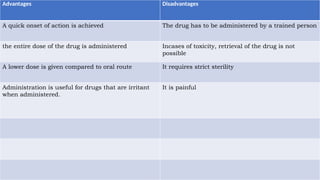
Advantages Disadvantages
A quickonset of action is achieved The drug has to be administered by a trained person
the entire dose of the drug is administered Incases of toxicity, retrieval of the drug is not
possible
A lower dose is given compared to oral route It requires strict sterility
Administration is useful for drugs that are irritant
when administered.
It is painful
19.
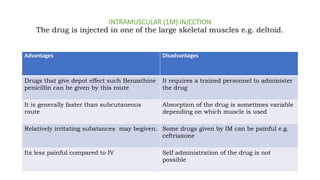
INTRAMUSCULAR (1M) INJECTION
Thedrug is injected in one of the large skeletal muscles e.g. deltoid.
Advantages Disadvantages
Drugs that give depot effect such Benzathine
penicillin can be given by this route
It requires a trained personnel to administer
the drug
It is generally faster than subcutaneous
route
Absorption of the drug is sometimes variable
depending on which muscle is used
Relatively irritating substances may begiven. Some drugs given by IM can be painful e.g.
ceftriaxone
Its less painful compared to IV Self administration of the drug is not
possible
20.
SUBCUTANEOUS(SC) INJECTION
• Thedrug is injected into the subcutaneous tissue, the
fatty layer of tissue underneath the dermis.
• It is commonly used in administering vaccines and
insulin.
• This route of administration, like the intramuscular,
provides absorption that is slower than the IV route.
21.
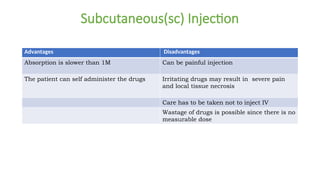
Subcutaneous(sc) Injection
Advantages Disadvantages
Absorptionis slower than 1M Can be painful injection
The patient can self administer the drugs Irritating drugs may result in severe pain
and local tissue necrosis
Care has to be taken not to inject IV
Wastage of drugs is possible since there is no
measurable dose
22.
Enteral route
This includes;rectal, oral, sublingual ,and buccal routes.
Rectal route
Drugs are administered via the rectum in form of suppositories or
enema
23.
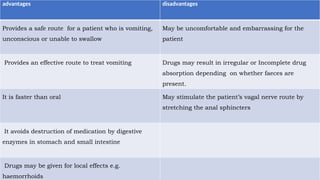
advantages disadvantages
Provides asafe route for a patient who is vomiting,
unconscious or unable to swallow
May be uncomfortable and embarrassing for the
patient
Provides an effective route to treat vomiting Drugs may result in irregular or Incomplete drug
absorption depending on whether faeces are
present.
It is faster than oral May stimulate the patient’s vagal nerve route by
stretching the anal sphincters
It avoids destruction of medication by digestive
enzymes in stomach and small intestine
Drugs may be given for local effects e.g.
haemorrhoids
24.
Topical route
• Drugsare applied directly to the skin or the mucous membrane of
the eye, ear or nose.
• Drugs given by this route are inform of creams, ointments, lotions,
gels etc.
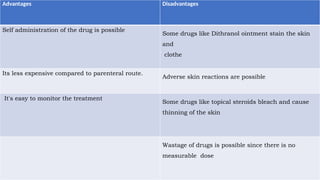
25.
Advantages Disadvantages
Self administrationof the drug is possible
Some drugs like Dithranol ointment stain the skin
and
clothe
Its less expensive compared to parenteral route.
Adverse skin reactions are possible
It's easy to monitor the treatment
Some drugs like topical steroids bleach and cause
thinning of the skin
Wastage of drugs is possible since there is no
measurable dose
26.
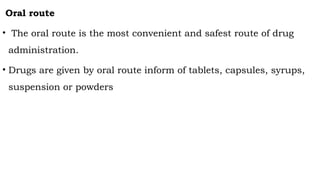
Oral route
• Theoral route is the most convenient and safest route of drug
administration.
• Drugs are given by oral route inform of tablets, capsules, syrups,
suspension or powders
27.
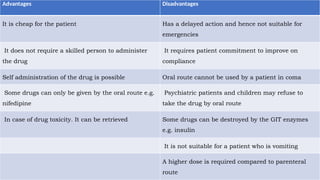
Advantages Disadvantages
It ischeap for the patient Has a delayed action and hence not suitable for
emergencies
It does not require a skilled person to administer
the drug
It requires patient commitment to improve on
compliance
Self administration of the drug is possible Oral route cannot be used by a patient in coma
Some drugs can only be given by the oral route e.g.
nifedipine
Psychiatric patients and children may refuse to
take the drug by oral route
In case of drug toxicity. It can be retrieved Some drugs can be destroyed by the GIT enzymes
e.g. insulin
It is not suitable for a patient who is vomiting
A higher dose is required compared to parenteral
route
28.
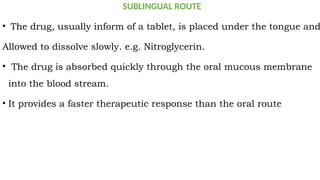
SUBLINGUAL ROUTE
• Thedrug, usually inform of a tablet, is placed under the tongue and
Allowed to dissolve slowly. e.g. Nitroglycerin.
• The drug is absorbed quickly through the oral mucous membrane
into the blood stream.
• It provides a faster therapeutic response than the oral route
29.
DRUG ADMINISTRATION INSPECIAL CASES
• Drugs should be administered with special attention in the following
cases; pregnancy, lactating mothers, pediatrics, and geriatrics.
Pregnancy
• Generally drug therapy during pregnancy is not needed unless
absolutely necessary as many of them cross the placenta and harm
the fetus.
Drugs can affect the fetus in any of the following ways;
• By directly causing damage, abnormal development leading to birth
defects or death.
• Altering the physiological function of the placenta causing
vasoconstriction thus reducing supply of nutrients and oxygen to the
fetus. This results into under development or under weight babies.
30.
• Can causecontraction of the uterine muscles injuring the fetus or causing
preterm labor.
• Examples of drugs contra-indicated in pregnancy;
• List types of drugs contraindicated in pregnancy
31.
PEDIATRICS
• A numberof drugs are not used during childhood because they are associated
with serious adverse reactions.
• List types of drugs not used in pediatrics
32.
LACTATING MOTHERS
• Ifa drug enters breast milk in pharmacologically significant
quantities, therapeutic doses in the mother may cause toxic effects
in the infant.
• In addition, some drugs suppress lactation such as combined oral
contraceptives while others may inhibit the infant's sucking reflex.
• With the above challenge, a proper decision should be made when
drugs are prescribed to a breastfeeding mother.
33.
GERIATRICS
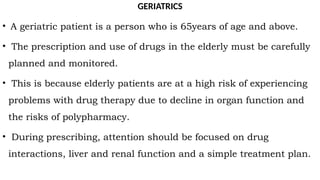
• A geriatricpatient is a person who is 65years of age and above.
• The prescription and use of drugs in the elderly must be carefully
planned and monitored.
• This is because elderly patients are at a high risk of experiencing
problems with drug therapy due to decline in organ function and
the risks of polypharmacy.
• During prescribing, attention should be focused on drug
interactions, liver and renal function and a simple treatment plan.
34.
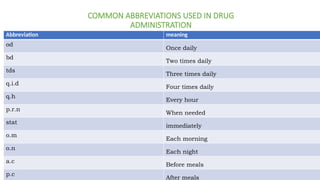
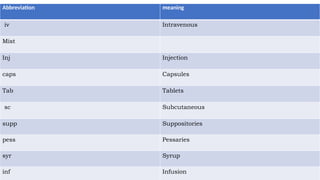
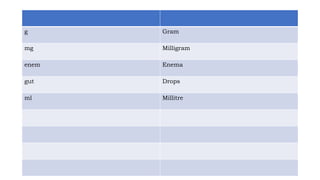
COMMON ABBREVIATIONS USEDIN DRUG
ADMINISTRATION
Abbreviation meaning
od
Once daily
bd
Two times daily
tds
Three times daily
q.i.d
Four times daily
q.h
Every hour
p.r.n
When needed
stat
immediately
o.m
Each morning
o.n
Each night
a.c
Before meals
p.c
After meals