Presentation on
“IV Infusion”
WELCOME
Presented byPresented by
A. N. M. SHARIF
Student,
University of Asia Pacific, Bangladesh.
E-mail: anm.sharif@live.com
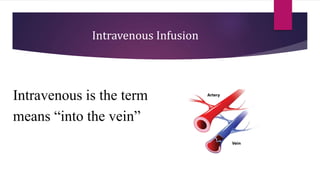
Intravenous Infusion
Intravenous is the term
means “into the vein”
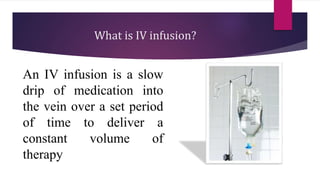
What is IV infusion?
An IV infusion is a slow
drip of medication into
the vein over a set period
of time to deliver a
constant volume of
therapy
History of IV infusion
 Intravenous technology started from
studies on cholera treatment in 1831
 It was further developed in 1930s but
was not widely available until the 1950s
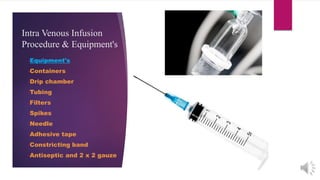
Intra Venous Infusion
Procedure & Equipment's
•Equipment's
•Containers
•Drip chamber
•Tubing
•Filters
•Spikes
•Needle
•Adhesive tape
•Constricting band
•Antiseptic and 2 x 2 gauze
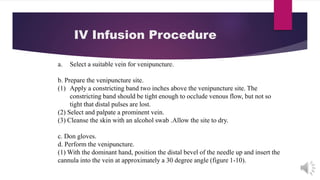
IV Infusion Procedure
a. Select a suitable vein for venipuncture.
b. Prepare the venipuncture site.
(1) Apply a constricting band two inches above the venipuncture site. The
constricting band should be tight enough to occlude venous flow, but not so
tight that distal pulses are lost.
(2) Select and palpate a prominent vein.
(3) Cleanse the skin with an alcohol swab .Allow the site to dry.
c. Don gloves.
d. Perform the venipuncture.
(1) With the dominant hand, position the distal bevel of the needle up and insert the
cannula into the vein at approximately a 30 degree angle (figure 1-10).
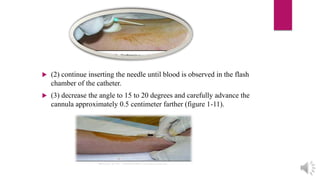
 (2) continue inserting the needle until blood is observed in the flash
chamber of the catheter.
 (3) decrease the angle to 15 to 20 degrees and carefully advance the
cannula approximately 0.5 centimeter farther (figure 1-11).
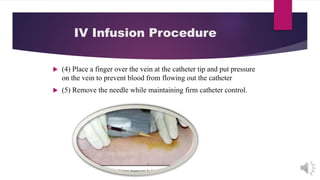
 (4) Place a finger over the vein at the catheter tip and put pressure
on the vein to prevent blood from flowing out the catheter
 (5) Remove the needle while maintaining firm catheter control.
IV Infusion Procedure
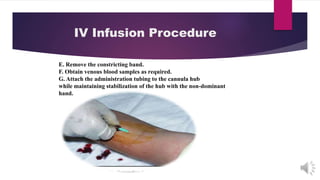
E. Remove the constricting band.
F. Obtain venous blood samples as required.
G. Attach the administration tubing to the cannula hub
while maintaining stabilization of the hub with the non-dominant
hand.
H. Open the flow-regulator clamp and observe for drips in the drip chamber. Allow
the fluid to run freely for several seconds.
I. Adjust to the desired flow rate.
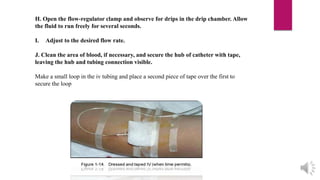
J. Clean the area of blood, if necessary, and secure the hub of catheter with tape,
leaving the hub and tubing connection visible.
Make a small loop in the iv tubing and place a second piece of tape over the first to
secure the loop
IV Infusion Procedure
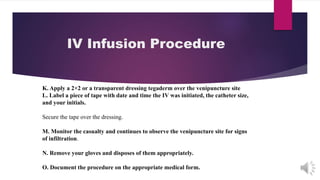
K. Apply a 2×2 or a transparent dressing tegaderm over the venipuncture site
L. Label a piece of tape with date and time the IV was initiated, the catheter size,
and your initials.
Secure the tape over the dressing.
M. Monitor the casualty and continues to observe the venipuncture site for signs
of infiltration.
N. Remove your gloves and disposes of them appropriately.
O. Document the procedure on the appropriate medical form.
Plasma drug concentration
for IV infusion following one
compartment model
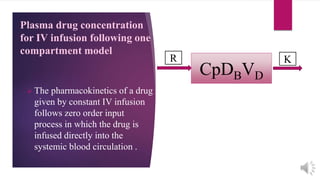
 The pharmacokinetics of a drug
given by constant IV infusion
follows zero order input
process in which the drug is
infused directly into the
systemic blood circulation .
CpDBVD
R K
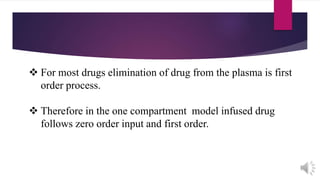
 For most drugs elimination of drug from the plasma is first
order process.
 Therefore in the one compartment model infused drug
follows zero order input and first order.
Here,
𝒅𝑫𝑩
𝒅𝒕
= rate in – rate out DB = amount of drug in the body
𝒅𝑫𝑩
𝒅𝒕
= R- K.DB R= infusion rate
dDB =  (R-K.DB) dt K= Elimination rate constant
DB =
𝑹
𝑲
(1 – e-kt)
Cp.VD =
𝑹
𝑲
(1- e-kt)
Cp =
𝑹
𝑽𝑫.𝑲
(1- e-kt) [DB = Cp.VD]
When, t = ∞ at he study state concentration the equation
will be Css =
𝑹
𝑲.𝑽𝑫
Calculation the
elimination rate
constant for a
drug given
through IV
infusion
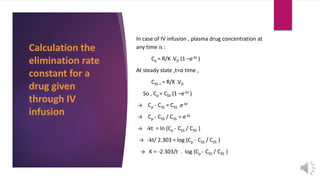
In case of IV infusion , plasma drug concentration at
any time is :
Cp = R/K .VD (1 –e-kt )
At steady state ,t=α time ,
CSS = = R/K .VD
So , Cp = CSS (1 –e-kt )
→ Cp - CSS = CSS .e-kt
→ Cp - CSS / CSS = e-kt
→ -kt = ln (Cp - CSS / CSS )
→ -kt/ 2.303 = log (Cp - CSS / CSS )
→ K = -2.303/t . log (Cp - CSS / CSS )
Loading Dose
Loading dose is the minimum effective dose
which is given initially at a time to obtain the
steady state plasma drug concentration as early
as possible.
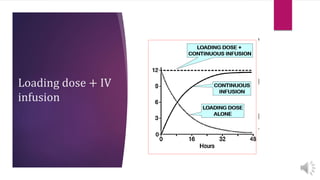
we use a
loading dose
to rapidly
achieve
therapeutic
concentration
of a drug
Css achieved immediately
Obtained desired
concentration
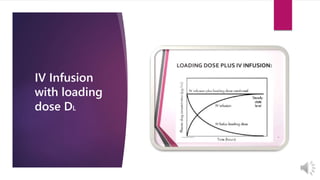
IV Infusion
with loading
dose DL
Time required
for achieving
99% of steady
state level in
terms of t1/2
An infinite long period of time is required to reach
steady state drug levels. In practice, it is quite
acceptable to reach 99% steady state level.
We know that,
Css =R/K.Vd
99% steady state level is:
99% r/ k.Vd
In case of IV infusion, plasma drug concentration at any time,
Cp = R/ K.VD (1-e-kt)
→ 99% r/ k.Vd = r/ k.VD (1-e-kt) [as css = cp]
→ 99% = (1-e-kt)
→ 1-(99/100) = e-kt
→ e-kt = 0.01
→ -kt = ln(0.01)
→ -Kt = -4.61
→ 0.693/ t1/2 × t = 4.61
→ T = (4.61/ 0.693) × t1/2
So, t99%ss = 6.65 t1/2
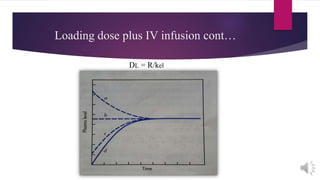
Cp=Css
 IV infusion
 Loading dose
 IV bolus dose
 Steady state
 Plasma drug
concentration
Loading dose + IV
infusion
tk
d
Ltk
p
elel
e
V
D
eCC 
 
1
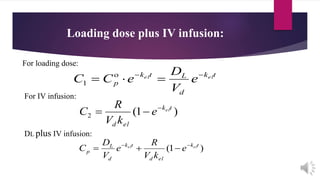
For loading dose:
For IV infusion:
)1(2
tk
eld
el
e
kV
R
C 

DL plus IV infusion:
)1( tk
eld
tk
d
L
p
elel
e
kV
R
e
V
D
C 

Loading dose plus IV infusion:
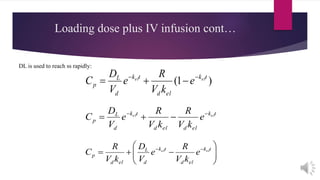
Loading dose plus IV infusion cont…
DL is used to reach ss rapidly:
)1( tk
eld
tk
d
L
p
elel
e
kV
R
e
V
D
C 

tk
eldeld
tk
d
L
p
elel
e
kV
R
kV
R
e
V
D
C 







  tk
eld
tk
d
L
eld
p
elel
e
kV
R
e
V
D
kV
R
C
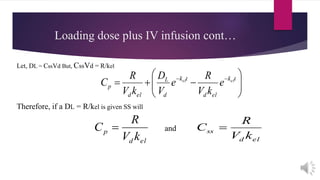
Loading dose plus IV infusion cont…
Let, DL = CssVd But, CssVd = R/kel






  tk
eld
tk
d
L
eld
p
elel
e
kV
R
e
V
D
kV
R
C
Therefore, if a DL = R/kel is given SS will
eld
p
kV
R
C 
eld
ss
kV
R
C and
Loading dose plus IV infusion cont…
DL = R/kel
Main reason for giving a drug by slow iv
infusion
 In case of IV infusion ,When drug is administered rapidly , it tends
to increase the volume of the blood . As a result, hypervolemia may
occur, thereby slowly infused.
 Slow IV infusion may be used to avoid side effects due to rapid drug
administration .eg: Intravenous immune globulin may cause a rapid
fall in blood pressure when infused rapidly.
Main reason for giving a drug by slow iv
infusion
 Some antisense drug injected rapidly by IV to the body, it cause a
rapid fall in blood pressure.
 The rate of infusion is particularly important in administering anti-
arrythmic agents in patients.
 The rapid IV bolus injection of many drugs that follow the
pharmacokinetic of multi-compartmental models, may cause an adverse
response due to the initial high drug conc.eg: If heparin is injected or
infused at a faster rate, cardiac arrest may arise.
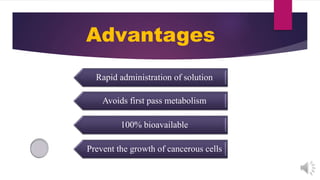
Advantages
Rapid administration of solution
Avoids first pass metabolism
100% bioavailable
Prevent the growth of cancerous cells
Advantage
Rapid delivery of the
drug/fluid to target sites
Suitable route
Plasma level
Body Temperature
IV
nutrient
therapy
Disadvantage
Painful & Fearful
Supervisor required to
administer
Infection
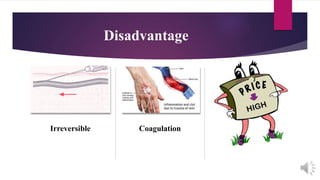
Disadvantage
Irreversible Coagulation
CATEGORIES
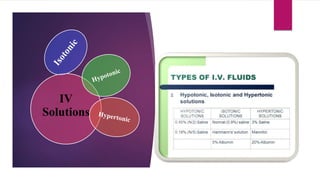
IV infusion can be categorized according
• Different types of solutions
• And depending on the function they serve
IV
Solutions
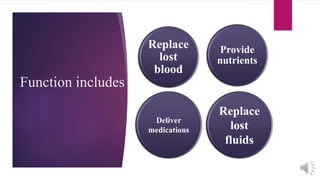
Function includes
Replace
lost
blood
Provide
nutrients
Deliver
medications
Replace
lost
fluids
If you have any
question, Please
feel free to ask
us!!!!!!!

IV Infusion

  • 1.
  • 2.
    Presented byPresented by A.N. M. SHARIF Student, University of Asia Pacific, Bangladesh. E-mail: anm.sharif@live.com
  • 3.
    Intravenous Infusion Intravenous isthe term means “into the vein”
  • 4.
    What is IVinfusion? An IV infusion is a slow drip of medication into the vein over a set period of time to deliver a constant volume of therapy
  • 5.
    History of IVinfusion  Intravenous technology started from studies on cholera treatment in 1831  It was further developed in 1930s but was not widely available until the 1950s
  • 6.
    Intra Venous Infusion Procedure& Equipment's •Equipment's •Containers •Drip chamber •Tubing •Filters •Spikes •Needle •Adhesive tape •Constricting band •Antiseptic and 2 x 2 gauze
  • 7.
    IV Infusion Procedure a.Select a suitable vein for venipuncture. b. Prepare the venipuncture site. (1) Apply a constricting band two inches above the venipuncture site. The constricting band should be tight enough to occlude venous flow, but not so tight that distal pulses are lost. (2) Select and palpate a prominent vein. (3) Cleanse the skin with an alcohol swab .Allow the site to dry. c. Don gloves. d. Perform the venipuncture. (1) With the dominant hand, position the distal bevel of the needle up and insert the cannula into the vein at approximately a 30 degree angle (figure 1-10).
  • 8.
     (2) continueinserting the needle until blood is observed in the flash chamber of the catheter.  (3) decrease the angle to 15 to 20 degrees and carefully advance the cannula approximately 0.5 centimeter farther (figure 1-11).
  • 9.
     (4) Placea finger over the vein at the catheter tip and put pressure on the vein to prevent blood from flowing out the catheter  (5) Remove the needle while maintaining firm catheter control. IV Infusion Procedure
  • 10.
    IV Infusion Procedure E.Remove the constricting band. F. Obtain venous blood samples as required. G. Attach the administration tubing to the cannula hub while maintaining stabilization of the hub with the non-dominant hand.
  • 11.
    H. Open theflow-regulator clamp and observe for drips in the drip chamber. Allow the fluid to run freely for several seconds. I. Adjust to the desired flow rate. J. Clean the area of blood, if necessary, and secure the hub of catheter with tape, leaving the hub and tubing connection visible. Make a small loop in the iv tubing and place a second piece of tape over the first to secure the loop
  • 12.
    IV Infusion Procedure K.Apply a 2×2 or a transparent dressing tegaderm over the venipuncture site L. Label a piece of tape with date and time the IV was initiated, the catheter size, and your initials. Secure the tape over the dressing. M. Monitor the casualty and continues to observe the venipuncture site for signs of infiltration. N. Remove your gloves and disposes of them appropriately. O. Document the procedure on the appropriate medical form.
  • 13.
    Plasma drug concentration forIV infusion following one compartment model  The pharmacokinetics of a drug given by constant IV infusion follows zero order input process in which the drug is infused directly into the systemic blood circulation . CpDBVD R K
  • 14.
     For mostdrugs elimination of drug from the plasma is first order process.  Therefore in the one compartment model infused drug follows zero order input and first order.
  • 15.
    Here, 𝒅𝑫𝑩 𝒅𝒕 = rate in– rate out DB = amount of drug in the body 𝒅𝑫𝑩 𝒅𝒕 = R- K.DB R= infusion rate dDB =  (R-K.DB) dt K= Elimination rate constant DB = 𝑹 𝑲 (1 – e-kt) Cp.VD = 𝑹 𝑲 (1- e-kt) Cp = 𝑹 𝑽𝑫.𝑲 (1- e-kt) [DB = Cp.VD] When, t = ∞ at he study state concentration the equation will be Css = 𝑹 𝑲.𝑽𝑫
  • 16.
    Calculation the elimination rate constantfor a drug given through IV infusion In case of IV infusion , plasma drug concentration at any time is : Cp = R/K .VD (1 –e-kt ) At steady state ,t=α time , CSS = = R/K .VD So , Cp = CSS (1 –e-kt ) → Cp - CSS = CSS .e-kt → Cp - CSS / CSS = e-kt → -kt = ln (Cp - CSS / CSS ) → -kt/ 2.303 = log (Cp - CSS / CSS ) → K = -2.303/t . log (Cp - CSS / CSS )
  • 17.
    Loading Dose Loading doseis the minimum effective dose which is given initially at a time to obtain the steady state plasma drug concentration as early as possible.
  • 18.
    we use a loadingdose to rapidly achieve therapeutic concentration of a drug Css achieved immediately Obtained desired concentration
  • 19.
  • 20.
    Time required for achieving 99%of steady state level in terms of t1/2 An infinite long period of time is required to reach steady state drug levels. In practice, it is quite acceptable to reach 99% steady state level. We know that, Css =R/K.Vd 99% steady state level is: 99% r/ k.Vd
  • 21.
    In case ofIV infusion, plasma drug concentration at any time, Cp = R/ K.VD (1-e-kt) → 99% r/ k.Vd = r/ k.VD (1-e-kt) [as css = cp] → 99% = (1-e-kt) → 1-(99/100) = e-kt → e-kt = 0.01 → -kt = ln(0.01) → -Kt = -4.61 → 0.693/ t1/2 × t = 4.61 → T = (4.61/ 0.693) × t1/2 So, t99%ss = 6.65 t1/2
  • 22.
    Cp=Css  IV infusion Loading dose  IV bolus dose  Steady state  Plasma drug concentration
  • 23.
    Loading dose +IV infusion
  • 24.
    tk d Ltk p elel e V D eCC    1 Forloading dose: For IV infusion: )1(2 tk eld el e kV R C   DL plus IV infusion: )1( tk eld tk d L p elel e kV R e V D C   Loading dose plus IV infusion:
  • 25.
    Loading dose plusIV infusion cont… DL is used to reach ss rapidly: )1( tk eld tk d L p elel e kV R e V D C   tk eldeld tk d L p elel e kV R kV R e V D C           tk eld tk d L eld p elel e kV R e V D kV R C
  • 26.
    Loading dose plusIV infusion cont… Let, DL = CssVd But, CssVd = R/kel         tk eld tk d L eld p elel e kV R e V D kV R C Therefore, if a DL = R/kel is given SS will eld p kV R C  eld ss kV R C and
  • 27.
    Loading dose plusIV infusion cont… DL = R/kel
  • 28.
    Main reason forgiving a drug by slow iv infusion  In case of IV infusion ,When drug is administered rapidly , it tends to increase the volume of the blood . As a result, hypervolemia may occur, thereby slowly infused.  Slow IV infusion may be used to avoid side effects due to rapid drug administration .eg: Intravenous immune globulin may cause a rapid fall in blood pressure when infused rapidly.
  • 29.
    Main reason forgiving a drug by slow iv infusion  Some antisense drug injected rapidly by IV to the body, it cause a rapid fall in blood pressure.  The rate of infusion is particularly important in administering anti- arrythmic agents in patients.  The rapid IV bolus injection of many drugs that follow the pharmacokinetic of multi-compartmental models, may cause an adverse response due to the initial high drug conc.eg: If heparin is injected or infused at a faster rate, cardiac arrest may arise.
  • 30.
    Advantages Rapid administration ofsolution Avoids first pass metabolism 100% bioavailable Prevent the growth of cancerous cells
  • 31.
    Advantage Rapid delivery ofthe drug/fluid to target sites Suitable route Plasma level Body Temperature
  • 32.
  • 33.
    Disadvantage Painful & Fearful Supervisorrequired to administer Infection
  • 34.
  • 35.
    CATEGORIES IV infusion canbe categorized according • Different types of solutions • And depending on the function they serve
  • 36.
  • 37.
  • 39.
    If you haveany question, Please feel free to ask us!!!!!!!