Pharmacokinetics.
• It isthe process by which the body handles and affects drugs.
• Can also be defined as the study of how the body acts on
drugs.
• It is how the body handles drugs from the site of
administration to the site of elimination.
• Involves;
– Absorption.
– Distribution.
– Metabolism.
– Excretion/ Elimination.
2.
1. ABSORPTION.
• Itis the movement of drug molecules from site of
administration into the body.
• Rate of absorption of a drug determines when it is
available to exert its action.
• Duration and intensity of drug action is influenced by
absorption , therefore, route of administration, dose and
dosage form are vital considerations during absorption.
3.
Factors influencing drugabsorption.
• A]. Nature of the absorbing surface.
-it is the cell membrane through which the drug must transverse.
- for example, the ileum has a larger surface area as compared to the colon and the
stomach therefore most of the absorption take place there.
B]. Blood flow to the site of administration.
-increased blood flow facilitates drug absorption.
C].health status of the person takin the drug.
- e.g in management of shock, IV drugs produce a good response because they are
introduced directly to the circulation.
D]. The lipid solubility of the dugs.
-the higher the solubility, the more a drug is absorbed.
4.
Cont.
• E].The PHof the drug.
-Acidic drugs are relatively less ionized in acidic environment hence diffuse
easily across membranes due to their lipid solubility.
- Basic drugs ionize in acidic environment hence not well absorbed through
gastric membrane since they are lipid insoluble and non diffusible.
F]. Drug concentration.
-highly concentrated drugs get absorbed better as the route of absorption is
guided by the law of mass action which stipulates that the rate of a chemical
reaction is proportional to the product of concentrations of reactants.
G]. Dosage form.
-e.g as a capsule, tablet, patches, suppositories.
5.
Routes of drugadministration.
1. Enteral route.
-These are drugs administered along any portion of the GIT.
-It is the most common route.
- It is safe because retrial of drug is easy.
- It is also convenient and economical.
- Absorption via this route can be oral, gastric or at the
small intestines.
6.
Cont.
2. Parenteral route.
-Drugsadministered by inj.
-E.G ; subcutaneous, IM, IV, intrathecal, intraspinal e.t.c.
- Offers the most rapid form of systemic therapy.
7.
Cont.
3. Pulmonary route.
-Some drugs are in form of gases or fine mist hence
administered by inhalation.
- Lungs have a high S.A and vascularity hence there is ready
entry into the systemic circulation.
- Examples of drugs administered through this route;
- Bronchodilators.
- Mycotic.
- Some antibiotics.
- Some of the devices used include nebulizers and pressure tanks.
8.
Cont.
• 4. Topical.
•-Drugs applied on the skin, mucous membrane of eyes,
ears, nasal mucosa , vagina, rectum.
• Should be applied on intact skin to avoid toxic effects.
• Massaging enhances absorption because capillaries
dilate due to warmth created by friction/ rubbing.
9.
Forms and preparationof drugs.
• Drugs are made in different forms.
• The forms reflect the route of administration of that
particular drug.
• Can be in form of;
– Solid e.g. tablets, capsules.
– Liquid e.g. solutions, syrups.
– semi solid e.g. cream, ointment.
– Gases e.g. aerosols.
10.
Concepts associated withabsorption.
1. Enterorhepatic ; circulation of drugs between the liver and intestines.
- Maintains the effects of some drugs for a longer period within the circulation.
2 .pre-systemic [first pass] elimination effect.
• -the metabolism of drugs during single pass through the gut wall.
• the portal blood delivers the drug to the liver prior to entry into the system.
• - differs between drugs and individuals.
• -causes variations in the systemic drug concentration hence drug response.
• -it influences bioavailability , plasma concentration and therapeutic effect.
• 3.Bioavailability.
• It is the % of active substances of a drug that is absorbed and becomes
available to the target tissues following administration.
• Drug form and degree of absorption determines the degree of bioavailability.
11.
2. DISTRIBUTION
Definition
• Isthe transportation of drug in the body fluid from
bloodstream to various tissues of the body and ultimately
its site of action
12.
Once a drugenters into system circulation by absorption or
direct administration, it must be distributed into interstitial
and intracellular fluids. Each organ or tissue can receive
different doses of the drug and the drug can remain in the
different organs or tissues for a varying amount of time
13.
Factors influencing therate of distribution
I. The permeability of capillaries to the drug
II. Lipid soluble and ionization of the drug. Lipid soluble drugs are
more rapidly absorbed and distributed than lipid insoluble drugs.
Ionised drugs are more readily absorbed compared to unionized
II. Cardiac function e.g. cardiac output and regional blood also
influence distribution. Drugs are first distributed to areas with the
reaches blood flow e.g. heart,liver,kidney,brain and later to those
with poor supply e.g. muscle,fat tissue.
14.
IV. Plasma proteinand tissue binding
• a)plasma protein binding
• Drugs circulate around the body partly in plasma water
and partly bound to plasma protein.
• Albumin is the main binding protein for drugs and other
natural substances Other proteins involved include
lipoproteins, alpha 1 acidic glycoprotein and globulins.
Some proteins are more specific for certain drugs while
others are not.
15.
• Albumin hasa high affinity (but low capacity) for binding
of acidic drugs and a low affinity (But high capacity) for
binding of basic drugs, hence a lot of drugs are bound but
readily released As free drug is eliminated by metabolism,
dialysis or excretion, it’s replaced by drug released from
the bound fraction. Those drugs that are tightly bound
have longer duration of action than those that are loosely
bound. Plasma protein binding may be influenced by
hypoalbuminaemia which may result from liver problems
like liver cirrhosis, hepatitis and severe malnutrition.
16.
b) Tissue binding:
•Adipose tissue: lipid soluble drugs have high affinity for
adipose tissue. The low blood flow to adipose tissue
makes it a good reservoirs for drugs e.g. thiopental. Other
drugs will bind to the bone
17.
Biological membrane
• Thebiological membranes which limit the distribution of drugs are:
a.)Blood brain barrier: Allows distribution of only lipid soluble drugs e.g.
general anesthetics, barbiturates into the brain and CSF.Drugs that don’t or
slowly cross blood brain barrier cannot be used to treat infections in the
brain.
b.)Placental barrier: These are Membranous layers that separate blood
vessels of the mother from those of the fetus. Lipid soluble and some lipid
insoluble substances can diffuse through it hence, some drugs meant for
the mother may pass through the barrier to harm fetus. Examples of such
drugs include: steroids, narcotics and, anesthetics.
c.)Blood – testis barrier: This may limit the effectiveness of some
chemotherapeutic agents used for treating testicular neoplasm.
18.
Metabolism
Metabolism describes thechemical reactions that change drugs into compounds
which are easier to eliminate. The products of these reactions are called metabolites
.Metabolic processes changes drug in two major ways
I By reducing lipid solubility which increase drug polarity and
Ii By reducing the biological activity
.Metabolites are generally more polar than parent compound hence excretion rate is
increased.
. Liver is the major organ of metabolism. Other organs like the kidney, gut mucosa,
lung and skin are also involved in drug metabolism.
Metabolism is catalysed by specific enzyme system which also catalyse metabolism
of endogenous substances
..
19.
PHASES OF METABOLISM/BIOTRANSFORMATION
•PHASE I(NON SYNTHETIC REACTION)
• Involve enzyme catalysed biotransformation of the drug
without any conjugation. These include oxidation,
reduction and hydrolysis reaction. They usually introduce
a functional group which serves as an active centre for
conjugation in phase ii
20.
• PHASE II(SYNTHETICREACTION)
• Are conjugated reaction which involves the enzyme
catalysed combination of a drug with an endogenous
substances e.g. amino group,metyl group,sulfate e.t.c.
21.
Major enzyme systemin metabolism
Cytochrome P-450 mono -oxygenase/ mixed function oxidase
This enzyme system is primarily located in the liver where it
plays central role in metabolism of drugs. A large variety of
P-450 exists. Each catalyzes the metabolism of a unique
spectrum of drugs with some overlapping in the substrate
specificities. Most of them are involved in phase I reactions.
.
22.
Factors influencing drugmetabolism
• Physiological factors like starvation, Liver diseases; cardiovascular
problem .These depresses microsomal enzyme systems.
• Age: People in extremes of age have decreased metabolism e.g. very young
people have immature enzyme systems while the elderly have degenerative
enzyme function.
• Genetic predisposition: Genetically determined differences in the rate of
metabolism of some drugs exist e.g. isoniazid, is metabolized by the
acetyltranferase enzyme system. They portray the tendency for fast and slow
acetylation which may lead to toxicity from metabolite and parent drug
respectively.
• Prior administration of the particular drug or other drugs e.g. repeated
administration of a drug may cause induction or inhibition of microsomal
enzymes.
Drug excretionis a process by which drugs and pharmacologically active or inactive metabolites are
eliminated from
the body.
This primarily occurs through the kidneys
Elimination occurs after whole or partial conversion of a drug to water soluble metabolite or in unchanged
form.
Other routes of drug elimination include intestines,lungs,tears and saliva.
25.
RENAL ELIMINATION/EXCRETION
It’s themost important route of drug elimination
Drugs are eliminated as unchanged or partially changed
Complete renal excretion of drugs is as a result of three separate processes
1.Filtration
2.Re absorption
3.Active tubular secretion
1.PASSIVE TUBULAR FILTRATION
The availability of drugs for filtration depends on its plasma concentration in the bound form.
Protein bound substances are too large to be filtered.
Highly bound drugs are cleared slowly .
Most drugs have a low molecular ,[less than 1000]] therefore are freely filtered from plasma at the glomerulus
The glomerulus allow drugs of molecular weight of less than 20,000.
20% of renal plasma flow is filtered through the glomeruli ,therefore 80% pass on to the proximal tubule.
26.
2. TUBULAR SECRETION
Two systems secrete drugs into ultra filtrate one for organic bases and another for organic acids
Secretion is an energy dependent transport system because it moves drugs against concentration gradient.
They are both non selective hence its a potential site for interaction as drugs compete for transporters.
Protein binding has no impact on tubular secretion because the affinity of the transporter system for most drugs is
greater than the affinity to plasma binding.
Tubular secretion is the most important/effective mechanism of renal elimination.
80% of the drug delivered to the kidney is presented to the carrier molecules .
100% of the drug free or bound is available to the carrier molecules , unlike in the glomerular filtration which only de
with the free fraction of the drug.
27.
RE ABSORBTION
Afterfiltration ,most lipid soluble substances is re absorbed or slowly excreted .
Water soluble ones are readily absorbed. Urine PH ranges from 4.6 -8.2.
Urine PH affects the amount of drugs re absorbed in the renal tubule by passive diffusion because passive diffu
depends on lipid solubility .
Most drugs are either weak acids or weak bases ,hence change of urine PH changes ionization status of drugs a
subsequently their lipid solubility.
The ion trapping effect means that a basic drug is more rapidly excreted in acid urine [ionization occurs]] and
acidic drugs are rapidly excreted in alkaline urine .
This concept can be used to treat poisoning from weak acids like aspirin and phenobarbital whereby alkalizing ur
leads to increased urine secretion.
Changing urine PH alters the rate of drug elimination.
28.
3 .PULMONARY ELIMINATION
Most drugs eliminated through this route are usually intact and not metabolites
Gases and volatile liquids [like in general anesthesia] are administered and excreted through the same route.
Increased cardiac output increases lung perfusion ,therefore increasing drug elimination and vice=versa.
Ethanol is expired by this route hence breath analyzers are used to regulate road regulations [alchoblow?].
SWEAT AND SALIVARY ELIMINATION
Its an insignificant route of elimination and is dependent on diffusion of lipids-soluble drugs through the
epithelial cells of the glands.
Elimination of drugs and metabolites into sweat may explain some side effects like dermatitis and photosensitivity
.
Those secreted via saliva are swallowed and undergo same fate as oral drugs.
• The intravenous administered drugs once secreted through the saliva may make one complain of bad test.
29.
2. INTESTINE/BILLIARY EXCRETION
After metabolism in the liver, the metabolite is secreted into bile and passed into the duodenum then
eliminated into feces.
Some substances that undergo enterohepatic recycling are later particularly excreted by the kidney.
There is active transport in the liver just like in the kidney for basic and acidic drugs substances of
molecular wt. less than300 excreted in bile.
Some drugs taken orally like neomycin should act locally in the gut and later eliminated in feces.
Some substances diffuse passively into the gut lumen from blood, such substances can be eliminated
sing activated charcoal which absorbs them.
30.
5 .BREAST/MILK ELIMINATION
Many drugs cross epithelium of mammary glands and are therefore excreted into breast milk.
Breast milk is acidic [PH 6.5] Hence basic drugs like narcotics achieve higher concentration in it
While acidic drugs like barbiturates,sulphonamide, concentrate less in breast milk because they
don’t ionize.
NB:Although breast/milk is an insignificant route of drug elimination ,it poses great health concerns
For the breast fed babies .These babies have an immature metabolizing enzyme system and kidneys.
For instance salicylates,antiepileptic,antidepressants,anticancer drugs,anti asthmatics, anxiolytics/sedatives are
Secreted in breast milk and may harm the baby.
31.
PHARMACODYNAMICS
• Its concernedwith specific chemical agents at various site in the body.
• Drug molecule must exert chemical influence on one or more cells in order to
produce pharmacological response.
• Drugs modify physiological activity but do not confer new function on a tissue
or organ in the body.
• Goal of the drug is to obtain a therapeutic effect they are used for treatment
of symptoms, cure disease, diagnosis and prevention of diseases.
• Drugs have to bind on a particular constituent of the cells/tissue to exert
effects.
The utility of a drug i pharmacologically is determined by ability to act on
specific tissue or cells ie drug binding site specificity.
32.
• Specificity --individual class of drugs bind only certain targets and
individual target recognize only certain classes of drugs
• Increasing dose of drugs will cause it to affect target other than principal one
and this can lead to side effects.
• Most drug produce effect by binding to protein molecule [target]. Others may
bind to macromolecules like DNA and RNA
33.
DRUG RECEPTORS
• Receptorsalso means intercellular receptors,transmembranious
enzyme,receptor via specific proteins and ion channels.
• The common proten molecules that drugs bind to produce therapeutic effects
includes:
• a] Enzyme
• b] Carrier molecules
• c] Ion channels
• d] Receptors
34.
A] Enzymes
• Enzymeare biochemical catalyst that controls all chemical reactions of the
cells.
• Drugs may alter activity because they resemble the natural substrate hence
compete with it for enzyme
• Structural resemblance to an enzyme is vital.
• Drugs resembling the natural enzyme substrate are called anti metabolites.
• They can either block normal enzyme function or result in production of other
substance with unique biochemical properties.
• E.g. ACE Enzyme is inhibited by enalapril [anti hypertensive] this leads to
formation of angiotensin 2 causing vasodilation and less sodium and water
retention.
35.
B] Carrier molecules
•Used for transport of ion and small organic molecules across cell membrane.
• The permeating molecules are often too polar to penetrate lipid membrane
on their own.
• Example of carrier molecule mediated include glucose and amino acid
transport into cell and renal tubule transport of ions and many organic
molecules.
• Carrier protein have site that are recognized by certain molecules this
transport system can be inhibited by some drugs e.g. omeprazole, cardiac
glycosides and loop diuretics depending on the site of their carrier
36.
Drug receptors cont.....
Ionschannels
-These are pproteins molecules that are designed to form water filled pores that span the membrane and can switch
between open and closed states
.
-Ligand- gatedion channels also commonly refferred as ionotropic receptors are a group of transmembrane ion channel
proteins which open to allow ions such as Na+,K+,Ca2+ to pass through when there is polarization of the cell.
37.
• Drugs affection channels function by interacting either with the receptor site of ligand-gated channels or
with other parts of the channel molecules and interaction can be direct_drug binds to the channel and
alters its function or indirect _ involving G-protein ( eg ACh)and other intermediaries.
38.
Receptors
– Receptors aremacromolecules found within or on the
surface of cells that chemically bind a drug.The binding of
a drug to receptor depends on the type of chemical bounds
that can be established between the drug and receptor.
39.
• Two termsrelated to receptors are affinity and
efficacy, where affinity is the tendency of a drug to
bind to a receptor while efficacy is the tendency of a
drug to activate the receptor once bound.
• Receptor numbers are not constant e.g continous
exposure to agonist receptor tend to decrease while
continous exposure to antagonist tend to increase.
40.
• Examples ofthese receptors include; ACh,
cytokines,steroid and hormone receptors.
41.
Pharmacodynamics of antimicrobials.
•Antimicrobial pharmacodynamics is the relationship between the concentration of
antibiotic and it's ability to inhibit the growth ofmicroorganisms.The drug has to cause an
alteration of metabolic process of the microorganism without affecting the human body.
42.
Mode of actionand target for antibacterial drugs.
• inhibitors of cell biosynthesis.
• inhibitors of protein biosynthesis.
• inhibitors of membrane function.
• inhibitors of nucleic acid synthesis.
43.
DRUG INTERACTIONS.
• Overview.
•It’s the use of more than one drug at a time.
• When two or more drugs are given together and alter
each others pharmacological actions in terms of;
Duration action and Magnitude action.
• It is common especially in the elderly who tend to
have multiple problems like Heart disease ,Increased
blood pressure ,Rheumatic disease and in acute
situations like Infections ,Myocardial
Infarction ,Traumatic injuries and so own.
44.
HARMFUL DRUG INTERACTIONS.
•Drug interactions can be beneficial or harmful.
Beneficial pharmacokinetic interactions includes;
Improvement of bioavailability of a drug[ i.e. by enhancing absorption
and or inhibiting metabolism] or prolongation of a drugs plasma level
within its therapeutic window [ i.e. by decreasing excretion ],
whereas beneficial pharmacodynamics interactions include ;
Additive or synergistic effects.
Mechanisms by which pharmacokinetic interactions can cause
beneficial effects includes enhancement of membrane permeability
[e.g. .structural changes in the epithelial cell membrane or opening of
tight junctions ],modulation of carrier proteins[e.g. inhibition of efflux
transporters] and inhibition of metabolic enzymes.
45.
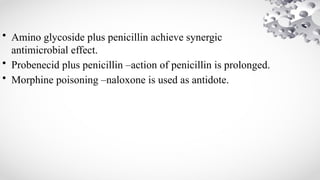
• Amino glycosideplus penicillin achieve synergic
antimicrobial effect.
• Probenecid plus penicillin –action of penicillin is prolonged.
• Morphine poisoning –naloxone is used as antidote.
46.
HARMFUL. DRUG INTERACTION
CONTINUATION
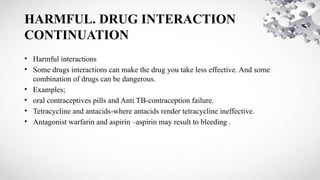
•Harmful interactions
• Some drugs interactions can make the drug you take less effective. And some
combination of drugs can be dangerous.
• Examples;
• oral contraceptives pills and Anti TB-contraception failure.
• Tetracycline and antacids-where antacids render tetracycline ineffective.
• Antagonist warfarin and aspirin –aspirin may result to bleeding .
47.
EFFECTS OF DRUGINTERACTIONS
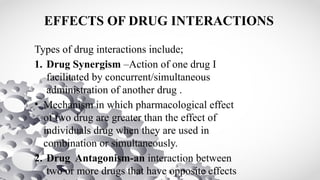
Types of drug interactions include;
1. Drug Synergism –Action of one drug I
facilitated by concurrent/simultaneous
administration of another drug .
• Mechanism in which pharmacological effect
of two drug are greater than the effect of
individuals drug when they are used in
combination or simultaneously.
2. Drug Antagonism-an interaction between
two or more drugs that have opposite effects
48.
• TYPES OFSYNERGISM
• There are three types of synergism namely
1. Additional effect synergism—when total effects of two or more drugs
administered concurrently is equal to the sum of their individual
pharmacological effect.[e.g. when A=3 B=1 then AB=4 [3+1] Aspirin --
analgesia plus paracetamol -antipyretic =analgesic antipyretic effect. Nitrous
oxide –weak anesthetic maintenance plus ether –very potent anesthetic
inducer=good anesthetic effect
2. Potentiation effect synergism.—increase in strength/potency .when total
pharmacological effect of two or more drugs used in combination is greater
than the of their individual effect.[e.g. sulphamethoxazole=bacteriostatic plus
trimethoprim =bacteriostatic =strength improvement bactericidal
effect ,codeine =analgesia acts though CNS plus = analgesia acts peripheral
=improvement in analgesic activity with less dose of both drugs.
49.
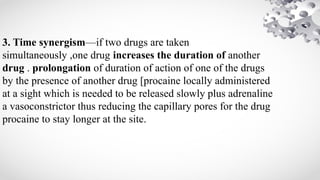
3. Time synergism—iftwo drugs are taken
simultaneously ,one drug increases the duration of another
drug . prolongation of duration of action of one of the drugs
by the presence of another drug [procaine locally administered
at a sight which is needed to be released slowly plus adrenaline
a vasoconstrictor thus reducing the capillary pores for the drug
procaine to stay longer at the site.
50.
ANTAGONISM EFFECT OFDRUGS
Occurs when two drugs oppose the action of one another
producing opposite pharmacodynamic effects on the same
physiological system .
Forms of antagonism effects of drugs include;
• Chemical antagonist.
• Pharmacokinetic antagonist .
• Antagonist by receptor block-block .
• Non- competitive antagonist -i.e. block receptor-effector-
linkage.
• Physiological antagonist.
51.
1. Chemical antagonist-wheretwo or more substances combine in solution ,hence
the effect of both drugs is lost e.g. antacid and tetracycline form a complex
which is excreted in feces.
2. Pharmacokinetics antagonist –is where the concentration of the active drug at
the site of action is reduced this occurs remotely from the site of action and can
happen at any of the pharmacokinetic stages.
3. Antagonist by receptor block.—it involves two mechanism ; Reversible and
Irreversible competitive antagonist.
• Reversible competitive antagonist-pharmacologic antagonist that can be
overcome by increasing the concentration of agonist thus increasing antagonist
dissociation from receptors .because binding of drugs to receptors obeys the law
of mass action. Agonist occupies the proportion of the vacant receptors hence
the rate of antagonist dissociation increases.
52.
• Irreversible /nonequilibrium competitive antagonist---pharmacokinetic
antagonist that can not be overcome by increasing agonist concentration . occurs
when antagonist dissociates very slowly or not at all from receptors .no change
in antagonist occupying takes place when agonist is applied. The agonist is
surmountable. This happens with drugs that posses reactive groups which form
covalent bonds with the receptors this drugs have minimal therapeutic use.
53.
CONTINUATION OF TYPESOF
ANTAGONISM
4.None competitive antagonisms/disposition
antagonist i.e. block receptor –effector –linkage
Antagonist blocks at some point the chain of events
that lead to the production of a response by the
agonists/the alteration of the disposition of o substance
[its absorption , biotransformation, distribution, or
excretion] so that less of the content reaches the target
organ or its persistence in the target organ is reduced.
54.
• 5.Physiological /functionalantagonist
• Interaction of two drugs whose opposing actions in the body tends to cancel each
other /a drug that counter the effects of another by binding a different receptor
and causing opposing effects .examples;
• B-adrenoceptor blocker overdose causes bradycardia this is relieved by atropine
which increase heart rate by blocking the parasympathetic nervous system
activity.
• Histamine and epinephrine
• Propranolol and glucagon
• Insulin and glucagon
55.
TYPES OF DRUGINTERACTIONS
• There are two types of drug interactions
• Pharmacokinetic interaction
• Pharmacodynamic interaction
56.
PHARMACOKINETIC INTERACTION
• Bothdrugs interact remotely from the target site to alter
plasma concentration of the drug so that the amount of
drug at the target site is altered.
• The concentration response curve of a drug should be
steep so that a change in plasma concentration leads to a
substantial change in effect.
• The pharmacokinetic interaction occurs at any
pharmacokinetic stages.
57.
a) Absorption
Altered GITabsorption due to:
• Altered pH
• Altered intestinal flora
• Complexation or chelation
• Drug – induced mucosal damage
• Altered motility
58.
a) Absorption Cont’d
a)Altered Gastric pH
• Non-ionized form of a drug is more lipid soluble and more
readily absorbed from GIT than the ionized form.
• E.g. antacids, H2 receptor blockers delay the absorption of
ciprofloxacin and ketocozanole.
b) Altered Intestinal Flora
• Antibiotics kill a large number of normal flora of the intestine
that influences the absorption of other drugs.
• E.g. in approx. 10% of patient, 40% of digoxin is metabolized
by intestinal flora.
59.
a) Absorption Cont’d
c)Complexation or Chelation
• E.g. tetracycline interacts with iron preparations, milk
forms insoluble complexes of drugs.
d) Drug Induced Mucosal Damage
• Antineoplastic agents (cyclophosphamide, vincristine,
etc.) inhibits absorption of several drugs (digoxin)
60.
a) Absorption Cont’d
e)Altered Motility
• Increased GI motility; decrease bioavailability of drugs
which are absorbed slowly.
• Decreased GI motility: decreases gastric emptying time
results in reduced bioavailability of drugs which are
absorbed from intestine.
61.
DISTRIBUTION Cont’d
• Effectis transient as clearance returns free levels to pre-
interaction levels.
• Hence clinically not much important.
62.
ALTERED METABOLISM
• Theeffect pf one drug on the metabolism of the other is
well documented.
• The liver is the major site of drug metabolism but other
organs can also do e.g. lings, GIT, etc.
• CYP450 family is the major metabolizing enzyme in
phase I metabolism. (oxydation)
63.
ALTERED METABOLISM Cont’d
%of Drug Metabolyzed by CYP Enzymes
• CYP3A4 – 60% CYP2D6 – 25%
• CYP1A2 – 15% CYP2C9 – Small no.
buy significant interaction
• CYP2C19 – Small no. significant interaction
64.
a) Enzyme Induction
•A drug may induce the enzyme that is responsible for the
metabolism of another drug or even itself.
• Most CYPs are inducible except CYP2D6.
• Time course of interaction depends on half – life of
inducer.
• Rifampicin has short half life and induction apparent with
24 hours.
• Phenobarbitone has longer half life so time to complete
induction takes longer.
65.
a) Enzyme InductionCont’d
• Known induction by:
– Riphampicin
– Phenobarbitone
– Carbamazepine
– Cigarette smoke
• E.g. carbamazepine increases its own metabolism of theophylline
and decreases its level leading to poor therapy outcome.
• Phenobarbital increases the metabolism of warfarin, resulting in
induced anticoagulation.
• Enzyme induction involves protein synthesis, therefore it needs time
up to three weeks to reach maximal effect.
66.
b) Enzyme Inhibition
•It is the decrease of the rate of metabolism of a drug by
another one.
• This will lead to the increase of the concentration of the
target drug and leading to the increase of its toxicity.
• Inhibition of the enzyme may be due to the competition on
its binding sites. So the onset is short may be within 24
hours.
• E.g. cimetidine, decrease theophylline metabolism.
67.
RENAL EXCRETION
a) ActiveTubular Secretion
• Occurs in proximal tubules
• Drug combines with a specific protein to pass through the
proximal tubules.
• E.g. probenecid decreases tubular secretion of penicillin
and some cephalosporin antibiotic.
68.
RENAL EXCRETION
b) TubularReabsorption
• Excretion and reabsorption or drugs occur in the tubules.
• By passive diffusion which is regulated by concentration
and lipid solubility.
• Ionized drug are reabsorbed lower than non-ionized
drugs.
• E.g. sodium bicarbonate increases lithium clearance and
decreases its action.
• Antacids increases salicylates clearance and decreases
its action.
69.
PHARMACODYNAMIC NTERACTIONS
• Itmeans alteration of the drug action without change in its
serum concentration by pharmacokinetic factors.
• Various types of pharmacodynamics interactions are:
– Additive effect
– Synergistic effect
– Potentiation effect
– Antagonism
• •Despite allthe care taken to use drugs rationally there is
always negative aspects of using drugs.
• •A critical knowledge of drugs ,patient/client,disease process
can really reduce the rate of occurance of these effects.
72.
Types Of UnwantedEffects Of Drugs
1.Side effects...this refers to responses other
than the expected ones that occur at
normal ,therapeutic doses.They usually occur to
everyone e.g hypokalaemia,headache e.t.c.
73.
Cont....
●This could bebeneficial such that drugs are
admini stered to exploit their side effects as
therapeutic effects e.g.Chloropheniramine
( Antihistamine) can be given to promote sleep.
74.
• 2.Adverse effects....Confinedto harmful,serious unpleasant
effects occuring at dosage intended for therapeutic
(prophylactic or diagnostic) effects. Usually call for reduction
or withdrawal of the drugs . E.g hypersensitivity reactions.
75.
• 3.Toxicity reactions....typesof adverse reaction
referring to direct damagingaction of a drug usually at
high doses. e.g.gentamicin may cause 8th cranial nerve
damaging(vestibulocochlear).
76.
Cont.....
●.Overdose can beabsolute due to high dose
(direct) or relative due to altered physiological
state e.g in diseases of the liver and
kidney.Toxicity can also result from drug
interactions.
77.
• 4.Secondary effects....Theseare indirect consequences
of primary drug action e.g. broad spectrum antibicsics may
cause pseudo membranous colitis.Diuretics may induce
hypokalaemia which causes digoxin toxicity.
78.
Classification Of AdverseDrug Reactions
●We are going to use the letters ABCDE to
classify the adverse drug effects.
79.
• A.Type A(Augmented)....willoccur in everyone if enough of the
drug is given.
• ●They are due to excess of normal,predictable dosre-
related,pharmacodynamic effects.
• .●They are commonand skilled treatment reduses their i
ncidence e.g.CNS depression.
80.
• B.Type B(Bizarre)reactions....These will occur to some people.
They are not part of the normal pharmacology of the drug and
are not drug related.related.They are due to unusual attributes of
the patient interacting with the drug.e.g drug allergy.
• D.Type D(Delayed)effects....Theseinclude reactions
like teratogenesis( teratogen is a substance or agent that
interfere with normal prenatal development).e.g
TEO...causes bone and teeth problems.
83.
• E.Type E(Endingof use)....reactions which occur
due to abrupt discontinuation e.g. rebound
adrenocortical insufficiency after prolonged steroid
use.use and rebound insomnia after withdrawal of
benzoidiazepines.

![Factors influencing drug absorption.
• A]. Nature of the absorbing surface.
-it is the cell membrane through which the drug must transverse.
- for example, the ileum has a larger surface area as compared to the colon and the
stomach therefore most of the absorption take place there.
B]. Blood flow to the site of administration.
-increased blood flow facilitates drug absorption.
C].health status of the person takin the drug.
- e.g in management of shock, IV drugs produce a good response because they are
introduced directly to the circulation.
D]. The lipid solubility of the dugs.
-the higher the solubility, the more a drug is absorbed.](https://image.slidesharecdn.com/pharmacology1-250215125344-2edf1826/85/introducton-toPHARMACOLOGY-lecturevnotes-3-320.jpg)
![Cont.
• E].The PH of the drug.
-Acidic drugs are relatively less ionized in acidic environment hence diffuse
easily across membranes due to their lipid solubility.
- Basic drugs ionize in acidic environment hence not well absorbed through
gastric membrane since they are lipid insoluble and non diffusible.
F]. Drug concentration.
-highly concentrated drugs get absorbed better as the route of absorption is
guided by the law of mass action which stipulates that the rate of a chemical
reaction is proportional to the product of concentrations of reactants.
G]. Dosage form.
-e.g as a capsule, tablet, patches, suppositories.](https://image.slidesharecdn.com/pharmacology1-250215125344-2edf1826/85/introducton-toPHARMACOLOGY-lecturevnotes-4-320.jpg)
![Concepts associated with absorption.
1. Enterorhepatic ; circulation of drugs between the liver and intestines.
- Maintains the effects of some drugs for a longer period within the circulation.
2 .pre-systemic [first pass] elimination effect.
• -the metabolism of drugs during single pass through the gut wall.
• the portal blood delivers the drug to the liver prior to entry into the system.
• - differs between drugs and individuals.
• -causes variations in the systemic drug concentration hence drug response.
• -it influences bioavailability , plasma concentration and therapeutic effect.
• 3.Bioavailability.
• It is the % of active substances of a drug that is absorbed and becomes
available to the target tissues following administration.
• Drug form and degree of absorption determines the degree of bioavailability.](https://image.slidesharecdn.com/pharmacology1-250215125344-2edf1826/85/introducton-toPHARMACOLOGY-lecturevnotes-10-320.jpg)
![RENAL ELIMINATION/EXCRETION
It’s the most important route of drug elimination
Drugs are eliminated as unchanged or partially changed
Complete renal excretion of drugs is as a result of three separate processes
1.Filtration
2.Re absorption
3.Active tubular secretion
1.PASSIVE TUBULAR FILTRATION
The availability of drugs for filtration depends on its plasma concentration in the bound form.
Protein bound substances are too large to be filtered.
Highly bound drugs are cleared slowly .
Most drugs have a low molecular ,[less than 1000]] therefore are freely filtered from plasma at the glomerulus
The glomerulus allow drugs of molecular weight of less than 20,000.
20% of renal plasma flow is filtered through the glomeruli ,therefore 80% pass on to the proximal tubule.](https://image.slidesharecdn.com/pharmacology1-250215125344-2edf1826/85/introducton-toPHARMACOLOGY-lecturevnotes-25-320.jpg)
![RE ABSORBTION
After filtration ,most lipid soluble substances is re absorbed or slowly excreted .
Water soluble ones are readily absorbed. Urine PH ranges from 4.6 -8.2.
Urine PH affects the amount of drugs re absorbed in the renal tubule by passive diffusion because passive diffu
depends on lipid solubility .
Most drugs are either weak acids or weak bases ,hence change of urine PH changes ionization status of drugs a
subsequently their lipid solubility.
The ion trapping effect means that a basic drug is more rapidly excreted in acid urine [ionization occurs]] and
acidic drugs are rapidly excreted in alkaline urine .
This concept can be used to treat poisoning from weak acids like aspirin and phenobarbital whereby alkalizing ur
leads to increased urine secretion.
Changing urine PH alters the rate of drug elimination.](https://image.slidesharecdn.com/pharmacology1-250215125344-2edf1826/85/introducton-toPHARMACOLOGY-lecturevnotes-27-320.jpg)
![ 3 . PULMONARY ELIMINATION
Most drugs eliminated through this route are usually intact and not metabolites
Gases and volatile liquids [like in general anesthesia] are administered and excreted through the same route.
Increased cardiac output increases lung perfusion ,therefore increasing drug elimination and vice=versa.
Ethanol is expired by this route hence breath analyzers are used to regulate road regulations [alchoblow?].
SWEAT AND SALIVARY ELIMINATION
Its an insignificant route of elimination and is dependent on diffusion of lipids-soluble drugs through the
epithelial cells of the glands.
Elimination of drugs and metabolites into sweat may explain some side effects like dermatitis and photosensitivity
.
Those secreted via saliva are swallowed and undergo same fate as oral drugs.
• The intravenous administered drugs once secreted through the saliva may make one complain of bad test.](https://image.slidesharecdn.com/pharmacology1-250215125344-2edf1826/85/introducton-toPHARMACOLOGY-lecturevnotes-28-320.jpg)
![5 .BREAST/MILK ELIMINATION
Many drugs cross epithelium of mammary glands and are therefore excreted into breast milk.
Breast milk is acidic [PH 6.5] Hence basic drugs like narcotics achieve higher concentration in it
While acidic drugs like barbiturates,sulphonamide, concentrate less in breast milk because they
don’t ionize.
NB:Although breast/milk is an insignificant route of drug elimination ,it poses great health concerns
For the breast fed babies .These babies have an immature metabolizing enzyme system and kidneys.
For instance salicylates,antiepileptic,antidepressants,anticancer drugs,anti asthmatics, anxiolytics/sedatives are
Secreted in breast milk and may harm the baby.](https://image.slidesharecdn.com/pharmacology1-250215125344-2edf1826/85/introducton-toPHARMACOLOGY-lecturevnotes-30-320.jpg)
![• Specificity -- individual class of drugs bind only certain targets and
individual target recognize only certain classes of drugs
• Increasing dose of drugs will cause it to affect target other than principal one
and this can lead to side effects.
• Most drug produce effect by binding to protein molecule [target]. Others may
bind to macromolecules like DNA and RNA](https://image.slidesharecdn.com/pharmacology1-250215125344-2edf1826/85/introducton-toPHARMACOLOGY-lecturevnotes-32-320.jpg)
![DRUG RECEPTORS
• Receptors also means intercellular receptors,transmembranious
enzyme,receptor via specific proteins and ion channels.
• The common proten molecules that drugs bind to produce therapeutic effects
includes:
• a] Enzyme
• b] Carrier molecules
• c] Ion channels
• d] Receptors](https://image.slidesharecdn.com/pharmacology1-250215125344-2edf1826/85/introducton-toPHARMACOLOGY-lecturevnotes-33-320.jpg)
![A] Enzymes
• Enzyme are biochemical catalyst that controls all chemical reactions of the
cells.
• Drugs may alter activity because they resemble the natural substrate hence
compete with it for enzyme
• Structural resemblance to an enzyme is vital.
• Drugs resembling the natural enzyme substrate are called anti metabolites.
• They can either block normal enzyme function or result in production of other
substance with unique biochemical properties.
• E.g. ACE Enzyme is inhibited by enalapril [anti hypertensive] this leads to
formation of angiotensin 2 causing vasodilation and less sodium and water
retention.](https://image.slidesharecdn.com/pharmacology1-250215125344-2edf1826/85/introducton-toPHARMACOLOGY-lecturevnotes-34-320.jpg)
![B] Carrier molecules
• Used for transport of ion and small organic molecules across cell membrane.
• The permeating molecules are often too polar to penetrate lipid membrane
on their own.
• Example of carrier molecule mediated include glucose and amino acid
transport into cell and renal tubule transport of ions and many organic
molecules.
• Carrier protein have site that are recognized by certain molecules this
transport system can be inhibited by some drugs e.g. omeprazole, cardiac
glycosides and loop diuretics depending on the site of their carrier](https://image.slidesharecdn.com/pharmacology1-250215125344-2edf1826/85/introducton-toPHARMACOLOGY-lecturevnotes-35-320.jpg)
![HARMFUL DRUG INTERACTIONS.
• Drug interactions can be beneficial or harmful.
Beneficial pharmacokinetic interactions includes;
Improvement of bioavailability of a drug[ i.e. by enhancing absorption
and or inhibiting metabolism] or prolongation of a drugs plasma level
within its therapeutic window [ i.e. by decreasing excretion ],
whereas beneficial pharmacodynamics interactions include ;
Additive or synergistic effects.
Mechanisms by which pharmacokinetic interactions can cause
beneficial effects includes enhancement of membrane permeability
[e.g. .structural changes in the epithelial cell membrane or opening of
tight junctions ],modulation of carrier proteins[e.g. inhibition of efflux
transporters] and inhibition of metabolic enzymes.](https://image.slidesharecdn.com/pharmacology1-250215125344-2edf1826/85/introducton-toPHARMACOLOGY-lecturevnotes-44-320.jpg)
![• TYPES OF SYNERGISM
• There are three types of synergism namely
1. Additional effect synergism—when total effects of two or more drugs
administered concurrently is equal to the sum of their individual
pharmacological effect.[e.g. when A=3 B=1 then AB=4 [3+1] Aspirin --
analgesia plus paracetamol -antipyretic =analgesic antipyretic effect. Nitrous
oxide –weak anesthetic maintenance plus ether –very potent anesthetic
inducer=good anesthetic effect
2. Potentiation effect synergism.—increase in strength/potency .when total
pharmacological effect of two or more drugs used in combination is greater
than the of their individual effect.[e.g. sulphamethoxazole=bacteriostatic plus
trimethoprim =bacteriostatic =strength improvement bactericidal
effect ,codeine =analgesia acts though CNS plus = analgesia acts peripheral
=improvement in analgesic activity with less dose of both drugs.](https://image.slidesharecdn.com/pharmacology1-250215125344-2edf1826/85/introducton-toPHARMACOLOGY-lecturevnotes-48-320.jpg)
![CONTINUATION OF TYPES OF
ANTAGONISM
4.None competitive antagonisms/disposition
antagonist i.e. block receptor –effector –linkage
Antagonist blocks at some point the chain of events
that lead to the production of a response by the
agonists/the alteration of the disposition of o substance
[its absorption , biotransformation, distribution, or
excretion] so that less of the content reaches the target
organ or its persistence in the target organ is reduced.](https://image.slidesharecdn.com/pharmacology1-250215125344-2edf1826/85/introducton-toPHARMACOLOGY-lecturevnotes-53-320.jpg)


![PERI-PROSTHETIC FRACTURE NAIL-PLATE CONSTRUCT [NPC].pptx](https://cdn.slidesharecdn.com/ss_thumbnails/drarunkumardrmohamedashrafperiprostheticfrasturenail-plateconstructnpc-260209164459-7e9d15a1-thumbnail.jpg?width=640&height=640&fit=bounds)


![CTEV [ clubfoot] DR ARUN LAL ,DR MOHAMED ASHRAF travancore medical college k...](https://cdn.slidesharecdn.com/ss_thumbnails/ctevclubfootdrarunlaldrmohamedashraftravancoremedicalcollegekollamkeralaindia-260208063247-18fc466c-thumbnail.jpg?width=640&height=640&fit=bounds)


