1
Dr. Ahmed Al- Akydy
Assoc. Prof. Pharmacology
&
Therapeutics
‫األدوية‬ ‫علم‬
1
PHARMACOLOGY 1
Pharmacokinetics
Learning Outcomes
 On completion of this lecture, the student will be:
1. Identify the four components of pharmacokinetics
2. Explain how substances travel across plasma membranes.
3. Discuss factors affecting drug absorption.
4. Discuss how drugs are distributed throughout the body.
5. Describe how plasma proteins affect drug distribution.
Pharmacodynamics
Pharmacokinetics
Item
 The actions of the drug on
the body
 The actions of the body on the drug
 Defention
 Mechanism of action
 Pharmacological actions
 Adverse effects
 ADME
o Absorption
o Distribution
o Metabolism
o Excretion
 Processes
 Propranolol →↓ blood
pressure (BP) & ↓ heart rate
(HR).
 Propranolol: absorbed from GI T,
metabolized in the liver & eliminated
by both liver & kidney.
 Example
Pharmacokinetics/Pharmacodynamics
Modes of drug transport across a biological membrane
 Biological membrane: a lipid bilayer membrane, consist of phospholipids,
cholesterol, & glycolipids.
2) Filtration:
 Depends on the molecular weight (MW)
of the drug
 Small drug molecules filter easily through
the pores of cell membrane
3) Facilitated diffusion
o Concentration gradient
o Not require energy, but need carrier, & saturable
o Example (s): transport of glucose by GLUT & Vit
B12
1) Passive diffusion
o Concentration gradient
o Not require energy/or carrier/& not
saturable
o Example (s): Lipid-soluble drugs
4) Active transport
o Against the concentration gradient,
o Require energy, carrier/& saturable
o Example (s): transport of
sympathomimetic amines into neural
tissue, transport of choline into cholinergic
neurons & absorption of levodopa from
the intestine.
5) Endocytosis
o A process in which the cell membrane engulfs a
drug molecule to form a vesicle, which transported
& released inside the cell by pinching off process
o Example (s): proteins, peptides, amino acids, fat,
fat - soluble vitamins (K, E, D, A), hormones
Action potential
Na+
NT
Effector
Organ
Postsynaptic neuron
Receptors
Presynaptic neuron
6) Exocytosis
o The reverse of endocytosis
o Example (s): certain neurotransmitters
(NTs) e.g. norepinephrine
7) Ion pair transport
o Organic anion combine with organic cation →
a neutral complex → transported through the
membrane by passive diffusion.
Pharmacokinetics (ADME)
Absorption
Absorption
Excretion
Excretion
Metabolism
Distribution
 The processes which
involve removal of the
drug/or its metabolites
from the body outside
the body
 The metabolic conversion of lipid -soluble drug
compounds to more water-soluble metabolites that
are more readily excreted.
 The transfer of a drug from its site
of administration to the
bloodstream
 The process by which a drug reversibly
leaves the bloodstream & enters the
tissues (interstitial &/or the cells).
Factors influencing drug absorption
A. Physicochemical properties of the drug
 Liquid form of the drug is better absorbed than solid form
1) Physical state
 Shorter the time, better is the absorption
2) Disintegration &
dissolution times
 Lipid-soluble & unionized form of the drug is better absorbed
than the water-soluble & ionized form.
3) Degree of
ionization &
lipid solubility
 Inorganic small molecules are better absorbed than organic larger
drugs
 E.g. microfine aspirin (well absorbed) , anthelmintics (larger
particle size) → poorly absorbed from GI tract → better effect on
gut helminthes]
4) Chemical nature
& MW
 Inert substances (lactose, starch, Ca sulphate, gum) are added to
formulations as binding agents→ affect the absorption of drugs
(e.g. Ca+2 → ↓ absorption of tetracyclines)
5) Formulations
(dosage forms)
 Ferrous form (Fe2+ ) is more absorbed than ferric form (Fe3+)
6) Valency
<
< <
B. Patient Related Factors:
1) ROA : IV > IM > SC > oral > skin
2) Surface area for absorption: larger surface area →↑ absorption of the drug (e.g.
the small intestine)
3) Blood flow to the absorption site (vascularity): a highly blood flow to the
absorption site →↑ absorption of the drug (e.g. small intestine > stomach)
4) Contact time at the absorbing surface:
 Motility of GI tract:
o Diarrhea →↑ movement of drug through the GI tract →↓ absorbed.
o Constipation→↓ movement of drug through the GI tract →↑absorption
 Gastric emptying: anything that delays the transport of the drug from the
stomach to the intestine → delays the rate of absorption.
o Metoclopramide →↑ gastric emptying →↑absorption of paracetamol
o Atropine →↓ gastric emptying → ↓absorption of paracetamol
 The presence of food in the GI tract:
o Food →↓ absorption of rifampicin, levodopa.
o Milk & dairy products→↓ the absorption of tetracyclines.
o Tannic acid from tea →↓ absorption of iron
o Fatty meal → ↑ the absorption of griseofulvin & fat –soluble vitamins
 Presence of other drugs: Ascorbic acid (↑ the absorption of oral iron),
Antacids (↓ the absorption of tetracyclines, & fluoroquinolones)
5) GI and other diseases:
 Atrophic gastritis/or mallabsorption syndrome →↓ absorption
 Achlorhydria →↓ absorption of iron from the gut
 Congestive heart failure (CHF) → GI mucosal oedema→↓the absorption of drug
6) Pharmacogenetic factors:
 In pernicious anaemia (lack of intrinsic factor) →↓ absorption of Vit B12.
7) pH and ionization:
A. Weak acid/or weak base drug:
 Its absorption depends on pH of medium.
1. Weakly acidic drugs (as salicylates):
 Better absorbed at low pH (from the stomach), d/t
non- ionized form predominates.
2. Weakly basic drugs(as chloroquine):
 Better absorbed at high pH (from the small
intestine), d/t non- ionized form predominates
B. Strong acids/or bases
 Poorly absorbed d/t strongly acidic (e.g. heparin)
& strongly basic (e.g. aminoglycoside) drugs
usually remain ionized at all pH
 The distribution of a drug between
its ionized & nonionized forms
depends on the pH of ambient &
pKa of the drug
 Drug pKa:
o Represents the pH value at which ½
(50% ) of the drug is present in its
ionic form
o Measure of the strength of the
interaction of a compound with a
proton (H)
o Different for different drugs
 Henderson- Hasselbalch equation:
o Describes the relationship between the pKa of an acidic/or basic drug & the pH
of the biological medium containing the drug
Protonated form (RH)
o pKa = pH + Log ‫ــــــــــــــــــــــــــــــــــــــــــــــــــــــــ‬
Unprotonated form (R)
o Useful in determining the amount of drug that will be found on either side of a
membrane, separates 2 compartments differ in pH (e.g. pH stomach = 2 & pH
plasma = 7.4).
 Lower pKa → the stronger the acid & the weaker base
 Higher pKa→ the stronger the base & the weaker acid
 First-pass metabolism:
o The metabolism of certain drugs,
which removed/or inactivated before
they reach the systemic circulation
o Example (s): nitroglycerin (> 90%
is cleared during a single passage
through the liver)
First - pass metabolism (first-pass effect, presystemic elimination)
 Orally administered drugs →
absorbed via gut wall to portal vein
& into the liver, then into the
systemic circulation by hepatic vein
 Resolutions 1st – pass metabolism:
o Administered drug by other route: parenterally (e.g. lignocaine by IV in
ventricular arrhythmias)/or sublingually (nitroglycerin in acute attack of angina)
o Administered drug with high orally dose
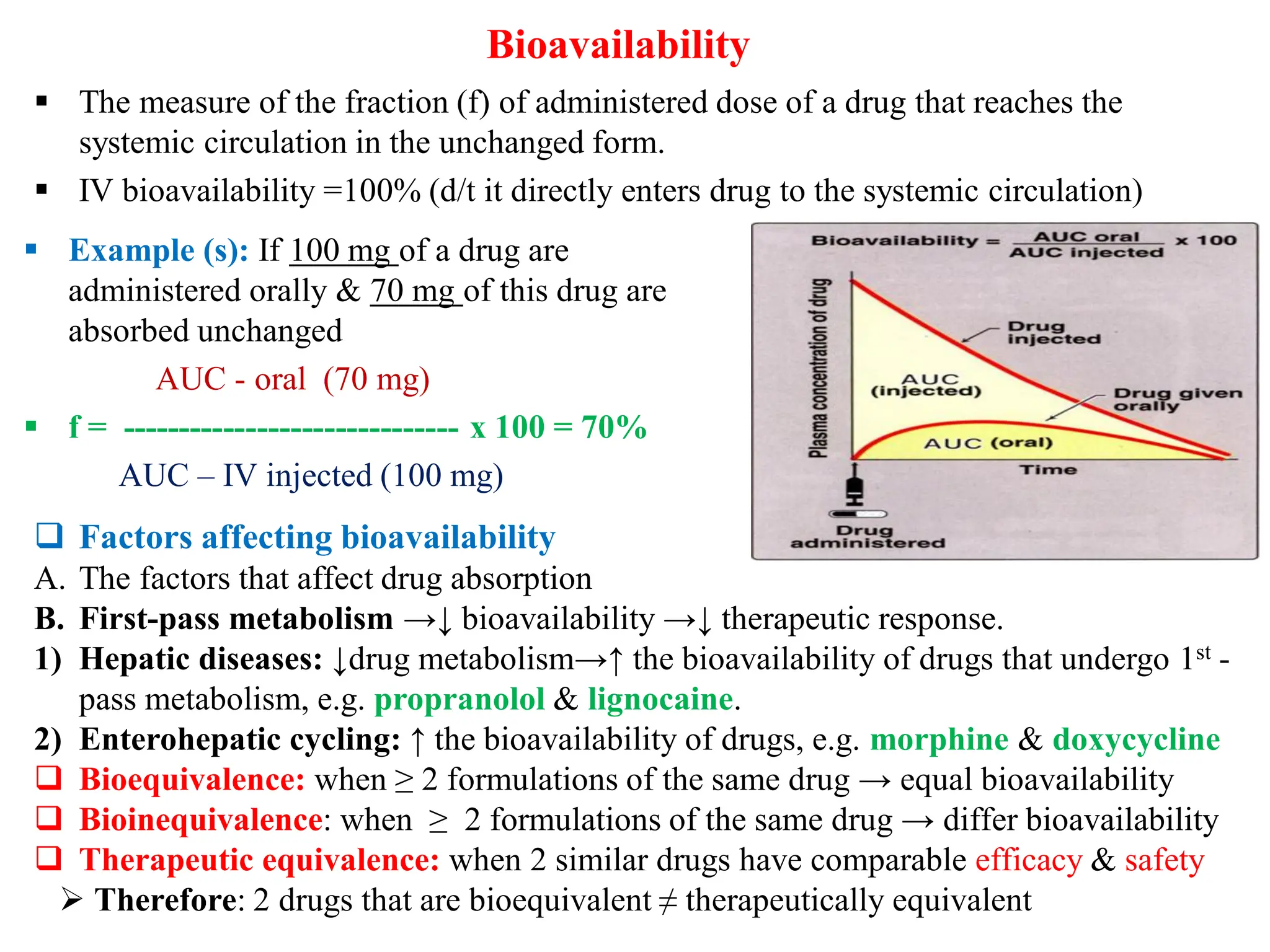
 The measure of the fraction (f) of administered dose of a drug that reaches the
systemic circulation in the unchanged form.
 IV bioavailability =100% (d/t it directly enters drug to the systemic circulation)
Bioavailability
 Factors affecting bioavailability
A. The factors that affect drug absorption
B. First-pass metabolism →↓ bioavailability →↓ therapeutic response.
1) Hepatic diseases: ↓drug metabolism→↑ the bioavailability of drugs that undergo 1st -
pass metabolism, e.g. propranolol & lignocaine.
2) Enterohepatic cycling: ↑ the bioavailability of drugs, e.g. morphine & doxycycline
 Bioequivalence: when ≥ 2 formulations of the same drug → equal bioavailability
 Bioinequivalence: when ≥ 2 formulations of the same drug → differ bioavailability
 Therapeutic equivalence: when 2 similar drugs have comparable efficacy & safety
 Therefore: 2 drugs that are bioequivalent ≠ therapeutically equivalent
 Example (s): If 100 mg of a drug are
administered orally & 70 mg of this drug are
absorbed unchanged
AUC - oral (70 mg)
 f = ------------------------------ x 100 = 70%
AUC – IV injected (100 mg)
 Many drugs & their metabolites are highly & reversibly bind to plasma proteins
 Acidic drugs bind to albumin, basic drugs bind to α1 –acid glycoprotein
 Estrogen/or testosterone bind to sex hormone-binding globulin (SHBG) &
thyroid hormones bind to thyroid -binding globulin (TBG)
Plasma Protein Binding (PPBs)
 Free drug:
 Pharmacologically active
 Available to the processes of
distribution, metabolism &
elimination
 Bound drug:
 Pharmacologically inactive
 Not available for the processes of
distribution, metabolism &
elimination
 Act as a temporary store of drug
 Clinical importance of PPB:
A. Drugs with highly PPBs→
o low Vd, delays the metabolism, delays excretion & longer duration of action of
the drug
o Difficult to be removed by haemodialysis in case of drug poisoning
o Displacement interactions.
 Co-administration ≥ 2 drugs that bind to the same binding site on plasma protein
→ the drug with higher affinity will displace the drug with lower affinity → ↑
level of the drug with lower affinity →↑its therapeutic & toxicity effects
 Ex.: Sulfonamide displaces warfarin from albumin binding site →↑ the
concentration of free warfarin in plasma →↑ its therapeutic & toxic effects.
 Ceftriaxone displaces bilirubin from its binding sites on albumin → exacerbates
the neonatal hyperbilirubinemia.
B. Alteration of plasma protein levels
 ↓PP levels →↑ free form of drug → ↑ drug therapeutic & toxicity effects
o Ex. chronic liver diseases, nephrotic syndrome, renal failure →
hypoalbuminemia →↑ the free form of acidic drug → ↑ its therapeutic & toxicity
effects.
 ↑PP levels →↓ free form of drug → ↓ drug activity→ failure of therapy
o Ex. cancer, arthritis, MI, & Crohn's disease patients, pregnant women →↑
levels of α1-acid glycoprotein→ ↑ binding of basic drugs → ↓ their activity.
Drug distribution
 Factors affected drug distribution
 Blood flow
 Capillary permeability
 Degree of drug binding to plasma & tissue proteins
 Relative hydrophobicity of the drug.
 Water body compartments (70-kg):
1. Plasma compartment (e.g., Heparin, warfarin,
dextran) → 6% of BW/or 4 L of body fluid
2. Extracellular fluid (e.g., aminoglycoside
antibiotics, mannitol, neostigmine) → 20% of
BW/or 14 L of body fluid
3. Total body water (most drugs, e.g., ethanol,
phenytoin, aspirin & barbiturates) → 60% of
BW/or 42 L of body fluid
4. Other sites
 The fetus: may take up drugs →↑ Vd
 Selective tissues: e. g., Calcium in bone, & Iodine in thyroid gland
 Drug reservoirs or tissue storage
o E.g., tetracyclines in bones and teeth; thiopental in adipose tissue;
chloroquine in the liver & retina; digoxin in the heart
 Redistribution
 E.g. Thiopental has a rapid onset of
action (10-20 Sec) → used for
induction of general anaesthesia
(GA )
 Volume of distribution (Vd)
 The hypothetical volume, represents the fluid volume that would be required to
contain the total amount of absorbed drug in the body at a concentration
equivalent to that in the plasma at steady state:
Total amount of drug in the body (D)
 Vd = ‫ـــــــــــــــــــــــــــــــــــــــــــــــــــــــــــــــــــــــــــــــ‬
Concentration of the drug in plasma(C)
o E.g., if 25 mg of a drug are administered, and the plasma concentration is 1
mg/L
D 25 mg
• Vd = ‫ــــــــــــــــــــــــ‬ = ‫ــــــــــــــــــــــــ‬ = 25 L
C 1 mg/L
B.Hydrophilic & ionized drugs are transported by facilitated/or active transport
proteins (influx transporters) in the BBB (e.g., levodopa)
 Hydrophilic drugs that fail to target facilitated/or active transport proteins in the
BBB cannot penetrate the CNS (e.g. aminoglycosides, neostigmine, dopamine)
 BBB can be bypassed using intrathecally (e.g. spinal anesthesia for a cesarean)
 Has some efflux transporters like P-gp → extrude many drugs that enter brain by
other processes
 Inflammation of meninges/or brain →↑ permeability of BBB for some drugs
(e.g. penicillin)
 Chemoreceptor trigger zone (CTZ ) in the medulla & at anterior hypothalamus is
not covered by BBB → even hydrophilic drugs are emetic
Special barriers to distribution
1. Blood–brain barrier (BBB):
 A lipid cellular barrier, consists of the
capillary boundary that is present between
the blood & brain
 Drugs designed to act in the CNS
A.Must be sufficiently small & hydrophobic,
unionized (e.g. barbiturates, diazepam,
volatile anaesthetics, amphetamine
2. Placental barrier:
 Lipid cellular barrier between mother & fetus
 Lipid soluble, non-ionized drugs can pass easily, (e.g., methimazole]
 Non-lipid soluble drugs (e.g., propylthiouracil ), quaternary ammonium
compounds, e.g. d- tubocurarine (d-TC) & substances with high MW like
insulin cannot cross the placental barrier
 Has some influx transporters, & placental efflux P-gp (limit foetal exposure to
maternally administered drugs)
 More permeable than BBB → almost any drug taken by the mother can affect
the foetus/or the newborn.
o Drug taken in the 1st - trimester as phenytoin & tetracyclines→ teratogenicity
/or malformations
o Drugs taken during labor as morphine & barbiturates → neonatal asphyxia
Thank you
Any
question?

L P- 2 Pharmacokinetics final_١٢٥٧٠٠.pdf

  • 1.
  • 2.
    Dr. Ahmed Al-Akydy Assoc. Prof. Pharmacology & Therapeutics ‫األدوية‬ ‫علم‬ 1 PHARMACOLOGY 1
  • 3.
  • 4.
    Learning Outcomes  Oncompletion of this lecture, the student will be: 1. Identify the four components of pharmacokinetics 2. Explain how substances travel across plasma membranes. 3. Discuss factors affecting drug absorption. 4. Discuss how drugs are distributed throughout the body. 5. Describe how plasma proteins affect drug distribution.
  • 5.
    Pharmacodynamics Pharmacokinetics Item  The actionsof the drug on the body  The actions of the body on the drug  Defention  Mechanism of action  Pharmacological actions  Adverse effects  ADME o Absorption o Distribution o Metabolism o Excretion  Processes  Propranolol →↓ blood pressure (BP) & ↓ heart rate (HR).  Propranolol: absorbed from GI T, metabolized in the liver & eliminated by both liver & kidney.  Example Pharmacokinetics/Pharmacodynamics
  • 6.
    Modes of drugtransport across a biological membrane  Biological membrane: a lipid bilayer membrane, consist of phospholipids, cholesterol, & glycolipids. 2) Filtration:  Depends on the molecular weight (MW) of the drug  Small drug molecules filter easily through the pores of cell membrane 3) Facilitated diffusion o Concentration gradient o Not require energy, but need carrier, & saturable o Example (s): transport of glucose by GLUT & Vit B12 1) Passive diffusion o Concentration gradient o Not require energy/or carrier/& not saturable o Example (s): Lipid-soluble drugs
  • 7.
    4) Active transport oAgainst the concentration gradient, o Require energy, carrier/& saturable o Example (s): transport of sympathomimetic amines into neural tissue, transport of choline into cholinergic neurons & absorption of levodopa from the intestine. 5) Endocytosis o A process in which the cell membrane engulfs a drug molecule to form a vesicle, which transported & released inside the cell by pinching off process o Example (s): proteins, peptides, amino acids, fat, fat - soluble vitamins (K, E, D, A), hormones
  • 8.
    Action potential Na+ NT Effector Organ Postsynaptic neuron Receptors Presynapticneuron 6) Exocytosis o The reverse of endocytosis o Example (s): certain neurotransmitters (NTs) e.g. norepinephrine 7) Ion pair transport o Organic anion combine with organic cation → a neutral complex → transported through the membrane by passive diffusion.
  • 9.
    Pharmacokinetics (ADME) Absorption Absorption Excretion Excretion Metabolism Distribution  Theprocesses which involve removal of the drug/or its metabolites from the body outside the body  The metabolic conversion of lipid -soluble drug compounds to more water-soluble metabolites that are more readily excreted.  The transfer of a drug from its site of administration to the bloodstream  The process by which a drug reversibly leaves the bloodstream & enters the tissues (interstitial &/or the cells).
  • 10.
    Factors influencing drugabsorption A. Physicochemical properties of the drug  Liquid form of the drug is better absorbed than solid form 1) Physical state  Shorter the time, better is the absorption 2) Disintegration & dissolution times  Lipid-soluble & unionized form of the drug is better absorbed than the water-soluble & ionized form. 3) Degree of ionization & lipid solubility  Inorganic small molecules are better absorbed than organic larger drugs  E.g. microfine aspirin (well absorbed) , anthelmintics (larger particle size) → poorly absorbed from GI tract → better effect on gut helminthes] 4) Chemical nature & MW  Inert substances (lactose, starch, Ca sulphate, gum) are added to formulations as binding agents→ affect the absorption of drugs (e.g. Ca+2 → ↓ absorption of tetracyclines) 5) Formulations (dosage forms)  Ferrous form (Fe2+ ) is more absorbed than ferric form (Fe3+) 6) Valency < < <
  • 11.
    B. Patient RelatedFactors: 1) ROA : IV > IM > SC > oral > skin 2) Surface area for absorption: larger surface area →↑ absorption of the drug (e.g. the small intestine) 3) Blood flow to the absorption site (vascularity): a highly blood flow to the absorption site →↑ absorption of the drug (e.g. small intestine > stomach) 4) Contact time at the absorbing surface:  Motility of GI tract: o Diarrhea →↑ movement of drug through the GI tract →↓ absorbed. o Constipation→↓ movement of drug through the GI tract →↑absorption  Gastric emptying: anything that delays the transport of the drug from the stomach to the intestine → delays the rate of absorption. o Metoclopramide →↑ gastric emptying →↑absorption of paracetamol o Atropine →↓ gastric emptying → ↓absorption of paracetamol  The presence of food in the GI tract: o Food →↓ absorption of rifampicin, levodopa. o Milk & dairy products→↓ the absorption of tetracyclines. o Tannic acid from tea →↓ absorption of iron o Fatty meal → ↑ the absorption of griseofulvin & fat –soluble vitamins  Presence of other drugs: Ascorbic acid (↑ the absorption of oral iron), Antacids (↓ the absorption of tetracyclines, & fluoroquinolones)
  • 12.
    5) GI andother diseases:  Atrophic gastritis/or mallabsorption syndrome →↓ absorption  Achlorhydria →↓ absorption of iron from the gut  Congestive heart failure (CHF) → GI mucosal oedema→↓the absorption of drug 6) Pharmacogenetic factors:  In pernicious anaemia (lack of intrinsic factor) →↓ absorption of Vit B12. 7) pH and ionization: A. Weak acid/or weak base drug:  Its absorption depends on pH of medium. 1. Weakly acidic drugs (as salicylates):  Better absorbed at low pH (from the stomach), d/t non- ionized form predominates. 2. Weakly basic drugs(as chloroquine):  Better absorbed at high pH (from the small intestine), d/t non- ionized form predominates B. Strong acids/or bases  Poorly absorbed d/t strongly acidic (e.g. heparin) & strongly basic (e.g. aminoglycoside) drugs usually remain ionized at all pH
  • 13.
     The distributionof a drug between its ionized & nonionized forms depends on the pH of ambient & pKa of the drug  Drug pKa: o Represents the pH value at which ½ (50% ) of the drug is present in its ionic form o Measure of the strength of the interaction of a compound with a proton (H) o Different for different drugs  Henderson- Hasselbalch equation: o Describes the relationship between the pKa of an acidic/or basic drug & the pH of the biological medium containing the drug Protonated form (RH) o pKa = pH + Log ‫ــــــــــــــــــــــــــــــــــــــــــــــــــــــــ‬ Unprotonated form (R) o Useful in determining the amount of drug that will be found on either side of a membrane, separates 2 compartments differ in pH (e.g. pH stomach = 2 & pH plasma = 7.4).
  • 14.
     Lower pKa→ the stronger the acid & the weaker base  Higher pKa→ the stronger the base & the weaker acid
  • 15.
     First-pass metabolism: oThe metabolism of certain drugs, which removed/or inactivated before they reach the systemic circulation o Example (s): nitroglycerin (> 90% is cleared during a single passage through the liver) First - pass metabolism (first-pass effect, presystemic elimination)  Orally administered drugs → absorbed via gut wall to portal vein & into the liver, then into the systemic circulation by hepatic vein  Resolutions 1st – pass metabolism: o Administered drug by other route: parenterally (e.g. lignocaine by IV in ventricular arrhythmias)/or sublingually (nitroglycerin in acute attack of angina) o Administered drug with high orally dose
  • 16.
     The measureof the fraction (f) of administered dose of a drug that reaches the systemic circulation in the unchanged form.  IV bioavailability =100% (d/t it directly enters drug to the systemic circulation) Bioavailability  Factors affecting bioavailability A. The factors that affect drug absorption B. First-pass metabolism →↓ bioavailability →↓ therapeutic response. 1) Hepatic diseases: ↓drug metabolism→↑ the bioavailability of drugs that undergo 1st - pass metabolism, e.g. propranolol & lignocaine. 2) Enterohepatic cycling: ↑ the bioavailability of drugs, e.g. morphine & doxycycline  Bioequivalence: when ≥ 2 formulations of the same drug → equal bioavailability  Bioinequivalence: when ≥ 2 formulations of the same drug → differ bioavailability  Therapeutic equivalence: when 2 similar drugs have comparable efficacy & safety  Therefore: 2 drugs that are bioequivalent ≠ therapeutically equivalent  Example (s): If 100 mg of a drug are administered orally & 70 mg of this drug are absorbed unchanged AUC - oral (70 mg)  f = ------------------------------ x 100 = 70% AUC – IV injected (100 mg)
  • 17.
     Many drugs& their metabolites are highly & reversibly bind to plasma proteins  Acidic drugs bind to albumin, basic drugs bind to α1 –acid glycoprotein  Estrogen/or testosterone bind to sex hormone-binding globulin (SHBG) & thyroid hormones bind to thyroid -binding globulin (TBG) Plasma Protein Binding (PPBs)  Free drug:  Pharmacologically active  Available to the processes of distribution, metabolism & elimination  Bound drug:  Pharmacologically inactive  Not available for the processes of distribution, metabolism & elimination  Act as a temporary store of drug
  • 18.
     Clinical importanceof PPB: A. Drugs with highly PPBs→ o low Vd, delays the metabolism, delays excretion & longer duration of action of the drug o Difficult to be removed by haemodialysis in case of drug poisoning o Displacement interactions.  Co-administration ≥ 2 drugs that bind to the same binding site on plasma protein → the drug with higher affinity will displace the drug with lower affinity → ↑ level of the drug with lower affinity →↑its therapeutic & toxicity effects  Ex.: Sulfonamide displaces warfarin from albumin binding site →↑ the concentration of free warfarin in plasma →↑ its therapeutic & toxic effects.  Ceftriaxone displaces bilirubin from its binding sites on albumin → exacerbates the neonatal hyperbilirubinemia. B. Alteration of plasma protein levels  ↓PP levels →↑ free form of drug → ↑ drug therapeutic & toxicity effects o Ex. chronic liver diseases, nephrotic syndrome, renal failure → hypoalbuminemia →↑ the free form of acidic drug → ↑ its therapeutic & toxicity effects.  ↑PP levels →↓ free form of drug → ↓ drug activity→ failure of therapy o Ex. cancer, arthritis, MI, & Crohn's disease patients, pregnant women →↑ levels of α1-acid glycoprotein→ ↑ binding of basic drugs → ↓ their activity.
  • 19.
    Drug distribution  Factorsaffected drug distribution  Blood flow  Capillary permeability  Degree of drug binding to plasma & tissue proteins  Relative hydrophobicity of the drug.  Water body compartments (70-kg): 1. Plasma compartment (e.g., Heparin, warfarin, dextran) → 6% of BW/or 4 L of body fluid 2. Extracellular fluid (e.g., aminoglycoside antibiotics, mannitol, neostigmine) → 20% of BW/or 14 L of body fluid 3. Total body water (most drugs, e.g., ethanol, phenytoin, aspirin & barbiturates) → 60% of BW/or 42 L of body fluid 4. Other sites  The fetus: may take up drugs →↑ Vd  Selective tissues: e. g., Calcium in bone, & Iodine in thyroid gland  Drug reservoirs or tissue storage o E.g., tetracyclines in bones and teeth; thiopental in adipose tissue; chloroquine in the liver & retina; digoxin in the heart
  • 20.
     Redistribution  E.g.Thiopental has a rapid onset of action (10-20 Sec) → used for induction of general anaesthesia (GA )  Volume of distribution (Vd)  The hypothetical volume, represents the fluid volume that would be required to contain the total amount of absorbed drug in the body at a concentration equivalent to that in the plasma at steady state: Total amount of drug in the body (D)  Vd = ‫ـــــــــــــــــــــــــــــــــــــــــــــــــــــــــــــــــــــــــــــــ‬ Concentration of the drug in plasma(C) o E.g., if 25 mg of a drug are administered, and the plasma concentration is 1 mg/L D 25 mg • Vd = ‫ــــــــــــــــــــــــ‬ = ‫ــــــــــــــــــــــــ‬ = 25 L C 1 mg/L
  • 21.
    B.Hydrophilic & ionizeddrugs are transported by facilitated/or active transport proteins (influx transporters) in the BBB (e.g., levodopa)  Hydrophilic drugs that fail to target facilitated/or active transport proteins in the BBB cannot penetrate the CNS (e.g. aminoglycosides, neostigmine, dopamine)  BBB can be bypassed using intrathecally (e.g. spinal anesthesia for a cesarean)  Has some efflux transporters like P-gp → extrude many drugs that enter brain by other processes  Inflammation of meninges/or brain →↑ permeability of BBB for some drugs (e.g. penicillin)  Chemoreceptor trigger zone (CTZ ) in the medulla & at anterior hypothalamus is not covered by BBB → even hydrophilic drugs are emetic Special barriers to distribution 1. Blood–brain barrier (BBB):  A lipid cellular barrier, consists of the capillary boundary that is present between the blood & brain  Drugs designed to act in the CNS A.Must be sufficiently small & hydrophobic, unionized (e.g. barbiturates, diazepam, volatile anaesthetics, amphetamine
  • 22.
    2. Placental barrier: Lipid cellular barrier between mother & fetus  Lipid soluble, non-ionized drugs can pass easily, (e.g., methimazole]  Non-lipid soluble drugs (e.g., propylthiouracil ), quaternary ammonium compounds, e.g. d- tubocurarine (d-TC) & substances with high MW like insulin cannot cross the placental barrier  Has some influx transporters, & placental efflux P-gp (limit foetal exposure to maternally administered drugs)  More permeable than BBB → almost any drug taken by the mother can affect the foetus/or the newborn. o Drug taken in the 1st - trimester as phenytoin & tetracyclines→ teratogenicity /or malformations o Drugs taken during labor as morphine & barbiturates → neonatal asphyxia
  • 23.