BASICS OF 
PHARMACOECONOMICS 
By Dr Ketan Asawalle 
JR1,Dept. of Pharmacology 
SVNGMC Yavatmal
SCOPE OF 
PRESENTATION 
1. Introduction 
2. Brief History 
3. Challenges
SCOPE OF 
PRESENTATION 
Pharmacoeconomic Evaluation 
5. Methods for Evaluation 
6. Assessment of Results
SCOPE OF 
PRESENTATION 
7. Limitations of Evaluation 
8. Summary
HISTORY
evaluations in the field of pharmacology started parameters were used to evaluate e.g. increased PHARMACOECONOMICS was used on a public forum
INTRODUCTION
• Who Pays for medical bills ? 
1.Government 
2.Insurance Companies
This NEVER 
Happens
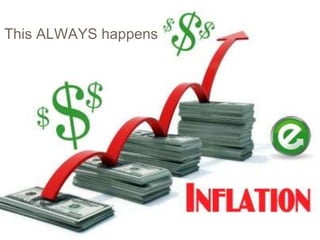
This ALWAYS happens
Funders try to make efforts to contain By 
• Price negotiations 
• Patient co-payments 
• Dedicated Drug Bills
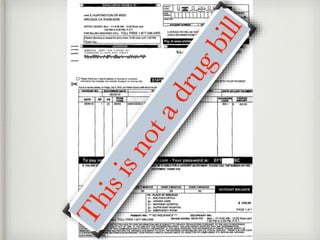
WHAT IS A DRUG 
BILL?
various policies of that government that it that particular country has allotted for
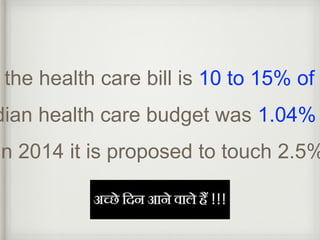
the health care bill is 10 to 15% of Indian health care budget was 1.04% In 2014 it is proposed to touch 2.5%
study all these aspects in order to achieve POSSIBLE ALONG WITH PROVIDING
VERY FIRST aspect of controlling drug EVALUATION OF EXPENDITURE OF DRUG
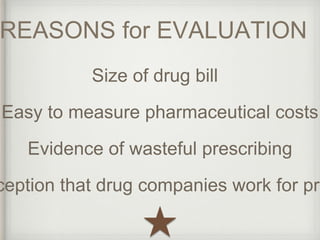
REASONS for EVALUATION 
Size of drug bill 
Easy to measure pharmaceutical costs 
Evidence of wasteful prescribing 
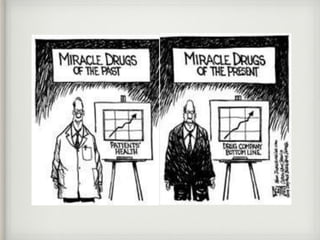
Perception that drug companies work for profits
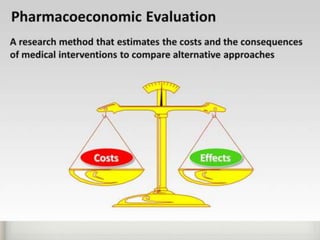
DEFINITION
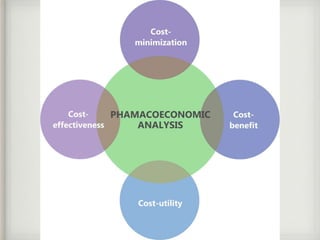
PHARMACOECONOMICS 
cost-minimization, cost-of-illness and
and methodology of HEALTH
of techniques used in health
analysis of the costs of drug
BASIC USES
• Make formulary decisions 
Design disease management programs 
cost- effectiveness of interventions
NEED FOR 
PHARMACOECONOMICS
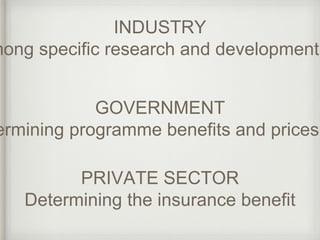
Determining programme benefits and prices INDUSTRY 
among specific research and development GOVERNMENT 
PRIVATE SECTOR 
Determining the insurance benefit
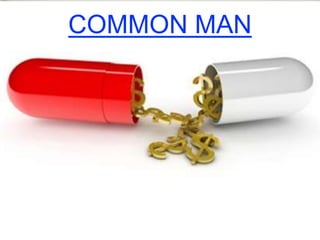
COMMON MAN
expenditures have led to the necessity to find the optimal therapy Pharmaceutical expenditure has increased dramatically 
Numerous alternatives for the same disease/condition 
Increasing costs of health care products
IMPORTANT 
TERMS
PRO i.e. PATIENT REPORTED OUTCOME 
HRQL i.e. HEALTH RELATED QUALITY OF LIFE 
QALY i.e. QUALITY ADJUSTED LIFE YEARS
PATIENT REPORTED OUTCOME (PRO) 
Measured by self-reported questioners 
patients own viewpoint about the new product
HEALTH RELATED QUALITY OF HRQL) is an individual's satisfaction
dimension of health (e.g., a disease or
The quality-adjusted life year QALY 
disease burden, including both the quality and the number of years of life that would be added by
CHALLENGES
Training and education in ANALYSIS of DATA 
Standardizing the methods and establishing GUIDELINES CONTINUED EDUCATION on relevant features 
Stable FUNDS
PHARMACO-ECONOMIC 
EVALUATION
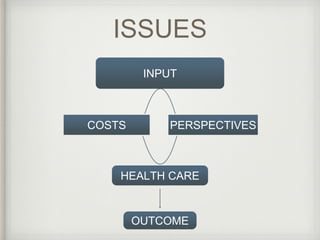
ISSUES 
INPUT 
COSTS PERSPECTIVES 
HEALTH CARE 
OUTCOME
PERSPECTIVE 
about from whose point of view the evaluation Two Types 
1. Health Service Perspective 
2. Societal Perspective
the health mangers facing problem of low Health service perspective contains direct cost 
Societal perspective contains indirect cost
COSTS 
Two main types 
Financial costs=Mandatory costs 
Economic costs=Non mandatory costs 
foregone when selecting one therapy alternative
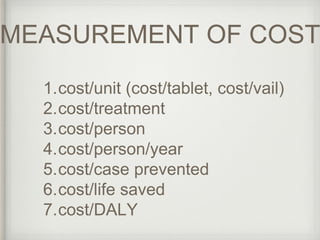
MEASUREMENT OF COST 
1.cost/unit (cost/tablet, cost/vail) 
2.cost/treatment 
3.cost/person 
4.cost/person/year 
5.cost/case prevented 
6.cost/life saved 
7.cost/DALY
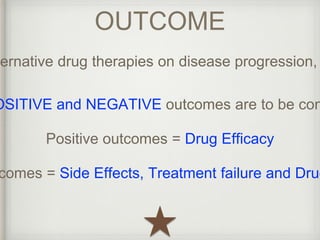
OUTCOME 
alternative drug therapies on disease progression, POSITIVE and NEGATIVE outcomes are to be considered 

Positive outcomes = Drug Efficacy 
outcomes = Side Effects, Treatment failure and Drug
METHODS OF 
PHARMACO-ECONOMIC 
EVALUATION
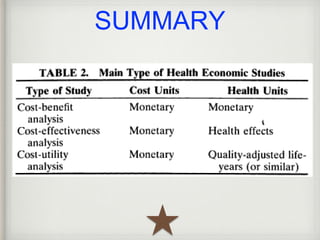
COST-MINIMIZATION 
ANALYSIS
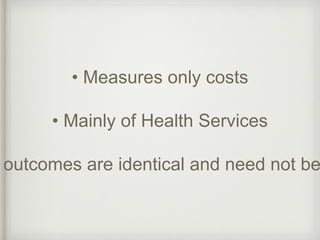
• Measures only costs 
• Mainly of Health Services 
outcomes are identical and need not be
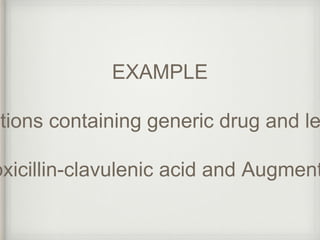
EXAMPLE 
prescriptions containing generic drug and leading Amoxicillin-clavulenic acid and Augmentin
is to project the least costly drug or treatment Reflects cost of preparing and administering a
COST-EFFECTIVENESS 
ANALYSIS
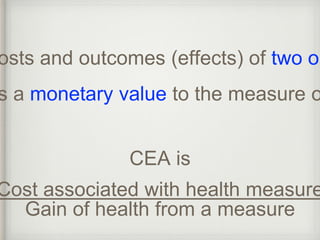
defined and measured in natural units (
costs and outcomes (effects) of two or Assigns a monetary value to the measure of CEA is 
Cost associated with health measure 
Gain of health from a measure
with qualitatively similar outcomes in a particular QALY is the most common outcome measure
patient relieved of symptoms using EXAMPLE
COST-UTILITY 
ANALYSIS
Similar to Cost-effectiveness analysis 
Costs are measured in Money 
Outcome is Defined 
Outcome is a Unit of Utility e.g. QALY
disease is not directly dependent in look into more than one area of medicine
bypass grafting versus cost per QAL EXAMPLE
difficult than measuring the monetary value of life the health improvement effects for every remaining DRAWBACK
COST-BENEFIT 
ANALYSIS
measured as the associated economic benefit 
monetary value of returning a worker to employment costs and benefits are expressed in money
to be made between very different areas, education and hence productivity) compared to establishing
very important benefits not measurable in in whom a return to productive employment DRAWBACKS
SUMMARY
RESULTS OF 
EVALUATION
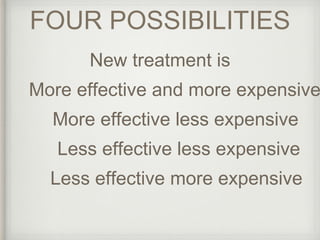
FOUR POSSIBILITIES 
New treatment is 
More effective and more expensive 
More effective less expensive 
Less effective less expensive 
Less effective more expensive
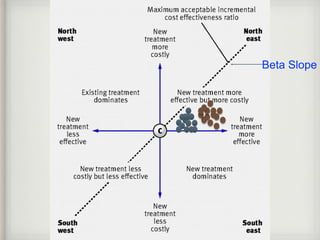
RESULTS OF ECONOMIC EVALUATION 
I 
IV 
III II
case in which only TWO treatment regimens or multiple regimens are considered
Beta Slope
MARKOV’S POPULATION TREE FOR DECISION METHODS OF DECISION MAKING 
NEEDED TO TREAT/NUMBER NEEDE
LIMITATIONS
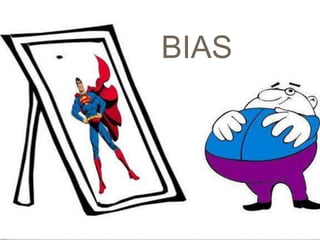
BIAS
• Choice of comparator drug 
• The assumptions made 
• Selective reporting of results
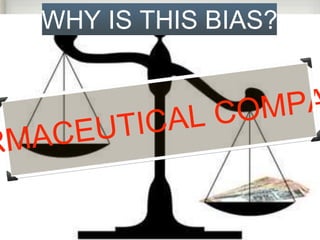
WHY IS THIS BIAS?
less well understood by doctors and others, with rationing or cost cutting, and therefore
MAIN PROBLEMS 
• A short term outlook 
operate in isolation, and it is not easy to move money may simply not be affordable no matter how cost • Young sciences 
• Need of proper guidelines
THANK YOU
REFERENCES 
1. A Practical Guide To Clinical Audit, Quality and Patient Safety(QPSD-D-029-1 V.1) 
2 Pharmacoeconomics: basic concepts and terminology T. Walley & A. Haycox (Department of Pharmacology 3. Pharmacoeconomics and Economic Evaluation of Drug Therapies Tom Walley, M.D. (Professor of Clinical 4. PHARMACOECONOMICS: A REVIEW SURENDRA G. GATTANI, Department of Pharmaceutics, R.C.ABASAHEB B. PATIL, Lecturer Department of Pharmaceutics , R.C.P.E.R. Malegaon, 
SACHIN S. KUSHARE, Department of Pharmaceutics R.C.Patel college of Pharmacy, Shirpur 
5. THE THEORY OF COST-BENEFIT ANALYSIS JEAN DREZE AND NICHOLAS STERN (London School 6. DRUG UTILIZATION AND THERAPEUTIC AUDIT, British journal of clinical pharmacology (1980), 9,

Pharmacoeconomics seminar