Dr Anu Chandran
Department of pharmacology
Trivandrum medical college
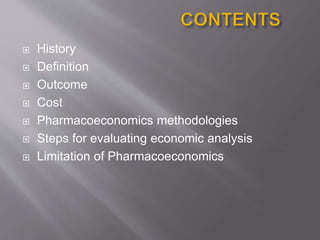
 History
 Definition
 Outcome
 Cost
 Pharmacoeconomics methodologies
 Steps for evaluating economic analysis
 Limitation of Pharmacoeconomics
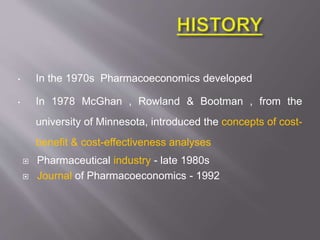
• In the 1970s Pharmacoeconomics developed
• In 1978 McGhan , Rowland & Bootman , from the
university of Minnesota, introduced the concepts of cost-
benefit & cost-effectiveness analyses
 Pharmaceutical industry - late 1980s
 Journal of Pharmacoeconomics - 1992
 Term first coined in 1986 by Townsend
 “the description and analysis of the costs
of drug therapy to health systems and
society”
Rl Townsend (1986)
Greek – Rules of household
‘Science of the distribution of
wealth and resources’.
“Study of how society decides what
gets produced, how and for
whom”.
Description and analysis of the costs
and consequences of pharmaceutical
products and services and their impact
on individuals, health care systems and
society.
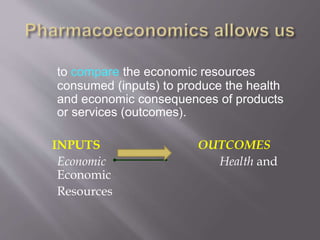
to compare the economic resources
consumed (inputs) to produce the health
and economic consequences of products
or services (outcomes).
INPUTS OUTCOMES
Economic Health and
Economic
Resources
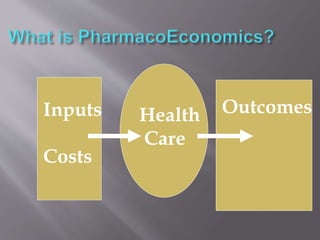
Inputs
Costs
Health
Care
Outcomes
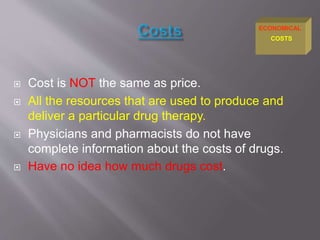
 Cost is NOT the same as price.
 All the resources that are used to produce and
deliver a particular drug therapy.
 Physicians and pharmacists do not have
complete information about the costs of drugs.
 Have no idea how much drugs cost.
COSTS
ECONOMICAL
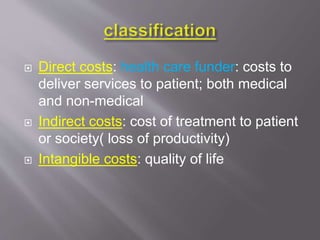
 Direct costs: health care funder: costs to
deliver services to patient; both medical
and non-medical
 Indirect costs: cost of treatment to patient
or society( loss of productivity)
 Intangible costs: quality of life
Opportunity cost:
Benefit forgone when selecting on therapy
alternative over next best alternative
Rupee given to someone is denied to
somebody
Marginal cost:
Costs where the resource use actually
changes substantially
 Both positive and negative outcomes should be
addressed
 Positive outcomes: drug’s efficacy measure
 Negative outcomes: ADR and treatment failure
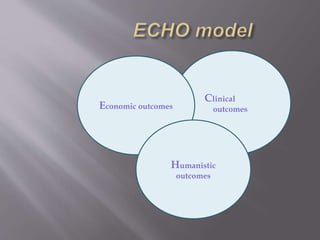
Clinical
outcomesEconomic outcomes
Humanistic
outcomes
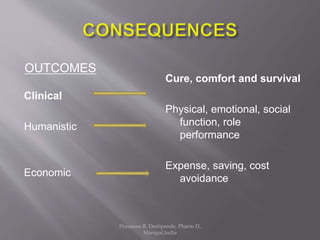
OUTCOMES
Clinical
Humanistic
Economic
Cure, comfort and survival
Physical, emotional, social
function, role
performance
Expense, saving, cost
avoidance
Prasanna R. Deshpande, Pharm D,
Manipal,India
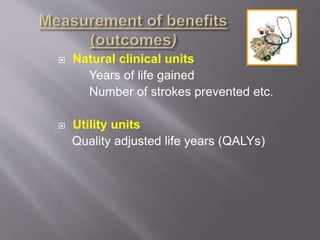
 Natural clinical units
Years of life gained
Number of strokes prevented etc.
 Utility units
Quality adjusted life years (QALYs)
Efficacy - Established by RCT
Cost - Decided by company
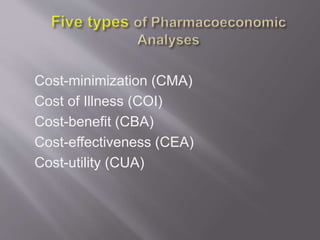
Cost-minimization (CMA)
Cost of Illness (COI)
Cost-benefit (CBA)
Cost-effectiveness (CEA)
Cost-utility (CUA)
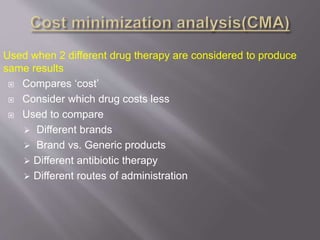
Used when 2 different drug therapy are considered to produce
same results
 Compares ‘cost’
 Consider which drug costs less
 Used to compare
 Different brands
 Brand vs. Generic products
 Different antibiotic therapy
 Different routes of administration
 Both cost and outcomes taken in monetary ( $ ) terms
 Ignores the intangible benefits
 Benefit and cost are expressed in terms of money
 Outcome expressed as:
Ratio of benefit to cost
Net benefit = benefit – cost
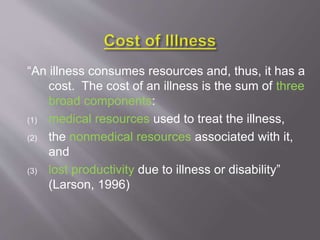
“An illness consumes resources and, thus, it has a
cost. The cost of an illness is the sum of three
broad components:
(1) medical resources used to treat the illness,
(2) the nonmedical resources associated with it,
and
(3) lost productivity due to illness or disability”
(Larson, 1996)
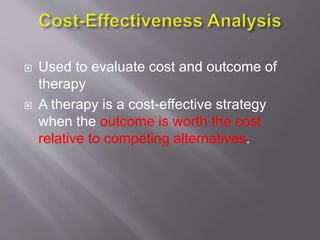
 Used to evaluate cost and outcome of
therapy
 A therapy is a cost-effective strategy
when the outcome is worth the cost
relative to competing alternatives.
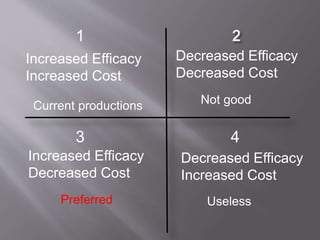
Current productions
1
Increased Efficacy
Increased Cost
Decreased Efficacy
Decreased Cost
Not good
3
Increased Efficacy
Decreased Cost
Preferred
4
Decreased Efficacy
Increased Cost
Useless
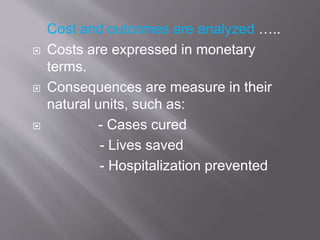
Cost and outcomes are analyzed …..
 Costs are expressed in monetary
terms.
 Consequences are measure in their
natural units, such as:
 - Cases cured
- Lives saved
- Hospitalization prevented
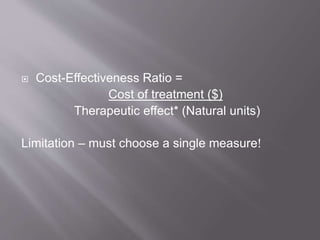
 Cost-Effectiveness Ratio =
Cost of treatment ($)
Therapeutic effect* (Natural units)
Limitation – must choose a single measure!
 Integrates both costs and consequences within the
utility analysis framework.
 A variation of CEA
 differences between CUA & CEA
 CUA requires the measurement of final outcomes
in terms of changes in life expectancy adjusted for
patient preferences
 Intermediate outcomes are not appropriate to use
in cost-utility analysis
 outcomes expressed in QALY gained.
 QALY- is a measure of disease burden,
including both the quality and the
quantity of life lived
 1.0 QALY = Disease free yr.
 0.5 QALY = Yr. spent with specific
disease
 0 = death
Prasanna R. Deshpande, Pharm D,
Manipal,India
Cost – monetary units
Outcome - Patient preferences or “Utility
based” unit QALY(quality adjusted life
years)
The most difficult analysis
Used when QOL is the important outcome
1. Define the problem
2. Identify the perspective and alternative
interventions to be compared
3. Identify and measure outcomes of each alternative
4. Identify, measure and value costs of all alternatives
5. use discounting and sensitivity analysis when
appropriate
 Identify the disease state and what aspect you want
to deal with.
 i.e. What is the most cost effective method for
controlling glucose in the treatment of type II
diabetes?
 that is, who will be utilizing the
information to make what decisions.
 This will guide you in choosing the
relevant costs and benefits.
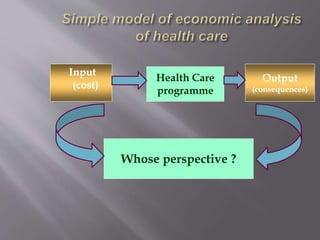
Input
(cost)
Health Care
programme
Output
(consequences)
Whose perspective ?
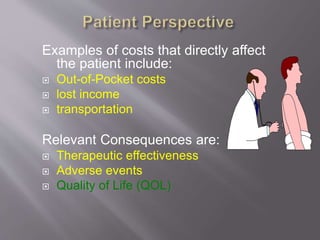
Examples of costs that directly affect
the patient include:
 Out-of-Pocket costs
 lost income
 transportation
Relevant Consequences are:
 Therapeutic effectiveness
 Adverse events
 Quality of Life (QOL)
Costs to physicians may include:
 Hospitalization
 Pharmacy
 Personnel
 Supplies
Consequences of interest are:
 Therapeutic effectiveness
 Adverse events
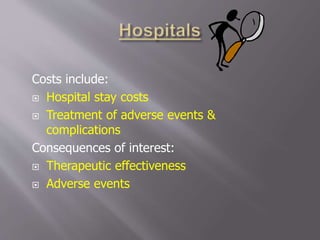
Costs include:
 Hospital stay costs
 Treatment of adverse events &
complications
Consequences of interest:
 Therapeutic effectiveness
 Adverse events
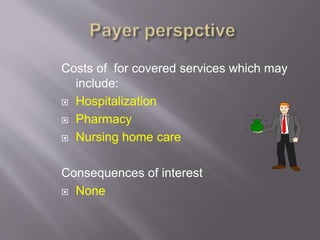
Costs of for covered services which may
include:
 Hospitalization
 Pharmacy
 Nursing home care
Consequences of interest
 None
 All possible costs including lost productivity
 All possible consequences including QoL, &
life years.
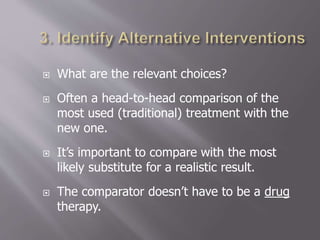
 What are the relevant choices?
 Often a head-to-head comparison of the
most used (traditional) treatment with the
new one.
 It’s important to compare with the most
likely substitute for a realistic result.
 The comparator doesn’t have to be a drug
therapy.
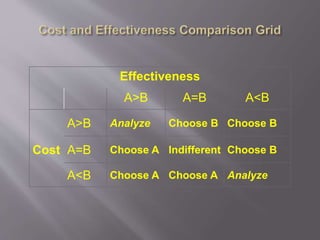
Effectiveness
A>B A=B A<B
A>B Analyze Choose B Choose B
Cost A=B Choose A Indifferent Choose B
A<B Choose A Choose A Analyze
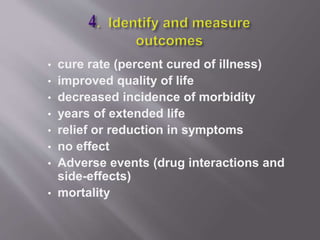
• cure rate (percent cured of illness)
• improved quality of life
• decreased incidence of morbidity
• years of extended life
• relief or reduction in symptoms
• no effect
• Adverse events (drug interactions and
side-effects)
• mortality
Costs are measured over a relevant time period
such as a month or year.
The length of time used depends on the typical
span of the illness.
If the analysis spans more than a year, then the
MONEY values must be adjusted to a common
point in time.
 Present Value = Future value
(1+r)n
where r = discount rate (typically ranges from .03 to .06)
and n = the number of years in the future.
 Decision makers
 Analysts
 Clinical trail economics
 Patient
 Patient counsellar
 HR
 Health economics
 Liable for bias
 Reduces the ability of the doctor to prescribe best
drugs
 Difficulties are faced during the implementation of the
results
 Methodologies at present are controversial and are at
development
 Drug development is very expensive process
 Duration of development – 10 to 15 yrs
 Patent life – 20 yrs.
 Patent life starts with preclinical phase.
 All new drugs are very expensive when they
come in market.
Tool for formulary designing and decision making process
Help in shaping the economic evaluations & allocate resources
properly
Effective utilization of restricted resources.
Provide clear picture about the likely costs and benefits of other
alternatives
"Not everything that can
be counted counts, and
not everything that counts
can be counted."
- Albert Einstein (1879-
1955)
THANK YOU
Pharmacoeconomics

Pharmacoeconomics

  • 1.
    Dr Anu Chandran Departmentof pharmacology Trivandrum medical college
  • 2.
     History  Definition Outcome  Cost  Pharmacoeconomics methodologies  Steps for evaluating economic analysis  Limitation of Pharmacoeconomics
  • 3.
    • In the1970s Pharmacoeconomics developed • In 1978 McGhan , Rowland & Bootman , from the university of Minnesota, introduced the concepts of cost- benefit & cost-effectiveness analyses  Pharmaceutical industry - late 1980s  Journal of Pharmacoeconomics - 1992
  • 4.
     Term firstcoined in 1986 by Townsend  “the description and analysis of the costs of drug therapy to health systems and society” Rl Townsend (1986)
  • 5.
    Greek – Rulesof household ‘Science of the distribution of wealth and resources’. “Study of how society decides what gets produced, how and for whom”.
  • 6.
    Description and analysisof the costs and consequences of pharmaceutical products and services and their impact on individuals, health care systems and society.
  • 7.
    to compare theeconomic resources consumed (inputs) to produce the health and economic consequences of products or services (outcomes). INPUTS OUTCOMES Economic Health and Economic Resources
  • 8.
  • 9.
     Cost isNOT the same as price.  All the resources that are used to produce and deliver a particular drug therapy.  Physicians and pharmacists do not have complete information about the costs of drugs.  Have no idea how much drugs cost. COSTS ECONOMICAL
  • 10.
     Direct costs:health care funder: costs to deliver services to patient; both medical and non-medical  Indirect costs: cost of treatment to patient or society( loss of productivity)  Intangible costs: quality of life
  • 11.
    Opportunity cost: Benefit forgonewhen selecting on therapy alternative over next best alternative Rupee given to someone is denied to somebody Marginal cost: Costs where the resource use actually changes substantially
  • 12.
     Both positiveand negative outcomes should be addressed  Positive outcomes: drug’s efficacy measure  Negative outcomes: ADR and treatment failure
  • 13.
  • 14.
    OUTCOMES Clinical Humanistic Economic Cure, comfort andsurvival Physical, emotional, social function, role performance Expense, saving, cost avoidance Prasanna R. Deshpande, Pharm D, Manipal,India
  • 15.
     Natural clinicalunits Years of life gained Number of strokes prevented etc.  Utility units Quality adjusted life years (QALYs)
  • 16.
    Efficacy - Establishedby RCT Cost - Decided by company
  • 17.
    Cost-minimization (CMA) Cost ofIllness (COI) Cost-benefit (CBA) Cost-effectiveness (CEA) Cost-utility (CUA)
  • 18.
    Used when 2different drug therapy are considered to produce same results  Compares ‘cost’  Consider which drug costs less  Used to compare  Different brands  Brand vs. Generic products  Different antibiotic therapy  Different routes of administration
  • 19.
     Both costand outcomes taken in monetary ( $ ) terms  Ignores the intangible benefits  Benefit and cost are expressed in terms of money  Outcome expressed as: Ratio of benefit to cost Net benefit = benefit – cost
  • 20.
    “An illness consumesresources and, thus, it has a cost. The cost of an illness is the sum of three broad components: (1) medical resources used to treat the illness, (2) the nonmedical resources associated with it, and (3) lost productivity due to illness or disability” (Larson, 1996)
  • 21.
     Used toevaluate cost and outcome of therapy  A therapy is a cost-effective strategy when the outcome is worth the cost relative to competing alternatives.
  • 22.
    Current productions 1 Increased Efficacy IncreasedCost Decreased Efficacy Decreased Cost Not good 3 Increased Efficacy Decreased Cost Preferred 4 Decreased Efficacy Increased Cost Useless
  • 23.
    Cost and outcomesare analyzed …..  Costs are expressed in monetary terms.  Consequences are measure in their natural units, such as:  - Cases cured - Lives saved - Hospitalization prevented
  • 24.
     Cost-Effectiveness Ratio= Cost of treatment ($) Therapeutic effect* (Natural units) Limitation – must choose a single measure!
  • 25.
     Integrates bothcosts and consequences within the utility analysis framework.  A variation of CEA  differences between CUA & CEA  CUA requires the measurement of final outcomes in terms of changes in life expectancy adjusted for patient preferences  Intermediate outcomes are not appropriate to use in cost-utility analysis  outcomes expressed in QALY gained.
  • 26.
     QALY- isa measure of disease burden, including both the quality and the quantity of life lived  1.0 QALY = Disease free yr.  0.5 QALY = Yr. spent with specific disease  0 = death Prasanna R. Deshpande, Pharm D, Manipal,India
  • 27.
    Cost – monetaryunits Outcome - Patient preferences or “Utility based” unit QALY(quality adjusted life years) The most difficult analysis Used when QOL is the important outcome
  • 28.
    1. Define theproblem 2. Identify the perspective and alternative interventions to be compared 3. Identify and measure outcomes of each alternative 4. Identify, measure and value costs of all alternatives 5. use discounting and sensitivity analysis when appropriate
  • 29.
     Identify thedisease state and what aspect you want to deal with.  i.e. What is the most cost effective method for controlling glucose in the treatment of type II diabetes?
  • 30.
     that is,who will be utilizing the information to make what decisions.  This will guide you in choosing the relevant costs and benefits.
  • 31.
  • 32.
    Examples of coststhat directly affect the patient include:  Out-of-Pocket costs  lost income  transportation Relevant Consequences are:  Therapeutic effectiveness  Adverse events  Quality of Life (QOL)
  • 33.
    Costs to physiciansmay include:  Hospitalization  Pharmacy  Personnel  Supplies Consequences of interest are:  Therapeutic effectiveness  Adverse events
  • 34.
    Costs include:  Hospitalstay costs  Treatment of adverse events & complications Consequences of interest:  Therapeutic effectiveness  Adverse events
  • 35.
    Costs of forcovered services which may include:  Hospitalization  Pharmacy  Nursing home care Consequences of interest  None
  • 36.
     All possiblecosts including lost productivity  All possible consequences including QoL, & life years.
  • 37.
     What arethe relevant choices?  Often a head-to-head comparison of the most used (traditional) treatment with the new one.  It’s important to compare with the most likely substitute for a realistic result.  The comparator doesn’t have to be a drug therapy.
  • 38.
    Effectiveness A>B A=B A<B A>BAnalyze Choose B Choose B Cost A=B Choose A Indifferent Choose B A<B Choose A Choose A Analyze
  • 39.
    • cure rate(percent cured of illness) • improved quality of life • decreased incidence of morbidity • years of extended life • relief or reduction in symptoms • no effect • Adverse events (drug interactions and side-effects) • mortality
  • 40.
    Costs are measuredover a relevant time period such as a month or year. The length of time used depends on the typical span of the illness.
  • 41.
    If the analysisspans more than a year, then the MONEY values must be adjusted to a common point in time.  Present Value = Future value (1+r)n where r = discount rate (typically ranges from .03 to .06) and n = the number of years in the future.
  • 42.
     Decision makers Analysts  Clinical trail economics  Patient  Patient counsellar  HR  Health economics
  • 43.
     Liable forbias  Reduces the ability of the doctor to prescribe best drugs  Difficulties are faced during the implementation of the results  Methodologies at present are controversial and are at development
  • 44.
     Drug developmentis very expensive process  Duration of development – 10 to 15 yrs  Patent life – 20 yrs.  Patent life starts with preclinical phase.  All new drugs are very expensive when they come in market.
  • 45.
    Tool for formularydesigning and decision making process Help in shaping the economic evaluations & allocate resources properly Effective utilization of restricted resources. Provide clear picture about the likely costs and benefits of other alternatives
  • 46.
    "Not everything thatcan be counted counts, and not everything that counts can be counted." - Albert Einstein (1879- 1955) THANK YOU