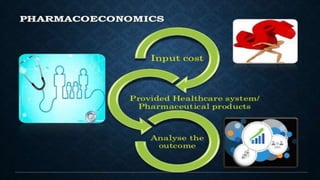
PHARMACOECONOMICS
PRESENTED BY:
AANCHAL ARYA
M PHARM (2ND SEM)
PHARMACOLOGY
INTRODUCTION
‱ Term coined by Townsend in 1986
‱ Branch of health economics Making choices between options, when there is scarcity of resources
Fundamentally comparative, weighing the costs and benefits of 2 options- 󱁋 Most efficient
PHARMACOECONOMICS ‱ The description & analysis of the costs of drug therapy to health care
system & society
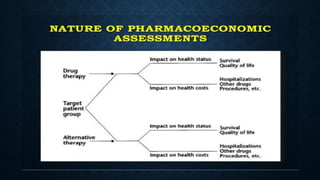
‱ Pharmacoeconomics research identifies, measures & compares the costs( i.e. resources consumed )
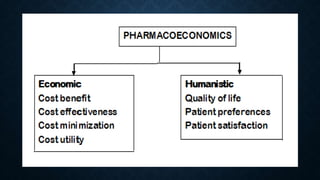
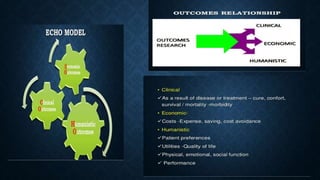
& consequences (i.e. clinical, economic , humanistic) of pharmaceutical products & services
‱ PE analysis
‱ Efficient allocation of limited resources among competing alternative medications and services
‱ To make the best use of limited resources
‱ Pharmacoeconomics is a scientific discipline concerned with the cost and value of
drugs, often with the goal of optimizing the allocation of health care resources.
‱ It compare the cost of various drugs with the outcomes, such as benefits of patients
receiving the drugs and costs.
‱ Over the last decade there has been tremendous interest in economic evaluations of
healthcare programmes, especially in the pharmaceutical field.
‱ Economic evaluations help decision makers determine whether the cost of this
extra effectiveness provided by the new drug is worthwhile, within the budget
available.
‱ Millions of people suffer and die in absence of access or inability to afford medical
care, many others suffer because they end up paying through borrowing debts and
selling assets etc.
NEED FOR PHARMACOECONOMICS
To find the optimal therapy at the lowest price.
To decrease the concern for patients, healthcare professionals, and the public.
In Industry- To decide among specific research and development alternatives.
In Government- To determine program benefits and prices paid.
In Private Sector- To design insurance benefit coverage.
GOALS:
To determine which healthcare alternatives provide the best healthcare outcome
in terms of money spent
To improve the allocation of resources for pharmaceutical products and services
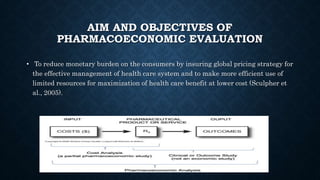
AIM AND OBJECTIVES OF
PHARMACOECONOMIC EVALUATION
‱ To reduce monetary burden on the consumers by insuring global pricing strategy for
the effective management of health care system and to make more efficient use of
limited resources for maximization of health care benefit at lower cost (Sculpher et
al., 2005).
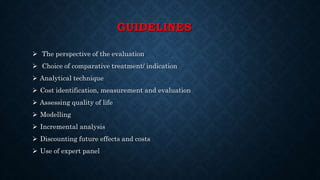
GUIDELINES
 The perspective of the evaluation
 Choice of comparative treatment/ indication
 Analytical technique
 Cost identification, measurement and evaluation
 Assessing quality of life
 Modelling
 Incremental analysis
 Discounting future effects and costs
 Use of expert panel
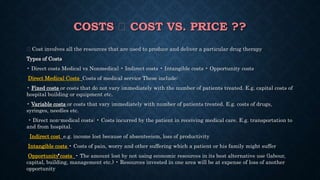
COSTS COST VS. PRICE ??
Cost involves all the resources that are used to produce and deliver a particular drug therapy
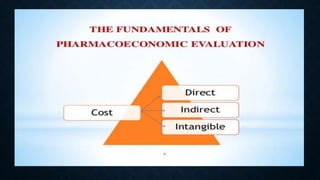
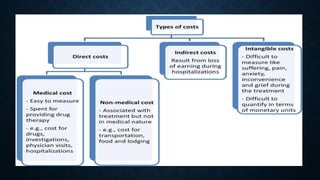
Types of Costs
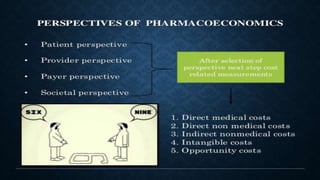
‱ Direct costs Medical vs Nonmedical ‱ Indirect costs ‱ Intangible costs ‱ Opportunity costs
Direct Medical Costs Costs of medical service These include:
‱ Fixed costs or costs that do not vary immediately with the number of patients treated. E.g. capital costs of
hospital building or equipment etc.
‱ Variable costs or costs that vary immediately with number of patients treated. E.g. costs of drugs,
syringes, needles etc.
‱ Direct non-medical costs: ‱ Costs incurred by the patient in receiving medical care. E.g. transportation to
and from hospital.
Indirect cost e.g. income lost because of absenteeism, loss of productivity
Intangible costs ‱ Costs of pain, worry and other suffering which a patient or his family might suffer
Opportunity costs ‱ The amount lost by not using economic resources in its best alternative use (labour,
capital, building, management etc.) ‱ Resources invested in one area will be at expense of loss of another
opportunity
‱
‱ PATIENT PERSPECTIVE
All the relevant cost and consequences experienced by the patient
Included costs: Direct Indirect Intangible
‱ PROVIDER PERSPECTIVE
Concerned with the expenses of providing products or services
Included costs: -Direct costs only
‱ PAYER PERSPECTIVE
Social Security/Government, third party payers eg. private
insurance companies and employers Included costs: -Direct costs
-Indirect costs relevant to employers lost workdays lost
productivity at work
‱ SOCIETAL PERSPECTIVE
The broadest of all perspectives that comprehensively evaluates
all costs and consequences
Considers the benefits to society as a whole Included costs: -
Direct; overall cost of providing care - Indirect; loss of productivity
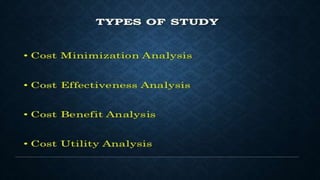
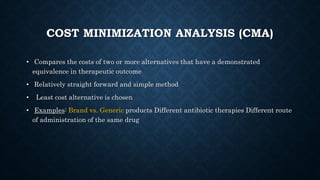
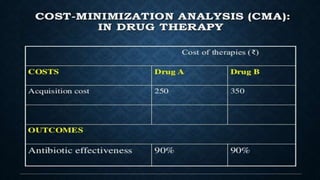
COST MINIMIZATION ANALYSIS (CMA)
‱ Compares the costs of two or more alternatives that have a demonstrated
equivalence in therapeutic outcome
‱ Relatively straight forward and simple method
‱ Least cost alternative is chosen
‱ Examples: Brand vs. Generic products Different antibiotic therapies Different route
of administration of the same drug
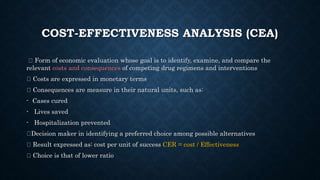
COST-EFFECTIVENESS ANALYSIS (CEA)
Form of economic evaluation whose goal is to identify, examine, and compare the
relevant costs and consequences of competing drug regimens and interventions
Costs are expressed in monetary terms
Consequences are measure in their natural units, such as:
- Cases cured
- Lives saved
- Hospitalization prevented
Decision maker in identifying a preferred choice among possible alternatives
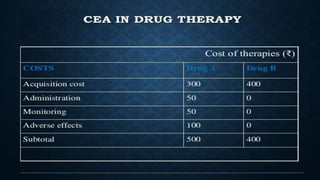
Result expressed as: cost per unit of success CER = cost / Effectiveness
Choice is that of lower ratio
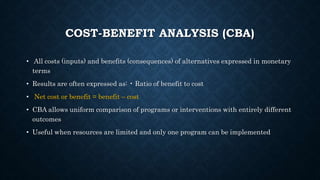
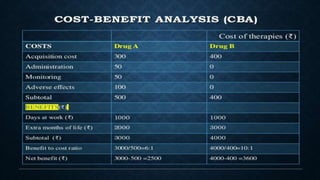
COST-BENEFIT ANALYSIS (CBA)
‱ All costs (inputs) and benefits (consequences) of alternatives expressed in monetary
terms
‱ Results are often expressed as: ‱ Ratio of benefit to cost
‱ Net cost or benefit = benefit – cost
‱ CBA allows uniform comparison of programs or interventions with entirely different
outcomes
‱ Useful when resources are limited and only one program can be implemented
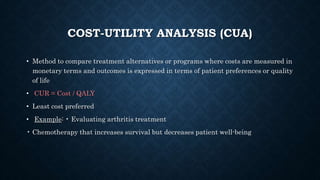
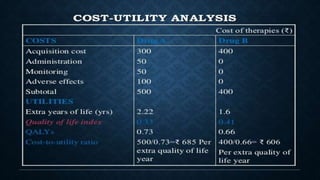
COST-UTILITY ANALYSIS (CUA)
‱ Method to compare treatment alternatives or programs where costs are measured in
monetary terms and outcomes is expressed in terms of patient preferences or quality
of life
‱ CUR = Cost / QALY
‱ Least cost preferred
‱ Example: ‱ Evaluating arthritis treatment
‱ Chemotherapy that increases survival but decreases patient well-being
IMPORTANCE OF PHARMACOECONOMICS
‱ To decrease health expenditures, whilst optimising healthcare results
‱ To choose the best among the numerous drug alternatives
‱ To spent less on cost of healthcare products and services Allocation of these
resources
BENEFITS OF PHARMACOECONOMICS
‱ Making cost-effective choices when resources are limited.
‱ To justify investment in a clinical service or program.
‱ To justify reimbursement of a clinical service or program.
‱ Inclusion or exclusion of new drugs. Drug Policy decisions.
INTERNATIONAL SOCIETY OF
PHARMACOECONOMICS & OUTCOMES
RESEARCH
‱ The mission of ISPOR is to increase the efficiency, effectiveness, and fairness of
health care to improve health.
‱ ISPOR is recognized globally as the authority for outcomes research and its use in
health care decisions towards improved health.
‱ The ISPOR scope and sphere of influence includes outcomes researchers, health
technology developers and assessors, regulators, health economists, health care policy
makers, payers, providers, patients, populations, and society as a whole.
PHARMACOECONOMICS – INDIAN
SCENARIO
‱ The Indian pharmaceutical industry (IPI) is the world’s fourth-largest by volume
and is likely to lead the manufacturing sector in India.
‱ The Indian Patent Act in 1970 played a major role in developing a base for the
manufacturing unit in India. ‱ The change in law in 2005 has created opportunities
for both international firms and local Indian companies for sharing expertise.
‱ As fourth largest producer of drugs by volume, Indian pharmaceutical industry has
diversity of medicines; yet, brand name prescriptions are the rule of the day.
‱ Formulary system is very weak and treatment protocols exist only in theory. ‱ The
resources are scarce and competing programs are plenty in healthcare. ‱ The concept
of healthcare insurance is yet to be popularized in the country.
CHALLENGES
‱ Establishing guidelines or standards of practice.
‱ Creating a cadre of trained producers and consumers of pharmacoeconomic work.
Continuing education on the relevant features of this discipline for practitioners,
government officials, private sector executives.
‱ Stable funding to support applied pharmacoeconomic research.
‱ Lack of full appreciation of the potential importance and application of
Pharmacoeconomics studies.
‱ Poor technical skills of healthcare professionals, especially of pharmacists.
‱ Lack of appropriate database of the healthcare system in order to bring about research
adaptation from another country
APPLICATIONS OF PHARMACOECONOMICS
‱ To aid clinical and policy decision making. Complete pharmacotherapy decisions
should contain assessments of three basic outcome areas whenever appropriate:
economic, clinical, and humanistic outcomes (ECHO).
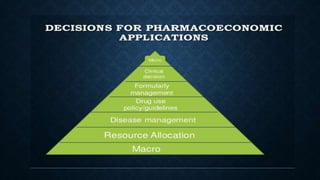
‱ To support various clinical decisions, ranging from the level of the patient to the
level of an entire healthcare system. For discussion purposes, the application of
pharmacoeconomics to decision making is divided into two basic areas: drug therapy
evaluation and clinical pharmacy service evaluation.
Pharmacoeconomis
Pharmacoeconomis

Pharmacoeconomis

  • 1.
  • 2.
    INTRODUCTION ‱ Term coinedby Townsend in 1986 ‱ Branch of health economics Making choices between options, when there is scarcity of resources Fundamentally comparative, weighing the costs and benefits of 2 options- 󱁋 Most efficient PHARMACOECONOMICS ‱ The description & analysis of the costs of drug therapy to health care system & society ‱ Pharmacoeconomics research identifies, measures & compares the costs( i.e. resources consumed ) & consequences (i.e. clinical, economic , humanistic) of pharmaceutical products & services ‱ PE analysis ‱ Efficient allocation of limited resources among competing alternative medications and services ‱ To make the best use of limited resources
  • 3.
    ‱ Pharmacoeconomics isa scientific discipline concerned with the cost and value of drugs, often with the goal of optimizing the allocation of health care resources. ‱ It compare the cost of various drugs with the outcomes, such as benefits of patients receiving the drugs and costs. ‱ Over the last decade there has been tremendous interest in economic evaluations of healthcare programmes, especially in the pharmaceutical field. ‱ Economic evaluations help decision makers determine whether the cost of this extra effectiveness provided by the new drug is worthwhile, within the budget available. ‱ Millions of people suffer and die in absence of access or inability to afford medical care, many others suffer because they end up paying through borrowing debts and selling assets etc.
  • 4.
    NEED FOR PHARMACOECONOMICS Tofind the optimal therapy at the lowest price. To decrease the concern for patients, healthcare professionals, and the public. In Industry- To decide among specific research and development alternatives. In Government- To determine program benefits and prices paid. In Private Sector- To design insurance benefit coverage. GOALS: To determine which healthcare alternatives provide the best healthcare outcome in terms of money spent To improve the allocation of resources for pharmaceutical products and services
  • 5.
    AIM AND OBJECTIVESOF PHARMACOECONOMIC EVALUATION ‱ To reduce monetary burden on the consumers by insuring global pricing strategy for the effective management of health care system and to make more efficient use of limited resources for maximization of health care benefit at lower cost (Sculpher et al., 2005).
  • 8.
    GUIDELINES  The perspectiveof the evaluation  Choice of comparative treatment/ indication  Analytical technique  Cost identification, measurement and evaluation  Assessing quality of life  Modelling  Incremental analysis  Discounting future effects and costs  Use of expert panel
  • 11.
    COSTS COST VS.PRICE ?? Cost involves all the resources that are used to produce and deliver a particular drug therapy Types of Costs ‱ Direct costs Medical vs Nonmedical ‱ Indirect costs ‱ Intangible costs ‱ Opportunity costs Direct Medical Costs Costs of medical service These include: ‱ Fixed costs or costs that do not vary immediately with the number of patients treated. E.g. capital costs of hospital building or equipment etc. ‱ Variable costs or costs that vary immediately with number of patients treated. E.g. costs of drugs, syringes, needles etc. ‱ Direct non-medical costs: ‱ Costs incurred by the patient in receiving medical care. E.g. transportation to and from hospital. Indirect cost e.g. income lost because of absenteeism, loss of productivity Intangible costs ‱ Costs of pain, worry and other suffering which a patient or his family might suffer Opportunity costs ‱ The amount lost by not using economic resources in its best alternative use (labour, capital, building, management etc.) ‱ Resources invested in one area will be at expense of loss of another opportunity ‱
  • 16.
    ‱ PATIENT PERSPECTIVE Allthe relevant cost and consequences experienced by the patient Included costs: Direct Indirect Intangible ‱ PROVIDER PERSPECTIVE Concerned with the expenses of providing products or services Included costs: -Direct costs only ‱ PAYER PERSPECTIVE Social Security/Government, third party payers eg. private insurance companies and employers Included costs: -Direct costs -Indirect costs relevant to employers lost workdays lost productivity at work ‱ SOCIETAL PERSPECTIVE The broadest of all perspectives that comprehensively evaluates all costs and consequences Considers the benefits to society as a whole Included costs: - Direct; overall cost of providing care - Indirect; loss of productivity
  • 18.
    COST MINIMIZATION ANALYSIS(CMA) ‱ Compares the costs of two or more alternatives that have a demonstrated equivalence in therapeutic outcome ‱ Relatively straight forward and simple method ‱ Least cost alternative is chosen ‱ Examples: Brand vs. Generic products Different antibiotic therapies Different route of administration of the same drug
  • 20.
    COST-EFFECTIVENESS ANALYSIS (CEA) Formof economic evaluation whose goal is to identify, examine, and compare the relevant costs and consequences of competing drug regimens and interventions Costs are expressed in monetary terms Consequences are measure in their natural units, such as: - Cases cured - Lives saved - Hospitalization prevented Decision maker in identifying a preferred choice among possible alternatives Result expressed as: cost per unit of success CER = cost / Effectiveness Choice is that of lower ratio
  • 22.
    COST-BENEFIT ANALYSIS (CBA) ‱All costs (inputs) and benefits (consequences) of alternatives expressed in monetary terms ‱ Results are often expressed as: ‱ Ratio of benefit to cost ‱ Net cost or benefit = benefit – cost ‱ CBA allows uniform comparison of programs or interventions with entirely different outcomes ‱ Useful when resources are limited and only one program can be implemented
  • 24.
    COST-UTILITY ANALYSIS (CUA) ‱Method to compare treatment alternatives or programs where costs are measured in monetary terms and outcomes is expressed in terms of patient preferences or quality of life ‱ CUR = Cost / QALY ‱ Least cost preferred ‱ Example: ‱ Evaluating arthritis treatment ‱ Chemotherapy that increases survival but decreases patient well-being
  • 26.
    IMPORTANCE OF PHARMACOECONOMICS ‱To decrease health expenditures, whilst optimising healthcare results ‱ To choose the best among the numerous drug alternatives ‱ To spent less on cost of healthcare products and services Allocation of these resources BENEFITS OF PHARMACOECONOMICS ‱ Making cost-effective choices when resources are limited. ‱ To justify investment in a clinical service or program. ‱ To justify reimbursement of a clinical service or program. ‱ Inclusion or exclusion of new drugs. Drug Policy decisions.
  • 27.
    INTERNATIONAL SOCIETY OF PHARMACOECONOMICS& OUTCOMES RESEARCH ‱ The mission of ISPOR is to increase the efficiency, effectiveness, and fairness of health care to improve health. ‱ ISPOR is recognized globally as the authority for outcomes research and its use in health care decisions towards improved health. ‱ The ISPOR scope and sphere of influence includes outcomes researchers, health technology developers and assessors, regulators, health economists, health care policy makers, payers, providers, patients, populations, and society as a whole.
  • 28.
    PHARMACOECONOMICS – INDIAN SCENARIO ‱The Indian pharmaceutical industry (IPI) is the world’s fourth-largest by volume and is likely to lead the manufacturing sector in India. ‱ The Indian Patent Act in 1970 played a major role in developing a base for the manufacturing unit in India. ‱ The change in law in 2005 has created opportunities for both international firms and local Indian companies for sharing expertise. ‱ As fourth largest producer of drugs by volume, Indian pharmaceutical industry has diversity of medicines; yet, brand name prescriptions are the rule of the day. ‱ Formulary system is very weak and treatment protocols exist only in theory. ‱ The resources are scarce and competing programs are plenty in healthcare. ‱ The concept of healthcare insurance is yet to be popularized in the country.
  • 29.
    CHALLENGES ‱ Establishing guidelinesor standards of practice. ‱ Creating a cadre of trained producers and consumers of pharmacoeconomic work. Continuing education on the relevant features of this discipline for practitioners, government officials, private sector executives. ‱ Stable funding to support applied pharmacoeconomic research. ‱ Lack of full appreciation of the potential importance and application of Pharmacoeconomics studies. ‱ Poor technical skills of healthcare professionals, especially of pharmacists. ‱ Lack of appropriate database of the healthcare system in order to bring about research adaptation from another country
  • 30.
    APPLICATIONS OF PHARMACOECONOMICS ‱To aid clinical and policy decision making. Complete pharmacotherapy decisions should contain assessments of three basic outcome areas whenever appropriate: economic, clinical, and humanistic outcomes (ECHO). ‱ To support various clinical decisions, ranging from the level of the patient to the level of an entire healthcare system. For discussion purposes, the application of pharmacoeconomics to decision making is divided into two basic areas: drug therapy evaluation and clinical pharmacy service evaluation.