PHARMACOECONOMICS
By
Ijeh Cyril PharmD
DEFINITION
 Economics quite simply is the study of how the forces of supply and demand allocate
scarce resources.
 Pharmacoeconomics as a term was first publicly used in 1986 at a meeting of pharmacist in
Toronto, Canada by Ray Townsend.
 Pharmacoeconomics (PE) has been defined as the description and the analysis of the cost
of drug therapy to health care systems and society1.
 It is the process of identifying, measuring, and comparing the costs, risks/consequences,
and benefits of programs, service, or therapies and determining which alternative produces
the best health outcome for the resource invested.
 It describes the economic relationship involving drug research, drug production
distribution, storage, pricing and use by the people2
Definiton contd
 PE is distinctly related to Outcome Research, and Pharmaceutical care.
Outcomes research is defined more broadly as studies that attempt to
identify measures and evaluate the results of health care services in general1,3
Pharmaceutical care has been defined as the responsible provision of drug
therapy for the purpose of achieving definite outcomes.
Pharmacoeconomics is a division of outcomes research that can be used to
quantify the value of pharmaceutical care products and services.
Cost
 the value of the resources consumed by a program or drug therapy of interest
 Assessing costs and consequences-the value of pharmaceutical product or service
depends heavily on the perspective of the evaluation.
 To evaluate the economics of drug therapy, cost is categorized into (Fig.1): i.
Direct cost: this may be medical or non-medical
ii. Indirect cost: his is the cost incurred by the patient, family, friends or society
iii. Intangible cost: These are costs related with the patient’s pain and
suffering; worry and other distress of the family members of a patient; effect on
quality of life and health perceptions
Cost of Drug
Direct cost
Medical cost
Eg laboratory cost,
medications, hospital
charges
Non-medical cost
Eg food, transportation
Indirect cost
Eg morbidity, mortality
Intangible cost
Eg inconveniences,
sufferings
Fig 1 Cost of Drug4
Perspective of PE
 The ‘point if view’ considered in economic analyses influences the
outcomes and costs considered to be most relevant:
 Patient perspective eg drug cost, insurance co-payments
 Provider perspective eg laboratory test, hospitalization
 Payer perspective eg insurance company.
 Social perspective eg morbidity, mortality.
Applications of PE
 Essential Drug List formulation. Essential medicines are those that
satisfy the priority health care needs of the population. They are
selected with due regard to disease prevalence, evidence of efficacy,
safety and comparative cost-effectiveness.
 Consideration of new drugs. Here evaluation of their relative efficacy,
safety, quality, price and availability are carried out (W.H.O. 1999).
 A decision-making criteria for Pharmacy and Therapeutics (P&T)
committee in hospitals. Table 1.
Applications of PE contd
Table 1. Relative importance of criteria for
managed care P&T committee decision-
making7.
Methods of PE
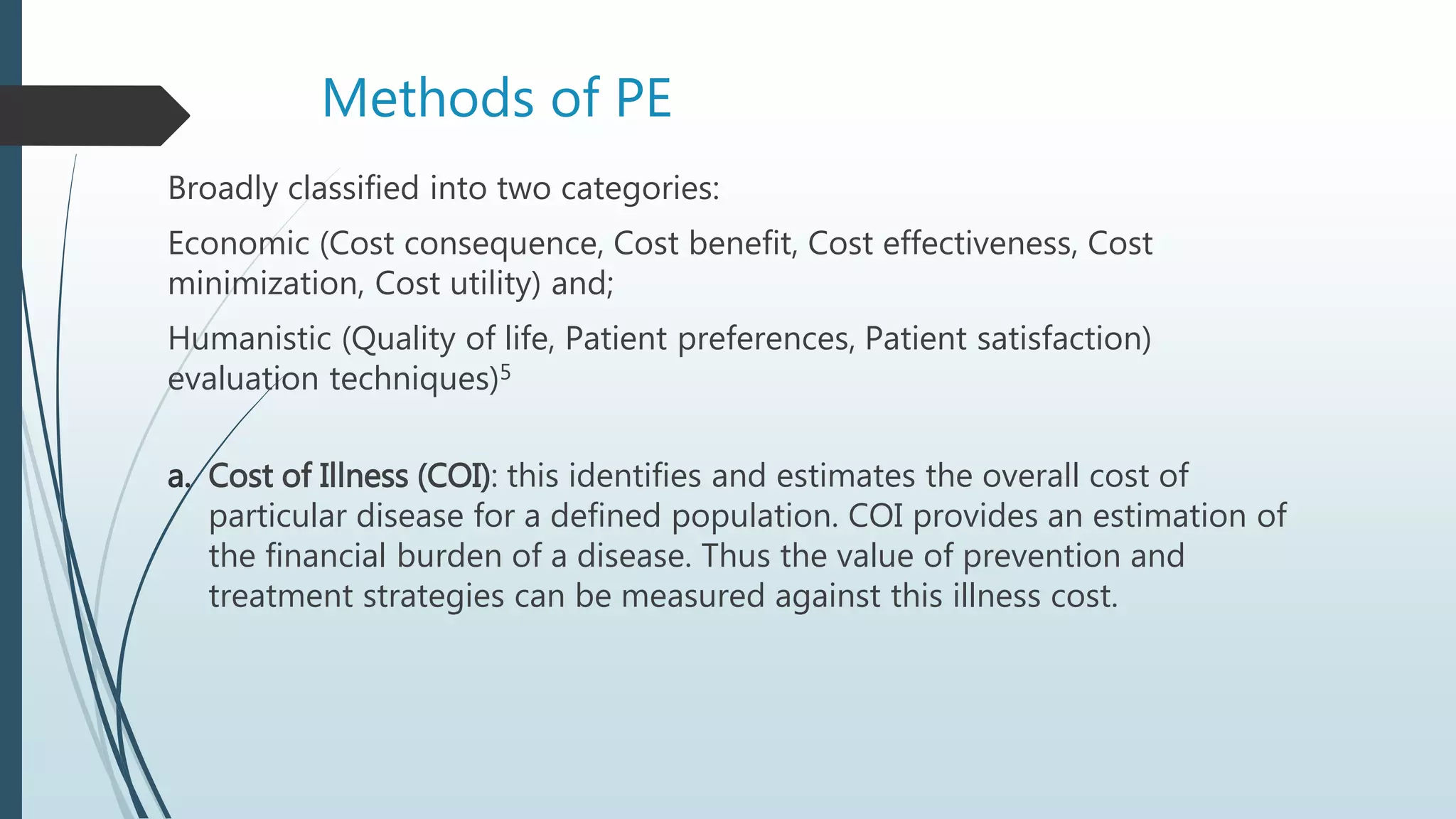
Broadly classified into two categories:
Economic (Cost consequence, Cost benefit, Cost effectiveness, Cost
minimization, Cost utility) and;
Humanistic (Quality of life, Patient preferences, Patient satisfaction)
evaluation techniques)5
a. Cost of Illness (COI): this identifies and estimates the overall cost of
particular disease for a defined population. COI provides an estimation of
the financial burden of a disease. Thus the value of prevention and
treatment strategies can be measured against this illness cost.
Methods of PE contd
b. Cost minimization analysis (CMA): involves the determination of the least costly
alternative when comparing two or more treatment alternatives. The alternatives
must have an assumed or demonstrated equivalency in safety and efficacy (i.e., the
two alternatives must be therapeutically equivalent).
c. Cost benefit analysis (CBA): the benefit is measured as the associated economic benefit
of an intervention (e.g. monetary value of returning a worker to employment earlier). It
aims to express both costs and benefits in the same monetary terms.
A clinical decision maker would choose the program or treatment alternative with the
highest net benefit or the greatest benefit to cost (B/C) ratio6. Guidelines for the
interpretation of this ratio are indicated
If B/C ratio> 1, the program or treatment is of value.
If B/C ratio = 1, the benefits equal the cost.
If B/C ratio <1, the program or treatment is not economically beneficial. The cost of
providing the program or treatment alternative outweighs the benefits realized by it.
Methods of PE contd
d Cost Effective Analysis (CEA): involves programs or treatment alternatives with different safety
and efficacy profiles. A cost is measured in monetary units, and outcomes are measured in
terms of obtaining a specific therapeutic outcome (such as drop in BP, reduction in body
temperature). For instance, in severe reflux oesophagitis, we could consider the costs per
patient relieved of symptoms using a proton pump inhibitor compared to those using H2
blockers.
e Cost Utility Analysis (CUA): differ from CEA by expressing therapeutic outcome in patient-
weighted utilities rather than in physical units. Often the utility measure used is a quality-
adjusted life year (QALY) gained.
In calculating QALYs, one year of life in perfect health is given a score of 1.0 QALY. This
allows for comparison between mortality (score 0) and morbidity. The summated rating scale
whereby patients score their state of health is commonly employed.
Results of CUA are also expressed in a ratio, a cost –utility ratio (C/U ratio). Most often, this
ratio is translated as the cost per QALY gained. The preferred treatment alternative is that
with the lowest cost per QALY (or other health status utility).
Methods of PE contd
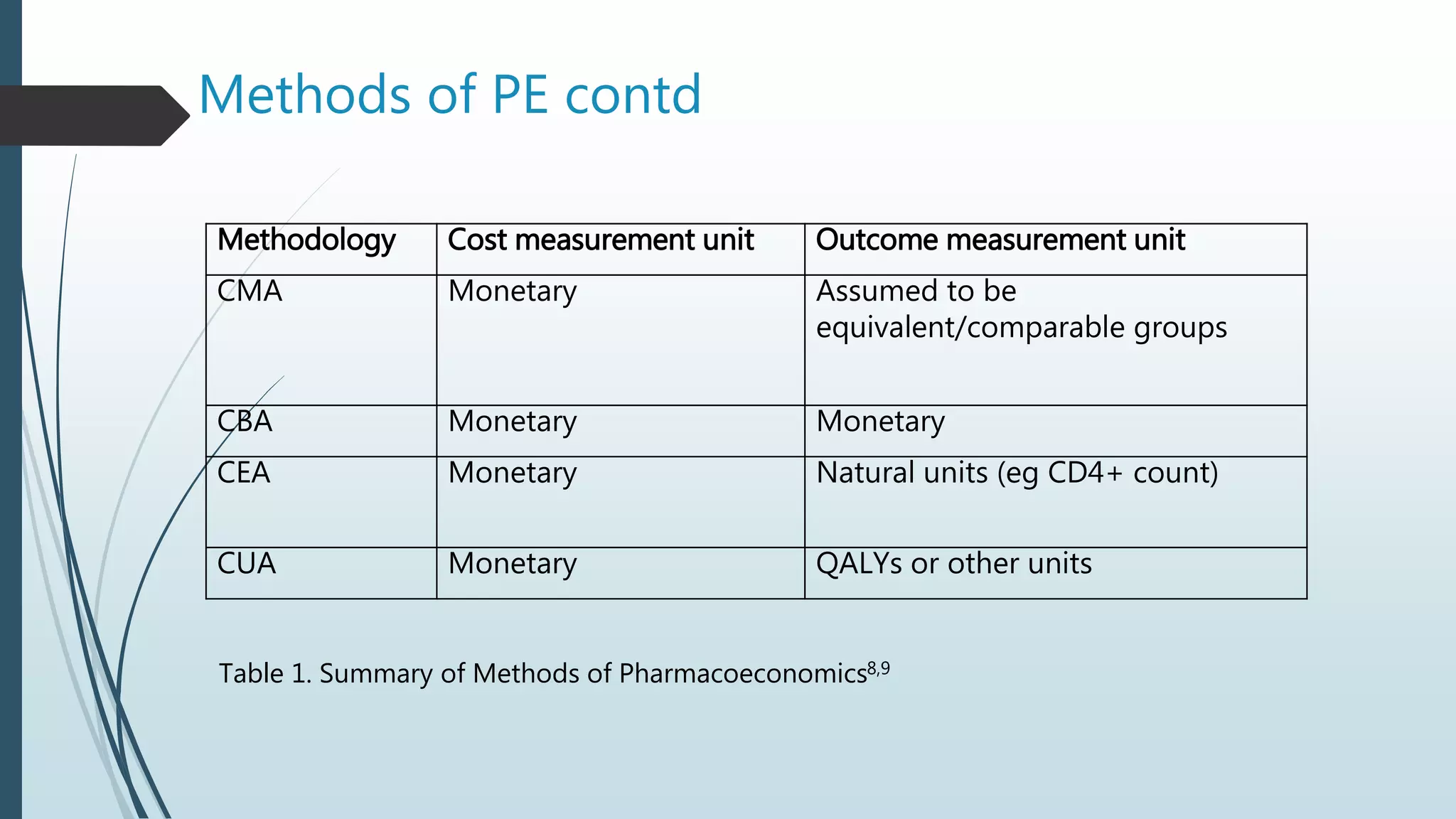
Methodology Cost measurement unit Outcome measurement unit
CMA Monetary Assumed to be
equivalent/comparable groups
CBA Monetary Monetary
CEA Monetary Natural units (eg CD4+ count)
CUA Monetary QALYs or other units
Table 1. Summary of Methods of Pharmacoeconomics8,9
How to Conduct a PE Evaluation
 Establish a perspective
 Describe all the treatment or intervention options under consideration.
 For each alternative, specify the possible outcomes and the probability of their
occurrence
 Specify and monitor the health-care resource, and non-medical resource
consumed in each alternative.
 Assign monetary values to each resource consumed.
 Specify and monitor nonmedical resources consumed by each alternative.
 Identify the appropriate pharmacoeconomic method to employ
 Specify the unit of outcome measurement.
 Specify other noneconomic attributes of the alternatives if appropriate.
 Analyse the data
 Develop a policy or an intervention.
Conclusion
Pharmacoeconomics evaluation has become an important area of interest to find the
optimal therapy at the lowest price as healthcare resources are not easily accessible
and affordable to many patients.
In a developing country like Nigeria, PE can help the middle and low class in society to
obtain adequate health care.
Applied PE has been the “missing link” in pharmacy. By understanding the principles,
methods, and application of pharmacoeconomics, pharmacists will be prepared to
make better, more-informed decisions regarding the use of pharmaceutical products
and services, that is, decisions that ultimately represent the best interests of the
patient, the health care system, and society.

Pharmacoeconomics

  • 1.
  • 2.
    DEFINITION  Economics quitesimply is the study of how the forces of supply and demand allocate scarce resources.  Pharmacoeconomics as a term was first publicly used in 1986 at a meeting of pharmacist in Toronto, Canada by Ray Townsend.  Pharmacoeconomics (PE) has been defined as the description and the analysis of the cost of drug therapy to health care systems and society1.  It is the process of identifying, measuring, and comparing the costs, risks/consequences, and benefits of programs, service, or therapies and determining which alternative produces the best health outcome for the resource invested.  It describes the economic relationship involving drug research, drug production distribution, storage, pricing and use by the people2
  • 3.
    Definiton contd  PEis distinctly related to Outcome Research, and Pharmaceutical care. Outcomes research is defined more broadly as studies that attempt to identify measures and evaluate the results of health care services in general1,3 Pharmaceutical care has been defined as the responsible provision of drug therapy for the purpose of achieving definite outcomes. Pharmacoeconomics is a division of outcomes research that can be used to quantify the value of pharmaceutical care products and services.
  • 4.
    Cost  the valueof the resources consumed by a program or drug therapy of interest  Assessing costs and consequences-the value of pharmaceutical product or service depends heavily on the perspective of the evaluation.  To evaluate the economics of drug therapy, cost is categorized into (Fig.1): i. Direct cost: this may be medical or non-medical ii. Indirect cost: his is the cost incurred by the patient, family, friends or society iii. Intangible cost: These are costs related with the patient’s pain and suffering; worry and other distress of the family members of a patient; effect on quality of life and health perceptions
  • 5.
    Cost of Drug Directcost Medical cost Eg laboratory cost, medications, hospital charges Non-medical cost Eg food, transportation Indirect cost Eg morbidity, mortality Intangible cost Eg inconveniences, sufferings Fig 1 Cost of Drug4
  • 6.
    Perspective of PE The ‘point if view’ considered in economic analyses influences the outcomes and costs considered to be most relevant:  Patient perspective eg drug cost, insurance co-payments  Provider perspective eg laboratory test, hospitalization  Payer perspective eg insurance company.  Social perspective eg morbidity, mortality.
  • 7.
    Applications of PE Essential Drug List formulation. Essential medicines are those that satisfy the priority health care needs of the population. They are selected with due regard to disease prevalence, evidence of efficacy, safety and comparative cost-effectiveness.  Consideration of new drugs. Here evaluation of their relative efficacy, safety, quality, price and availability are carried out (W.H.O. 1999).  A decision-making criteria for Pharmacy and Therapeutics (P&T) committee in hospitals. Table 1.
  • 8.
    Applications of PEcontd Table 1. Relative importance of criteria for managed care P&T committee decision- making7.
  • 9.
    Methods of PE Broadlyclassified into two categories: Economic (Cost consequence, Cost benefit, Cost effectiveness, Cost minimization, Cost utility) and; Humanistic (Quality of life, Patient preferences, Patient satisfaction) evaluation techniques)5 a. Cost of Illness (COI): this identifies and estimates the overall cost of particular disease for a defined population. COI provides an estimation of the financial burden of a disease. Thus the value of prevention and treatment strategies can be measured against this illness cost.
  • 10.
    Methods of PEcontd b. Cost minimization analysis (CMA): involves the determination of the least costly alternative when comparing two or more treatment alternatives. The alternatives must have an assumed or demonstrated equivalency in safety and efficacy (i.e., the two alternatives must be therapeutically equivalent). c. Cost benefit analysis (CBA): the benefit is measured as the associated economic benefit of an intervention (e.g. monetary value of returning a worker to employment earlier). It aims to express both costs and benefits in the same monetary terms. A clinical decision maker would choose the program or treatment alternative with the highest net benefit or the greatest benefit to cost (B/C) ratio6. Guidelines for the interpretation of this ratio are indicated If B/C ratio> 1, the program or treatment is of value. If B/C ratio = 1, the benefits equal the cost. If B/C ratio <1, the program or treatment is not economically beneficial. The cost of providing the program or treatment alternative outweighs the benefits realized by it.
  • 11.
    Methods of PEcontd d Cost Effective Analysis (CEA): involves programs or treatment alternatives with different safety and efficacy profiles. A cost is measured in monetary units, and outcomes are measured in terms of obtaining a specific therapeutic outcome (such as drop in BP, reduction in body temperature). For instance, in severe reflux oesophagitis, we could consider the costs per patient relieved of symptoms using a proton pump inhibitor compared to those using H2 blockers. e Cost Utility Analysis (CUA): differ from CEA by expressing therapeutic outcome in patient- weighted utilities rather than in physical units. Often the utility measure used is a quality- adjusted life year (QALY) gained. In calculating QALYs, one year of life in perfect health is given a score of 1.0 QALY. This allows for comparison between mortality (score 0) and morbidity. The summated rating scale whereby patients score their state of health is commonly employed. Results of CUA are also expressed in a ratio, a cost –utility ratio (C/U ratio). Most often, this ratio is translated as the cost per QALY gained. The preferred treatment alternative is that with the lowest cost per QALY (or other health status utility).
  • 12.
    Methods of PEcontd Methodology Cost measurement unit Outcome measurement unit CMA Monetary Assumed to be equivalent/comparable groups CBA Monetary Monetary CEA Monetary Natural units (eg CD4+ count) CUA Monetary QALYs or other units Table 1. Summary of Methods of Pharmacoeconomics8,9
  • 13.
    How to Conducta PE Evaluation  Establish a perspective  Describe all the treatment or intervention options under consideration.  For each alternative, specify the possible outcomes and the probability of their occurrence  Specify and monitor the health-care resource, and non-medical resource consumed in each alternative.  Assign monetary values to each resource consumed.  Specify and monitor nonmedical resources consumed by each alternative.  Identify the appropriate pharmacoeconomic method to employ  Specify the unit of outcome measurement.  Specify other noneconomic attributes of the alternatives if appropriate.  Analyse the data  Develop a policy or an intervention.
  • 14.
    Conclusion Pharmacoeconomics evaluation hasbecome an important area of interest to find the optimal therapy at the lowest price as healthcare resources are not easily accessible and affordable to many patients. In a developing country like Nigeria, PE can help the middle and low class in society to obtain adequate health care. Applied PE has been the “missing link” in pharmacy. By understanding the principles, methods, and application of pharmacoeconomics, pharmacists will be prepared to make better, more-informed decisions regarding the use of pharmaceutical products and services, that is, decisions that ultimately represent the best interests of the patient, the health care system, and society.

Editor's Notes

  • #3 1Townsend RJ. Post marketing drug research and development. Ann pharmacotherapy 1987; 21:134-136 2Surendra G. G., Abasaheb B. P., Sachni S. K. Pharmacoeconomics: A Review. Asian Journal of Pharmaceutical and Clinical Research Vol 2 Issue 3, July-September 2009; p15-25.
  • #4 1Townsend RJ. Post marketing drug research and development. Ann pharmacotherapy 1987; 21:134-136 3Wally T, Haycox A (1997). P.harmacoeconomics: Basic concept and terminology. Br. J Clinical Pharmacology, 43: 343-348.
  • #6 4Ojaswi G., Anubha K.; Pharmacoeconomics – A brief Review. Indian Pharmacist November 2012, p29-36.
  • #9  7Thamizhanban Pillay PhD, David Newby PhD, Emily Walkom PhD The role of pharmacoeconomics in formulary decision-making. Formulary Journal 01 August, 2006.
  • #10 5Lisa A. Sanchez, Pharm.D. President, PE Applications, Applied Pharmacoeconomics: Putting Theory into Practice- www.slideserve.com/.../applied-pharmacoeconomicsputting-theory-into-practice- Accessed on 10.07.12
  • #11 6P Belien, “Healthcare systems. A New European Model?”, PharmacoEconomics, 18 (S1) (2000), pp. 85–93.
  • #13 8Bootman JL, Townsend RJ, McGhan WF. Principles of Pharmacoeconomics. 3rd edition. Cincinnati: Harvey Whitney Books, 1996. 9Walley T. Haycox A. Boland A. eds. Pharmacoeconomics. London: Churchill Livingstone, 2004.