Pharmacoeconomics
GENERAL CONCEPTS
 Economics
 The study of how individuals & society end up choosing,
with or without the use of money, to employ scarce
resources that could have alternative uses, to produce
various commodities & distribute them for consumption,
now or in the future, among various people and groups in
society. Paul Samuelson
 Health economics
Is Science of assessing cost and benefits of healthcare.
The aim of pharmacoeconomics:
 To compare the economics of different pharmaceutical products
 To compare drug therapy to other treatments.
 To identify what is most efficient, so that the greatest amount of
benefit can be bought for a given amount of money or resources.
 To find the optimal therapy at the lowest price.
 To decrease the concern for patients, healthcare professionals, and the
public.
 In Industry- To decide among specific research and development
alternatives.
 In Government- To determine program benefits and prices paid.
 In Private Sector- To design insurance benefit coverage
INTRODUCTION
Health care funders (governments, social security funds,
insurance companies) are struggling to meet their rising
costs.
They make many efforts to contain drug costs, by price
negotiation, patient co-payments or
dedicated drug budgets.
The aim is to identify what is most efficient, so that the
greatest amount of benefit can be bought for a given
amount of money or resources.
Pharmacoeconomics
 Pharmacoeconomics is a branch of health
economics which compares the value of one drug
or a drug therapy to another.
 Or
 Measurement of both the cost & consequences in
therapeutic decision making is termed as PE.
Pharmacoeconomics
 PE: is a division of health economics, is desidned to
provide decision makers with information about the value
of the different pharmaco-therapies. PE balances the cost
with the consequences or outcomes of pharmaceutical
therapies & services.
 Or
 Estimation of cost effectiveness are derived from
economic evaluations. Which are the comparative analysis
of two or more alternative course of actions (intervention)
in terms of their cost & consequences.
Pharmacoeconomics
Pharmacoeconomics is a branch of health economics that
particularly considers drug therapy.
It is of particular interest to pharmaceutical companies who
in developing a new drug and after the traditional hurdles
of
 efficacy,
 safety and
 tolerability
 cost effectiveness
 affordability
Pharmacoeconomics is about making choices between
options, when there is scarcity of resources.
It is fundamentally comparative, weighing the
costs and benefits
of option 1 with those of option 2
(for instance, a new drug and the previous best therapy - traditional medical evaluation focused
only on the benefits),
to determine which is the most efficient way to use our limited resources
BASIC CONCEPTS AND TERMINOLOGY
Efficiency is a key concept in
pharmacoeconomics, i.e. how to buy the
greatest amount of benefit for a given
resource use.
pharmacoeconomic evaluations of drug
therapy are increasingly important in
decision making.
The Quality Adjusted Life Year (QALY)
QALY is one widely used measure, which attempts
to integrate both quality and the quantity of life.
Broadly, it assumes that if a treatment increases
one’s life expectancy by 2 years, but causes
adverse effects or inconvenience, such that one’s
quality of life or utility are decreased by 25%, the
net gain is 2 x 0.75 = 1.5 QALYs.
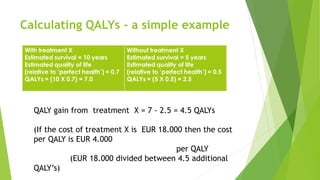
Calculating QALYs - a simple example
QALY gain from treatment X = 7 - 2.5 = 4.5 QALYs
(If the cost of treatment X is EUR 18.000 then the cost
per QALY is EUR 4.000
per QALY
(EUR 18.000 divided between 4.5 additional
QALY’s)
Pharmaco-economic Analysis
 Pharmaco-economic analysis involves…
1. Identifying and measuring costs
2. Identifying and measuring
consequences
3. Choosing a perspective
COSTS
 Define : The value of the resources consumed by a
program or drug therapy, is defined as Cost.
 Or
 Sum of product resources that are used & the unit cost of
each item
 price of drug, price of its administration
 price of hospitalization, outpatient treatment
 price of transportation
 price of ADRs
COSTS Types
1. Direct cost
2. Indirect cost
Types
 Direct cost: costs directly related to producing/ providing
a specific quantity of service or output e.g (salary, drug
cost, supply cost for provision of pharmacy services )
 Indirect cost: cost that are allocated to the areas that
produces/provide a specific quantity of services or output
(over head cost)
 cost
 All the expenses directly & indirectly necessary to provide
a product or services.
Other Types of Cost
1. Total cost
2. Average cost
3. Fixed cost
4. Variable cost
5. Marginal cost
6. Incremental cost
7. Direct cost
8. Indirect cost
9. Allowable cost
10. Opportunity cost
 Direct costs = Direct medical costs + Direct nonmedical costs
 Direct Medical Costs :what is paid for specified health resources and
services physician visit, lab.
 Direct Non-Medical Costs - costs necessary to enable an individual to
receive medical care. Lost work time, transportation.
 Indirect costs = Morbidity costs + Mortality costs
 lost productivity in society, unpaid caregivers, lost wages.
 Total costs = Direct costs + Indirect costs + Intangible costs
Direct medical costs – drugs, medical supplies, laboratory tests
and diagnostic tests, hospitalizations, and physician visits
Direct non-medical costs – transportation to and from
healthcare facilities, extra trips to A&E, special diets and
various other out-of-pocket expenses
Indirect costs – morbidity costs (loss of productivity), Mortality
(loss of years of services due to premature death)
Intangible costs – nonfinancial outcomes of the disease
and medical care e.g. pain, suffering, inconvenience, and
grief
Or
Costs of pain, worry & other suffering which a pt. or his
family might suffer.
Or
Cost related to psychological impact of disease or
treatment(pain & suffering)
Opportunity costs - the cost of the benefit of pursuing an
alternative course of action. Loss of potential gain.
Opportunity costs: economic benefit of the alternative
therapy that was foregone
 Fixed cost: All kinds of expenses which do not vary with
the rate of production are known are known as fixed cost.
e,g rent of building, cost of machinery. Property tax, labor
salary.
 Variable cost: are the cost that varies with the rate of
production. variable cost increases as the output of firm
increases and decreases with the decreases of output. E.g
raw material, material fuel, transportation services,
labor.
 Marginal cost : is the extra cost incurred when the total
output is increased by one unit.
 Average cost: is total cost divided by total unit of
output.
 Allowable cost: Let's assume that your company
is hired by the government to clean up an oil spill.
The government can state in the contract that it
will reimburse the company for travel and flight
expenses as long as the flights are coach tickets.
A coach ticket would be considered an allowable
cost because it is specified in this contract. If all
the company managers flew first class to the job
site, the government would not be obligated to
pay for the tickets. These first class tickets would
be considered unallowable costs because the
contract only allows travel reimbursement for
coach tickets.
Consequences/ Benefits/ Outcomes
They are health outcomes e.g the impact of
therapy on quality of life & mortality of life
or both.
OR
Consequence is defined as the effects, outputs,
or outcomes of the program or drug therapy
Outcomes
 lifetime prolongation
 improved quality of life
 remission-free interval
 better compliance
 simplified therapeutic regime
Benefits
The benefits we expect from an intervention might be
measured in:
A. “Natural” units - e.g. years of life saved, strokes
prevented, peptic ulcers healed etc.
B. “Utility” units - utility is an economist’s word for
satisfaction, or sense of well being, and is an attempt to
evaluate the quality of a state of health, and not just its
quantity
Outcomes research (OR)
Study of healthcare interventions, care delivery
process, and healthcare quality that is evaluated to
measure the extent to which optimal and desirable
outcomes can be reached.
Purpose of OR is to assess the value of a therapy or
program in question.
Areas of outcomes are Economic outcomes, clinical
outcomes and humanistic outcomes
Themes of Outcome Research
 Safety
 Efficacy
 Equity
 Timeliness
 System Responsiveness
 Patient Centeredness.
Examples of outcomes measures:
1. Economic outcomes
2. Clinical outcomes
3. Humanistic outcomes
Economic outcomes
 Comparing direct, indirect, and intangible costs with
the consequences of medical treatment alternatives.
Acquisition costs associated with care
labor costs associated with care
costs to treat ADRs
costs of treatment failure
costs of hospital readmissions,
costs of emergency rooms & clinic visits
Clinical outcomes
 Medical events that occur as a result of disease or
treatment
(e.g., safety and efficacy end points).
Length of hospital stay
ADRs
 hospital readmissions
Mortality
Humanistic outcomes
Consequences of disease or treatment on patient
functional status such as physical function, social
function, general health and well-being, and life
satisfaction.
Patient satisfaction
Patient preferences
Quality of life (QoL) assessment
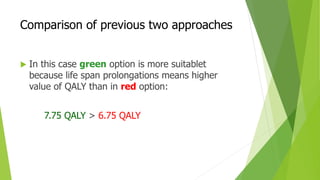
Two approaches with distinct life span
expectancy and quality of life
Comparison of previous two approaches
 In this case green option is more suitablet
because life span prolongations means higher
value of QALY than in red option:
7.75 QALY > 6.75 QALY
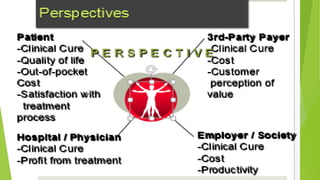
PERSPECTIVES OF EVALUATION
Perspective is PE term that describes whose
costs are relevant based on the purpose of the
study.
1. Patient perspectives
2. Payer’s perspectives
3. Provider’s perspectives
4. Society perspectives
PERSPECTIVES OF EVALUATION
1. Patient perspectives- portion of costs not covered by
Insurance
2. Payer’s perspective- Insurance companies, employer,
Govt.
3. Provider’s perspectives- Hospital Govt./Pvt. Physicians
etc.
4. Societal perspectives- all direct and indirect costs,
morbidity & mortality
Patient Perspective
 Patient perspective is paramount because patients are the
ultimate consumers of healthcare services.
 Costs from the perspective of patients are essentially what
patients pay for a product or service—that is, the portion not
covered by insurance. Consequences, from a patient's
perspective, are the clinical effects, both positive and negative, of
a program or treatment alternative.
 For example, various costs from a patient's perspective might
include insurance copayments and out-of-pocket drug costs, as
well as indirect costs, such as lost wages.
Provider Perspective
 Costs from the provider's perspective are the actual
expense of providing a product or service, regardless of
what the provider charges.
 Providers can be hospitals, managed-care organizations
(MCOs), or private-practice physicians.
 From this perspective, direct costs such as drugs,
hospitalization, laboratory tests, supplies, and salaries of
healthcare professionals can be identified, measured, and
compared.
 However, indirect costs can be of less importance to the
provider.
Payer’s Perspective
 Payers include insurance companies, employers, or the
government.
 From this perspective, costs represent the charges for
healthcare products and services allowed or reimbursed
by the payer.
 The primary cost for a payer is of a direct nature.
 However, indirect costs, such as lost workdays
(absenteeism), being at work but not feeling well and
therefore having lower productivity (presentism), also can
contribute to the total cost of healthcare to the payer.
 When insurance companies and employers are contracting
with MCOs or selecting healthcare benefits for their
employees, then the payer's perspective should be
Societal Perspective
 The perspective of society is the broadest of all perspectives
because it is the only one that considers the benefit to society
as a whole.
 Theoretically, all direct and indirect costs are included in an
economic evaluation performed from a societal perspective.
 Costs from this perspective include patient morbidity and
mortality and the overall costs of giving and receiving medical
care.
 An evaluation from this perspective also would include all the
important consequences an individual could experience.
 In countries with nationalized medicine, society is the
predominant perspective.
GUIDELINES OF PERFORMING PE
ANALYSIS
1. Defining the problem
2. Determining the study’s perspective
3. Determining the alternatives and outcomes
4. Selecting the appropriate PE method
5. Placing monetary values on the outcomes
6. Identifying study resources
7. Establishing the probabilities of the outcomes
8. Applying decision analysis
9. Presenting the results along with any limitations of the
study
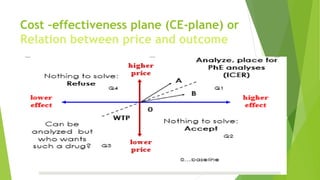
Cost –effectiveness plane (CE-plane) or
Relation between price and outcome
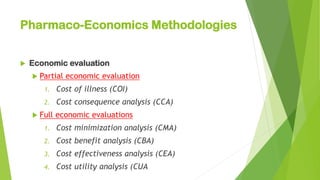
Pharmaco-Economics Methodologies
 Economic evaluation
 Partial economic evaluation
1. Cost of illness (COI)
2. Cost consequence analysis (CCA)
 Full economic evaluations
1. Cost minimization analysis (CMA)
2. Cost benefit analysis (CBA)
3. Cost effectiveness analysis (CEA)
4. Cost utility analysis (CUA
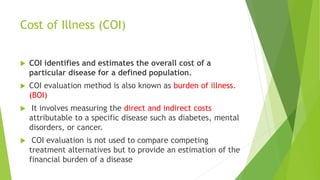
Cost of Illness (COI)
 COI identifies and estimates the overall cost of a
particular disease for a defined population.
 COI evaluation method is also known as burden of illness.
(BOI)
 It involves measuring the direct and indirect costs
attributable to a specific disease such as diabetes, mental
disorders, or cancer.
 COI evaluation is not used to compare competing
treatment alternatives but to provide an estimation of the
financial burden of a disease
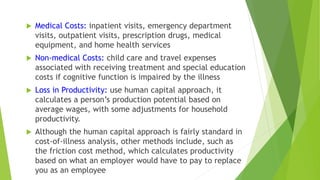
 Medical Costs: inpatient visits, emergency department
visits, outpatient visits, prescription drugs, medical
equipment, and home health services
 Non-medical Costs: child care and travel expenses
associated with receiving treatment and special education
costs if cognitive function is impaired by the illness
 Loss in Productivity: use human capital approach, it
calculates a person’s production potential based on
average wages, with some adjustments for household
productivity.
 Although the human capital approach is fairly standard in
cost-of-illness analysis, other methods include, such as
the friction cost method, which calculates productivity
based on what an employer would have to pay to replace
you as an employee
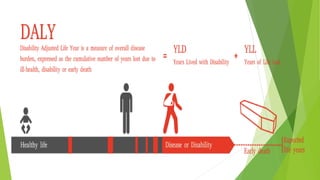
Cost of Illness or Burden of Disease
(BOD)
 Measured in terms of DALYs – measures loss of years of healthy life
 Disability adjusted Life Years (DALYs), where
 DALYs = YLL+ YLD
 YLL = Years of Life Lost – measures social burden of fatal outcomes –
 YLL = N x L, where:
 N = number of deaths
 L = standard life expectancy at age of death in years
 YLD = Years lost to Disability – estimates non-fatal outcomes
 YLD = I x DW x L, where:
 I = number of incident cases in a population
 DW = disability weight
 L = average duration of the case until remission or death (years)
Cost-Consequence Analysis (CCA)
 A form of health economic evaluation study in which all
direct and indirect costs and a catalog of different
outcomes of all alternatives are listed separately. No
specific preference for one costing approach or one
outcome measure (as is the case for cost‐effectiveness
analysis or cost-utility analysis) is made
 the decision maker has to form their own opinion
concerning the relative importance of costs and outcomes
Pharmaco-Economics Methodologies
 Economic evaluation
 Partial economic evaluation
1. Cost of illness (COI)
2. Cost consequence analysis (CCA)
 Full economic evaluations
1. Cost minimization analysis (CMA)
2. Cost benefit analysis (CBA)
3. Cost effectiveness analysis (CEA)
4. Cost utility analysis (CUA
pharmacoeconomic analysis
 Recall that a pharmacoeconomic analysis compares two or more
pharmaceutical products or services using:
 Costs as the input, and
 Outcomes, or consequences, as the output
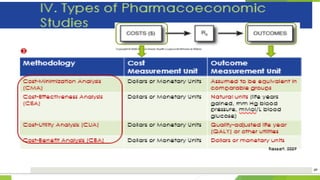
 This table lists the four basic types of pharmacoeconomic studies.
 Each method measures costs in dollars (or some other type of
monetary unit).
 But they differ regarding how health outcomes are measured and
compared.
1. A Cost-Minimization Analysis (CMA) doesn’t measure outcomes;
instead it assumes the outcomes are equivalent in comparable groups
of patients
2. A Cost-Effectiveness Analysis (CEA) measures outcomes in natural
units, such as
1.life years gained for a chemotherapy agent,
2.mm Hg blood pressure for a hypertension treatment,
3.mmol/L blood glucose for an oral antidiabetic medication
3. A Cost-Utility Analysis (CUA) measures outcomes in
Quality-Adjusted Life Years (QALYs) or other “utilities”
4. A Cost-Benefit Analysis (CBA) measures outcomes in
Dollars or Monetary Units
Types of Pharmacoeconomic Studies
A. Cost-Minimization Analysis (CMA)
 Definition
 Sample Problem
 Common Applications
 Advantages and Disadvantages
CMA
 DEFINITION :
 Only approach where there is strong evidence to
show that two or more intervention have exactly
the same heath effects that is they are
THERAPEUTICALLY EQUIVALENT in terms of health
benefits & adverse effects,
(CMA)
When we perform a PE analysis, we always compare two (or more)
pharmaceutical interventions or alternatives.
In a CMA, we assume that the alternatives have equivalent
outcomes, so we are only concerned with the costs.
The objective is simply to choose the least costly alternative among
equally effective alternatives.
Cost-Minimization Analysis (CMA
 PE analysis where outcomes of two or more
interventions are assumed to be equivalent
Thus, only costs of intervention are compared
 Objective: choose the least costly alternative
 Example :
 Brand vs generic products
 Different antibiotics therapies
 Different route of administration of same drug
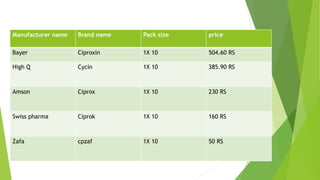
Manufacturer name Brand name Pack size price
Bayer Ciproxin 1X 10 504.60 RS
High Q Cycin 1X 10 385.90 RS
Amson Ciprox 1X 10 230 RS
Swiss pharma Ciprok 1X 10 160 RS
Zafa cpzaf 1X 10 50 RS
Example Problem:2
Example Problem: Administration of prostaglandin E2 gel intracervically to expectant
mothers on the day before labor was to be induced.
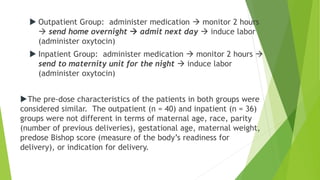
 Outpatient Group: administer medication  monitor 2 hours  send home
overnight  admit next day  induce labor
 Inpatient Group: administer medication  monitor 2 hours  send to
maternity unit for the night  induce labor
Example 2
CMA – Example Problem: A cost-minimization analysis of
intracervical prostaglandin for cervical ripening in an
outpatient versus inpatient setting (Farmer et al., 1996).
Introduction: A study explored the costs associated with
prostaglandin E2 gel administered intracervically to
expectant mothers on the day before labor was to be
induced (to help ripen/soften the cervix and allow labor to
progress more easily). Two different settings were
compared.
 Outpatient Group: administer medication  monitor 2 hours
 send home overnight  admit next day  induce labor
(administer oxytocin)
 Inpatient Group: administer medication  monitor 2 hours 
send to maternity unit for the night  induce labor
(administer oxytocin)
The pre-dose characteristics of the patients in both groups were
considered similar. The outpatient (n = 40) and inpatient (n = 36)
groups were not different in terms of maternal age, race, parity
(number of previous deliveries), gestational age, maternal weight,
predose Bishop score (measure of the body’s readiness for
delivery), or indication for delivery.
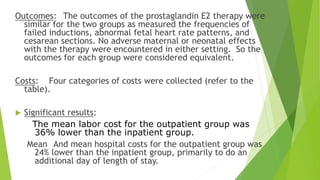
Outcomes: The outcomes of the prostaglandin E2 therapy were
similar for the two groups as measured the frequencies of
failed inductions, abnormal fetal heart rate patterns, and
cesarean sections. No adverse maternal or neonatal effects
with the therapy were encountered in either setting. So the
outcomes for each group were considered equivalent.
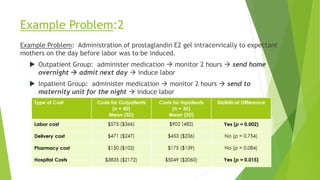
Costs: Four categories of costs were collected (refer to the
table).
 Significant results:
The mean labor cost for the outpatient group was
36% lower than the inpatient group.
Mean And mean hospital costs for the outpatient group was
24% lower than the inpatient group, primarily to do an
additional day of length of stay.
Would you recommend the outpatient
program?
 The authors of this CMA was concluded yes , “Substantial
cost savings were found with prostaglandin E2
therapy in an outpatient rather than an inpatient
setting for patients who required an induction of
labor and were candidates for outpatient cervical
ripening.”
Applications
Cost comparison of two generic medications rated as
equivalent by FDA
 Ex: Comparing two different generic antibiotics for the
same type of infection; each may have different costs and
possibly different adverse events, but their effectiveness
is considered equivalent.
Cost comparison of same drug therapy in different settingsEx:
Comparing the cost of receiving IV antibiotics in a hospital setting
vs. receiving IV antibiotics (same drug and dose) at home via a
home health care service.
 CMA is not appropriate for comparing different classes of medications.
Ex: Comparing an ACE inhibitor and a beta blocker for treating
hypertension. A CMA would not be appropriate because one is not
necessarily a substitute for the other.
Advantages and Disadvantages
 Advantage: simplest analysis to conduct
 Disadvantage: cannot be used when outcomes of each
intervention are different
Cost-Effectiveness Analysis (CEA)
 Definition
 Sample Problem
 Common Applications
 Advantages and Disadvantages
CEA
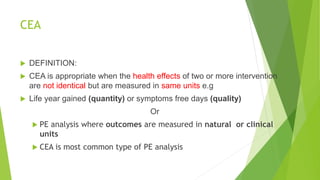
 DEFINITION:
 CEA is appropriate when the health effects of two or more intervention
are not identical but are measured in same units e.g
 Life year gained (quantity) or symptoms free days (quality)
Or
 PE analysis where outcomes are measured in natural or clinical
units
 CEA is most common type of PE analysis
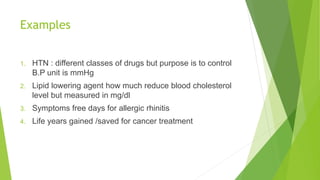
Examples
1. HTN : different classes of drugs but purpose is to control
B.P unit is mmHg
2. Lipid lowering agent how much reduce blood cholesterol
level but measured in mg/dl
3. Symptoms free days for allergic rhinitis
4. Life years gained /saved for cancer treatment
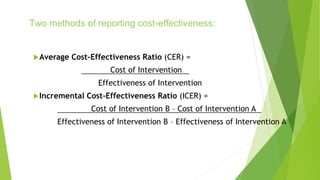
Two methods of reporting cost-effectiveness:
Average Cost-Effectiveness Ratio (CER) =
Cost of Intervention
Effectiveness of Intervention
Incremental Cost-Effectiveness Ratio (ICER) =
Cost of Intervention B – Cost of Intervention A
Effectiveness of Intervention B – Effectiveness of Intervention A
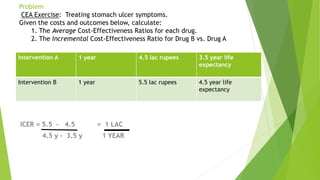
Problem
CEA Exercise: Treating stomach ulcer symptoms.
Given the costs and outcomes below, calculate:
1. The Average Cost-Effectiveness Ratios for each drug.
2. The Incremental Cost-Effectiveness Ratio for Drug B vs. Drug A
ICER = 5.5 - 4.5 = 1 LAC
4.5 y - 3.5 y 1 YEAR
Intervention A 1 year 4.5 lac rupees 3.5 year life
expectancy
Intervention B 1 year 5.5 lac rupees 4.5 year life
expectancy
Applications
 Medications with the same type of primary outcomes,
and most often for treatment of the same types of health
condition
 CEA is only performed when the outcome of one
intervention is both better than another AND the cost is
greater.
Advantages
1. Health units are common outcomes routinely
measured in clinical trials – familiar to clinicians
2. Outcomes are easier to quantify than CUA or CBA
Disadvantages:
1. Interventions with different types of outcomes cannot be
compared
2. Can’t combine more than one important outcome
3. Difficult to collapse both the effectiveness and the side effects
into one unit of measurement
4. CEA estimates extra cost associated with each additional unit of
outcome, but who is to say that added cost is worth added
outcomes? Requires judgment call.
Cost-Utility Analysis (CUA)
 Definition
 Sample Problem
 Common Applications
 Advantages and Disadvantages
(
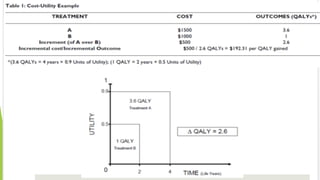
 Definition :
 CUA is the most useful form of economic evaluation & is appropriate
when the health effects of 2 or more interventions can be measured
in terms of over all impact on quality & quantity of life.(QALY’S)
 Or
 A PE analysis which measures outcomes based on years of life that
are adjusted by “utility” weights (patient preferences) range [0, 1]
 Most common utility is the Quality-Adjusted Life Year (QALY)
1.0 QALY = 1 year of life in perfect health
0.0 QALY = death
0.0 < QALY < 1.0: a year when health is diminished by disease
or treatment
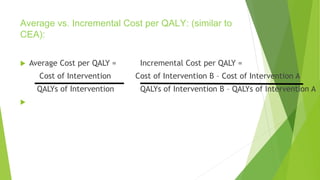
Average vs. Incremental Cost per QALY: (similar to
CEA):
 Average Cost per QALY = Incremental Cost per QALY =
Cost of Intervention Cost of Intervention B – Cost of Intervention A
QALYs of Intervention QALYs of Intervention B – QALYs of Intervention A

Applications
 CUA is useful when utility adjustments are needed, such as when:
 Length of life (quantity) and quality of life are different
 Length of life (quantity) is unaffected and quality of life is different
 Outcomes are very different
 CUA is not warranted when:
 Number of life years saved (quantity) is different but quality of each year of life
is very similar
Advantages:
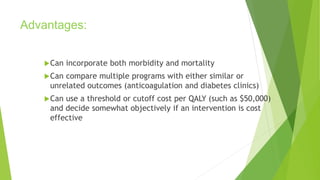
Can incorporate both morbidity and mortality
Can compare multiple programs with either similar or
unrelated outcomes (anticoagulation and diabetes clinics)
Can use a threshold or cutoff cost per QALY (such as $50,000)
and decide somewhat objectively if an intervention is cost
effective
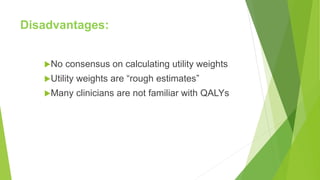
Disadvantages:
No consensus on calculating utility weights
Utility weights are “rough estimates”
Many clinicians are not familiar with QALYs
Cost-Benefit Analysis (CBA)
 Definition
 Sample Problem
 Common Applications
 Advantages and Disadvantages
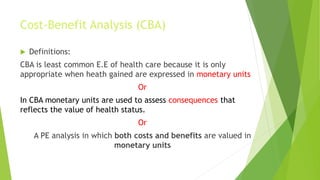
Cost-Benefit Analysis (CBA)
 Definitions:
CBA is least common E.E of health care because it is only
appropriate when heath gained are expressed in monetary units
Or
In CBA monetary units are used to assess consequences that
reflects the value of health status.
Or
A PE analysis in which both costs and benefits are valued in
monetary units
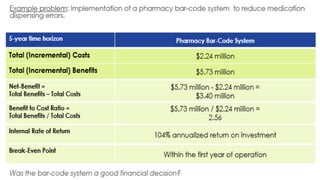
The results of a CBA can be presented in several formats:
1. Net Benefit = Total Benefits – Total Costs
Cost beneficial if Net Benefit > 0
2. Benefit-to-Cost Ratio = Total Benefits / Total Costs
Cost beneficial if Benefit-to-Cost > 1
3. Internal Rate of Return (IRR) = The rate of return that equates the present value of benefits
to the present value of costs
4. Break-Even Point = The time required to recoup the investment
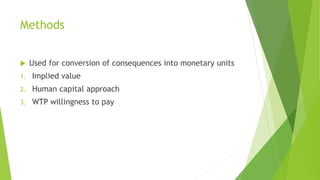
Methods
 Used for conversion of consequences into monetary units
1. Implied value
2. Human capital approach
3. WTP willingness to pay
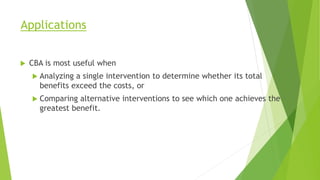
Applications
 CBA is most useful when
 Analyzing a single intervention to determine whether its total
benefits exceed the costs, or
 Comparing alternative interventions to see which one achieves the
greatest benefit.
Advantages
 Major advantages:
Can determine if benefits exceed costs of program – less
subjective than CEA or CUA
Can compare multiple programs with either similar or unrelated
outcomes (anticoagulation and diabetes clinics)
Disadvantage:
Difficult to place a monetary value on health outcomes
Different methods of doing so may elicit different
estimates
Application of Pharmacoeconomics

Pharmacoeconomics 2.pdf a

  • 1.
  • 2.
    GENERAL CONCEPTS  Economics The study of how individuals & society end up choosing, with or without the use of money, to employ scarce resources that could have alternative uses, to produce various commodities & distribute them for consumption, now or in the future, among various people and groups in society. Paul Samuelson  Health economics Is Science of assessing cost and benefits of healthcare.
  • 3.
    The aim ofpharmacoeconomics:  To compare the economics of different pharmaceutical products  To compare drug therapy to other treatments.  To identify what is most efficient, so that the greatest amount of benefit can be bought for a given amount of money or resources.  To find the optimal therapy at the lowest price.  To decrease the concern for patients, healthcare professionals, and the public.  In Industry- To decide among specific research and development alternatives.  In Government- To determine program benefits and prices paid.  In Private Sector- To design insurance benefit coverage
  • 4.
    INTRODUCTION Health care funders(governments, social security funds, insurance companies) are struggling to meet their rising costs. They make many efforts to contain drug costs, by price negotiation, patient co-payments or dedicated drug budgets. The aim is to identify what is most efficient, so that the greatest amount of benefit can be bought for a given amount of money or resources.
  • 5.
    Pharmacoeconomics  Pharmacoeconomics isa branch of health economics which compares the value of one drug or a drug therapy to another.  Or  Measurement of both the cost & consequences in therapeutic decision making is termed as PE.
  • 6.
    Pharmacoeconomics  PE: isa division of health economics, is desidned to provide decision makers with information about the value of the different pharmaco-therapies. PE balances the cost with the consequences or outcomes of pharmaceutical therapies & services.  Or  Estimation of cost effectiveness are derived from economic evaluations. Which are the comparative analysis of two or more alternative course of actions (intervention) in terms of their cost & consequences.
  • 7.
    Pharmacoeconomics Pharmacoeconomics is abranch of health economics that particularly considers drug therapy. It is of particular interest to pharmaceutical companies who in developing a new drug and after the traditional hurdles of  efficacy,  safety and  tolerability  cost effectiveness  affordability
  • 8.
    Pharmacoeconomics is aboutmaking choices between options, when there is scarcity of resources. It is fundamentally comparative, weighing the costs and benefits of option 1 with those of option 2 (for instance, a new drug and the previous best therapy - traditional medical evaluation focused only on the benefits), to determine which is the most efficient way to use our limited resources
  • 9.
    BASIC CONCEPTS ANDTERMINOLOGY Efficiency is a key concept in pharmacoeconomics, i.e. how to buy the greatest amount of benefit for a given resource use. pharmacoeconomic evaluations of drug therapy are increasingly important in decision making.
  • 10.
    The Quality AdjustedLife Year (QALY) QALY is one widely used measure, which attempts to integrate both quality and the quantity of life. Broadly, it assumes that if a treatment increases one’s life expectancy by 2 years, but causes adverse effects or inconvenience, such that one’s quality of life or utility are decreased by 25%, the net gain is 2 x 0.75 = 1.5 QALYs.
  • 11.
    Calculating QALYs -a simple example QALY gain from treatment X = 7 - 2.5 = 4.5 QALYs (If the cost of treatment X is EUR 18.000 then the cost per QALY is EUR 4.000 per QALY (EUR 18.000 divided between 4.5 additional QALY’s)
  • 12.
    Pharmaco-economic Analysis  Pharmaco-economicanalysis involves… 1. Identifying and measuring costs 2. Identifying and measuring consequences 3. Choosing a perspective
  • 13.
    COSTS  Define :The value of the resources consumed by a program or drug therapy, is defined as Cost.  Or  Sum of product resources that are used & the unit cost of each item  price of drug, price of its administration  price of hospitalization, outpatient treatment  price of transportation  price of ADRs
  • 14.
    COSTS Types 1. Directcost 2. Indirect cost
  • 15.
    Types  Direct cost:costs directly related to producing/ providing a specific quantity of service or output e.g (salary, drug cost, supply cost for provision of pharmacy services )  Indirect cost: cost that are allocated to the areas that produces/provide a specific quantity of services or output (over head cost)  cost  All the expenses directly & indirectly necessary to provide a product or services.
  • 16.
    Other Types ofCost 1. Total cost 2. Average cost 3. Fixed cost 4. Variable cost 5. Marginal cost 6. Incremental cost 7. Direct cost 8. Indirect cost 9. Allowable cost 10. Opportunity cost
  • 17.
     Direct costs= Direct medical costs + Direct nonmedical costs  Direct Medical Costs :what is paid for specified health resources and services physician visit, lab.  Direct Non-Medical Costs - costs necessary to enable an individual to receive medical care. Lost work time, transportation.  Indirect costs = Morbidity costs + Mortality costs  lost productivity in society, unpaid caregivers, lost wages.  Total costs = Direct costs + Indirect costs + Intangible costs
  • 18.
    Direct medical costs– drugs, medical supplies, laboratory tests and diagnostic tests, hospitalizations, and physician visits Direct non-medical costs – transportation to and from healthcare facilities, extra trips to A&E, special diets and various other out-of-pocket expenses Indirect costs – morbidity costs (loss of productivity), Mortality (loss of years of services due to premature death)
  • 19.
    Intangible costs –nonfinancial outcomes of the disease and medical care e.g. pain, suffering, inconvenience, and grief Or Costs of pain, worry & other suffering which a pt. or his family might suffer. Or Cost related to psychological impact of disease or treatment(pain & suffering) Opportunity costs - the cost of the benefit of pursuing an alternative course of action. Loss of potential gain. Opportunity costs: economic benefit of the alternative therapy that was foregone
  • 20.
     Fixed cost:All kinds of expenses which do not vary with the rate of production are known are known as fixed cost. e,g rent of building, cost of machinery. Property tax, labor salary.  Variable cost: are the cost that varies with the rate of production. variable cost increases as the output of firm increases and decreases with the decreases of output. E.g raw material, material fuel, transportation services, labor.  Marginal cost : is the extra cost incurred when the total output is increased by one unit.
  • 21.
     Average cost:is total cost divided by total unit of output.
  • 22.
     Allowable cost:Let's assume that your company is hired by the government to clean up an oil spill. The government can state in the contract that it will reimburse the company for travel and flight expenses as long as the flights are coach tickets. A coach ticket would be considered an allowable cost because it is specified in this contract. If all the company managers flew first class to the job site, the government would not be obligated to pay for the tickets. These first class tickets would be considered unallowable costs because the contract only allows travel reimbursement for coach tickets.
  • 23.
    Consequences/ Benefits/ Outcomes Theyare health outcomes e.g the impact of therapy on quality of life & mortality of life or both. OR Consequence is defined as the effects, outputs, or outcomes of the program or drug therapy
  • 24.
    Outcomes  lifetime prolongation improved quality of life  remission-free interval  better compliance  simplified therapeutic regime
  • 25.
    Benefits The benefits weexpect from an intervention might be measured in: A. “Natural” units - e.g. years of life saved, strokes prevented, peptic ulcers healed etc. B. “Utility” units - utility is an economist’s word for satisfaction, or sense of well being, and is an attempt to evaluate the quality of a state of health, and not just its quantity
  • 26.
    Outcomes research (OR) Studyof healthcare interventions, care delivery process, and healthcare quality that is evaluated to measure the extent to which optimal and desirable outcomes can be reached. Purpose of OR is to assess the value of a therapy or program in question. Areas of outcomes are Economic outcomes, clinical outcomes and humanistic outcomes
  • 27.
    Themes of OutcomeResearch  Safety  Efficacy  Equity  Timeliness  System Responsiveness  Patient Centeredness.
  • 28.
    Examples of outcomesmeasures: 1. Economic outcomes 2. Clinical outcomes 3. Humanistic outcomes
  • 29.
    Economic outcomes  Comparingdirect, indirect, and intangible costs with the consequences of medical treatment alternatives. Acquisition costs associated with care labor costs associated with care costs to treat ADRs costs of treatment failure costs of hospital readmissions, costs of emergency rooms & clinic visits
  • 30.
    Clinical outcomes  Medicalevents that occur as a result of disease or treatment (e.g., safety and efficacy end points). Length of hospital stay ADRs  hospital readmissions Mortality
  • 31.
    Humanistic outcomes Consequences ofdisease or treatment on patient functional status such as physical function, social function, general health and well-being, and life satisfaction. Patient satisfaction Patient preferences Quality of life (QoL) assessment
  • 32.
    Two approaches withdistinct life span expectancy and quality of life
  • 33.
    Comparison of previoustwo approaches  In this case green option is more suitablet because life span prolongations means higher value of QALY than in red option: 7.75 QALY > 6.75 QALY
  • 34.
    PERSPECTIVES OF EVALUATION Perspectiveis PE term that describes whose costs are relevant based on the purpose of the study. 1. Patient perspectives 2. Payer’s perspectives 3. Provider’s perspectives 4. Society perspectives
  • 35.
    PERSPECTIVES OF EVALUATION 1.Patient perspectives- portion of costs not covered by Insurance 2. Payer’s perspective- Insurance companies, employer, Govt. 3. Provider’s perspectives- Hospital Govt./Pvt. Physicians etc. 4. Societal perspectives- all direct and indirect costs, morbidity & mortality
  • 36.
    Patient Perspective  Patientperspective is paramount because patients are the ultimate consumers of healthcare services.  Costs from the perspective of patients are essentially what patients pay for a product or service—that is, the portion not covered by insurance. Consequences, from a patient's perspective, are the clinical effects, both positive and negative, of a program or treatment alternative.  For example, various costs from a patient's perspective might include insurance copayments and out-of-pocket drug costs, as well as indirect costs, such as lost wages.
  • 37.
    Provider Perspective  Costsfrom the provider's perspective are the actual expense of providing a product or service, regardless of what the provider charges.  Providers can be hospitals, managed-care organizations (MCOs), or private-practice physicians.  From this perspective, direct costs such as drugs, hospitalization, laboratory tests, supplies, and salaries of healthcare professionals can be identified, measured, and compared.  However, indirect costs can be of less importance to the provider.
  • 38.
    Payer’s Perspective  Payersinclude insurance companies, employers, or the government.  From this perspective, costs represent the charges for healthcare products and services allowed or reimbursed by the payer.  The primary cost for a payer is of a direct nature.  However, indirect costs, such as lost workdays (absenteeism), being at work but not feeling well and therefore having lower productivity (presentism), also can contribute to the total cost of healthcare to the payer.  When insurance companies and employers are contracting with MCOs or selecting healthcare benefits for their employees, then the payer's perspective should be
  • 39.
    Societal Perspective  Theperspective of society is the broadest of all perspectives because it is the only one that considers the benefit to society as a whole.  Theoretically, all direct and indirect costs are included in an economic evaluation performed from a societal perspective.  Costs from this perspective include patient morbidity and mortality and the overall costs of giving and receiving medical care.  An evaluation from this perspective also would include all the important consequences an individual could experience.  In countries with nationalized medicine, society is the predominant perspective.
  • 41.
    GUIDELINES OF PERFORMINGPE ANALYSIS 1. Defining the problem 2. Determining the study’s perspective 3. Determining the alternatives and outcomes 4. Selecting the appropriate PE method 5. Placing monetary values on the outcomes 6. Identifying study resources 7. Establishing the probabilities of the outcomes 8. Applying decision analysis 9. Presenting the results along with any limitations of the study
  • 42.
    Cost –effectiveness plane(CE-plane) or Relation between price and outcome
  • 43.
    Pharmaco-Economics Methodologies  Economicevaluation  Partial economic evaluation 1. Cost of illness (COI) 2. Cost consequence analysis (CCA)  Full economic evaluations 1. Cost minimization analysis (CMA) 2. Cost benefit analysis (CBA) 3. Cost effectiveness analysis (CEA) 4. Cost utility analysis (CUA
  • 44.
    Cost of Illness(COI)  COI identifies and estimates the overall cost of a particular disease for a defined population.  COI evaluation method is also known as burden of illness. (BOI)  It involves measuring the direct and indirect costs attributable to a specific disease such as diabetes, mental disorders, or cancer.  COI evaluation is not used to compare competing treatment alternatives but to provide an estimation of the financial burden of a disease
  • 45.
     Medical Costs:inpatient visits, emergency department visits, outpatient visits, prescription drugs, medical equipment, and home health services  Non-medical Costs: child care and travel expenses associated with receiving treatment and special education costs if cognitive function is impaired by the illness  Loss in Productivity: use human capital approach, it calculates a person’s production potential based on average wages, with some adjustments for household productivity.  Although the human capital approach is fairly standard in cost-of-illness analysis, other methods include, such as the friction cost method, which calculates productivity based on what an employer would have to pay to replace you as an employee
  • 47.
    Cost of Illnessor Burden of Disease (BOD)  Measured in terms of DALYs – measures loss of years of healthy life  Disability adjusted Life Years (DALYs), where  DALYs = YLL+ YLD  YLL = Years of Life Lost – measures social burden of fatal outcomes –  YLL = N x L, where:  N = number of deaths  L = standard life expectancy at age of death in years  YLD = Years lost to Disability – estimates non-fatal outcomes  YLD = I x DW x L, where:  I = number of incident cases in a population  DW = disability weight  L = average duration of the case until remission or death (years)
  • 48.
    Cost-Consequence Analysis (CCA) A form of health economic evaluation study in which all direct and indirect costs and a catalog of different outcomes of all alternatives are listed separately. No specific preference for one costing approach or one outcome measure (as is the case for cost‐effectiveness analysis or cost-utility analysis) is made  the decision maker has to form their own opinion concerning the relative importance of costs and outcomes
  • 49.
    Pharmaco-Economics Methodologies  Economicevaluation  Partial economic evaluation 1. Cost of illness (COI) 2. Cost consequence analysis (CCA)  Full economic evaluations 1. Cost minimization analysis (CMA) 2. Cost benefit analysis (CBA) 3. Cost effectiveness analysis (CEA) 4. Cost utility analysis (CUA
  • 51.
    pharmacoeconomic analysis  Recallthat a pharmacoeconomic analysis compares two or more pharmaceutical products or services using:  Costs as the input, and  Outcomes, or consequences, as the output  This table lists the four basic types of pharmacoeconomic studies.  Each method measures costs in dollars (or some other type of monetary unit).  But they differ regarding how health outcomes are measured and compared.
  • 52.
    1. A Cost-MinimizationAnalysis (CMA) doesn’t measure outcomes; instead it assumes the outcomes are equivalent in comparable groups of patients 2. A Cost-Effectiveness Analysis (CEA) measures outcomes in natural units, such as 1.life years gained for a chemotherapy agent, 2.mm Hg blood pressure for a hypertension treatment, 3.mmol/L blood glucose for an oral antidiabetic medication
  • 53.
    3. A Cost-UtilityAnalysis (CUA) measures outcomes in Quality-Adjusted Life Years (QALYs) or other “utilities” 4. A Cost-Benefit Analysis (CBA) measures outcomes in Dollars or Monetary Units
  • 54.
    Types of PharmacoeconomicStudies A. Cost-Minimization Analysis (CMA)  Definition  Sample Problem  Common Applications  Advantages and Disadvantages
  • 55.
    CMA  DEFINITION : Only approach where there is strong evidence to show that two or more intervention have exactly the same heath effects that is they are THERAPEUTICALLY EQUIVALENT in terms of health benefits & adverse effects,
  • 56.
    (CMA) When we performa PE analysis, we always compare two (or more) pharmaceutical interventions or alternatives. In a CMA, we assume that the alternatives have equivalent outcomes, so we are only concerned with the costs. The objective is simply to choose the least costly alternative among equally effective alternatives.
  • 57.
    Cost-Minimization Analysis (CMA PE analysis where outcomes of two or more interventions are assumed to be equivalent Thus, only costs of intervention are compared  Objective: choose the least costly alternative  Example :  Brand vs generic products  Different antibiotics therapies  Different route of administration of same drug
  • 58.
    Manufacturer name Brandname Pack size price Bayer Ciproxin 1X 10 504.60 RS High Q Cycin 1X 10 385.90 RS Amson Ciprox 1X 10 230 RS Swiss pharma Ciprok 1X 10 160 RS Zafa cpzaf 1X 10 50 RS
  • 59.
    Example Problem:2 Example Problem:Administration of prostaglandin E2 gel intracervically to expectant mothers on the day before labor was to be induced.  Outpatient Group: administer medication  monitor 2 hours  send home overnight  admit next day  induce labor  Inpatient Group: administer medication  monitor 2 hours  send to maternity unit for the night  induce labor
  • 60.
    Example 2 CMA –Example Problem: A cost-minimization analysis of intracervical prostaglandin for cervical ripening in an outpatient versus inpatient setting (Farmer et al., 1996). Introduction: A study explored the costs associated with prostaglandin E2 gel administered intracervically to expectant mothers on the day before labor was to be induced (to help ripen/soften the cervix and allow labor to progress more easily). Two different settings were compared.
  • 61.
     Outpatient Group:administer medication  monitor 2 hours  send home overnight  admit next day  induce labor (administer oxytocin)  Inpatient Group: administer medication  monitor 2 hours  send to maternity unit for the night  induce labor (administer oxytocin) The pre-dose characteristics of the patients in both groups were considered similar. The outpatient (n = 40) and inpatient (n = 36) groups were not different in terms of maternal age, race, parity (number of previous deliveries), gestational age, maternal weight, predose Bishop score (measure of the body’s readiness for delivery), or indication for delivery.
  • 62.
    Outcomes: The outcomesof the prostaglandin E2 therapy were similar for the two groups as measured the frequencies of failed inductions, abnormal fetal heart rate patterns, and cesarean sections. No adverse maternal or neonatal effects with the therapy were encountered in either setting. So the outcomes for each group were considered equivalent. Costs: Four categories of costs were collected (refer to the table).  Significant results: The mean labor cost for the outpatient group was 36% lower than the inpatient group. Mean And mean hospital costs for the outpatient group was 24% lower than the inpatient group, primarily to do an additional day of length of stay.
  • 63.
    Would you recommendthe outpatient program?  The authors of this CMA was concluded yes , “Substantial cost savings were found with prostaglandin E2 therapy in an outpatient rather than an inpatient setting for patients who required an induction of labor and were candidates for outpatient cervical ripening.”
  • 64.
    Applications Cost comparison oftwo generic medications rated as equivalent by FDA  Ex: Comparing two different generic antibiotics for the same type of infection; each may have different costs and possibly different adverse events, but their effectiveness is considered equivalent.
  • 65.
    Cost comparison ofsame drug therapy in different settingsEx: Comparing the cost of receiving IV antibiotics in a hospital setting vs. receiving IV antibiotics (same drug and dose) at home via a home health care service.  CMA is not appropriate for comparing different classes of medications. Ex: Comparing an ACE inhibitor and a beta blocker for treating hypertension. A CMA would not be appropriate because one is not necessarily a substitute for the other.
  • 66.
    Advantages and Disadvantages Advantage: simplest analysis to conduct  Disadvantage: cannot be used when outcomes of each intervention are different
  • 67.
    Cost-Effectiveness Analysis (CEA) Definition  Sample Problem  Common Applications  Advantages and Disadvantages
  • 68.
    CEA  DEFINITION:  CEAis appropriate when the health effects of two or more intervention are not identical but are measured in same units e.g  Life year gained (quantity) or symptoms free days (quality) Or  PE analysis where outcomes are measured in natural or clinical units  CEA is most common type of PE analysis
  • 69.
    Examples 1. HTN :different classes of drugs but purpose is to control B.P unit is mmHg 2. Lipid lowering agent how much reduce blood cholesterol level but measured in mg/dl 3. Symptoms free days for allergic rhinitis 4. Life years gained /saved for cancer treatment
  • 70.
    Two methods ofreporting cost-effectiveness: Average Cost-Effectiveness Ratio (CER) = Cost of Intervention Effectiveness of Intervention Incremental Cost-Effectiveness Ratio (ICER) = Cost of Intervention B – Cost of Intervention A Effectiveness of Intervention B – Effectiveness of Intervention A
  • 71.
    Problem CEA Exercise: Treatingstomach ulcer symptoms. Given the costs and outcomes below, calculate: 1. The Average Cost-Effectiveness Ratios for each drug. 2. The Incremental Cost-Effectiveness Ratio for Drug B vs. Drug A ICER = 5.5 - 4.5 = 1 LAC 4.5 y - 3.5 y 1 YEAR Intervention A 1 year 4.5 lac rupees 3.5 year life expectancy Intervention B 1 year 5.5 lac rupees 4.5 year life expectancy
  • 72.
    Applications  Medications withthe same type of primary outcomes, and most often for treatment of the same types of health condition  CEA is only performed when the outcome of one intervention is both better than another AND the cost is greater.
  • 73.
    Advantages 1. Health unitsare common outcomes routinely measured in clinical trials – familiar to clinicians 2. Outcomes are easier to quantify than CUA or CBA
  • 74.
    Disadvantages: 1. Interventions withdifferent types of outcomes cannot be compared 2. Can’t combine more than one important outcome 3. Difficult to collapse both the effectiveness and the side effects into one unit of measurement 4. CEA estimates extra cost associated with each additional unit of outcome, but who is to say that added cost is worth added outcomes? Requires judgment call.
  • 75.
    Cost-Utility Analysis (CUA) Definition  Sample Problem  Common Applications  Advantages and Disadvantages (
  • 76.
     Definition : CUA is the most useful form of economic evaluation & is appropriate when the health effects of 2 or more interventions can be measured in terms of over all impact on quality & quantity of life.(QALY’S)  Or  A PE analysis which measures outcomes based on years of life that are adjusted by “utility” weights (patient preferences) range [0, 1]  Most common utility is the Quality-Adjusted Life Year (QALY) 1.0 QALY = 1 year of life in perfect health 0.0 QALY = death 0.0 < QALY < 1.0: a year when health is diminished by disease or treatment
  • 77.
    Average vs. IncrementalCost per QALY: (similar to CEA):  Average Cost per QALY = Incremental Cost per QALY = Cost of Intervention Cost of Intervention B – Cost of Intervention A QALYs of Intervention QALYs of Intervention B – QALYs of Intervention A 
  • 79.
    Applications  CUA isuseful when utility adjustments are needed, such as when:  Length of life (quantity) and quality of life are different  Length of life (quantity) is unaffected and quality of life is different  Outcomes are very different  CUA is not warranted when:  Number of life years saved (quantity) is different but quality of each year of life is very similar
  • 80.
    Advantages: Can incorporate bothmorbidity and mortality Can compare multiple programs with either similar or unrelated outcomes (anticoagulation and diabetes clinics) Can use a threshold or cutoff cost per QALY (such as $50,000) and decide somewhat objectively if an intervention is cost effective
  • 81.
    Disadvantages: No consensus oncalculating utility weights Utility weights are “rough estimates” Many clinicians are not familiar with QALYs
  • 82.
    Cost-Benefit Analysis (CBA) Definition  Sample Problem  Common Applications  Advantages and Disadvantages
  • 83.
    Cost-Benefit Analysis (CBA) Definitions: CBA is least common E.E of health care because it is only appropriate when heath gained are expressed in monetary units Or In CBA monetary units are used to assess consequences that reflects the value of health status. Or A PE analysis in which both costs and benefits are valued in monetary units
  • 84.
    The results ofa CBA can be presented in several formats: 1. Net Benefit = Total Benefits – Total Costs Cost beneficial if Net Benefit > 0 2. Benefit-to-Cost Ratio = Total Benefits / Total Costs Cost beneficial if Benefit-to-Cost > 1 3. Internal Rate of Return (IRR) = The rate of return that equates the present value of benefits to the present value of costs 4. Break-Even Point = The time required to recoup the investment
  • 86.
    Methods  Used forconversion of consequences into monetary units 1. Implied value 2. Human capital approach 3. WTP willingness to pay
  • 87.
    Applications  CBA ismost useful when  Analyzing a single intervention to determine whether its total benefits exceed the costs, or  Comparing alternative interventions to see which one achieves the greatest benefit.
  • 88.
    Advantages  Major advantages: Candetermine if benefits exceed costs of program – less subjective than CEA or CUA Can compare multiple programs with either similar or unrelated outcomes (anticoagulation and diabetes clinics)
  • 89.
    Disadvantage: Difficult to placea monetary value on health outcomes Different methods of doing so may elicit different estimates
  • 92.