M. Pharm Sem-I Presentations
Title: manufacturing and manufacturing flowchart and IPQC of tablet
SUBMITTED TO
SAVITRIBAI PHULE, PUNE UNIVERSITY , PUNE
FOR
PARTIAL FULFILMENT OF REQUIREMENTS FOR THE AWARD OF
MASTER OF PHARMACY
IN THE SUBJECT
Pharmaceutical Quality Assurance
IN THE FACULTY OF SCIENCE AND TECHNOLOGY
Bhujbal Knowledge City,
MET’s Institute of Pharmacy,
Adgaon, Nashik, 422003.
Maharashtra, India
Academic Year-2021-2022 1
Presented By- Prajakta
Sanjay thorat
Guided By : Dr. s. p.
ahirrao
Content:-
• Introduction
• Manufacturing
• Manufacturing flowchart
• IPQC test
2
Introduction
• Tablet is define as a compressed solid unit dosage form
containing medicament with or without excipient.
• Tablets are commonly manufactured by wet granulation, dry
granulation or direct compression.
• These methods may be considered to consist of a series of
steps (unit processes) – weighing, milling, mixing, granulation,
drying, compaction, (frequently) coating and packaging.
• Regardless of the method used the unit processes – weighing,
milling and mixing, are the same; subsequent steps differ.
3
Primary goals of tablet manufacturing process
• To formulate tablets that are strong and hard to withstand
mechanical shock encountered during manufacturing,
packing, shipping, dispensing and use.
• To formulate tablets that are uniform in weight and in drug
content.
• To formulate tablets that are bioavailable according to
indication requirements.
• To formulate tablets that are chemically and physically stable
over a long period of time.
• To formulate tablets that have elegant product identity which
is free from any tablet defects
4
Procedure for Manufacturing Tablets
• Dispensing: Each ingredient in the tablet formula is weighed
and accurately dispensed as per dose. This is one of the
critical steps in any type of formulation process and should be
done under technical supervision.
• Sizing: Formulation ingredients must be in finely divided
form, otherwise, size reduction should be carried out for
better flow property and easy mixing
5
CONT….
• Powder blending: Powders are mixed using a suitable blender
to obtain a uniform and homogeneous powder mix. The drug
substance and excipients are mixed in geometric dilution.
• Granulation: Here small powder particles are gathered
together into layers, and permanent aggregates to render
them into free-flowing states.
• Drying and dry screening: Screened wet granules need to be
dried for a particular time period in tray dryer or fluid bed
dryer at controlled temperature not exceeding 550 ◦C. Dried
granules are screened through the appropriate mesh screen
6
CONT…
• Tablet compression: This step involves the compression of
granules into a flat or convex, round, oblong, or unique
shaped, scored or unscored tablets; engraved with an
identifying symbol and/ or code number using tablet press.
• Coating: Tablets and granules are coated if there is need to
mask the unpleasant taste/odour of some drug substance or
to increase the aesthetic appeal of uncoated tablets as well as
to modify the release or control the release of drug substance
from tablets. This is achieved by enclosing or covering the
core tablet or granules with coating solutions
7
Method used in tablet formulation :-
• Tablet are commonly manufactured by
1. Direct compression
2. Dry granulation
3. Wet granulation
8
Direct compression :-
• Direct compression involves direct compression of powdered
materials into tablets without modifying the physical nature
of the materials itself.
• Direct compression avoids many of the problems associated
with wet and dry granulations.
9
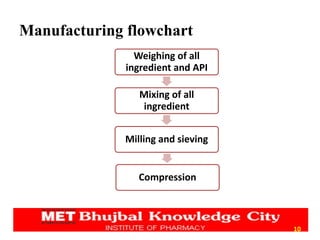
Manufacturing flowchart
10
Weighing of all
ingredient and API
Mixing of all
ingredient
Milling and sieving
Compression
Dry granulation
• Dry granulation involve the compaction of the component of
tablet formulation by mean of tablet press followed by milling
and screening , prior to final compression into tablet.
• When initial blend of powder is forced into the dies of large
capacity tablet press and is compacted by mean of flat-faced
punches, the compacted masses are called as slugs, and
process is called as “slugging”.
• The slugs are then screened or milled to produce granule .
• Granules are then compressed.
11
Manufacturing flowchart
Weighing of all
ingredient and API
Dry mixing of drug
and diluent
Slugging or pre
compression
Milling and sieving
lubrication
Discharge for
compression
12
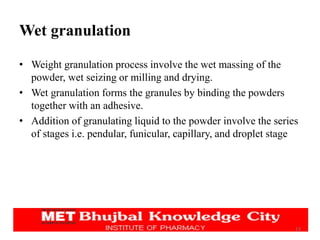
Wet granulation
• Weight granulation process involve the wet massing of the
powder, wet seizing or milling and drying.
• Wet granulation forms the granules by binding the powders
together with an adhesive.
• Addition of granulating liquid to the powder involve the series
of stages i.e. pendular, funicular, capillary, and droplet stage
13
Manufacturing flowchart
Weighing, milling and mixing of
API with excipient
Mix binder solution with powder
to form damp mass
Screen damp mass into granule
using 6-12 mesh screen
14
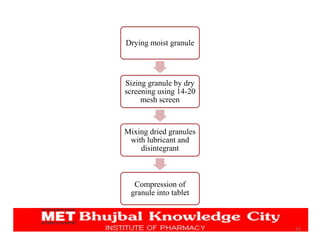
Drying moist granule
Sizing granule by dry
screening using 14-20
mesh screen
Mixing dried granules
with lubricant and
disintegrant
Compression of
granule into tablet
15
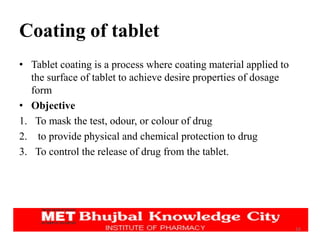
Coating of tablet
• Tablet coating is a process where coating material applied to
the surface of tablet to achieve desire properties of dosage
form
• Objective
1. To mask the test, odour, or colour of drug
2. to provide physical and chemical protection to drug
3. To control the release of drug from the tablet.
16
Coating excipient
• Film former
• Non enteric material – hydroxypropyl methyl cellulose, ethyl
cellulose, methyl hydroxyethyl cellulose, ethyl cellulose,
povidone, hydroxypropyl cellulose, polyethylene glycols.
• Enteric material – cellulose acetate phthalate, acrylate
polymers, hydroxypropyl methyl cellulose phthalate, polyvinyl
acetate phthalate.
17
Coating method
• Sugar coating
Steps – 1)sealing, 2) sub coating, 3) syruping, 4) finishing and
5) polishing.
• Film coating
• Pan-pour method
• Pan-spray method
18
In process quality control test
• Official test
1. Weight variation test
2. Content uniformity test
3. Disintegration test
4. Dissolution test
• Unofficial test
1. Hardness test
2. Friability test
19
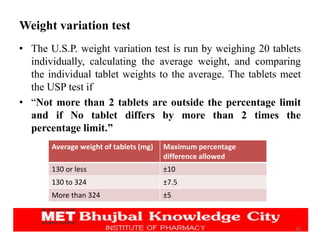
Weight variation test
• The U.S.P. weight variation test is run by weighing 20 tablets
individually, calculating the average weight, and comparing
the individual tablet weights to the average. The tablets meet
the USP test if
• “Not more than 2 tablets are outside the percentage limit
and if No tablet differs by more than 2 times the
percentage limit.”
20
Average weight of tablets (mg) Maximum percentage
difference allowed
130 or less ±10
130 to 324 ±7.5
More than 324 ±5
Content uniformity test
• In this test 30 tablets are randomly selected for sample, and at
least 10 of them are assayed individually according to the
official assay method.
• Nine of the 10 tablets must have potency within ± 15 % of the
labeled drug content. Only one tablet may be within ±25%.
• If this conditions are not met then the tablets remaining from
the 30 must be assayed individually and none may fall outside
±15% of the labeled content.
• Conclusion: Out of the 30 tablets the potency of only 2
tablets may remain within ± 15 to ± 25 % rest of all the
tablets should remain within ± 15%.
21
Disintegration test
• For most tablets, the first important step toward solution is
breakdown of the tablet into smaller particles or granules – this
process is known as disintegration.
• The time a tablet takes to disintegrate is the disintegration
time.
• The USP device to test disintegration uses glass tubes with the
following dimensions:
Number of tubes = 6
Length = 3 inches
Upper end open, lower end closed with #10 mesh screen
22
• To test the disintegration time one tablet is placed in each tube,
and the basket rack assembly is positioned in a 1-litre beaker
of water, simulated gastric fluid or simulated intestinal fluid, at
37◦C ± 2◦C, such that the tablet remain 2.5 cm from the
bottom of the beaker.
• A standard motor moves the basket up and down through a
distance of 5 to 6 cm at a frequency of 28 to 32 cpm (cycles
per minute).
• USP disintegration test will be passed if all the tablets
disintegrate and the particles passed through the #10 mesh
screen within the specified time.
23
24
• Majority of the uncoated tablets have maximum disintegration
time (DT) of 30 minutes, Enteric coated tablets shows no
evidence of disintegration after 2 hrs. in simulated gastric
fluid. The same tablets are then tested in simulated intestinal
fluid and are to disintegrate in 1 hrs.
• Dissolution test
• Disintegration test simply identifies the time required for the
tablet to break up under the condition of the test but it does not
ensure the drug release in the bulk of the fluid.
• Rate of dissolution is directly related to the efficacy of the
drug.
• In general, a single tablet is placed in a small wire mesh basket
and immersed in the dissolution medium contained in a 1000
ml flask at 37 ◦ ± 0.5 ◦ C. Generally it is rotated at 50 rpm and
time require for dissolution is noted.
Hardness test
• The hardness is pressure at which the tablet crushes.
• Unit of hardness: Kg/sq.in. Or lb./ sq.in
• Limit: Generally maximum 5 kg/sq.in. Hardness is required.
• Hardness tester: Monsanto tester, strong-cobb tester, Pfizer
tester, erweka tester, etc.
• Friability test
• Tablet hardness is not an absolute indicator of strength since
some formulations, when compressed into very hard tablets
may produce chipping, capping and lamination problems.
Therefore another measure of tablet strength i.e. friability is
often measured, i.e. the friability.
25
• Instrument: ROCHE FRIABILATOR
• Method: Few tablets, previously weighed (W1) are taken in
the plastic chamber of the laboratory friability tester. In the
plastic chamber the tablets are subjected to abrasion and shock
by rotating the plastic chamber at 25 rpm for 4 mins (i.e. total
100 revolutions). The tablets are dusted and reweighed (W2).
• Limit For conventional compressed tablet the weight loss
should be within 0.5 to 1.0 %.
26
Friability = 100×(1-w2/w1)
Reference
27
1. Roop k Khar, SP Vyas, Farhan k Jain. Lachman/Liberman's
the theory and practice of industrial pharmacy. CBS
publisher& distributor pvt ltd, 2013.
2. Michael E. Aulton, K. M. (n.d.). Aulton's pharmaceutics the
design and manufacture of medicines. Churchill Livingstone
Elsevier.
3. Indian Pharmacopoeia Commission. Indian Pharmacopoeia.
7th ed. Ghaziabad: Indian Pharmacopoeia Commission : 2014.
4. United States Pharmacopeial Convention. United Stated
Pharmacopoeia 33- National Formulary 28. USA : Stationary
office; 2010.

Pharmaceutical Manufacturing Technique PPT

  • 1.
    M. Pharm Sem-IPresentations Title: manufacturing and manufacturing flowchart and IPQC of tablet SUBMITTED TO SAVITRIBAI PHULE, PUNE UNIVERSITY , PUNE FOR PARTIAL FULFILMENT OF REQUIREMENTS FOR THE AWARD OF MASTER OF PHARMACY IN THE SUBJECT Pharmaceutical Quality Assurance IN THE FACULTY OF SCIENCE AND TECHNOLOGY Bhujbal Knowledge City, MET’s Institute of Pharmacy, Adgaon, Nashik, 422003. Maharashtra, India Academic Year-2021-2022 1 Presented By- Prajakta Sanjay thorat Guided By : Dr. s. p. ahirrao
  • 2.
    Content:- • Introduction • Manufacturing •Manufacturing flowchart • IPQC test 2
  • 3.
    Introduction • Tablet isdefine as a compressed solid unit dosage form containing medicament with or without excipient. • Tablets are commonly manufactured by wet granulation, dry granulation or direct compression. • These methods may be considered to consist of a series of steps (unit processes) – weighing, milling, mixing, granulation, drying, compaction, (frequently) coating and packaging. • Regardless of the method used the unit processes – weighing, milling and mixing, are the same; subsequent steps differ. 3
  • 4.
    Primary goals oftablet manufacturing process • To formulate tablets that are strong and hard to withstand mechanical shock encountered during manufacturing, packing, shipping, dispensing and use. • To formulate tablets that are uniform in weight and in drug content. • To formulate tablets that are bioavailable according to indication requirements. • To formulate tablets that are chemically and physically stable over a long period of time. • To formulate tablets that have elegant product identity which is free from any tablet defects 4
  • 5.
    Procedure for ManufacturingTablets • Dispensing: Each ingredient in the tablet formula is weighed and accurately dispensed as per dose. This is one of the critical steps in any type of formulation process and should be done under technical supervision. • Sizing: Formulation ingredients must be in finely divided form, otherwise, size reduction should be carried out for better flow property and easy mixing 5
  • 6.
    CONT…. • Powder blending:Powders are mixed using a suitable blender to obtain a uniform and homogeneous powder mix. The drug substance and excipients are mixed in geometric dilution. • Granulation: Here small powder particles are gathered together into layers, and permanent aggregates to render them into free-flowing states. • Drying and dry screening: Screened wet granules need to be dried for a particular time period in tray dryer or fluid bed dryer at controlled temperature not exceeding 550 ◦C. Dried granules are screened through the appropriate mesh screen 6
  • 7.
    CONT… • Tablet compression:This step involves the compression of granules into a flat or convex, round, oblong, or unique shaped, scored or unscored tablets; engraved with an identifying symbol and/ or code number using tablet press. • Coating: Tablets and granules are coated if there is need to mask the unpleasant taste/odour of some drug substance or to increase the aesthetic appeal of uncoated tablets as well as to modify the release or control the release of drug substance from tablets. This is achieved by enclosing or covering the core tablet or granules with coating solutions 7
  • 8.
    Method used intablet formulation :- • Tablet are commonly manufactured by 1. Direct compression 2. Dry granulation 3. Wet granulation 8
  • 9.
    Direct compression :- •Direct compression involves direct compression of powdered materials into tablets without modifying the physical nature of the materials itself. • Direct compression avoids many of the problems associated with wet and dry granulations. 9
  • 10.
    Manufacturing flowchart 10 Weighing ofall ingredient and API Mixing of all ingredient Milling and sieving Compression
  • 11.
    Dry granulation • Drygranulation involve the compaction of the component of tablet formulation by mean of tablet press followed by milling and screening , prior to final compression into tablet. • When initial blend of powder is forced into the dies of large capacity tablet press and is compacted by mean of flat-faced punches, the compacted masses are called as slugs, and process is called as “slugging”. • The slugs are then screened or milled to produce granule . • Granules are then compressed. 11
  • 12.
    Manufacturing flowchart Weighing ofall ingredient and API Dry mixing of drug and diluent Slugging or pre compression Milling and sieving lubrication Discharge for compression 12
  • 13.
    Wet granulation • Weightgranulation process involve the wet massing of the powder, wet seizing or milling and drying. • Wet granulation forms the granules by binding the powders together with an adhesive. • Addition of granulating liquid to the powder involve the series of stages i.e. pendular, funicular, capillary, and droplet stage 13
  • 14.
    Manufacturing flowchart Weighing, millingand mixing of API with excipient Mix binder solution with powder to form damp mass Screen damp mass into granule using 6-12 mesh screen 14
  • 15.
    Drying moist granule Sizinggranule by dry screening using 14-20 mesh screen Mixing dried granules with lubricant and disintegrant Compression of granule into tablet 15
  • 16.
    Coating of tablet •Tablet coating is a process where coating material applied to the surface of tablet to achieve desire properties of dosage form • Objective 1. To mask the test, odour, or colour of drug 2. to provide physical and chemical protection to drug 3. To control the release of drug from the tablet. 16
  • 17.
    Coating excipient • Filmformer • Non enteric material – hydroxypropyl methyl cellulose, ethyl cellulose, methyl hydroxyethyl cellulose, ethyl cellulose, povidone, hydroxypropyl cellulose, polyethylene glycols. • Enteric material – cellulose acetate phthalate, acrylate polymers, hydroxypropyl methyl cellulose phthalate, polyvinyl acetate phthalate. 17
  • 18.
    Coating method • Sugarcoating Steps – 1)sealing, 2) sub coating, 3) syruping, 4) finishing and 5) polishing. • Film coating • Pan-pour method • Pan-spray method 18
  • 19.
    In process qualitycontrol test • Official test 1. Weight variation test 2. Content uniformity test 3. Disintegration test 4. Dissolution test • Unofficial test 1. Hardness test 2. Friability test 19
  • 20.
    Weight variation test •The U.S.P. weight variation test is run by weighing 20 tablets individually, calculating the average weight, and comparing the individual tablet weights to the average. The tablets meet the USP test if • “Not more than 2 tablets are outside the percentage limit and if No tablet differs by more than 2 times the percentage limit.” 20 Average weight of tablets (mg) Maximum percentage difference allowed 130 or less ±10 130 to 324 ±7.5 More than 324 ±5
  • 21.
    Content uniformity test •In this test 30 tablets are randomly selected for sample, and at least 10 of them are assayed individually according to the official assay method. • Nine of the 10 tablets must have potency within ± 15 % of the labeled drug content. Only one tablet may be within ±25%. • If this conditions are not met then the tablets remaining from the 30 must be assayed individually and none may fall outside ±15% of the labeled content. • Conclusion: Out of the 30 tablets the potency of only 2 tablets may remain within ± 15 to ± 25 % rest of all the tablets should remain within ± 15%. 21
  • 22.
    Disintegration test • Formost tablets, the first important step toward solution is breakdown of the tablet into smaller particles or granules – this process is known as disintegration. • The time a tablet takes to disintegrate is the disintegration time. • The USP device to test disintegration uses glass tubes with the following dimensions: Number of tubes = 6 Length = 3 inches Upper end open, lower end closed with #10 mesh screen 22
  • 23.
    • To testthe disintegration time one tablet is placed in each tube, and the basket rack assembly is positioned in a 1-litre beaker of water, simulated gastric fluid or simulated intestinal fluid, at 37◦C ± 2◦C, such that the tablet remain 2.5 cm from the bottom of the beaker. • A standard motor moves the basket up and down through a distance of 5 to 6 cm at a frequency of 28 to 32 cpm (cycles per minute). • USP disintegration test will be passed if all the tablets disintegrate and the particles passed through the #10 mesh screen within the specified time. 23
  • 24.
    24 • Majority ofthe uncoated tablets have maximum disintegration time (DT) of 30 minutes, Enteric coated tablets shows no evidence of disintegration after 2 hrs. in simulated gastric fluid. The same tablets are then tested in simulated intestinal fluid and are to disintegrate in 1 hrs. • Dissolution test • Disintegration test simply identifies the time required for the tablet to break up under the condition of the test but it does not ensure the drug release in the bulk of the fluid. • Rate of dissolution is directly related to the efficacy of the drug. • In general, a single tablet is placed in a small wire mesh basket and immersed in the dissolution medium contained in a 1000 ml flask at 37 ◦ ± 0.5 ◦ C. Generally it is rotated at 50 rpm and time require for dissolution is noted.
  • 25.
    Hardness test • Thehardness is pressure at which the tablet crushes. • Unit of hardness: Kg/sq.in. Or lb./ sq.in • Limit: Generally maximum 5 kg/sq.in. Hardness is required. • Hardness tester: Monsanto tester, strong-cobb tester, Pfizer tester, erweka tester, etc. • Friability test • Tablet hardness is not an absolute indicator of strength since some formulations, when compressed into very hard tablets may produce chipping, capping and lamination problems. Therefore another measure of tablet strength i.e. friability is often measured, i.e. the friability. 25
  • 26.
    • Instrument: ROCHEFRIABILATOR • Method: Few tablets, previously weighed (W1) are taken in the plastic chamber of the laboratory friability tester. In the plastic chamber the tablets are subjected to abrasion and shock by rotating the plastic chamber at 25 rpm for 4 mins (i.e. total 100 revolutions). The tablets are dusted and reweighed (W2). • Limit For conventional compressed tablet the weight loss should be within 0.5 to 1.0 %. 26 Friability = 100×(1-w2/w1)
  • 27.
    Reference 27 1. Roop kKhar, SP Vyas, Farhan k Jain. Lachman/Liberman's the theory and practice of industrial pharmacy. CBS publisher& distributor pvt ltd, 2013. 2. Michael E. Aulton, K. M. (n.d.). Aulton's pharmaceutics the design and manufacture of medicines. Churchill Livingstone Elsevier. 3. Indian Pharmacopoeia Commission. Indian Pharmacopoeia. 7th ed. Ghaziabad: Indian Pharmacopoeia Commission : 2014. 4. United States Pharmacopeial Convention. United Stated Pharmacopoeia 33- National Formulary 28. USA : Stationary office; 2010.