Physical Geography
Class 5: Earth Movements and
Seasons
What are the changes that happen
seasonally?
• Think about local changes
• Changes elsewhere
• List, with your group, as many seasonal
differences as you can think of
What do you notice about the Sun’s
angle throughout the year?
• Is the sun at the same height each morning
when you wake up?
• Is the sun in the same direction every morning
when you drive to school?
• Does the sun reach the same height in the sky
at its highest throughout the year?
• Think about changes – in your home, along
your commute, at school, etc.
Why is it warmer in Summer?
0%0%0%
1 2 3
1. We’re closer to the
Sun in our annual
orbit
2. We receive more
direct sunlight
3. Our hemisphere is
tilted toward the
sun, making us
closer to the sun
than the other
hemisphere
What causes Earth’s seasons?
• Is it the distance to the Sun?
How does distance to Sun change
throughout year?
• Perihelion – orbital point closest to sun
• Aphelion – orbital point furthest from sun
So what does cause seasons?
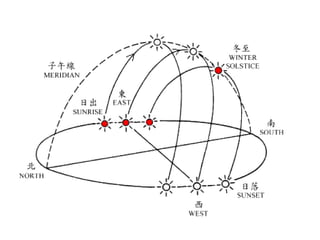
• Angle of sun’s rays changes
• This changes the “subsolar point” = point on
Earth that receives Sun’s direct (90 degree)
rays
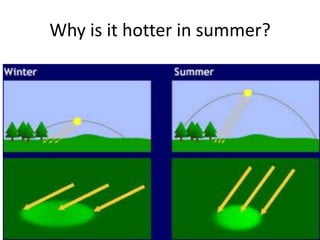
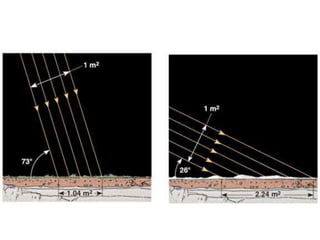
Why is it hotter in summer?
What caused the angle of the Sun’s
rays to change?
• From day to night…..
• From season to season……
• And from place to place?
1. Rotation
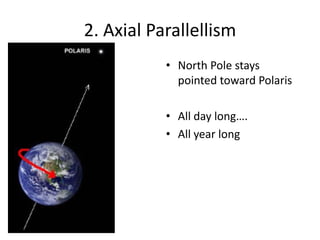
2. Axial Parallellism
• North Pole stays
pointed toward Polaris
• All day long….
• All year long
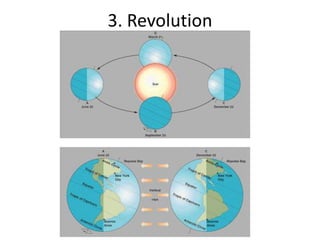
3. Revolution
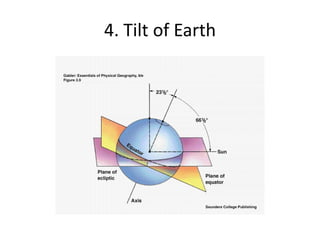
4. Tilt of Earth
This shows axial parallelism, revolution
and tilt
5. Sphericity
• Also shows rotation and tilt
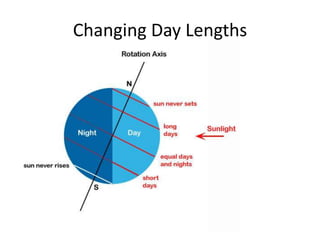
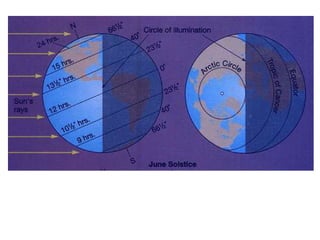
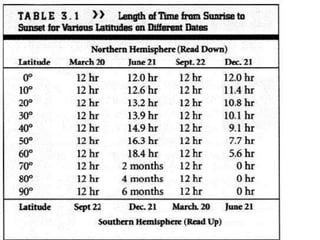
Changing Day Lengths
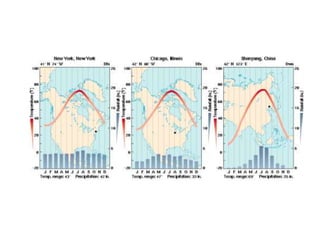
Where are seasonal changes the most
pronounced?
1. Sub Polar
2. Mid Latitudes
3. Sub Tropical
4. Equatorial
Where do daylight hours change the
most?
• Sub Polar
• Mid Latitudes
• Sub Tropical
• Equatorial
80%
20% 0%0%
1 2 3 4
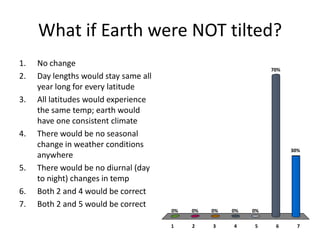
What if Earth were NOT tilted?
1 2 3 4 5 6 7
0% 0% 0%
30%
70%
0%0%
1. No change
2. Day lengths would stay same all
year long for every latitude
3. All latitudes would experience
the same temp; earth would
have one consistent climate
4. There would be no seasonal
change in weather conditions
anywhere
5. There would be no diurnal (day
to night) changes in temp
6. Both 2 and 4 would be correct
7. Both 2 and 5 would be correct
What if Earth were more tilted?
1 2 3 4
0%
10%
20%
70%
1. Conditions would stay the same
2. Summers would be warmer and
winter would be colder, but
average temps would be same
3. More direct rays at higher
latitudes in summer would lead
to warmer overall annual temps
4. Less direct rays at higher
latitudes in winter would lead to
colder temps, more snowfall,
more reflection and less
absorption of sun, leading to
overall cooling
Special Latitudes
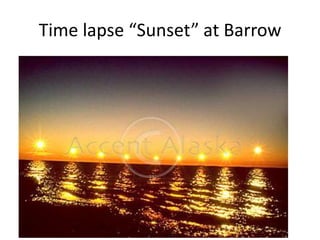
Time lapse “Sunset” at Barrow
Pg tp-class5-earth movements and seasons

Pg tp-class5-earth movements and seasons

  • 1.
    Physical Geography Class 5:Earth Movements and Seasons
  • 2.
    What are thechanges that happen seasonally? • Think about local changes • Changes elsewhere • List, with your group, as many seasonal differences as you can think of
  • 3.
    What do younotice about the Sun’s angle throughout the year? • Is the sun at the same height each morning when you wake up? • Is the sun in the same direction every morning when you drive to school? • Does the sun reach the same height in the sky at its highest throughout the year? • Think about changes – in your home, along your commute, at school, etc.
  • 4.
    Why is itwarmer in Summer? 0%0%0% 1 2 3 1. We’re closer to the Sun in our annual orbit 2. We receive more direct sunlight 3. Our hemisphere is tilted toward the sun, making us closer to the sun than the other hemisphere
  • 5.
    What causes Earth’sseasons? • Is it the distance to the Sun?
  • 7.
    How does distanceto Sun change throughout year? • Perihelion – orbital point closest to sun • Aphelion – orbital point furthest from sun
  • 8.
    So what doescause seasons? • Angle of sun’s rays changes • This changes the “subsolar point” = point on Earth that receives Sun’s direct (90 degree) rays
  • 9.
    Why is ithotter in summer?
  • 11.
    What caused theangle of the Sun’s rays to change? • From day to night….. • From season to season…… • And from place to place?
  • 12.
  • 13.
    2. Axial Parallellism •North Pole stays pointed toward Polaris • All day long…. • All year long
  • 14.
  • 15.
  • 16.
    This shows axialparallelism, revolution and tilt
  • 17.
    5. Sphericity • Alsoshows rotation and tilt
  • 18.
  • 19.
    Where are seasonalchanges the most pronounced? 1. Sub Polar 2. Mid Latitudes 3. Sub Tropical 4. Equatorial
  • 20.
    Where do daylighthours change the most? • Sub Polar • Mid Latitudes • Sub Tropical • Equatorial 80% 20% 0%0% 1 2 3 4
  • 22.
    What if Earthwere NOT tilted? 1 2 3 4 5 6 7 0% 0% 0% 30% 70% 0%0% 1. No change 2. Day lengths would stay same all year long for every latitude 3. All latitudes would experience the same temp; earth would have one consistent climate 4. There would be no seasonal change in weather conditions anywhere 5. There would be no diurnal (day to night) changes in temp 6. Both 2 and 4 would be correct 7. Both 2 and 5 would be correct
  • 23.
    What if Earthwere more tilted? 1 2 3 4 0% 10% 20% 70% 1. Conditions would stay the same 2. Summers would be warmer and winter would be colder, but average temps would be same 3. More direct rays at higher latitudes in summer would lead to warmer overall annual temps 4. Less direct rays at higher latitudes in winter would lead to colder temps, more snowfall, more reflection and less absorption of sun, leading to overall cooling
  • 24.
  • 29.