DAY AND
NIGHT
By abdulbari
WHY DOWE HAVE DAY
AND NIGHT?
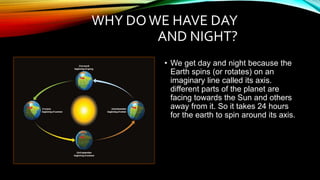
• We get day and night because the
Earth spins (or rotates) on an
imaginary line called its axis.
different parts of the planet are
facing towards the Sun and others
away from it. So it takes 24 hours
for the earth to spin around its axis.
WHAT ISTHE EFFECT BETWEEN DAY AND NIGHT IN
DIFFERENT SEASONS?
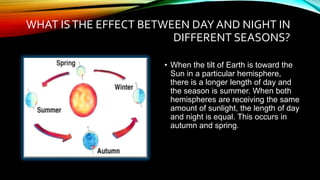
• When the tilt of Earth is toward the
Sun in a particular hemisphere,
there is a longer length of day and
the season is summer. When both
hemispheres are receiving the same
amount of sunlight, the length of day
and night is equal. This occurs in
autumn and spring.
WHY CANWE SEETHE
MOONAT NIGHT?
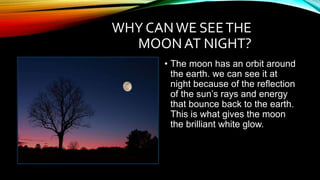
• The moon has an orbit around
the earth. we can see it at
night because of the reflection
of the sun’s rays and energy
that bounce back to the earth.
This is what gives the moon
the brilliant white glow.
WHY CAN’T WE SEETHE
SUN AT NIGHT?
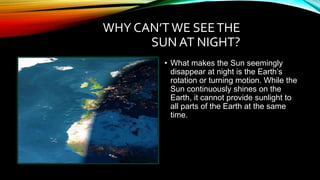
• What makes the Sun seemingly
disappear at night is the Earth’s
rotation or turning motion. While the
Sun continuously shines on the
Earth, it cannot provide sunlight to
all parts of the Earth at the same
time.
QUESTI
ONS
• WHY DO WE HAVE DAY AND NIGHT?
• WHAT IS THE EFFECT BETWEEN DAY AND
NIGHT IN DIFFERENT SEASONS?
• WHY CAN WE SEE THE MOON AT NIGHT?
• WHY CAN’T WE SEE THE SUN AT NIGHT?
SUMM
ERY
• We have day and night because the earth spins on its axis.
• The effect between day and night in different seasons is when the
tilt of Earth is towards the sun in a particular hemisphere.
• We can see the moon at night because of the reflection of the
sun’s rays and energy that bounce back to the Earth.
• We can’t see the sun at night because the Earth rotates while the
sun shines on it, so it cannot provide sunlight to all parts of the
world
Day and night

Day and night

  • 1.
  • 2.
    WHY DOWE HAVEDAY AND NIGHT? • We get day and night because the Earth spins (or rotates) on an imaginary line called its axis. different parts of the planet are facing towards the Sun and others away from it. So it takes 24 hours for the earth to spin around its axis.
  • 3.
    WHAT ISTHE EFFECTBETWEEN DAY AND NIGHT IN DIFFERENT SEASONS? • When the tilt of Earth is toward the Sun in a particular hemisphere, there is a longer length of day and the season is summer. When both hemispheres are receiving the same amount of sunlight, the length of day and night is equal. This occurs in autumn and spring.
  • 4.
    WHY CANWE SEETHE MOONATNIGHT? • The moon has an orbit around the earth. we can see it at night because of the reflection of the sun’s rays and energy that bounce back to the earth. This is what gives the moon the brilliant white glow.
  • 5.
    WHY CAN’T WESEETHE SUN AT NIGHT? • What makes the Sun seemingly disappear at night is the Earth’s rotation or turning motion. While the Sun continuously shines on the Earth, it cannot provide sunlight to all parts of the Earth at the same time.
  • 6.
    QUESTI ONS • WHY DOWE HAVE DAY AND NIGHT? • WHAT IS THE EFFECT BETWEEN DAY AND NIGHT IN DIFFERENT SEASONS? • WHY CAN WE SEE THE MOON AT NIGHT? • WHY CAN’T WE SEE THE SUN AT NIGHT?
  • 7.
    SUMM ERY • We haveday and night because the earth spins on its axis. • The effect between day and night in different seasons is when the tilt of Earth is towards the sun in a particular hemisphere. • We can see the moon at night because of the reflection of the sun’s rays and energy that bounce back to the Earth. • We can’t see the sun at night because the Earth rotates while the sun shines on it, so it cannot provide sunlight to all parts of the world