Environmental Science
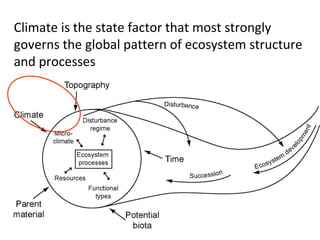
Climate is the state factor that most strongly
governs the global pattern of ecosystem structure
and processes
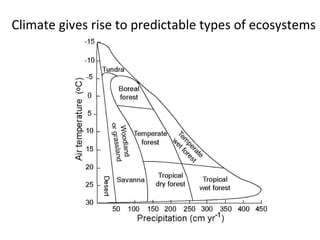
Climate gives rise to predictable types of ecosystems
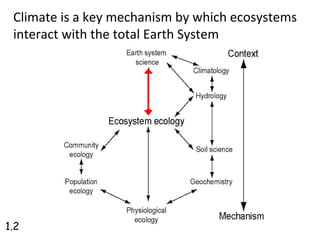
Climate is a key mechanism by which ecosystems
 interact with the total Earth System


1.2
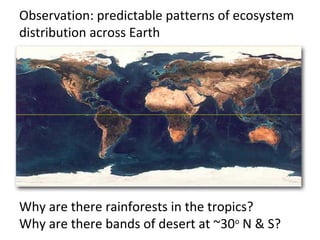
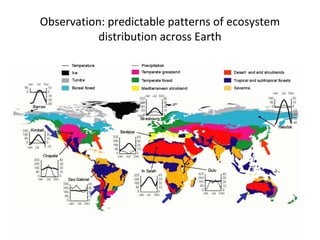
Observation: predictable patterns of ecosystem
distribution across Earth


Why are there rainforests in the tropics?
Why are there bands of desert at ~30o N & S?
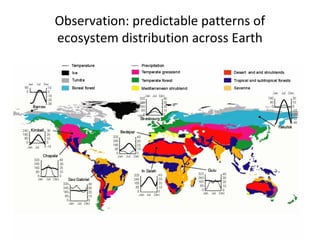
Observation: predictable patterns of
ecosystem distribution across Earth
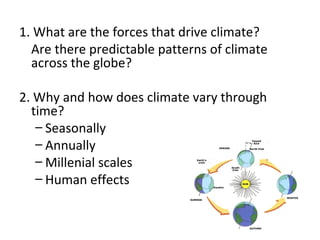
1. What are the forces that drive climate?
  Are there predictable patterns of climate
  across the globe?

2. Why and how does climate vary through
  time?
   – Seasonally
   – Annually
   – Millenial scales
   – Human effects
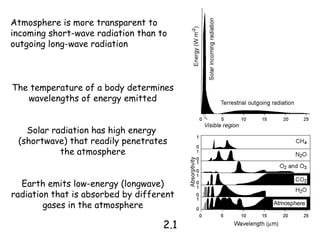
Atmosphere is more transparent to
incoming short-wave radiation than to
outgoing long-wave radiation


The temperature of a body determines
   wavelengths of energy emitted


   Solar radiation has high energy
 (shortwave) that readily penetrates
           the atmosphere


  Earth emits low-energy (longwave)
radiation that is absorbed by different
        gases in the atmosphere

                                    2.1
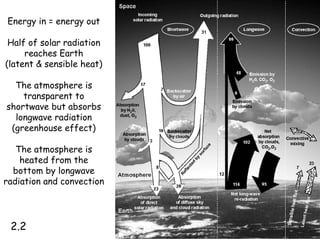
Energy in = energy out

 Half of solar radiation
     reaches Earth
(latent & sensible heat)

  The atmosphere is
    transparent to
shortwave but absorbs
  longwave radiation
 (greenhouse effect)

   The atmosphere is
    heated from the
  bottom by longwave
radiation and convection


 2.2
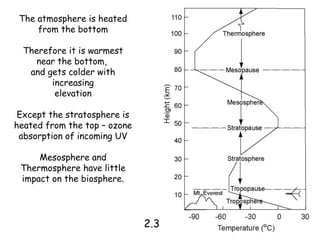
The atmosphere is heated
     from the bottom

  Therefore it is warmest
     near the bottom,
   and gets colder with
        increasing
         elevation

 Except the stratosphere is
heated from the top – ozone
 absorption of incoming UV

     Mesosphere and
 Thermosphere have little
 impact on the biosphere.


                              2.3
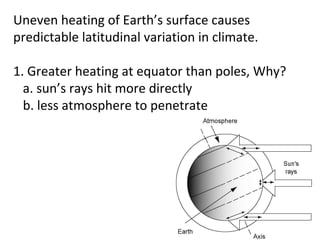
Uneven heating of Earth’s surface causes
predictable latitudinal variation in climate.

1. Greater heating at equator than poles, Why?
  a. sun’s rays hit more directly
  b. less atmosphere to penetrate
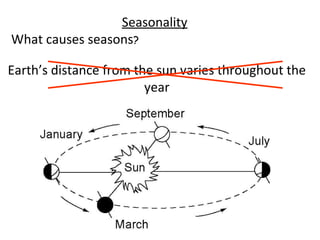
Seasonality
What causes seasons?

Earth’s distance from the sun varies throughout the
                        year
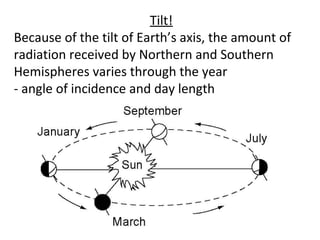
Tilt!
Because of the tilt of Earth’s axis, the amount of
radiation received by Northern and Southern
Hemispheres varies through the year
- angle of incidence and day length
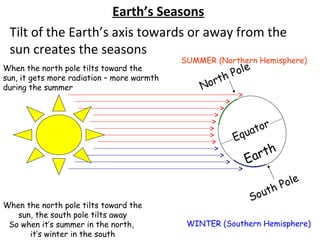
Earth’s Seasons
 Tilt of the Earth’s axis towards or away from the
 sun creates the seasons
                                            SUMMER (Northern Hemisphere)
                                                             e
                                                      P ol
When the north pole tilts toward the
                                                    h
                                                 ort
sun, it gets more radiation – more warmth
during the summer                               N


                                                                  r
                                                           qu ato
                                                       E

                                                             Eart h
                                                                           e
                                                                     h P ol
                                                                 Sout
When the north pole tilts toward the
   sun, the south pole tilts away
 So when it’s summer in the north,           WINTER (Southern Hemisphere)
      it’s winter in the south
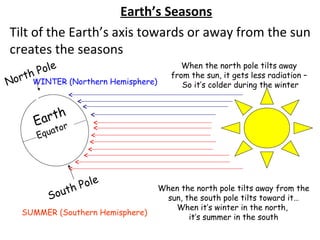
Earth’s Seasons
Tilt of the Earth’s axis towards or away from the sun
creates the seasons
         Pole
                                            When the north pole tilts away
      th                                 from the sun, it gets less radiation –
Nor    WINTER (Northern Hemisphere)         So it’s colder during the winter


          rt h
        Ea or
             t
        Equ a


                 h Pole
             out
                                      When the north pole tilts away from the
           S                           sun, the south pole tilts toward it…
                                         When it’s winter in the north,
  SUMMER (Southern Hemisphere)
                                             it’s summer in the south
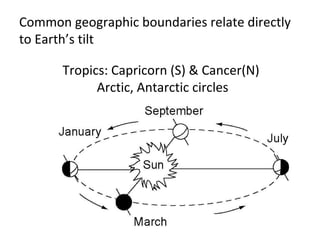
Common geographic boundaries relate directly
to Earth’s tilt

       Tropics: Capricorn (S) & Cancer(N)
             Arctic, Antarctic circles
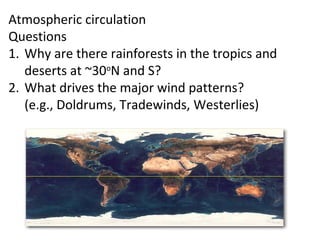
Atmospheric circulation
Questions
1. Why are there rainforests in the tropics and
   deserts at ~30oN and S?
2. What drives the major wind patterns?
   (e.g., Doldrums, Tradewinds, Westerlies)
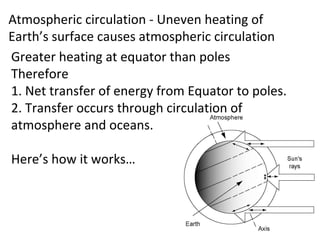
Atmospheric circulation - Uneven heating of
Earth’s surface causes atmospheric circulation
Greater heating at equator than poles
Therefore
1. Net transfer of energy from Equator to poles.
2. Transfer occurs through circulation of
atmosphere and oceans.

Here’s how it works…
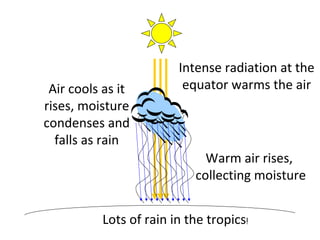
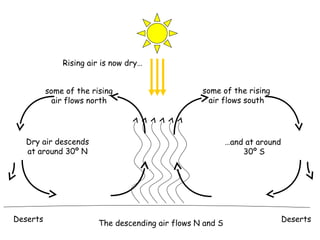
Intense radiation at the
 Air cools as it         equator warms the air
rises, moisture
condenses and
  falls as rain
                             Warm air rises,
                           collecting moisture


          Lots of rain in the tropics!
Rising air is now dry…


          some of the rising                      some of the rising
            air flows north                         air flows south


  Dry air descends                                         …and at around
  at around 30º N                                              30º S


Deserts                                                                     Deserts
                        The descending air flows N and S
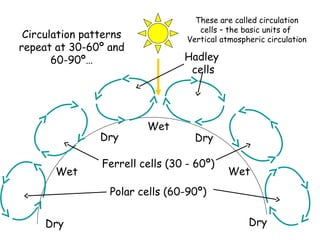
These are called circulation
                                     cells – the basic units of
 Circulation patterns             Vertical atmospheric circulation
repeat at 30-60º and
       60-90º…                   Hadley
                                  cells


                         Wet
                Dry                 Dry

                Ferrell cells (30 - 60º)
       Wet                                  Wet
                  Polar cells (60-90º)


     Dry                                          Dry
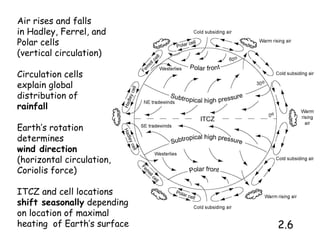
Air rises and falls
in Hadley, Ferrel, and
Polar cells
(vertical circulation)

Circulation cells
explain global
distribution of
rainfall

Earth’s rotation
determines
wind direction
(horizontal circulation,
Coriolis force)

ITCZ and cell locations
shift seasonally depending
on location of maximal
heating of Earth’s surface   2.6
These general circulation patterns are modified
by the distribution of oceans and continents.

High heat capacity of water and ocean currents
buffer ocean temperatures

Land temperatures fluctuate more, especially in
higher latitudes

These differences in surface energy balance
influence air movements, and create prevailing
winds
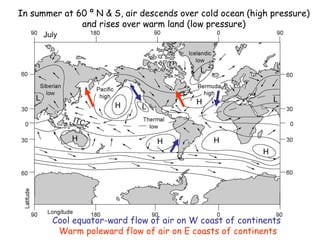
In summer at 60 º N & S, air descends over cold ocean (high pressure)
              and rises over warm land (low pressure)


        Cool equator-ward flow of air on W coast of continents
         Warm poleward flow of air on E coasts of continents
Observation: predictable patterns of ecosystem
           distribution across Earth
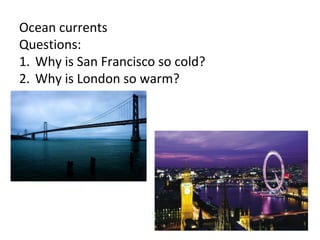
Ocean currents
Questions:
1. Why is San Francisco so cold?
2. Why is London so warm?
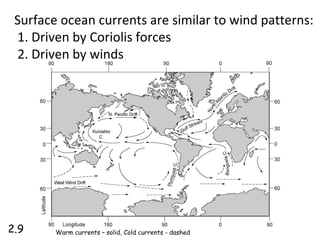
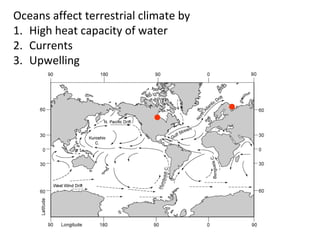
Surface ocean currents are similar to wind patterns:
 1. Driven by Coriolis forces
 2. Driven by winds


2.9     Warm currents – solid, Cold currents - dashed
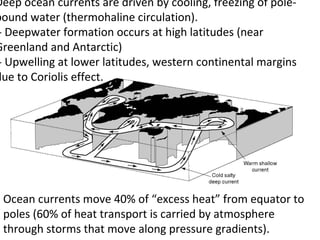
Deep ocean currents are driven by cooling, freezing of pole-
bound water (thermohaline circulation).
- Deepwater formation occurs at high latitudes (near
Greenland and Antarctic)
- Upwelling at lower latitudes, western continental margins
due to Coriolis effect.


 Ocean currents move 40% of “excess heat” from equator to
 poles (60% of heat transport is carried by atmosphere
 through storms that move along pressure gradients).
Oceans affect terrestrial climate by
1. High heat capacity of water
2. Currents
3. Upwelling
Landform effects on climate
Mountain effects
  – Orographic precipitation
  – Rain shadow
  – Effects of aspect
  – Air drainage (inversion, arising due to
    topography, where cold air settles in valleys,
    for example)
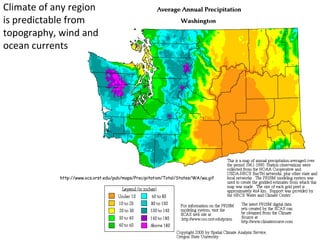
Climate of any region
is predictable from
topography, wind and
ocean currents


            http://www.ocs.orst.edu/pub/maps/Precipitation/Total/States/WA/wa.gif
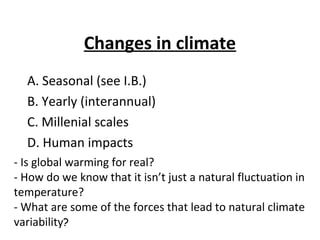
Changes in climate
  A. Seasonal (see I.B.)
  B. Yearly (interannual)
  C. Millenial scales
  D. Human impacts
- Is global warming for real?
- How do we know that it isn’t just a natural fluctuation in
temperature?
- What are some of the forces that lead to natural climate
variability?
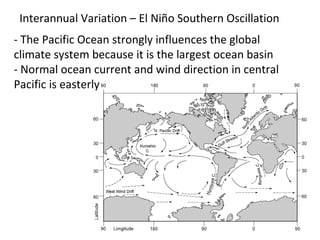
Interannual Variation – El Niño Southern Oscillation
- The Pacific Ocean strongly influences the global
climate system because it is the largest ocean basin
- Normal ocean current and wind direction in central
Pacific is easterly
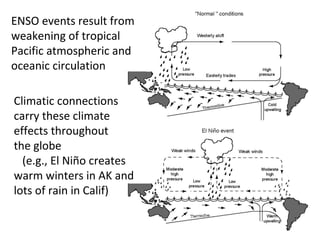
ENSO events result from
weakening of tropical
Pacific atmospheric and
oceanic circulation

Climatic connections
carry these climate
effects throughout
the globe
  (e.g., El Niño creates
warm winters in AK and
lots of rain in Calif)
II. C. Millenial scale variation
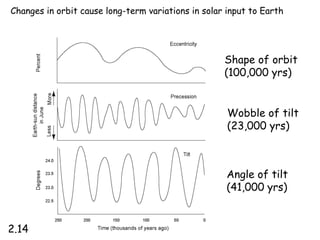
Changes in orbit cause long-term variations in solar input to Earth


                                                    Shape of orbit
                                                    (100,000 yrs)


                                                     Wobble of tilt
                                                     (23,000 yrs)


                                                     Angle of tilt
                                                     (41,000 yrs)


2.14
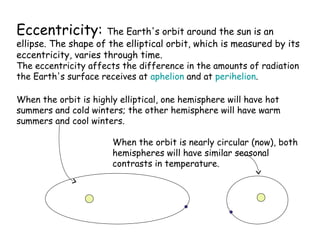
Eccentricity:         The Earth's orbit around the sun is an
ellipse. The shape of the elliptical orbit, which is measured by its
eccentricity, varies through time.
The eccentricity affects the difference in the amounts of radiation
the Earth's surface receives at aphelion and at perihelion.

When the orbit is highly elliptical, one hemisphere will have hot
summers and cold winters; the other hemisphere will have warm
summers and cool winters.

                       When the orbit is nearly circular (now), both
                       hemispheres will have similar seasonal
                       contrasts in temperature.
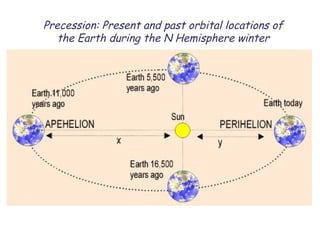
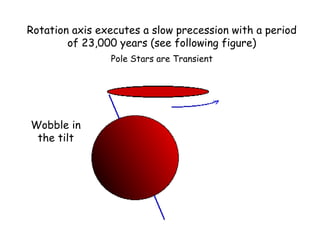
Rotation axis executes a slow precession with a period
        of 23,000 years (see following figure)
                Pole Stars are Transient


Wobble in
 the tilt
Precession: Present and past orbital locations of
   the Earth during the N Hemisphere winter
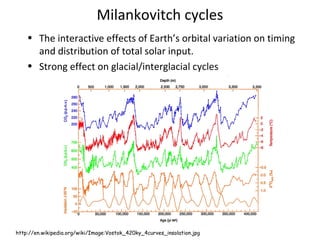
Milankovitch cycles
    • The interactive effects of Earth’s orbital variation on timing
      and distribution of total solar input.
    • Strong effect on glacial/interglacial cycles


http://en.wikipedia.org/wiki/Image:Vostok_420ky_4curves_insolation.jpg
D. Human effects
• Global warming
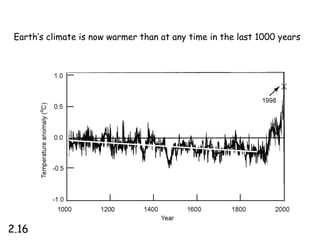
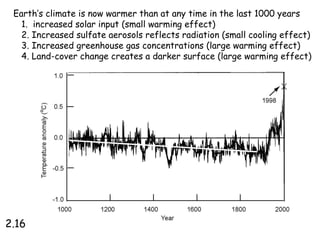
Earth’s climate is now warmer than at any time in the last 1000 years


2.16
How can the
        atmosphere warm?

       1. Increased solar input

 2. Less reflected shortwave,
 less sulfate aerosols, darker
 surface of Earth (land-cover
            change)

      3. More absorbed longwave
      more “greenhouse gases”


2.2
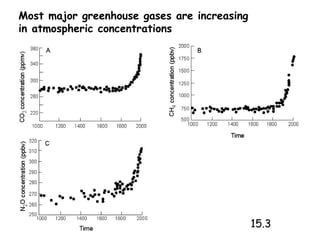
Most major greenhouse gases are increasing
in atmospheric concentrations


                                             15.3
Earth’s climate is now warmer than at any time in the last 1000 years
   1. increased solar input (small warming effect)
   2. Increased sulfate aerosols reflects radiation (small cooling effect)
   3. Increased greenhouse gas concentrations (large warming effect)
   4. Land-cover change creates a darker surface (large warming effect)


2.16
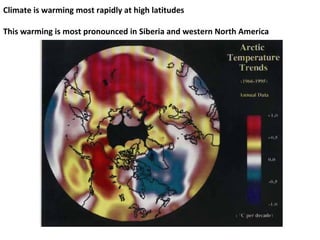
Climate is warming most rapidly at high latitudes

This warming is most pronounced in Siberia and western North America
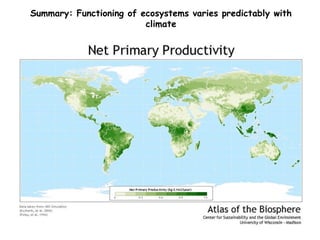
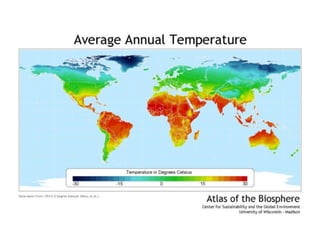
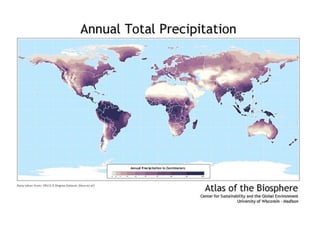
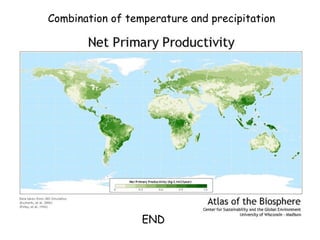
Summary: Functioning of ecosystems varies predictably with
                         climate
Combination of temperature and precipitation


                  END
In January…
 At 30º N & S, air descends more strongly over cold ocean than over land


   At 60 º N & S, air descends more strongly over cold land than over ocean
These pressure gradients create geographic variation in prevailing winds

2.1 environmental science

  • 1.
  • 2.
    Climate is thestate factor that most strongly governs the global pattern of ecosystem structure and processes
  • 3.
    Climate gives riseto predictable types of ecosystems
  • 4.
    Climate is akey mechanism by which ecosystems interact with the total Earth System 1.2
  • 5.
    Observation: predictable patternsof ecosystem distribution across Earth Why are there rainforests in the tropics? Why are there bands of desert at ~30o N & S?
  • 6.
    Observation: predictable patternsof ecosystem distribution across Earth
  • 7.
    1. What arethe forces that drive climate? Are there predictable patterns of climate across the globe? 2. Why and how does climate vary through time? – Seasonally – Annually – Millenial scales – Human effects
  • 8.
    Atmosphere is moretransparent to incoming short-wave radiation than to outgoing long-wave radiation The temperature of a body determines wavelengths of energy emitted Solar radiation has high energy (shortwave) that readily penetrates the atmosphere Earth emits low-energy (longwave) radiation that is absorbed by different gases in the atmosphere 2.1
  • 9.
    Energy in =energy out Half of solar radiation reaches Earth (latent & sensible heat) The atmosphere is transparent to shortwave but absorbs longwave radiation (greenhouse effect) The atmosphere is heated from the bottom by longwave radiation and convection 2.2
  • 10.
    The atmosphere isheated from the bottom Therefore it is warmest near the bottom, and gets colder with increasing elevation Except the stratosphere is heated from the top – ozone absorption of incoming UV Mesosphere and Thermosphere have little impact on the biosphere. 2.3
  • 11.
    Uneven heating ofEarth’s surface causes predictable latitudinal variation in climate. 1. Greater heating at equator than poles, Why? a. sun’s rays hit more directly b. less atmosphere to penetrate
  • 12.
    Seasonality What causes seasons? Earth’sdistance from the sun varies throughout the year
  • 13.
    Tilt! Because of thetilt of Earth’s axis, the amount of radiation received by Northern and Southern Hemispheres varies through the year - angle of incidence and day length
  • 14.
    Earth’s Seasons Tiltof the Earth’s axis towards or away from the sun creates the seasons SUMMER (Northern Hemisphere) e P ol When the north pole tilts toward the h ort sun, it gets more radiation – more warmth during the summer N r qu ato E Eart h e h P ol Sout When the north pole tilts toward the sun, the south pole tilts away So when it’s summer in the north, WINTER (Southern Hemisphere) it’s winter in the south
  • 15.
    Earth’s Seasons Tilt ofthe Earth’s axis towards or away from the sun creates the seasons Pole When the north pole tilts away th from the sun, it gets less radiation – Nor WINTER (Northern Hemisphere) So it’s colder during the winter rt h Ea or t Equ a h Pole out When the north pole tilts away from the S sun, the south pole tilts toward it… When it’s winter in the north, SUMMER (Southern Hemisphere) it’s summer in the south
  • 16.
    Common geographic boundariesrelate directly to Earth’s tilt Tropics: Capricorn (S) & Cancer(N) Arctic, Antarctic circles
  • 17.
    Atmospheric circulation Questions 1. Whyare there rainforests in the tropics and deserts at ~30oN and S? 2. What drives the major wind patterns? (e.g., Doldrums, Tradewinds, Westerlies)
  • 18.
    Atmospheric circulation -Uneven heating of Earth’s surface causes atmospheric circulation Greater heating at equator than poles Therefore 1. Net transfer of energy from Equator to poles. 2. Transfer occurs through circulation of atmosphere and oceans. Here’s how it works…
  • 19.
    Intense radiation atthe Air cools as it equator warms the air rises, moisture condenses and falls as rain Warm air rises, collecting moisture Lots of rain in the tropics!
  • 20.
    Rising air isnow dry… some of the rising some of the rising air flows north air flows south Dry air descends …and at around at around 30º N 30º S Deserts Deserts The descending air flows N and S
  • 21.
    These are calledcirculation cells – the basic units of Circulation patterns Vertical atmospheric circulation repeat at 30-60º and 60-90º… Hadley cells Wet Dry Dry Ferrell cells (30 - 60º) Wet Wet Polar cells (60-90º) Dry Dry
  • 22.
    Air rises andfalls in Hadley, Ferrel, and Polar cells (vertical circulation) Circulation cells explain global distribution of rainfall Earth’s rotation determines wind direction (horizontal circulation, Coriolis force) ITCZ and cell locations shift seasonally depending on location of maximal heating of Earth’s surface 2.6
  • 23.
    These general circulationpatterns are modified by the distribution of oceans and continents. High heat capacity of water and ocean currents buffer ocean temperatures Land temperatures fluctuate more, especially in higher latitudes These differences in surface energy balance influence air movements, and create prevailing winds
  • 24.
    In summer at60 º N & S, air descends over cold ocean (high pressure) and rises over warm land (low pressure) Cool equator-ward flow of air on W coast of continents Warm poleward flow of air on E coasts of continents
  • 25.
    Observation: predictable patternsof ecosystem distribution across Earth
  • 26.
    Ocean currents Questions: 1. Whyis San Francisco so cold? 2. Why is London so warm?
  • 27.
    Surface ocean currentsare similar to wind patterns: 1. Driven by Coriolis forces 2. Driven by winds 2.9 Warm currents – solid, Cold currents - dashed
  • 28.
    Deep ocean currentsare driven by cooling, freezing of pole- bound water (thermohaline circulation). - Deepwater formation occurs at high latitudes (near Greenland and Antarctic) - Upwelling at lower latitudes, western continental margins due to Coriolis effect. Ocean currents move 40% of “excess heat” from equator to poles (60% of heat transport is carried by atmosphere through storms that move along pressure gradients).
  • 29.
    Oceans affect terrestrialclimate by 1. High heat capacity of water 2. Currents 3. Upwelling
  • 30.
    Landform effects onclimate Mountain effects – Orographic precipitation – Rain shadow – Effects of aspect – Air drainage (inversion, arising due to topography, where cold air settles in valleys, for example)
  • 31.
    Climate of anyregion is predictable from topography, wind and ocean currents http://www.ocs.orst.edu/pub/maps/Precipitation/Total/States/WA/wa.gif
  • 32.
    Changes in climate A. Seasonal (see I.B.) B. Yearly (interannual) C. Millenial scales D. Human impacts - Is global warming for real? - How do we know that it isn’t just a natural fluctuation in temperature? - What are some of the forces that lead to natural climate variability?
  • 33.
    Interannual Variation –El Niño Southern Oscillation - The Pacific Ocean strongly influences the global climate system because it is the largest ocean basin - Normal ocean current and wind direction in central Pacific is easterly
  • 34.
    ENSO events resultfrom weakening of tropical Pacific atmospheric and oceanic circulation Climatic connections carry these climate effects throughout the globe (e.g., El Niño creates warm winters in AK and lots of rain in Calif)
  • 35.
    II. C. Millenialscale variation
  • 36.
    Changes in orbitcause long-term variations in solar input to Earth Shape of orbit (100,000 yrs) Wobble of tilt (23,000 yrs) Angle of tilt (41,000 yrs) 2.14
  • 37.
    Eccentricity: The Earth's orbit around the sun is an ellipse. The shape of the elliptical orbit, which is measured by its eccentricity, varies through time. The eccentricity affects the difference in the amounts of radiation the Earth's surface receives at aphelion and at perihelion. When the orbit is highly elliptical, one hemisphere will have hot summers and cold winters; the other hemisphere will have warm summers and cool winters. When the orbit is nearly circular (now), both hemispheres will have similar seasonal contrasts in temperature.
  • 38.
    Rotation axis executesa slow precession with a period of 23,000 years (see following figure) Pole Stars are Transient Wobble in the tilt
  • 39.
    Precession: Present andpast orbital locations of the Earth during the N Hemisphere winter
  • 40.
    Milankovitch cycles • The interactive effects of Earth’s orbital variation on timing and distribution of total solar input. • Strong effect on glacial/interglacial cycles http://en.wikipedia.org/wiki/Image:Vostok_420ky_4curves_insolation.jpg
  • 41.
    D. Human effects •Global warming
  • 42.
    Earth’s climate isnow warmer than at any time in the last 1000 years 2.16
  • 43.
    How can the atmosphere warm? 1. Increased solar input 2. Less reflected shortwave, less sulfate aerosols, darker surface of Earth (land-cover change) 3. More absorbed longwave more “greenhouse gases” 2.2
  • 44.
    Most major greenhousegases are increasing in atmospheric concentrations 15.3
  • 45.
    Earth’s climate isnow warmer than at any time in the last 1000 years 1. increased solar input (small warming effect) 2. Increased sulfate aerosols reflects radiation (small cooling effect) 3. Increased greenhouse gas concentrations (large warming effect) 4. Land-cover change creates a darker surface (large warming effect) 2.16
  • 46.
    Climate is warmingmost rapidly at high latitudes This warming is most pronounced in Siberia and western North America
  • 47.
    Summary: Functioning ofecosystems varies predictably with climate
  • 50.
    Combination of temperatureand precipitation END
  • 51.
    In January… At30º N & S, air descends more strongly over cold ocean than over land At 60 º N & S, air descends more strongly over cold land than over ocean These pressure gradients create geographic variation in prevailing winds

Editor's Notes

  • #3 Climate is the state factor which is most important in explaining global patterns of ecosystem distribution and function. That’s why we have tundra near the poles or mountain tops and rainforest near the equator.
  • #10 Let’s start by trying to understand the average energy budget of Earth. Over a year, on average the amount of incoming energy must be balanced by the same amount of energy leaving Earth.
  • #12 Now let’s look at regional variations in Earth’s energy budget
  • #18 Now let’s look at regional variations in Earth’s energy budget
  • #19 Now let’s look at regional variations in Earth’s energy budget
  • #44 Let’s start by trying to understand the average energy budget of Earth. Over a year, on average the amount of incoming energy must be balanced by the same amount of energy leaving Earth.