Koya University
Faculty of Engineering
Chemical Engineering Department – 2nd Stage
Petroleum Laboratory
Lab Report
Number of Experiment: 4
Experiment Name: Penetration Test
Experiment Date: 25/11/2020
Submitted on: 16/12/2020
Instructor: Mr. Haval
Group: B
Prepared by:
Safeen Yaseen Jafar
Table of Content
Aim of Experiment ..................................................................................................1
Theory/Introduction .................................................................................................2
Tools and Apparatus ................................................................................................3
Procedure .................................................................................................................4
Table of Reading......................................................................................................6
Discussions ..............................................................................................................7
References................................................................................................................8
1
Aim of Experiment
To examine the consistency of a sample of bitumen by determining the distance in
tenths of a millimeter that a standard needle vertically penetrates the bitumen
specimen under known conditions of loading, time and temperature.
2
Theory/Introduction
Aside from chewing, the penetration test is the oldest asphalt test. In 1888, H.C.
Bowen of the Barber Asphalt Paving Company invented the forerunner to the
penetration test, the Bowen Penetration Machine. It’s basic principle, and the basic
principle of the penetration test, was to determine the depth to which a truncated
No. 2 sewing needle penetrated an asphalt sample under specified conditions of
load, time and temperature. In 1915, ASTM even went as far as specifying the
brand of needle. (Halstead and Welborn, 1974). ()
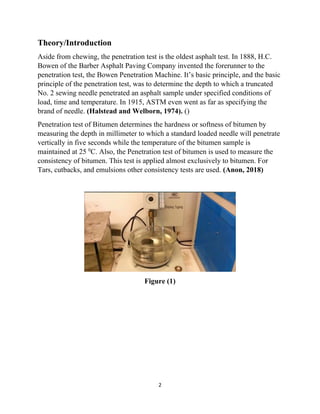
Penetration test of Bitumen determines the hardness or softness of bitumen by
measuring the depth in millimeter to which a standard loaded needle will penetrate
vertically in five seconds while the temperature of the bitumen sample is
maintained at 25 0
C. Also, the Penetration test of bitumen is used to measure the
consistency of bitumen. This test is applied almost exclusively to bitumen. For
Tars, cutbacks, and emulsions other consistency tests are used. (Anon, 2018)
Figure (1)
3
Tools and Apparatus
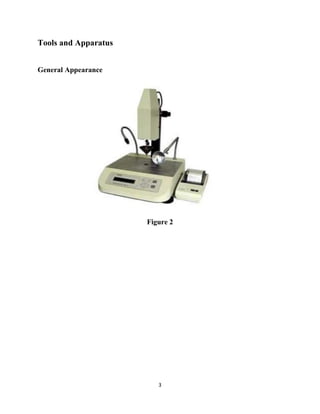
General Appearance
Figure 2
4
Procedure
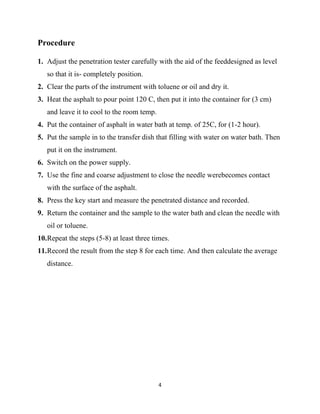
1. Adjust the penetration tester carefully with the aid of the feeddesigned as level
so that it is- completely position.
2. Clear the parts of the instrument with toluene or oil and dry it.
3. Heat the asphalt to pour point 120 C, then put it into the container for (3 cm)
and leave it to cool to the room temp.
4. Put the container of asphalt in water bath at temp. of 25C, for (1-2 hour).
5. Put the sample in to the transfer dish that filling with water on water bath. Then
put it on the instrument.
6. Switch on the power supply.
7. Use the fine and coarse adjustment to close the needle werebecomes contact
with the surface of the asphalt.
8. Press the key start and measure the penetrated distance and recorded.
9. Return the container and the sample to the water bath and clean the needle with
oil or toluene.
10.Repeat the steps (5-8) at least three times.
11.Record the result from the step 8 for each time. And then calculate the average
distance.
5
6
Table of Reading
No. Reading Penetration
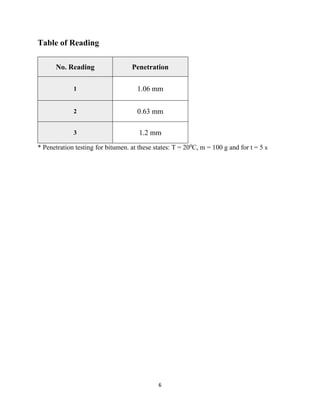
1 1.06 mm
2 0.63 mm
3 1.2 mm
* Penetration testing for bitumen. at these states: T = 200
C, m = 100 g and for t = 5 s
7
Discussions
Discussion – Safeen Yaseen Jafar
1. Discuss the reasons of any error happened during the Exp. And how
can be corrected?
As we saw in the lab, we have some errors in this test like:
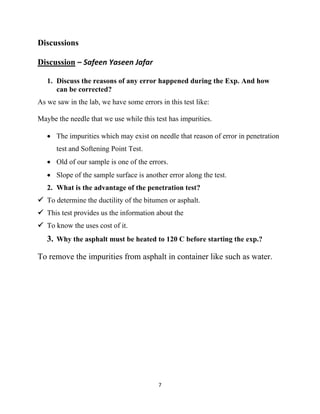
Maybe the needle that we use while this test has impurities.
• The impurities which may exist on needle that reason of error in penetration
test and Softening Point Test.
• Old of our sample is one of the errors.
• Slope of the sample surface is another error along the test.
2. What is the advantage of the penetration test?
✓ To determine the ductility of the bitumen or asphalt.
✓ This test provides us the information about the
✓ To know the uses cost of it.
3. Why the asphalt must be heated to 120 C before starting the exp.?
To remove the impurities from asphalt in container like such as water.
8
References
1. Halstead, W.J. and Welborn, J.Y. (1974). Penetration Test. [online]
Pavement Interactive. Available at:
https://pavementinteractive.org/reference-desk/testing/binder-
tests/penetration-test/. [Accessed 9 Dec. 2020].
2. Anon, (2018). Penetration Test of Bitumen-Procedure, Apparatus, and Uses
for Road Construction – Cement Concrete. [online] Available at:
https://cementconcrete.org/material-testing-guide/penetration-test-of-
bitumen/1216/#:~:text=Penetration%20test%20of%20Bitumen%20determin
es. [Accessed 9 Dec. 2020].

Petroleum lab experiment 04 - penetration

  • 1.
    Koya University Faculty ofEngineering Chemical Engineering Department – 2nd Stage Petroleum Laboratory Lab Report Number of Experiment: 4 Experiment Name: Penetration Test Experiment Date: 25/11/2020 Submitted on: 16/12/2020 Instructor: Mr. Haval Group: B Prepared by: Safeen Yaseen Jafar
  • 2.
    Table of Content Aimof Experiment ..................................................................................................1 Theory/Introduction .................................................................................................2 Tools and Apparatus ................................................................................................3 Procedure .................................................................................................................4 Table of Reading......................................................................................................6 Discussions ..............................................................................................................7 References................................................................................................................8
  • 3.
    1 Aim of Experiment Toexamine the consistency of a sample of bitumen by determining the distance in tenths of a millimeter that a standard needle vertically penetrates the bitumen specimen under known conditions of loading, time and temperature.
  • 4.
    2 Theory/Introduction Aside from chewing,the penetration test is the oldest asphalt test. In 1888, H.C. Bowen of the Barber Asphalt Paving Company invented the forerunner to the penetration test, the Bowen Penetration Machine. It’s basic principle, and the basic principle of the penetration test, was to determine the depth to which a truncated No. 2 sewing needle penetrated an asphalt sample under specified conditions of load, time and temperature. In 1915, ASTM even went as far as specifying the brand of needle. (Halstead and Welborn, 1974). () Penetration test of Bitumen determines the hardness or softness of bitumen by measuring the depth in millimeter to which a standard loaded needle will penetrate vertically in five seconds while the temperature of the bitumen sample is maintained at 25 0 C. Also, the Penetration test of bitumen is used to measure the consistency of bitumen. This test is applied almost exclusively to bitumen. For Tars, cutbacks, and emulsions other consistency tests are used. (Anon, 2018) Figure (1)
  • 5.
    3 Tools and Apparatus GeneralAppearance Figure 2
  • 6.
    4 Procedure 1. Adjust thepenetration tester carefully with the aid of the feeddesigned as level so that it is- completely position. 2. Clear the parts of the instrument with toluene or oil and dry it. 3. Heat the asphalt to pour point 120 C, then put it into the container for (3 cm) and leave it to cool to the room temp. 4. Put the container of asphalt in water bath at temp. of 25C, for (1-2 hour). 5. Put the sample in to the transfer dish that filling with water on water bath. Then put it on the instrument. 6. Switch on the power supply. 7. Use the fine and coarse adjustment to close the needle werebecomes contact with the surface of the asphalt. 8. Press the key start and measure the penetrated distance and recorded. 9. Return the container and the sample to the water bath and clean the needle with oil or toluene. 10.Repeat the steps (5-8) at least three times. 11.Record the result from the step 8 for each time. And then calculate the average distance.
  • 7.
  • 8.
    6 Table of Reading No.Reading Penetration 1 1.06 mm 2 0.63 mm 3 1.2 mm * Penetration testing for bitumen. at these states: T = 200 C, m = 100 g and for t = 5 s
  • 9.
    7 Discussions Discussion – SafeenYaseen Jafar 1. Discuss the reasons of any error happened during the Exp. And how can be corrected? As we saw in the lab, we have some errors in this test like: Maybe the needle that we use while this test has impurities. • The impurities which may exist on needle that reason of error in penetration test and Softening Point Test. • Old of our sample is one of the errors. • Slope of the sample surface is another error along the test. 2. What is the advantage of the penetration test? ✓ To determine the ductility of the bitumen or asphalt. ✓ This test provides us the information about the ✓ To know the uses cost of it. 3. Why the asphalt must be heated to 120 C before starting the exp.? To remove the impurities from asphalt in container like such as water.
  • 10.
    8 References 1. Halstead, W.J.and Welborn, J.Y. (1974). Penetration Test. [online] Pavement Interactive. Available at: https://pavementinteractive.org/reference-desk/testing/binder- tests/penetration-test/. [Accessed 9 Dec. 2020]. 2. Anon, (2018). Penetration Test of Bitumen-Procedure, Apparatus, and Uses for Road Construction – Cement Concrete. [online] Available at: https://cementconcrete.org/material-testing-guide/penetration-test-of- bitumen/1216/#:~:text=Penetration%20test%20of%20Bitumen%20determin es. [Accessed 9 Dec. 2020].