Department of Civil Engineering
Indian Institute of Technology Guwahati
Presented by
Sunny Kumar (236104108)
PhD, IIT Guwahati
Guided by
Dr. Rajan Choudhary
Professor
Department of Civil Engineering, IIT Guwahati
A Presentation on Asphalt Binder
Introduction
1. Bitumen have adhesive and waterproofing
properties
2. Bitumen is available Naturally or By Refining
from crude oil
3. Bitumen behave as a softer and harder
4. Expose fume at higher temperature
1. Tar has a similar application
2. Tar is available By manufacturing from
destructive distillation of bituminous coal
3. Comparative harder at a lower temperature
4. Expose more fumes
Bitumen (Asphalt) Tar
Bitumen
Natural Refined
(Obtained from
veins rock
formation)
(Obtained by
refining of petrol
crude)
https://www.indiamart.com/proddetail/ref
ining-bitumen-oil-21833125891.html
https://gilsoniteco.com/2017/06/21/natura
l-bitumen/
https://infinitygalaxy.org/where-does-bitumen-come-from
https://www.bitumenmalaysia.com/natural-bitumen-
gilsonite-like/
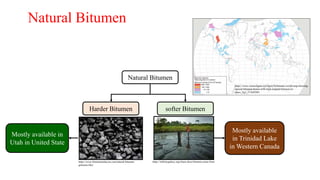
Mostly available in
Utah in United State
Mostly available
in Trinidad Lake
in Western Canada
Harder Bitumen softer Bitumen
Natural Bitumen
Natural Bitumen
https://www.researchgate.net/figure/Schematic-world-map-showing-
natural-bitumen-basins-with-total-original-bitumen-in-
place_fig1_273692901
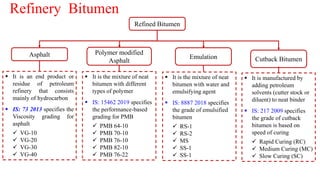
Refinery Bitumen
Cutback Bitumen
Polymer modified
Asphalt
Emulation
Refined Bitumen
Asphalt
 It is an end product or
residue of petroleum
refinery that consists
mainly of hydrocarbon
 IS: 73 2013 specifies the
Viscosity grading for
asphalt
 VG-10
 VG-20
 VG-30
 VG-40
 It is the mixture of neat
bitumen with different
types of polymer
 IS: 15462 2019 specifies
the performance-based
grading for PMB
 PMB 64-10
 PMB 70-10
 PMB 76-10
 PMB 82-10
 PMB 76-22
 It is the mixture of neat
bitumen with water and
emulsifying agent
 IS: 8887 2018 specifies
the grade of emulsified
bitumen
 RS-1
 RS-2
 MS
 SS-1
 SS-1
 It is manufactured by
adding petroleum
solvents (cutter stock or
diluent) to neat binder
 IS: 217 2009 specifies
the grade of cutback
bitumen is based on
speed of curing
 Rapid Curing (RC)
 Medium Curing (MC)
 Slow Curing (SC)
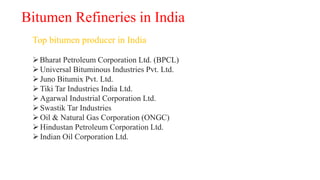
Bitumen Refineries in India
Top bitumen producer in India
Bharat Petroleum Corporation Ltd. (BPCL)
Universal Bituminous Industries Pvt. Ltd.
Juno Bitumix Pvt. Ltd.
Tiki Tar Industries India Ltd.
Agarwal Industrial Corporation Ltd.
Swastik Tar Industries
Oil & Natural Gas Corporation (ONGC)
Hindustan Petroleum Corporation Ltd.
Indian Oil Corporation Ltd.
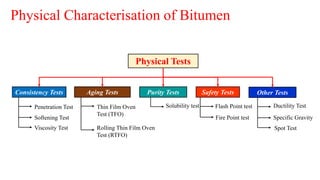
Physical Characterisation of Bitumen
Physical Tests
Consistency Tests Aging Tests Purity Tests Safety Tests Other Tests
Penetration Test
Softening Test
Viscosity Test
Thin Film Oven
Test (TFO)
Rolling Thin Film Oven
Test (RTFO)
Solubility test Flash Point test
Fire Point test
Ductility Test
Specific Gravity
Spot Test
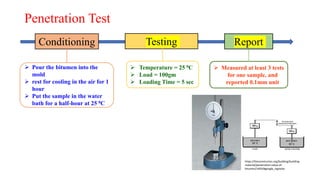
Penetration Test
Conditioning Testing Report
https://theconstructor.org/building/building-
material/penetration-value-of-
bitumen/1403/#google_vignette
 Pour the bitumen into the
mold
 rest for cooling in the air for 1
hour
 Put the sample in the water
bath for a half-hour at 25 0C
 Temperature = 25 0C
 Load = 100gm
 Loading Time = 5 sec
 Measured at least 3 tests
for one sample, and
reported 0.1mm unit
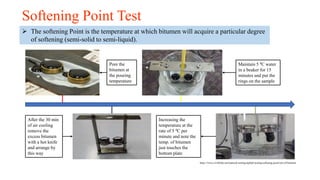
Softening Point Test
 The softening Point is the temperature at which bitumen will acquire a particular degree
of softening (semi-solid to semi-liquid).
Pore the
bitumen at
the pouring
temperature
After the 30 min
of air cooling
remove the
excess bitumen
with a hot knife
and arrange by
this way
Maintain 5 0C water
in a beaker for 15
minutes and put the
rings on the sample
Increasing the
temperature at the
rate of 5 0C per
minute and note the
temp. of bitumen
just touches the
bottom plate
https://www.civilferba.net/material-testing/asphalt-testing/softening-point-test-of-bitumen
Viscosity Test
 The viscosity of bitumen is defined as resistance to flow. It measured mainly 60 0C (Absolute
Viscosity) and 135 0C (Kinematic Viscosity)
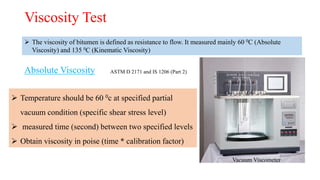
Absolute Viscosity
Vacuum Viscometer
 Temperature should be 60 0c at specified partial
vacuum condition (specific shear stress level)
 measured time (second) between two specified levels
 Obtain viscosity in poise (time * calibration factor)
ASTM D 2171 and IS 1206 (Part 2)
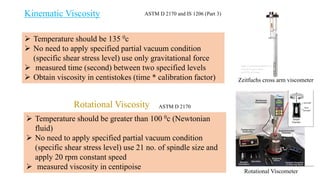
Kinematic Viscosity ASTM D 2170 and IS 1206 (Part 3)
 Temperature should be 135 0c
 No need to apply specified partial vacuum condition
(specific shear stress level) use only gravitational force
 measured time (second) between two specified levels
 Obtain viscosity in centistokes (time * calibration factor)
https://cannoninstrument.co
m/zcac-4-zeit-x-arm-
cal9723-s59.html
Zeitfuchs cross arm viscometer
Rotational Viscometer
ASTM D 2170
Rotational Viscosity
 Temperature should be greater than 100 0c (Newtonian
fluid)
 No need to apply specified partial vacuum condition
(specific shear stress level) use 21 no. of spindle size and
apply 20 rpm constant speed
 measured viscosity in centipoise
Durability Test
 The durability test quantifies the effect of aging (hardening) properties of asphalt binder. Bitumen
ages during hot storage, production, and in-service.
Ageing Test
Short-term aging
(TFO, RTFO)
Long-term aging
(PAV)
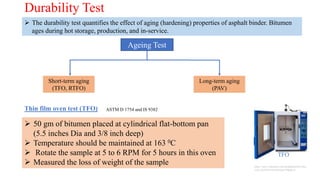
Thin film oven test (TFO) ASTM D 1754 and IS 9382
 50 gm of bitumen placed at cylindrical flat-bottom pan
(5.5 inches Dia and 3/8 inch deep)
 Temperature should be maintained at 163 0C
 Rotate the sample at 5 to 6 RPM for 5 hours in this oven
 Measured the loss of weight of the sample
TFO
https://www.indiamart.com/proddetail/thin-film-
oven-2654956730.html?pos=9&pla=n
Rolling Thin Film Oven Test (RTFO)
RTFO
https://www.matest.com/en/rolling-thin-film-
oven/
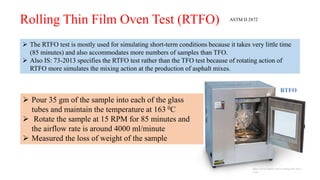
 The RTFO test is mostly used for simulating short-term conditions because it takes very little time
(85 minutes) and also accommodates more numbers of samples than TFO.
 Also IS: 73-2013 specifies the RTFO test rather than the TFO test because of rotating action of
RTFO more simulates the mixing action at the production of asphalt mixes.
ASTM D 2872
 Pour 35 gm of the sample into each of the glass
tubes and maintain the temperature at 163 0C
 Rotate the sample at 15 RPM for 85 minutes and
the airflow rate is around 4000 ml/minute
 Measured the loss of weight of the sample
Purity Test
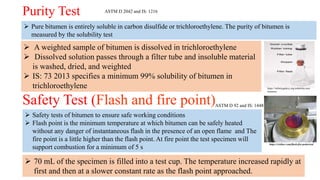
 Pure bitumen is entirely soluble in carbon disulfide or trichloroethylene. The purity of bitumen is
measured by the solubility test
ASTM D 2042 and IS: 1216
https://infinitygalaxy.org/solubility-test-
bitumen/
 A weighted sample of bitumen is dissolved in trichloroethylene
 Dissolved solution passes through a filter tube and insoluble material
is washed, dried, and weighted
 IS: 73 2013 specifies a minimum 99% solubility of bitumen in
trichloroethylene
Safety Test (Flash and fire point)
https://civilarc.com/flash-fire-point-test/
ASTM D 92 and IS: 1448
 Safety tests of bitumen to ensure safe working conditions
 Flash point is the minimum temperature at which bitumen can be safely heated
without any danger of instantaneous flash in the presence of an open flame and The
fire point is a little higher than the flash point. At fire point the test specimen will
support combustion for a minimum of 5 s
 70 mL of the specimen is filled into a test cup. The temperature increased rapidly at
first and then at a slower constant rate as the flash point approached.
Bitumen Characterization
 Bitumen is characterized by penetration grading and viscosity grading
Penetration Grading
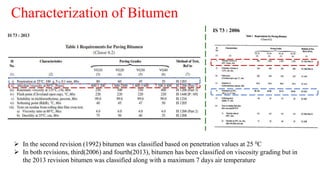
Characterization of Bitumen
 In the second revision (1992) bitumen was classified based on penetration values at 25 0C
 In both revisions, third(2006) and fourth(2013), bitumen has been classified on viscosity grading but in
the 2013 revision bitumen was classified along with a maximum 7 days air temperature
IS 73 : 2006

Chapter 1 Bituminous Binder for Roads.pptx

  • 1.
    Department of CivilEngineering Indian Institute of Technology Guwahati Presented by Sunny Kumar (236104108) PhD, IIT Guwahati Guided by Dr. Rajan Choudhary Professor Department of Civil Engineering, IIT Guwahati A Presentation on Asphalt Binder
  • 2.
    Introduction 1. Bitumen haveadhesive and waterproofing properties 2. Bitumen is available Naturally or By Refining from crude oil 3. Bitumen behave as a softer and harder 4. Expose fume at higher temperature 1. Tar has a similar application 2. Tar is available By manufacturing from destructive distillation of bituminous coal 3. Comparative harder at a lower temperature 4. Expose more fumes Bitumen (Asphalt) Tar Bitumen Natural Refined (Obtained from veins rock formation) (Obtained by refining of petrol crude) https://www.indiamart.com/proddetail/ref ining-bitumen-oil-21833125891.html https://gilsoniteco.com/2017/06/21/natura l-bitumen/
  • 3.
    https://infinitygalaxy.org/where-does-bitumen-come-from https://www.bitumenmalaysia.com/natural-bitumen- gilsonite-like/ Mostly available in Utahin United State Mostly available in Trinidad Lake in Western Canada Harder Bitumen softer Bitumen Natural Bitumen Natural Bitumen https://www.researchgate.net/figure/Schematic-world-map-showing- natural-bitumen-basins-with-total-original-bitumen-in- place_fig1_273692901
  • 4.
    Refinery Bitumen Cutback Bitumen Polymermodified Asphalt Emulation Refined Bitumen Asphalt  It is an end product or residue of petroleum refinery that consists mainly of hydrocarbon  IS: 73 2013 specifies the Viscosity grading for asphalt  VG-10  VG-20  VG-30  VG-40  It is the mixture of neat bitumen with different types of polymer  IS: 15462 2019 specifies the performance-based grading for PMB  PMB 64-10  PMB 70-10  PMB 76-10  PMB 82-10  PMB 76-22  It is the mixture of neat bitumen with water and emulsifying agent  IS: 8887 2018 specifies the grade of emulsified bitumen  RS-1  RS-2  MS  SS-1  SS-1  It is manufactured by adding petroleum solvents (cutter stock or diluent) to neat binder  IS: 217 2009 specifies the grade of cutback bitumen is based on speed of curing  Rapid Curing (RC)  Medium Curing (MC)  Slow Curing (SC)
  • 5.
    Bitumen Refineries inIndia Top bitumen producer in India Bharat Petroleum Corporation Ltd. (BPCL) Universal Bituminous Industries Pvt. Ltd. Juno Bitumix Pvt. Ltd. Tiki Tar Industries India Ltd. Agarwal Industrial Corporation Ltd. Swastik Tar Industries Oil & Natural Gas Corporation (ONGC) Hindustan Petroleum Corporation Ltd. Indian Oil Corporation Ltd.
  • 6.
    Physical Characterisation ofBitumen Physical Tests Consistency Tests Aging Tests Purity Tests Safety Tests Other Tests Penetration Test Softening Test Viscosity Test Thin Film Oven Test (TFO) Rolling Thin Film Oven Test (RTFO) Solubility test Flash Point test Fire Point test Ductility Test Specific Gravity Spot Test
  • 7.
    Penetration Test Conditioning TestingReport https://theconstructor.org/building/building- material/penetration-value-of- bitumen/1403/#google_vignette  Pour the bitumen into the mold  rest for cooling in the air for 1 hour  Put the sample in the water bath for a half-hour at 25 0C  Temperature = 25 0C  Load = 100gm  Loading Time = 5 sec  Measured at least 3 tests for one sample, and reported 0.1mm unit
  • 8.
    Softening Point Test The softening Point is the temperature at which bitumen will acquire a particular degree of softening (semi-solid to semi-liquid). Pore the bitumen at the pouring temperature After the 30 min of air cooling remove the excess bitumen with a hot knife and arrange by this way Maintain 5 0C water in a beaker for 15 minutes and put the rings on the sample Increasing the temperature at the rate of 5 0C per minute and note the temp. of bitumen just touches the bottom plate https://www.civilferba.net/material-testing/asphalt-testing/softening-point-test-of-bitumen
  • 9.
    Viscosity Test  Theviscosity of bitumen is defined as resistance to flow. It measured mainly 60 0C (Absolute Viscosity) and 135 0C (Kinematic Viscosity) Absolute Viscosity Vacuum Viscometer  Temperature should be 60 0c at specified partial vacuum condition (specific shear stress level)  measured time (second) between two specified levels  Obtain viscosity in poise (time * calibration factor) ASTM D 2171 and IS 1206 (Part 2)
  • 10.
    Kinematic Viscosity ASTMD 2170 and IS 1206 (Part 3)  Temperature should be 135 0c  No need to apply specified partial vacuum condition (specific shear stress level) use only gravitational force  measured time (second) between two specified levels  Obtain viscosity in centistokes (time * calibration factor) https://cannoninstrument.co m/zcac-4-zeit-x-arm- cal9723-s59.html Zeitfuchs cross arm viscometer Rotational Viscometer ASTM D 2170 Rotational Viscosity  Temperature should be greater than 100 0c (Newtonian fluid)  No need to apply specified partial vacuum condition (specific shear stress level) use 21 no. of spindle size and apply 20 rpm constant speed  measured viscosity in centipoise
  • 11.
    Durability Test  Thedurability test quantifies the effect of aging (hardening) properties of asphalt binder. Bitumen ages during hot storage, production, and in-service. Ageing Test Short-term aging (TFO, RTFO) Long-term aging (PAV) Thin film oven test (TFO) ASTM D 1754 and IS 9382  50 gm of bitumen placed at cylindrical flat-bottom pan (5.5 inches Dia and 3/8 inch deep)  Temperature should be maintained at 163 0C  Rotate the sample at 5 to 6 RPM for 5 hours in this oven  Measured the loss of weight of the sample TFO https://www.indiamart.com/proddetail/thin-film- oven-2654956730.html?pos=9&pla=n
  • 12.
    Rolling Thin FilmOven Test (RTFO) RTFO https://www.matest.com/en/rolling-thin-film- oven/  The RTFO test is mostly used for simulating short-term conditions because it takes very little time (85 minutes) and also accommodates more numbers of samples than TFO.  Also IS: 73-2013 specifies the RTFO test rather than the TFO test because of rotating action of RTFO more simulates the mixing action at the production of asphalt mixes. ASTM D 2872  Pour 35 gm of the sample into each of the glass tubes and maintain the temperature at 163 0C  Rotate the sample at 15 RPM for 85 minutes and the airflow rate is around 4000 ml/minute  Measured the loss of weight of the sample
  • 13.
    Purity Test  Purebitumen is entirely soluble in carbon disulfide or trichloroethylene. The purity of bitumen is measured by the solubility test ASTM D 2042 and IS: 1216 https://infinitygalaxy.org/solubility-test- bitumen/  A weighted sample of bitumen is dissolved in trichloroethylene  Dissolved solution passes through a filter tube and insoluble material is washed, dried, and weighted  IS: 73 2013 specifies a minimum 99% solubility of bitumen in trichloroethylene Safety Test (Flash and fire point) https://civilarc.com/flash-fire-point-test/ ASTM D 92 and IS: 1448  Safety tests of bitumen to ensure safe working conditions  Flash point is the minimum temperature at which bitumen can be safely heated without any danger of instantaneous flash in the presence of an open flame and The fire point is a little higher than the flash point. At fire point the test specimen will support combustion for a minimum of 5 s  70 mL of the specimen is filled into a test cup. The temperature increased rapidly at first and then at a slower constant rate as the flash point approached.
  • 14.
    Bitumen Characterization  Bitumenis characterized by penetration grading and viscosity grading Penetration Grading
  • 15.
    Characterization of Bitumen In the second revision (1992) bitumen was classified based on penetration values at 25 0C  In both revisions, third(2006) and fourth(2013), bitumen has been classified on viscosity grading but in the 2013 revision bitumen was classified along with a maximum 7 days air temperature IS 73 : 2006