Perthes Disease
Definition
 It is a self limiting disorder of the hip
produced by ischemia and varying
degrees of necrosis of the femoral
head.
Synonyms
 Coxa Plana
 Pseudocoxalgia (Calve)
 Arthritis deformans juvenilis
(Perthes)
 Osteochondroses of the hip.
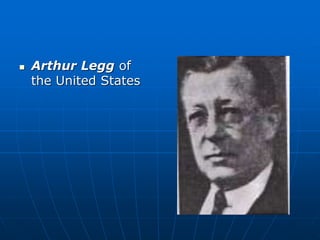
 Arthur Legg of
the United States
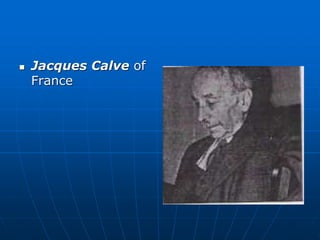
 Jacques Calve of
France
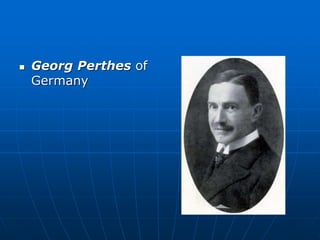
 Georg Perthes of
Germany
Historical aspect
 Parker started the use of broomstick
cast in 1929.
 Eyre-Brook introduced traction in bed
for 18-24 months.
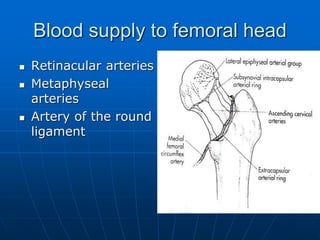
Blood supply to femoral head
 Retinacular arteries
 Metaphyseal
arteries
 Artery of the round
ligament
Blood supply to femoral head
 Infants
1. Metaphyseal arteries .
2. Lat epiphyseal arteries
3. Lig teres – insignificant
 4 mts – 4 years
1. Lat epiphyseal
2. Metaphyseal art. decrease in number
(due to appearance of growth plate).
Blood supply to femoral head
 4 yrs to 7 years
1. Epiphyseal plate forms a barrier to
metaphyseal vessels.
 Pre-adolescent
1. After 7 yrs arteries of lig teres become
more prominent and anastomose with
the lateral epiphyseal vessels.
Blood supply to femoral head
 Adolescent
After skeletal maturity metaphyseal
vessels again come into picture
Incidence
 Male : Female = 4-5:1
 2.5:1 in India
 Age of onset earlier in females.
 Age –
Range – 2-13 years.
Most common 4-8 years.
Average – 6 years.
 Bilateral in 10-12 %
 Incidence more in Caucasians as compared
to Negroid, mongoloid.
Etiology
 Etiology not known.
 Coagulation disorders.
 Altered arterial status of femoral head.
 Abnormal venous drainage.
 Abnormal growth and development.
 Trauma.
 Hyperactivity or attention deficit
disorder.
 Genetic component.
 Environmental influences.
 As a sequelae to synovitis.
Coagulation disorders
 Protein C or S deficiency
 Thrombophilia
 Hypofibrinolysis
Altered arterial status
 Angiographic studies have shown obstruction of
superior capsular arteries and decreased flow in
medial circumflex femoral arteries .
 The intracapsular ring has been found to be
incomplete.
Abnormal venous drainage
 Increased venous pressure in the
femoral neck
 Congestion in the metaphysis
 Venous outflow exits more distally in the
diaphysis.
Abnormal growth and
development
 A delay in Bone age of 1.5 to 2
years
 Low birth weight
 Low levels of somatomedin C
Trauma.
 In the developing femur (4 – 7
yrs),the major lateral epiphyseal
vessels must course through a
narrow passage ,which could make it
susceptible to trauma.
Hyperactivity or attention
deficit disorder
Genetic component
 Familial association.
 X-Linked recessive inheritance.
Environmental influences
 Low socioeconomic status.
Sequel to synovitis
 Synovitis of the hip occurs early in
Perthes disease.
 Increased pressure in synovitis may
cause a tamponade effect on the
vasculature
Pathogenesis
 Waldenstrom staged the
pathological process of the disease
as
1. Initial or ischaemic stage
2. Resorption or fragmentation stage
3. Reparative stage
4. Remodelling stage
Pathogenesis
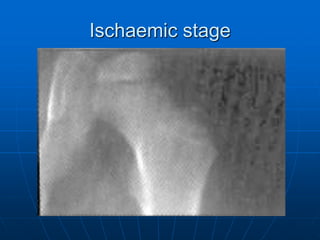
 Ischaemic stage
- Necrosis
- Crushing of trabaculae.
- degeneration of basal layer of
articular cartilage
- Thickening of peripheral
cartilagenous cap.
- Shape of head maintained.
Ischaemic stage
Pathogenesis cont…
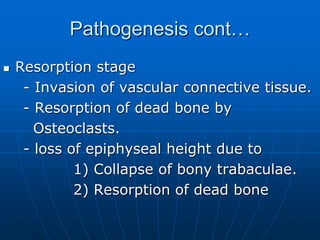
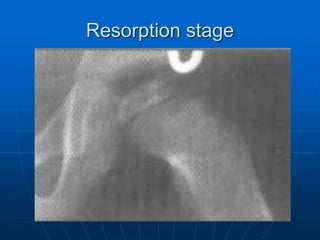
 Resorption stage
- Invasion of vascular connective tissue.
- Resorption of dead bone by
Osteoclasts.
- loss of epiphyseal height due to
1) Collapse of bony trabaculae.
2) Resorption of dead bone
Resorption stage
Pathogenesis cont…
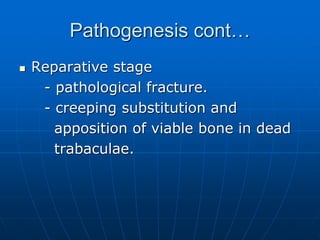
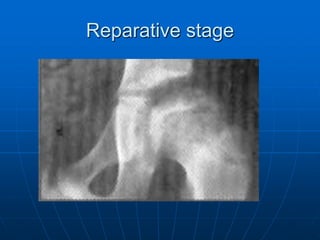
 Reparative stage
- pathological fracture.
- creeping substitution and
apposition of viable bone in dead
trabaculae.
Reparative stage
Remodelling stage
(replacement by biologically
plastic bone)
If treated
 Femoral head is
congrous
If untreated
 Subluxation and
deformity
Clinical Features
 Painless limp leads to painful limp
 Pain in the groin,anterior hip
or greater trochanter
 Referred pain to the knee
 Combination of antalgic & trendelenburg
gait.
 Decreased range of motion especially
abduction and internal rotation.
 Atrophy of thigh muscles.
 Shortening
Investigation
 X-Ray –AP & Frog leg Lat view
(Lowenstein view)
 USG
 Arthrography
 Bone Scan
 MRI
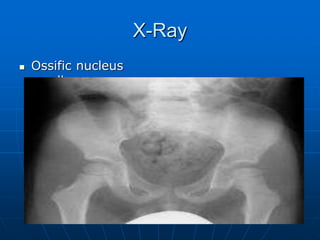
X-Ray
 Ossific nucleus
smaller
X-Ray
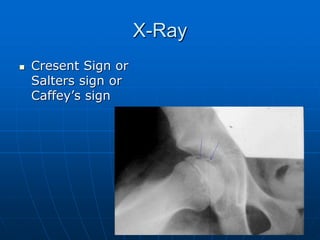
 Cresent Sign or
Salters sign or
Caffey’s sign
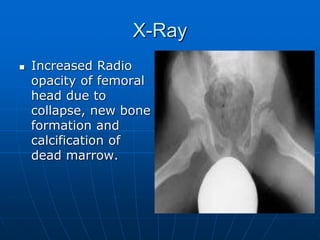
X-Ray
 Increased Radio
opacity of femoral
head due to
collapse, new bone
formation and
calcification of
dead marrow.
X-Ray
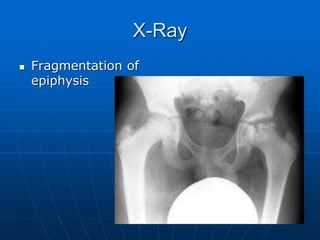
 Fragmentation of
epiphysis
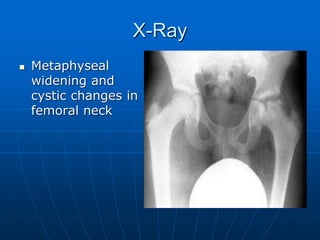
X-Ray
 Metaphyseal
widening and
cystic changes in
femoral neck
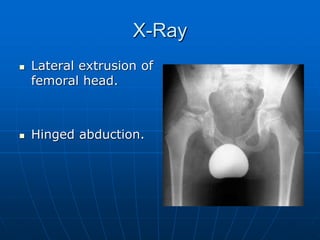
X-Ray
 Lateral extrusion of
femoral head.
 Hinged abduction.
X-Ray
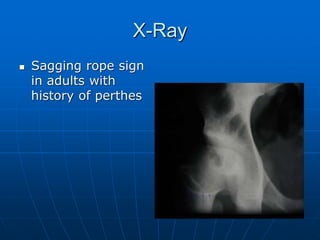
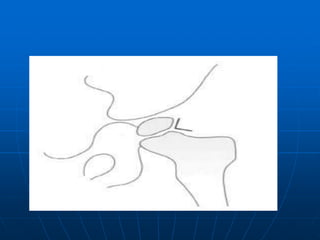
 Sagging rope sign
in adults with
history of perthes
Ultrasound
 Synovial effusion
 Cartilage hypertrophy in early stages
Arthrography
 Shows configuration of the femoral
head and its relation with the
acetabulum.
 Containment
 Congruity
 Not routinely used .
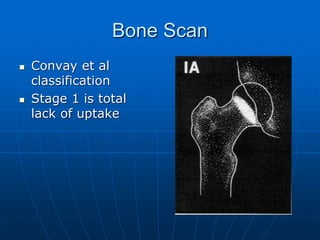
Bone Scan
 Diagnosis possible months before
signs appear on X-Ray.
 Avascular areas show cold spots.
Bone Scan
 Convay et al
classification
 Stage 1 is total
lack of uptake
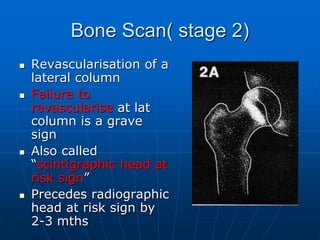
Bone Scan( stage 2)
 Revascularisation of a
lateral column
 Failure to
revascularise at lat
column is a grave
sign
 Also called
“scintigraphic head at
risk sign”
 Precedes radiographic
head at risk sign by
2-3 mths
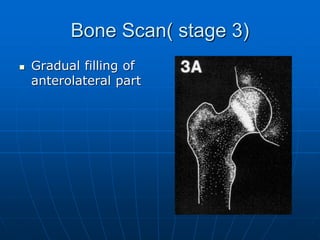
Bone Scan( stage 3)
 Gradual filling of
anterolateral part
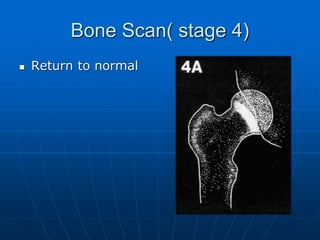
Bone Scan( stage 4)
 Return to normal
MRI
 Accurate in early diagnosis.
 Shows
congruity,containment,synovial
hypertrophy well.
Classification
 Waldenstroms classification.
 Catterall classification
 Salter classification
 Herrings lateral pillar classification.
Waldenstroms classification
(Pathological classification)
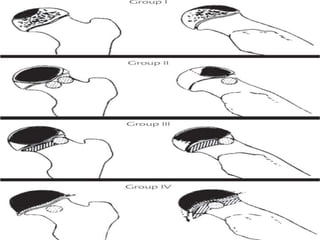
Catterall classification
(based on x ray AP and Lat view).
 I – only anterior portion of epiphysis
affected.
 II – anterior segment involved central
sequestrum present
 III – most of epiphysis sequestered with
unaffected portions located medial
and lateral to central segment
 IV – all of epiphysis sequestered.
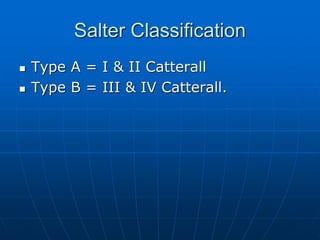
Salter Classification
 Type A = I & II Catterall
 Type B = III & IV Catterall.
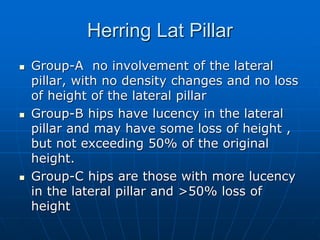
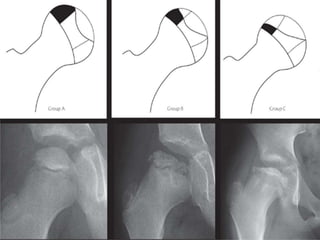
Herring Lat Pillar
 Group-A no involvement of the lateral
pillar, with no density changes and no loss
of height of the lateral pillar
 Group-B hips have lucency in the lateral
pillar and may have some loss of height ,
but not exceeding 50% of the original
height.
 Group-C hips are those with more lucency
in the lateral pillar and >50% loss of
height
Prognostic Factors
1. Age at diagnosis
<6 yrs – good
6 – 9 yrs – fair
>9 yrs - poor
1. Extent of involvement
2. Sex
3. Catterall “head at risk” signs
Catterall “head at risk”
signs
 Clinical
 Radiographic
 Clinical
1. Progressive loss of hip motion more
so abduction.
2. Obese child
 Radiographic
1. Gage sign
2. Calcification lateral to epiphysis
3. Diffuse metaphyseal rarefaction
4. Lateral extrusion of femoral head
5. Growth disturbance of physis
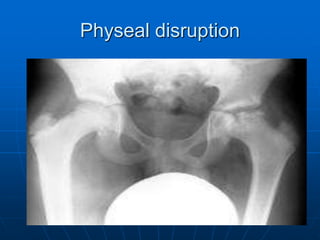
Physeal disruption
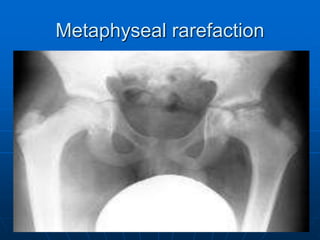
Metaphyseal rarefaction
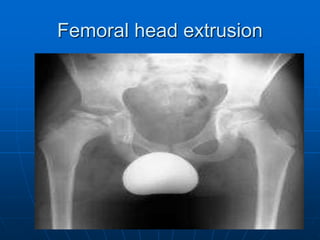
Femoral head extrusion
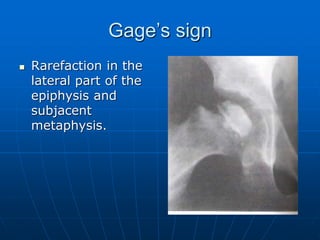
Gage’s sign
 Rarefaction in the
lateral part of the
epiphysis and
subjacent
metaphysis.
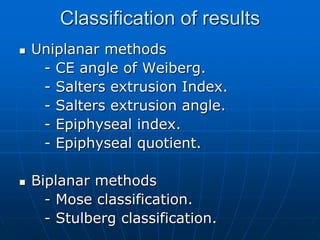
Classification of results
 Uniplanar methods
- CE angle of Weiberg.
- Salters extrusion Index.
- Salters extrusion angle.
- Epiphyseal index.
- Epiphyseal quotient.
 Biplanar methods
- Mose classification.
- Stulberg classification.
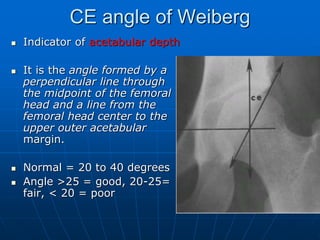
CE angle of Weiberg
 Indicator of acetabular depth
 It is the angle formed by a
perpendicular line through
the midpoint of the femoral
head and a line from the
femoral head center to the
upper outer acetabular
margin.
 Normal = 20 to 40 degrees
 Angle >25 = good, 20-25=
fair, < 20 = poor
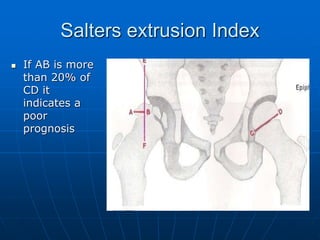
Salters extrusion Index
 If AB is more
than 20% of
CD it
indicates a
poor
prognosis
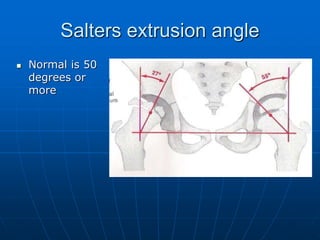
Salters extrusion angle
 Normal is 50
degrees or
more
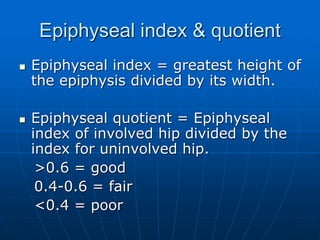
Epiphyseal index & quotient
 Epiphyseal index = greatest height of
the epiphysis divided by its width.
 Epiphyseal quotient = Epiphyseal
index of involved hip divided by the
index for uninvolved hip.
>0.6 = good
0.4-0.6 = fair
<0.4 = poor
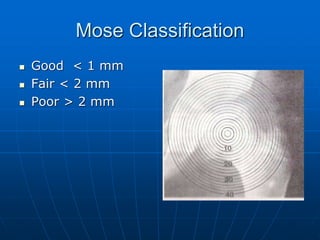
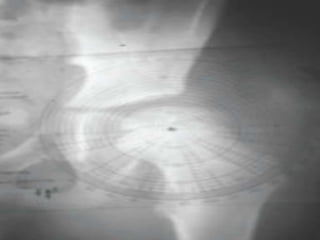
Mose Classification
 Good < 1 mm
 Fair < 2 mm
 Poor > 2 mm
Stulberg classificaton
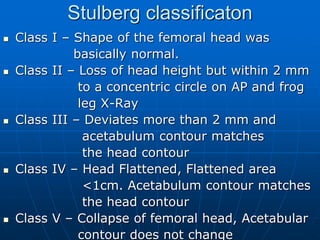
 Class I – Shape of the femoral head was
basically normal.
 Class II – Loss of head height but within 2 mm
to a concentric circle on AP and frog
leg X-Ray
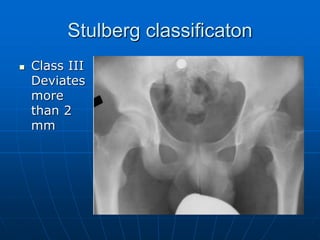
 Class III – Deviates more than 2 mm and
acetabulum contour matches
the head contour
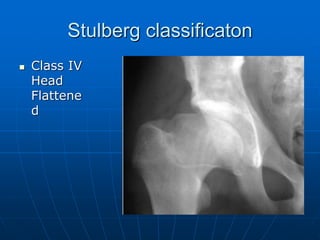
 Class IV – Head Flattened, Flattened area
<1cm. Acetabulum contour matches
the head contour
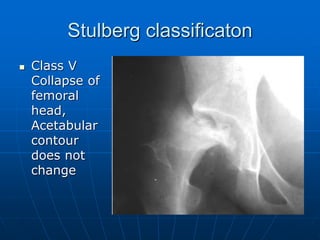
 Class V – Collapse of femoral head, Acetabular
contour does not change
Stulberg classificaton
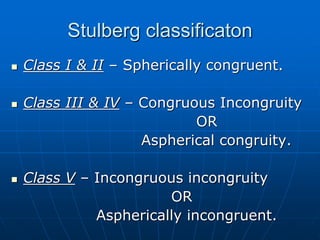
 Class I & II – Spherically congruent.
 Class III & IV – Congruous Incongruity
OR
Aspherical congruity.
 Class V – Incongruous incongruity
OR
Aspherically incongruent.
Stulberg classificaton
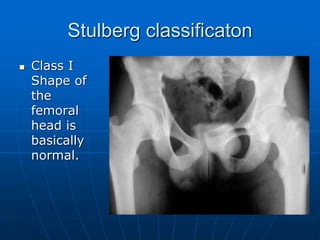
 Class I
Shape of
the
femoral
head is
basically
normal.
Stulberg classificaton
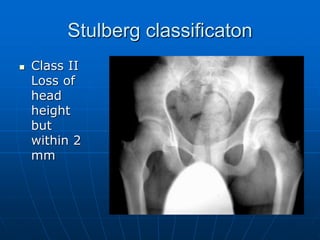
 Class II
Loss of
head
height
but
within 2
mm
Stulberg classificaton
 Class III
Deviates
more
than 2
mm
Stulberg classificaton
 Class IV
Head
Flattene
d
Stulberg classificaton
 Class V
Collapse of
femoral
head,
Acetabular
contour
does not
change
Differential diagnosis
 Tuberculosis of the hip
 AVN due to leukemia, lymphoma,
gauchers disease,
hemoglobinopathies etc
 Meyers dysplasia
 AVN following dislocation.
 Transient synovitis
Treatment
 Objectives
- To produce a normal femoral
head and neck
- To produce a normal acetabulum
- A congruous hip which is fully
mobile
- To prevent degenerative arthritis
of the hip later in life
Treatment
 Treatment efforts are directed
towards
- Restoration and maintenance of
full mobility of the hip
- Containment of the femoral
head.
- Resumption of weight bearing
and full activity as soon as
possible
Treatment
 Caterall group 1 and
group 2 ( < 7 years)
No
 Herring group 1 & Treatment
group 2 (< 6 years)
Treatment
Treatment is divided into 3 phases
 Initial Phase – restore & maintain
mobility
 Active Phase – Containment and
maintainance of full mobility.
 Reconstructive phase – correct
residual deformities.
Treatment ( Initial Phase )
 Physiotherapy – active and passive
range of motion
exercises to restore
motion
 Traction – B/L skin traction and
gradually abducting over 1-2
weeks till full abduction is
regained.
Treatment ( Active Phase )
 Consists of containment of the
femoral head within the acetabulum.
This can be achieved by
orthosis
or by
surgery
Treatment (Orthosis)
 Non Ambulatory weight releiving
1. Abduction broomstick plaster cast
2. Hip pica cast
 Ambulatory Both limbs included
1. Petrie Abduction cast
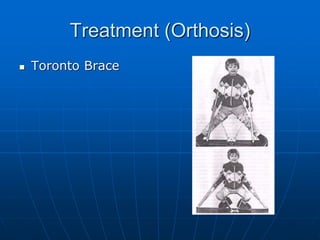
2. Toronto orthosis
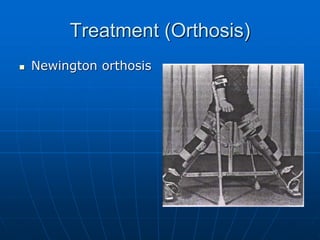
3. Newington orthosis
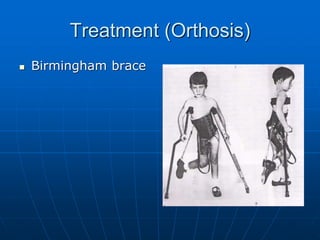
4. Birmingham brace
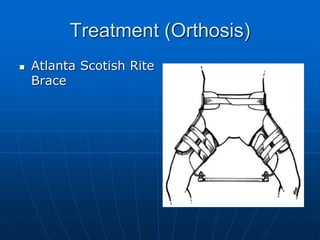
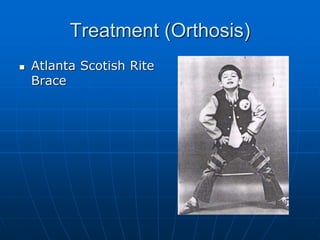
5. Atlanta Scotish Rite Brace
 Ambulatory unilateral
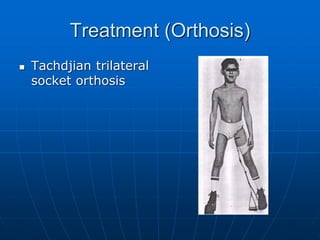
1. Tachdjian trilateral socket orthosis
Treatment (Orthosis)
 Atlanta Scotish Rite
Brace
Treatment (Orthosis)
 Atlanta Scotish Rite
Brace
Treatment (Orthosis)
 Newington orthosis
Treatment (Orthosis)
 Birmingham brace
Treatment (Orthosis)
 Toronto Brace
Treatment (Orthosis)
 Tachdjian trilateral
socket orthosis
Treatment (Orthosis)
 Orthotic treatment is discontinued when
the disease enters the reparative phase
and healing is established.
 The radiographic evidence of healing are
1. Appearance of irregular ossification in the
femoral head.
2 . Increased density of femoral head should
disappear.
3 . Medial segment of femoral head should
increase in size and height.
4 . Metaphyseal rarefaction involving the lateral
cortex of the metaphysis should ossify.
5 . There should be intact lateral column.
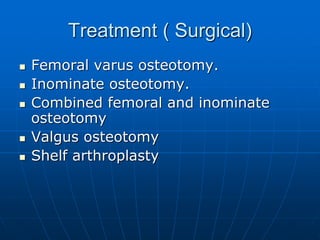
Treatment ( Surgical)
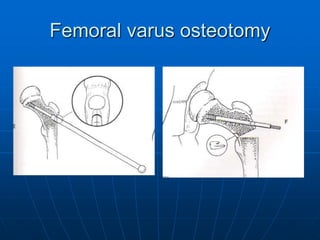
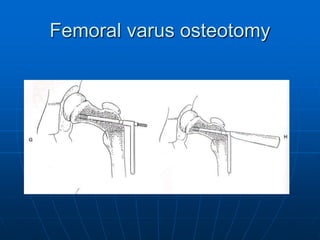
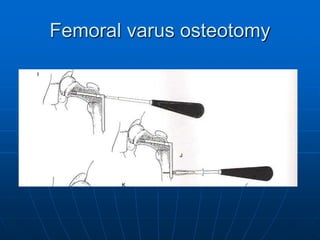
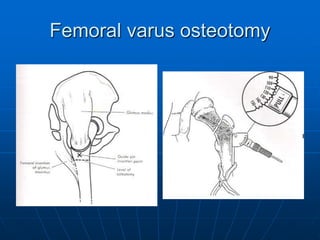
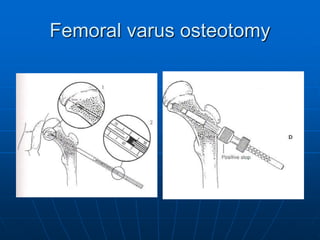
 Femoral varus osteotomy.
 Inominate osteotomy.
 Combined femoral and inominate
osteotomy
 Valgus osteotomy
 Shelf arthroplasty
Femoral varus osteotomy
Recent Advances
 Anticoagulant
 Ibadronate
Thank You

fdocuments.in_legg-calve-perthes-disease-2.ppt