PERT
GANTT CHART & MBO
PRESESNTED BY :
NAVANEETA KUSUM
M.SC. NSG
2ND YR.
Program (Project) Evaluation and
Review Technique (PERT):
• It is a project management tool used to
schedule, organize and coordinate tasks within
a project.
• It is basically a method to analyse the tasks
involved in completing a given project,
especially the time needed to complete each
task, and to identify the minimum time needed
to complete the total project.
Definition
PERT is a work model devised to complete the
project work in time.
It analyses the actual work time
required to complete a task.
PERT in NSG.
In our daily nursing routines, we sometimes fail
to understand overriding nursing administration
goals and objectives, as a result we are not
prepared to deal with the situations that arise and
also fail to anticipate situations that may have
benefited from advance thought and planning.
PERT model is used in the nursing field to
delegate the work schedule, analyse the time
required to complete a task and prepare the duty
roster for all the nurses in the hospital by calculating
the approximate time required to provide care to
each patient.
Components of PERT Model
Predecessor event: It is an event that precedes some
other event; it can be single or multiple.
Successor event: It is an event that immediately
follows some other event; it can have single or
multiple successor events.
Optimistic time (O): It is the minimum possible time
required to complete the task anticipating that every
event has occurred better than usually expected.
Pessimistic time (P): This means the maximum
possible time required to complete the given task,
expecting or assuming everything goes wrong except
the main catastrophes.
Cont....
Most likely time (M): The actual and the best time
required to complete the task assuming everything
goes in an usual way.
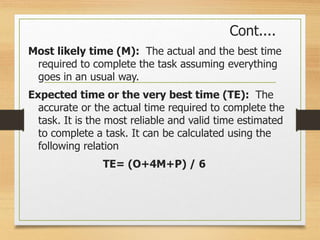
Expected time or the very best time (TE): The
accurate or the actual time required to complete the
task. It is the most reliable and valid time estimated
to complete a task. It can be calculated using the
following relation
TE= (O+4M+P) / 6
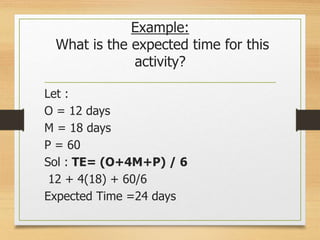
Example:
What is the expected time for this
activity?
Let :
O = 12 days
M = 18 days
P = 60
Sol : TE= (O+4M+P) / 6
12 + 4(18) + 60/6
Expected Time =24 days
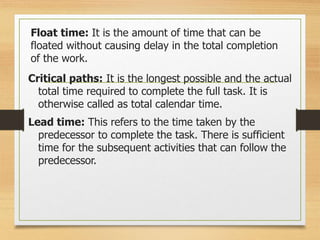
Float time: It is the amount of time that can be
floated without causing delay in the total completion
of the work.
Critical paths: It is the longest possible and the actual
total time required to complete the full task. It is
otherwise called as total calendar time.
Lead time: This refers to the time taken by the
predecessor to complete the task. There is sufficient
time for the subsequent activities that can follow the
predecessor.
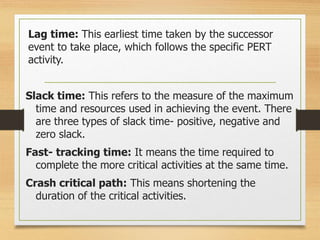
Lag time: This earliest time taken by the successor
event to take place, which follows the specific PERT
activity.
Slack time: This refers to the measure of the maximum
time and resources used in achieving the event. There
are three types of slack time- positive, negative and
zero slack.
Fast- tracking time: It means the time required to
complete the more critical activities at the same time.
Crash critical path: This means shortening the
duration of the critical activities.
PERT Chart
PERT Chart is a graphical representation of the
activities of a project, showing the sequence that
has to be performed continuously. It has the critical
path of the tasks that has to be finished in time.
This chart helps to focus only the needed activity
and omit the unwanted ones; therefore it saves
time, energy and material.
Network Path of PERT
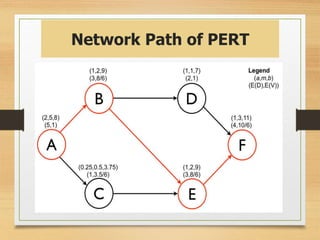
• The Circles mark the beginnings and ends of
Tasks to be down in the project, called Nodes.
• The Arrows are the tasks themselves.
• The Numbers after the task are the Durations
of the task.
• When a node has two or more tasks branching
from it, it means those tasks can be done
concurrently. When a node has incoming
arrows, it means the incoming task must be
completed before progress may continue to
any arrows heading away from the node.
• E.g. Task A must be completed before tasks B
or C may begin.
Benefits of PERT
• Enables to determine the exact date of completion of
the task
• Completion of work is possible before the specified
date
• Critical path activities specify the main impact in
completion of activities in time
• Slack time can be noted out early
• Entire project data can be organized and used for
decision making
cont..
• Prevents overlapping of activities, creates
better understanding of the task activities
• Helps to identify early start, late start and
the slack-time activity
• Identifies the accurate critical path visible
and clear to all.
• Helps to prevent loss of money, material and
time
• Allows the management to economically use
the resources, estimate time management
and evaluate the work done in time
Limitations of PERT
• Expert guidance is always needed.
• Difficult to categorize, more than 100/1000 of activity.
• Approximation of time estimate can lead to errors in
evaluation of time during work
• PERT uses distribution of probability, but the actual
distribution may be different.
• The PERT chart is usually very large and requires
several paged for printing. It also needs a special
signed paper.
• Before planning a PERT chart, one needs to do proper
planning to estimate the time frames for each activity.
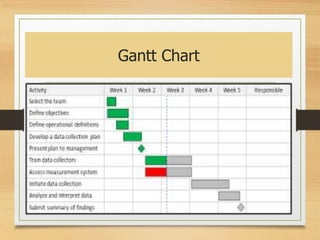
GANTT CHART (ACTIVITY PLAN)
It is defined as a graphical device that illustrate the
tasks, machines, personnel and resources used to
complete a task.
It is always done on a calendar-oriented grid.
It is not only lists out the start and the finish data
but also summary elements of the project.
Components of Gantt Chart
Horizontal axis: It represents time scale expressed as
absolute time from the project start to its end.
Horizontal bar indicate time needed to do the project.
Vertical marker or vertical axis: It is used to
represent the present point in time; vertical lines are
indicated to denote progress and completion.
Broken lines: These indicate gap or slippage times
during the project schedule
Diamond symbol: It indicates rescheduled work.
Gantt Chart
Advantages of Gantt Chart
• Excellent tool to communicate wide population
around the world
• At a single glance, work done can be analyzed
quickly
• It is used as a reporting tool for large projects
• It gives cost, time and scope of the project
Disadvantages
• It cannot effortlessly display more than 30 activities
• It is valuable only for short projects
• Chart can communicate only little information at a
time
• Magnitude behind the schedule is easily mis-
communicated, since it does not represent full size
of the project
• It is not suitable for most computer displays
Management by Objectives (MBO)
MBO is a comprehensive managerial system that
integrates many key managerial activities in a
systematic manner, consciously directed toward the
effective and efficient achievement of
organizational objectives.
It is a result centered, non-specialist,
operational managerial process for the effective
utilization of material, physical and human
resources of the organization.
Objectives of MBO
• To measure and judge performance
• To related individual performance to organizational
goals
• To clarify both the job to be done and the
expectations of accomplishment
• To enhance communication between superior and
inferior.
• To stimulate the subordinates motivation
• To serve as a device for organizational control and
integration
Characteristics of MBO
• MBO employs several techniques but it is not merely sum total
of these technique. It is a way of thinking about management
• Periodic review of performance is an important feature of MBO
• MBO provides the stimulus for the introduction of new
techniques of management and enhances the relevance and
utility of the existing ones.
• The basic emphasis of MBO is an objectives. MBO is also
concerned with determining what these results and resources
should be. This MBO tries to match objectives and resources.
• MBO is characteristics by the participation concerned managers
in objective setting, the performance reviews, and his
performance.
• Objectives in MBO provide guidelines for appropriate systems
procedure.
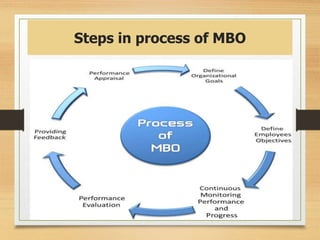
Steps in process of MBO
• Setting of Organizational Purpose and Objectives
• Establishment of the objectives of the Supervision
• Recommending objectives for the subordinates by the
supervisors
• Setting subordinates objectives
• Periodic review of the performance of the subordinates
• Review of the performance by the superiors
• Final review of performance by the supervisors
• Performance appraisal by superiors
• Providing feedback to the top level
Steps in process of MBO
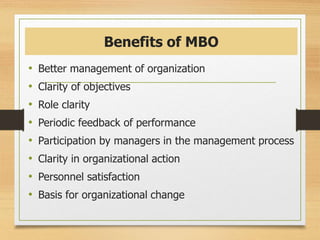
Benefits of MBO
• Better management of organization
• Clarity of objectives
• Role clarity
• Periodic feedback of performance
• Participation by managers in the management process
• Clarity in organizational action
• Personnel satisfaction
• Basis for organizational change
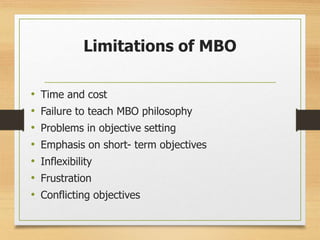
Limitations of MBO
• Time and cost
• Failure to teach MBO philosophy
• Problems in objective setting
• Emphasis on short- term objectives
• Inflexibility
• Frustration
• Conflicting objectives
Implication of MBO in Nursing
MBO is not only essential and useful
for business managers, but is equally
important to nursing administrators to
improve the efficiency of nursing personnel.
MBO based on Taylorist principles
can be used in nursing managerial process:
cont....
• It measures and judge performance
• It correlates individual performance to
organizational goals
• It clarifies the job responsibilities expected
from staff
• It fosters the increasing competence and
growth of the subordinates
• It provides a data base for estimating the
salary and promotion
• It stimulates the subordinates motivation
Conclusion:
PERT has been widely used in all types of management to
carry out the work efficiently. There is always a need for a
model like PERT to estimate the time limit for any work.
Gantt chart found its own importance in nursing.
These are used in nursing field to represent mortality and
morbidity rates and also a indicate duty rosters. All Nurses
must be involved in the planning process in their
organizations. The daily routine activities however often
cause nurses to devote little time to planning. Nurse
manager plays a significant role in planning process to
achieve the organizations primary goals rather than just
focusing on short term objectives and day to day operations.
THANK YOU

PERT MBO GANTT CHART

  • 1.
    PERT GANTT CHART &MBO PRESESNTED BY : NAVANEETA KUSUM M.SC. NSG 2ND YR.
  • 2.
    Program (Project) Evaluationand Review Technique (PERT): • It is a project management tool used to schedule, organize and coordinate tasks within a project. • It is basically a method to analyse the tasks involved in completing a given project, especially the time needed to complete each task, and to identify the minimum time needed to complete the total project.
  • 3.
    Definition PERT is awork model devised to complete the project work in time. It analyses the actual work time required to complete a task.
  • 4.
    PERT in NSG. Inour daily nursing routines, we sometimes fail to understand overriding nursing administration goals and objectives, as a result we are not prepared to deal with the situations that arise and also fail to anticipate situations that may have benefited from advance thought and planning. PERT model is used in the nursing field to delegate the work schedule, analyse the time required to complete a task and prepare the duty roster for all the nurses in the hospital by calculating the approximate time required to provide care to each patient.
  • 5.
    Components of PERTModel Predecessor event: It is an event that precedes some other event; it can be single or multiple. Successor event: It is an event that immediately follows some other event; it can have single or multiple successor events. Optimistic time (O): It is the minimum possible time required to complete the task anticipating that every event has occurred better than usually expected. Pessimistic time (P): This means the maximum possible time required to complete the given task, expecting or assuming everything goes wrong except the main catastrophes.
  • 6.
    Cont.... Most likely time(M): The actual and the best time required to complete the task assuming everything goes in an usual way. Expected time or the very best time (TE): The accurate or the actual time required to complete the task. It is the most reliable and valid time estimated to complete a task. It can be calculated using the following relation TE= (O+4M+P) / 6
  • 7.
    Example: What is theexpected time for this activity? Let : O = 12 days M = 18 days P = 60 Sol : TE= (O+4M+P) / 6 12 + 4(18) + 60/6 Expected Time =24 days
  • 8.
    Float time: Itis the amount of time that can be floated without causing delay in the total completion of the work. Critical paths: It is the longest possible and the actual total time required to complete the full task. It is otherwise called as total calendar time. Lead time: This refers to the time taken by the predecessor to complete the task. There is sufficient time for the subsequent activities that can follow the predecessor.
  • 9.
    Lag time: Thisearliest time taken by the successor event to take place, which follows the specific PERT activity. Slack time: This refers to the measure of the maximum time and resources used in achieving the event. There are three types of slack time- positive, negative and zero slack. Fast- tracking time: It means the time required to complete the more critical activities at the same time. Crash critical path: This means shortening the duration of the critical activities.
  • 10.
    PERT Chart PERT Chartis a graphical representation of the activities of a project, showing the sequence that has to be performed continuously. It has the critical path of the tasks that has to be finished in time. This chart helps to focus only the needed activity and omit the unwanted ones; therefore it saves time, energy and material.
  • 11.
  • 12.
    • The Circlesmark the beginnings and ends of Tasks to be down in the project, called Nodes. • The Arrows are the tasks themselves. • The Numbers after the task are the Durations of the task. • When a node has two or more tasks branching from it, it means those tasks can be done concurrently. When a node has incoming arrows, it means the incoming task must be completed before progress may continue to any arrows heading away from the node. • E.g. Task A must be completed before tasks B or C may begin.
  • 13.
    Benefits of PERT •Enables to determine the exact date of completion of the task • Completion of work is possible before the specified date • Critical path activities specify the main impact in completion of activities in time • Slack time can be noted out early • Entire project data can be organized and used for decision making
  • 14.
    cont.. • Prevents overlappingof activities, creates better understanding of the task activities • Helps to identify early start, late start and the slack-time activity • Identifies the accurate critical path visible and clear to all. • Helps to prevent loss of money, material and time • Allows the management to economically use the resources, estimate time management and evaluate the work done in time
  • 15.
    Limitations of PERT •Expert guidance is always needed. • Difficult to categorize, more than 100/1000 of activity. • Approximation of time estimate can lead to errors in evaluation of time during work • PERT uses distribution of probability, but the actual distribution may be different. • The PERT chart is usually very large and requires several paged for printing. It also needs a special signed paper. • Before planning a PERT chart, one needs to do proper planning to estimate the time frames for each activity.
  • 16.
    GANTT CHART (ACTIVITYPLAN) It is defined as a graphical device that illustrate the tasks, machines, personnel and resources used to complete a task. It is always done on a calendar-oriented grid. It is not only lists out the start and the finish data but also summary elements of the project.
  • 17.
    Components of GanttChart Horizontal axis: It represents time scale expressed as absolute time from the project start to its end. Horizontal bar indicate time needed to do the project. Vertical marker or vertical axis: It is used to represent the present point in time; vertical lines are indicated to denote progress and completion. Broken lines: These indicate gap or slippage times during the project schedule Diamond symbol: It indicates rescheduled work.
  • 18.
  • 19.
    Advantages of GanttChart • Excellent tool to communicate wide population around the world • At a single glance, work done can be analyzed quickly • It is used as a reporting tool for large projects • It gives cost, time and scope of the project
  • 20.
    Disadvantages • It cannoteffortlessly display more than 30 activities • It is valuable only for short projects • Chart can communicate only little information at a time • Magnitude behind the schedule is easily mis- communicated, since it does not represent full size of the project • It is not suitable for most computer displays
  • 21.
    Management by Objectives(MBO) MBO is a comprehensive managerial system that integrates many key managerial activities in a systematic manner, consciously directed toward the effective and efficient achievement of organizational objectives. It is a result centered, non-specialist, operational managerial process for the effective utilization of material, physical and human resources of the organization.
  • 22.
    Objectives of MBO •To measure and judge performance • To related individual performance to organizational goals • To clarify both the job to be done and the expectations of accomplishment • To enhance communication between superior and inferior. • To stimulate the subordinates motivation • To serve as a device for organizational control and integration
  • 23.
    Characteristics of MBO •MBO employs several techniques but it is not merely sum total of these technique. It is a way of thinking about management • Periodic review of performance is an important feature of MBO • MBO provides the stimulus for the introduction of new techniques of management and enhances the relevance and utility of the existing ones. • The basic emphasis of MBO is an objectives. MBO is also concerned with determining what these results and resources should be. This MBO tries to match objectives and resources. • MBO is characteristics by the participation concerned managers in objective setting, the performance reviews, and his performance. • Objectives in MBO provide guidelines for appropriate systems procedure.
  • 24.
    Steps in processof MBO • Setting of Organizational Purpose and Objectives • Establishment of the objectives of the Supervision • Recommending objectives for the subordinates by the supervisors • Setting subordinates objectives • Periodic review of the performance of the subordinates • Review of the performance by the superiors • Final review of performance by the supervisors • Performance appraisal by superiors • Providing feedback to the top level
  • 25.
  • 26.
    Benefits of MBO •Better management of organization • Clarity of objectives • Role clarity • Periodic feedback of performance • Participation by managers in the management process • Clarity in organizational action • Personnel satisfaction • Basis for organizational change
  • 27.
    Limitations of MBO •Time and cost • Failure to teach MBO philosophy • Problems in objective setting • Emphasis on short- term objectives • Inflexibility • Frustration • Conflicting objectives
  • 28.
    Implication of MBOin Nursing MBO is not only essential and useful for business managers, but is equally important to nursing administrators to improve the efficiency of nursing personnel. MBO based on Taylorist principles can be used in nursing managerial process:
  • 29.
    cont.... • It measuresand judge performance • It correlates individual performance to organizational goals • It clarifies the job responsibilities expected from staff • It fosters the increasing competence and growth of the subordinates • It provides a data base for estimating the salary and promotion • It stimulates the subordinates motivation
  • 30.
    Conclusion: PERT has beenwidely used in all types of management to carry out the work efficiently. There is always a need for a model like PERT to estimate the time limit for any work. Gantt chart found its own importance in nursing. These are used in nursing field to represent mortality and morbidity rates and also a indicate duty rosters. All Nurses must be involved in the planning process in their organizations. The daily routine activities however often cause nurses to devote little time to planning. Nurse manager plays a significant role in planning process to achieve the organizations primary goals rather than just focusing on short term objectives and day to day operations.
  • 31.