REPUBLIC OF MOLDOVA
MINISTRY OF EDUCATION
―ION CREANGA‖ STATE PEDAGOGICAL UNIVERSITY
FACULTY OF FOREIGN LANGUAGES AND LITERATURE
ENGLISH PHILOLOGY CHAIR
MASTER‘S DEGREE PAPER
PERSUASION AND ARGUMENT IN
WRITING
Submitted by:
Ceban Cristina
Scientific adviser:
E. Sagoian, Ph.D.
associate professor
Chişinău - 2012
2
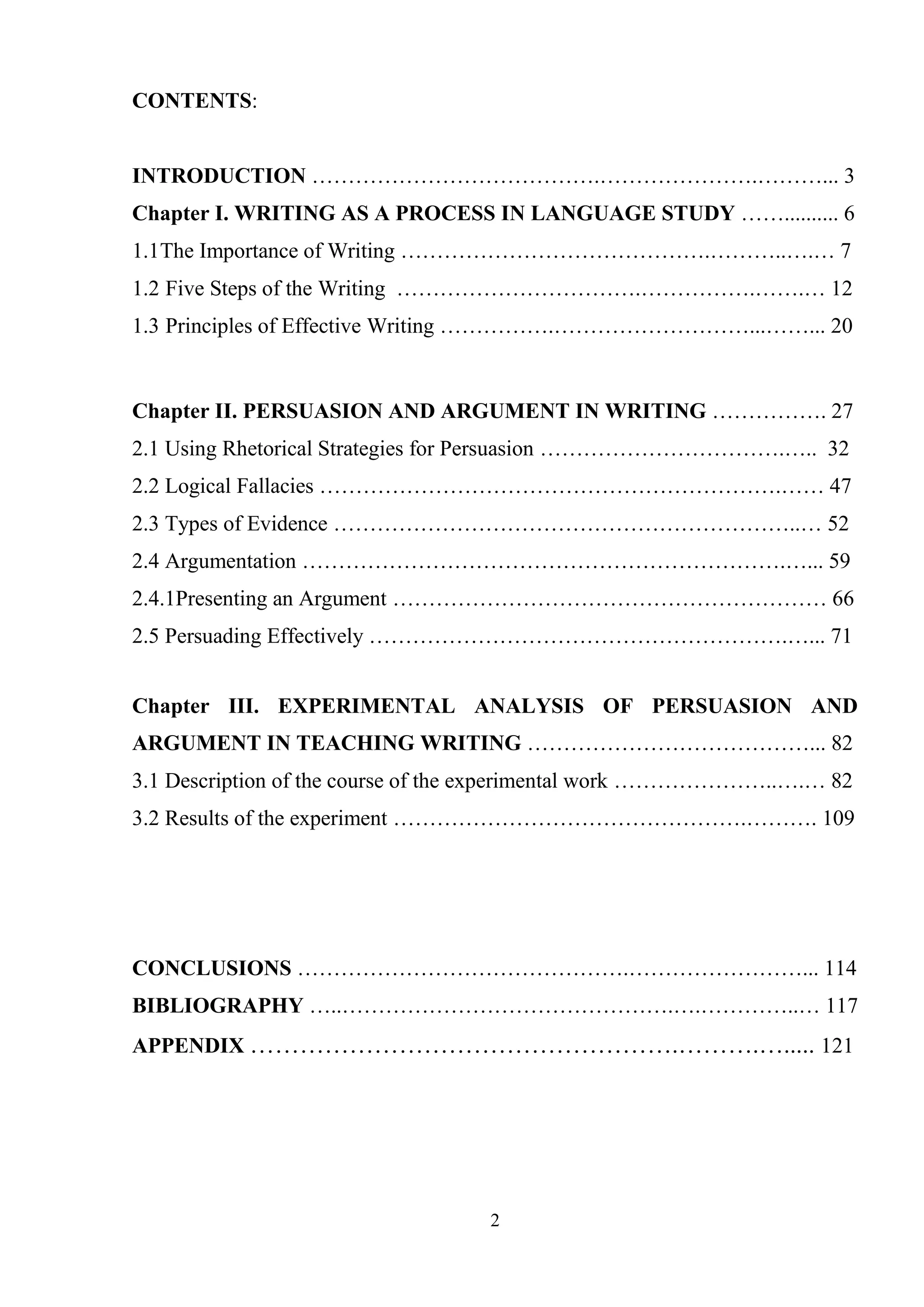
CONTENTS:
INTRODUCTION ………………………………….………………….………... 3
Chapter I. WRITING AS A PROCESS IN LANGUAGE STUDY …….......... 6
1.1The Importance of Writing …………………………………….………..….… 7
1.2 Five Steps of the Writing …………………………….…………….…….… 12
1.3 Principles of Effective Writing …………….………………………...……... 20
Chapter II. PERSUASION AND ARGUMENT IN WRITING ……………. 27
2.1 Using Rhetorical Strategies for Persuasion …………………………….….. 32
2.2 Logical Fallacies ……………………………………………………….…… 47
2.3 Types of Evidence ………………………………………………………..… 52
2.4 Argumentation ………………………………………………………….…... 59
2.4.1Presenting an Argument …………………………………………………… 66
2.5 Persuading Effectively ………………………………………………….…... 71
Chapter III. EXPERIMENTAL ANALYSIS OF PERSUASION AND
ARGUMENT IN TEACHING WRITING …………………………………... 82
3.1 Description of the course of the experimental work …………………..….… 82
3.2 Results of the experiment ………………………………………….………. 109
CONCLUSIONS ……………………………………….……………………... 114
BIBLIOGRAPHY …..……………………………………….….…………..… 117
APPENDIX …………………………………………….……….…..... 121
3
INTRODUCTION
The Master‘s Paper is devoted to the topic ―PERSUASION AND
ARGUMENT IN WRITING‖. The conducted investigation is from the field of
methods of teaching foreign languages.
Writing is the active thinking process of understanding the author`s ideas,
connecting those ideas to what you already know, and organizing all the ideas so
one can put them on paper. Writing is a complex developmental challenge to be
intertwined with many other developmental accomplishments: attention, memory,
language, and motivation. Being a good writer in English means that a student has
gained a functional knowledge of the principles of the English grammar and
writing system. Most teachers agree that writing skills are increasingly important
and often not adequately taught, writing instruction often takes a backseat to
phonics, handwriting skills, and reading comprehension. Many scholars find that
teaching writing may be more challenging than other subjects where there is an
answer key. Effective writing is one of the most important abilities that an English-
speaker needs. Such ability is a crucial tool that aids the learning process and it is
important in the nowadays ever-changing world. Additionally, a lot of international
standardized tests increasingly contain a writing component, and in some cases
these include a requirement to write an essay on a timed test.
Writing is usefully described by scholars as a process, something which
shows continuous change in time like growth in organic nature. Different things
happen at different stages in the process of putting thoughts into words and words
onto paper. Today's world requires that the goal of teaching writing should
improve students' communicative skills, because, only in that way, students can
express themselves and learn how to follow the social and cultural rules
appropriate in each communicative circumstance.
Many successful language learners know that one of the most important
abilities to possess is the ability to persuade and influence others. Persuasion is
widely perceived as a skill reserved for social influence, the process of guiding
others toward the adoption of an idea, attitude or action by rational and symbolic,
4
though not always logic, means. It is also commonly seen as just another form of
manipulation – devious and to be avoided. But persuasion can be a force for
enormous good, it can pull people together, move ideas forward, galvanize change,
and forge constructive solutions. To do all that, however, people must understand
persuasion for what it is – it means to win others over, not to defeat them.
Furthermore, it must be seen as an art form that requires commitment and practice,
especially as today‘s world makes persuasion more necessary than ever.
The actuality of the research work is to understand better teaching writing
concepts and strategies for developing persuasive and argumentative skills.
Second, it is quite useful to enrich our knowledge on methods of teaching aimed at
developing writing skills when we teach English. Third, this research is quite
useful and can have practical value for teaching and studying English as a foreign
(second) language.
The main objectives of the Work are the following:
1. to give general notion on writing concepts, presenting the process of writing,
strategies forming writing skills while studying English.
2. to describe in details activities which are used in teaching persuasive
writing.
3. to show the practical use of different writing activities.
4. to show principles and stages in developing persuasive writing skills.
While writing this Master’s Paper the following research methods were
used:
1) Analysis.
2) Comparison.
3) Description.
4) Generalization.
5) Selection.
6) Synthetical method.
The analytical method has been applied for making an overview of the
existing teaching writing concepts. Comparison was used for finding out common
5
features and distinctions in the viewpoints of professional teachers who dealt with
the problem of teaching writing. Descriptive method is the leading one for the
writing of this Paper and is used within each point both in theoretical and practical
parts. Selection is also widely used for the writing practical part, namely when all
the selected activities, methods and strategies were collected and described. For
making general conclusions we have applied synthetical method.
While writing this Paper different scientific works were used. The Work
consists of the Introduction, three Chapters, Conclusion, Bibliography and
Appendix.
The Introduction includes the main goal and objectives of the investigation,
the actuality of the topic and the motives for its choice.
Chapter І presents the general idea of what writing is and the teaching
writing components. It also contains the description of methods, activities and
strategies for developing writing skills.
Chapter ІІ contains an overview of persuasive and argumentative writing,
and such activities used in mastering persuasive skills. The main focus is made on
practical use of the writing activities during the lesson.
Chapter ІІІ contains Experimental Analysis of ―Persuasion and Argument
Techniques in Writing‖ and its results.
The Conclusion contains the results of the investigation on the topic.
Bibliography presents the materials that helped the researcher in the overall
study of the certain topic and finally to realize the objectives of investigation.
6
Chapter I. WRITING AS A PROCESS IN LANGUAGE STUDY
Writing which was once considered the domain of the elite and well
educated, has become an essential tool for people of all walks of life in today‘s
global community. Whether used in reporting analyses of current events for
newspapers or web pages, composing academic essays, business reports, letters, or
e-mail messages, the ability to write effectively allows individuals from different
cultures and backgrounds to communicate. Furthermore it is now widely
recognized that writing plays a vital role not only in conveying information, but
also in transforming knowledge to create new knowledge. It is thus of central
importance to students in academic and second language programs throughout the
world. In many of these settings, the assessment of writing ability is of critical
importance. Employers, academic instructors and writing teachers need to make
decisions about potential employees and students, based on how well they can
communicate in writing.
Writing is normally a continuing and sustained act of communication. This
is not true of most spoken contexts especially those most commonly experienced
by children, who are most accustomed to ‗short burst‘ utterances and the give and
take interruptions, questioning and replies from their listeners. Writing is in
contrast a more solitary and demanding activity. The writer seeks to maintain an
independent and if possible uninterrupted flow of language sometimes over an
extended period of time before the final written product is achieved. Compared to
speech writing is ‗painfully slow‘. In contrast to speaking, writing is normally
much more organized and coherent. The writer is expected to edit out digressions
and repetitions. In most written texts there is no place for ‗fillers‘ and only very
limited opportunities exist to communicate the subtleties of intonation, facial
expression and gesture (by means of underlining, for example, exclamation marks
or block capitals). In fact in creating a written text of any length the writer is
normally expected to choose language forms that are more concise than those used
7
in spoken contexts, but at the same time expression is often more complex in its
syntax and more varied in its vocabulary.
Since writing is a complex and cognitively demanding activity, to be
successful, writers need an understanding of the components of a quality
test as well as knowledge of writing strategies that can be used to shape
and organize the writing process. The following subchapters examine the
nature of writing as a process which involves a variety of activities, as well
as analyse writing components in order to increase the reader’s awareness
of what appears to happen when a student attempts to create a written text.
[31, pp.10-16]
§1.1 The Importance of Writing
The ability to write effectively is becoming increasingly important in our
global community, and instruction in writing is thus assuming an increasing role in
foreign-language education. As advances in transportation and technology allow
people from nations and cultures throughout the world to interact with each other,
communications across languages becomes ever more essentials. As a result, the
ability to speak and write a second language is becoming widely recognized as an
important skill for educational, business, and personal reasons. Writing has also
become more important as tenets of communicative language teaching-that is,
teaching language as a system of communication rather than as an object of study-
have taken hold in both second-and foreign-language settings. The traditional view
in language classes that writing functions primarily to support and reinforce
patterns of oral language use, grammar, and vocabulary, is being supplanted by the
notion that writing in a second language is a worthwhile enterprise in and of itself.
Wherever the acquisition of a specific language skill is seen as important, it
becomes equally important to test that skill, and writing is no exception. Thus, as
the role of writing in second- language education increases, there is an ever greater
demand for valid and reliable way to test writing ability, both for classroom use
8
and as a predictor of future professional or academic success. Writing is put by
people in different situations are so varied that no single definition can cover all
situations. For example, the ability to write down exactly what someone else says
is quite different from the ability to write a persuasive argument. Instead of
attempting an all-encompassing definition, then, it may be more useful to begin by
delineating the situations in which people learn and use second languages in
general and second-language writing in particular, and the types of writing that are
likely to be relevant for second-language writers. While virtually all children are
able to speak their native language when they begin school, writing must be
explicitly taught. Furthermore, in comparison to speaking, listening, and reading,
writing outside of school settings is relatively rare, and extensive public writing is
reserved for those employed in specialized careers such as education, law, or
journalism. In first-language settings, the ability to write well has a very close
relationship to academic and professional success.
Writing as compared to speaking, can be seen as a more standardized system
which must be acquired through special instruction. Mastery of this standard
system is an important prerequisite of cultural and educational participation and the
maintenance of one‘s rights and duties. The fact that writing is more standardized
than speaking allows for a higher degree of sanctions when people deviate from
that standard. Thus, in first-language education, learning to write involves learning
a specialized version of a language already known to students. This specialized
language differs in important ways from spoken language, both in form and use,
but builds upon linguistic resources that students already possess. The ultimate
goal of learning to write is, for most students, to be able to participate fully in
many aspects of society beyond school, and for some, to pursue careers that
involve extensive writing. [52, pp.32-46]
The value of being able to write effectively increases as students‘ progress
through compulsory education on to higher education. At the university level in
particular, writing is seen not just as a standardized system of communication but
also as an essential tool for learning. At least in the English-speaking world one of
9
the main functions of writing at higher levels of education is to expand one‘s own
knowledge through reflection rather than simply to communicate information.
Writing and critical thinking are seen as closely linked, and expertise in writing is
seen as an indication that students have mastered the cognitive skills required for
university work. Or to phrase it somewhat more negatively, a perceived lack of
writing expertise is frequently seen as a sign that students do not possess the
appropriate thinking and reasoning skills that they need to succeed. In first-
language writing instruction, therefore, particularly in higher education, a great
deal of emphasis is placed on originality of thought, the development of ideas, and
the soundness of the writer‘s logic. Conventions of language {voice, tone, style,
accuracy, mechanics} are important as well, but frequently these are seen as
secondary matters, to be addressed after matters of content and organization. While
the specific goals of writing instruction may vary from culture to culture, it is clear
that writing is an important part of the curriculum in schools from earliest grades
onward, and that most children in countries that have a formal education system
will learn to write, at least at a basic level, in that setting. In this sense, we can say
that first language writing instruction is relatively standardized within a particular
culture. [27, pp.44-61]
In contrast, the same cannot be said of second-language writing because of
the wide variety of situations in which people learn and use second languages, both
as children and as adults, in schools and in other settings. We can distinguish
between at least five main groups of second- language learners {adapted from
Bernhardt, 1991}. The first group consists of children from a minority language
group receiving their education in the majority language. These children need to
learn to read and write in a language that is not spoken in their home in order to
succeed in school and ultimately in the workplace. A second group of children are
majority language speakers in immersion programs or otherwise learning a second
language in school. In this case, mastery of the second language enhances their
education but is not critical to ultimate educational success, in contrast to the first
group. A common factor for both groups of children is that their first language id
10
drill developing, and that, like first- language writers, writing is very much a
school-based and school-oriented activity.
There are also three distinct groups of adult second-language learners. The
first group consists of immigrants to a new country, who are frequently from a
lower-prestige language background and may or may not be literate in their first
language. For these learners, writing at a basic functional level is essential for
survival in the workplace. In marked contrast to this group is a second group of
adults: those who have left their home countries to seek an advanced university
degree. These adults are already highly educated and literate in their first language,
and their writing needs are very sophisticated. Finally, there is a third group of L2
learners: majority language group members who are learning a second language for
personal interest and/ or career or educational enhancement. Like the second
group, this third group is generally well educated; unlike the second group,
however, they may not have as great a need to write in their second language, and
certainly the writing that they will do is less complex and demanding than that of
the second group. To summarize, then, groups of second-language learners can be
distinguished by age, by level of education and first-language literacy, and by the
real-world need for writing outside of the classroom. In addition to these factors,
the ability and opportunity to write in a second language are also determined by
other considerations. An additional factor is the relative similarity or difference
between the two languages: writing in a language that is closely related to one‘s
native language in terms of grammar, vocabulary, and writing system is clearly
easier than writing in a language that is vastly different. Finally, an important
consideration, which is related to the real-world need for writing discussed above,
is the role of the second language as a language of wider communication: someone
learning English as a foreign language will probably have more realistic needs for
writing in that language than someone learning Russian.
Effective writing skills are to a writer what petrol is to a car. Like the petrol
and car relationship, without solid skills writers cannot move ahead. These skills
don‘t come overnight, and they require patience and determination. You have to
11
work smart and hard to acquire them. Only with experience, you can enter the
realm of effective, always-in-demand writers.
Of course, effective writing requires a good command of the language in
which you write or want to write. Once you have that command, you need to learn
some tips and tricks so that you can have an edge over others in this hard-to-
succeed world of writers. There are some gifted writers, granted. But gifted writers
also need to polish their skills frequently in order to stay ahead of competition and
earn their livelihood. [41, pp.212-242]
Good writing stays sharply focused. The writer knows what the subject is,
and never veers far away from that subject. Think of the writer as a rower of a boat
trying to row ashore. That rower must keep his eyes acutely focused on an object
on the shore in order to row straight. If he shifts focus, he'll shift course and miss
the dock. The same holds true for the writer. Good writing is also simple and clear,
one should leave no doubt in the minds of his readers about what he or she is trying
to say to them. Unfortunately, some people seem to forget this principle, especially
when they write.
In academic writing, students struggle to achieve a style of writing that does
not come naturally to them. Learners imagine that they must follow a convoluted
style based on vague impressions of what they read in the scientific literature.
Nothing could be further from the truth and it is here that many of the models that
they use in the literature let them down.
There are just three immutable characteristics of good academic writing that
distinguish it from all other literature. It must always be:
• precise
• clear
• brief
... and in that order.
If it is vague, it is not academic writing; if it is unclear or ambiguous, it is
not academic writing and if it is long winded and unnecessarily discursive, it is
poor academic writing. But precision or clarity should not be sacrificed in order to
12
be brief. So, if it has to take a few more words to make the thoughts crystal clear to
as many readers as possible, then one should use those words. The good news is
that, if one is precise, clear and brief, then he or she does not have to conform to
any other specific rules to be a good scientific writer. The style of academic
writing is plain and simple English, similar to that one would use in a conversation
with a colleague. [30, pp.24-51]
§1.2 Five Steps of Writing
Writing is a complex process that allows writers to explore thoughts and
ideas, and make them visible and concrete. It encourages thinking and learning for
it motivates communication and makes thought available for reflection. When
thought is written down, ideas can be examined, reconsidered, added to,
rearranged, and changed. Writing is most likely to encourage thinking and learning
when students view writing as a process. By recognizing that writing is a recursive
process, and that every writer uses the process in a different way, students
experience less pressure to ‗get it right the first time‘ and are more willing to
experiment, explore, revise, and edit. Yet, novice writers need to practice ‗writing‘
or exercises that involve copying or reproduction of learned material in order to
learn the conventions of spelling, punctuation, grammatical agreement, and the
like. Furthermore, students need to ‗write in the language‘ through engaging in a
variety of grammar practice activities of controlled nature. Finally, they need to
begin to write within a framework ‗flexibility measures‘ that include:
transformation exercises, sentence combining, expansion, embellishments, idea
frames, and similar activities. [59]
Writing may be described as a five-step process: generating ideas,
organizing ideas, writing a draft, revising and rewriting, and proofreading.
13
Generating Ideas
Whatever type of writing a student is attempting, the prewriting stage can
be the most important. This is when students gather their information, and begin to
organize it into a cohesive unit. Prewriting is the most creative step and most
students develop a preferred way to organize their thoughts. Step 1, Generating
Ideas, may be accomplished by using one or more of the following activities:
Freewriting
This term was used by Peter Elbow (Writing Without Teachers, Oxford,
1973) to describe what is essentially free - association writing, where the writer
starts in one direction or another but lets the writing take whatever direction it
seems to want. In freewriting, the teacher sets a page limit or time limit, and then
students simply write about the general topic until the time limit is expired or until
they have met the page limit. Start a class in either composition or literature by
inviting the students to write for five minutes in response to a prompt that has
something directly to do with the day's agenda (What makes writing hard? When is
it easy for you? What is the best [or worst] writing you‘ve ever done? Etc.)
Directions for freewriting are simple and students usually do it easily the
first time they try:
1. Write fast for a limited period of time (five or ten minutes).
2. Don't stop moving your pen or typing on the keyboard to make sure new words
help generate ideas.
3. Write for the whole time period since good ideas often come late in the writing
process.
4. Don‘t worry about spelling, punctuation, organization, or style since you are the
audience.
As learners write, they do not have to worry about spelling, grammar,
punctuation, etc. They simply write down whatever comes to mind regarding the
14
general topic. Once students have free written, it s a good idea to have them share
with nearby classmates and simply talk about what they were writing about. They
can also examine what was written, looking for categories into which ideas may be
grouped, ideas that show a cause-effect relationship, and so on. The information
generated in this manner may form the basis for developing your topic. Once the
class fills up with student voices, you can interrupt and ask for volunteers to share
thoughts with the class as a whole.
When students free write as a regular part of each writing class, instructors
commonly ask that these informal writings be kept in "journals"--so that each free
write becomes, in essence, a journal entry. If you plan for students to keep
journals, ask them to buy loose-leaf notebooks, so that the first writing they do in
class can be inserted as the first entries in their journals.
Brainstorming
On a given topic, students simply list ideas as they occur to them instead of
engaging in continuous writing ideas in a limited time. Depending on the context,
either individual or group brainstorming is effective and learners generate ideas
quickly and freely. The good characteristics of brainstorming are that the students
are not criticized for their ideas so students will be open to sharing new ideas.
Branching
With branching, you use a large sheet of paper and write the general topic
in the center of the paper and draw a circle around it. Then, as new ideas related to
the general topic come to mind, you draw a short line extending outward from the
center circle; at the end of the line, you draw another circle and write the related
idea in this new circle, forming what resembles a spoked wheel. Each new idea
may, in turn, cause new related ideas to come to mind. If so, simply draw new
spokes outward from the circle containing the related idea, draw a new circle at the
end of the line, and write the new, related idea in the circle. At some point in the
15
process, you may identify a main topic for your essay in a center circle and
supporting ideas in the surrounding, spoked circles.
Questioning
Questioning works very well when you have a general topic in mind. In
this case, you simply find answers to questions such as: Who? What? When?
Where? Why? How? The answers to these questions are the supporting details
used to develop the main topic.
Other sources of ideas may include:
Journals
If you maintain a personal journal/diary, this may be a tremendous source
of ideas. After all, the events and observations you record reflect things that you
know and things about which you have not only knowledge, but also strong
feelings.
Conversations with Friends
Recalling recent conversations with friends may be an excellent source of
ideas for topics. The topics you discuss with friends will be topics of interest to
you and your audience. Selecting interesting topics is a very important aspect of
topic selection; it will help you keep the reader involved.
Readings
Recalling things you have read recently may provide ideas for topics just
as recalling recent conversations with friends.
Organizing Ideas
Step 2, Organizing Your Ideas, is a two-part step. First, it involves
narrowing the number of supporting details to a reasonable size. As you do this,
16
remember to select an appropriate number of details to accomplish your purpose in
writing. You should also ensure your supporting details are specific, relevant, and
typical. Then, arrange the selected details in a reasonable order. If you are writing
a narrative essay, then arrange details in chronological order. If you are writing a
descriptive essay, then spatial (geographical) order may be best (e.g. left-to-right,
top-to-bottom, near-to-far, etc.). For a persuasive essay, arranging details
according to importance (least-to-most or most-to-least) may work best. When
working with examples, work from general to specific or from least complex to
most complex.
Writing the First Draft
The actual writing stage is essentially just an extension of the prewriting
process. The student transfers the information they have gathered and organized
into a traditional format. This may take the shape of a simple paragraph, a one-
page essay, or a multi-page report. Up until this stage, they may not be exactly
certain which direction their ideas will go, but this stage allows them to settle on
the course the paper will take. Teaching about writing can sometimes be as simple
as evaluation good literature together, and exploring what makes the piece
enjoyable or effective. It also involves helping a student choose topics for writing
based on their personal interests. Modeling the writing process in front of your
child also helps them see that even adults struggle for words and have to work at
putting ideas together. [20, p.38]
Unlike freewriting or journal writing, the writers aim drafts at audiences
other than themselves. Most drafting is done by a writer alone, most often outside
of class-- though sometimes class time is allotted for writers to start or work on
drafts in class—a quiet, supportive environment. It is fair to expect early drafts to
be rough; when reading these, instructors usually attend to larger intentions (topic,
organization, evidence) and skip over surface problems (spelling, punctuation,
wordiness), since students will go beyond these language constructions in
17
subsequent drafts; to attend to matters of editing too early is a waste of both
instructor and student time.
In the third step, Writing a Draft, the goal is to express your ideas in an
organized, focused form. A simple way to begin is to first construct a sentence
outline of your essay. To accomplish this, you write one sentence that expresses
your main idea (this is the thesis). Then, you write one sentence for each
supporting/developing idea in the order you have already determined. From this
outline, you can easily construct a simple draft of your essay.
Begin the draft with a general introduction. This may be background
information, a quotation from an expert on the topic, a personal anecdote, or
whatever else will allow you to lead into the thesis statement. Once you have
introduced the subject and included your thesis, you are ready for the draft of the
body of the essay.
In the body, you will write one paragraph for each supporting idea. The
sentences you wrote for the supporting details in the sentence outline will serve as
topic sentences for the paragraphs in the body. Generally, each paragraph of the
body will begin with a topic sentence, which will be followed by additional
clarification/explanation. If you have doubts about an idea‘s value in the body,
include it. If new ideas come to mind while you are writing the draft, include
them. You can always eliminate unwanted items later.
Once the body is drafted, you are ready for the final part of the essay, the
conclusion. In the conclusion, you need to provide a sense of closure. This is
often accomplished by summarizing the main elements of the body, restating the
main point from the thesis, and/or adding any final observations about the topic
(such as a warning or a statement to urge the reader to action).
18
Revision and Rewriting
Revising and Rewriting, the fourth step in the writing process, generally
begins with a review of the supporting details in your essay. First, review the
thesis (sentence that expresses the main idea of the essay) to make sure it is clear,
direct, and complete. Next, reread the topic sentences for the paragraphs in the
body to ensure they relate to the main idea contained in the thesis. Review the
supporting details to make sure they are specific, relevant, typical, and sufficient in
number to accomplish your purpose. Then review the order of presentation to
ensure it is reasonable.
Next, make sure paragraphs have beginnings and endings. Transitions
(linking expressions such as first, second, next, later, above, and below) are
commonly used to introduce new paragraphs. Also, make sure sentences within
paragraphs are connected to each other. Introduce examples used to illustrate
supporting ideas with transitions (such as for example, in contrast, also, therefore,
and consequently). Then, review all sentences with each paragraph. Delete, revise,
or combine sentences that say the same thing.
Replace vague, unclear words with more descriptive ones.
Finally, revise wording, grammar, spelling, and punctuation to ensure they
are in Standard English form and are appropriate for the audience and purpose of
the essay. You should continue to revise your essay until you are satisfied with
what you have said and how you have said it.
Rewriting implies returning to a draft one or more times to make sure that
the language says exactly what the writer intends it to say. After some number of
drafts, the writer lets the piece go and calls it finished. It is common in writing
classes for students to actually finish only a small number of formal papers (3-5) in
several drafts each, since many instructors believe that it's the in-depth
19
involvement with a single topic that lets a writer master and advance that topic--
and in the process learn the tricks of the writer's trade.
Revision is conceptual work. It is attending to the larger conceptual matters of
writing: organization, ideas, how an argument works, whether it's well supported,
what to include and exclude from a paragraph or paper. Editing is primarily
sentence level work, making sure that ideas are articulated clearly, precisely, and
correctly for a given audience.
Revising, or editing is usually the least favorite stage of the writing process,
especially for beginning writers. Critiquing one‘s own writing can easily create
tension and frustration. But as you support your young writers, remind them that
even the most celebrated authors spend the majority of their time on this stage of
the writing process. Revising can include adding, deleting, rearranging and
substituting words, sentences, and even entire paragraphs to make their writing
more accurately represent their ideas. It is often not a one-time event, but a
continual process as the paper progresses. When teaching revision, be sure to allow
your child time to voice aloud the problems they see in their writing. This may be
very difficult for some children, especially sensitive ones, so allow them to start
with something small, such as replacing some passive verbs in their paper with
more active ones. [69]
Proofreading
In the fifth step in the writing process, Proofreading, check for errors with
mechanics. Your final essay is to be in Standard English form, so you should
review it a final time to ensure it does not contain any errors in English usage.
Run-on sentences and fragments should be eliminated. You should also ensure
there are no errors in spelling, punctuation, grammar, and capitalization. [54]
Proofreading - is a chance for the writer to scan his or her paper for
mistakes in grammar, punctuation, and spelling. Although it can be tempting for
parents to perform this stage of the writing process for the child, it is important that
20
they gain proofreading skills for themselves as this improves a student‘s writing
over time. And because children want their writing to be effective, this can actually
be the most opportune to teach some of the standard rules of grammar and
punctuation. When students learn the rules of mechanics during the writing process
they are much more likely to remember to use them in the future. [1, pp.48-62]
§1.3 Principles of Effective Writing
Writing is the art of making an utterance perfectly natural through the
perfectly unnatural process of making every word and phrase again and again,
cutting here and adding there, until it is just so. It is contrived spontaneity. What
the writer wants is something just like speech only more compressed, more
melodic, more economical, more balanced, more precise.
According to Aristotle: ―To write well, express yourself like the common
people, but think like a wise man.‖ What makes a good writer is that he knows the
difference between those of his sentences that work and those that don‘t; between
those he gets nearly right and those he nails; between those that sing and swing and
those that mumble and fail. Sentences fail for many reasons. You may not know
enough about what a sentence is, for instance, to reach the end with poise. Or you
may know more than enough, but you give them too much weight to carry; you
work them too hard. And they break. [18, pp.3-55]
Students must express their ideas clearly, concisely, and completely when
speaking and writing. If their written messages aren't clear or lack important
details, people will be confused and will not know how to respond. In addition, if
their written messages are too lengthy, people simply don't read them.
The process of good writing involves three basic steps - preparing, writing, and
editing. Practicing the following 16 principles will help anyone be a more effective
writer.
21
Know your objective
Think before you write. What's your goal? Make sure you fully understand
the assignment. Are you writing a one-paragraph executive summary or a five-
page report? Try answering this question: What specifically do I want the reader to
know, think, or do?
Make a list
Write down the ideas or points you want to cover. Why? This helps you get
started in identifying the key ideas you want to discuss. If you have trouble getting
started, try discussing your ideas with someone else. "Kicking an idea around"
often helps you clarify your objective and fine-tune what you are trying to
accomplish.
Organize your ideas
Just as it's difficult to find what you want in a messy, disorganized desk
drawer, it's hard to find important ideas in a poorly organized message. Here are a
few ways you can organize your ideas:
Importance - Begin with the most important piece of information and then
move on to the next most important.
Chronological order - Describe what happened first, second, third.
Problem-Solution - Define the problem, then describe possible alternatives
or the solution you recommend.
Question-Answer - State a question and then provide your answer.
Organize your ideas so the reader can easily follow your argument or
the point you are trying to get across.
Back it up
Have an opinion but back it up - support with data. There are a number of
ways you can support your ideas, including explanations, examples, facts, personal
22
experiences, stories, statistics, and quotations. It's best to use a combination of
approaches to develop and support your ideas.
Separate main ideas
Each paragraph should have one main point or idea captured in a topic
sentence. The topic sentence is normally the first sentence in the paragraph. Each
paragraph should be started by an indentation or by skipping a line.
Use bullets or numbers
If you are listing or discussing a number of items, use bullets or number
your points like I have done in this paper. Here's an example of using bullets.
Join the Business Club to:
Increase sales
Gain new marketing ideas
Make new friends
Give back to your profession
Write complete sentences
A sentence is about someone doing something - taking action. The
‗someone‘ may be a manager, employee, customer, etc. The "doing something -
taking action" can include mental processes such as thinking, evaluating, and
deciding, or physical actions such as writing and talking. A good rule to practice is
to have subjects closely followed by their verbs.
Use short sentences
Sentences should be a maximum of 12 to 15 words in length. According
to the American Press Institute, sentences with 15 or fewer words are understood
90% of the time. Sentences with eight or fewer words are understood 100% of the
time.
23
Be precise and accurate
Words like "large", "small", "as soon as possible", "they", "people",
"teamwork", and "customer focus" are vague and imprecise. The reader may
interpret these words to mean something different than what you intended.
Reduce communication breakdowns by being specific and precise. Define
terms as needed. The reader may not understand certain acronyms and
abbreviations.
Use commas appropriately
A comma should be used: to separate the elements in a series of three or more
items: His favorite colors are red, white, and blue; to set off introductory
elements: After coffee and donuts, the meeting will begin; to separate
adjectives: That tall, distinguished, good-looking professor teaches history.
Use the correct word
Here are several words that cause confusion.
You're is a contraction for "you are" Your means possession, such as "your
coat."
It's is a contraction for "it is." ‗Its‘ indicates possession.
Their means possession/ownership-"their house." There means location.
They're is a contraction for "they are."
Avoid redundancies
It is a redundancy to use multiple words that mean or say the same thing. For
example, consider the following:
Redundant - My personal beliefs… Beliefs are personal, so just state, My
beliefs...
Redundant - I decided to paint the machine gray in color. Gray is a color,
so just state, I decided to paint the machine gray.
24
Numbers
When using numbers in the body of your paper, spell out numbers one
through nine, such as "Three men decided…" When using numbers 10 or above it's
proper to write the number, such as "The report indicated 68 customers…"
Have a conclusion
Would you really enjoy watching a movie or sporting event that had no
conclusion? No. The conclusion ties your points together. The reader wants to
know the final score - the bottom line message.
Edit your work
Read what you have written several times.
On your first read, focus on organization and sentence structure. Shorten
long sentences. Cross out unnecessary words and phrases. Reorganize
material as needed.
Read it again and make sure commas are used appropriately and that there is
a punctuation mark at the end of every sentence.
Read it a third time and focus on word choice. Are there certain words that
are vague or unclear? Replace them with specific words.
Read what you have written aloud to yourself or to a friend to see if he or
she (and you) can understand it and improve it in any way.
A significant part of good writing involves editing. Very few people can sit
down and write a perfect paragraph on their first try. It requires multiple rewrites.
Get help
There are several web sites that can help improve students‘ writing
providing useful articles and tips on good writing, other sites also offer help with
25
spelling and making sure the use of words is correct, and also have links to lots of
other resources.
Good writers take almost too much care with their work. This led Thomas
Mann to say that ―a writer is somebody for whom writing is more difficult than it
is for other people‖. To be a writer you don‘t have to be the smartest soul on earth;
you don‘t have to know the biggest words. You just have to commit yourself to
saying what it is you have to say as clearly as you can manage; you have to listen
to it and remake it till it sounds like you at your best; you just have to make
yourself hard to please, word after word. Until you make it seem easy. Work hard
to make your writing seem to have cost you no effort at all. Struggle gamely to
make it seem that your words came as naturally to you as the sun to the sky in the
morning. Just as though you opened your mouth and spoke. ―The end of all
method,‖ said Zeno, ―is to seem to have no method at all.‖ [26, pp.43-59]
Of all the arts writing is the most vulgar — and the least like art. It makes art
out of words, out of the stuff we conduct our lives in: it makes art, not out of paint
or textiles, but out of speech, out of what we use to buy the paper and scold the
children and write the report. The best writing sounds just like speech, only better.
Good writing is a transcendent kind of talking. But because writing isn‘t, in fact,
speaking, we have to take more care with it: writing lasts, and we have only the
words with which to make our point and strike our tone. [23, pp.24-52]
To overcome the fear that you don‘t know how to write, the best thing to do
is the most important writing step of all — start writing, uncomfortable though it
may feel, as though you were talking. Don‘t think of it as writing at all — think of
it as talking on paper, and start talking with your fingers. Once you‘ve tricked
yourself into trusting the words your ―speaking mind‖ suggests, once you‘ve
stopped thinking about it as writing, you‘ll be surprised how much more easily the
writing comes to you, and how much better it works.
26
Writing, as Carol Gelderman put it, is the most exact form of thinking. It
exacts — from those of us who want to do it well — precision, discernment,
fineness of observation and detachment. By its nature, true writing practices
critical thinking. ‗Critical’ has come to mean to most people something like
―negative.‖ It also means ―very important.‖ But its primary meaning is ―exacting,‖
―skeptical,‖ ―disinterested,‖ ―discerning,‖ ―analytical.‖ We take it from the Greek
word ‗kritikos’, meaning ―one who is skilled in judging; one who takes things
apart.‖ The writer is the ‗kritikos’, but she‘s also skilled at putting things back
together again. Good, sustained critical thinking underlies good, clear writing: you
could almost say that good writing is critical thinking. It is critical thinking
resolved and put down on paper — elegantly.
―What you‘re saying is that you want it said short and right and nice.‖ The
sentences, though they may still work, lose their life and their capacity to inform,
let alone delight, anyone, including ourselves, who makes them. The shapelier and
elegant one‘s sentences are, the sounder they are structurally, the better one‘s
writing will be. The leaner and clearer and livelier one‘s sentences are, the bigger
is their effect and paragraphs will simply rock and roll. Writing is both creativity
and discipline; it is freedom within bounds. You need to know the constraints in
order to know how to be free within them. [38, p.37-88]
Summing all up, one doesn't have to be a great writer to be successful.
However, he or she must be able to clearly and succinctly explain his/hers thoughts
and ideas in writing. Strive to be simple, clear, and brief. Like any skill,
"good writing" requires practice, feedback, and ongoing improvement.
27
Chapter II. PERSUASION AND ARGUMENT IN WRTITING
Every day we are confronted by persuasion. Food makers want us to buy
their newest products, while movie studios want us to go see the latest
blockbusters. Because persuasion is such a pervasive component of our lives, it is
easy to overlook how we are influenced by outside sources. Due to the usefulness
of influence, persuasion techniques have been studied and observed since ancient
times, but social psychologists began formally studying these techniques early in
the 20th-century. The goal of persuasion is to convince the target to internalize the
persuasive argument and adopt this new attitude as a part of their core belief
system. When we think of persuasion, negative examples are often the first to
come to mind, but persuasion can also be used as a positive force. Public service
campaigns that urge people to recycle or quit smoking are great examples of
persuasion used to improve people‘s lives. [55]
Every single human requires the art of persuasion at some point in their
lives. As a child, one might use persuasion for the attainment of a toy or as an adult
for the acquiring of other objects. A person might whine, throw tantrums, but this
behavior never seems to attain what is wanted by the person and just makes things
worse. What one needs is persuasion as it is the only method that can be pursued
by one to achieve what he wants. While the art and science of persuasion has been
of interest since the time of the Ancient Greeks, there are significant differences
between how persuasion occurs today and how it has occurred in the past. [70]
In his book The Dynamics of Persuasion: Communication and Attitudes in
the 21st Century, Richard M. Perloff outlines the five major ways in which modern
persuasion differs from the past:
1. The number of persuasive message has grown tremendously. Think for a
moment about how many advertisements you encounter on a daily basis.
According to various sources, the number of advertisements the average U.S.
adult is exposed to each day ranges from around 300 to over 3,000.
28
2. Persuasive communication travels far more rapidly. Television, radio and
the Internet all help spread persuasive messages very quickly.
3. Persuasion is big business. In addition to the companies that are in business
purely for persuasive purposes (such as advertising agencies, marketing firms,
public relations companies), many other business are reliant on persuasion to
sell goods and services.
4. Contemporary persuasion is much more subtle. Of course, there are plenty
of ads that use very obvious persuasive strategies, but many messages are far
more subtle. For example, businesses sometimes carefully craft very specific
image designed to urge viewers to buy products or services in order to attain
that projected lifestyle.
5. Persuasion is more complex. Consumers are more diverse and have more
choices, so marketers have to be savvier when it comes to selecting their
persuasive medium and message. [32, pp.45-58]
All of the written texts have to a greater or lesser degree stressed persuasion,
or what language scholars call rhetoric, the use of persuasive language to influence
readers or listeners. For example, asking readers to accept your interpretation of a
description or your idea about how two things compare or contrast involves a mild
form of persuasion even if the discussion is largely factual and objective. So too
does having someone accept your definition of an important idea or term or of
what you think is comparable or analogous to that term. The point is that almost
every form of writing except the listing of purely factual information tries to
persuade the reader to some degree. Furthermore, even a completely objective list
may try to be persuasive if those facts have been carefully selected with the
ultimate goal of changing the reader‘s mind. Imagine a list of ‗top restaurants in
town‘ published by the local restaurant owners association: Would the eateries of
non-members be included? Some less reputable newspapers and magazines do
favorable features stories on establishments in their pages. Persuasion, even in
seemingly objective forms, is all around us.
29
According to definition, ―Persuasion is a form of influence. It is the process
of guiding people toward the adoption of an idea, attitude, or action by rational and
symbolic (though not only logical) means. It is a problem-solving strategy and
relies on ―appeals‖ rather than force‖. Dictionary.com site describes the verb
‗persuade‘ as to induce to believe by appealing to reason or understanding;
convince; a symbolic process in which communicators try to convince other people
to change their attitudes or behaviors regarding an issue through the transmission
of a message in an atmosphere of free choice. Put simply, persuasion is
convincing another person of your conclusions. You want to agree with you, even
champion your cause. The key elements of this definition of persuasion are that:
Persuasion is symbolic, utilizing words, images, sounds, etc
It involves a deliberate attempt to influence others.
Self-persuasion is key. People are not coerced; they are instead free to choose.
Methods of transmitting persuasive messages can occur in a variety of ways,
including verbally and nonverbally via television, radio, Internet or face-to-face
communication. [15, pp.49-78]
Persuasion of the type required in many college and university courses is
similar to these forms of persuasion, but is more forceful, more argumentative.
Tailored definitions, example and classification categories, and carefully chosen
cause/effect relationships are common developmental methods used in persuasive
arguments.
When describing serious writing, the word ‗argument‘ does not mean ‗verbal
disagreement‘ but rather the logical steps or reasons given in support of a position
or a series of statements or ideas in an essay or a discussion. In formal writing and
in oral presentations in law courts, in scientific and medical seminars, and in
formal business meetings, a special discipline is imposed on discussions. The
discipline is the discipline of argument or argumentation, and its purpose is to
discover the truth or at least the closest possible approximation to the truth.
30
In Western cultures, argumentation has been heavily influenced by the
classical rhetorical tradition of ancient Greece and Rome. Thus, even today
freshman English students may study the logic of the Greek philosopher Aristotle,
who lived over 2000 years ago. However, whether an argument follows the strict
classical rule or whether it is more modern and casual, its goal is to use language to
persuade readers to a particular point of view.
One may find the concept of argument-to-discover-the-truth very similar to
what is practiced in different cultures, and one may think it alien and peculiar. The
Western tradition underlies the legal, political, and social systems of a great
number of European-influenced countries, and especially the US. The idea goes
back, in part, to ‗trial by combat‘, the practice of allowing medieval knights to
literally fight in defence of their positions, with God and fate determining the
winner. Argument-to-discover-truth also reflects the capitalist notion of the
‗marketplace of ideas‘, where competing theories and philosophies are tested in an
open ‗market‘ to see which will be ‗bought‘ and which will be left ‗bankrupt‘ and
failed. Presumably, this testing by a wide variety of ‗consumers‘ allows the
strongest and most promising ideas to survive and succeed, although whether this
is always true is a good question. What is certain is that the practice is highly
culture-bound, determined by Western tradition and history.
From the point of view of the individual student writer, the importance of
understanding ‗argument-to-discover-truth‘ lies in accepting the role of advocate
and forceful defender of a position. In many cultures, especially those influenced
by Confucian and other Asian traditions, the role of aggressive advocate may seem
rude and egotistical, the placing of individual interests before those of the group.
The acceptance of such a role is sometimes psychologically painful for students
from cultures that stress cooperation and group satisfaction. In fact, even
Americans sometimes become upset with lawyers who defend unpopular positions;
therefore, it is worth repeating the rules of the game. A person presenting an
argumentative position, whether that position is freely chosen or assigned, is
supposed to argue as forcefully and as energetically as possible.
31
Rhetorical modes are based on the ways human brains process information.
Choosing the one mode that matches your topic helps you organize your writing
and helps the reader process the information you want to discuss. Using key words
that emphasize the chosen mode helps reinforce your essay's coherence.
[19, pp.24-67]
What is Persuasive Writing?
The purpose of persuasive writing is to convince the reader to accept a
particular point of view or to take a specific action. If it is important to present
other sides of an issue, the writer does so, but in a way that makes his or her
position clear. The unmistakable purpose of this type of writing is to convince the
reader of something. In well-written persuasion, the topic or issue is clearly stated
and elaborated as necessary to indicate understanding and conviction on the part of
the writer. [60]
Persuasive writers use persuasion to make people conform to their ideas that
he or she presents in his work. To write persuasively, first of all the writer needs to
have an argument. The argument has to be one-sided and the other side of the
argument or the opposite answer is disregarded, but another fact is that persuasive
writing is never related to the pros and cons of the topic, but general facts related to
its factuality. According to sources, ―It can‘t be a fact. If you were to choose as
your topic, ―Vipers are dangerous,‖ you wouldn‘t have to persuade anyone of that.
However, if your topic was, ―Vipers should be eliminated from the animal
kingdom,‖ then you would have presented an opinion that could be debated. Your
persuasive work/essay will focus on only one side–your chosen side–of the
argument. This will not be a pros-and-cons essay. Also, it won‘t be a personal
opinion essay. You must be prepared to back up your logic with evidence collected
in research that supports your position‖. [74]
Persuasive writing moves the reader to take an action or to form or change
an opinion. This type of writing is assessed for three reasons:
32
1) it requires thinking skills such as analysis, synthesis and evaluation;
2) it requires writers to choose from a variety of situations and to take a
stand; and 3) it is a skill frequently used in school and the workplace.
Persuasive writing has several functions: to state and support a position,
opinion or issue; to defend, refute or argue. A persuasive writing chart is presented
in the Appendix 1.
Early rhetoricians dealt with persuasive writing and oration. Cicero most
notably defined persuasive writing as the grand style in his work ‗Orator‘. Cicero
stated, ―This eloquence has power to sway man‘s mind and move them in every
possible way‖. He also stated, however, that the most effective orator, or in this
case, writer, uses a combination of the plain, middle, and this grand style to suit the
context.
2.1Using Rhetorical Strategies for Persuasion
Aristotle defines the rhetorician as someone who is always able to see what
is persuasive. Correspondingly, rhetoric is defined as the art of discovering, the
ability to see what is possibly persuasive in every given case. This is not to say that
the rhetorician will be able to convince under all circumstances. Rather he is in a
situation similar to that of the physician: the latter has a complete grasp of his art
only if he neglects nothing that might heal his patient, though he is not able to heal
every patient. Similarly, the rhetorician has a complete grasp of his method, if he
discovers the available means of persuasion, though he is not able to
convince everybody.
There are three types of rhetorical appeals, or persuasive strategies, used in
arguments to support claims and respond to opposing arguments. A good argument
will generally use a combination of all three appeals to make its case.
33
✦ Logos
Logos or the appeal to reason relies on logic or reason. Logos often depends
on the use of inductive or deductive reasoning.
Inductive reasoning takes a specific representative case or facts and then
draws generalizations or conclusions from them. Inductive reasoning must be
based on a sufficient amount of reliable evidence. In other words, the facts you
draw on must fairly represent the larger situation or population.
Example: Fair trade agreements have raised the quality of life for coffee
producers, so fair trade agreements could be used to help other farmers as well.
In this example the specific case of fair trade agreements with coffee producers is
being used as the starting point for the claim. Because these agreements have
worked the author concludes that it could work for other farmers as well.
Deductive reasoning begins with a generalization and then applies it to a
specific case. The generalization you start with must have been based on a
sufficient amount of reliable evidence.
Example: Genetically modified seeds have caused poverty, hunger, and a
decline in bio-diversity everywhere they have been introduced, so there is no
reason the same thing will not occur when genetically modified corn seeds are
introduced in Mexico.
In this example the author starts with a large claim, that genetically modified seeds
have been problematic everywhere, and from this draws the more localized or
specific conclusion that Mexico will be affected in the same way.
Logic is a formal system of analysis that helps writers invent, demonstrate,
and prove arguments. It works by testing propositions against one another to
determine their accuracy. People often think they are using logic when they avoid
emotion or make arguments based on their common sense, such as "Everyone
34
should look out for their own self interests" or "People have the right to be free."
However, unemotional or common sense statements are not always equivalent to
logical statements. To be logical, a proposition must be tested within a logical
sequence. Winkler & McCuen said that ‗your argument is logical when you can
demonstrate that anyone using the same reasoning process and the same evidence
must inevitably come to the same conclusion.‖
The most famous logical sequence, called the syllogism, was developed by
the Greek philosopher Aristotle. His most famous syllogism is:
Premise 1: All men are mortal.
Premise 2: Socrates is a man.
Conclusion: Therefore, Socrates is mortal.
In this sequence, premise 2 is tested against premise 1 to reach the logical
conclusion. Within this system, if both premises are considered valid, there is no
other logical conclusion than determining that Socrates is a mortal.
Logic is a very effective tool for persuading an audience about the accuracy
of an argument. However, people are not always persuaded by logic. Sometimes
audiences are not persuaded because they have used values or emotions instead of
logic to reach conclusions. But just as often, audiences have reached a different
logical conclusion by using different premises. Therefore, arguments must often
spend as much time convincing audiences of the legitimacy of the premises as the
legitimacy of the conclusions.
For instance, assume a writer was using the following logic to convince an
audience to adopt a smaller government:
Premise 1: The government that governs least, governs best.
Premise 2: The government I am proposing does very little governing.
Conclusion: Therefore, the government I am proposing is best.
35
Some members of the audience may be persuaded by this logic. However,
other members of the audience may follow this logic instead:
Premise 1: The government that governs best, governs most.
Premise 2: The government proposed by the speaker does very little governing.
Conclusion: Therefore, the government proposed by the speaker is bad.
Because they adhere to a different logical sequence, these members of the
audience will not be persuaded to change their minds logically until they are
persuaded to different values through other means besides logic.
It is important to remember that logic is only one aspect of a successful
argument. Non-logical arguments, statements that cannot be logically proven or
disproved, are important in argumentative writing, such as appeals to emotions or
values. Illogical arguments, on the other hand, are false and must be avoided.
Understanding how to create logical syllogisms does not automatically mean
that writers understand how to use logic to build an argument. Crafting a logical
sequence into a written argument can be a very difficult task. Don't assume that an
audience will easily follow the logic that seems clear to you. When converting
logical syllogisms into written arguments, remember to:
lay out each premise clearly;
provide evidence for each premise;
draw a clear connection to the conclusion.
Supposing a writer was crafting an editorial to argue against using taxpayer
dollars for the construction of a new stadium in the town of Mill Creek. The
author's logic may look like this:
Premise 1: Projects funded by taxpayer dollars should benefit a majority of the
public.
Premise 2: The proposed stadium construction benefits very few members of the
36
public.
Conclusion: Therefore, the stadium construction should not be funded by taxpayer
dollars.
This is a logical conclusion, but without elaboration it may not persuade the
writer's opposition, or even people on the fence. Therefore, the writer will want to
expand her argument like this:
Historically, Mill Creek has only funded public projects that benefit the
population as a whole. Recent initiatives to build a light rail system and a
new courthouse were approved because of their importance to the city. Last
election, Mayor West reaffirmed this commitment in his inauguration speech
by promising "I am determined to return public funds to the public." This is
a sound commitment and a worthy pledge.
However, the new initiative to construct a stadium for the local baseball
team, the Bears, does not follow this commitment. While baseball is an
enjoyable pastime, it does not receive enough public support to justify
spending $210 million in public funds for an improved stadium. Attendance
in the past five years has been declining, and last year only an average of
400 people attended each home game, meaning that less than 1% of the
population attends the stadium. The Bears have a dismal record at 0-43
which generates little public interest in the team.
The population of Mill Creek is plagued by many problems that affect the
majority of the public, including its decrepit high school and decaying water
filtration system. Based on declining attendance and interest, a new Bears
stadium is not one of those needs, so the project should not be publicly
funded. Funding this project would violate the mayor's commitment to use
public money for the public.
Notice that the piece uses each paragraph to focus on one premise of the syllogism
(this is not a hard and fast rule, especially since complex arguments require far
37
more than three premises and paragraphs to develop). Concrete evidence for both
premises is provided. The conclusion is specifically stated as following from those
premises.
Consider this example, where a writer wants to argue that the state minimum
wage should be increased. The writer does not follow the guidelines above when
making his argument.
It is obvious to anyone thinking logically that minimum wage should be
increased. The current minimum wage is an insult and is unfair to the people
who receive it. The fact that the last proposed minimum wage increase was
denied is proof that the government of this state is crooked and corrupt. The
only way for them to prove otherwise is to raise minimum wage
immediately.
The paragraph does not build a logical argument for several reasons. First, it
assumes that anyone thinking logically will already agree with the author, which is
clearly untrue. If that were the case, the minimum wage increase would have
already occurred. Secondly, the argument does not follow a logical structure. There
is no development of premises which lead to a conclusion. Thirdly, the author
provides no evidence for the claims made.
In order to develop a logical argument, the author first needs to determine
the logic behind his own argument. It is likely that the writer did not consider this
before writing, which demonstrates that arguments which could be logical are not
automatically logical. They must be made logical by careful arrangement.
The writer could choose several different logical approaches to defend this point,
such as a syllogism like this:
Premise 1: Minimum wage should match the cost of living in society.
Premise 2: The current minimum wage does not match the cost of living in
38
society.
Conclusion: Therefore, minimum wage should be increased.
Once the syllogism has been determined, the author needs to elaborate each step in
writing that provides evidence for the premises:
The purpose of minimum wage is to ensure that workers can provide basic
amenities to themselves and their families. A report in the Journal of
Economic Studies indicated that workers cannot live above the poverty line
when minimum wage is not proportionate with the cost of living. It is
beneficial to society and individuals for a minimum wage to match living
costs.
Unfortunately, our state's minimum wage no longer reflects an increasing
cost of living. When the minimum wage was last set at $5.85, the yearly
salary of $12,168 guaranteed by this wage was already below the poverty
line. Years later, after inflation has consistently raised the cost of living,
workers earning minimum wage must struggle to support a family, often
taking 2 or 3 jobs just to make ends meet. 35% of our state's poor population
is made up of people with full time minimum wage jobs.
In order to remedy this problem and support the workers of this state,
minimum wage must be increased. A modest increase could help alleviate
the burden placed on the many residents who work too hard for too little just
to make ends meet.
This piece explicitly states each logical premise in order, allowing them to build to
their conclusion. Evidence is provided for each premise, and the conclusion is
closely related to the premises and evidence. Notice, however, that even though
this argument is logical, it is not irrefutable. An opponent with a different
perspective and logical premises could challenge this argument. [28, pp.74-98]
39
Example of logos:
‗Let us begin with a simple proposition: What democracy requires is public
debate, not information. Of course it needs information too, but the kind of
information it needs can be generated only by vigorous popular debate. We
do not know what we need to know until we ask the right questions, and we
can identify the right questions only by subjecting our ideas about the world
to the test of public controversy. Information, usually seen as the
precondition of debate, is better understood as its by product. When we get
into arguments that focus and fully engage our attention, we become avid
seekers of relevant information. Otherwise, we take in information passively
– if we take it in at all.‘
Christopher Lasch, ‗The Lost Art of Political Argument‘
✦Ethos
Ethos or the ethical appeal is based on the character, credibility, or reliability of
the writer. There are many ways to establish good character and credibility as an
author:
Use only credible, reliable sources to build your argument and cite those
sources properly.
Respect the reader by stating the opposing position accurately.
Establish common ground with your audience. Most of the time, this can be
done by acknowledging values and beliefs shared by those on both sides of
the argument.
If appropriate for the assignment, disclose why you are interested in this
topic or what personal experiences you have had with the topic.
Organize your argument in a logical, easy to follow manner. You can use a
simple pattern such as chronological order, most general to most detailed
example, earliest to most recent example, etc.
40
Proofread the argument. Too many careless grammar mistakes cast doubt on
your character as a writer.
According to Aristotle, writers can invent a character suitable to an occasion--
this is invented ethos. However, if writers are fortunate enough to enjoy a good
reputation in the community, they can use it as an ethical proof--this is situated
ethos. [11, pp. 18-34]
The status of ethos in the hierarchy of rhetorical principles has fluctuated as
rhetoricians in different eras have tended to define rhetoric in terms of either
idealistic aims or pragmatic skills. For Plato the reality of the speaker's virtue is
presented as a prerequisite to effective speaking. In contrast,
Aristotle's Rhetoric presents rhetoric as a strategic art which facilitates decisions in
civil matters and accepts the appearance of goodness as sufficient to inspire
conviction in hearers. The contrasting views of Cicero and Quintilian about the
aims of rhetoric and the function of ethos are reminiscent of Plato's and Aristotle's
differences of opinion about whether or not moral virtue in the speaker is intrinsic
and prerequisite or selected and strategically presented. [10, pp.28-32]
If Aristotle's study of pathos is a psychology of emotion, then his treatment
of ethos amounts to sociology of character. It is not simply a how-to guide to
establishing one's credibility with an audience, but rather it is a careful study of
what Athenians consider to be the qualities of a trustworthy individual. [21, p.45]
Some types of oratory may rely more heavily on one type of proof than another.
Today, for example, we note that a great deal of advertising uses ethos extensively
through celebrity endorsements, but it might not use pathos. It is clear from
Aristotle's discussion in Rhetoric, however, that, overall, the three proofs work in
conjunction to persuade. Moreover, it is equally clear that ethical character is the
lynch pin that holds everything together. As Aristotle stated, 'moral character …
constitutes the most effective means of proof'. An audience is just not likely to
41
respond positively to a speaker of bad character: His or her statement
of premises will be met with skepticism; he or she will find it difficult to rouse the
emotions appropriate to the situation; and the quality of the speech itself will be
viewed negatively. [49, pp.22-46]
Fundamental to the Aristotelian concept of ethos is the ethical principle of
voluntary choice: the speaker's intelligence, character, and qualities comprehended
by good will are evidenced through invention, style, delivery, and likewise
incorporated in the arrangement of the speech. Ethos is primarily developed by
Aristotle as a function of rhetorical invention; secondarily, through style and
delivery. [61]
The appeal of our good character can occur on one or more of the following
levels in any given argument:
 Are you a reasonable person? (That is, are you willing to listen, compromise,
concede points?)
 Are you authoritative? (Are you experienced and/or knowledgeable in the field
you are arguing in?)
 Are you an ethical/moral person (Is what you're arguing for ethically
sound/morally right)
 Are you concerned for the well-being of your audience? (To what extent will
you benefit as a result of arguing from your particular position?)
The ethical appeal is based on the audience's perception of the speaker.
Therefore, the audience must trust the speaker in order to accept the arguments.
Don't overlook ethical appeal, as it can be the most effective of the three.
Example of ethos:
If, in my low moments, in word, deed or attitude, through some error of
temper, taste, or tone, I have caused anyone discomfort, created pain, or
revived someone's fears, that was not my truest self. If there were occasions
42
when my grape turned into a raisin and my joy bell lost its resonance, please
forgive me. Charge it to my head and not to my heart. My head - so limited
in its finitude; my heart, which is boundless in its love for the human family.
I am not a perfect servant. I am a public servant doing my best against the
odds." (Jesse Jackson, Democratic National Convention
Keynote Address, 1984)
✦Pathos
Pathos, or emotional appeal, appeals to an audience's needs, values, and
emotional sensibilities.
Argument emphasizes reason, but used properly there is often a place for
emotion as well. Emotional appeals can use sources such as interviews and
individual stories to paint a more legitimate and moving picture of reality or
illuminate the truth. For example, telling the story of a single child who has been
abused may make for a more persuasive argument than simply the number of
children abused each year because it would give a human face to the numbers.
The logical appeal is certainly an extremely persuasive tool. However, our
human nature also lets us be influenced by our emotions. Emotions range from
mild to intense; some, such as well-being, are gentle attitudes and outlooks, while
others, such as sudden fury, are so intense that they overwhelm rational
thought. Images are particularly effective in arousing emotions, whether those
images are visual and direct as sensations, or cognitive and indirect as memory or
imagination, and part of a writer's task is to associate the subject with such images.
[24, pp.128-136]
Example (to my father who smokes): "I remember when Grandma died of
lung cancer. It was the first time I had ever seen you cry Dad. I remember that you
also made me promise not to start smoking." You could also offer vivid examples
43
in support of your argument. Use language and images that are emotionally
charged:
 You might detail the pain of going through chemo therapy.
 You could use Xrays of diseased lungs, or photos of cancerous gums.
Be careful, however, that when you use emotional appeal, you use it
"legitimately." James D. Lester states that ―raw emotion cannot win the day
against opponents who demand factual evidence, yet the dull recitation of
statistical facts may be meaningless unless you motivate readers and get them
involved.‖ You should not use it as a substitute for logical and/or ethical appeals.
Don't use emotional appeals to draw on stereotypes or manipulate our emotional
fears. Don't use emotional appeal to get an automatic, knee-jerk reaction from
someone. If you use emotionally charged language or examples simply to upset or
anger an audience, you are using emotion illegitimately. Your use of emotional
appeal shouldn't oversimplify a complicated issue. [65]
"The man who can carry the judge with him, and put him in whatever frame
of mind he wishes, whose words move men to tears or anger, has always been a
rare creature. Yet this is what dominates the courts, this is the eloquence that reigns
supreme. . . . Where force has to be brought to bear on the judges' feelings and
their minds distracted from the truth, there the orator's true work begins." taken
from Quintilian, Institutio Oratoria, c. 95 A.D.
Hillary Clinton used a moment of brilliantly staged emotion to win the New
Hampshire Democratic primary. As she answered questions in a diner on the
morning before the election, Mrs. Clinton's voice began to waver and crack when
she said: 'It's not easy. This is very personal for me.' Emotions can be an
electoral trump card, especially if one can show them as Mrs. Clinton did, without
tears. The key is to appear stirred without appearing weak. [62]
44
It is perilous to announce to an audience that we are going to play on the
emotions. As soon as we apprise an audience of such an intention, we jeopardize, if
we do not entirely destroy, the effectiveness of the emotional appeal. It is not so
with appeals to the understanding. [57]
A brilliant young woman was asked once to support her argument in favor
of social welfare. She named the most powerful source imaginable: the look in a
mother's face when she cannot feed her children. Can you look that hungry child in
the eyes? See the blood on his feet from working barefoot in the cotton fields. Or
do you ask his baby sister with her belly swollen from hunger if she cares about
her daddy's work ethics?
Only use an emotional appeal if it truly supports the claim you are making,
not as a way to distract from the real issues of debate. An argument should never
use emotion to misrepresent the topic or frighten people.
Emotional and ethical appeals prompt your audience to care about an issue
on more than an intellectual level. As with introductions, conclusions are an
excellent place to do this because it reminds your audience that your position is not
merely an academic one, but one that has consequences for real people.
Concluding on emotional and ethical grounds provides an opportunity to
strengthen the appeal of you position.
For example:
The safety of our society is directly influenced by the correct handling of our
household hazardous waste. Everyone uses dangerous chemicals every day
and the dangers are astounding when they aren't disposed of in a proper and
professional manner. In an age of many chemicals, we must be careful not to
put each other, our pets, and our environment in harm's way: We do not need
sanitation workers losing their lives or are pets poisoned. In a country with a
population the size of the United States, it is necessary that every
homeowner ensure a healthy environment for everyone-plants and animals
included-by taking precautions when disposing of hazardous waste. It is the
45
job of every responsible citizen to ensure that others are not put at risk when
disposing of chemicals. [64]
Examples of pathos:
"This is the lesson: Never give in. Never give in. Never, never, never, never-
-in nothing, great or small, large or petty--never give in, except to
convictions of honor and good sense. Never yield to force. Never yield to the
apparently overwhelming might of the enemy. We stood all alone a year ago,
and to many countries it seemed that our account was closed, we were
finished. All this tradition of ours, our songs, our School history, this part of
the history of this country, were gone and finished and liquidated. Very
different is the mood today. Britain, other nations thought, had drawn a
sponge across her slate. But instead our country stood in the gap. There was
no flinching and no thought of giving in; and by what seemed almost a
miracle to those outside these Islands, though we ourselves never doubted it,
we now find ourselves in a position where I say that we can be sure that we
have only to persevere to conquer."
Below are three quotes from President Clinton's 1996 State of the Union speech
to consider as an example which includes all three types of appeals. Here Clinton
combines all of the available means of persuasion for his given thesis:
Ethical appeal (ethos)
"Before I go on, I would like to take just a moment to thank my own family,
and to thank the person who has taught me more than anyone else over 25
years about the importance of families and children — a wonderful wife, a
magnificent mother and a great First Lady. Thank you, Hillary" — showing
himself to be a sensitive family man;
Emotional appeal (pathos)
46
"I have heard Mrs. Gore say that it's hard to be a parent today, but it's even
harder to be a child" — reminding listeners of the challenges children face;
and
Rational appeal (logos)
"To the media, I say you should create movies and CDs and television
shows you'd want your own children and grandchildren to enjoy. I call on
Congress to pass the requirement for a V-chip in TV sets so that parents can
screen out programs they believe are inappropriate for their children. When
parents control what their young children see, that is not censorship; that is
enabling parents to assume more personal responsibility for their children's
upbringing. And I urge them to do it."
Those three examples above appeared early in the address. To get a better
sense of how Clinton used those appeals, look at the whole passage from which
those examples were drawn:
"Our first challenge is to cherish our children and strengthen America's families.
Family is the foundation of American life. If we have stronger families, we will
have a stronger America. Before I go on, I would like to take just a moment to
thank my own family, and to thank the person who has taught me more than
anyone else over 25 years about the importance of families and children — a
wonderful wife, a magnificent mother and a great First Lady. Thank you, Hillary.
All strong families begin with taking more responsibility for our children. I have
heard Mrs. Gore say that it's hard to be a parent today, but it's even harder to be a
child. So all of us, not just as parents, but all of us in our other roles — our media,
our schools, our teachers, our communities, our churches and synagogues, our
businesses, our governments — all of us have a responsibility to help our children
to make it and to make the most of their lives and their God-given capacities.
47
To the media, I say you should create movies and CDs and television shows you'd
want your own children and grandchildren to enjoy. I call on Congress to pass the
requirement for a V-chip in TV sets so that parents can screen out programs they
believe are inappropriate for their children. When parents control what their
young children see, that is not censorship; that is enabling parents to assume more
personal responsibility for their children's upbringing. And I urge them to do it.
The V-chip requirement is part of the important telecommunications bill now
pending in this Congress. It has bipartisan support, and I urge you to pass it now.
To make the V-chip work, I challenge the broadcast industry to do what movies
have done — to identify your programming in ways that help parents to protect
their children. And I invite the leaders of major media corporations in the
entertainment industry to come to the White House next month to work with us in
a positive way on concrete ways to improve what our children see on television. I
am ready to work with you." [63]
2.2 Logical Fallacies
Fallacies are common errors in reasoning that will undermine the logic of
your argument. Fallacies can be either illegitimate arguments or irrelevant points,
and are often identified because they lack evidence that supports their claim. Avoid
these common fallacies in your own arguments and watch for them in the
arguments of others.
Slippery slope
This is a conclusion based on the premise that if A happens, then eventually
through a series of small steps, through B, C,..., X, Y, Z will happen, too, basically
equating A and Z. So, if we don't want Z to occur A must not be allowed to occur
either.
48
Example: If we ban Hummers because they are bad for the environment
eventually the government will ban all cars, so we should not ban Hummers.
In this example the author is equating banning Hummers with banning all
cars, which is not the same thing.
Hasty Generalization
This is a conclusion based on insufficient or biased evidence. In other words,
you are rushing to a conclusion before you have all the relevant facts.
Example: Even though it's only the first day, I can tell this is going to be a
boring course.
In this example the author is basing their evaluation of the entire course on
only one class, and on the first day which is notoriously boring and full of
housekeeping tasks for most courses. To make a fair and reasonable evaluation the
author must attend several classes, and possibly even examine the textbook, talk to
the professor, or talk to others who have previously finished the course in order to
have sufficient evidence to base a conclusion on.
Post hoc ergo propter hoc
This is a conclusion that assumes that if 'A' occurred after 'B' then 'B' must
have caused 'A.'
Example: I drank bottled water and now I am sick, so the water must have
made me sick.
In this example the author assumes that if one event chronologically follows
another the first event must have caused the second. But the illness could have
been caused by the burrito the night before, a flu bug that had been working on the
body for days, or a chemical spill across campus. There is no reason, without more
evidence, to assume the water caused the person to be sick.
49
Genetic Fallacy
A conclusion is based on an argument that the origins of a person, idea,
institute, or theory determine its character, nature, or worth.
Example: The Volkswagen Beetle is an evil car because it was originally
designed by Hitler's army.
In this example the author is equating the character of a car with the
character of the people who built the car.
Begging the Claim
The conclusion that the writer should prove is validated within the claim.
Example: Filthy and polluting coal should be banned.
Arguing that coal pollutes the earth and thus should be banned would be
logical. But the very conclusion that should be proved, that coal causes enough
pollution to warrant banning its use, is already assumed in the claim by referring to
it as "filthy and polluting." [29, pp.165-176]
Circular Argument
This restates the argument rather than actually proving it.
Example: George Bush is a good communicator because he speaks
effectively.
In this example the conclusion that Bush is a "good communicator" and the
evidence used to prove it "he speaks effectively" are basically the same idea.
Specific evidence such as using everyday language, breaking down complex
problems, or illustrating his points with humorous stories would be needed to
prove either half of the sentence.
50
Either/or
This is a conclusion that oversimplifies the argument by reducing it to only
two sides or choices.
Example: We can either stop using cars or destroy the earth.
In this example where two choices are presented as the only options, yet the
author ignores a range of choices in between such as developing cleaner
technology, car sharing systems for necessities and emergencies, or better
community planning to discourage daily driving.
Ad hominem
This is an attack on the character of a person rather than their opinions or
arguments.
Example: Green Peace's strategies aren't effective because they are all dirty,
lazy hippies.
In this example the author doesn't even name particular strategies Green
Peace has suggested, much less evaluate those strategies on their merits. Instead,
the author attacks the characters of the individuals in the group.
Ad populum
This is an emotional appeal that speaks to positive (such as patriotism,
religion, democracy) or negative (such as terrorism or fascism) concepts rather
than the real issue at hand.
Example: If you were a true American you would support the rights of
people to choose whatever vehicle they want.
In this example the author equates being a "true American," a concept that
people want to be associated with, particularly in a time of war, with allowing
51
people to buy any vehicle they want even though there is no inherent connection
between the two.
Red Herring
This is a diversionary tactic that avoids the key issues, often by avoiding
opposing arguments rather than addressing them.
Example: The level of mercury in seafood may be unsafe, but what will
fishers do to support their families.
In this example the author switches the discussion away from the safety of
the food and talks instead about an economic issue, the livelihood of those catching
fish. While one issue may effect the other, it does not mean we should ignore
possible safety issues because of possible economic consequences to a few
individuals.
Straw Man
This move oversimplifies an opponent's viewpoint and then attacks that
hollow argument.
Example: People who don't support the proposed state minimum wage
increase hate the poor.
In this example, the author attributes the worst possible motive to an
opponent's position. In reality, however, the opposition probably has more
complex and sympathetic arguments to support their point. By not addressing those
arguments, the author is not treating the opposition with respect or refuting their
position.
52
Moral Equivalence
This fallacy compares minor misdeeds with major atrocities.
Example: That parking attendant who gave me a ticket is as bad as Hitler.
In this example, the author is comparing the relatively harmless actions of a
person doing their job with the horrific actions of Hitler. This comparison is unfair
and inaccurate. [12, pp.227-286]
2.3 Types of Evidence
Evidence is the information that helps in the formation of a conclusion or
judgment. Whether we know it or not, we provide evidence in most of our
conversations – they‘re all the things we say to try and support our claims. For
example, when you leave a movie theater, turn to your friend, and say ―That movie
was awesome! Did you see those fight scenes?! Unreal!‖, you have just made a
claim and backed it up.
Evidence is required so as to support the claim made by the writer. The
evidence cannot be general statements but have to be valid with good sources.
Apart from evidence, persuasion needs to be sequential with one fact of the topic
leading to the other for the betterment of the reader, as this would help him or her
in understanding the topic as well as the claim. For example, if one is writing an
essay on the above mentioned statement that is, ―Vipers should be eliminated from
the animal kingdom,‖ the writer needs to begin by the dangers posed by the vipers
and then move on to numerical data as to how much disaster is caused by them and
then carry this argument forward.
The effectiveness of such arguments – whether they are persuasive or not –
depends on two main factors, the credibility of the evidence and the validity of the
argument itself, with ‗validity‘ meaning how well the argument is put together.
Most people think of ―evidence‖ as numbers and quotes from famous
53
people. While those are valid types of evidence, there are more to choose from
than just statistics and quotes, though. Before you make a choice, review the
points you made and decide if your statements can be backed up by evidence.
Types of evidence include:
Facts - a powerful means of convincing, facts can come from your reading,
observation, or personal experience. Note: Do not confuse facts with truths. A
"truth" is an idea believed by many people, but it cannot be proven. Nancy R.
Comley writes that ―facts do not speak for themselves, nor do figures add up on
their own. Even the most vividly detailed printout requires someone to make sense
of the information it contains.‖
Statistics - these can provide excellent support. Be sure your statistics come
from responsible sources. Statistical evidence is the kind of data people tend to
look for first when trying to prove a point. That‘s not surprising when you
consider how prevalent it is in today‘s society. Remember those McDonald‘s
signs that said ―Over 1 billion served‖? How about those Trident chewing gum
commercials that say ―4 out of 5 dentists recommend chewing sugarless gum‖?
Every time you use numbers to support a main point, you‘re relying on statistical
evidence to carry your argument. [8, pp.83-95]
Quotes - direct quotes from leading experts that support your position are
invaluable.
Examples - Examples enhance your meaning and make your ideas concrete.
They are the proof. Sometimes making an argument can be strengthened by being
specific. If I tell you in class that not having insurance is a problem, this is a claim,
but does not have any evidence supporting it. I may then go on and describe that
people without insurance often delay going to the doctor, go to emergency rooms
for routine care instead of to clinics or doctors' offices, or go without care at all.
These last points are examples. The examples could further be strengthened by
statistics on how often uninsured people delay care, go to the emergency room, or
go without care. The information could be strengthened yet further by comparing
these statistics to similar statistics on people who have insurance. And so on.
54
Expert Testimony – Testimonial evidence is another type of evidence that
is commonly turned to by people trying to prove a point. Commercials that use
spokespersons to testify about the quality of a company‘s product, lawyers who
rely on eye-witness accounts to win a case, and students who quote an authority in
their essays are all using testimonial evidence. You will probably run across
studies conducted by clinicians, economists, or other types of researchers. The
information they provide will be one of three types: facts, informed opinions, and
speculation. Factual information is incontrovertible; anyone could find the same
information. Informed opinions and speculation will be the interpretation that the
researcher applies to the information. For instance, a researcher might conclude
that treatment Y is cost-effective, based on a cost-effectiveness ratio of $50,000
per quality of life year saved. Another researcher might think that an appropriate
cut-off for "cost-effectiveness" is $10,000 per QUALY, and would disagree. The
conclusion that the treatment is cost-effective is an informed opinion. Speculation
is another form of interpretation. Often, the answers many economists get are
based on information from a select sample of individuals, let's say middle-age
women. Applying these results to another group of the population, for example,
elderly women, would call for "out-of-sample" predictions, and these are really just
speculation. Another potential problem is that predictions might be based on a
particular statistical technique and using a different method might give one
different predictions. I don't expect you to know all of these nuances in statistics,
but be aware that the conclusions you read in others' research are not hard-and-fast
rules. The first thing to do is to check the credentials of the expert. Check for
possible conflicts of interest (did a pharmaceutical company fund the research?) If
you find many different researchers coming to the same opinion, that lends greater
weight to the evidence.
Personal/anecdotal experience - Often dismissed as untrustworthy and
meaningless, anecdotal evidence is one of the more underutilized types of
evidence. Anecdote is evidence that is based on a person‘s observations of the
world. It can actually be very useful for disproving generalizations because all
55
you need is one example that contradicts a claim. Be careful when using this type
of evidence to try and support your claims. One example of a non-native English
speaker who has perfect grammar does NOT prove that ALL non-native English
speakers have perfect grammar. All the anecdote can do is disprove the claim that
all immigrants who are non-native English speakers have terrible grammar.
You CAN use this type of evidence to support claims, though, if you use it
in conjunction with other types of evidence. Personal observations can serve as
wonderful examples to introduce a topic and build it up – just make sure you
include statistical evidence so the reader of your paper doesn‘t question whether
your examples are just isolated incidents. There are appropriate ways to use this
type of evidence. It may focus an argument, provide an example, or illuminate. It
may make the reading more interesting. Just don't rely on this type of information
only. [66]
Analogy - is mainly useful when dealing with a topic that is under-
researched. If you are on the cutting edge of an issue, you‘re the person breaking
new ground. When you don‘t have statistics to refer to or other authorities on the
matter to quote, you have to get your evidence from somewhere. Analogical
evidence steps in to save the day. Take the following example: You work for a
company that is considering turning some land into a theme park. On that land
there happens to be a river that your bosses think would make a great white-water
rafting ride. They‘ve called on you to assess whether or not that ride would be a
good idea. Since the land in question is as yet undeveloped, you have no casualty
reports or statistics to refer to. In this case, you can look to other rivers with the
same general shape to them, altitude, etc. and see if any white-water rafting
casualties have occurred on those rivers. Although the rivers are different, the
similarities between them should be strong enough to give credibility to your
research. Realtors use the same type of analogical evidence when determining the
value of a home.
Analogy may be a writing tool to make your points clear and interesting, but
56
you may also use analogies as evidence. For instance, if you are studying a
relatively new government policy or a new trend in health care markets, you may
need to speculate on the benefits/costs of the policy based on results from similar
policies that have been instituted in the past or in trends from other markets that are
similar. You will need to use reasoning and logic to make the connections. You
should also describe the possible differences between past policies and today or
non-health markets and healthcare markets, etc... and how these differences might
affect your conclusions, but this type of evidence can be very persuasive.
When you use analogies to support your claims, always remember
their power. [67]
Evidence provides support for claims. Evidence is subcategorized according
to how it is used to support the claim. Evidence that focuses on our ability to think
is classified as rational appeal, evidence that focuses on our ability to 'feel'
is emotional appeal, and evidence that focuses on our ability to trust those we find
to be credible is ethical appeal.
TYPES OF EVIDENCE
[63]
Rational Appeals
Facts
Case studies
Statistics
Experiments
Logical reasoning
Analogies
Anecdotes
Emotional Appeals
Higher emotions
- Altruism
- Love …
Base emotions
- Greed
- Lust
Ethical Appeals
Trustworthiness
Credibility:
-expert testimony
-reliable sources
Fairness
57
At least in theory, arguments should avoid the personal and the emotional. An
argument may try to move the feelings of its listeners or hearers – pictures of
burned forests to persuade campers to be careful about smoking and putting out
campfires would be an example – but it should use evidence to do so. The evidence
could be of many kinds: statistics, examples, illustrations, the testimony of experts,
the results of experiments, quotes from documents, and so on. The nature of the
evidence used in arguments is probably less important than its sources, which are
supposed to be objective and fair, and its appropriateness to the subject. For
example, U.S. supermarkets sell many tabloid newspapers filled with fantastic
stories and revelations: Men from Mars have a cure for cancer might be a typical
headline. However, few people take this ‗news‘ seriously because the tabloid
newspapers themselves have little credibility, and the evidence used to back up
their claims is inadequate or nonexistent. One of the most important ways we
evaluate the truth of a statement is by considering its source.
Arguments need not be based on factual evidence; they may instead use a
series of generally accepted statements to move the reader toward a conclusion.
For example, to convince students that the tuition they pay for class should be
raised, a college might compile statistics about rising costs and examples of
comparable costs at other institutions; or the argument could consist of a series of
assertions which students might be likely to accept as true: This college has always
charged the minimum possible for its classes; the college‘s costs go up at the same
rate as everyone else‘s; we will have to raise tuition. [48, pp.142-151]
Solid evidence is:
Relevant: speaks directly to the point.
Representative: you cannot make a point for the whole U.S. population
based on information about one state, for example. If information is only
available for one state, present the evidence, but note the problems.
Accurate: try to find the same information in more than one place, if
possible.
58
Detailed: provide as much as possible. If you know how many thousands of
people smoke, tell us the exact number, don't just say "thousands smoke."
Adequate: Figure out which are the most important points in your arguments
and support these in the most detail. Lesser points also need evidence, but
don't get bogged down on debating a minor detail of the policy.
Using Evidence
Distinguish facts from informed opinion or speculation.
Use statistics carefully.
Use examples to clarify meaning, demonstrate why, or to entertain.
Use logic and reason to connect the evidence to the points.
Use personal experience or anecdotal evidence sparingly. [67]
Credibility
The credibility of an argument means whether or not others believe it is true.
Credibility is obviously an important value in everyday life as well as in writing,
and it is worth considering what makes us believe or disbelieve the statements of
our friends, of salespeople, of teachers, and other authority figures. Obviously,
some people evoke more trust than others, but that is a circular argument, for it
suggests that some people have credibility because they create trust and that we
trust some people because they have credibility. It is more helpful to ask what
causes these trusting feelings in the first place.
Belief is usually created when what people claim to be is true is confirmed
later on, when it is verified by later events or by other people. These verifications
by other people also affect our initial belief; we tend to go along with the majority,
placing a great deal of trust in respected sources such as The New York Times or a
university or government agency and very little in the supermarket tabloids
mentioned above. This is because it is impossible for average individuals to verify
facts themselves; we must trust authorities for most of our information, and we
learn which authorities have credibility from the opinions of other people. For
59
instance, consider an example like, ‗There are over four billion people in the world
today.‘ This statement is impossible to verify directly: no one could count the
world‘s population alone. Yet it is clearly ‗factual‘ since the various agencies
which keep track of such figures, such as the United Nations, confirm this figure. It
would also be possible to decide that some sources – say a poetry journal or a
sports magazine – might not have much credibility in estimating the world‘s
population, were they do so, although, of course, they might have great credibility
in their own field. Thus, careful writers are also careful readers of sources of
information and ask themselves whether their sources are considered credible by
others, whether these ‚others‘ themselves are credible, and whether the sources are
operating within their fields of expertise. [46, pp.186-204]
2.4 Argumentation
While some teachers consider persuasive papers and argument papers to be
basically the same thing, it‘s usually safe to assume that an argument paper
presents a stronger claim—possibly to a more resistant audience. For example:
while a persuasive paper might claim that cities need to adopt recycling programs,
an argument paper on the same topic might be addressed to a particular town. The
argument paper would go further, suggesting specific ways that a recycling
program should be adopted and utilized in that particular area. To write an
argument paper or essay, you’ll need to gather evidence and present a well-
reasoned argument on a debatable issue. [71]
The American Heritage Dictionary of the English Language, 3rd
Edition gives
the following definition to ‗argument‘:
putting forth reasons for or against; debating;
attempting to prove by reasoning; maintain or content;
giving evidence of; indicate;
persuading or influence (another), as by presenting reasons.
60
The argumentative writing requires that the student will investigate a topic,
collect, generate, and evaluate evidence, and establish a position on the topic in a
concise manner. The argumentative essay is commonly assigned as a capstone or
final project in first year writing or advanced composition courses and involves
lengthy, detailed research. Argumentative essay assignments generally call for
extensive research of literature or previously published material. Argumentative
assignments may also require empirical research where the student collects data
through interviews, surveys, observations, or experiments. Detailed research
allows the student to learn about the topic and to understand different points of
view regarding the topic so that s/he may choose a position and support it with the
evidence collected during research. Regardless of the amount or type of research
involved, argumentative essays must establish a clear thesis and follow sound
reasoning. [51, pp.287-320]
The word "argument" does not have to be written anywhere in the assignment
for it to be an important part of the task. In fact, making an argument—expressing
a point of view on a subject and supporting it with evidence—is often the aim of
academic writing. Many instructors may assume that students know this and thus
may not explain the importance of arguments in class.
Most material one learns in college or university is or has been debated by
someone, somewhere, at some time. Even when the material you read or hear is
presented as simple "fact," it may actually be one person's interpretation of a set of
information. Instructors may call on you to examine that interpretation and defend
it, refute it, or offer some new view of your own. In writing assignments, you will
almost always need to do more than just summarize information that you have
gathered or regurgitate facts that have been discussed in class. You will need to
develop a point of view on or interpretation of that material and provide evidence
for your position. [76]
One may think that "fact," not argument, rules intelligent thinking, below is an
example for consideration. For nearly 2000 years, educated people in many
61
Western cultures believed that bloodletting—deliberately causing a sick person to
lose blood—was the most effective treatment for a variety of illnesses. The "fact"
that bloodletting is beneficial to human health was not widely questioned until the
1800's, and some physicians continued to recommend bloodletting as late as the
1920's. We have come to accept a different set of "facts" now because some people
began to doubt the effectiveness of bloodletting; these people argued against it and
provided convincing evidence. Human knowledge grows out of such differences of
opinion, and scholars like your instructors spend their lives engaged in debate over
what may be counted as "true," "real," or "right" in their fields. In their courses,
they want you to engage in similar kinds of critical thinking and debate.
Argumentation is not just what your instructors do. We all use argumentation
on a daily basis, and you probably already have some skill at crafting an argument.
The more you improve your skills in this area, the better you will be at thinking
critically, reasoning, making choices, and weighing evidence.
In academic writing, an argument is usually a main idea, often called a "claim"
or "thesis statement," backed up with evidence that supports the idea. In the
majority of college papers, you will need to make some sort of claim and use
evidence to support it, and your ability to do this well will separate your papers
from those of students who see assignments as mere accumulations of fact and
detail. It is time to stake out a position and prove why it is a good position for a
thinking person to hold.
The thesis statement or main claim must be debatable
An argumentative or persuasive piece of writing must begin with a
debatable thesis or claim. In other words, the thesis must be something that people
could reasonably have differing opinions on. If your thesis is something that is
generally agreed upon or accepted as fact then there is no reason to try to persuade
people.
62
Example of a non-debatable thesis statement: Pollution is bad for the
environment.
This thesis statement is not debatable. First, the word pollution means that
something is bad or negative in some way. Further, all studies agree that pollution
is a problem, they simply disagree on the impact it will have or the scope of the
problem. No one could reasonably argue that pollution is good.
Example of a debatable thesis statement: At least twenty-five percent of
the federal budget should be spent on limiting pollution.
This is an example of a debatable thesis because reasonable people could disagree
with it. Some people might think that this is how we should spend the nation's
money. Others might feel that we should be spending more money on education.
Still others could argue that corporations, not the government, should be paying to
limit pollution.
Another example of a debatable thesis statement: America's anti-
pollution efforts should focus on privately owned cars.
In this example there is also room for disagreement between rational individuals.
Some citizens might think focusing on recycling programs rather than private
automobiles is the most effective strategy.
The thesis needs to be narrow
Although the scope of your paper might seem overwhelming at the start, generally
the narrower the thesis the more effective your argument will be. Your thesis or
claim must be supported by evidence. The broader your claim is, the more
evidence you will need to convince readers that your position is right.
Example of a thesis that is too broad: Drug use is detrimental to society.
63
There are several reasons this statement is too broad to argue. First, what is
included in the category "drugs"? Is the author talking about illegal drug use,
recreational drug use (which might include alcohol and cigarettes), or all uses of
medication in general? Second, in what ways are drugs detrimental? Is drug use
causing deaths (and is the author equating deaths from overdoses and deaths from
drug related violence)? Is drug use changing the moral climate or causing the
economy to decline? Finally, what does the author mean by "society"? Is the
author referring only to America or to the global population? Does the author make
any distinction between the effects on children and adults? There are just too many
questions that the claim leaves open. The author could not cover all of the topics
listed above, yet the generality of the claim leaves all of these possibilities open to
debate.
Example of a narrow or focused thesis: Illegal drug use is detrimental
because it encourages gang violence.
In this example the topic of drugs has been narrowed down to illegal drugs and the
detriment has been narrowed down to gang violence. This is a much more
manageable topic. We could narrow each debatable thesis from the previous
examples in the following way:
Narrowed debatable thesis 1:
At least twenty-five percent of the federal budget should be spent on helping
upgrade business to clean technologies, researching renewable energy
sources, and planting more trees in order to control or eliminate pollution.
This thesis narrows the scope of the argument by specifying not just the amount of
money used but also how the money could actually help to control pollution.
64
Narrowed debatable thesis 2:
America's anti-pollution efforts should focus on privately owned cars
because it would allow most citizens to contribute to national efforts and
care about the outcome.
This thesis narrows the scope of the argument by specifying not just what the focus
of a national anti-pollution campaign should be but also why this is the appropriate
focus.
Qualifiers such as "typically," "generally," "usually," or "on average" also help to
limit the scope of your claim by allowing for the almost inevitable exception to the
rule. [73]
Types of Thesis Statements/ Claims
Claims typically fall into one of four categories. Thinking about how you want to
approach your topic, in other words what type of claim you want to make, is one
way to focus your thesis on one particular aspect of you broader topic.
Claims of fact or definition: These claims argue about what the definition of
something is or whether something is a settled fact. Example:
What some people refer to as global warming is actually nothing more than
normal, long-term cycles of climate change.
Claims of cause and effect: These claims argue that one person, thing, or event
caused another thing or event to occur. Example:
The popularity of SUV's in America has caused pollution to increase.
Claims about value: These are claims made about what something is worth,
whether we value it or not, how we would rate or categorize something. Example:
65
Global warming is the most pressing challenge facing the world today.
Claims about solutions or policies: These are claims that argue for or against a
certain solution or policy approach to a problem. Example:
Instead of drilling for oil in Alaska we should be focusing on ways to reduce
oil consumption, such as researching renewable energy sources.
Which type of thesis or claim you use for your argument will depend on your
position and knowledge on the topic, your audience, and the context of your paper.
You might want to think about where you imagine your audience to be on this
topic and pinpoint where you think the biggest difference in viewpoints might be.
Even if you start with one type of claim you probably will be using several within
the paper. Regardless of the type of claim you choose to utilize it is key to identify
the controversy or debate you are addressing and to define your position early on
in the paper!
There are two types of evidence that should be used while writing an
argument. First hand research is research you have conducted yourself such as
interviews, experiments, surveys, or personal experience and anecdotes. Second
hand research is research you are getting from various texts that has been supplied
and compiled by others such as books, periodicals, and websites. Regardless of
what type of sources you use, they must be credible. In other words, your sources
must be reliable, accurate, and trustworthy.
You can ask the following questions to determine if a source is credible:
Who is the author? Credible sources are written by authors respected their
fields of study. Responsible, credible authors will cite their sources so that you can
check the accuracy of and support for what they've written. (This is also a good
way to find more sources for your own research.)
66
How recent is the source? The choice to seek recent sources depends on
your topic. While sources on the American Civil War may be decades old and still
contain accurate information, sources on information technologies, or other areas
that are experiencing rapid changes, need to be much more current.
What is the author's purpose? When deciding which sources to use, you
should take the purpose or point of view of the author into consideration. Is the
author presenting a neutral, objective view of a topic? Or is the author advocating
one specific view of a topic? Who is funding the research or writing of this source?
A source written from a particular point of view may be credible; however, you
need to be careful that your sources don't limit your coverage of a topic to one side
of a debate.
What type of sources does your audience value? If you are writing for a
professional or academic audience, they may value peer-reviewed journals as the
most credible sources of information. If you are writing for a group of residents in
your hometown, they might be more comfortable with mainstream sources, such
as Time or Newsweek. A younger audience may be more accepting of information
found on the Internet than an older audience might be.
Be especially careful when evaluating Internet sources! Never use Web
sites where an author cannot be determined, unless the site is associated with a
reputable institution such as a respected university, a credible media outlet,
government program or department, or well-known non-governmental
organizations. Beware of using sites like Wikipedia, which are collaboratively
developed by users. Because anyone can add or change content, the validity of
information on such sites may not meet the standards for academic research.
[4, pp.58-72]
67
2.4.1Presenting an Argument
Use an organizational structure that arranges the argument in a way that will make
sense to the reader. The Toulmin Method of logic is a common and easy to use
formula for organizing an argument.
The basic format for the Toulmin Method is as follows:
Claim: The overall thesis the writer will argue for.
Data: Evidence gathered to support the claim.
Warrant (also referred to as a bridge): Explanation of why or how the data
supports the claim, the underlying assumption that connects your data to your
claim.
Backing (also referred to as the foundation): Additional logic or reasoning that
may be necessary to support the warrant.
Counterclaim: A claim that negates or disagrees with the thesis/claim.
Rebuttal: Evidence that negates or disagrees with the counterclaim.
Including a well thought out warrant or bridge is essential to writing a good
argumentative essay or paper. If you present data to your audience without
explaining how it supports your thesis they may not make a connection between
the two or they may draw different conclusions.
Don't avoid the opposing side of an argument. Instead, include the opposing side as
a counterclaim. Find out what the other side is saying and respond to it within your
own argument. This is important so that the audience is not swayed by weak, but
irrefutable arguments. Including counterclaims allows you to find common ground
with more of your readers. It also makes you look more credible because you
appear to be knowledgeable about the entirety of the debate rather than just being
68
biased or uniformed. You may want to include several counterclaims to show that
you have thoroughly researched the topic.
Example:
Claim: Hybrid cars are an effective strategy to fight pollution.
Data1:Driving a private car is a typical citizen's most air polluting activity.
Warrant 1:Because cars are the largest source of private, as opposed to industry
produced, air pollution switching to hybrid cars should have an impact on fighting
pollution.
Data 2: Each vehicle produced is going to stay on the road for roughly 12 to 15
years.
Warrant 2: Cars generally have a long lifespan, meaning that a decision to switch
to a hybrid car will make a long-term impact on pollution levels.
Data 3: Hybrid cars combine a gasoline engine with a battery-powered electric
motor.
Warrant 3: This combination of technologies means that less pollution is
produced. According to ineedtoknow.org "the hybrid engine of the Prius, made by
Toyota, produces 90 percent fewer harmful emissions than a comparable gasoline
engine."
Counterclaim: Instead of focusing on cars, which still encourages a culture of
driving even if it cuts down on pollution, the nation should focus on building and
encouraging use of mass transit systems.
Rebuttal: While mass transit is an environmentally sound idea that should be
encouraged, it is not feasible in many rural and suburban areas, or for people who
69
must commute to work; thus hybrid cars are a better solution for much of the
nation's population.
The structure of the argumentative piece of writing is held together by the
following:
A clear, concise, and defined thesis statement that occurs in the first
paragraph of the essay.
In the first paragraph of an argument essay, students should set the context by
reviewing the topic in a general way. Next the author should explain why the topic
is important (exigency) or why readers should care about the issue. Lastly, students
should present the thesis statement. It is essential that this thesis statement be
appropriately narrowed to follow the guidelines set forth in the assignment. If the
student does not master this portion of the essay, it will be quite difficult to
compose an effective or persuasive essay.
Clear and logical transitions between the introduction, body, and
conclusion.
Transitions are the mortar that holds the foundation of the essay together. Without
logical progression of thought, the reader is unable to follow the essay‘s argument,
and the structure will collapse. Transitions should wrap up the idea from the
previous section and introduce the idea that is to follow in the next section.
Providing additional arguments one can use the following transitions: what is
more, in addition to, further, not only will … but … will also .., etc. Showing
contrast: however, on the other hand, although, unfortunately. Ordering: first of
all, then, next, finally. Summarizing: to sum up, in conclusion, in summary,
all things considered. Expressing opinion: in my opinion, I feel / think that ...,
personally.
70
Body paragraphs that include evidential support.
Each paragraph should be limited to the discussion of one general idea. This will
allow for clarity and direction throughout the essay. In addition, such conciseness
creates an ease of readability for one‘s audience. It is important to note that each
paragraph in the body of the essay must have some logical connection to the thesis
statement in the opening paragraph. Some paragraphs will directly support the
thesis statement with evidence collected during research. It is also important to
explain how and why the evidence supports the thesis (warrant).
However, argumentative essays should also consider and explain differing points
of view regarding the topic. Depending on the length of the assignment, students
should dedicate one or two paragraphs of an argumentative essay to discussing
conflicting opinions on the topic. Rather than explaining how these differing
opinions are wrong outright, students should note how opinions that do not align
with their thesis might not be well informed or how they might be out of date.
Evidential support (whether factual, logical, statistical, or anecdotal).
The argumentative essay requires well-researched, accurate, detailed, and current
information to support the thesis statement and consider other points of view.
Some factual, logical, statistical, or anecdotal evidence should support the thesis.
However, students must consider multiple points of view when collecting
evidence. As noted in the paragraph above, a successful and well-rounded
argumentative essay will also discuss opinions not aligning with the thesis. It is
unethical to exclude evidence that may not support the thesis. It is not the student‘s
job to point out how other positions are wrong outright, but rather to explain how
other positions may not be well informed or up to date on the topic.
71
A conclusion that does not simply restate the thesis, but readdresses it in
light of the evidence provided.
It is at this point of the essay that students may begin to struggle. This is the
portion of the essay that will leave the most immediate impression on the mind of
the reader. Therefore, it must be effective and logical. Do not introduce any new
information into the conclusion; rather, synthesize the information presented in the
body of the essay. Restate why the topic is important, review the main points, and
review your thesis. You may also want to include a short discussion of more
research that should be completed in light of your work. [9, pp.138-144]
2.5 Persuading Effectively
―They who influence the thoughts of their times, influence all the times that
follow. They have made their impression on eternity.‖ Anonymous
Persuasion requires technique. No one would believe anything said by
another until and unless he or she is persuaded into believing it. Whether you are
writing an advertisement, an email to a friend or an essay trying to convince a
group of people to come over to your way of thinking, you need to know the
methods top persuaders use to change people‘s thinking and get them to take
action. Persuasion can be done by certain methods.
Here is a collection of the most persuasive techniques used by politicians,
advertising copywriters, spin-doctors, propaganda writers, lawyers etc., anybody
who has to change an individual‘s mind–or groups of people‘s minds–quickly.
A student could use these techniques to get people to do things they
wouldn‘t ordinarily do, change their beliefs, get them to change their minds, get
them to take action.
72
■ Appeal to Their Identity
Who a person is and how they see themselves is an incredibly important
influence tool, maybe the most important of them all. If you can tie in what you
want with what their identity would do in a similar situation, you‘d have a very
good chance of getting him or her to do it. As a matter of fact, if you‘re convincing
enough, you would cause inner conflict that would compel them to act in the way
you want. Of course people have more than one identity. They combine with their
roles in life and how they see themselves. Many of these are fairly universal: being
a good parent, a good friend, a good manager, being interesting, honest, etc.
Another use of the Appeal to Their Identity is the use of Labels. What
positive label could you put on the person(s) you are writing to? Here are some
frames you can use for labeling someone:
* You‘re a natural _______. (―You’re a natural entrepreneur.‖)
* You‘re not the type of person who _______. (―You’re not the type of person who
would lie .‖ The label here - Honest.)
* One thing I really like about you is _______. (―One thing I really like about you
is your open-mindedness.―)
* Unlike other ______, you‘re ________. (―Unlike other managers, you’re
generous.―)
The above frames are very useful in buttering a person up before asking
them to do something for you. You would use one of the above frames and then
make a request that would cause a conflict with the label you gave them. So, if I
used the, ―Unlike other managers, you‘re generous, ‖ I would then, later on, ask for
a raise or a loan of some sort.
While you‘re writing, ask yourself, ―Who is this person?‖ Who does she
think she is?‖ ―What roles are important to him?‖ ―What positive, complimentary
label can I apply to him or her?‖
73
■ Use Their Hierarchy of Values
This technique can tie into the one above. People place a value on practically
everything. And that includes time, goods, ideas, people, etc. But they do have
priorities. They will compare the characteristics of one thing to another to
determine which one is more valuable to them, especially if they have to make a
choice. How can you tie in what you‘re offering with one or more of their highest
values?
Some of the fairly universal values are these: love, health, attractiveness,
security, safety of family, pleasure, impressing others, happiness.
Think of something fairly expensive you bought recently. Why did you buy
it? What value(s) of yours made it appeal to you? What would have stopped you
from buying it? What would have had to happen for you to pay twice the money
for it? Whatever your answers to these questions, they show the values you applied
to your purchase.
An example:
• What’s more important to you, saving a few bucks or your health?
Questions to ask yourself while writing: ―What‘s important to this person?‖ ―How
can I make my offer just as valuable?‖
■ Invoke Emotions
As any professional advertising copywriter knows, you sell something by
getting the prospective customers‘ emotions involved. Propagandists and spin-
doctors know this too. Positive emotions like hope, anticipation, love, and negative
emotions like anger, loneliness, disgust can spur people into action.
You also need to use emotionally charged words that add impact to your
writing. Try to pull out bland words and head to a thesaurus to find words that have
a punch.
Example: Show the love for your dog that he or she shows you.
Ask yourself, ―What emotions do I want to invoke, and how can I do it?‖
74
■ Motivate Your Reader
Why should they do what you ask them? What‘s in it for your reader? What
do they get? What‘s the incentive? What are the major benefits of doing what you
are asking them to do? Make big promises. Promises you can keep if you don‘t
want major fallout later. A great way to get your readers motivated is to use a list
of benefits, just pile on all the great benefits of what you are offering or what they
will get when they do what you are asking.
Here‘s an example: When you exercise, you’ll notice you will:
* Be more content and happier
* Sleep better
* Be less likely to get sick
* Recover from injuries faster
* Have cleaner breath
While writing, ask yourself, ―How can I motivate my reader(s) to act now? How
can I light a fire under them? What are all the benefits they will get if they act?‖
■ Show Them the Consequences
How will your readers lose out by not doing what you suggest? Paint a word
picture for them. What pain will they experience if they don‘t do as you ask. This
doesn‘t mean make threats. That will set up resistance. Just tell them some of the
negatives of not doing what you want, choosing an alternative to what you are
offering…or doing nothing.
Example: Many foods are not nutritionally balanced, especially imported food.
The last thing you need is for you to get sick, start losing hair, becoming listless,
just because you have been serving canned food that isn’t as healthy.
An important point when using this technique is to NOT dwell on the
negatives for too long. People are exposed to negative news all day long. If you
spend too much time on the consequences, you might lose them. Keep it short.
Ask yourself, ―How will they lose out if they don‘t act now?‖ ―What pain
will they experience if they don‘t do as I ask?‖
75
■ Ask Questions
When you ask lots of questions of your readers, you get them involved. And
once they are involved, you can lead them where you want them to go. One old
time use of questions in sales and copywriting is to ask several questions in a row
that get the prospective customer to say ―Yes‖. This will, more often than not, get
them into a positive mood and more receptive to your request. Another good way
to use questions in your writing is to make suggestions rather than orders.
―Why not order now while you are still on this website, instead of just using
―Order now!!‖. Questions are an ideal way to insert embedded commands.
Some examples:
• How do you know you are getting the proper nutrition you deserve?
• Why not treat yourself to a Special dinner today?
When writing try to put in a few questions to get your readers involved.
■ Reframe Possible Objections
What would stop someone from doing what you want them to do? What
possible anxiety could they feel about doing what you ask? Write down all they
could possibly reject about your offer or request. Then take your list of possible
objections and reframe them. Put a spin on them or change their perspective.
Example: Special-J Food contains micro-capsules to release nutrients into your
body all throughout the day, keeping your immune system running at peak levels,
lessening the chance to get sick. (THE POSSIBLE OBJECTION IS: ―All food is
the same.‖)
What you DON‘T want to do is ignore any possible objections. By not
bringing them up, you risk looking like you‘re hiding something, or you are
making your offer sound too good to be true by leaving those objections out.
Ask yourself, ―What would stop this person from doing what I want? How can I
put a more positive spin on this objection? What else could this mean? What‘s not
apparent to them?‖
76
■ Use Quotes
Authority and Social Proof are incredibly convincing ways to persuade. Just
by quoting an expert or a celebrity (in the form of quotations), or satisfied
customers (in the form of testimonials) you ramp up the persuasive content of your
writing quite a few notches. Another benefit of using quotes in your writing is that
they attract the eye when put inside quotation marks.
Example:
• ―Nine out of ten veterinarians feed their dogs Special Food.‖
• ―My dogs love Special-J Dog Food. They’re healthier, happier, and look great!‖
~ Marlin Perkins
When writing your piece, ask yourself where you can find quotes and
testimonials that will support your case.
■ Employ Metaphor
Metaphors (analogies and similes) have been used to influence, persuade,
educate, and convince for thousands of years. Most of the Bible and other religious
books are written in metaphor. It‘s another powerful technique. How is what you
want them to do like something they love to do? What are the parallels between the
two?
If you are selling a product, how is your product like something else very
desirable? The classic advertising positioning statement ―ABC is the Rolls-Royce of
printer inks‖ uses metaphor for this effect.
Here are some examples:
• Omega 3 fatty acids act like immunity boosters shot for you.
• It’s the Fountain of Youth!
Ask yourself, ―What is my offer like?‖
77
■ Compliment and Flatter
If you can pull it off, make your reader feel special. This technique might be
a bit transparent when writing to cold audiences (people you don‘t know), but if
you know them or you know the type of people they are (like a certain car owner),
you should compliment them, especially if you have something negative to tell
them. If you can‘t think of anything nice to tell your reader, you can always do
what Joe Gerard (Guinness Book of Records‘ World‘s Greatest Salesman used to
do: mail them cards that said ―I like you!‖ inside. He swore that this technique
worked miracles. It also ties in quite well with Technique 1 (―Appeal to Their
Identity‖).
Ask yourself, ―What do I appreciate about this person? What do I like about
this person? How can I compliment them with sounding like a brown-nose?‖
■ Show No Gray Area
Point out to your readers that there really isn‘t any choice in what you have
to offer. They have only a very positive outcome if they do as you say or a very
negative one if they don‘t. Which one are you going to choose? You can (or will)
do/have/be (POSITIVE), or (NEGATIVE).
An example of this technique: You can eat nutritious, balanced meals, or you can
get weaker every month.
When you are writing your piece, ask yourself how your readers don‘t have
a choice. It‘s only black or white.
■ Belong to a Special Group
Because of our tribal nature, we almost always seek out people who are
similar to us. Veterans, collectors, artists, even people who have the same illnesses
are all groups that come together in rapport.
78
There are a few variations on this technique that you can use alone or in
combination:
a) People who already belong to a special, desirable group
b) People who don‘t belong to a special group…BUT WANT TO
b) Having a mutual enemy
c) Getting on the bandwagon or being left out
Each one would require a different approach.
Here are some examples using each of the variations above:
a) To all you pit bull owners out there….
b) Here’s how you can become a pit bull terrier lover too…
c) The State wants to take your pit bull away!
d) If you own a pit bull terrier, this is your last chance to join Pit Bull Owners of
America.
―A sharply defined enemy is a far stronger argument for your side than all the
words you could possibly put together.‖ ~ Robert Greene
Of course this technique works well with Technique 1 (―Appeal to Their
Identity‖) because when you are part of a group, it‘s also a party or your identity or
a role you take on. When using this, ask yourself, ―What groups of people does my
offer appeal to? What are their interests and desires? What group of people would
my target want to belong to?‖ ―Can I start a desirable group of my own?‖
■ Have Them Make a Commitment
When people make a commitment to an idea, they tend to find it very
difficult to change their minds without creating conflict or anxiety (called,
Cognitive Dissonance). This is a little more difficult to do in one-way writing (say
an advertisement or a sales letter), but it can be done. For an advertisement, you
would first ask your readers a question where they would most likely say yes. Then
you‘d continue with your writing. Finally, you‘d remind them of what they said
yes to.
79
For example: Do you love your dog? (THEN I‘D CONTINUE WITH THE BODY
COPY OF THE AD.) Earlier in this article (letter/ad), I asked you if you loved
your dog. What better way to show your love for her by giving her a delicious and
nutritious meal...
For a more personal correspondence, say an email, online chatting, or a
letter, you could ask one of these questions:
• I thought you said you were….,
―I thought you said you were a Conservative. That‘s not what a Conservative
would say.‖
• Didn’t you say you…,
―Didn‘t you say you loved animals? Why would you eat meat…‖
• Don’t you think (UNDESIRABLE TRAIT or TYPE OF PERSON) is (NEGATIVE
LABEL)? IF THEY AGREE…LATER FOLLOW UP.
YOU: Don‘t you think being a cheapskate is a horrible?
HE: Yeah, sure.
…LATER…
YOU: Hey, can I borrow twenty bucks?
When writing your piece, find out how you can get your reader to make a
commitment, even a small one: donating a little money, trying something, even
saying ―yes‖ to something, etc.
■ Change their life
Most people are unhappy with their lives or at least a some aspect of it.
Many of them want change. But they don‘t know how to change, or if they do, they
are too afraid or lazy to do so.
How can what you are offering change your target‘s life for the better? Your
offer must do more than change lives though, it has to change lives with the least
amount of effort. What many people are looking for is the Magic Pill. Something
where they wake up and their lives are magically different.
80
• As you know, your health affects your whole family. You, your spouse, especially
your kids are affected by the condition of your health.
Your offer can probably change your readers‘ lives for the better someway,
somehow. How?
■ Overcome Inertia
The first rule here is to simplify the steps they need to take. Don‘t go into
too much detail as to what they have to do. Narrow their choices or options down.
It‘s been proven that people won‘t take action if they have too many choices
available to them. It also helps to show them the consequences of not acting now
(See Technique 5 ―Show Them the Consequences‖).
Top persuaders often create urgency by telling their readers how scarce their
offer has become. You can use a time deadline, a limited quantity, a limited supply
of a freebie/bonus/premium, or a soon-to-arrive price increase to get your readers
off their butts.
Some examples: Get a 25% discount on jewelry now before November 10th.
Receive a bottle of Baby Shampoo with every case of Special Baby Food. But
please hurry, we only have 53 bottles left.
Ask, ―How can I increase the urgency of my offer?‖ ―How can I add a deadline?‖
■ Add Presuppositions
These are compelling ways to put thoughts into people‘s heads without even
verbalizing the thought. Here‘s a quick way to incorporate presuppositions into
your writing: Use questions. This requires a little more thought than Technique 6
(―Ask Questions‖) presented above. Just think of what you want your readers to
believe about your offer or product. Then put it into a question form.
Some examples:
81
• Do you know of any other baby food that makes your child healthier than Special
Baby Food? (NOTE: Whether they answer yes or no, by answering the question
they imply that Special Baby Food will make their child healthy.)
When writing, ask yourself how you are going to imply your claims.
■ Use Rhetorical Questions to Make Claims
This one is used a lot by the mass media, because it lets claims slip into
readers‘ minds without resistance. If I say, ―XYZ tablets let you lose weight while
you sleep,‖ you probably won‘t really believe it; you‘ve heard claims like this all
the time. But if I ask, ―How has XYZ tablets helped thousands of people across the
USA lose weight while they sleep?―, it has a better chance of being accepted
without resistance.
Take a claim that you want to make, and try out different types of questions
to frame it in.
Example: How do Decatrim pills help you boost your self-confidence?
When you are writing, ask yourself, ―How can I put some of my claims into
question form?‖
When working on your project, keep sentences fairly short. One mistake in
ads and other forms of persuasive writing is sentences that are too long. The longer
your sentences, the more difficult they are too read, and the more likely they will
be ignored. You can mix and match these techniques depending on your project.
These were the seventeen ways to influence and persuade, and one now has
a ton of power in his/her hands. Turn your pen (or keyboard) into a formidable
weapon and use this power ethically. Because as Clint Eastwood put it “It takes
tremendous discipline to control the influence, the power you have over other
people‘s lives.” [68]
82
Chapter III. EXPERIMENTAL ANALYSIS OF PERSUASION AND
ARGUMENT IN WRITING
3.1. The Experimental analysis of the master’s paper.
The pedagogical practice was carried out at the State Pedagogical University
―Ion Creanga‖. Hence the experiment which is necessary for the writing of the
Master‘s Paper had been conducted in the group 302 and 304 from 3rd
year
students. There were 10 students in group 302, and 7 students in group 304. Group
1 (302) was considered a control one, it was taught in a traditional way conform
the methods of teaching characteristic to the course book ―Практический Курс
Английского Языка 3 курс‖ (authors – В.Д. Аракин, И.А. Новикова, О.В.
Афанасьева, and others). Group 2 (304) which is an experimental one, was taught
with the use of some persuasive strategies on creating workshop in the classroom.
For instance, during the process of fulfilling the assignment students were
involved in some modern methods of teaching which are not supposed by the
named textbook. Thus, in teaching writing, the teacher used such activities, as
discussions, brainstorming, matching, storey-telling, interviews, reading about the
topic, timed writing, listing and categorizing information etc.
The students` writing abilities were examined at the pre-experimental stage.
A questionnaire whose purpose was to reveal difficulties students face to while
performing writing assignments were handed to the learners. The sample of the
questionnaire is presented below:
Questionnaire which must be filled in before the experiment:
Put the numbers from 4 to 1 to show your agreement or disagreement with
the given statements following this pattern:
1 – completely disagree; 2 – partially disagree; 3 – partially agree; 4 –
completely agree
1. It is difficult to write persuasively.
2. I cannot always organize my ideas into sentences.
83
3. I do not know how to connect my sentences into a coherent text.
4. I cannot structure an argument.
5. My vocabulary is poor.
6. I am not sure in appropriateness of my essay to writing standards.
The results obtained with the help of the questionnaire are shown in the table
below:
№
Problem area
Number of points Percentage of
students
Group 1
(of 40
possible)
Group 2
(of 28
possible)
Group1 Group 2
1. Writing persuasively 38 26 28% 25%
2. Organizing ideas into
sentences
34 20 23.5% 19%
3. Organizing a coherent
text
34 21 23.5% 19.4%
4. Structuring an argument 38 27 28% 25,5%
5. Poor vocabulary stock 21 18 14.5% 17%
6. Appropriateness of the
essay
19 23 12.5% 21%
As it turned out a big number of students (28% and 25%) are faced to lack the
skill of writing persuasively. The other problem illuminated by the learners is the
difficulty of structuring an argument (28% and 25,5%). Once ideas have been
generated for writing, the selection of appropriate words to communicate precise
meanings is very important. Some students feel that the words they use are
unsuitable and the poor word stock does not permit them to replace the
inappropriate words with their synonyms or definitions. The next problem for
students is correct development of ideas (23,5% and 19%) and uncertainty with
text‘s coherence (23,5% and 19,4%).
84
In that way the problems that learners have in relation to various features of
persuasive writing were highlighted and taken into consideration in the process of
investigation.
The purpose of the experiment was to identify the type of writing activities
students are more successful at and to prove the necessity of creating writing
workshop in the classroom.
The first type of writing examined during the experiment was persuasive
writing. The control group (or Group 1) was taught according to the structure
suggested by the above-mentioned course-book. In the experimental group this
writing activity was viewed as an independent part of the lesson including all the
stages. The procedure was the following:
1st
stage: Pre-writing
TASK 1
Directions: Comment on the following quotations:
1. Children begin by loving their parents. After a time they judge them. Rarely, if
ever, do they forgive them. (O. Wilde)
2. The childhood shows the man as morning shows the day. (J. Milton)
3. It is a wise father that knows his own child. (W. Shakespeare)
4. When children are doing nothing, they are doing mischief. (H. Fielding)
TASK 2
Directions: The word ‗School‘ is recorded on the board. Each student should
think about the times when he/she was in school for about one minute and list all
their thoughts, ideas and associations that the word generates. The best ideas are
chosen to make a definition of the word ‗School‘.
85
TASK 3
Directions: Answer the questions below. The points for discussion are the
following:
What was your favorite subject at school? Why?
What did you do to learn it well?
Did you read many books on your favorite subject?
Did you have a favorite teacher?
What kind of man/woman is he/she?
What foreign languages have you studied at school?
Is your school large or small?
Is your school old or new?
How many stories are there in your school?
Was there a playground, a garden or a gymnasium?
Did you like your school?
Where was your classroom situated?
Did you often go to the school library? Why? Why not?
TASK 4
Directions: Work in teams of three or four.
1. Each team throws the dice. The team with the highest score starts.
2. Teams take turns to throw the dice for the vertical and horizontal axis in order to
select the topic. Each team has to give two reasons in favor of or against the topic –
if they take too long or give a bad reason one of their members is out. The next
team then rolls the dice.
3. They continue until one team is left which is the winner.
Arguments should be reasonable and valid.
86
1 2 3 4 5 6
1 Dogs make
better pets
than cats.
Your
parents are
your best
teachers.
You can
learn more
from
experience
than from
books.
Boys and
girls should
wear the
same clothes.
Learning
about the
past has no
value
because we
live in the
present.
We are
becoming too
dependent on
computers.
2 It should be
illegal to sell
junk food.
Happiness
is more
important
than money.
Films with
violence and
bad language
should never
be shown on
television.
Books are
more
satisfying
than films.
Children
should be
required to
help with
household
tasks.
It is cruel to
keep animals
in zoos.
3 Naughty
children
should be
punished by
smacking.
Everybody
should go to
church (or
participate
in religion).
War is
always
wrong.
Every job
should have
the same
salary.
All school
students
should wear
a school
uniform.
Wealthy
nations should
share their
wealth with
poorer nations.
4 Space
exploration is
a waste of
money.
Children
should be
allowed to
wear what
they like.
Britain
should
replace the
royal family
with a
president.
Footballers
are overpaid.
Aliens have
visited
earth.
Laws should
be introduced
to control car
ownership and
use.
5 Too much
television is
bad for you.
Children
should not
be allowed
to bring
mobile
phones to
school.
Factory
farming
should be
abolished.
Children
under 11
should be in
bed by 9
o‘clock.
Smoking
should be
treated as a
drug and
made
illegal.
Sometimes its
better not to
tell the truth.
6 Under 11s
should be
banned from
the internet.
Homework
is good for
you.
Motorists
should pay to
drive in city
centers.
The use of
animals to
test drugs and
other
products
should be
banned.
Girls work
harder than
boys.
Progress is
always good.
[16, pp.62-144]
TASK 5
Directions: Read the following paragraph. Determine what the next
paragraphs should be about based on the preview of main points. Listen to each
87
other (desk-mates or partners) and express your opinions by suggesting some
revisions and reconstructions.
According to a recent survey conducted in our community, parents and
teachers think school uniforms are a good idea. However, the results were quite
different when students were asked their opinion. Overwhelmingly, students feel
that school uniforms are a bad idea. I agree. School uniforms take away our ability
to express our unique style through our clothes, cost more to purchase than items
on sale, and can be hot and uncomfortable.
What should be discussed in the first body paragraph? ____________________
______________________________________________________________
What should be discussed in the second body paragraph? __________________
______________________________________________________________
What should be discussed in the third body paragraph? ____________________
______________________________________________________________
2nd
stage: Writing
The next stage is o give students the writing assignment with a clear
purpose.
TASK 1
Directions: Write about why wearing a uniform at school is a good or bad
idea, include all the reasons we have discussed. Discuss with your partner the
supporting reasons:
Firstly………………………………………………………………………………..
………………………………………………………………………………………
88
Secondly...................................................................................……………………...
.....................................................................................................................................
Finally……………………………………………………………………………….
……………………………………………………………………………………….
Use these words to help you link the writing together:
Therefore, so, because, if, means that, and, although, however, to start with,
the reason why..., that's why..., for this reason..., that's the reason why...,
many people think...., some believe that …, considering..., allowing for the
fact that..., when you consider that..., moreover…,surely…,it is certain…
[17, pp.164-169]
TASK 2
Directions: Work in groups. Discuss the abstract from the previous task and
the problem of wearing school uniform. One of the groups will insist that children
should wear school uniform; the other group will defend the opposite point of
view. Choose one person from your group to persuade others. Think of an
interesting title, and be sure to provide sound reasons for whatever you say
supported by solid evidence. Listen to each other and express your opinions by
suggesting some revisions and reconstructions. Each group has 5 minutes to
present their ideas.
Consider the following frame to guide you.
Persuasion writing frame
Title ______________________________________________________________
Although not everybody would agree, I want to say that _____________________
__________________________________________________________________
__________________________________________________________________
89
I have several reasons for arguing this point of view.
My first reason is ____________________________________________________
__________________________________________________________________
A further reason is ___________________________________________________
__________________________________________________________________
Furthermore ________________________________________________________
______________________________________________________________
Therefore though some people might argue that ____________________________
______________________________________________________________
I think that I have shown ______________________________________________
______________________________________________________________
[13, p.134]
Which persuasive techniques will you include?
Asking your listeners a question, e.g. Would you like it if......?
Using exaggeration, e.g. If this happens, I’ll go wild!
Involving facts or numbers to support your ideas, e.g. 75% of children think
that......
Sentences with groups of 3 adjectives, e.g. Television is fabulous, fun and
informative.
Words that involve emotions or feelings e.g. Poor helpless animals suffer when
they are abandoned......
Repeating phrases using pronouns e.g. We have listened. We have learned.
We have tried to make things better.
90
TASK 3
Directions: Persuade your partner to wear formal clothes at university.
Listen to each other and express your opinions by suggesting some revisions and
reconstructions.
Use the following format.
Persuade Somebody to Wear Formal Clothes:
_______________________________________________________
Provide 3 facts that will encourage somebody to wear formal clothes:
1. ______________________________________________________
2. ______________________________________________________
3. ______________________________________________________
Provide 3 opinions that will encourage somebody to wear formal clothes:
1. ______________________________________________________
2. ______________________________________________________
3. ______________________________________________________
Why might somebody not want to wear formal clothes?
________________________________________________________
How will you persuade them otherwise?
________________________________________________________
TASK 4
Directions:
1. Match up the techniques to their definition and examples by drawing a line to
link them.
91
2) Imagine you are trying to persuade your parents to allow you to stay out late.
Which 4 persuasive techniques would you use?
For each one, write a sentence which is persuasive.
e.g. Don't you remember what it was like when you were my age? When
everyone else was out and you had to sit in? [58]
Definition and example
When 3 adjectives or phrases are used to
emphasize a point. e.g. Homework is boring,
dull and uninteresting.
When information is given that is over the top,
or slightly untrue. e.g. If I get set one more
homework I am going to move to the moon!
When truthful information is given to back up a
point. e.g. 95% of pupils feel that there is too
much homework.
A question that is asked which makes the reader
think. e.g. How would you feel is you had 2
hours of homework every night?
When words are used to make the reader feel a
certain emotion, like sadness or anger. e.g. We
are the poor, helpless children who are forced
to do hours and hours of homework every night.
Words or phrases are repeated so that they stick
in the reader‘s mind. e.g. remember what is was
like to be at school, remember how much work
you had.
Persuasive Technique
Rhetorical question
Repetition
Emotive Language
Exaggeration
Facts and Statistics
Groups of Three
92
TASK5
Directions: Group discussion. Give your own views on the problems below
and speak against your opponents.
1) Is school a place for the imparting of knowledge (understood as
certain material to memorize) or a place for the creation and
development of a child‘s personality?
2) Do children have opportunities to learn before school? Are the y eager
to find and figure things out? Are they confident, independent or
persistent? Have they achieved a degree of success without any formal
instruction in school to help them solve the mystery of the language?
3) Learning – a passive or an active process on the part of a pupil? Don‘t
teachers often make children feel that they are inadequate, worthless,
unworthy, fit only to take other people‘s orders, a blank sheet of paper
to write on? Isn‘t what we say about respect for the child in school
usually opposed to what teachers do?
4) ‗To be wrong, uncertain and confused – is a crime; right answers are
what the school wants‘ – the motto of certain (if not many) schools.
Do children in such schools or classes acquire some undesirable
habits? Do they not learn to dodge, bluff, fake, cheat, to be lazy, to be
bored, to work with a small part of their mind, to escape from the
reality around them into daydreams and fantasies?
[53, pp.105]
3rd
stage: Post-writing
TASK 1
Directions: Write a persuasive essay on the topic ‗Children should wear
school uniform‘. You may consider the basic format of the following persuasive
map below. The teacher distributes worksheets to the students.
93
PERSUASION MAP
Bo dy
[75]
Do… Don’t…
-use passionate language -use weak qualifiers like ―I believe,‖ ―I feel,‖
or ―I think‖—just tell us!
-cite experts who agree with you -claim to be an expert if you‘re not one
-provide facts, evidence, and statistics to
support your position
-use strictly moral or religious claims as
support for your argument
-provide reasons to support your claim -assume the audience will agree with you about
any aspect of your argument
-address the opposing side‘s argument and
refute their claims
-attempt to make others look bad (i.e. Mr.
Smith is ignorant—don‘t listen to him!)
Introduction
Thesis – a statement that describes one side of an
arguable viewpoint. What is the thesis or viewpoint you
are trying to persuade?
Reason 1 Reason 2
Facts/Examples for R 1
1. _____________
2. _____________
3. _____________
Facts/Examples for R2
1. ______________
2. ______________
3. ______________
Facts/Examples for R3
1. _____________
2. _____________
3. _______________
__
Reason 3
Conclusion
1or 2 sentences that summarize and
conclude your writing
94
Receiving the assignment students are told to write their draft. The following
set of questions is used to aid students as they cope with the writing assignment.
Persuasive Writing Checklist
Introduction
1. Did you use one or two sentences to introduce the topic?
2. Did you introduce your issue or controversy?
3. Did you provide one or two sentences to show an opponents‘ view?
4. Is your own opinion stated clearly?
5. Did you give 3 brief reasons for your opinion/position?
Body
1. Do you have a paragraph for each of your 3 reasons for your opinion?
2. Is each reason re-stated at the beginning of each paragraph?
3. Did you back up each reason with facts and opinions?
4. Did you include closing remarks at the end of each paragraph?
Conclusion
1. Did you re-state your position/opinion?
2. Did you finish with a solution or suggest some action that should be taken?
3. Did you leave the reader with a sense of ending?
Overall:
1. Does your persuasive writing sound convincing enough to change the mind of
an opponent?
2. Did you use opinions, facts and logic?
3. Do you address what may be wrong with the opponent‘s view?
4. Have you really made your readers think?
5. Have you touched the hearts of your readers in some way?
At the final stage learners read their essays, discuss them and choose the best
one.
95
The second type of writing examined during the experiment was
argumentative writing. The work in the control group (Group 1) was carried out
according to the course-book. The writing assignment in the experimental group
(Group 2) was fulfilled according to the following stages:
1st
stage: Pre-writing
TASK 1
Directions: Comment on the following quotations:
1. Art is magic delivered from the lie of being truth. (T. Adorno)
2. Art enables us to find ourselves and lose ourselves at the same time. (T. Merton)
3. A man paints with his brains and not with his hands. (Michelangelo)
4. Art is a step from what is obvious and well-known toward what is arcane and
concealed. (K. Gibran)
5. Art is the only way to run away without leaving home. (Twyla Tharp)
6. Art is the stored honey of the human soul, gathered on wings of misery and
travail. (Theodore Dreiser)
TASK 2
Directions: Answer the questions below. The points for discussion are the
following:
1. What is your favorite style of art?
2. What styles of art don‘t you like?
3. When was the last time you went to an art gallery?
4. Do you have paintings on your walls at home?
5. If you could afford it, what kind of art would you have in your
home?
6. Which is your favorite famous work of art? Why?
7. What feelings, moods or ideas does it evoke in you?
8. What service do you think the artist performs for mankind?
96
9. What are some of the qualities a true artist must possess?
10. Why does it sometimes happen that an artist is not appreciated
in his lifetime?
TASK 3
Directions: The word ‗Art‘ is recorded on the board. Each student should
think for about one minute and list all their thoughts, ideas and associations that the
word generates, as well as think of at least three adjectives to describe the word.
The best ideas are chosen to make a definition of the word ‗Art‘.
TASK 4
Directions: Read the following text. Find in it arguments for including
popular arts in the art curriculum and against it. Copy them out into two columns
‗for‘ and ‗against‘.
A new issue in aesthetic education today has to do with the choice of art
examples to use in the classroom, specifically, whether they should be
restricted to recognized works of fine art or allowed to include such art
forms as posters, album covers, billboards, and particularly cinema and
television.
Since the popular arts are a reflection and product of popular culture,
exploring the popular culture should be a valid method of inquiry. Popular
arts are already a part of the children‘s lives and they enable the teacher to
‗start where the kids are‘. Further, they facilitate the responses the children
are already having with their preferred art forms rather than imposing adult
middle class standards on them. We know also that art which students
encounter in schools – the official or high art embodied in the official
curriculum – stands in an adversary relation to the media of popular
entertainment. A critical analysis of the forms reflected in popular art is
imperative if we want to elicit meaningful dialogue about art.
97
Not all writers in art education have taken a positive position in regard to
the popular arts. An opinion exists that fine art objects are the only objects
with the power to impart a markedly aesthetic aspect to human experience.
Certain scholars ‗refuse to cheapen art‘s magnificent and supreme
excellence by comparing it to comic strips and other essentially vulgar
commodities‘, claiming that popular culture was the result of the public‘s
inability to appreciate high art. Even those who recognize popular arts as art
forms suggest that the schools should go beyond them, because ‗serious art‘
makes more demands on the viewer.
Some art educators argue that concepts of fine art and popular art are
relative and that the distinction between the two is slight if not illusory.
What we see in art museums and art galleries includes a lot of different
things from all over the world, from cultures and periods of time in which
the concept of art, as we know it, did not exist. In their original contexts,
such objects often served a variety of functions, such as magical, ritualistic,
narrative, or utilitarian but almost never aesthetic.
It is well known that many of the things we regard so highly today, such
as Gothic cathedrals, Rembrandts, El Grecos, Goyas or Cezzannes, were
ignored or scorned at different periods of time. Many things we ignore or
scorn today, such as the work of the French Royal Academies in the 19th
century, were at one time highly regarded. A work‘s reputation can be
affected precipitously by the accident of reattribution. A highly regarded
Rembrandt subsequently discovered to be not by Rembrandt drops in value
immediately. The same thing can happen in reverse. Finally, there are cases
in which objects have lost not only their monetary and intrinsic value, but
also their status as objects of art because they are fakes.
[53, p.171]
98
2nd
stage: Writing
TASK 1
Directions: Discuss with your partner and write if ‗Popular arts should be
included in the art curriculum‘. List the supporting and opposing reasons. Listen to
each other and express your opinions by suggesting some revisions and
reconstructions.
Pros (+) Cons (-)
1. ___________________ 1. ________________________
2. ___________________ 2. _______________________
3. ___________________ 3. _______________________
Below you will find phrases and language helpful in expressing opinions, offering
explanations and disagreeing.
Opinions and Preferences:
I think..., In my opinion..., I'd like to..., I'd rather..., I'd prefer..., The way
I see it..., As far as I'm concerned..., If it were up to me..., I suppose..., I
suspect that..., I'm pretty sure that..., It is fairly certain that..., I'm
convinced that..., I honestly feel that, I strongly believe that..., Without a
doubt,...,
Disagreeing:
I don't think that..., Don't you think it would be better..., I don't agree, I'd
prefer..., Shouldn't we consider..., But what about..., I'm afraid I don't
agree..., Frankly, I doubt if..., Let's face it, The truth of the matter is...,
The problem with your point of view is that...
99
TASK 2
Directions: Convince your partner to visit an art gallery. Use the following
frame. Listen to your classmates and express your opinions by suggesting some
revisions and reconstructions. The teacher distributes worksheets to the students.
Convince Me!!!
Issue: ____________________________________________________
Clearly stated position: _______________________________________
_________________________________________________________
How will you get the reader‘s interest? ____________________________
__________________________________________________________
Relevant information: ___________________________________________
__________________________________________________________
Research and facts are: _______________________________________
__________________________________________________________
Convincing words you will use are: _______________________________
__________________________________________________________
The arguments against will be: __________________________________
_________________________________________________________
Reasons you are ready for the counterarguments are: ________________
_________________________________________________________
Consider the following great sentence starters:
Most people would agree that…
Only a fool would think that…
A sensible idea would be to…
We ALL know that…
Doesn‘t everyone know that…?
It wouldn‘t be very difficult to…
The REAL truth is that…
100
Are we expected to…?
Naturally I feel that…
The fact is that…
EVERBODY knows that…
Surely you would agree that…
Here are two reasons why…
This clearly shows that…
We can see from the evidence that…
There is a lot of discussion about whether …
The people who agree with this idea, claim that …
They also argue that …
A further point they make is …
However there are strong arguments against the point of view …
They also say that …
After looking at the different points of view and the evidence for them I
think … [44, pp.6-32]
TASK 3
Directions: Write an article about the ‘Educational Value of Art’. Use
this outline to format and structure your ideas for your argumentative
assignment. This outline should help to form the argument’s body
paragraphs that should argue your point with claims and evidence. You
should have at least one claim and one piece of evidence for each body
paragraph. However, to make your writing more effective, it may be
necessary to have more than one piece of evidence for each claim.
Because each claim and its corresponding evidence equals one body
paragraph, your piece of writing should have at least two body paragraphs.
The teacher distributes worksheets to the students.
101
Topic:
_______________________________________________________
Audience:
____________________________________________________
I. Introductory statement
____________________________________________________________
______
____________________________________________________________
______
A. Claim #1
____________________________________________________________
______
____________________________________________________________
______
a. Evidence #1
______________________________________________________
____________________________________________________________
______
a. Evidence #2
______________________________________________________
____________________________________________________________
______
B. Claim #2
____________________________________________________________
______
____________________________________________________________
______
b. Evidence #1
______________________________________________________
102
____________________________________________________________
______
b. Evidence #2
______________________________________________________
____________________________________________________________
______
II. Concluding Statement
____________________________________________________________
______
____________________________________________________________
______
[39, pp.196-202]
TASK4
Directions: Group discussion. Give your own views on the problems below
and speak against your opponents. Comment on other person's point of view.
1. Is the appreciation of pictures a special faculty which only a few can
possess?
2. Does a great painting enrich our experience of life, just as a great poem
does or a great musical composition?
3. Can apparently a dull picture be considered excellent?
4. Should the habit of looking at good pictures form someone‘s good taste?
5. Might a painting evoke some powerful feelings or moods in someone?
6. Does the specific arrangement of the light and shadow in a painting
intensify an effect? Which one?
7. Do the main physical features of a character give a psychological insight
of the artist‘s soul?
3rd
stage: Post-writing
TASK 1
103
Directions: Write an argumentative essay on the topic ‗Art should make our
life much more colorful‘. You may consider the basic format of the following
organization pattern presented below.
Parts of an argument
Paragraph 1: Introduce the Issue – problem or controversy about which
people disagree; give some background information. Clearly state the Claim – the
position on the issue (thesis).
Paragraph 2: Present the Support – reasons and evidence that the claim is
reasonable and should be accepted. Select two or three the most appealing reasons,
back them up with relevant evidence (facts, examples, statistics, expert
testimonies).
Paragraph 3: List the opposing viewpoints = Refutation. Select two or three
of the strongest arguments against the issue, support them with valid examples.
Paragraph 4: Conclude the essay – express your personal opinion about the
topic. [2, p.173-175]
The argumentative essay may be formatted in several ways:
Example 1: Claim/Counter Claim
Introduce the topic and state or
explain the question. State both the
claim (your position) and the counter
claim (the opposing position).
Start building a strong case by
refuting or disproving the opposing
position.
Use one paragraph to state each
I. Introduction (Claim and counter
claim statement)
II. Body Part I
A. First counter point and refuting
information
B. Second counter point and refuting
information
104
counter point, following your
statement with related evidence that
refutes the point.
Present your case in the second
section of the body.
Use one paragraph to state each of
your points, following your statement
with the evidence that proves or
supports your point.
The conclusion of this format is a
restatement of your claim and a
summary of the information that
supports it.
C. Third counter point and refuting
information
III Body Part II
A. First point and supporting
information
B. Second point and supporting
information
C. Third point and supporting
information
IV Conclusion – Restatement of claim
and summary of the main ideas
Example 2: The Cluster Format
Introduce the topic and state or
explain the question.
Start the first section of the body
with your statement of claim or
position.
In this format, you begin by stating
and supporting your points. Use one
paragraph to state each of your points,
following your statement with the
evidence that proves or supports your
point.
Follow each point with an opposing
view related to that point and evidence
that supports the objection. Use one
paragraph for each counter point and
its evidence.
After you have finished presenting
all points, counter points and evidence,
start the second section of the body
with your rebuttals to each of the
counter points.
Back your rebuttals with evidence
and logic that shows why the
objections are invalid. If the opposing
I. Introduction (Claim and counter
claim statement)
II. Body Part I – Presenting the Case
A. Statement of the claim
B. First point and supporting
information
C. First point opposition and
refuting evidence
D. Second point and supporting
information
E. Second point opposition and
refuting evidence
F. Third point and supporting
information
G. Third point opposition and
refuting evidence
III. Body Part II– Author‘s rebuttal
105
view is valid, acknowledge it as so but
use your evidence to show that it‘s
somehow unattractive and that your
position is the more desirable of the
two.
Use one paragraph to rebut each
counter claim.
The conclusion of this format is a
restatement of your claim, a summary
of supporting information and an
assessment of rebuttals.
A. First point rebuttal
B. Second point rebuttal
C. Third point rebuttal
IV Conclusion
Example 3: The Alternating Format
Introduce the topic and state or
explain the question.
Start the body with your statement of
claim or position.
In this format, you begin by stating
and supporting your points. Use one
paragraph to state each of your points,
following your statement with the
evidence that proves or supports your
point.
Follow each point with an opposing
view related to that point and evidence
that supports the objection. Use one
paragraph for each counter point and
its evidence.
Follow each objection with your
rebuttal. Use one paragraph to rebut
each counter claim.
The conclusion of this format is a
restatement of your claim, a summary
of supporting information and an
assessment of rebuttals.
I. Introduction (Claim and counter
claim statement)
II. Body
A. Statement of the claim
B. First point and supporting
information
C. First point opposition and
refuting evidence
D. First rebuttal and supporting
information
E. Second point and supporting
information
F. Second point opposition and
refuting evidence
G. Second rebuttal and supporting
information
III Conclusion
[77]
Use these key words to help you link the writing together:
106
Apparently, firstly, secondly, finally, because, therefore, as a result, as a
consequence, in addition, one reason is, another reason is, one point of view is, an
alternative point of view is, furthermore, boldly, clearly, definitely, obviously,
unmistakably, speaks for itself, goes without saying, consequently, besides that, in
the same way, moreover, in the light of the … it is easy to see that, on the other
hand, on the contrary, nobody denies, at this level, admittedly, indeed.
Use: Present tense, passive, conditionals (would, could, might, if, unless)
Use Rhetorical questions: ‗Are we to believe that ….‘
Use Emotive language: No one can deny, some people believe that …
The following checklist was suggested for self-evaluation at home or peer
evaluation in the classroom environment.
Argumentative Writing Checklist
1. Did the opening paragraph highlight the issue?
2. Did you state your point of view clearly in the introduction and the
conclusion?
3. Did you back each argument with relevant evidence and detail?
4. Is there enough evidence to present a strong, indisputable case?
5. Is the argument mainly in the present Tense?
6. Did you use conditionals; would, could, might, if, unless?
7. Did you use connectives:
 To structure the argument: first, finally etc.
 To link ideas within the argument: because, consequently, so,
therefore etc.
8. Did you use persuasive devices such as:
 Statistics: ‗More than 50%.....‘
 Emotive language; strong adjective
 Rhetorical questions: ‗Are we to believe that ….‘
9. What could you do to improve the argument next time?
107
10. Does your writing progress logically to its conclusion?
11. Did you restate the most powerful evidence?
12. Did you persuade the reader to accept your point of view?
13. Did you revise the writing to ensure the best words, style, and tone was
used?
14. Did you check for clarity and conciseness and remove all jargon?
15. Did you eliminate all punctuation, grammatical and spelling errors?
16. Did you focus on coherence through the use of effective transitions?
17. Did you check for factual errors?
The following criteria are essential to produce an effective argument
Be well informed about your topic. To add to your knowledge of a topic, read
thoroughly about it, using legitimate sources. Take notes.
Test your thesis. Your thesis, i.e., argument, must have two sides. It must be
debatable. If you can write down a thesis statement directly opposing your own,
you will ensure that your own argument is debatable.
Disprove the opposing argument. Understand the opposite viewpoint of your
position and then counter it by providing contrasting evidence or by finding
mistakes and inconsistencies in the logic of the opposing argument.
Support your position with evidence. Remember that your evidence must appeal
to reason. [42, pp.31-47]
Having written the argumentative essay students present their versions to
the class. Learners listen to all the essays and comment on them.
Thus the writing activities fulfilled in both groups differ in the following
aspects:
1) Each writing activity in the experimental group started with a clear task. To
generate their ideas students were asked to comment on a quotation, then
they were involved in a discussion;
108
2) Learners from the experimental group had a clear purpose of the writing
assignment and a perspective of audience;
3) During the lesson a discussion (total and group), an argumentative game, a
conversation, a brainstorming activity were used. Students of the
experimental group had the possibility to listen to each other (desk-mates or
partners) and express their opinions by suggesting some revisions and
reconstructions. Peer review techniques helped students to analyze and
improve each other‘s persuasive arguments (oral or written).
At the post-experimental stage students were proposed to fill the same
questionnaire they had filled at the pre-experimental stage.
The results obtained in both groups are presented below:
№
Problem area
Number of points Percentage drop
Group 1
(of 40
possible)
Group 2
(of 28
possible)
Group1 Group 2
1. Writing persuasively 34 14 5,5% 47%
2. Organizing ideas into
sentences
30 10 4% 50%
3. Organizing a coherent text 31 11 3% 45%
4. Structuring an argument 34 17 5,5% 40%
5. Poor vocabulary stock 20 9 2% 44%
6. Appropriateness of the essay 18 12 1% 46%
Moreover, learners from the experimental group (Group 2) were asked to
share their opinions on writing assignments they had performed. They were given a
feedback questionnaire on their speaking activities.
109
Students Feedback Questionnaire
Make a check mark to show your agreement or disagreement with the
following statements.
№ Statements Agree Disagree
1. Techniques which were used did not help me to
practice my writing abilities.
1 6
2. The purpose of writing was clear for me. 6 1
3. I found nothing different from previous written
tasks I had done.
2 5
4. Work at each stage was set up clearly. 5 2
5. Pre-writing tasks helped me to write more
effectively.
6 1
6. I participated better during class, group, pair work. 5 2
7. I was not involved emotionally and cognitively
during individual work.
2 5
8. Some of the tasks were confusing. 1 6
9. Similar tasks should be designed during the school
year.
6 1
3.2 Results of the experiment.
After having analyzed writing assignments fulfilled by the students and having
compared learners` questionnaires completed before and after the experiment,
there were distinguished significant changes on students` perception of writing
tasks and the results achieved by the learners in Group 2, i.e. experimental group.
Considering two diagrams reflecting the difficulties encountered by the students
110
during the process of writing, it is easy to notice that the amount of difficulties that
learners have in relation to various features of writing has decreased.
Before the experiment
After the experiment
0
5
10
15
20
25
30
111
The given diagrams illustrate results of the questionnaires filled by the
learners of Group 2 before and after the experiment. Ax X shows the ordinal
number of the problem area and ax Y shows the amount of points obtained by this
problem area. The total number of points gained by each of the six statements of
the questionnaire reveals the degree of difficulty of counterparts of written
discourse (e.g. difficulties writing persuasively, organization of ideas, coherence,
vocabulary, etc.) The larger number of points acquired the greater degree of
difficulties students encounter.
Let us compare the two diagrams. The quantity of difficulties that students
have while writing persuasively has lessened twice (from 26 to 14 points). These
results were achieved due to the pre-writing techniques used during the
experiment. Such pre-writing activities as discussions, brainstorming,
commentary, interviews, playing a game, matching etc. helped students to generate
ideas. As a result the amount of difficulties encountered by the learners while
organizing their ideas into sentences has decreased almost twice (from 20 to 10
points). The other technique that enabled students to get started and organize their
ideas in a proper way was giving the purpose of writing. It specifies the content of
the assignment and helps learners to write more effectively.
0
2
4
6
8
10
12
14
16
18
112
The process of drafting as well as revising the compositions helped students
to lessen the problem of structuring an argument (from 27 to 17 points) and poor
vocabulary stock (from 18 to 9 points) selection. When students write their first
assignment they are asked to concentrate more on the meaning of their speaking
then on style and grammar. This helps to reduce the feeling of uncertainty and
encourages learners to write more freely and to feel satisfied with their work. Peer
evaluation of the first draft gives students the possibility to exchange their ideas
with their partners and to consider their writing from another perspective. Their
partners` suggestions concerning the structure of their work put by the neighbor if
he / she does not agree or does not understand the ideas expressed do not
discourage the learners. On the contrary, peer evaluation gives students the sense
of audience, the idea of communicating their thoughts or others. Though more time
is spent on all the pre-writing and redrafting activities the whole amount of time
used for fulfilling the assignments is practically equal in both experimental and
control groups. Students of the experimental group do not waste much time on
generating their ideas and compiling a coherent text as they do it working together
at the pre-writing stage.
On considering students feedback questionnaires it was evident that most
students were satisfied with the writing assignments they had fulfilled. Most
students (6) agree that pre-writing tasks helped them to write more effectively.
Additionally 5 students from 7 think that work at each stage of writing was set up
clearly and techniques which were designed helped them to practice their writing
abilities. Moreover, 5 learners from 7 were eager to fulfill other writing
assignments designed in the same way.
The results obtained after analyzing questionnaires of the control Group 1
showed that the amount of difficulties students encounter while fulfilling writing
assignments has remained practically unchanged. The following charts illustrate
this fact.
Before the experiment
113
After the experiment
It is obvious that the amount of difficulties represented by the ax X –
practically hasn`t been changed after the experiment.
In general students from the experimental group were more successful at
fulfilling all the assignments.
After having checked the writing assignments fulfilled by the students of
both groups, there was made the analysis of mistakes done by the learners.
0
5
10
15
20
25
30
35
40
0
5
10
15
20
25
30
35
40
114
The results of the analysis and the difference in percentage between two
groups are shown in the table below.
Kinds of irregularities Number of mistakes Percentage
differenceGroup 1 Group 2
Writing persuasively 50 34 32%
Poor vocabulary 29 21 6%
Lack of logical coherence 31 27 3.4%
Poor argumentation 42 30 10%
The data from the table illustrate the fact that learners of the experimental
group have done approximately 32% of mistakes less than the learners of the
control group.
This proves the fact that the use of different modern activities is of great use
for acquiring good persuasive writing skills.
Use of such activities helps the learners to gain the knowledge of the
essential writing structures that are necessary for performing the certain persuasive
assignment.
Peer evaluation gives the learners opportunity to revise their work and to get
aware of the mistakes made by them and their partners.
CONCLUSIONS
115
Our Master‘s Paper is dedicated to the topic ―PERSUASION AND
ARGUMENT IN WRITING.‖
After the theoretical and practical investigation of our topic we have come to
the following conclusions:
1. Writing is one of the most difficult tasks in language acquisition. It should
be considered as a very important part of second language learning. The ability to
write in a second language clearly and efficiently contributes to the success of the
learner in school, college or university and success later in every phase of life.
With this aim, various writing activities can contribute a great deal to students in
developing persuasive skills necessary for life. Learners need to learn the craft of
writing, they also need a rich stimulus which will make them want to write and
draw upon their real experience.
2. Each piece of writing should pass through the following different stages:
prewriting, writing, revising, and proofreading. Each stage has its own aims,
activities and peculiarities. Demonstration of the writing process allows the learner
to observe and participate in the decision-making process, in relation to ideas,
structural organization and language features, which will lead to the completion of
a piece of writing. One of the ways of getting students to write a composition is
involving them in many pre-writing activities such as: freewriting, brainstorming,
branching, questioning, discussion, journals, conversations, reading and
commenting, etc. These types of activities make students more active in the
learning process and at the same time make their learning more meaningful and fun
for them. Each writing activity should be meaningful for learners and it should
have a clear purpose and audience perception. If teachers emphasize pre-writing
and carefully prepare students to use certain kinds of sources and to think their
ideas through before they write, compositions will automatically improve. Both the
teacher and the student need a strategy about writing that is broader and more
practical in day-to-day situations than any there was available in the best of text-
books.
116
3. Persuasive writing focuses on only one chosen side of a viewpoint and the
other side of the argument or the opposite answer is disregarded. Another fact is
that a persuasive writing is never related to the pros and cons of the topic, but
general facts related to its factuality. It may serve to clarify beliefs as one
persuades others to accept a particular perspective. The foundation of a persuasive
paper is the thesis (often called a claim). To create an effective thesis, one must
select an appropriate topic and decide on his/her position. To sound persuasive, the
information must be solid and reasonable. In order to be convincing, one should
appropriately apply the three basic persuasive techniques of logos (appeal to reason
by using facts, statistics, research, logical arguments, etc.), ethos (appeal to the
credibility or character of the author or of the people quoted), and pathos (appeal to
emotion, values, and beliefs). All these techniques should be used with care. While
writing persuasively one should avoid errors in reasoning that will undermine the
logic of the paper. Fallacies or common errors in reasoning can be irrelevant
points, often identified because they lack supportive evidence.
4. A persuasive writer should present sufficient evidence to justify each
point of his/her argument, because readers are willing to accept only evidence that
is relevant, recent, reliable, representative, impartial, accurate, adequate and
detailed. One should gain his reader support for the actions he/she recommends
and the positions that are advocated. Possible persuasive strategies include:
emphasizing benefits for the reader, addressing readers‘ concerns, and showing
sound reasoning.
5. The argumentative writing, although bearing many similarities to the
persuasive, has several very distinct differences. The objective of a persuasive
essay is to ―win‖ the reader over to a side of an argument, while the primary
objective of an argumentative essay is just to show that one has a valid argument,
allowing the reader either to adopt writer‘s position or to ―agree to disagree‖.
Another difference between the two types of essay is that in the persuasive essay,
although the writer acknowledges the opposing view, only one side of the issue is
debated. The argumentative writing actively takes into account both sides of the
117
argument. An important part of the argumentative essay is to use evidence both to
substantiate one‘s own position and to refute the opposing argument.
6. It should be mentioned that each English lesson is supposed for
developing fluency of the acquired language, and writing plays the leading role in
this process. The subject matter of the topic should, as far as possible, involve
learners in the developing of writing skills. It is worth using group work, pair
work, because learners are more attracted to work. The teacher should try to
organize writing workshop: discussion, brainstorming, or an interview because
students will be active participant without to be afraid of making mistakes. An
important part of the writing experience is peer evaluation because students
develop an awareness of the fact that a writer is producing something to be read by
someone else. Learners will put more thought and effort into a piece of writing
activity that communicates his own interests and opinions to a learner and learner
whether the teacher or student, will certainly be able to respond to a piece of
writing if student made interested in the content. At the same time through
analyzing and commenting on another student‘s work, learners develop the ability
to view their own writing from a critical point of view. Learners should be
involved in the process of writing, i.e. in (1) the acquisition of information about
the writing models, (2) drill and transformation to form writing habits, and (3) the
making use of the habits acquired.
This rich material can be used for deepening one`s knowledge in studying to
write persuasively in English as a second language. The practical significance of
this research project lies in elaboration of a set of suggestions that can be used by
the people who are interested in learning English. This research is quite useful and
can have practical value for the interrelations among some subjects, as, for
example, Methods of Teaching, Lexis, Grammar, and some other.
118
BIBLIOGRAPY
1. Anson, C. M. and Schwegler, R.A, The Longman Handbook for Writers and
Readers, 2nd ed., New York, Longman, 2000, 315p.
2. Arnaudet, M. L. and Barret, M. E., Paragaph Development: A Guide for
Students of English as a Second Language, Englewood Cliffs, N.J.: Prentice-
Hall, 1981, 248p.
3. Badger, R., White, G., A process genre approach to teaching writing. ELT
Journal 54 (2), pp.60-153
4. Becker, H. S., & Richards, P., Writing for social scientists: How to start and
finish your thesis, book, or article, 2nd
ed., Chicago: University of Chicago
Press, 2007, 190p.
5. Britton, J., The Development of Writing Abilities, London: Macmillan
Education, 1975, 240p.
6. Booth, W. C. The Craft of Research, 2nd
ed. Chicago, University of Chicago
Press, 2003, 278p.
7. Byrne, D., Teaching Writing Skills, London, Longman, 1979, 215p.
8. Coffin, C., Teaching academic writing: A toolkit for higher education,
Routledge, 2003, 207p.
9. Clark, R. P., Writing Tools: 50 Essential Strategies for Every Writer, New
York: Little, Brown and Company, 2008, 224p.
10. Connors, R. J., Ede, L., Lunsford, A., Essays on Classical Rhetoric and
Modern Discourse, Southern Illinois Univ. Press, 1984, pp. 28-32
11. Crowley, S. and Hawhee, D., Ancient Rhetorics for Contemporary Students.
Pearson, 2004, 234p.
12. Dietsh, B. M., Reasoning and Writing well: a rhetoric, research guide,
reader, and handbook, 3rd ed., McGraw-Hill Companies, 2003, pp.227-286
13. Dorret, T., Breaking the Writing Barrier, Activities for Adolescents, Pro
Lingua Associates, Publishers, 2001, p.134
14. Ede, L., Work in Progress, New York: St. Martin's Press, 1989, 194p.
119
15. Elbow, P., Writing with power, New York: Oxford University Press, 1998,
pp.49-78
16. Ferris, D., Hedgcock, J. S. Teaching ESL composition: Purpose, process,
and practice, Mahwah, NY: Lawrence Erlbaum Associates, 1998, pp.62-144
17. Fawcett, S., and Sandberg, A., Evergreen with Readings, A guide to writing,
6th ed., Houghton Mifflin Company, New York, 2000, pp.164-169
18. Furley, D. J., and Nehamas A., Aristotle's Rhetoric. Princeton: Princeton
University Press., 1994, pp. 3–55
19. Gage, J. T., The Shape of Reason: Argumentative Writing in College, New
York: Macmillan Publishing Company, 1991, 268p.
20. Gallingane, G. and Byrd, D., Write Away: A Course for Writing English as
a Second Language, Book 1, New York, Collier Macmillan, 1977, 230p.
21. Greene, L. D., "Pathos," Encyclopedia of Rhetoric, Oxford Univ. Press,
2001, 295p.
22. Haynes, A., Writing successful academic books, New York: Cambridge
University Press, 2001, 340p.
23. Hill, L. A., Writing for a Purpose, Oxford, Oxford University Press, 1978,
pp.24-80
24. Herrick, J., The History and Theory of Rhetoric, Allyn and Bacon, 2001,
p.128-136
25. Johnson, K., Communicate in Writing, London, Longman, 1981, 185p.
26. Lamb, S. E., How to Write It: A Complete Guide to Everything You’ll Ever
Write, Berkeley, California: Ten Speed Press, 1998, 278p.
27. Lawrence, M. S., Writing as a Thinking Process, University of Michigan
Press, 1972, 252p.
28. Lunsford, A. and Ruszkiewicz, J., Everything's an Argument, Boston/New
York: Bedford/St. Martin's, 1999, pp.74-98
29. Macdonald, A. F., and Macdonald, G. L., Mastering Writing Essentials,
Teacher‘s Mannual, Prenetice Hall Regents, 1997, pp.165-176
120
30. Meyers, A,, Writing with Confidence, Scott, Foresman and Company, 1979,
320p.
31. Peacock, C., Teaching writing:a systematic approach, Croom Helm Ltd,
1986, pp.10-16
32. Perloff, R. M., The Dynamics of Persuasion: Communication and Attitudes
in the 21st Century, 2nd ed., Lawrence Erlbaum Associates, Inc., 2003,
392p.
33. Peregoy, S. F., Reading, writing, and learning in ESL: A resource book for
K-12 teachers, New York, Longman, 2001, 537p.
34. Raimes, A., Keys for Writers, Fourth Edition, Houghton Mifflin Company,
New York, 2005, pp.44-61
35. Raimes, A., Techniques in Teaching Writing, Oxford University Press,
1983, 164p.
36. Reid, J. M., Teaching ESL WRITING, Prentice Hall Regents, 1993, 354p.
37. Robinson, L., Guided Writing and Free Writing, 2nd ed., New York,
Harper& Row, 1975, pp.65-90
38. Rosen, L. J., and Behrens, L., The Allyn & Bacon Handbook. Boston: Allyn
& Bacon, 1997, pp. 37-88
39. Ruetten, M. K., Developing Composition Skills, Rhetoric and Grammar,
Heinle & Heinle Publishers, 1997, pp. 196-202
40. Simons, W., and Curtis, R., A Guide to Writing Unbeatable Resumes. New
York: McGraw-Hill, 2004, 320p.
41. Shoemaker, C., and Larson, D., Write in the Middle: A Guide to Writing for
the ESL Students, 2nd ed., Harcout Brace& Company, New York, 1998,
pp.212-242
42. Susser, B., Process approaches in ESL/EFL writing instruction. Journal of
Second Language Writing 3, Nomad Press, 1994, pp.31-47
43. Tredinnick, M., Writing Well, Cambridge University Press, New York,
2008, pp.37-88
121
44. Topping, K., Paired collaborative writing, New York, Oxford University
Press, 2001, pp.6-32
45. Tucker, A., and Costello, J., The Random House: Writing Course for ESL,
Random House, Inc., 1985, pp.367-425
46. University of Chicago, The Chicago Manual of Style: The Essential Guide
for Writers, Editors, and Publishers. 15th ed. Chicago: The University of
Chicago Press, 2003, 530p.
47. Warren, S., and Curtis, R., The Resume.Com: Guide to Writing Unbeatable
Resumes. New York: McGraw-Hill, 2004, 248p.
48.Williams, J. M., The craft of argument, with readings, New York: Longman,
2003, 244p.
49. Williams, J. D., An Introduction to Classical Rhetoric, Wiley, 2009, 328p.
50. Worth, R. P., Communication Skills, Third Edition, Ferguson Publishing
2009, pp.64- 80
51. Wyrick, J., Steps to Writing Well, eight edition, Heinle, a part of Thomson
Learning, Inc., 2002, pp.287-320
52. Zinsser, W., On writing well, 6th Ed,. New York: HarperCollins, 2001,
195p.
53. Аракин, В.Д, Новикова, И.А., Афанасьева, О.В., Практический Курс
Английского Языка 3 курс, Москва, Гуманитарный Издательский Центр
Владос, 2006, pp.105-176
Sites
54. http://library.thinkquest.org/10888/
55. http://careerplanning.about.com/cs/miscskills/a/writing_skills.htm +
56. http://en.wikipedia.org/wiki/Persuasive_writing +
57. http://plato.stanford.edu/entries/aristotle-rhetoric/#means
58. http://essayinfo.com/essays/persuasive_essay.php +
59. http://www.nadasisland.com/ghaith-writing.html#nature
60. http://psychology.about.com/od/socialinfluence/f/what-is-persuasion.htm +
122
61. http://grammar.about.com/od/e/g/ethosterm.htm
62. http://grammar.about.com/od/pq/g/pathosterm.htm
63. http://papyr.com/hbp/appeals.htm
64.http://writing.colostate.edu/guides/documents/argueparts/emotionalandethica
l.cfm
65. http://www.public.asu.edu/~macalla/logosethospathos.html
66. http://www.writingsimplified.com/2009/10/4-types-of-evidence.html
67. http://www.facstaff.bucknell.edu/awolaver/term1.htm
68. http://blog.nlp-techniques.com/2010/06/17-of-the-worlds-most-powerful-
written-persuasion-techniques/
69. http://www.time4learning.com/teaching-writing.shtml +
70.http://www.annbadillo.com/leadership/files/necessary_art_persuasion_jay_c
onger.pdf +
71.http://grammar.ccc.commnet.edu/grammar/composition/argument.htm +
72. http://unilearning.uow.edu.au/essay +
73. http://www.essaywritinghelp.com/thesisstatement.htm +
74.http://esl.about.com/od/intermediatewritin1/a/persuasive_writing.htm +
75.http://www.roanestate.edu/owl/Argument.html
76.http://writingcenter.unc.edu/resources/handouts-demos/writing-the-
paper/argument
77.http://www.essaywritinghelp.com/argumentative.htm
78.http://www.abcarticledirectory.com/Article/Golden-Rules-Of-
Argumentative-Essay/1156071
123
Appendix 1
PERSUASIVE WRITING
AUDIENCE
Take account of TARGET audience
Listener or reader
Peer/ general public
PURPOSE
To persuade by promotion of a
particular argument or point of view
TEACHING IDEAS
(Audience and genre
will determine
language features)
Organize key issues
Practice sequencing
ideas from existing
models
Create a counter
argument to original
persuasive text/ article
Show learners a
‗factual account‘ of an
issue and an ‗opinion
account‘
Write a ‗persuasive‘
article to counter the
opinion/ article
Model introduction/
conclusions
Analyse good/
improving/ poor
examples
Provide article with
introduction / or
conclusion deleted
STYLE and TONE
Can be formal/ informal
Repetition
Imperatives
Rhetorical questions
Exaggeration
Flattery
Figurative language
Subjective
Linking words (because,
therefore, consequently,
without doubt)
Use of emotive language
Using facts emotively
Trying to ‗hook‘ the
reader initially
Often first person stance
FORMAT
Advert
Speech
Letter
Newspaper
article
Magazine
article
Report
Pamphlet
STRUCTURAL
ASPECTS
Opening statement
Identify argument /
issue
Main text
Opinions supported by
facts or facts
supported by opinions
Body organized
around key ideas and
facts which support
opinion
Conclusion
Summary and
restatement of the
opening position
-to sum up issue and
line of argument
-to leave audience
with a clear picture of
the point of view
124
Appendix 2
Golden Rules Of Argumentative Piece of Writing
An argument is a discussion involving differing viewpoints. It is a statement,
or fact for or against a point. An argumentative essay is an elementary assignment
for all levels of students. In this type of essay, you have to prove your point. You
are changing and challenging the general opinion. A fine-looking argumentative
essay shows your command over the subject under discussion and capability for
powerful arguments. You can construct a pleasing argumentative essay by
following a few simple guidelines.
Set a Target
In an argumentative essay, you are trying to prove that your point is right. For
that, you have to undermine the already established conventions and doctrines.
But, don't try to win by hook or crook. Be commonsensical in stating your
views. Study the topic from all possible angles. Form multiple dimensions to your
claims. Before beginning an essay, you must have a clear idea about the matter
under discussion. Your destination has to be marked prior to reaching the finishing
point. A correct preplanning alone can lead you to a logical argument.
Mind the Readers' Mind
Your attempt is to make the reader accept your point of view. For that, a
psychological understanding of the readers' mind is essential. Know their pulse.
What is the generally believed notion about your topic should be kept in your
mind. You can divert from the generally accepted ideas only if you are well aware
in it. Do a research. Present your version of the issue. No matter how strange your
explanation is. How you proceed to make it believable is of supreme important.
125
Choose the Angle
No opinion is one-sided. There are multiple points of view for anything and
everything. For the same reason, there are always rooms for arguments on all. As
there is nothing called the ultimate truth, the generally spread ‗truths' about a
certain topic can be viewed, studied and scrutinized from a number of different
angles. Which stand you opt in the given area is significant. It decides the direction
of your essay. When making your choice, certain things have to be kept in mind.
The area chosen must provide enough scope for arguments. A trivial topic restricts
your proceedings. At the same time, an interesting and relevant topic opens a wide
range of opportunities before you. So it is always advisable to be extra careful in
selecting the topic for your argumentative essay.
Identify your supporting points and opposing views. Provide evidence for your
claim. The purpose of an argumentative essay is to demonstrate that your assertion
is correct or more convincing. The success depends upon how well you present the
facts and statistics.
Convince the Readers
The readers are always critical. They will not take anything for granted. A
highly advanced reader community need not take in your arguments if it explains a
sophisticated detail peripherally. Go deeper in to the issue. Support each and every
claim with convincing points. A weakly supported claim will be discharged
without a second thought. Find adequate background information. Make an
impression that yours is not a mere claim. It is technically apt and judiciously
reasonable. Such a well-backed assertion will always be readable and appealing.
Examples are always convincing. Give illustrative examples to convey your points
effectively. Different from a descriptive essay, an argumentative essay makes good
use of numerical figures. Statistical data can be a valuable component in your
essay.
126
Make a Draft
Logical organization is the crux of all types of academic writings. How
much appealing your essay is closely linked to how well it is organized. It is in the
draft where you first organize the structure of your essay. A draft is an obligatory
aspect of writing process. An argumentative essay can be collapsed by an illogical
sequence of presentation. The points need to be presented in a certain order. Prior
to writing the essay, prioritize the claims. Begin with stunning interpretations.
Proceed aggressively. End up credibly. A well written draft is the father of all such
patterns in an argumentative essay.
[78]

Persuasion and argument in writing

  • 1.
    REPUBLIC OF MOLDOVA MINISTRYOF EDUCATION ―ION CREANGA‖ STATE PEDAGOGICAL UNIVERSITY FACULTY OF FOREIGN LANGUAGES AND LITERATURE ENGLISH PHILOLOGY CHAIR MASTER‘S DEGREE PAPER PERSUASION AND ARGUMENT IN WRITING Submitted by: Ceban Cristina Scientific adviser: E. Sagoian, Ph.D. associate professor Chişinău - 2012
  • 2.
    2 CONTENTS: INTRODUCTION ………………………………….………………….………... 3 ChapterI. WRITING AS A PROCESS IN LANGUAGE STUDY …….......... 6 1.1The Importance of Writing …………………………………….………..….… 7 1.2 Five Steps of the Writing …………………………….…………….…….… 12 1.3 Principles of Effective Writing …………….………………………...……... 20 Chapter II. PERSUASION AND ARGUMENT IN WRITING ……………. 27 2.1 Using Rhetorical Strategies for Persuasion …………………………….….. 32 2.2 Logical Fallacies ……………………………………………………….…… 47 2.3 Types of Evidence ………………………………………………………..… 52 2.4 Argumentation ………………………………………………………….…... 59 2.4.1Presenting an Argument …………………………………………………… 66 2.5 Persuading Effectively ………………………………………………….…... 71 Chapter III. EXPERIMENTAL ANALYSIS OF PERSUASION AND ARGUMENT IN TEACHING WRITING …………………………………... 82 3.1 Description of the course of the experimental work …………………..….… 82 3.2 Results of the experiment ………………………………………….………. 109 CONCLUSIONS ……………………………………….……………………... 114 BIBLIOGRAPHY …..……………………………………….….…………..… 117 APPENDIX …………………………………………….……….…..... 121
  • 3.
    3 INTRODUCTION The Master‘s Paperis devoted to the topic ―PERSUASION AND ARGUMENT IN WRITING‖. The conducted investigation is from the field of methods of teaching foreign languages. Writing is the active thinking process of understanding the author`s ideas, connecting those ideas to what you already know, and organizing all the ideas so one can put them on paper. Writing is a complex developmental challenge to be intertwined with many other developmental accomplishments: attention, memory, language, and motivation. Being a good writer in English means that a student has gained a functional knowledge of the principles of the English grammar and writing system. Most teachers agree that writing skills are increasingly important and often not adequately taught, writing instruction often takes a backseat to phonics, handwriting skills, and reading comprehension. Many scholars find that teaching writing may be more challenging than other subjects where there is an answer key. Effective writing is one of the most important abilities that an English- speaker needs. Such ability is a crucial tool that aids the learning process and it is important in the nowadays ever-changing world. Additionally, a lot of international standardized tests increasingly contain a writing component, and in some cases these include a requirement to write an essay on a timed test. Writing is usefully described by scholars as a process, something which shows continuous change in time like growth in organic nature. Different things happen at different stages in the process of putting thoughts into words and words onto paper. Today's world requires that the goal of teaching writing should improve students' communicative skills, because, only in that way, students can express themselves and learn how to follow the social and cultural rules appropriate in each communicative circumstance. Many successful language learners know that one of the most important abilities to possess is the ability to persuade and influence others. Persuasion is widely perceived as a skill reserved for social influence, the process of guiding others toward the adoption of an idea, attitude or action by rational and symbolic,
  • 4.
    4 though not alwayslogic, means. It is also commonly seen as just another form of manipulation – devious and to be avoided. But persuasion can be a force for enormous good, it can pull people together, move ideas forward, galvanize change, and forge constructive solutions. To do all that, however, people must understand persuasion for what it is – it means to win others over, not to defeat them. Furthermore, it must be seen as an art form that requires commitment and practice, especially as today‘s world makes persuasion more necessary than ever. The actuality of the research work is to understand better teaching writing concepts and strategies for developing persuasive and argumentative skills. Second, it is quite useful to enrich our knowledge on methods of teaching aimed at developing writing skills when we teach English. Third, this research is quite useful and can have practical value for teaching and studying English as a foreign (second) language. The main objectives of the Work are the following: 1. to give general notion on writing concepts, presenting the process of writing, strategies forming writing skills while studying English. 2. to describe in details activities which are used in teaching persuasive writing. 3. to show the practical use of different writing activities. 4. to show principles and stages in developing persuasive writing skills. While writing this Master’s Paper the following research methods were used: 1) Analysis. 2) Comparison. 3) Description. 4) Generalization. 5) Selection. 6) Synthetical method. The analytical method has been applied for making an overview of the existing teaching writing concepts. Comparison was used for finding out common
  • 5.
    5 features and distinctionsin the viewpoints of professional teachers who dealt with the problem of teaching writing. Descriptive method is the leading one for the writing of this Paper and is used within each point both in theoretical and practical parts. Selection is also widely used for the writing practical part, namely when all the selected activities, methods and strategies were collected and described. For making general conclusions we have applied synthetical method. While writing this Paper different scientific works were used. The Work consists of the Introduction, three Chapters, Conclusion, Bibliography and Appendix. The Introduction includes the main goal and objectives of the investigation, the actuality of the topic and the motives for its choice. Chapter І presents the general idea of what writing is and the teaching writing components. It also contains the description of methods, activities and strategies for developing writing skills. Chapter ІІ contains an overview of persuasive and argumentative writing, and such activities used in mastering persuasive skills. The main focus is made on practical use of the writing activities during the lesson. Chapter ІІІ contains Experimental Analysis of ―Persuasion and Argument Techniques in Writing‖ and its results. The Conclusion contains the results of the investigation on the topic. Bibliography presents the materials that helped the researcher in the overall study of the certain topic and finally to realize the objectives of investigation.
  • 6.
    6 Chapter I. WRITINGAS A PROCESS IN LANGUAGE STUDY Writing which was once considered the domain of the elite and well educated, has become an essential tool for people of all walks of life in today‘s global community. Whether used in reporting analyses of current events for newspapers or web pages, composing academic essays, business reports, letters, or e-mail messages, the ability to write effectively allows individuals from different cultures and backgrounds to communicate. Furthermore it is now widely recognized that writing plays a vital role not only in conveying information, but also in transforming knowledge to create new knowledge. It is thus of central importance to students in academic and second language programs throughout the world. In many of these settings, the assessment of writing ability is of critical importance. Employers, academic instructors and writing teachers need to make decisions about potential employees and students, based on how well they can communicate in writing. Writing is normally a continuing and sustained act of communication. This is not true of most spoken contexts especially those most commonly experienced by children, who are most accustomed to ‗short burst‘ utterances and the give and take interruptions, questioning and replies from their listeners. Writing is in contrast a more solitary and demanding activity. The writer seeks to maintain an independent and if possible uninterrupted flow of language sometimes over an extended period of time before the final written product is achieved. Compared to speech writing is ‗painfully slow‘. In contrast to speaking, writing is normally much more organized and coherent. The writer is expected to edit out digressions and repetitions. In most written texts there is no place for ‗fillers‘ and only very limited opportunities exist to communicate the subtleties of intonation, facial expression and gesture (by means of underlining, for example, exclamation marks or block capitals). In fact in creating a written text of any length the writer is normally expected to choose language forms that are more concise than those used
  • 7.
    7 in spoken contexts,but at the same time expression is often more complex in its syntax and more varied in its vocabulary. Since writing is a complex and cognitively demanding activity, to be successful, writers need an understanding of the components of a quality test as well as knowledge of writing strategies that can be used to shape and organize the writing process. The following subchapters examine the nature of writing as a process which involves a variety of activities, as well as analyse writing components in order to increase the reader’s awareness of what appears to happen when a student attempts to create a written text. [31, pp.10-16] §1.1 The Importance of Writing The ability to write effectively is becoming increasingly important in our global community, and instruction in writing is thus assuming an increasing role in foreign-language education. As advances in transportation and technology allow people from nations and cultures throughout the world to interact with each other, communications across languages becomes ever more essentials. As a result, the ability to speak and write a second language is becoming widely recognized as an important skill for educational, business, and personal reasons. Writing has also become more important as tenets of communicative language teaching-that is, teaching language as a system of communication rather than as an object of study- have taken hold in both second-and foreign-language settings. The traditional view in language classes that writing functions primarily to support and reinforce patterns of oral language use, grammar, and vocabulary, is being supplanted by the notion that writing in a second language is a worthwhile enterprise in and of itself. Wherever the acquisition of a specific language skill is seen as important, it becomes equally important to test that skill, and writing is no exception. Thus, as the role of writing in second- language education increases, there is an ever greater demand for valid and reliable way to test writing ability, both for classroom use
  • 8.
    8 and as apredictor of future professional or academic success. Writing is put by people in different situations are so varied that no single definition can cover all situations. For example, the ability to write down exactly what someone else says is quite different from the ability to write a persuasive argument. Instead of attempting an all-encompassing definition, then, it may be more useful to begin by delineating the situations in which people learn and use second languages in general and second-language writing in particular, and the types of writing that are likely to be relevant for second-language writers. While virtually all children are able to speak their native language when they begin school, writing must be explicitly taught. Furthermore, in comparison to speaking, listening, and reading, writing outside of school settings is relatively rare, and extensive public writing is reserved for those employed in specialized careers such as education, law, or journalism. In first-language settings, the ability to write well has a very close relationship to academic and professional success. Writing as compared to speaking, can be seen as a more standardized system which must be acquired through special instruction. Mastery of this standard system is an important prerequisite of cultural and educational participation and the maintenance of one‘s rights and duties. The fact that writing is more standardized than speaking allows for a higher degree of sanctions when people deviate from that standard. Thus, in first-language education, learning to write involves learning a specialized version of a language already known to students. This specialized language differs in important ways from spoken language, both in form and use, but builds upon linguistic resources that students already possess. The ultimate goal of learning to write is, for most students, to be able to participate fully in many aspects of society beyond school, and for some, to pursue careers that involve extensive writing. [52, pp.32-46] The value of being able to write effectively increases as students‘ progress through compulsory education on to higher education. At the university level in particular, writing is seen not just as a standardized system of communication but also as an essential tool for learning. At least in the English-speaking world one of
  • 9.
    9 the main functionsof writing at higher levels of education is to expand one‘s own knowledge through reflection rather than simply to communicate information. Writing and critical thinking are seen as closely linked, and expertise in writing is seen as an indication that students have mastered the cognitive skills required for university work. Or to phrase it somewhat more negatively, a perceived lack of writing expertise is frequently seen as a sign that students do not possess the appropriate thinking and reasoning skills that they need to succeed. In first- language writing instruction, therefore, particularly in higher education, a great deal of emphasis is placed on originality of thought, the development of ideas, and the soundness of the writer‘s logic. Conventions of language {voice, tone, style, accuracy, mechanics} are important as well, but frequently these are seen as secondary matters, to be addressed after matters of content and organization. While the specific goals of writing instruction may vary from culture to culture, it is clear that writing is an important part of the curriculum in schools from earliest grades onward, and that most children in countries that have a formal education system will learn to write, at least at a basic level, in that setting. In this sense, we can say that first language writing instruction is relatively standardized within a particular culture. [27, pp.44-61] In contrast, the same cannot be said of second-language writing because of the wide variety of situations in which people learn and use second languages, both as children and as adults, in schools and in other settings. We can distinguish between at least five main groups of second- language learners {adapted from Bernhardt, 1991}. The first group consists of children from a minority language group receiving their education in the majority language. These children need to learn to read and write in a language that is not spoken in their home in order to succeed in school and ultimately in the workplace. A second group of children are majority language speakers in immersion programs or otherwise learning a second language in school. In this case, mastery of the second language enhances their education but is not critical to ultimate educational success, in contrast to the first group. A common factor for both groups of children is that their first language id
  • 10.
    10 drill developing, andthat, like first- language writers, writing is very much a school-based and school-oriented activity. There are also three distinct groups of adult second-language learners. The first group consists of immigrants to a new country, who are frequently from a lower-prestige language background and may or may not be literate in their first language. For these learners, writing at a basic functional level is essential for survival in the workplace. In marked contrast to this group is a second group of adults: those who have left their home countries to seek an advanced university degree. These adults are already highly educated and literate in their first language, and their writing needs are very sophisticated. Finally, there is a third group of L2 learners: majority language group members who are learning a second language for personal interest and/ or career or educational enhancement. Like the second group, this third group is generally well educated; unlike the second group, however, they may not have as great a need to write in their second language, and certainly the writing that they will do is less complex and demanding than that of the second group. To summarize, then, groups of second-language learners can be distinguished by age, by level of education and first-language literacy, and by the real-world need for writing outside of the classroom. In addition to these factors, the ability and opportunity to write in a second language are also determined by other considerations. An additional factor is the relative similarity or difference between the two languages: writing in a language that is closely related to one‘s native language in terms of grammar, vocabulary, and writing system is clearly easier than writing in a language that is vastly different. Finally, an important consideration, which is related to the real-world need for writing discussed above, is the role of the second language as a language of wider communication: someone learning English as a foreign language will probably have more realistic needs for writing in that language than someone learning Russian. Effective writing skills are to a writer what petrol is to a car. Like the petrol and car relationship, without solid skills writers cannot move ahead. These skills don‘t come overnight, and they require patience and determination. You have to
  • 11.
    11 work smart andhard to acquire them. Only with experience, you can enter the realm of effective, always-in-demand writers. Of course, effective writing requires a good command of the language in which you write or want to write. Once you have that command, you need to learn some tips and tricks so that you can have an edge over others in this hard-to- succeed world of writers. There are some gifted writers, granted. But gifted writers also need to polish their skills frequently in order to stay ahead of competition and earn their livelihood. [41, pp.212-242] Good writing stays sharply focused. The writer knows what the subject is, and never veers far away from that subject. Think of the writer as a rower of a boat trying to row ashore. That rower must keep his eyes acutely focused on an object on the shore in order to row straight. If he shifts focus, he'll shift course and miss the dock. The same holds true for the writer. Good writing is also simple and clear, one should leave no doubt in the minds of his readers about what he or she is trying to say to them. Unfortunately, some people seem to forget this principle, especially when they write. In academic writing, students struggle to achieve a style of writing that does not come naturally to them. Learners imagine that they must follow a convoluted style based on vague impressions of what they read in the scientific literature. Nothing could be further from the truth and it is here that many of the models that they use in the literature let them down. There are just three immutable characteristics of good academic writing that distinguish it from all other literature. It must always be: • precise • clear • brief ... and in that order. If it is vague, it is not academic writing; if it is unclear or ambiguous, it is not academic writing and if it is long winded and unnecessarily discursive, it is poor academic writing. But precision or clarity should not be sacrificed in order to
  • 12.
    12 be brief. So,if it has to take a few more words to make the thoughts crystal clear to as many readers as possible, then one should use those words. The good news is that, if one is precise, clear and brief, then he or she does not have to conform to any other specific rules to be a good scientific writer. The style of academic writing is plain and simple English, similar to that one would use in a conversation with a colleague. [30, pp.24-51] §1.2 Five Steps of Writing Writing is a complex process that allows writers to explore thoughts and ideas, and make them visible and concrete. It encourages thinking and learning for it motivates communication and makes thought available for reflection. When thought is written down, ideas can be examined, reconsidered, added to, rearranged, and changed. Writing is most likely to encourage thinking and learning when students view writing as a process. By recognizing that writing is a recursive process, and that every writer uses the process in a different way, students experience less pressure to ‗get it right the first time‘ and are more willing to experiment, explore, revise, and edit. Yet, novice writers need to practice ‗writing‘ or exercises that involve copying or reproduction of learned material in order to learn the conventions of spelling, punctuation, grammatical agreement, and the like. Furthermore, students need to ‗write in the language‘ through engaging in a variety of grammar practice activities of controlled nature. Finally, they need to begin to write within a framework ‗flexibility measures‘ that include: transformation exercises, sentence combining, expansion, embellishments, idea frames, and similar activities. [59] Writing may be described as a five-step process: generating ideas, organizing ideas, writing a draft, revising and rewriting, and proofreading.
  • 13.
    13 Generating Ideas Whatever typeof writing a student is attempting, the prewriting stage can be the most important. This is when students gather their information, and begin to organize it into a cohesive unit. Prewriting is the most creative step and most students develop a preferred way to organize their thoughts. Step 1, Generating Ideas, may be accomplished by using one or more of the following activities: Freewriting This term was used by Peter Elbow (Writing Without Teachers, Oxford, 1973) to describe what is essentially free - association writing, where the writer starts in one direction or another but lets the writing take whatever direction it seems to want. In freewriting, the teacher sets a page limit or time limit, and then students simply write about the general topic until the time limit is expired or until they have met the page limit. Start a class in either composition or literature by inviting the students to write for five minutes in response to a prompt that has something directly to do with the day's agenda (What makes writing hard? When is it easy for you? What is the best [or worst] writing you‘ve ever done? Etc.) Directions for freewriting are simple and students usually do it easily the first time they try: 1. Write fast for a limited period of time (five or ten minutes). 2. Don't stop moving your pen or typing on the keyboard to make sure new words help generate ideas. 3. Write for the whole time period since good ideas often come late in the writing process. 4. Don‘t worry about spelling, punctuation, organization, or style since you are the audience. As learners write, they do not have to worry about spelling, grammar, punctuation, etc. They simply write down whatever comes to mind regarding the
  • 14.
    14 general topic. Oncestudents have free written, it s a good idea to have them share with nearby classmates and simply talk about what they were writing about. They can also examine what was written, looking for categories into which ideas may be grouped, ideas that show a cause-effect relationship, and so on. The information generated in this manner may form the basis for developing your topic. Once the class fills up with student voices, you can interrupt and ask for volunteers to share thoughts with the class as a whole. When students free write as a regular part of each writing class, instructors commonly ask that these informal writings be kept in "journals"--so that each free write becomes, in essence, a journal entry. If you plan for students to keep journals, ask them to buy loose-leaf notebooks, so that the first writing they do in class can be inserted as the first entries in their journals. Brainstorming On a given topic, students simply list ideas as they occur to them instead of engaging in continuous writing ideas in a limited time. Depending on the context, either individual or group brainstorming is effective and learners generate ideas quickly and freely. The good characteristics of brainstorming are that the students are not criticized for their ideas so students will be open to sharing new ideas. Branching With branching, you use a large sheet of paper and write the general topic in the center of the paper and draw a circle around it. Then, as new ideas related to the general topic come to mind, you draw a short line extending outward from the center circle; at the end of the line, you draw another circle and write the related idea in this new circle, forming what resembles a spoked wheel. Each new idea may, in turn, cause new related ideas to come to mind. If so, simply draw new spokes outward from the circle containing the related idea, draw a new circle at the end of the line, and write the new, related idea in the circle. At some point in the
  • 15.
    15 process, you mayidentify a main topic for your essay in a center circle and supporting ideas in the surrounding, spoked circles. Questioning Questioning works very well when you have a general topic in mind. In this case, you simply find answers to questions such as: Who? What? When? Where? Why? How? The answers to these questions are the supporting details used to develop the main topic. Other sources of ideas may include: Journals If you maintain a personal journal/diary, this may be a tremendous source of ideas. After all, the events and observations you record reflect things that you know and things about which you have not only knowledge, but also strong feelings. Conversations with Friends Recalling recent conversations with friends may be an excellent source of ideas for topics. The topics you discuss with friends will be topics of interest to you and your audience. Selecting interesting topics is a very important aspect of topic selection; it will help you keep the reader involved. Readings Recalling things you have read recently may provide ideas for topics just as recalling recent conversations with friends. Organizing Ideas Step 2, Organizing Your Ideas, is a two-part step. First, it involves narrowing the number of supporting details to a reasonable size. As you do this,
  • 16.
    16 remember to selectan appropriate number of details to accomplish your purpose in writing. You should also ensure your supporting details are specific, relevant, and typical. Then, arrange the selected details in a reasonable order. If you are writing a narrative essay, then arrange details in chronological order. If you are writing a descriptive essay, then spatial (geographical) order may be best (e.g. left-to-right, top-to-bottom, near-to-far, etc.). For a persuasive essay, arranging details according to importance (least-to-most or most-to-least) may work best. When working with examples, work from general to specific or from least complex to most complex. Writing the First Draft The actual writing stage is essentially just an extension of the prewriting process. The student transfers the information they have gathered and organized into a traditional format. This may take the shape of a simple paragraph, a one- page essay, or a multi-page report. Up until this stage, they may not be exactly certain which direction their ideas will go, but this stage allows them to settle on the course the paper will take. Teaching about writing can sometimes be as simple as evaluation good literature together, and exploring what makes the piece enjoyable or effective. It also involves helping a student choose topics for writing based on their personal interests. Modeling the writing process in front of your child also helps them see that even adults struggle for words and have to work at putting ideas together. [20, p.38] Unlike freewriting or journal writing, the writers aim drafts at audiences other than themselves. Most drafting is done by a writer alone, most often outside of class-- though sometimes class time is allotted for writers to start or work on drafts in class—a quiet, supportive environment. It is fair to expect early drafts to be rough; when reading these, instructors usually attend to larger intentions (topic, organization, evidence) and skip over surface problems (spelling, punctuation, wordiness), since students will go beyond these language constructions in
  • 17.
    17 subsequent drafts; toattend to matters of editing too early is a waste of both instructor and student time. In the third step, Writing a Draft, the goal is to express your ideas in an organized, focused form. A simple way to begin is to first construct a sentence outline of your essay. To accomplish this, you write one sentence that expresses your main idea (this is the thesis). Then, you write one sentence for each supporting/developing idea in the order you have already determined. From this outline, you can easily construct a simple draft of your essay. Begin the draft with a general introduction. This may be background information, a quotation from an expert on the topic, a personal anecdote, or whatever else will allow you to lead into the thesis statement. Once you have introduced the subject and included your thesis, you are ready for the draft of the body of the essay. In the body, you will write one paragraph for each supporting idea. The sentences you wrote for the supporting details in the sentence outline will serve as topic sentences for the paragraphs in the body. Generally, each paragraph of the body will begin with a topic sentence, which will be followed by additional clarification/explanation. If you have doubts about an idea‘s value in the body, include it. If new ideas come to mind while you are writing the draft, include them. You can always eliminate unwanted items later. Once the body is drafted, you are ready for the final part of the essay, the conclusion. In the conclusion, you need to provide a sense of closure. This is often accomplished by summarizing the main elements of the body, restating the main point from the thesis, and/or adding any final observations about the topic (such as a warning or a statement to urge the reader to action).
  • 18.
    18 Revision and Rewriting Revisingand Rewriting, the fourth step in the writing process, generally begins with a review of the supporting details in your essay. First, review the thesis (sentence that expresses the main idea of the essay) to make sure it is clear, direct, and complete. Next, reread the topic sentences for the paragraphs in the body to ensure they relate to the main idea contained in the thesis. Review the supporting details to make sure they are specific, relevant, typical, and sufficient in number to accomplish your purpose. Then review the order of presentation to ensure it is reasonable. Next, make sure paragraphs have beginnings and endings. Transitions (linking expressions such as first, second, next, later, above, and below) are commonly used to introduce new paragraphs. Also, make sure sentences within paragraphs are connected to each other. Introduce examples used to illustrate supporting ideas with transitions (such as for example, in contrast, also, therefore, and consequently). Then, review all sentences with each paragraph. Delete, revise, or combine sentences that say the same thing. Replace vague, unclear words with more descriptive ones. Finally, revise wording, grammar, spelling, and punctuation to ensure they are in Standard English form and are appropriate for the audience and purpose of the essay. You should continue to revise your essay until you are satisfied with what you have said and how you have said it. Rewriting implies returning to a draft one or more times to make sure that the language says exactly what the writer intends it to say. After some number of drafts, the writer lets the piece go and calls it finished. It is common in writing classes for students to actually finish only a small number of formal papers (3-5) in several drafts each, since many instructors believe that it's the in-depth
  • 19.
    19 involvement with asingle topic that lets a writer master and advance that topic-- and in the process learn the tricks of the writer's trade. Revision is conceptual work. It is attending to the larger conceptual matters of writing: organization, ideas, how an argument works, whether it's well supported, what to include and exclude from a paragraph or paper. Editing is primarily sentence level work, making sure that ideas are articulated clearly, precisely, and correctly for a given audience. Revising, or editing is usually the least favorite stage of the writing process, especially for beginning writers. Critiquing one‘s own writing can easily create tension and frustration. But as you support your young writers, remind them that even the most celebrated authors spend the majority of their time on this stage of the writing process. Revising can include adding, deleting, rearranging and substituting words, sentences, and even entire paragraphs to make their writing more accurately represent their ideas. It is often not a one-time event, but a continual process as the paper progresses. When teaching revision, be sure to allow your child time to voice aloud the problems they see in their writing. This may be very difficult for some children, especially sensitive ones, so allow them to start with something small, such as replacing some passive verbs in their paper with more active ones. [69] Proofreading In the fifth step in the writing process, Proofreading, check for errors with mechanics. Your final essay is to be in Standard English form, so you should review it a final time to ensure it does not contain any errors in English usage. Run-on sentences and fragments should be eliminated. You should also ensure there are no errors in spelling, punctuation, grammar, and capitalization. [54] Proofreading - is a chance for the writer to scan his or her paper for mistakes in grammar, punctuation, and spelling. Although it can be tempting for parents to perform this stage of the writing process for the child, it is important that
  • 20.
    20 they gain proofreadingskills for themselves as this improves a student‘s writing over time. And because children want their writing to be effective, this can actually be the most opportune to teach some of the standard rules of grammar and punctuation. When students learn the rules of mechanics during the writing process they are much more likely to remember to use them in the future. [1, pp.48-62] §1.3 Principles of Effective Writing Writing is the art of making an utterance perfectly natural through the perfectly unnatural process of making every word and phrase again and again, cutting here and adding there, until it is just so. It is contrived spontaneity. What the writer wants is something just like speech only more compressed, more melodic, more economical, more balanced, more precise. According to Aristotle: ―To write well, express yourself like the common people, but think like a wise man.‖ What makes a good writer is that he knows the difference between those of his sentences that work and those that don‘t; between those he gets nearly right and those he nails; between those that sing and swing and those that mumble and fail. Sentences fail for many reasons. You may not know enough about what a sentence is, for instance, to reach the end with poise. Or you may know more than enough, but you give them too much weight to carry; you work them too hard. And they break. [18, pp.3-55] Students must express their ideas clearly, concisely, and completely when speaking and writing. If their written messages aren't clear or lack important details, people will be confused and will not know how to respond. In addition, if their written messages are too lengthy, people simply don't read them. The process of good writing involves three basic steps - preparing, writing, and editing. Practicing the following 16 principles will help anyone be a more effective writer.
  • 21.
    21 Know your objective Thinkbefore you write. What's your goal? Make sure you fully understand the assignment. Are you writing a one-paragraph executive summary or a five- page report? Try answering this question: What specifically do I want the reader to know, think, or do? Make a list Write down the ideas or points you want to cover. Why? This helps you get started in identifying the key ideas you want to discuss. If you have trouble getting started, try discussing your ideas with someone else. "Kicking an idea around" often helps you clarify your objective and fine-tune what you are trying to accomplish. Organize your ideas Just as it's difficult to find what you want in a messy, disorganized desk drawer, it's hard to find important ideas in a poorly organized message. Here are a few ways you can organize your ideas: Importance - Begin with the most important piece of information and then move on to the next most important. Chronological order - Describe what happened first, second, third. Problem-Solution - Define the problem, then describe possible alternatives or the solution you recommend. Question-Answer - State a question and then provide your answer. Organize your ideas so the reader can easily follow your argument or the point you are trying to get across. Back it up Have an opinion but back it up - support with data. There are a number of ways you can support your ideas, including explanations, examples, facts, personal
  • 22.
    22 experiences, stories, statistics,and quotations. It's best to use a combination of approaches to develop and support your ideas. Separate main ideas Each paragraph should have one main point or idea captured in a topic sentence. The topic sentence is normally the first sentence in the paragraph. Each paragraph should be started by an indentation or by skipping a line. Use bullets or numbers If you are listing or discussing a number of items, use bullets or number your points like I have done in this paper. Here's an example of using bullets. Join the Business Club to: Increase sales Gain new marketing ideas Make new friends Give back to your profession Write complete sentences A sentence is about someone doing something - taking action. The ‗someone‘ may be a manager, employee, customer, etc. The "doing something - taking action" can include mental processes such as thinking, evaluating, and deciding, or physical actions such as writing and talking. A good rule to practice is to have subjects closely followed by their verbs. Use short sentences Sentences should be a maximum of 12 to 15 words in length. According to the American Press Institute, sentences with 15 or fewer words are understood 90% of the time. Sentences with eight or fewer words are understood 100% of the time.
  • 23.
    23 Be precise andaccurate Words like "large", "small", "as soon as possible", "they", "people", "teamwork", and "customer focus" are vague and imprecise. The reader may interpret these words to mean something different than what you intended. Reduce communication breakdowns by being specific and precise. Define terms as needed. The reader may not understand certain acronyms and abbreviations. Use commas appropriately A comma should be used: to separate the elements in a series of three or more items: His favorite colors are red, white, and blue; to set off introductory elements: After coffee and donuts, the meeting will begin; to separate adjectives: That tall, distinguished, good-looking professor teaches history. Use the correct word Here are several words that cause confusion. You're is a contraction for "you are" Your means possession, such as "your coat." It's is a contraction for "it is." ‗Its‘ indicates possession. Their means possession/ownership-"their house." There means location. They're is a contraction for "they are." Avoid redundancies It is a redundancy to use multiple words that mean or say the same thing. For example, consider the following: Redundant - My personal beliefs… Beliefs are personal, so just state, My beliefs... Redundant - I decided to paint the machine gray in color. Gray is a color, so just state, I decided to paint the machine gray.
  • 24.
    24 Numbers When using numbersin the body of your paper, spell out numbers one through nine, such as "Three men decided…" When using numbers 10 or above it's proper to write the number, such as "The report indicated 68 customers…" Have a conclusion Would you really enjoy watching a movie or sporting event that had no conclusion? No. The conclusion ties your points together. The reader wants to know the final score - the bottom line message. Edit your work Read what you have written several times. On your first read, focus on organization and sentence structure. Shorten long sentences. Cross out unnecessary words and phrases. Reorganize material as needed. Read it again and make sure commas are used appropriately and that there is a punctuation mark at the end of every sentence. Read it a third time and focus on word choice. Are there certain words that are vague or unclear? Replace them with specific words. Read what you have written aloud to yourself or to a friend to see if he or she (and you) can understand it and improve it in any way. A significant part of good writing involves editing. Very few people can sit down and write a perfect paragraph on their first try. It requires multiple rewrites. Get help There are several web sites that can help improve students‘ writing providing useful articles and tips on good writing, other sites also offer help with
  • 25.
    25 spelling and makingsure the use of words is correct, and also have links to lots of other resources. Good writers take almost too much care with their work. This led Thomas Mann to say that ―a writer is somebody for whom writing is more difficult than it is for other people‖. To be a writer you don‘t have to be the smartest soul on earth; you don‘t have to know the biggest words. You just have to commit yourself to saying what it is you have to say as clearly as you can manage; you have to listen to it and remake it till it sounds like you at your best; you just have to make yourself hard to please, word after word. Until you make it seem easy. Work hard to make your writing seem to have cost you no effort at all. Struggle gamely to make it seem that your words came as naturally to you as the sun to the sky in the morning. Just as though you opened your mouth and spoke. ―The end of all method,‖ said Zeno, ―is to seem to have no method at all.‖ [26, pp.43-59] Of all the arts writing is the most vulgar — and the least like art. It makes art out of words, out of the stuff we conduct our lives in: it makes art, not out of paint or textiles, but out of speech, out of what we use to buy the paper and scold the children and write the report. The best writing sounds just like speech, only better. Good writing is a transcendent kind of talking. But because writing isn‘t, in fact, speaking, we have to take more care with it: writing lasts, and we have only the words with which to make our point and strike our tone. [23, pp.24-52] To overcome the fear that you don‘t know how to write, the best thing to do is the most important writing step of all — start writing, uncomfortable though it may feel, as though you were talking. Don‘t think of it as writing at all — think of it as talking on paper, and start talking with your fingers. Once you‘ve tricked yourself into trusting the words your ―speaking mind‖ suggests, once you‘ve stopped thinking about it as writing, you‘ll be surprised how much more easily the writing comes to you, and how much better it works.
  • 26.
    26 Writing, as CarolGelderman put it, is the most exact form of thinking. It exacts — from those of us who want to do it well — precision, discernment, fineness of observation and detachment. By its nature, true writing practices critical thinking. ‗Critical’ has come to mean to most people something like ―negative.‖ It also means ―very important.‖ But its primary meaning is ―exacting,‖ ―skeptical,‖ ―disinterested,‖ ―discerning,‖ ―analytical.‖ We take it from the Greek word ‗kritikos’, meaning ―one who is skilled in judging; one who takes things apart.‖ The writer is the ‗kritikos’, but she‘s also skilled at putting things back together again. Good, sustained critical thinking underlies good, clear writing: you could almost say that good writing is critical thinking. It is critical thinking resolved and put down on paper — elegantly. ―What you‘re saying is that you want it said short and right and nice.‖ The sentences, though they may still work, lose their life and their capacity to inform, let alone delight, anyone, including ourselves, who makes them. The shapelier and elegant one‘s sentences are, the sounder they are structurally, the better one‘s writing will be. The leaner and clearer and livelier one‘s sentences are, the bigger is their effect and paragraphs will simply rock and roll. Writing is both creativity and discipline; it is freedom within bounds. You need to know the constraints in order to know how to be free within them. [38, p.37-88] Summing all up, one doesn't have to be a great writer to be successful. However, he or she must be able to clearly and succinctly explain his/hers thoughts and ideas in writing. Strive to be simple, clear, and brief. Like any skill, "good writing" requires practice, feedback, and ongoing improvement.
  • 27.
    27 Chapter II. PERSUASIONAND ARGUMENT IN WRTITING Every day we are confronted by persuasion. Food makers want us to buy their newest products, while movie studios want us to go see the latest blockbusters. Because persuasion is such a pervasive component of our lives, it is easy to overlook how we are influenced by outside sources. Due to the usefulness of influence, persuasion techniques have been studied and observed since ancient times, but social psychologists began formally studying these techniques early in the 20th-century. The goal of persuasion is to convince the target to internalize the persuasive argument and adopt this new attitude as a part of their core belief system. When we think of persuasion, negative examples are often the first to come to mind, but persuasion can also be used as a positive force. Public service campaigns that urge people to recycle or quit smoking are great examples of persuasion used to improve people‘s lives. [55] Every single human requires the art of persuasion at some point in their lives. As a child, one might use persuasion for the attainment of a toy or as an adult for the acquiring of other objects. A person might whine, throw tantrums, but this behavior never seems to attain what is wanted by the person and just makes things worse. What one needs is persuasion as it is the only method that can be pursued by one to achieve what he wants. While the art and science of persuasion has been of interest since the time of the Ancient Greeks, there are significant differences between how persuasion occurs today and how it has occurred in the past. [70] In his book The Dynamics of Persuasion: Communication and Attitudes in the 21st Century, Richard M. Perloff outlines the five major ways in which modern persuasion differs from the past: 1. The number of persuasive message has grown tremendously. Think for a moment about how many advertisements you encounter on a daily basis. According to various sources, the number of advertisements the average U.S. adult is exposed to each day ranges from around 300 to over 3,000.
  • 28.
    28 2. Persuasive communicationtravels far more rapidly. Television, radio and the Internet all help spread persuasive messages very quickly. 3. Persuasion is big business. In addition to the companies that are in business purely for persuasive purposes (such as advertising agencies, marketing firms, public relations companies), many other business are reliant on persuasion to sell goods and services. 4. Contemporary persuasion is much more subtle. Of course, there are plenty of ads that use very obvious persuasive strategies, but many messages are far more subtle. For example, businesses sometimes carefully craft very specific image designed to urge viewers to buy products or services in order to attain that projected lifestyle. 5. Persuasion is more complex. Consumers are more diverse and have more choices, so marketers have to be savvier when it comes to selecting their persuasive medium and message. [32, pp.45-58] All of the written texts have to a greater or lesser degree stressed persuasion, or what language scholars call rhetoric, the use of persuasive language to influence readers or listeners. For example, asking readers to accept your interpretation of a description or your idea about how two things compare or contrast involves a mild form of persuasion even if the discussion is largely factual and objective. So too does having someone accept your definition of an important idea or term or of what you think is comparable or analogous to that term. The point is that almost every form of writing except the listing of purely factual information tries to persuade the reader to some degree. Furthermore, even a completely objective list may try to be persuasive if those facts have been carefully selected with the ultimate goal of changing the reader‘s mind. Imagine a list of ‗top restaurants in town‘ published by the local restaurant owners association: Would the eateries of non-members be included? Some less reputable newspapers and magazines do favorable features stories on establishments in their pages. Persuasion, even in seemingly objective forms, is all around us.
  • 29.
    29 According to definition,―Persuasion is a form of influence. It is the process of guiding people toward the adoption of an idea, attitude, or action by rational and symbolic (though not only logical) means. It is a problem-solving strategy and relies on ―appeals‖ rather than force‖. Dictionary.com site describes the verb ‗persuade‘ as to induce to believe by appealing to reason or understanding; convince; a symbolic process in which communicators try to convince other people to change their attitudes or behaviors regarding an issue through the transmission of a message in an atmosphere of free choice. Put simply, persuasion is convincing another person of your conclusions. You want to agree with you, even champion your cause. The key elements of this definition of persuasion are that: Persuasion is symbolic, utilizing words, images, sounds, etc It involves a deliberate attempt to influence others. Self-persuasion is key. People are not coerced; they are instead free to choose. Methods of transmitting persuasive messages can occur in a variety of ways, including verbally and nonverbally via television, radio, Internet or face-to-face communication. [15, pp.49-78] Persuasion of the type required in many college and university courses is similar to these forms of persuasion, but is more forceful, more argumentative. Tailored definitions, example and classification categories, and carefully chosen cause/effect relationships are common developmental methods used in persuasive arguments. When describing serious writing, the word ‗argument‘ does not mean ‗verbal disagreement‘ but rather the logical steps or reasons given in support of a position or a series of statements or ideas in an essay or a discussion. In formal writing and in oral presentations in law courts, in scientific and medical seminars, and in formal business meetings, a special discipline is imposed on discussions. The discipline is the discipline of argument or argumentation, and its purpose is to discover the truth or at least the closest possible approximation to the truth.
  • 30.
    30 In Western cultures,argumentation has been heavily influenced by the classical rhetorical tradition of ancient Greece and Rome. Thus, even today freshman English students may study the logic of the Greek philosopher Aristotle, who lived over 2000 years ago. However, whether an argument follows the strict classical rule or whether it is more modern and casual, its goal is to use language to persuade readers to a particular point of view. One may find the concept of argument-to-discover-the-truth very similar to what is practiced in different cultures, and one may think it alien and peculiar. The Western tradition underlies the legal, political, and social systems of a great number of European-influenced countries, and especially the US. The idea goes back, in part, to ‗trial by combat‘, the practice of allowing medieval knights to literally fight in defence of their positions, with God and fate determining the winner. Argument-to-discover-truth also reflects the capitalist notion of the ‗marketplace of ideas‘, where competing theories and philosophies are tested in an open ‗market‘ to see which will be ‗bought‘ and which will be left ‗bankrupt‘ and failed. Presumably, this testing by a wide variety of ‗consumers‘ allows the strongest and most promising ideas to survive and succeed, although whether this is always true is a good question. What is certain is that the practice is highly culture-bound, determined by Western tradition and history. From the point of view of the individual student writer, the importance of understanding ‗argument-to-discover-truth‘ lies in accepting the role of advocate and forceful defender of a position. In many cultures, especially those influenced by Confucian and other Asian traditions, the role of aggressive advocate may seem rude and egotistical, the placing of individual interests before those of the group. The acceptance of such a role is sometimes psychologically painful for students from cultures that stress cooperation and group satisfaction. In fact, even Americans sometimes become upset with lawyers who defend unpopular positions; therefore, it is worth repeating the rules of the game. A person presenting an argumentative position, whether that position is freely chosen or assigned, is supposed to argue as forcefully and as energetically as possible.
  • 31.
    31 Rhetorical modes arebased on the ways human brains process information. Choosing the one mode that matches your topic helps you organize your writing and helps the reader process the information you want to discuss. Using key words that emphasize the chosen mode helps reinforce your essay's coherence. [19, pp.24-67] What is Persuasive Writing? The purpose of persuasive writing is to convince the reader to accept a particular point of view or to take a specific action. If it is important to present other sides of an issue, the writer does so, but in a way that makes his or her position clear. The unmistakable purpose of this type of writing is to convince the reader of something. In well-written persuasion, the topic or issue is clearly stated and elaborated as necessary to indicate understanding and conviction on the part of the writer. [60] Persuasive writers use persuasion to make people conform to their ideas that he or she presents in his work. To write persuasively, first of all the writer needs to have an argument. The argument has to be one-sided and the other side of the argument or the opposite answer is disregarded, but another fact is that persuasive writing is never related to the pros and cons of the topic, but general facts related to its factuality. According to sources, ―It can‘t be a fact. If you were to choose as your topic, ―Vipers are dangerous,‖ you wouldn‘t have to persuade anyone of that. However, if your topic was, ―Vipers should be eliminated from the animal kingdom,‖ then you would have presented an opinion that could be debated. Your persuasive work/essay will focus on only one side–your chosen side–of the argument. This will not be a pros-and-cons essay. Also, it won‘t be a personal opinion essay. You must be prepared to back up your logic with evidence collected in research that supports your position‖. [74] Persuasive writing moves the reader to take an action or to form or change an opinion. This type of writing is assessed for three reasons:
  • 32.
    32 1) it requiresthinking skills such as analysis, synthesis and evaluation; 2) it requires writers to choose from a variety of situations and to take a stand; and 3) it is a skill frequently used in school and the workplace. Persuasive writing has several functions: to state and support a position, opinion or issue; to defend, refute or argue. A persuasive writing chart is presented in the Appendix 1. Early rhetoricians dealt with persuasive writing and oration. Cicero most notably defined persuasive writing as the grand style in his work ‗Orator‘. Cicero stated, ―This eloquence has power to sway man‘s mind and move them in every possible way‖. He also stated, however, that the most effective orator, or in this case, writer, uses a combination of the plain, middle, and this grand style to suit the context. 2.1Using Rhetorical Strategies for Persuasion Aristotle defines the rhetorician as someone who is always able to see what is persuasive. Correspondingly, rhetoric is defined as the art of discovering, the ability to see what is possibly persuasive in every given case. This is not to say that the rhetorician will be able to convince under all circumstances. Rather he is in a situation similar to that of the physician: the latter has a complete grasp of his art only if he neglects nothing that might heal his patient, though he is not able to heal every patient. Similarly, the rhetorician has a complete grasp of his method, if he discovers the available means of persuasion, though he is not able to convince everybody. There are three types of rhetorical appeals, or persuasive strategies, used in arguments to support claims and respond to opposing arguments. A good argument will generally use a combination of all three appeals to make its case.
  • 33.
    33 ✦ Logos Logos orthe appeal to reason relies on logic or reason. Logos often depends on the use of inductive or deductive reasoning. Inductive reasoning takes a specific representative case or facts and then draws generalizations or conclusions from them. Inductive reasoning must be based on a sufficient amount of reliable evidence. In other words, the facts you draw on must fairly represent the larger situation or population. Example: Fair trade agreements have raised the quality of life for coffee producers, so fair trade agreements could be used to help other farmers as well. In this example the specific case of fair trade agreements with coffee producers is being used as the starting point for the claim. Because these agreements have worked the author concludes that it could work for other farmers as well. Deductive reasoning begins with a generalization and then applies it to a specific case. The generalization you start with must have been based on a sufficient amount of reliable evidence. Example: Genetically modified seeds have caused poverty, hunger, and a decline in bio-diversity everywhere they have been introduced, so there is no reason the same thing will not occur when genetically modified corn seeds are introduced in Mexico. In this example the author starts with a large claim, that genetically modified seeds have been problematic everywhere, and from this draws the more localized or specific conclusion that Mexico will be affected in the same way. Logic is a formal system of analysis that helps writers invent, demonstrate, and prove arguments. It works by testing propositions against one another to determine their accuracy. People often think they are using logic when they avoid emotion or make arguments based on their common sense, such as "Everyone
  • 34.
    34 should look outfor their own self interests" or "People have the right to be free." However, unemotional or common sense statements are not always equivalent to logical statements. To be logical, a proposition must be tested within a logical sequence. Winkler & McCuen said that ‗your argument is logical when you can demonstrate that anyone using the same reasoning process and the same evidence must inevitably come to the same conclusion.‖ The most famous logical sequence, called the syllogism, was developed by the Greek philosopher Aristotle. His most famous syllogism is: Premise 1: All men are mortal. Premise 2: Socrates is a man. Conclusion: Therefore, Socrates is mortal. In this sequence, premise 2 is tested against premise 1 to reach the logical conclusion. Within this system, if both premises are considered valid, there is no other logical conclusion than determining that Socrates is a mortal. Logic is a very effective tool for persuading an audience about the accuracy of an argument. However, people are not always persuaded by logic. Sometimes audiences are not persuaded because they have used values or emotions instead of logic to reach conclusions. But just as often, audiences have reached a different logical conclusion by using different premises. Therefore, arguments must often spend as much time convincing audiences of the legitimacy of the premises as the legitimacy of the conclusions. For instance, assume a writer was using the following logic to convince an audience to adopt a smaller government: Premise 1: The government that governs least, governs best. Premise 2: The government I am proposing does very little governing. Conclusion: Therefore, the government I am proposing is best.
  • 35.
    35 Some members ofthe audience may be persuaded by this logic. However, other members of the audience may follow this logic instead: Premise 1: The government that governs best, governs most. Premise 2: The government proposed by the speaker does very little governing. Conclusion: Therefore, the government proposed by the speaker is bad. Because they adhere to a different logical sequence, these members of the audience will not be persuaded to change their minds logically until they are persuaded to different values through other means besides logic. It is important to remember that logic is only one aspect of a successful argument. Non-logical arguments, statements that cannot be logically proven or disproved, are important in argumentative writing, such as appeals to emotions or values. Illogical arguments, on the other hand, are false and must be avoided. Understanding how to create logical syllogisms does not automatically mean that writers understand how to use logic to build an argument. Crafting a logical sequence into a written argument can be a very difficult task. Don't assume that an audience will easily follow the logic that seems clear to you. When converting logical syllogisms into written arguments, remember to: lay out each premise clearly; provide evidence for each premise; draw a clear connection to the conclusion. Supposing a writer was crafting an editorial to argue against using taxpayer dollars for the construction of a new stadium in the town of Mill Creek. The author's logic may look like this: Premise 1: Projects funded by taxpayer dollars should benefit a majority of the public. Premise 2: The proposed stadium construction benefits very few members of the
  • 36.
    36 public. Conclusion: Therefore, thestadium construction should not be funded by taxpayer dollars. This is a logical conclusion, but without elaboration it may not persuade the writer's opposition, or even people on the fence. Therefore, the writer will want to expand her argument like this: Historically, Mill Creek has only funded public projects that benefit the population as a whole. Recent initiatives to build a light rail system and a new courthouse were approved because of their importance to the city. Last election, Mayor West reaffirmed this commitment in his inauguration speech by promising "I am determined to return public funds to the public." This is a sound commitment and a worthy pledge. However, the new initiative to construct a stadium for the local baseball team, the Bears, does not follow this commitment. While baseball is an enjoyable pastime, it does not receive enough public support to justify spending $210 million in public funds for an improved stadium. Attendance in the past five years has been declining, and last year only an average of 400 people attended each home game, meaning that less than 1% of the population attends the stadium. The Bears have a dismal record at 0-43 which generates little public interest in the team. The population of Mill Creek is plagued by many problems that affect the majority of the public, including its decrepit high school and decaying water filtration system. Based on declining attendance and interest, a new Bears stadium is not one of those needs, so the project should not be publicly funded. Funding this project would violate the mayor's commitment to use public money for the public. Notice that the piece uses each paragraph to focus on one premise of the syllogism (this is not a hard and fast rule, especially since complex arguments require far
  • 37.
    37 more than threepremises and paragraphs to develop). Concrete evidence for both premises is provided. The conclusion is specifically stated as following from those premises. Consider this example, where a writer wants to argue that the state minimum wage should be increased. The writer does not follow the guidelines above when making his argument. It is obvious to anyone thinking logically that minimum wage should be increased. The current minimum wage is an insult and is unfair to the people who receive it. The fact that the last proposed minimum wage increase was denied is proof that the government of this state is crooked and corrupt. The only way for them to prove otherwise is to raise minimum wage immediately. The paragraph does not build a logical argument for several reasons. First, it assumes that anyone thinking logically will already agree with the author, which is clearly untrue. If that were the case, the minimum wage increase would have already occurred. Secondly, the argument does not follow a logical structure. There is no development of premises which lead to a conclusion. Thirdly, the author provides no evidence for the claims made. In order to develop a logical argument, the author first needs to determine the logic behind his own argument. It is likely that the writer did not consider this before writing, which demonstrates that arguments which could be logical are not automatically logical. They must be made logical by careful arrangement. The writer could choose several different logical approaches to defend this point, such as a syllogism like this: Premise 1: Minimum wage should match the cost of living in society. Premise 2: The current minimum wage does not match the cost of living in
  • 38.
    38 society. Conclusion: Therefore, minimumwage should be increased. Once the syllogism has been determined, the author needs to elaborate each step in writing that provides evidence for the premises: The purpose of minimum wage is to ensure that workers can provide basic amenities to themselves and their families. A report in the Journal of Economic Studies indicated that workers cannot live above the poverty line when minimum wage is not proportionate with the cost of living. It is beneficial to society and individuals for a minimum wage to match living costs. Unfortunately, our state's minimum wage no longer reflects an increasing cost of living. When the minimum wage was last set at $5.85, the yearly salary of $12,168 guaranteed by this wage was already below the poverty line. Years later, after inflation has consistently raised the cost of living, workers earning minimum wage must struggle to support a family, often taking 2 or 3 jobs just to make ends meet. 35% of our state's poor population is made up of people with full time minimum wage jobs. In order to remedy this problem and support the workers of this state, minimum wage must be increased. A modest increase could help alleviate the burden placed on the many residents who work too hard for too little just to make ends meet. This piece explicitly states each logical premise in order, allowing them to build to their conclusion. Evidence is provided for each premise, and the conclusion is closely related to the premises and evidence. Notice, however, that even though this argument is logical, it is not irrefutable. An opponent with a different perspective and logical premises could challenge this argument. [28, pp.74-98]
  • 39.
    39 Example of logos: ‗Letus begin with a simple proposition: What democracy requires is public debate, not information. Of course it needs information too, but the kind of information it needs can be generated only by vigorous popular debate. We do not know what we need to know until we ask the right questions, and we can identify the right questions only by subjecting our ideas about the world to the test of public controversy. Information, usually seen as the precondition of debate, is better understood as its by product. When we get into arguments that focus and fully engage our attention, we become avid seekers of relevant information. Otherwise, we take in information passively – if we take it in at all.‘ Christopher Lasch, ‗The Lost Art of Political Argument‘ ✦Ethos Ethos or the ethical appeal is based on the character, credibility, or reliability of the writer. There are many ways to establish good character and credibility as an author: Use only credible, reliable sources to build your argument and cite those sources properly. Respect the reader by stating the opposing position accurately. Establish common ground with your audience. Most of the time, this can be done by acknowledging values and beliefs shared by those on both sides of the argument. If appropriate for the assignment, disclose why you are interested in this topic or what personal experiences you have had with the topic. Organize your argument in a logical, easy to follow manner. You can use a simple pattern such as chronological order, most general to most detailed example, earliest to most recent example, etc.
  • 40.
    40 Proofread the argument.Too many careless grammar mistakes cast doubt on your character as a writer. According to Aristotle, writers can invent a character suitable to an occasion-- this is invented ethos. However, if writers are fortunate enough to enjoy a good reputation in the community, they can use it as an ethical proof--this is situated ethos. [11, pp. 18-34] The status of ethos in the hierarchy of rhetorical principles has fluctuated as rhetoricians in different eras have tended to define rhetoric in terms of either idealistic aims or pragmatic skills. For Plato the reality of the speaker's virtue is presented as a prerequisite to effective speaking. In contrast, Aristotle's Rhetoric presents rhetoric as a strategic art which facilitates decisions in civil matters and accepts the appearance of goodness as sufficient to inspire conviction in hearers. The contrasting views of Cicero and Quintilian about the aims of rhetoric and the function of ethos are reminiscent of Plato's and Aristotle's differences of opinion about whether or not moral virtue in the speaker is intrinsic and prerequisite or selected and strategically presented. [10, pp.28-32] If Aristotle's study of pathos is a psychology of emotion, then his treatment of ethos amounts to sociology of character. It is not simply a how-to guide to establishing one's credibility with an audience, but rather it is a careful study of what Athenians consider to be the qualities of a trustworthy individual. [21, p.45] Some types of oratory may rely more heavily on one type of proof than another. Today, for example, we note that a great deal of advertising uses ethos extensively through celebrity endorsements, but it might not use pathos. It is clear from Aristotle's discussion in Rhetoric, however, that, overall, the three proofs work in conjunction to persuade. Moreover, it is equally clear that ethical character is the lynch pin that holds everything together. As Aristotle stated, 'moral character … constitutes the most effective means of proof'. An audience is just not likely to
  • 41.
    41 respond positively toa speaker of bad character: His or her statement of premises will be met with skepticism; he or she will find it difficult to rouse the emotions appropriate to the situation; and the quality of the speech itself will be viewed negatively. [49, pp.22-46] Fundamental to the Aristotelian concept of ethos is the ethical principle of voluntary choice: the speaker's intelligence, character, and qualities comprehended by good will are evidenced through invention, style, delivery, and likewise incorporated in the arrangement of the speech. Ethos is primarily developed by Aristotle as a function of rhetorical invention; secondarily, through style and delivery. [61] The appeal of our good character can occur on one or more of the following levels in any given argument:  Are you a reasonable person? (That is, are you willing to listen, compromise, concede points?)  Are you authoritative? (Are you experienced and/or knowledgeable in the field you are arguing in?)  Are you an ethical/moral person (Is what you're arguing for ethically sound/morally right)  Are you concerned for the well-being of your audience? (To what extent will you benefit as a result of arguing from your particular position?) The ethical appeal is based on the audience's perception of the speaker. Therefore, the audience must trust the speaker in order to accept the arguments. Don't overlook ethical appeal, as it can be the most effective of the three. Example of ethos: If, in my low moments, in word, deed or attitude, through some error of temper, taste, or tone, I have caused anyone discomfort, created pain, or revived someone's fears, that was not my truest self. If there were occasions
  • 42.
    42 when my grapeturned into a raisin and my joy bell lost its resonance, please forgive me. Charge it to my head and not to my heart. My head - so limited in its finitude; my heart, which is boundless in its love for the human family. I am not a perfect servant. I am a public servant doing my best against the odds." (Jesse Jackson, Democratic National Convention Keynote Address, 1984) ✦Pathos Pathos, or emotional appeal, appeals to an audience's needs, values, and emotional sensibilities. Argument emphasizes reason, but used properly there is often a place for emotion as well. Emotional appeals can use sources such as interviews and individual stories to paint a more legitimate and moving picture of reality or illuminate the truth. For example, telling the story of a single child who has been abused may make for a more persuasive argument than simply the number of children abused each year because it would give a human face to the numbers. The logical appeal is certainly an extremely persuasive tool. However, our human nature also lets us be influenced by our emotions. Emotions range from mild to intense; some, such as well-being, are gentle attitudes and outlooks, while others, such as sudden fury, are so intense that they overwhelm rational thought. Images are particularly effective in arousing emotions, whether those images are visual and direct as sensations, or cognitive and indirect as memory or imagination, and part of a writer's task is to associate the subject with such images. [24, pp.128-136] Example (to my father who smokes): "I remember when Grandma died of lung cancer. It was the first time I had ever seen you cry Dad. I remember that you also made me promise not to start smoking." You could also offer vivid examples
  • 43.
    43 in support ofyour argument. Use language and images that are emotionally charged:  You might detail the pain of going through chemo therapy.  You could use Xrays of diseased lungs, or photos of cancerous gums. Be careful, however, that when you use emotional appeal, you use it "legitimately." James D. Lester states that ―raw emotion cannot win the day against opponents who demand factual evidence, yet the dull recitation of statistical facts may be meaningless unless you motivate readers and get them involved.‖ You should not use it as a substitute for logical and/or ethical appeals. Don't use emotional appeals to draw on stereotypes or manipulate our emotional fears. Don't use emotional appeal to get an automatic, knee-jerk reaction from someone. If you use emotionally charged language or examples simply to upset or anger an audience, you are using emotion illegitimately. Your use of emotional appeal shouldn't oversimplify a complicated issue. [65] "The man who can carry the judge with him, and put him in whatever frame of mind he wishes, whose words move men to tears or anger, has always been a rare creature. Yet this is what dominates the courts, this is the eloquence that reigns supreme. . . . Where force has to be brought to bear on the judges' feelings and their minds distracted from the truth, there the orator's true work begins." taken from Quintilian, Institutio Oratoria, c. 95 A.D. Hillary Clinton used a moment of brilliantly staged emotion to win the New Hampshire Democratic primary. As she answered questions in a diner on the morning before the election, Mrs. Clinton's voice began to waver and crack when she said: 'It's not easy. This is very personal for me.' Emotions can be an electoral trump card, especially if one can show them as Mrs. Clinton did, without tears. The key is to appear stirred without appearing weak. [62]
  • 44.
    44 It is perilousto announce to an audience that we are going to play on the emotions. As soon as we apprise an audience of such an intention, we jeopardize, if we do not entirely destroy, the effectiveness of the emotional appeal. It is not so with appeals to the understanding. [57] A brilliant young woman was asked once to support her argument in favor of social welfare. She named the most powerful source imaginable: the look in a mother's face when she cannot feed her children. Can you look that hungry child in the eyes? See the blood on his feet from working barefoot in the cotton fields. Or do you ask his baby sister with her belly swollen from hunger if she cares about her daddy's work ethics? Only use an emotional appeal if it truly supports the claim you are making, not as a way to distract from the real issues of debate. An argument should never use emotion to misrepresent the topic or frighten people. Emotional and ethical appeals prompt your audience to care about an issue on more than an intellectual level. As with introductions, conclusions are an excellent place to do this because it reminds your audience that your position is not merely an academic one, but one that has consequences for real people. Concluding on emotional and ethical grounds provides an opportunity to strengthen the appeal of you position. For example: The safety of our society is directly influenced by the correct handling of our household hazardous waste. Everyone uses dangerous chemicals every day and the dangers are astounding when they aren't disposed of in a proper and professional manner. In an age of many chemicals, we must be careful not to put each other, our pets, and our environment in harm's way: We do not need sanitation workers losing their lives or are pets poisoned. In a country with a population the size of the United States, it is necessary that every homeowner ensure a healthy environment for everyone-plants and animals included-by taking precautions when disposing of hazardous waste. It is the
  • 45.
    45 job of everyresponsible citizen to ensure that others are not put at risk when disposing of chemicals. [64] Examples of pathos: "This is the lesson: Never give in. Never give in. Never, never, never, never- -in nothing, great or small, large or petty--never give in, except to convictions of honor and good sense. Never yield to force. Never yield to the apparently overwhelming might of the enemy. We stood all alone a year ago, and to many countries it seemed that our account was closed, we were finished. All this tradition of ours, our songs, our School history, this part of the history of this country, were gone and finished and liquidated. Very different is the mood today. Britain, other nations thought, had drawn a sponge across her slate. But instead our country stood in the gap. There was no flinching and no thought of giving in; and by what seemed almost a miracle to those outside these Islands, though we ourselves never doubted it, we now find ourselves in a position where I say that we can be sure that we have only to persevere to conquer." Below are three quotes from President Clinton's 1996 State of the Union speech to consider as an example which includes all three types of appeals. Here Clinton combines all of the available means of persuasion for his given thesis: Ethical appeal (ethos) "Before I go on, I would like to take just a moment to thank my own family, and to thank the person who has taught me more than anyone else over 25 years about the importance of families and children — a wonderful wife, a magnificent mother and a great First Lady. Thank you, Hillary" — showing himself to be a sensitive family man; Emotional appeal (pathos)
  • 46.
    46 "I have heardMrs. Gore say that it's hard to be a parent today, but it's even harder to be a child" — reminding listeners of the challenges children face; and Rational appeal (logos) "To the media, I say you should create movies and CDs and television shows you'd want your own children and grandchildren to enjoy. I call on Congress to pass the requirement for a V-chip in TV sets so that parents can screen out programs they believe are inappropriate for their children. When parents control what their young children see, that is not censorship; that is enabling parents to assume more personal responsibility for their children's upbringing. And I urge them to do it." Those three examples above appeared early in the address. To get a better sense of how Clinton used those appeals, look at the whole passage from which those examples were drawn: "Our first challenge is to cherish our children and strengthen America's families. Family is the foundation of American life. If we have stronger families, we will have a stronger America. Before I go on, I would like to take just a moment to thank my own family, and to thank the person who has taught me more than anyone else over 25 years about the importance of families and children — a wonderful wife, a magnificent mother and a great First Lady. Thank you, Hillary. All strong families begin with taking more responsibility for our children. I have heard Mrs. Gore say that it's hard to be a parent today, but it's even harder to be a child. So all of us, not just as parents, but all of us in our other roles — our media, our schools, our teachers, our communities, our churches and synagogues, our businesses, our governments — all of us have a responsibility to help our children to make it and to make the most of their lives and their God-given capacities.
  • 47.
    47 To the media,I say you should create movies and CDs and television shows you'd want your own children and grandchildren to enjoy. I call on Congress to pass the requirement for a V-chip in TV sets so that parents can screen out programs they believe are inappropriate for their children. When parents control what their young children see, that is not censorship; that is enabling parents to assume more personal responsibility for their children's upbringing. And I urge them to do it. The V-chip requirement is part of the important telecommunications bill now pending in this Congress. It has bipartisan support, and I urge you to pass it now. To make the V-chip work, I challenge the broadcast industry to do what movies have done — to identify your programming in ways that help parents to protect their children. And I invite the leaders of major media corporations in the entertainment industry to come to the White House next month to work with us in a positive way on concrete ways to improve what our children see on television. I am ready to work with you." [63] 2.2 Logical Fallacies Fallacies are common errors in reasoning that will undermine the logic of your argument. Fallacies can be either illegitimate arguments or irrelevant points, and are often identified because they lack evidence that supports their claim. Avoid these common fallacies in your own arguments and watch for them in the arguments of others. Slippery slope This is a conclusion based on the premise that if A happens, then eventually through a series of small steps, through B, C,..., X, Y, Z will happen, too, basically equating A and Z. So, if we don't want Z to occur A must not be allowed to occur either.
  • 48.
    48 Example: If weban Hummers because they are bad for the environment eventually the government will ban all cars, so we should not ban Hummers. In this example the author is equating banning Hummers with banning all cars, which is not the same thing. Hasty Generalization This is a conclusion based on insufficient or biased evidence. In other words, you are rushing to a conclusion before you have all the relevant facts. Example: Even though it's only the first day, I can tell this is going to be a boring course. In this example the author is basing their evaluation of the entire course on only one class, and on the first day which is notoriously boring and full of housekeeping tasks for most courses. To make a fair and reasonable evaluation the author must attend several classes, and possibly even examine the textbook, talk to the professor, or talk to others who have previously finished the course in order to have sufficient evidence to base a conclusion on. Post hoc ergo propter hoc This is a conclusion that assumes that if 'A' occurred after 'B' then 'B' must have caused 'A.' Example: I drank bottled water and now I am sick, so the water must have made me sick. In this example the author assumes that if one event chronologically follows another the first event must have caused the second. But the illness could have been caused by the burrito the night before, a flu bug that had been working on the body for days, or a chemical spill across campus. There is no reason, without more evidence, to assume the water caused the person to be sick.
  • 49.
    49 Genetic Fallacy A conclusionis based on an argument that the origins of a person, idea, institute, or theory determine its character, nature, or worth. Example: The Volkswagen Beetle is an evil car because it was originally designed by Hitler's army. In this example the author is equating the character of a car with the character of the people who built the car. Begging the Claim The conclusion that the writer should prove is validated within the claim. Example: Filthy and polluting coal should be banned. Arguing that coal pollutes the earth and thus should be banned would be logical. But the very conclusion that should be proved, that coal causes enough pollution to warrant banning its use, is already assumed in the claim by referring to it as "filthy and polluting." [29, pp.165-176] Circular Argument This restates the argument rather than actually proving it. Example: George Bush is a good communicator because he speaks effectively. In this example the conclusion that Bush is a "good communicator" and the evidence used to prove it "he speaks effectively" are basically the same idea. Specific evidence such as using everyday language, breaking down complex problems, or illustrating his points with humorous stories would be needed to prove either half of the sentence.
  • 50.
    50 Either/or This is aconclusion that oversimplifies the argument by reducing it to only two sides or choices. Example: We can either stop using cars or destroy the earth. In this example where two choices are presented as the only options, yet the author ignores a range of choices in between such as developing cleaner technology, car sharing systems for necessities and emergencies, or better community planning to discourage daily driving. Ad hominem This is an attack on the character of a person rather than their opinions or arguments. Example: Green Peace's strategies aren't effective because they are all dirty, lazy hippies. In this example the author doesn't even name particular strategies Green Peace has suggested, much less evaluate those strategies on their merits. Instead, the author attacks the characters of the individuals in the group. Ad populum This is an emotional appeal that speaks to positive (such as patriotism, religion, democracy) or negative (such as terrorism or fascism) concepts rather than the real issue at hand. Example: If you were a true American you would support the rights of people to choose whatever vehicle they want. In this example the author equates being a "true American," a concept that people want to be associated with, particularly in a time of war, with allowing
  • 51.
    51 people to buyany vehicle they want even though there is no inherent connection between the two. Red Herring This is a diversionary tactic that avoids the key issues, often by avoiding opposing arguments rather than addressing them. Example: The level of mercury in seafood may be unsafe, but what will fishers do to support their families. In this example the author switches the discussion away from the safety of the food and talks instead about an economic issue, the livelihood of those catching fish. While one issue may effect the other, it does not mean we should ignore possible safety issues because of possible economic consequences to a few individuals. Straw Man This move oversimplifies an opponent's viewpoint and then attacks that hollow argument. Example: People who don't support the proposed state minimum wage increase hate the poor. In this example, the author attributes the worst possible motive to an opponent's position. In reality, however, the opposition probably has more complex and sympathetic arguments to support their point. By not addressing those arguments, the author is not treating the opposition with respect or refuting their position.
  • 52.
    52 Moral Equivalence This fallacycompares minor misdeeds with major atrocities. Example: That parking attendant who gave me a ticket is as bad as Hitler. In this example, the author is comparing the relatively harmless actions of a person doing their job with the horrific actions of Hitler. This comparison is unfair and inaccurate. [12, pp.227-286] 2.3 Types of Evidence Evidence is the information that helps in the formation of a conclusion or judgment. Whether we know it or not, we provide evidence in most of our conversations – they‘re all the things we say to try and support our claims. For example, when you leave a movie theater, turn to your friend, and say ―That movie was awesome! Did you see those fight scenes?! Unreal!‖, you have just made a claim and backed it up. Evidence is required so as to support the claim made by the writer. The evidence cannot be general statements but have to be valid with good sources. Apart from evidence, persuasion needs to be sequential with one fact of the topic leading to the other for the betterment of the reader, as this would help him or her in understanding the topic as well as the claim. For example, if one is writing an essay on the above mentioned statement that is, ―Vipers should be eliminated from the animal kingdom,‖ the writer needs to begin by the dangers posed by the vipers and then move on to numerical data as to how much disaster is caused by them and then carry this argument forward. The effectiveness of such arguments – whether they are persuasive or not – depends on two main factors, the credibility of the evidence and the validity of the argument itself, with ‗validity‘ meaning how well the argument is put together. Most people think of ―evidence‖ as numbers and quotes from famous
  • 53.
    53 people. While thoseare valid types of evidence, there are more to choose from than just statistics and quotes, though. Before you make a choice, review the points you made and decide if your statements can be backed up by evidence. Types of evidence include: Facts - a powerful means of convincing, facts can come from your reading, observation, or personal experience. Note: Do not confuse facts with truths. A "truth" is an idea believed by many people, but it cannot be proven. Nancy R. Comley writes that ―facts do not speak for themselves, nor do figures add up on their own. Even the most vividly detailed printout requires someone to make sense of the information it contains.‖ Statistics - these can provide excellent support. Be sure your statistics come from responsible sources. Statistical evidence is the kind of data people tend to look for first when trying to prove a point. That‘s not surprising when you consider how prevalent it is in today‘s society. Remember those McDonald‘s signs that said ―Over 1 billion served‖? How about those Trident chewing gum commercials that say ―4 out of 5 dentists recommend chewing sugarless gum‖? Every time you use numbers to support a main point, you‘re relying on statistical evidence to carry your argument. [8, pp.83-95] Quotes - direct quotes from leading experts that support your position are invaluable. Examples - Examples enhance your meaning and make your ideas concrete. They are the proof. Sometimes making an argument can be strengthened by being specific. If I tell you in class that not having insurance is a problem, this is a claim, but does not have any evidence supporting it. I may then go on and describe that people without insurance often delay going to the doctor, go to emergency rooms for routine care instead of to clinics or doctors' offices, or go without care at all. These last points are examples. The examples could further be strengthened by statistics on how often uninsured people delay care, go to the emergency room, or go without care. The information could be strengthened yet further by comparing these statistics to similar statistics on people who have insurance. And so on.
  • 54.
    54 Expert Testimony –Testimonial evidence is another type of evidence that is commonly turned to by people trying to prove a point. Commercials that use spokespersons to testify about the quality of a company‘s product, lawyers who rely on eye-witness accounts to win a case, and students who quote an authority in their essays are all using testimonial evidence. You will probably run across studies conducted by clinicians, economists, or other types of researchers. The information they provide will be one of three types: facts, informed opinions, and speculation. Factual information is incontrovertible; anyone could find the same information. Informed opinions and speculation will be the interpretation that the researcher applies to the information. For instance, a researcher might conclude that treatment Y is cost-effective, based on a cost-effectiveness ratio of $50,000 per quality of life year saved. Another researcher might think that an appropriate cut-off for "cost-effectiveness" is $10,000 per QUALY, and would disagree. The conclusion that the treatment is cost-effective is an informed opinion. Speculation is another form of interpretation. Often, the answers many economists get are based on information from a select sample of individuals, let's say middle-age women. Applying these results to another group of the population, for example, elderly women, would call for "out-of-sample" predictions, and these are really just speculation. Another potential problem is that predictions might be based on a particular statistical technique and using a different method might give one different predictions. I don't expect you to know all of these nuances in statistics, but be aware that the conclusions you read in others' research are not hard-and-fast rules. The first thing to do is to check the credentials of the expert. Check for possible conflicts of interest (did a pharmaceutical company fund the research?) If you find many different researchers coming to the same opinion, that lends greater weight to the evidence. Personal/anecdotal experience - Often dismissed as untrustworthy and meaningless, anecdotal evidence is one of the more underutilized types of evidence. Anecdote is evidence that is based on a person‘s observations of the world. It can actually be very useful for disproving generalizations because all
  • 55.
    55 you need isone example that contradicts a claim. Be careful when using this type of evidence to try and support your claims. One example of a non-native English speaker who has perfect grammar does NOT prove that ALL non-native English speakers have perfect grammar. All the anecdote can do is disprove the claim that all immigrants who are non-native English speakers have terrible grammar. You CAN use this type of evidence to support claims, though, if you use it in conjunction with other types of evidence. Personal observations can serve as wonderful examples to introduce a topic and build it up – just make sure you include statistical evidence so the reader of your paper doesn‘t question whether your examples are just isolated incidents. There are appropriate ways to use this type of evidence. It may focus an argument, provide an example, or illuminate. It may make the reading more interesting. Just don't rely on this type of information only. [66] Analogy - is mainly useful when dealing with a topic that is under- researched. If you are on the cutting edge of an issue, you‘re the person breaking new ground. When you don‘t have statistics to refer to or other authorities on the matter to quote, you have to get your evidence from somewhere. Analogical evidence steps in to save the day. Take the following example: You work for a company that is considering turning some land into a theme park. On that land there happens to be a river that your bosses think would make a great white-water rafting ride. They‘ve called on you to assess whether or not that ride would be a good idea. Since the land in question is as yet undeveloped, you have no casualty reports or statistics to refer to. In this case, you can look to other rivers with the same general shape to them, altitude, etc. and see if any white-water rafting casualties have occurred on those rivers. Although the rivers are different, the similarities between them should be strong enough to give credibility to your research. Realtors use the same type of analogical evidence when determining the value of a home. Analogy may be a writing tool to make your points clear and interesting, but
  • 56.
    56 you may alsouse analogies as evidence. For instance, if you are studying a relatively new government policy or a new trend in health care markets, you may need to speculate on the benefits/costs of the policy based on results from similar policies that have been instituted in the past or in trends from other markets that are similar. You will need to use reasoning and logic to make the connections. You should also describe the possible differences between past policies and today or non-health markets and healthcare markets, etc... and how these differences might affect your conclusions, but this type of evidence can be very persuasive. When you use analogies to support your claims, always remember their power. [67] Evidence provides support for claims. Evidence is subcategorized according to how it is used to support the claim. Evidence that focuses on our ability to think is classified as rational appeal, evidence that focuses on our ability to 'feel' is emotional appeal, and evidence that focuses on our ability to trust those we find to be credible is ethical appeal. TYPES OF EVIDENCE [63] Rational Appeals Facts Case studies Statistics Experiments Logical reasoning Analogies Anecdotes Emotional Appeals Higher emotions - Altruism - Love … Base emotions - Greed - Lust Ethical Appeals Trustworthiness Credibility: -expert testimony -reliable sources Fairness
  • 57.
    57 At least intheory, arguments should avoid the personal and the emotional. An argument may try to move the feelings of its listeners or hearers – pictures of burned forests to persuade campers to be careful about smoking and putting out campfires would be an example – but it should use evidence to do so. The evidence could be of many kinds: statistics, examples, illustrations, the testimony of experts, the results of experiments, quotes from documents, and so on. The nature of the evidence used in arguments is probably less important than its sources, which are supposed to be objective and fair, and its appropriateness to the subject. For example, U.S. supermarkets sell many tabloid newspapers filled with fantastic stories and revelations: Men from Mars have a cure for cancer might be a typical headline. However, few people take this ‗news‘ seriously because the tabloid newspapers themselves have little credibility, and the evidence used to back up their claims is inadequate or nonexistent. One of the most important ways we evaluate the truth of a statement is by considering its source. Arguments need not be based on factual evidence; they may instead use a series of generally accepted statements to move the reader toward a conclusion. For example, to convince students that the tuition they pay for class should be raised, a college might compile statistics about rising costs and examples of comparable costs at other institutions; or the argument could consist of a series of assertions which students might be likely to accept as true: This college has always charged the minimum possible for its classes; the college‘s costs go up at the same rate as everyone else‘s; we will have to raise tuition. [48, pp.142-151] Solid evidence is: Relevant: speaks directly to the point. Representative: you cannot make a point for the whole U.S. population based on information about one state, for example. If information is only available for one state, present the evidence, but note the problems. Accurate: try to find the same information in more than one place, if possible.
  • 58.
    58 Detailed: provide asmuch as possible. If you know how many thousands of people smoke, tell us the exact number, don't just say "thousands smoke." Adequate: Figure out which are the most important points in your arguments and support these in the most detail. Lesser points also need evidence, but don't get bogged down on debating a minor detail of the policy. Using Evidence Distinguish facts from informed opinion or speculation. Use statistics carefully. Use examples to clarify meaning, demonstrate why, or to entertain. Use logic and reason to connect the evidence to the points. Use personal experience or anecdotal evidence sparingly. [67] Credibility The credibility of an argument means whether or not others believe it is true. Credibility is obviously an important value in everyday life as well as in writing, and it is worth considering what makes us believe or disbelieve the statements of our friends, of salespeople, of teachers, and other authority figures. Obviously, some people evoke more trust than others, but that is a circular argument, for it suggests that some people have credibility because they create trust and that we trust some people because they have credibility. It is more helpful to ask what causes these trusting feelings in the first place. Belief is usually created when what people claim to be is true is confirmed later on, when it is verified by later events or by other people. These verifications by other people also affect our initial belief; we tend to go along with the majority, placing a great deal of trust in respected sources such as The New York Times or a university or government agency and very little in the supermarket tabloids mentioned above. This is because it is impossible for average individuals to verify facts themselves; we must trust authorities for most of our information, and we learn which authorities have credibility from the opinions of other people. For
  • 59.
    59 instance, consider anexample like, ‗There are over four billion people in the world today.‘ This statement is impossible to verify directly: no one could count the world‘s population alone. Yet it is clearly ‗factual‘ since the various agencies which keep track of such figures, such as the United Nations, confirm this figure. It would also be possible to decide that some sources – say a poetry journal or a sports magazine – might not have much credibility in estimating the world‘s population, were they do so, although, of course, they might have great credibility in their own field. Thus, careful writers are also careful readers of sources of information and ask themselves whether their sources are considered credible by others, whether these ‚others‘ themselves are credible, and whether the sources are operating within their fields of expertise. [46, pp.186-204] 2.4 Argumentation While some teachers consider persuasive papers and argument papers to be basically the same thing, it‘s usually safe to assume that an argument paper presents a stronger claim—possibly to a more resistant audience. For example: while a persuasive paper might claim that cities need to adopt recycling programs, an argument paper on the same topic might be addressed to a particular town. The argument paper would go further, suggesting specific ways that a recycling program should be adopted and utilized in that particular area. To write an argument paper or essay, you’ll need to gather evidence and present a well- reasoned argument on a debatable issue. [71] The American Heritage Dictionary of the English Language, 3rd Edition gives the following definition to ‗argument‘: putting forth reasons for or against; debating; attempting to prove by reasoning; maintain or content; giving evidence of; indicate; persuading or influence (another), as by presenting reasons.
  • 60.
    60 The argumentative writingrequires that the student will investigate a topic, collect, generate, and evaluate evidence, and establish a position on the topic in a concise manner. The argumentative essay is commonly assigned as a capstone or final project in first year writing or advanced composition courses and involves lengthy, detailed research. Argumentative essay assignments generally call for extensive research of literature or previously published material. Argumentative assignments may also require empirical research where the student collects data through interviews, surveys, observations, or experiments. Detailed research allows the student to learn about the topic and to understand different points of view regarding the topic so that s/he may choose a position and support it with the evidence collected during research. Regardless of the amount or type of research involved, argumentative essays must establish a clear thesis and follow sound reasoning. [51, pp.287-320] The word "argument" does not have to be written anywhere in the assignment for it to be an important part of the task. In fact, making an argument—expressing a point of view on a subject and supporting it with evidence—is often the aim of academic writing. Many instructors may assume that students know this and thus may not explain the importance of arguments in class. Most material one learns in college or university is or has been debated by someone, somewhere, at some time. Even when the material you read or hear is presented as simple "fact," it may actually be one person's interpretation of a set of information. Instructors may call on you to examine that interpretation and defend it, refute it, or offer some new view of your own. In writing assignments, you will almost always need to do more than just summarize information that you have gathered or regurgitate facts that have been discussed in class. You will need to develop a point of view on or interpretation of that material and provide evidence for your position. [76] One may think that "fact," not argument, rules intelligent thinking, below is an example for consideration. For nearly 2000 years, educated people in many
  • 61.
    61 Western cultures believedthat bloodletting—deliberately causing a sick person to lose blood—was the most effective treatment for a variety of illnesses. The "fact" that bloodletting is beneficial to human health was not widely questioned until the 1800's, and some physicians continued to recommend bloodletting as late as the 1920's. We have come to accept a different set of "facts" now because some people began to doubt the effectiveness of bloodletting; these people argued against it and provided convincing evidence. Human knowledge grows out of such differences of opinion, and scholars like your instructors spend their lives engaged in debate over what may be counted as "true," "real," or "right" in their fields. In their courses, they want you to engage in similar kinds of critical thinking and debate. Argumentation is not just what your instructors do. We all use argumentation on a daily basis, and you probably already have some skill at crafting an argument. The more you improve your skills in this area, the better you will be at thinking critically, reasoning, making choices, and weighing evidence. In academic writing, an argument is usually a main idea, often called a "claim" or "thesis statement," backed up with evidence that supports the idea. In the majority of college papers, you will need to make some sort of claim and use evidence to support it, and your ability to do this well will separate your papers from those of students who see assignments as mere accumulations of fact and detail. It is time to stake out a position and prove why it is a good position for a thinking person to hold. The thesis statement or main claim must be debatable An argumentative or persuasive piece of writing must begin with a debatable thesis or claim. In other words, the thesis must be something that people could reasonably have differing opinions on. If your thesis is something that is generally agreed upon or accepted as fact then there is no reason to try to persuade people.
  • 62.
    62 Example of anon-debatable thesis statement: Pollution is bad for the environment. This thesis statement is not debatable. First, the word pollution means that something is bad or negative in some way. Further, all studies agree that pollution is a problem, they simply disagree on the impact it will have or the scope of the problem. No one could reasonably argue that pollution is good. Example of a debatable thesis statement: At least twenty-five percent of the federal budget should be spent on limiting pollution. This is an example of a debatable thesis because reasonable people could disagree with it. Some people might think that this is how we should spend the nation's money. Others might feel that we should be spending more money on education. Still others could argue that corporations, not the government, should be paying to limit pollution. Another example of a debatable thesis statement: America's anti- pollution efforts should focus on privately owned cars. In this example there is also room for disagreement between rational individuals. Some citizens might think focusing on recycling programs rather than private automobiles is the most effective strategy. The thesis needs to be narrow Although the scope of your paper might seem overwhelming at the start, generally the narrower the thesis the more effective your argument will be. Your thesis or claim must be supported by evidence. The broader your claim is, the more evidence you will need to convince readers that your position is right. Example of a thesis that is too broad: Drug use is detrimental to society.
  • 63.
    63 There are severalreasons this statement is too broad to argue. First, what is included in the category "drugs"? Is the author talking about illegal drug use, recreational drug use (which might include alcohol and cigarettes), or all uses of medication in general? Second, in what ways are drugs detrimental? Is drug use causing deaths (and is the author equating deaths from overdoses and deaths from drug related violence)? Is drug use changing the moral climate or causing the economy to decline? Finally, what does the author mean by "society"? Is the author referring only to America or to the global population? Does the author make any distinction between the effects on children and adults? There are just too many questions that the claim leaves open. The author could not cover all of the topics listed above, yet the generality of the claim leaves all of these possibilities open to debate. Example of a narrow or focused thesis: Illegal drug use is detrimental because it encourages gang violence. In this example the topic of drugs has been narrowed down to illegal drugs and the detriment has been narrowed down to gang violence. This is a much more manageable topic. We could narrow each debatable thesis from the previous examples in the following way: Narrowed debatable thesis 1: At least twenty-five percent of the federal budget should be spent on helping upgrade business to clean technologies, researching renewable energy sources, and planting more trees in order to control or eliminate pollution. This thesis narrows the scope of the argument by specifying not just the amount of money used but also how the money could actually help to control pollution.
  • 64.
    64 Narrowed debatable thesis2: America's anti-pollution efforts should focus on privately owned cars because it would allow most citizens to contribute to national efforts and care about the outcome. This thesis narrows the scope of the argument by specifying not just what the focus of a national anti-pollution campaign should be but also why this is the appropriate focus. Qualifiers such as "typically," "generally," "usually," or "on average" also help to limit the scope of your claim by allowing for the almost inevitable exception to the rule. [73] Types of Thesis Statements/ Claims Claims typically fall into one of four categories. Thinking about how you want to approach your topic, in other words what type of claim you want to make, is one way to focus your thesis on one particular aspect of you broader topic. Claims of fact or definition: These claims argue about what the definition of something is or whether something is a settled fact. Example: What some people refer to as global warming is actually nothing more than normal, long-term cycles of climate change. Claims of cause and effect: These claims argue that one person, thing, or event caused another thing or event to occur. Example: The popularity of SUV's in America has caused pollution to increase. Claims about value: These are claims made about what something is worth, whether we value it or not, how we would rate or categorize something. Example:
  • 65.
    65 Global warming isthe most pressing challenge facing the world today. Claims about solutions or policies: These are claims that argue for or against a certain solution or policy approach to a problem. Example: Instead of drilling for oil in Alaska we should be focusing on ways to reduce oil consumption, such as researching renewable energy sources. Which type of thesis or claim you use for your argument will depend on your position and knowledge on the topic, your audience, and the context of your paper. You might want to think about where you imagine your audience to be on this topic and pinpoint where you think the biggest difference in viewpoints might be. Even if you start with one type of claim you probably will be using several within the paper. Regardless of the type of claim you choose to utilize it is key to identify the controversy or debate you are addressing and to define your position early on in the paper! There are two types of evidence that should be used while writing an argument. First hand research is research you have conducted yourself such as interviews, experiments, surveys, or personal experience and anecdotes. Second hand research is research you are getting from various texts that has been supplied and compiled by others such as books, periodicals, and websites. Regardless of what type of sources you use, they must be credible. In other words, your sources must be reliable, accurate, and trustworthy. You can ask the following questions to determine if a source is credible: Who is the author? Credible sources are written by authors respected their fields of study. Responsible, credible authors will cite their sources so that you can check the accuracy of and support for what they've written. (This is also a good way to find more sources for your own research.)
  • 66.
    66 How recent isthe source? The choice to seek recent sources depends on your topic. While sources on the American Civil War may be decades old and still contain accurate information, sources on information technologies, or other areas that are experiencing rapid changes, need to be much more current. What is the author's purpose? When deciding which sources to use, you should take the purpose or point of view of the author into consideration. Is the author presenting a neutral, objective view of a topic? Or is the author advocating one specific view of a topic? Who is funding the research or writing of this source? A source written from a particular point of view may be credible; however, you need to be careful that your sources don't limit your coverage of a topic to one side of a debate. What type of sources does your audience value? If you are writing for a professional or academic audience, they may value peer-reviewed journals as the most credible sources of information. If you are writing for a group of residents in your hometown, they might be more comfortable with mainstream sources, such as Time or Newsweek. A younger audience may be more accepting of information found on the Internet than an older audience might be. Be especially careful when evaluating Internet sources! Never use Web sites where an author cannot be determined, unless the site is associated with a reputable institution such as a respected university, a credible media outlet, government program or department, or well-known non-governmental organizations. Beware of using sites like Wikipedia, which are collaboratively developed by users. Because anyone can add or change content, the validity of information on such sites may not meet the standards for academic research. [4, pp.58-72]
  • 67.
    67 2.4.1Presenting an Argument Usean organizational structure that arranges the argument in a way that will make sense to the reader. The Toulmin Method of logic is a common and easy to use formula for organizing an argument. The basic format for the Toulmin Method is as follows: Claim: The overall thesis the writer will argue for. Data: Evidence gathered to support the claim. Warrant (also referred to as a bridge): Explanation of why or how the data supports the claim, the underlying assumption that connects your data to your claim. Backing (also referred to as the foundation): Additional logic or reasoning that may be necessary to support the warrant. Counterclaim: A claim that negates or disagrees with the thesis/claim. Rebuttal: Evidence that negates or disagrees with the counterclaim. Including a well thought out warrant or bridge is essential to writing a good argumentative essay or paper. If you present data to your audience without explaining how it supports your thesis they may not make a connection between the two or they may draw different conclusions. Don't avoid the opposing side of an argument. Instead, include the opposing side as a counterclaim. Find out what the other side is saying and respond to it within your own argument. This is important so that the audience is not swayed by weak, but irrefutable arguments. Including counterclaims allows you to find common ground with more of your readers. It also makes you look more credible because you appear to be knowledgeable about the entirety of the debate rather than just being
  • 68.
    68 biased or uniformed.You may want to include several counterclaims to show that you have thoroughly researched the topic. Example: Claim: Hybrid cars are an effective strategy to fight pollution. Data1:Driving a private car is a typical citizen's most air polluting activity. Warrant 1:Because cars are the largest source of private, as opposed to industry produced, air pollution switching to hybrid cars should have an impact on fighting pollution. Data 2: Each vehicle produced is going to stay on the road for roughly 12 to 15 years. Warrant 2: Cars generally have a long lifespan, meaning that a decision to switch to a hybrid car will make a long-term impact on pollution levels. Data 3: Hybrid cars combine a gasoline engine with a battery-powered electric motor. Warrant 3: This combination of technologies means that less pollution is produced. According to ineedtoknow.org "the hybrid engine of the Prius, made by Toyota, produces 90 percent fewer harmful emissions than a comparable gasoline engine." Counterclaim: Instead of focusing on cars, which still encourages a culture of driving even if it cuts down on pollution, the nation should focus on building and encouraging use of mass transit systems. Rebuttal: While mass transit is an environmentally sound idea that should be encouraged, it is not feasible in many rural and suburban areas, or for people who
  • 69.
    69 must commute towork; thus hybrid cars are a better solution for much of the nation's population. The structure of the argumentative piece of writing is held together by the following: A clear, concise, and defined thesis statement that occurs in the first paragraph of the essay. In the first paragraph of an argument essay, students should set the context by reviewing the topic in a general way. Next the author should explain why the topic is important (exigency) or why readers should care about the issue. Lastly, students should present the thesis statement. It is essential that this thesis statement be appropriately narrowed to follow the guidelines set forth in the assignment. If the student does not master this portion of the essay, it will be quite difficult to compose an effective or persuasive essay. Clear and logical transitions between the introduction, body, and conclusion. Transitions are the mortar that holds the foundation of the essay together. Without logical progression of thought, the reader is unable to follow the essay‘s argument, and the structure will collapse. Transitions should wrap up the idea from the previous section and introduce the idea that is to follow in the next section. Providing additional arguments one can use the following transitions: what is more, in addition to, further, not only will … but … will also .., etc. Showing contrast: however, on the other hand, although, unfortunately. Ordering: first of all, then, next, finally. Summarizing: to sum up, in conclusion, in summary, all things considered. Expressing opinion: in my opinion, I feel / think that ..., personally.
  • 70.
    70 Body paragraphs thatinclude evidential support. Each paragraph should be limited to the discussion of one general idea. This will allow for clarity and direction throughout the essay. In addition, such conciseness creates an ease of readability for one‘s audience. It is important to note that each paragraph in the body of the essay must have some logical connection to the thesis statement in the opening paragraph. Some paragraphs will directly support the thesis statement with evidence collected during research. It is also important to explain how and why the evidence supports the thesis (warrant). However, argumentative essays should also consider and explain differing points of view regarding the topic. Depending on the length of the assignment, students should dedicate one or two paragraphs of an argumentative essay to discussing conflicting opinions on the topic. Rather than explaining how these differing opinions are wrong outright, students should note how opinions that do not align with their thesis might not be well informed or how they might be out of date. Evidential support (whether factual, logical, statistical, or anecdotal). The argumentative essay requires well-researched, accurate, detailed, and current information to support the thesis statement and consider other points of view. Some factual, logical, statistical, or anecdotal evidence should support the thesis. However, students must consider multiple points of view when collecting evidence. As noted in the paragraph above, a successful and well-rounded argumentative essay will also discuss opinions not aligning with the thesis. It is unethical to exclude evidence that may not support the thesis. It is not the student‘s job to point out how other positions are wrong outright, but rather to explain how other positions may not be well informed or up to date on the topic.
  • 71.
    71 A conclusion thatdoes not simply restate the thesis, but readdresses it in light of the evidence provided. It is at this point of the essay that students may begin to struggle. This is the portion of the essay that will leave the most immediate impression on the mind of the reader. Therefore, it must be effective and logical. Do not introduce any new information into the conclusion; rather, synthesize the information presented in the body of the essay. Restate why the topic is important, review the main points, and review your thesis. You may also want to include a short discussion of more research that should be completed in light of your work. [9, pp.138-144] 2.5 Persuading Effectively ―They who influence the thoughts of their times, influence all the times that follow. They have made their impression on eternity.‖ Anonymous Persuasion requires technique. No one would believe anything said by another until and unless he or she is persuaded into believing it. Whether you are writing an advertisement, an email to a friend or an essay trying to convince a group of people to come over to your way of thinking, you need to know the methods top persuaders use to change people‘s thinking and get them to take action. Persuasion can be done by certain methods. Here is a collection of the most persuasive techniques used by politicians, advertising copywriters, spin-doctors, propaganda writers, lawyers etc., anybody who has to change an individual‘s mind–or groups of people‘s minds–quickly. A student could use these techniques to get people to do things they wouldn‘t ordinarily do, change their beliefs, get them to change their minds, get them to take action.
  • 72.
    72 ■ Appeal toTheir Identity Who a person is and how they see themselves is an incredibly important influence tool, maybe the most important of them all. If you can tie in what you want with what their identity would do in a similar situation, you‘d have a very good chance of getting him or her to do it. As a matter of fact, if you‘re convincing enough, you would cause inner conflict that would compel them to act in the way you want. Of course people have more than one identity. They combine with their roles in life and how they see themselves. Many of these are fairly universal: being a good parent, a good friend, a good manager, being interesting, honest, etc. Another use of the Appeal to Their Identity is the use of Labels. What positive label could you put on the person(s) you are writing to? Here are some frames you can use for labeling someone: * You‘re a natural _______. (―You’re a natural entrepreneur.‖) * You‘re not the type of person who _______. (―You’re not the type of person who would lie .‖ The label here - Honest.) * One thing I really like about you is _______. (―One thing I really like about you is your open-mindedness.―) * Unlike other ______, you‘re ________. (―Unlike other managers, you’re generous.―) The above frames are very useful in buttering a person up before asking them to do something for you. You would use one of the above frames and then make a request that would cause a conflict with the label you gave them. So, if I used the, ―Unlike other managers, you‘re generous, ‖ I would then, later on, ask for a raise or a loan of some sort. While you‘re writing, ask yourself, ―Who is this person?‖ Who does she think she is?‖ ―What roles are important to him?‖ ―What positive, complimentary label can I apply to him or her?‖
  • 73.
    73 ■ Use TheirHierarchy of Values This technique can tie into the one above. People place a value on practically everything. And that includes time, goods, ideas, people, etc. But they do have priorities. They will compare the characteristics of one thing to another to determine which one is more valuable to them, especially if they have to make a choice. How can you tie in what you‘re offering with one or more of their highest values? Some of the fairly universal values are these: love, health, attractiveness, security, safety of family, pleasure, impressing others, happiness. Think of something fairly expensive you bought recently. Why did you buy it? What value(s) of yours made it appeal to you? What would have stopped you from buying it? What would have had to happen for you to pay twice the money for it? Whatever your answers to these questions, they show the values you applied to your purchase. An example: • What’s more important to you, saving a few bucks or your health? Questions to ask yourself while writing: ―What‘s important to this person?‖ ―How can I make my offer just as valuable?‖ ■ Invoke Emotions As any professional advertising copywriter knows, you sell something by getting the prospective customers‘ emotions involved. Propagandists and spin- doctors know this too. Positive emotions like hope, anticipation, love, and negative emotions like anger, loneliness, disgust can spur people into action. You also need to use emotionally charged words that add impact to your writing. Try to pull out bland words and head to a thesaurus to find words that have a punch. Example: Show the love for your dog that he or she shows you. Ask yourself, ―What emotions do I want to invoke, and how can I do it?‖
  • 74.
    74 ■ Motivate YourReader Why should they do what you ask them? What‘s in it for your reader? What do they get? What‘s the incentive? What are the major benefits of doing what you are asking them to do? Make big promises. Promises you can keep if you don‘t want major fallout later. A great way to get your readers motivated is to use a list of benefits, just pile on all the great benefits of what you are offering or what they will get when they do what you are asking. Here‘s an example: When you exercise, you’ll notice you will: * Be more content and happier * Sleep better * Be less likely to get sick * Recover from injuries faster * Have cleaner breath While writing, ask yourself, ―How can I motivate my reader(s) to act now? How can I light a fire under them? What are all the benefits they will get if they act?‖ ■ Show Them the Consequences How will your readers lose out by not doing what you suggest? Paint a word picture for them. What pain will they experience if they don‘t do as you ask. This doesn‘t mean make threats. That will set up resistance. Just tell them some of the negatives of not doing what you want, choosing an alternative to what you are offering…or doing nothing. Example: Many foods are not nutritionally balanced, especially imported food. The last thing you need is for you to get sick, start losing hair, becoming listless, just because you have been serving canned food that isn’t as healthy. An important point when using this technique is to NOT dwell on the negatives for too long. People are exposed to negative news all day long. If you spend too much time on the consequences, you might lose them. Keep it short. Ask yourself, ―How will they lose out if they don‘t act now?‖ ―What pain will they experience if they don‘t do as I ask?‖
  • 75.
    75 ■ Ask Questions Whenyou ask lots of questions of your readers, you get them involved. And once they are involved, you can lead them where you want them to go. One old time use of questions in sales and copywriting is to ask several questions in a row that get the prospective customer to say ―Yes‖. This will, more often than not, get them into a positive mood and more receptive to your request. Another good way to use questions in your writing is to make suggestions rather than orders. ―Why not order now while you are still on this website, instead of just using ―Order now!!‖. Questions are an ideal way to insert embedded commands. Some examples: • How do you know you are getting the proper nutrition you deserve? • Why not treat yourself to a Special dinner today? When writing try to put in a few questions to get your readers involved. ■ Reframe Possible Objections What would stop someone from doing what you want them to do? What possible anxiety could they feel about doing what you ask? Write down all they could possibly reject about your offer or request. Then take your list of possible objections and reframe them. Put a spin on them or change their perspective. Example: Special-J Food contains micro-capsules to release nutrients into your body all throughout the day, keeping your immune system running at peak levels, lessening the chance to get sick. (THE POSSIBLE OBJECTION IS: ―All food is the same.‖) What you DON‘T want to do is ignore any possible objections. By not bringing them up, you risk looking like you‘re hiding something, or you are making your offer sound too good to be true by leaving those objections out. Ask yourself, ―What would stop this person from doing what I want? How can I put a more positive spin on this objection? What else could this mean? What‘s not apparent to them?‖
  • 76.
    76 ■ Use Quotes Authorityand Social Proof are incredibly convincing ways to persuade. Just by quoting an expert or a celebrity (in the form of quotations), or satisfied customers (in the form of testimonials) you ramp up the persuasive content of your writing quite a few notches. Another benefit of using quotes in your writing is that they attract the eye when put inside quotation marks. Example: • ―Nine out of ten veterinarians feed their dogs Special Food.‖ • ―My dogs love Special-J Dog Food. They’re healthier, happier, and look great!‖ ~ Marlin Perkins When writing your piece, ask yourself where you can find quotes and testimonials that will support your case. ■ Employ Metaphor Metaphors (analogies and similes) have been used to influence, persuade, educate, and convince for thousands of years. Most of the Bible and other religious books are written in metaphor. It‘s another powerful technique. How is what you want them to do like something they love to do? What are the parallels between the two? If you are selling a product, how is your product like something else very desirable? The classic advertising positioning statement ―ABC is the Rolls-Royce of printer inks‖ uses metaphor for this effect. Here are some examples: • Omega 3 fatty acids act like immunity boosters shot for you. • It’s the Fountain of Youth! Ask yourself, ―What is my offer like?‖
  • 77.
    77 ■ Compliment andFlatter If you can pull it off, make your reader feel special. This technique might be a bit transparent when writing to cold audiences (people you don‘t know), but if you know them or you know the type of people they are (like a certain car owner), you should compliment them, especially if you have something negative to tell them. If you can‘t think of anything nice to tell your reader, you can always do what Joe Gerard (Guinness Book of Records‘ World‘s Greatest Salesman used to do: mail them cards that said ―I like you!‖ inside. He swore that this technique worked miracles. It also ties in quite well with Technique 1 (―Appeal to Their Identity‖). Ask yourself, ―What do I appreciate about this person? What do I like about this person? How can I compliment them with sounding like a brown-nose?‖ ■ Show No Gray Area Point out to your readers that there really isn‘t any choice in what you have to offer. They have only a very positive outcome if they do as you say or a very negative one if they don‘t. Which one are you going to choose? You can (or will) do/have/be (POSITIVE), or (NEGATIVE). An example of this technique: You can eat nutritious, balanced meals, or you can get weaker every month. When you are writing your piece, ask yourself how your readers don‘t have a choice. It‘s only black or white. ■ Belong to a Special Group Because of our tribal nature, we almost always seek out people who are similar to us. Veterans, collectors, artists, even people who have the same illnesses are all groups that come together in rapport.
  • 78.
    78 There are afew variations on this technique that you can use alone or in combination: a) People who already belong to a special, desirable group b) People who don‘t belong to a special group…BUT WANT TO b) Having a mutual enemy c) Getting on the bandwagon or being left out Each one would require a different approach. Here are some examples using each of the variations above: a) To all you pit bull owners out there…. b) Here’s how you can become a pit bull terrier lover too… c) The State wants to take your pit bull away! d) If you own a pit bull terrier, this is your last chance to join Pit Bull Owners of America. ―A sharply defined enemy is a far stronger argument for your side than all the words you could possibly put together.‖ ~ Robert Greene Of course this technique works well with Technique 1 (―Appeal to Their Identity‖) because when you are part of a group, it‘s also a party or your identity or a role you take on. When using this, ask yourself, ―What groups of people does my offer appeal to? What are their interests and desires? What group of people would my target want to belong to?‖ ―Can I start a desirable group of my own?‖ ■ Have Them Make a Commitment When people make a commitment to an idea, they tend to find it very difficult to change their minds without creating conflict or anxiety (called, Cognitive Dissonance). This is a little more difficult to do in one-way writing (say an advertisement or a sales letter), but it can be done. For an advertisement, you would first ask your readers a question where they would most likely say yes. Then you‘d continue with your writing. Finally, you‘d remind them of what they said yes to.
  • 79.
    79 For example: Doyou love your dog? (THEN I‘D CONTINUE WITH THE BODY COPY OF THE AD.) Earlier in this article (letter/ad), I asked you if you loved your dog. What better way to show your love for her by giving her a delicious and nutritious meal... For a more personal correspondence, say an email, online chatting, or a letter, you could ask one of these questions: • I thought you said you were…., ―I thought you said you were a Conservative. That‘s not what a Conservative would say.‖ • Didn’t you say you…, ―Didn‘t you say you loved animals? Why would you eat meat…‖ • Don’t you think (UNDESIRABLE TRAIT or TYPE OF PERSON) is (NEGATIVE LABEL)? IF THEY AGREE…LATER FOLLOW UP. YOU: Don‘t you think being a cheapskate is a horrible? HE: Yeah, sure. …LATER… YOU: Hey, can I borrow twenty bucks? When writing your piece, find out how you can get your reader to make a commitment, even a small one: donating a little money, trying something, even saying ―yes‖ to something, etc. ■ Change their life Most people are unhappy with their lives or at least a some aspect of it. Many of them want change. But they don‘t know how to change, or if they do, they are too afraid or lazy to do so. How can what you are offering change your target‘s life for the better? Your offer must do more than change lives though, it has to change lives with the least amount of effort. What many people are looking for is the Magic Pill. Something where they wake up and their lives are magically different.
  • 80.
    80 • As youknow, your health affects your whole family. You, your spouse, especially your kids are affected by the condition of your health. Your offer can probably change your readers‘ lives for the better someway, somehow. How? ■ Overcome Inertia The first rule here is to simplify the steps they need to take. Don‘t go into too much detail as to what they have to do. Narrow their choices or options down. It‘s been proven that people won‘t take action if they have too many choices available to them. It also helps to show them the consequences of not acting now (See Technique 5 ―Show Them the Consequences‖). Top persuaders often create urgency by telling their readers how scarce their offer has become. You can use a time deadline, a limited quantity, a limited supply of a freebie/bonus/premium, or a soon-to-arrive price increase to get your readers off their butts. Some examples: Get a 25% discount on jewelry now before November 10th. Receive a bottle of Baby Shampoo with every case of Special Baby Food. But please hurry, we only have 53 bottles left. Ask, ―How can I increase the urgency of my offer?‖ ―How can I add a deadline?‖ ■ Add Presuppositions These are compelling ways to put thoughts into people‘s heads without even verbalizing the thought. Here‘s a quick way to incorporate presuppositions into your writing: Use questions. This requires a little more thought than Technique 6 (―Ask Questions‖) presented above. Just think of what you want your readers to believe about your offer or product. Then put it into a question form. Some examples:
  • 81.
    81 • Do youknow of any other baby food that makes your child healthier than Special Baby Food? (NOTE: Whether they answer yes or no, by answering the question they imply that Special Baby Food will make their child healthy.) When writing, ask yourself how you are going to imply your claims. ■ Use Rhetorical Questions to Make Claims This one is used a lot by the mass media, because it lets claims slip into readers‘ minds without resistance. If I say, ―XYZ tablets let you lose weight while you sleep,‖ you probably won‘t really believe it; you‘ve heard claims like this all the time. But if I ask, ―How has XYZ tablets helped thousands of people across the USA lose weight while they sleep?―, it has a better chance of being accepted without resistance. Take a claim that you want to make, and try out different types of questions to frame it in. Example: How do Decatrim pills help you boost your self-confidence? When you are writing, ask yourself, ―How can I put some of my claims into question form?‖ When working on your project, keep sentences fairly short. One mistake in ads and other forms of persuasive writing is sentences that are too long. The longer your sentences, the more difficult they are too read, and the more likely they will be ignored. You can mix and match these techniques depending on your project. These were the seventeen ways to influence and persuade, and one now has a ton of power in his/her hands. Turn your pen (or keyboard) into a formidable weapon and use this power ethically. Because as Clint Eastwood put it “It takes tremendous discipline to control the influence, the power you have over other people‘s lives.” [68]
  • 82.
    82 Chapter III. EXPERIMENTALANALYSIS OF PERSUASION AND ARGUMENT IN WRITING 3.1. The Experimental analysis of the master’s paper. The pedagogical practice was carried out at the State Pedagogical University ―Ion Creanga‖. Hence the experiment which is necessary for the writing of the Master‘s Paper had been conducted in the group 302 and 304 from 3rd year students. There were 10 students in group 302, and 7 students in group 304. Group 1 (302) was considered a control one, it was taught in a traditional way conform the methods of teaching characteristic to the course book ―Практический Курс Английского Языка 3 курс‖ (authors – В.Д. Аракин, И.А. Новикова, О.В. Афанасьева, and others). Group 2 (304) which is an experimental one, was taught with the use of some persuasive strategies on creating workshop in the classroom. For instance, during the process of fulfilling the assignment students were involved in some modern methods of teaching which are not supposed by the named textbook. Thus, in teaching writing, the teacher used such activities, as discussions, brainstorming, matching, storey-telling, interviews, reading about the topic, timed writing, listing and categorizing information etc. The students` writing abilities were examined at the pre-experimental stage. A questionnaire whose purpose was to reveal difficulties students face to while performing writing assignments were handed to the learners. The sample of the questionnaire is presented below: Questionnaire which must be filled in before the experiment: Put the numbers from 4 to 1 to show your agreement or disagreement with the given statements following this pattern: 1 – completely disagree; 2 – partially disagree; 3 – partially agree; 4 – completely agree 1. It is difficult to write persuasively. 2. I cannot always organize my ideas into sentences.
  • 83.
    83 3. I donot know how to connect my sentences into a coherent text. 4. I cannot structure an argument. 5. My vocabulary is poor. 6. I am not sure in appropriateness of my essay to writing standards. The results obtained with the help of the questionnaire are shown in the table below: № Problem area Number of points Percentage of students Group 1 (of 40 possible) Group 2 (of 28 possible) Group1 Group 2 1. Writing persuasively 38 26 28% 25% 2. Organizing ideas into sentences 34 20 23.5% 19% 3. Organizing a coherent text 34 21 23.5% 19.4% 4. Structuring an argument 38 27 28% 25,5% 5. Poor vocabulary stock 21 18 14.5% 17% 6. Appropriateness of the essay 19 23 12.5% 21% As it turned out a big number of students (28% and 25%) are faced to lack the skill of writing persuasively. The other problem illuminated by the learners is the difficulty of structuring an argument (28% and 25,5%). Once ideas have been generated for writing, the selection of appropriate words to communicate precise meanings is very important. Some students feel that the words they use are unsuitable and the poor word stock does not permit them to replace the inappropriate words with their synonyms or definitions. The next problem for students is correct development of ideas (23,5% and 19%) and uncertainty with text‘s coherence (23,5% and 19,4%).
  • 84.
    84 In that waythe problems that learners have in relation to various features of persuasive writing were highlighted and taken into consideration in the process of investigation. The purpose of the experiment was to identify the type of writing activities students are more successful at and to prove the necessity of creating writing workshop in the classroom. The first type of writing examined during the experiment was persuasive writing. The control group (or Group 1) was taught according to the structure suggested by the above-mentioned course-book. In the experimental group this writing activity was viewed as an independent part of the lesson including all the stages. The procedure was the following: 1st stage: Pre-writing TASK 1 Directions: Comment on the following quotations: 1. Children begin by loving their parents. After a time they judge them. Rarely, if ever, do they forgive them. (O. Wilde) 2. The childhood shows the man as morning shows the day. (J. Milton) 3. It is a wise father that knows his own child. (W. Shakespeare) 4. When children are doing nothing, they are doing mischief. (H. Fielding) TASK 2 Directions: The word ‗School‘ is recorded on the board. Each student should think about the times when he/she was in school for about one minute and list all their thoughts, ideas and associations that the word generates. The best ideas are chosen to make a definition of the word ‗School‘.
  • 85.
    85 TASK 3 Directions: Answerthe questions below. The points for discussion are the following: What was your favorite subject at school? Why? What did you do to learn it well? Did you read many books on your favorite subject? Did you have a favorite teacher? What kind of man/woman is he/she? What foreign languages have you studied at school? Is your school large or small? Is your school old or new? How many stories are there in your school? Was there a playground, a garden or a gymnasium? Did you like your school? Where was your classroom situated? Did you often go to the school library? Why? Why not? TASK 4 Directions: Work in teams of three or four. 1. Each team throws the dice. The team with the highest score starts. 2. Teams take turns to throw the dice for the vertical and horizontal axis in order to select the topic. Each team has to give two reasons in favor of or against the topic – if they take too long or give a bad reason one of their members is out. The next team then rolls the dice. 3. They continue until one team is left which is the winner. Arguments should be reasonable and valid.
  • 86.
    86 1 2 34 5 6 1 Dogs make better pets than cats. Your parents are your best teachers. You can learn more from experience than from books. Boys and girls should wear the same clothes. Learning about the past has no value because we live in the present. We are becoming too dependent on computers. 2 It should be illegal to sell junk food. Happiness is more important than money. Films with violence and bad language should never be shown on television. Books are more satisfying than films. Children should be required to help with household tasks. It is cruel to keep animals in zoos. 3 Naughty children should be punished by smacking. Everybody should go to church (or participate in religion). War is always wrong. Every job should have the same salary. All school students should wear a school uniform. Wealthy nations should share their wealth with poorer nations. 4 Space exploration is a waste of money. Children should be allowed to wear what they like. Britain should replace the royal family with a president. Footballers are overpaid. Aliens have visited earth. Laws should be introduced to control car ownership and use. 5 Too much television is bad for you. Children should not be allowed to bring mobile phones to school. Factory farming should be abolished. Children under 11 should be in bed by 9 o‘clock. Smoking should be treated as a drug and made illegal. Sometimes its better not to tell the truth. 6 Under 11s should be banned from the internet. Homework is good for you. Motorists should pay to drive in city centers. The use of animals to test drugs and other products should be banned. Girls work harder than boys. Progress is always good. [16, pp.62-144] TASK 5 Directions: Read the following paragraph. Determine what the next paragraphs should be about based on the preview of main points. Listen to each
  • 87.
    87 other (desk-mates orpartners) and express your opinions by suggesting some revisions and reconstructions. According to a recent survey conducted in our community, parents and teachers think school uniforms are a good idea. However, the results were quite different when students were asked their opinion. Overwhelmingly, students feel that school uniforms are a bad idea. I agree. School uniforms take away our ability to express our unique style through our clothes, cost more to purchase than items on sale, and can be hot and uncomfortable. What should be discussed in the first body paragraph? ____________________ ______________________________________________________________ What should be discussed in the second body paragraph? __________________ ______________________________________________________________ What should be discussed in the third body paragraph? ____________________ ______________________________________________________________ 2nd stage: Writing The next stage is o give students the writing assignment with a clear purpose. TASK 1 Directions: Write about why wearing a uniform at school is a good or bad idea, include all the reasons we have discussed. Discuss with your partner the supporting reasons: Firstly……………………………………………………………………………….. ………………………………………………………………………………………
  • 88.
    88 Secondly...................................................................................……………………... ..................................................................................................................................... Finally………………………………………………………………………………. ………………………………………………………………………………………. Use these wordsto help you link the writing together: Therefore, so, because, if, means that, and, although, however, to start with, the reason why..., that's why..., for this reason..., that's the reason why..., many people think...., some believe that …, considering..., allowing for the fact that..., when you consider that..., moreover…,surely…,it is certain… [17, pp.164-169] TASK 2 Directions: Work in groups. Discuss the abstract from the previous task and the problem of wearing school uniform. One of the groups will insist that children should wear school uniform; the other group will defend the opposite point of view. Choose one person from your group to persuade others. Think of an interesting title, and be sure to provide sound reasons for whatever you say supported by solid evidence. Listen to each other and express your opinions by suggesting some revisions and reconstructions. Each group has 5 minutes to present their ideas. Consider the following frame to guide you. Persuasion writing frame Title ______________________________________________________________ Although not everybody would agree, I want to say that _____________________ __________________________________________________________________ __________________________________________________________________
  • 89.
    89 I have severalreasons for arguing this point of view. My first reason is ____________________________________________________ __________________________________________________________________ A further reason is ___________________________________________________ __________________________________________________________________ Furthermore ________________________________________________________ ______________________________________________________________ Therefore though some people might argue that ____________________________ ______________________________________________________________ I think that I have shown ______________________________________________ ______________________________________________________________ [13, p.134] Which persuasive techniques will you include? Asking your listeners a question, e.g. Would you like it if......? Using exaggeration, e.g. If this happens, I’ll go wild! Involving facts or numbers to support your ideas, e.g. 75% of children think that...... Sentences with groups of 3 adjectives, e.g. Television is fabulous, fun and informative. Words that involve emotions or feelings e.g. Poor helpless animals suffer when they are abandoned...... Repeating phrases using pronouns e.g. We have listened. We have learned. We have tried to make things better.
  • 90.
    90 TASK 3 Directions: Persuadeyour partner to wear formal clothes at university. Listen to each other and express your opinions by suggesting some revisions and reconstructions. Use the following format. Persuade Somebody to Wear Formal Clothes: _______________________________________________________ Provide 3 facts that will encourage somebody to wear formal clothes: 1. ______________________________________________________ 2. ______________________________________________________ 3. ______________________________________________________ Provide 3 opinions that will encourage somebody to wear formal clothes: 1. ______________________________________________________ 2. ______________________________________________________ 3. ______________________________________________________ Why might somebody not want to wear formal clothes? ________________________________________________________ How will you persuade them otherwise? ________________________________________________________ TASK 4 Directions: 1. Match up the techniques to their definition and examples by drawing a line to link them.
  • 91.
    91 2) Imagine youare trying to persuade your parents to allow you to stay out late. Which 4 persuasive techniques would you use? For each one, write a sentence which is persuasive. e.g. Don't you remember what it was like when you were my age? When everyone else was out and you had to sit in? [58] Definition and example When 3 adjectives or phrases are used to emphasize a point. e.g. Homework is boring, dull and uninteresting. When information is given that is over the top, or slightly untrue. e.g. If I get set one more homework I am going to move to the moon! When truthful information is given to back up a point. e.g. 95% of pupils feel that there is too much homework. A question that is asked which makes the reader think. e.g. How would you feel is you had 2 hours of homework every night? When words are used to make the reader feel a certain emotion, like sadness or anger. e.g. We are the poor, helpless children who are forced to do hours and hours of homework every night. Words or phrases are repeated so that they stick in the reader‘s mind. e.g. remember what is was like to be at school, remember how much work you had. Persuasive Technique Rhetorical question Repetition Emotive Language Exaggeration Facts and Statistics Groups of Three
  • 92.
    92 TASK5 Directions: Group discussion.Give your own views on the problems below and speak against your opponents. 1) Is school a place for the imparting of knowledge (understood as certain material to memorize) or a place for the creation and development of a child‘s personality? 2) Do children have opportunities to learn before school? Are the y eager to find and figure things out? Are they confident, independent or persistent? Have they achieved a degree of success without any formal instruction in school to help them solve the mystery of the language? 3) Learning – a passive or an active process on the part of a pupil? Don‘t teachers often make children feel that they are inadequate, worthless, unworthy, fit only to take other people‘s orders, a blank sheet of paper to write on? Isn‘t what we say about respect for the child in school usually opposed to what teachers do? 4) ‗To be wrong, uncertain and confused – is a crime; right answers are what the school wants‘ – the motto of certain (if not many) schools. Do children in such schools or classes acquire some undesirable habits? Do they not learn to dodge, bluff, fake, cheat, to be lazy, to be bored, to work with a small part of their mind, to escape from the reality around them into daydreams and fantasies? [53, pp.105] 3rd stage: Post-writing TASK 1 Directions: Write a persuasive essay on the topic ‗Children should wear school uniform‘. You may consider the basic format of the following persuasive map below. The teacher distributes worksheets to the students.
  • 93.
    93 PERSUASION MAP Bo dy [75] Do…Don’t… -use passionate language -use weak qualifiers like ―I believe,‖ ―I feel,‖ or ―I think‖—just tell us! -cite experts who agree with you -claim to be an expert if you‘re not one -provide facts, evidence, and statistics to support your position -use strictly moral or religious claims as support for your argument -provide reasons to support your claim -assume the audience will agree with you about any aspect of your argument -address the opposing side‘s argument and refute their claims -attempt to make others look bad (i.e. Mr. Smith is ignorant—don‘t listen to him!) Introduction Thesis – a statement that describes one side of an arguable viewpoint. What is the thesis or viewpoint you are trying to persuade? Reason 1 Reason 2 Facts/Examples for R 1 1. _____________ 2. _____________ 3. _____________ Facts/Examples for R2 1. ______________ 2. ______________ 3. ______________ Facts/Examples for R3 1. _____________ 2. _____________ 3. _______________ __ Reason 3 Conclusion 1or 2 sentences that summarize and conclude your writing
  • 94.
    94 Receiving the assignmentstudents are told to write their draft. The following set of questions is used to aid students as they cope with the writing assignment. Persuasive Writing Checklist Introduction 1. Did you use one or two sentences to introduce the topic? 2. Did you introduce your issue or controversy? 3. Did you provide one or two sentences to show an opponents‘ view? 4. Is your own opinion stated clearly? 5. Did you give 3 brief reasons for your opinion/position? Body 1. Do you have a paragraph for each of your 3 reasons for your opinion? 2. Is each reason re-stated at the beginning of each paragraph? 3. Did you back up each reason with facts and opinions? 4. Did you include closing remarks at the end of each paragraph? Conclusion 1. Did you re-state your position/opinion? 2. Did you finish with a solution or suggest some action that should be taken? 3. Did you leave the reader with a sense of ending? Overall: 1. Does your persuasive writing sound convincing enough to change the mind of an opponent? 2. Did you use opinions, facts and logic? 3. Do you address what may be wrong with the opponent‘s view? 4. Have you really made your readers think? 5. Have you touched the hearts of your readers in some way? At the final stage learners read their essays, discuss them and choose the best one.
  • 95.
    95 The second typeof writing examined during the experiment was argumentative writing. The work in the control group (Group 1) was carried out according to the course-book. The writing assignment in the experimental group (Group 2) was fulfilled according to the following stages: 1st stage: Pre-writing TASK 1 Directions: Comment on the following quotations: 1. Art is magic delivered from the lie of being truth. (T. Adorno) 2. Art enables us to find ourselves and lose ourselves at the same time. (T. Merton) 3. A man paints with his brains and not with his hands. (Michelangelo) 4. Art is a step from what is obvious and well-known toward what is arcane and concealed. (K. Gibran) 5. Art is the only way to run away without leaving home. (Twyla Tharp) 6. Art is the stored honey of the human soul, gathered on wings of misery and travail. (Theodore Dreiser) TASK 2 Directions: Answer the questions below. The points for discussion are the following: 1. What is your favorite style of art? 2. What styles of art don‘t you like? 3. When was the last time you went to an art gallery? 4. Do you have paintings on your walls at home? 5. If you could afford it, what kind of art would you have in your home? 6. Which is your favorite famous work of art? Why? 7. What feelings, moods or ideas does it evoke in you? 8. What service do you think the artist performs for mankind?
  • 96.
    96 9. What aresome of the qualities a true artist must possess? 10. Why does it sometimes happen that an artist is not appreciated in his lifetime? TASK 3 Directions: The word ‗Art‘ is recorded on the board. Each student should think for about one minute and list all their thoughts, ideas and associations that the word generates, as well as think of at least three adjectives to describe the word. The best ideas are chosen to make a definition of the word ‗Art‘. TASK 4 Directions: Read the following text. Find in it arguments for including popular arts in the art curriculum and against it. Copy them out into two columns ‗for‘ and ‗against‘. A new issue in aesthetic education today has to do with the choice of art examples to use in the classroom, specifically, whether they should be restricted to recognized works of fine art or allowed to include such art forms as posters, album covers, billboards, and particularly cinema and television. Since the popular arts are a reflection and product of popular culture, exploring the popular culture should be a valid method of inquiry. Popular arts are already a part of the children‘s lives and they enable the teacher to ‗start where the kids are‘. Further, they facilitate the responses the children are already having with their preferred art forms rather than imposing adult middle class standards on them. We know also that art which students encounter in schools – the official or high art embodied in the official curriculum – stands in an adversary relation to the media of popular entertainment. A critical analysis of the forms reflected in popular art is imperative if we want to elicit meaningful dialogue about art.
  • 97.
    97 Not all writersin art education have taken a positive position in regard to the popular arts. An opinion exists that fine art objects are the only objects with the power to impart a markedly aesthetic aspect to human experience. Certain scholars ‗refuse to cheapen art‘s magnificent and supreme excellence by comparing it to comic strips and other essentially vulgar commodities‘, claiming that popular culture was the result of the public‘s inability to appreciate high art. Even those who recognize popular arts as art forms suggest that the schools should go beyond them, because ‗serious art‘ makes more demands on the viewer. Some art educators argue that concepts of fine art and popular art are relative and that the distinction between the two is slight if not illusory. What we see in art museums and art galleries includes a lot of different things from all over the world, from cultures and periods of time in which the concept of art, as we know it, did not exist. In their original contexts, such objects often served a variety of functions, such as magical, ritualistic, narrative, or utilitarian but almost never aesthetic. It is well known that many of the things we regard so highly today, such as Gothic cathedrals, Rembrandts, El Grecos, Goyas or Cezzannes, were ignored or scorned at different periods of time. Many things we ignore or scorn today, such as the work of the French Royal Academies in the 19th century, were at one time highly regarded. A work‘s reputation can be affected precipitously by the accident of reattribution. A highly regarded Rembrandt subsequently discovered to be not by Rembrandt drops in value immediately. The same thing can happen in reverse. Finally, there are cases in which objects have lost not only their monetary and intrinsic value, but also their status as objects of art because they are fakes. [53, p.171]
  • 98.
    98 2nd stage: Writing TASK 1 Directions:Discuss with your partner and write if ‗Popular arts should be included in the art curriculum‘. List the supporting and opposing reasons. Listen to each other and express your opinions by suggesting some revisions and reconstructions. Pros (+) Cons (-) 1. ___________________ 1. ________________________ 2. ___________________ 2. _______________________ 3. ___________________ 3. _______________________ Below you will find phrases and language helpful in expressing opinions, offering explanations and disagreeing. Opinions and Preferences: I think..., In my opinion..., I'd like to..., I'd rather..., I'd prefer..., The way I see it..., As far as I'm concerned..., If it were up to me..., I suppose..., I suspect that..., I'm pretty sure that..., It is fairly certain that..., I'm convinced that..., I honestly feel that, I strongly believe that..., Without a doubt,..., Disagreeing: I don't think that..., Don't you think it would be better..., I don't agree, I'd prefer..., Shouldn't we consider..., But what about..., I'm afraid I don't agree..., Frankly, I doubt if..., Let's face it, The truth of the matter is..., The problem with your point of view is that...
  • 99.
    99 TASK 2 Directions: Convinceyour partner to visit an art gallery. Use the following frame. Listen to your classmates and express your opinions by suggesting some revisions and reconstructions. The teacher distributes worksheets to the students. Convince Me!!! Issue: ____________________________________________________ Clearly stated position: _______________________________________ _________________________________________________________ How will you get the reader‘s interest? ____________________________ __________________________________________________________ Relevant information: ___________________________________________ __________________________________________________________ Research and facts are: _______________________________________ __________________________________________________________ Convincing words you will use are: _______________________________ __________________________________________________________ The arguments against will be: __________________________________ _________________________________________________________ Reasons you are ready for the counterarguments are: ________________ _________________________________________________________ Consider the following great sentence starters: Most people would agree that… Only a fool would think that… A sensible idea would be to… We ALL know that… Doesn‘t everyone know that…? It wouldn‘t be very difficult to… The REAL truth is that…
  • 100.
    100 Are we expectedto…? Naturally I feel that… The fact is that… EVERBODY knows that… Surely you would agree that… Here are two reasons why… This clearly shows that… We can see from the evidence that… There is a lot of discussion about whether … The people who agree with this idea, claim that … They also argue that … A further point they make is … However there are strong arguments against the point of view … They also say that … After looking at the different points of view and the evidence for them I think … [44, pp.6-32] TASK 3 Directions: Write an article about the ‘Educational Value of Art’. Use this outline to format and structure your ideas for your argumentative assignment. This outline should help to form the argument’s body paragraphs that should argue your point with claims and evidence. You should have at least one claim and one piece of evidence for each body paragraph. However, to make your writing more effective, it may be necessary to have more than one piece of evidence for each claim. Because each claim and its corresponding evidence equals one body paragraph, your piece of writing should have at least two body paragraphs. The teacher distributes worksheets to the students.
  • 101.
    101 Topic: _______________________________________________________ Audience: ____________________________________________________ I. Introductory statement ____________________________________________________________ ______ ____________________________________________________________ ______ A.Claim #1 ____________________________________________________________ ______ ____________________________________________________________ ______ a. Evidence #1 ______________________________________________________ ____________________________________________________________ ______ a. Evidence #2 ______________________________________________________ ____________________________________________________________ ______ B. Claim #2 ____________________________________________________________ ______ ____________________________________________________________ ______ b. Evidence #1 ______________________________________________________
  • 102.
    102 ____________________________________________________________ ______ b. Evidence #2 ______________________________________________________ ____________________________________________________________ ______ II.Concluding Statement ____________________________________________________________ ______ ____________________________________________________________ ______ [39, pp.196-202] TASK4 Directions: Group discussion. Give your own views on the problems below and speak against your opponents. Comment on other person's point of view. 1. Is the appreciation of pictures a special faculty which only a few can possess? 2. Does a great painting enrich our experience of life, just as a great poem does or a great musical composition? 3. Can apparently a dull picture be considered excellent? 4. Should the habit of looking at good pictures form someone‘s good taste? 5. Might a painting evoke some powerful feelings or moods in someone? 6. Does the specific arrangement of the light and shadow in a painting intensify an effect? Which one? 7. Do the main physical features of a character give a psychological insight of the artist‘s soul? 3rd stage: Post-writing TASK 1
  • 103.
    103 Directions: Write anargumentative essay on the topic ‗Art should make our life much more colorful‘. You may consider the basic format of the following organization pattern presented below. Parts of an argument Paragraph 1: Introduce the Issue – problem or controversy about which people disagree; give some background information. Clearly state the Claim – the position on the issue (thesis). Paragraph 2: Present the Support – reasons and evidence that the claim is reasonable and should be accepted. Select two or three the most appealing reasons, back them up with relevant evidence (facts, examples, statistics, expert testimonies). Paragraph 3: List the opposing viewpoints = Refutation. Select two or three of the strongest arguments against the issue, support them with valid examples. Paragraph 4: Conclude the essay – express your personal opinion about the topic. [2, p.173-175] The argumentative essay may be formatted in several ways: Example 1: Claim/Counter Claim Introduce the topic and state or explain the question. State both the claim (your position) and the counter claim (the opposing position). Start building a strong case by refuting or disproving the opposing position. Use one paragraph to state each I. Introduction (Claim and counter claim statement) II. Body Part I A. First counter point and refuting information B. Second counter point and refuting information
  • 104.
    104 counter point, followingyour statement with related evidence that refutes the point. Present your case in the second section of the body. Use one paragraph to state each of your points, following your statement with the evidence that proves or supports your point. The conclusion of this format is a restatement of your claim and a summary of the information that supports it. C. Third counter point and refuting information III Body Part II A. First point and supporting information B. Second point and supporting information C. Third point and supporting information IV Conclusion – Restatement of claim and summary of the main ideas Example 2: The Cluster Format Introduce the topic and state or explain the question. Start the first section of the body with your statement of claim or position. In this format, you begin by stating and supporting your points. Use one paragraph to state each of your points, following your statement with the evidence that proves or supports your point. Follow each point with an opposing view related to that point and evidence that supports the objection. Use one paragraph for each counter point and its evidence. After you have finished presenting all points, counter points and evidence, start the second section of the body with your rebuttals to each of the counter points. Back your rebuttals with evidence and logic that shows why the objections are invalid. If the opposing I. Introduction (Claim and counter claim statement) II. Body Part I – Presenting the Case A. Statement of the claim B. First point and supporting information C. First point opposition and refuting evidence D. Second point and supporting information E. Second point opposition and refuting evidence F. Third point and supporting information G. Third point opposition and refuting evidence III. Body Part II– Author‘s rebuttal
  • 105.
    105 view is valid,acknowledge it as so but use your evidence to show that it‘s somehow unattractive and that your position is the more desirable of the two. Use one paragraph to rebut each counter claim. The conclusion of this format is a restatement of your claim, a summary of supporting information and an assessment of rebuttals. A. First point rebuttal B. Second point rebuttal C. Third point rebuttal IV Conclusion Example 3: The Alternating Format Introduce the topic and state or explain the question. Start the body with your statement of claim or position. In this format, you begin by stating and supporting your points. Use one paragraph to state each of your points, following your statement with the evidence that proves or supports your point. Follow each point with an opposing view related to that point and evidence that supports the objection. Use one paragraph for each counter point and its evidence. Follow each objection with your rebuttal. Use one paragraph to rebut each counter claim. The conclusion of this format is a restatement of your claim, a summary of supporting information and an assessment of rebuttals. I. Introduction (Claim and counter claim statement) II. Body A. Statement of the claim B. First point and supporting information C. First point opposition and refuting evidence D. First rebuttal and supporting information E. Second point and supporting information F. Second point opposition and refuting evidence G. Second rebuttal and supporting information III Conclusion [77] Use these key words to help you link the writing together:
  • 106.
    106 Apparently, firstly, secondly,finally, because, therefore, as a result, as a consequence, in addition, one reason is, another reason is, one point of view is, an alternative point of view is, furthermore, boldly, clearly, definitely, obviously, unmistakably, speaks for itself, goes without saying, consequently, besides that, in the same way, moreover, in the light of the … it is easy to see that, on the other hand, on the contrary, nobody denies, at this level, admittedly, indeed. Use: Present tense, passive, conditionals (would, could, might, if, unless) Use Rhetorical questions: ‗Are we to believe that ….‘ Use Emotive language: No one can deny, some people believe that … The following checklist was suggested for self-evaluation at home or peer evaluation in the classroom environment. Argumentative Writing Checklist 1. Did the opening paragraph highlight the issue? 2. Did you state your point of view clearly in the introduction and the conclusion? 3. Did you back each argument with relevant evidence and detail? 4. Is there enough evidence to present a strong, indisputable case? 5. Is the argument mainly in the present Tense? 6. Did you use conditionals; would, could, might, if, unless? 7. Did you use connectives:  To structure the argument: first, finally etc.  To link ideas within the argument: because, consequently, so, therefore etc. 8. Did you use persuasive devices such as:  Statistics: ‗More than 50%.....‘  Emotive language; strong adjective  Rhetorical questions: ‗Are we to believe that ….‘ 9. What could you do to improve the argument next time?
  • 107.
    107 10. Does yourwriting progress logically to its conclusion? 11. Did you restate the most powerful evidence? 12. Did you persuade the reader to accept your point of view? 13. Did you revise the writing to ensure the best words, style, and tone was used? 14. Did you check for clarity and conciseness and remove all jargon? 15. Did you eliminate all punctuation, grammatical and spelling errors? 16. Did you focus on coherence through the use of effective transitions? 17. Did you check for factual errors? The following criteria are essential to produce an effective argument Be well informed about your topic. To add to your knowledge of a topic, read thoroughly about it, using legitimate sources. Take notes. Test your thesis. Your thesis, i.e., argument, must have two sides. It must be debatable. If you can write down a thesis statement directly opposing your own, you will ensure that your own argument is debatable. Disprove the opposing argument. Understand the opposite viewpoint of your position and then counter it by providing contrasting evidence or by finding mistakes and inconsistencies in the logic of the opposing argument. Support your position with evidence. Remember that your evidence must appeal to reason. [42, pp.31-47] Having written the argumentative essay students present their versions to the class. Learners listen to all the essays and comment on them. Thus the writing activities fulfilled in both groups differ in the following aspects: 1) Each writing activity in the experimental group started with a clear task. To generate their ideas students were asked to comment on a quotation, then they were involved in a discussion;
  • 108.
    108 2) Learners fromthe experimental group had a clear purpose of the writing assignment and a perspective of audience; 3) During the lesson a discussion (total and group), an argumentative game, a conversation, a brainstorming activity were used. Students of the experimental group had the possibility to listen to each other (desk-mates or partners) and express their opinions by suggesting some revisions and reconstructions. Peer review techniques helped students to analyze and improve each other‘s persuasive arguments (oral or written). At the post-experimental stage students were proposed to fill the same questionnaire they had filled at the pre-experimental stage. The results obtained in both groups are presented below: № Problem area Number of points Percentage drop Group 1 (of 40 possible) Group 2 (of 28 possible) Group1 Group 2 1. Writing persuasively 34 14 5,5% 47% 2. Organizing ideas into sentences 30 10 4% 50% 3. Organizing a coherent text 31 11 3% 45% 4. Structuring an argument 34 17 5,5% 40% 5. Poor vocabulary stock 20 9 2% 44% 6. Appropriateness of the essay 18 12 1% 46% Moreover, learners from the experimental group (Group 2) were asked to share their opinions on writing assignments they had performed. They were given a feedback questionnaire on their speaking activities.
  • 109.
    109 Students Feedback Questionnaire Makea check mark to show your agreement or disagreement with the following statements. № Statements Agree Disagree 1. Techniques which were used did not help me to practice my writing abilities. 1 6 2. The purpose of writing was clear for me. 6 1 3. I found nothing different from previous written tasks I had done. 2 5 4. Work at each stage was set up clearly. 5 2 5. Pre-writing tasks helped me to write more effectively. 6 1 6. I participated better during class, group, pair work. 5 2 7. I was not involved emotionally and cognitively during individual work. 2 5 8. Some of the tasks were confusing. 1 6 9. Similar tasks should be designed during the school year. 6 1 3.2 Results of the experiment. After having analyzed writing assignments fulfilled by the students and having compared learners` questionnaires completed before and after the experiment, there were distinguished significant changes on students` perception of writing tasks and the results achieved by the learners in Group 2, i.e. experimental group. Considering two diagrams reflecting the difficulties encountered by the students
  • 110.
    110 during the processof writing, it is easy to notice that the amount of difficulties that learners have in relation to various features of writing has decreased. Before the experiment After the experiment 0 5 10 15 20 25 30
  • 111.
    111 The given diagramsillustrate results of the questionnaires filled by the learners of Group 2 before and after the experiment. Ax X shows the ordinal number of the problem area and ax Y shows the amount of points obtained by this problem area. The total number of points gained by each of the six statements of the questionnaire reveals the degree of difficulty of counterparts of written discourse (e.g. difficulties writing persuasively, organization of ideas, coherence, vocabulary, etc.) The larger number of points acquired the greater degree of difficulties students encounter. Let us compare the two diagrams. The quantity of difficulties that students have while writing persuasively has lessened twice (from 26 to 14 points). These results were achieved due to the pre-writing techniques used during the experiment. Such pre-writing activities as discussions, brainstorming, commentary, interviews, playing a game, matching etc. helped students to generate ideas. As a result the amount of difficulties encountered by the learners while organizing their ideas into sentences has decreased almost twice (from 20 to 10 points). The other technique that enabled students to get started and organize their ideas in a proper way was giving the purpose of writing. It specifies the content of the assignment and helps learners to write more effectively. 0 2 4 6 8 10 12 14 16 18
  • 112.
    112 The process ofdrafting as well as revising the compositions helped students to lessen the problem of structuring an argument (from 27 to 17 points) and poor vocabulary stock (from 18 to 9 points) selection. When students write their first assignment they are asked to concentrate more on the meaning of their speaking then on style and grammar. This helps to reduce the feeling of uncertainty and encourages learners to write more freely and to feel satisfied with their work. Peer evaluation of the first draft gives students the possibility to exchange their ideas with their partners and to consider their writing from another perspective. Their partners` suggestions concerning the structure of their work put by the neighbor if he / she does not agree or does not understand the ideas expressed do not discourage the learners. On the contrary, peer evaluation gives students the sense of audience, the idea of communicating their thoughts or others. Though more time is spent on all the pre-writing and redrafting activities the whole amount of time used for fulfilling the assignments is practically equal in both experimental and control groups. Students of the experimental group do not waste much time on generating their ideas and compiling a coherent text as they do it working together at the pre-writing stage. On considering students feedback questionnaires it was evident that most students were satisfied with the writing assignments they had fulfilled. Most students (6) agree that pre-writing tasks helped them to write more effectively. Additionally 5 students from 7 think that work at each stage of writing was set up clearly and techniques which were designed helped them to practice their writing abilities. Moreover, 5 learners from 7 were eager to fulfill other writing assignments designed in the same way. The results obtained after analyzing questionnaires of the control Group 1 showed that the amount of difficulties students encounter while fulfilling writing assignments has remained practically unchanged. The following charts illustrate this fact. Before the experiment
  • 113.
    113 After the experiment Itis obvious that the amount of difficulties represented by the ax X – practically hasn`t been changed after the experiment. In general students from the experimental group were more successful at fulfilling all the assignments. After having checked the writing assignments fulfilled by the students of both groups, there was made the analysis of mistakes done by the learners. 0 5 10 15 20 25 30 35 40 0 5 10 15 20 25 30 35 40
  • 114.
    114 The results ofthe analysis and the difference in percentage between two groups are shown in the table below. Kinds of irregularities Number of mistakes Percentage differenceGroup 1 Group 2 Writing persuasively 50 34 32% Poor vocabulary 29 21 6% Lack of logical coherence 31 27 3.4% Poor argumentation 42 30 10% The data from the table illustrate the fact that learners of the experimental group have done approximately 32% of mistakes less than the learners of the control group. This proves the fact that the use of different modern activities is of great use for acquiring good persuasive writing skills. Use of such activities helps the learners to gain the knowledge of the essential writing structures that are necessary for performing the certain persuasive assignment. Peer evaluation gives the learners opportunity to revise their work and to get aware of the mistakes made by them and their partners. CONCLUSIONS
  • 115.
    115 Our Master‘s Paperis dedicated to the topic ―PERSUASION AND ARGUMENT IN WRITING.‖ After the theoretical and practical investigation of our topic we have come to the following conclusions: 1. Writing is one of the most difficult tasks in language acquisition. It should be considered as a very important part of second language learning. The ability to write in a second language clearly and efficiently contributes to the success of the learner in school, college or university and success later in every phase of life. With this aim, various writing activities can contribute a great deal to students in developing persuasive skills necessary for life. Learners need to learn the craft of writing, they also need a rich stimulus which will make them want to write and draw upon their real experience. 2. Each piece of writing should pass through the following different stages: prewriting, writing, revising, and proofreading. Each stage has its own aims, activities and peculiarities. Demonstration of the writing process allows the learner to observe and participate in the decision-making process, in relation to ideas, structural organization and language features, which will lead to the completion of a piece of writing. One of the ways of getting students to write a composition is involving them in many pre-writing activities such as: freewriting, brainstorming, branching, questioning, discussion, journals, conversations, reading and commenting, etc. These types of activities make students more active in the learning process and at the same time make their learning more meaningful and fun for them. Each writing activity should be meaningful for learners and it should have a clear purpose and audience perception. If teachers emphasize pre-writing and carefully prepare students to use certain kinds of sources and to think their ideas through before they write, compositions will automatically improve. Both the teacher and the student need a strategy about writing that is broader and more practical in day-to-day situations than any there was available in the best of text- books.
  • 116.
    116 3. Persuasive writingfocuses on only one chosen side of a viewpoint and the other side of the argument or the opposite answer is disregarded. Another fact is that a persuasive writing is never related to the pros and cons of the topic, but general facts related to its factuality. It may serve to clarify beliefs as one persuades others to accept a particular perspective. The foundation of a persuasive paper is the thesis (often called a claim). To create an effective thesis, one must select an appropriate topic and decide on his/her position. To sound persuasive, the information must be solid and reasonable. In order to be convincing, one should appropriately apply the three basic persuasive techniques of logos (appeal to reason by using facts, statistics, research, logical arguments, etc.), ethos (appeal to the credibility or character of the author or of the people quoted), and pathos (appeal to emotion, values, and beliefs). All these techniques should be used with care. While writing persuasively one should avoid errors in reasoning that will undermine the logic of the paper. Fallacies or common errors in reasoning can be irrelevant points, often identified because they lack supportive evidence. 4. A persuasive writer should present sufficient evidence to justify each point of his/her argument, because readers are willing to accept only evidence that is relevant, recent, reliable, representative, impartial, accurate, adequate and detailed. One should gain his reader support for the actions he/she recommends and the positions that are advocated. Possible persuasive strategies include: emphasizing benefits for the reader, addressing readers‘ concerns, and showing sound reasoning. 5. The argumentative writing, although bearing many similarities to the persuasive, has several very distinct differences. The objective of a persuasive essay is to ―win‖ the reader over to a side of an argument, while the primary objective of an argumentative essay is just to show that one has a valid argument, allowing the reader either to adopt writer‘s position or to ―agree to disagree‖. Another difference between the two types of essay is that in the persuasive essay, although the writer acknowledges the opposing view, only one side of the issue is debated. The argumentative writing actively takes into account both sides of the
  • 117.
    117 argument. An importantpart of the argumentative essay is to use evidence both to substantiate one‘s own position and to refute the opposing argument. 6. It should be mentioned that each English lesson is supposed for developing fluency of the acquired language, and writing plays the leading role in this process. The subject matter of the topic should, as far as possible, involve learners in the developing of writing skills. It is worth using group work, pair work, because learners are more attracted to work. The teacher should try to organize writing workshop: discussion, brainstorming, or an interview because students will be active participant without to be afraid of making mistakes. An important part of the writing experience is peer evaluation because students develop an awareness of the fact that a writer is producing something to be read by someone else. Learners will put more thought and effort into a piece of writing activity that communicates his own interests and opinions to a learner and learner whether the teacher or student, will certainly be able to respond to a piece of writing if student made interested in the content. At the same time through analyzing and commenting on another student‘s work, learners develop the ability to view their own writing from a critical point of view. Learners should be involved in the process of writing, i.e. in (1) the acquisition of information about the writing models, (2) drill and transformation to form writing habits, and (3) the making use of the habits acquired. This rich material can be used for deepening one`s knowledge in studying to write persuasively in English as a second language. The practical significance of this research project lies in elaboration of a set of suggestions that can be used by the people who are interested in learning English. This research is quite useful and can have practical value for the interrelations among some subjects, as, for example, Methods of Teaching, Lexis, Grammar, and some other.
  • 118.
    118 BIBLIOGRAPY 1. Anson, C.M. and Schwegler, R.A, The Longman Handbook for Writers and Readers, 2nd ed., New York, Longman, 2000, 315p. 2. Arnaudet, M. L. and Barret, M. E., Paragaph Development: A Guide for Students of English as a Second Language, Englewood Cliffs, N.J.: Prentice- Hall, 1981, 248p. 3. Badger, R., White, G., A process genre approach to teaching writing. ELT Journal 54 (2), pp.60-153 4. Becker, H. S., & Richards, P., Writing for social scientists: How to start and finish your thesis, book, or article, 2nd ed., Chicago: University of Chicago Press, 2007, 190p. 5. Britton, J., The Development of Writing Abilities, London: Macmillan Education, 1975, 240p. 6. Booth, W. C. The Craft of Research, 2nd ed. Chicago, University of Chicago Press, 2003, 278p. 7. Byrne, D., Teaching Writing Skills, London, Longman, 1979, 215p. 8. Coffin, C., Teaching academic writing: A toolkit for higher education, Routledge, 2003, 207p. 9. Clark, R. P., Writing Tools: 50 Essential Strategies for Every Writer, New York: Little, Brown and Company, 2008, 224p. 10. Connors, R. J., Ede, L., Lunsford, A., Essays on Classical Rhetoric and Modern Discourse, Southern Illinois Univ. Press, 1984, pp. 28-32 11. Crowley, S. and Hawhee, D., Ancient Rhetorics for Contemporary Students. Pearson, 2004, 234p. 12. Dietsh, B. M., Reasoning and Writing well: a rhetoric, research guide, reader, and handbook, 3rd ed., McGraw-Hill Companies, 2003, pp.227-286 13. Dorret, T., Breaking the Writing Barrier, Activities for Adolescents, Pro Lingua Associates, Publishers, 2001, p.134 14. Ede, L., Work in Progress, New York: St. Martin's Press, 1989, 194p.
  • 119.
    119 15. Elbow, P.,Writing with power, New York: Oxford University Press, 1998, pp.49-78 16. Ferris, D., Hedgcock, J. S. Teaching ESL composition: Purpose, process, and practice, Mahwah, NY: Lawrence Erlbaum Associates, 1998, pp.62-144 17. Fawcett, S., and Sandberg, A., Evergreen with Readings, A guide to writing, 6th ed., Houghton Mifflin Company, New York, 2000, pp.164-169 18. Furley, D. J., and Nehamas A., Aristotle's Rhetoric. Princeton: Princeton University Press., 1994, pp. 3–55 19. Gage, J. T., The Shape of Reason: Argumentative Writing in College, New York: Macmillan Publishing Company, 1991, 268p. 20. Gallingane, G. and Byrd, D., Write Away: A Course for Writing English as a Second Language, Book 1, New York, Collier Macmillan, 1977, 230p. 21. Greene, L. D., "Pathos," Encyclopedia of Rhetoric, Oxford Univ. Press, 2001, 295p. 22. Haynes, A., Writing successful academic books, New York: Cambridge University Press, 2001, 340p. 23. Hill, L. A., Writing for a Purpose, Oxford, Oxford University Press, 1978, pp.24-80 24. Herrick, J., The History and Theory of Rhetoric, Allyn and Bacon, 2001, p.128-136 25. Johnson, K., Communicate in Writing, London, Longman, 1981, 185p. 26. Lamb, S. E., How to Write It: A Complete Guide to Everything You’ll Ever Write, Berkeley, California: Ten Speed Press, 1998, 278p. 27. Lawrence, M. S., Writing as a Thinking Process, University of Michigan Press, 1972, 252p. 28. Lunsford, A. and Ruszkiewicz, J., Everything's an Argument, Boston/New York: Bedford/St. Martin's, 1999, pp.74-98 29. Macdonald, A. F., and Macdonald, G. L., Mastering Writing Essentials, Teacher‘s Mannual, Prenetice Hall Regents, 1997, pp.165-176
  • 120.
    120 30. Meyers, A,,Writing with Confidence, Scott, Foresman and Company, 1979, 320p. 31. Peacock, C., Teaching writing:a systematic approach, Croom Helm Ltd, 1986, pp.10-16 32. Perloff, R. M., The Dynamics of Persuasion: Communication and Attitudes in the 21st Century, 2nd ed., Lawrence Erlbaum Associates, Inc., 2003, 392p. 33. Peregoy, S. F., Reading, writing, and learning in ESL: A resource book for K-12 teachers, New York, Longman, 2001, 537p. 34. Raimes, A., Keys for Writers, Fourth Edition, Houghton Mifflin Company, New York, 2005, pp.44-61 35. Raimes, A., Techniques in Teaching Writing, Oxford University Press, 1983, 164p. 36. Reid, J. M., Teaching ESL WRITING, Prentice Hall Regents, 1993, 354p. 37. Robinson, L., Guided Writing and Free Writing, 2nd ed., New York, Harper& Row, 1975, pp.65-90 38. Rosen, L. J., and Behrens, L., The Allyn & Bacon Handbook. Boston: Allyn & Bacon, 1997, pp. 37-88 39. Ruetten, M. K., Developing Composition Skills, Rhetoric and Grammar, Heinle & Heinle Publishers, 1997, pp. 196-202 40. Simons, W., and Curtis, R., A Guide to Writing Unbeatable Resumes. New York: McGraw-Hill, 2004, 320p. 41. Shoemaker, C., and Larson, D., Write in the Middle: A Guide to Writing for the ESL Students, 2nd ed., Harcout Brace& Company, New York, 1998, pp.212-242 42. Susser, B., Process approaches in ESL/EFL writing instruction. Journal of Second Language Writing 3, Nomad Press, 1994, pp.31-47 43. Tredinnick, M., Writing Well, Cambridge University Press, New York, 2008, pp.37-88
  • 121.
    121 44. Topping, K.,Paired collaborative writing, New York, Oxford University Press, 2001, pp.6-32 45. Tucker, A., and Costello, J., The Random House: Writing Course for ESL, Random House, Inc., 1985, pp.367-425 46. University of Chicago, The Chicago Manual of Style: The Essential Guide for Writers, Editors, and Publishers. 15th ed. Chicago: The University of Chicago Press, 2003, 530p. 47. Warren, S., and Curtis, R., The Resume.Com: Guide to Writing Unbeatable Resumes. New York: McGraw-Hill, 2004, 248p. 48.Williams, J. M., The craft of argument, with readings, New York: Longman, 2003, 244p. 49. Williams, J. D., An Introduction to Classical Rhetoric, Wiley, 2009, 328p. 50. Worth, R. P., Communication Skills, Third Edition, Ferguson Publishing 2009, pp.64- 80 51. Wyrick, J., Steps to Writing Well, eight edition, Heinle, a part of Thomson Learning, Inc., 2002, pp.287-320 52. Zinsser, W., On writing well, 6th Ed,. New York: HarperCollins, 2001, 195p. 53. Аракин, В.Д, Новикова, И.А., Афанасьева, О.В., Практический Курс Английского Языка 3 курс, Москва, Гуманитарный Издательский Центр Владос, 2006, pp.105-176 Sites 54. http://library.thinkquest.org/10888/ 55. http://careerplanning.about.com/cs/miscskills/a/writing_skills.htm + 56. http://en.wikipedia.org/wiki/Persuasive_writing + 57. http://plato.stanford.edu/entries/aristotle-rhetoric/#means 58. http://essayinfo.com/essays/persuasive_essay.php + 59. http://www.nadasisland.com/ghaith-writing.html#nature 60. http://psychology.about.com/od/socialinfluence/f/what-is-persuasion.htm +
  • 122.
    122 61. http://grammar.about.com/od/e/g/ethosterm.htm 62. http://grammar.about.com/od/pq/g/pathosterm.htm 63.http://papyr.com/hbp/appeals.htm 64.http://writing.colostate.edu/guides/documents/argueparts/emotionalandethica l.cfm 65. http://www.public.asu.edu/~macalla/logosethospathos.html 66. http://www.writingsimplified.com/2009/10/4-types-of-evidence.html 67. http://www.facstaff.bucknell.edu/awolaver/term1.htm 68. http://blog.nlp-techniques.com/2010/06/17-of-the-worlds-most-powerful- written-persuasion-techniques/ 69. http://www.time4learning.com/teaching-writing.shtml + 70.http://www.annbadillo.com/leadership/files/necessary_art_persuasion_jay_c onger.pdf + 71.http://grammar.ccc.commnet.edu/grammar/composition/argument.htm + 72. http://unilearning.uow.edu.au/essay + 73. http://www.essaywritinghelp.com/thesisstatement.htm + 74.http://esl.about.com/od/intermediatewritin1/a/persuasive_writing.htm + 75.http://www.roanestate.edu/owl/Argument.html 76.http://writingcenter.unc.edu/resources/handouts-demos/writing-the- paper/argument 77.http://www.essaywritinghelp.com/argumentative.htm 78.http://www.abcarticledirectory.com/Article/Golden-Rules-Of- Argumentative-Essay/1156071
  • 123.
    123 Appendix 1 PERSUASIVE WRITING AUDIENCE Takeaccount of TARGET audience Listener or reader Peer/ general public PURPOSE To persuade by promotion of a particular argument or point of view TEACHING IDEAS (Audience and genre will determine language features) Organize key issues Practice sequencing ideas from existing models Create a counter argument to original persuasive text/ article Show learners a ‗factual account‘ of an issue and an ‗opinion account‘ Write a ‗persuasive‘ article to counter the opinion/ article Model introduction/ conclusions Analyse good/ improving/ poor examples Provide article with introduction / or conclusion deleted STYLE and TONE Can be formal/ informal Repetition Imperatives Rhetorical questions Exaggeration Flattery Figurative language Subjective Linking words (because, therefore, consequently, without doubt) Use of emotive language Using facts emotively Trying to ‗hook‘ the reader initially Often first person stance FORMAT Advert Speech Letter Newspaper article Magazine article Report Pamphlet STRUCTURAL ASPECTS Opening statement Identify argument / issue Main text Opinions supported by facts or facts supported by opinions Body organized around key ideas and facts which support opinion Conclusion Summary and restatement of the opening position -to sum up issue and line of argument -to leave audience with a clear picture of the point of view
  • 124.
    124 Appendix 2 Golden RulesOf Argumentative Piece of Writing An argument is a discussion involving differing viewpoints. It is a statement, or fact for or against a point. An argumentative essay is an elementary assignment for all levels of students. In this type of essay, you have to prove your point. You are changing and challenging the general opinion. A fine-looking argumentative essay shows your command over the subject under discussion and capability for powerful arguments. You can construct a pleasing argumentative essay by following a few simple guidelines. Set a Target In an argumentative essay, you are trying to prove that your point is right. For that, you have to undermine the already established conventions and doctrines. But, don't try to win by hook or crook. Be commonsensical in stating your views. Study the topic from all possible angles. Form multiple dimensions to your claims. Before beginning an essay, you must have a clear idea about the matter under discussion. Your destination has to be marked prior to reaching the finishing point. A correct preplanning alone can lead you to a logical argument. Mind the Readers' Mind Your attempt is to make the reader accept your point of view. For that, a psychological understanding of the readers' mind is essential. Know their pulse. What is the generally believed notion about your topic should be kept in your mind. You can divert from the generally accepted ideas only if you are well aware in it. Do a research. Present your version of the issue. No matter how strange your explanation is. How you proceed to make it believable is of supreme important.
  • 125.
    125 Choose the Angle Noopinion is one-sided. There are multiple points of view for anything and everything. For the same reason, there are always rooms for arguments on all. As there is nothing called the ultimate truth, the generally spread ‗truths' about a certain topic can be viewed, studied and scrutinized from a number of different angles. Which stand you opt in the given area is significant. It decides the direction of your essay. When making your choice, certain things have to be kept in mind. The area chosen must provide enough scope for arguments. A trivial topic restricts your proceedings. At the same time, an interesting and relevant topic opens a wide range of opportunities before you. So it is always advisable to be extra careful in selecting the topic for your argumentative essay. Identify your supporting points and opposing views. Provide evidence for your claim. The purpose of an argumentative essay is to demonstrate that your assertion is correct or more convincing. The success depends upon how well you present the facts and statistics. Convince the Readers The readers are always critical. They will not take anything for granted. A highly advanced reader community need not take in your arguments if it explains a sophisticated detail peripherally. Go deeper in to the issue. Support each and every claim with convincing points. A weakly supported claim will be discharged without a second thought. Find adequate background information. Make an impression that yours is not a mere claim. It is technically apt and judiciously reasonable. Such a well-backed assertion will always be readable and appealing. Examples are always convincing. Give illustrative examples to convey your points effectively. Different from a descriptive essay, an argumentative essay makes good use of numerical figures. Statistical data can be a valuable component in your essay.
  • 126.
    126 Make a Draft Logicalorganization is the crux of all types of academic writings. How much appealing your essay is closely linked to how well it is organized. It is in the draft where you first organize the structure of your essay. A draft is an obligatory aspect of writing process. An argumentative essay can be collapsed by an illogical sequence of presentation. The points need to be presented in a certain order. Prior to writing the essay, prioritize the claims. Begin with stunning interpretations. Proceed aggressively. End up credibly. A well written draft is the father of all such patterns in an argumentative essay. [78]