This document outlines the significance of study in writing an introduction to a thesis. It discusses what significance should answer, including why the work is important, its implications, and how it will inform policy or understanding. The purpose of significance is to show how the research may resolve theoretical questions, influence models or policy, or change practices in a field. Techniques for writing significance include directly referring to the problem statement and writing from general contributions to specific impacts. Examples provided show significance discussing how a study on VoIP technology could benefit providers and users by increasing awareness of threats, and how a study of student online communities could help transfer learning from informal to formal settings.
Ministry of HigherEducation &
scientific Research
Salahadin University- Erbil
College of Language-
Department of English.
الرحيم الرحمن هللا بسم
The Significance of Study
2016-2017
AWAN K.MUHAMMED
MA STUDENT
3.
Outline
What is thesignificance of study
The questions that significance should answers
THE PURPOSE OF SIGNIFICANCE
TECHNIQUES OF SIGNIFICANCE
EXAMPLES FOR HOW TO WRITE SIGNIFICANCE
4.
What is thesignificance of study?
In writing the introduction of a thesis, a section is devoted to the
significance of the study. This section, often referred to as the "rationale" is
crucial, because it is one place in which the researcher tries to convince an
audience that the research is worth doing. It should establish why the
audience should want to read on. It could also persuade someone of why
he or she would want to support, or fund, a research project.
5.
The questions thatsignificance should
answers:
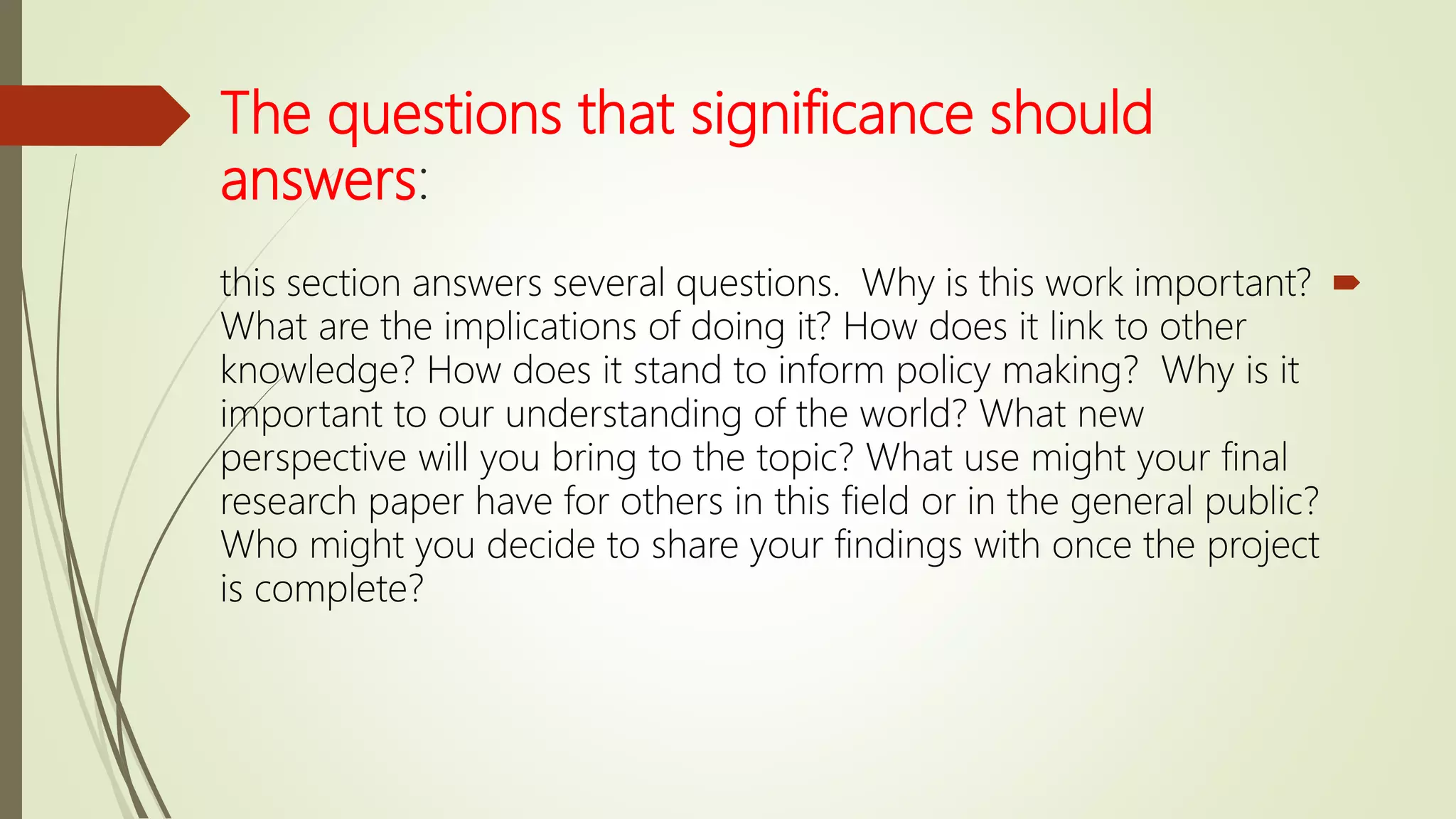
this section answers several questions. Why is this work important?
What are the implications of doing it? How does it link to other
knowledge? How does it stand to inform policy making? Why is it
important to our understanding of the world? What new
perspective will you bring to the topic? What use might your final
research paper have for others in this field or in the general public?
Who might you decide to share your findings with once the project
is complete?
6.
THE PURPOSE OFSIGNIFICANCE:
The researcher should think about how the research:
may resolve theoretical questions in the research area
may develop better theoretical models in the research
area
may influence public policy
may change the way people do their jobs in a particular
field, or may change the way people live.
And if there are other contributions the research will
make, the researcher should also describe them in detail.
7.
TECHNIQUES OF SIGNIFICANCE
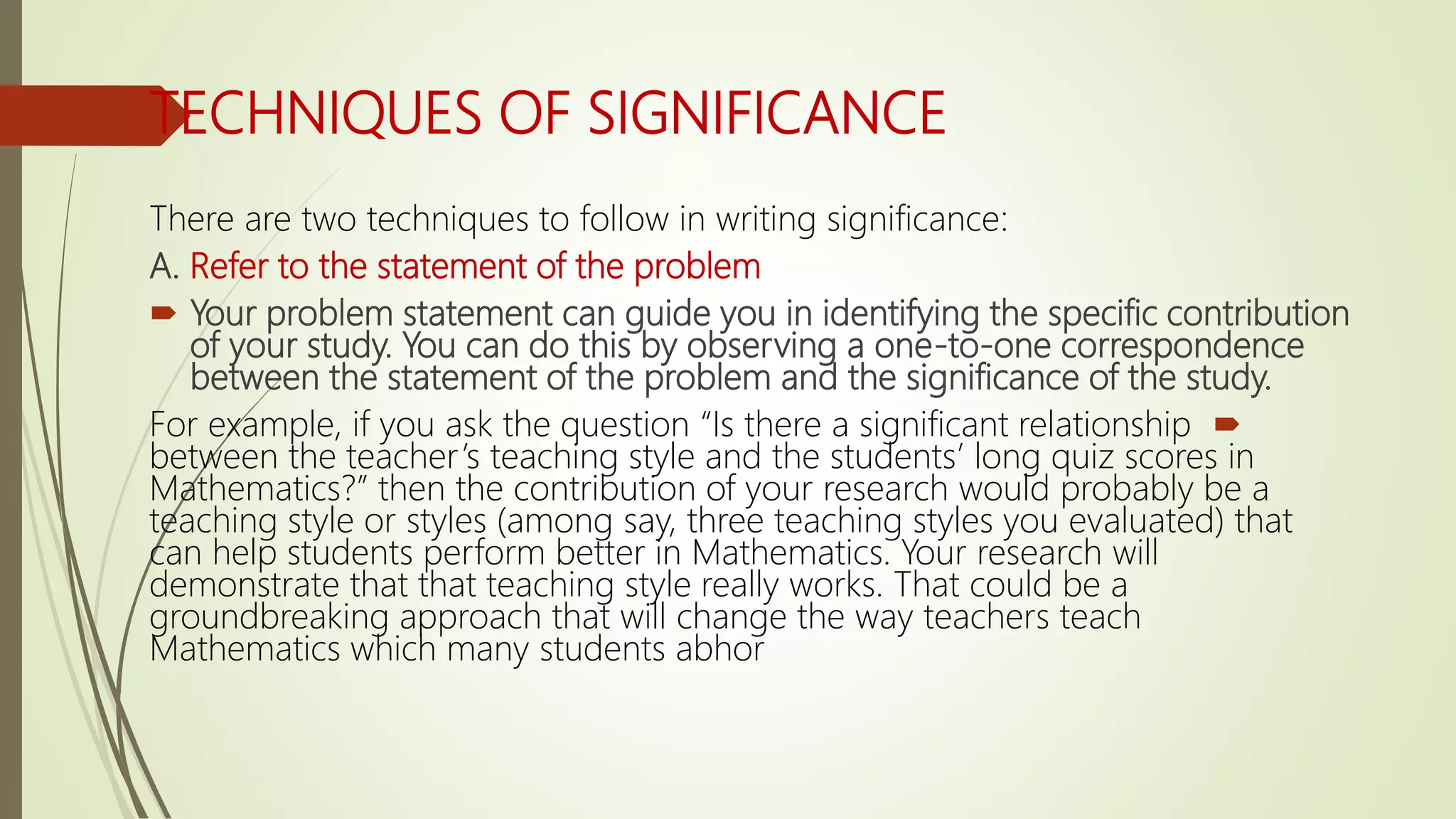
Thereare two techniques to follow in writing significance:
A. Refer to the statement of the problem
Your problem statement can guide you in identifying the specific contribution
of your study. You can do this by observing a one-to-one correspondence
between the statement of the problem and the significance of the study.
For example, if you ask the question “Is there a significant relationship
between the teacher’s teaching style and the students’ long quiz scores in
Mathematics?” then the contribution of your research would probably be a
teaching style or styles (among say, three teaching styles you evaluated) that
can help students perform better in Mathematics. Your research will
demonstrate that that teaching style really works. That could be a
groundbreaking approach that will change the way teachers teach
Mathematics which many students abhor
8.
B. Write fromgeneral to specific contribution
Write the significance of the study by looking into the general
contribution of your study, such as its importance to society as a
whole, then proceed downwards—towards its contribution to
individuals and that may include yourself as a researcher. You
off broadly then taper off gradually to a specific group or
9.
For example, inthe study on teaching style given in
#1, you may write:
11.
EXAMPLES FOR HOWTO WRITE SIGNIFICANCE
Example A:
The research study could provide information on the issues of Voice-over-Internet Protocol
technology particularly on the integrity, vulnerability and security of VoIP calls. Further, this
study would also be a review on the VoIP Technology present and service providers based in
the United States, particularly in local area.This study would be beneficial to the Commission
on Telecommunication in the city as this study enhance the knowledge of the telephony
providers and users about the possible issues on VoIP Technology. Furthermore, this study
would be beneficial to the telephony providers and the users as this study would provide the
necessary information on the different threats and attacks in VoIP technology. This would
expectedly heighten the awareness of the providers and the users to equip a counterattack to
possible threats. To the future researchers, this study can provide baseline information on the
recent status of VoIP technology.
12.
Example B:
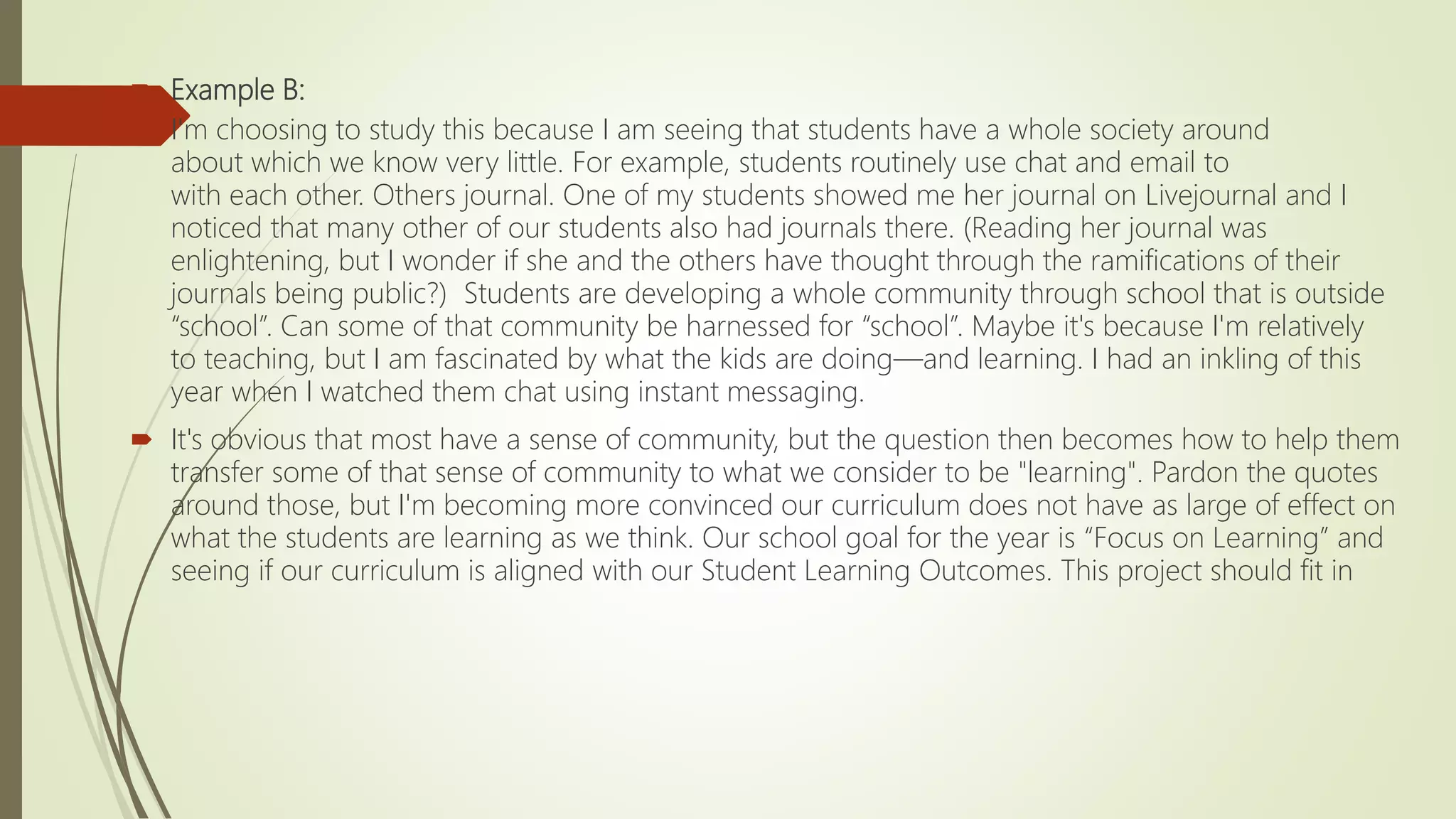
I'm choosing to study this because I am seeing that students have a whole society around
about which we know very little. For example, students routinely use chat and email to
with each other. Others journal. One of my students showed me her journal on Livejournal and I
noticed that many other of our students also had journals there. (Reading her journal was
enlightening, but I wonder if she and the others have thought through the ramifications of their
journals being public?) Students are developing a whole community through school that is outside
“school”. Can some of that community be harnessed for “school”. Maybe it's because I'm relatively
to teaching, but I am fascinated by what the kids are doing—and learning. I had an inkling of this
year when I watched them chat using instant messaging.
It's obvious that most have a sense of community, but the question then becomes how to help them
transfer some of that sense of community to what we consider to be "learning". Pardon the quotes
around those, but I'm becoming more convinced our curriculum does not have as large of effect on
what the students are learning as we think. Our school goal for the year is “Focus on Learning” and
seeing if our curriculum is aligned with our Student Learning Outcomes. This project should fit in