Critical Reading and Writing
The Importance of Critical Reading Critical writing depends on critical reading. Most of the papers you write will involve  reflection  on written texts - the thinking and research that has already been done on your subject.   Making judgments and interpretations of the texts you read is the  first step  toward  formulating your own approach .
Critical Readin g:  What is It? To read critically is to make  judgments  about how a text is argued.  This is a highly  reflective  skill requiring you to "stand back" from the text you are reading.  You might have to read a text through once to get a  basic grasp  of content before you launch into an intensive critical reading.
The Keys DON’T  read looking only or primarily for information. DO  read looking for ways of thinking about the subject matter.
Another Key When you are reading, highlighting, or taking notes,  avoid  extracting and compiling lists of facts, illustrations, examples, details, data.
ASK How  does this text work?
ASK How  is it argued?
ASK How  does it reach its conclusions?
ASK How  can I use it to develop my own argument?
How Do I Read Looking for  Ways of Thinking?
Determine the  central claims  or purpose of the text. What is the author’s  thesis ? Who  is the author and  why  is he/she interested in this topic? Why  might the author be concerned about this matter?
Consider the context of the work When  was this text written? What  historical events  surrounding this subject matter might have influenced the writer? Is the writer  responding to another  writer or idea?
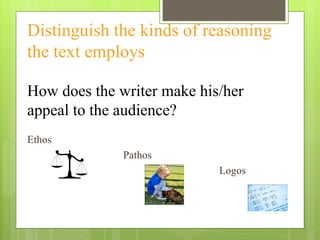
Distinguish the kinds of reasoning the text employs  How does the writer make his/her  appeal to the audience? Ethos Pathos Logos
Examine the kinds of evidence the text employs   Numbers, data?  Case reports?
Evaluate the work Is valid  evidence  provided? How might the evidence be reinterpreted? Is the author blind to any issues?
Practical Tips Skim the work before critically reading. Highlight the arguments and patterns of thought in a work. If using a portion of another work, consider context. Use quotations wisely. Listen critically in class.

Critical reading and writing

  • 1.
  • 2.
    The Importance ofCritical Reading Critical writing depends on critical reading. Most of the papers you write will involve reflection on written texts - the thinking and research that has already been done on your subject. Making judgments and interpretations of the texts you read is the first step toward formulating your own approach .
  • 3.
    Critical Readin g: What is It? To read critically is to make judgments about how a text is argued. This is a highly reflective skill requiring you to "stand back" from the text you are reading. You might have to read a text through once to get a basic grasp of content before you launch into an intensive critical reading.
  • 4.
    The Keys DON’T read looking only or primarily for information. DO read looking for ways of thinking about the subject matter.
  • 5.
    Another Key Whenyou are reading, highlighting, or taking notes, avoid extracting and compiling lists of facts, illustrations, examples, details, data.
  • 6.
    ASK How does this text work?
  • 7.
    ASK How is it argued?
  • 8.
    ASK How does it reach its conclusions?
  • 9.
    ASK How can I use it to develop my own argument?
  • 10.
    How Do IRead Looking for Ways of Thinking?
  • 11.
    Determine the central claims or purpose of the text. What is the author’s thesis ? Who is the author and why is he/she interested in this topic? Why might the author be concerned about this matter?
  • 12.
    Consider the contextof the work When was this text written? What historical events surrounding this subject matter might have influenced the writer? Is the writer responding to another writer or idea?
  • 13.
    Distinguish the kindsof reasoning the text employs How does the writer make his/her appeal to the audience? Ethos Pathos Logos
  • 14.
    Examine the kindsof evidence the text employs Numbers, data? Case reports?
  • 15.
    Evaluate the workIs valid evidence provided? How might the evidence be reinterpreted? Is the author blind to any issues?
  • 16.
    Practical Tips Skimthe work before critically reading. Highlight the arguments and patterns of thought in a work. If using a portion of another work, consider context. Use quotations wisely. Listen critically in class.