ENGLISH IV
MS. CLZIANOSKI
Take notes that stress the main idea and
details dealing with argument and
persuasion
Analyze elements of persuasion,
ambiguity and rhetoric
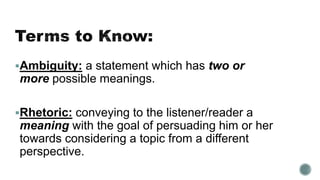
Ambiguity: a statement which has two or
more possible meanings.
Rhetoric: conveying to the listener/reader a
meaning with the goal of persuading him or her
towards considering a topic from a different
perspective.
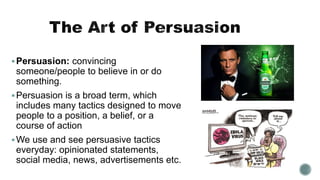
Persuasion: convincing
someone/people to believe in or do
something.
Persuasion is a broad term, which
includes many tactics designed to move
people to a position, a belief, or a
course of action
We use and see persuasive tactics
everyday: opinionated statements,
social media, news, advertisements etc.
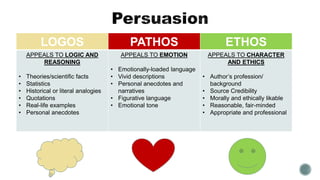
LOGOS PATHOS ETHOS
APPEALS TO LOGIC AND
REASONING
• Theories/scientific facts
• Statistics
• Historical or literal analogies
• Quotations
• Real-life examples
• Personal anecdotes
APPEALS TO EMOTION
• Emotionally-loaded language
• Vivid descriptions
• Personal anecdotes and
narratives
• Figurative language
• Emotional tone
APPEALS TO CHARACTER
AND ETHICS
• Author’s profession/
background
• Source Credibility
• Morally and ethically likable
• Reasonable, fair-minded
• Appropriate and professional
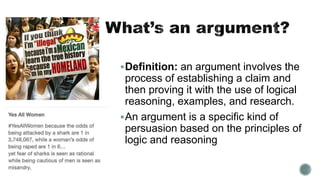
Definition: an argument involves the
process of establishing a claim and
then proving it with the use of logical
reasoning, examples, and research.
An argument is a specific kind of
persuasion based on the principles of
logic and reasoning
The point of argument and persuasion is
to move or influence people/someone to a
belief, position, or course of action.
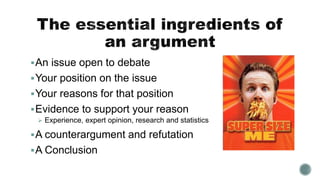
An issue open to debate
Your position on the issue
Your reasons for that position
Evidence to support your reason
 Experience, expert opinion, research and statistics
A counterargument and refutation
A Conclusion
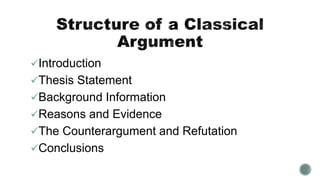
Introduction
Thesis Statement
Background Information
Reasons and Evidence
The Counterargument and Refutation
Conclusions
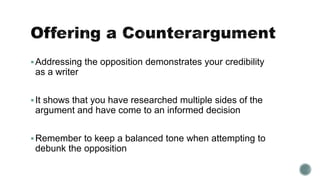
Addressing the opposition demonstrates your credibility
as a writer
It shows that you have researched multiple sides of the
argument and have come to an informed decision
Remember to keep a balanced tone when attempting to
debunk the opposition
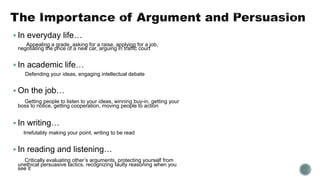
 In everyday life…
Appealing a grade, asking for a raise, applying for a job,
negotiating the price of a new car, arguing in traffic court
 In academic life…
Defending your ideas, engaging intellectual debate
 On the job…
Getting people to listen to your ideas, winning buy-in, getting your
boss to notice, getting cooperation, moving people to action
 In writing…
Irrefutably making your point, writing to be read
 In reading and listening…
Critically evaluating other’s arguments, protecting yourself from
unethical persuasive tactics, recognizing faulty reasoning when you
see it

12th ARGUMENT AND PERSUASION

  • 1.
  • 2.
    Take notes thatstress the main idea and details dealing with argument and persuasion Analyze elements of persuasion, ambiguity and rhetoric
  • 3.
    Ambiguity: a statementwhich has two or more possible meanings. Rhetoric: conveying to the listener/reader a meaning with the goal of persuading him or her towards considering a topic from a different perspective.
  • 4.
    Persuasion: convincing someone/people tobelieve in or do something. Persuasion is a broad term, which includes many tactics designed to move people to a position, a belief, or a course of action We use and see persuasive tactics everyday: opinionated statements, social media, news, advertisements etc.
  • 5.
    LOGOS PATHOS ETHOS APPEALSTO LOGIC AND REASONING • Theories/scientific facts • Statistics • Historical or literal analogies • Quotations • Real-life examples • Personal anecdotes APPEALS TO EMOTION • Emotionally-loaded language • Vivid descriptions • Personal anecdotes and narratives • Figurative language • Emotional tone APPEALS TO CHARACTER AND ETHICS • Author’s profession/ background • Source Credibility • Morally and ethically likable • Reasonable, fair-minded • Appropriate and professional
  • 7.
    Definition: an argumentinvolves the process of establishing a claim and then proving it with the use of logical reasoning, examples, and research. An argument is a specific kind of persuasion based on the principles of logic and reasoning
  • 8.
    The point ofargument and persuasion is to move or influence people/someone to a belief, position, or course of action.
  • 9.
    An issue opento debate Your position on the issue Your reasons for that position Evidence to support your reason  Experience, expert opinion, research and statistics A counterargument and refutation A Conclusion
  • 10.
    Introduction Thesis Statement Background Information Reasonsand Evidence The Counterargument and Refutation Conclusions
  • 11.
    Addressing the oppositiondemonstrates your credibility as a writer It shows that you have researched multiple sides of the argument and have come to an informed decision Remember to keep a balanced tone when attempting to debunk the opposition
  • 12.
     In everydaylife… Appealing a grade, asking for a raise, applying for a job, negotiating the price of a new car, arguing in traffic court  In academic life… Defending your ideas, engaging intellectual debate  On the job… Getting people to listen to your ideas, winning buy-in, getting your boss to notice, getting cooperation, moving people to action  In writing… Irrefutably making your point, writing to be read  In reading and listening… Critically evaluating other’s arguments, protecting yourself from unethical persuasive tactics, recognizing faulty reasoning when you see it