Language (OALD: 9th Edition)
 The word language has 5 Senses
→ Language of a country
− the system of communication in speech and
writing that is used by people of a particular
country, Germen Language, English Language
etc
etc
→ Communication
− the use by humans of a system of sounds and
words to communicate
→ style of speaking / writing
− a particular style of speaking or writing, bad
language, slang language, formal Lang
Language (OALD: 9th Edition)
 The word language has 5 Senses
→ movements / symbols / sound
− a way of expressing ideas and feelings using
movements, symbols and sound, the language
of dolphin/bees
of dolphin/bees
→ Computing
− a system of symbols and rules that is used to
operate a computer
More Simplified Version
 A means of communication
 Communication
→ a human’s social need
− No Language'''&& No communication'''no
chance of survival in a society
Why do we need to learn a foreign
language?
 Era of communication & technology'''
→ Now''world'&&& a global
village'''competitive world''& Survival of
the fittest''&&
− Survival of fittest''&be the best from all
aspects'''know culture,traditional
values,social values&&&&religion''language'
 Why all this''
→ to understand each other better'&&to
facilitate,help each other'' only way of
survival'''&
English Language
 International Language
 Language of Science and technology
 Good job'''
 open door to knowledge'&
 language of computer, mobile phone'''&
 official language''
 widely spoken all over the world
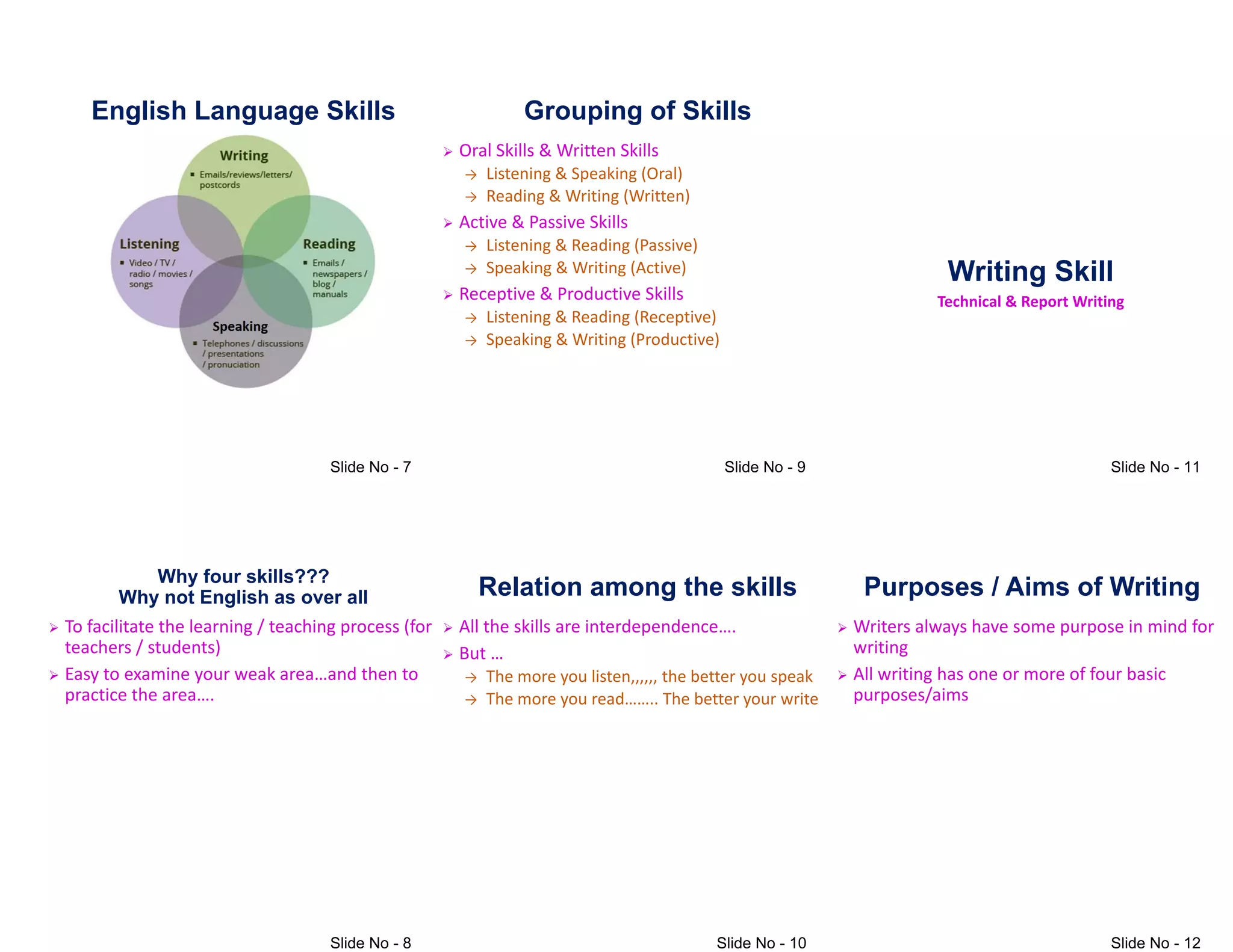
English Language Skills
Why four skills???
Why not English as over all
 To facilitate the learning / teaching process (for
teachers / students)
 Easy to examine your weak area'and then to
practice the area'&
Grouping of Skills
 Oral Skills & Written Skills
→ Listening & Speaking (Oral)
→ Reading & Writing (Written)
 Active & Passive Skills
Listening & Reading (Passive)
→ Listening & Reading (Passive)
→ Speaking & Writing (Active)
 Receptive & Productive Skills
→ Listening & Reading (Receptive)
→ Speaking & Writing (Productive)
Relation among the skills
 All the skills are interdependence'&
 But '
→ The more you listen,,,,,, the better you speak
→ The more you read''&& The better your write
Writing Skill
Technical & Report Writing
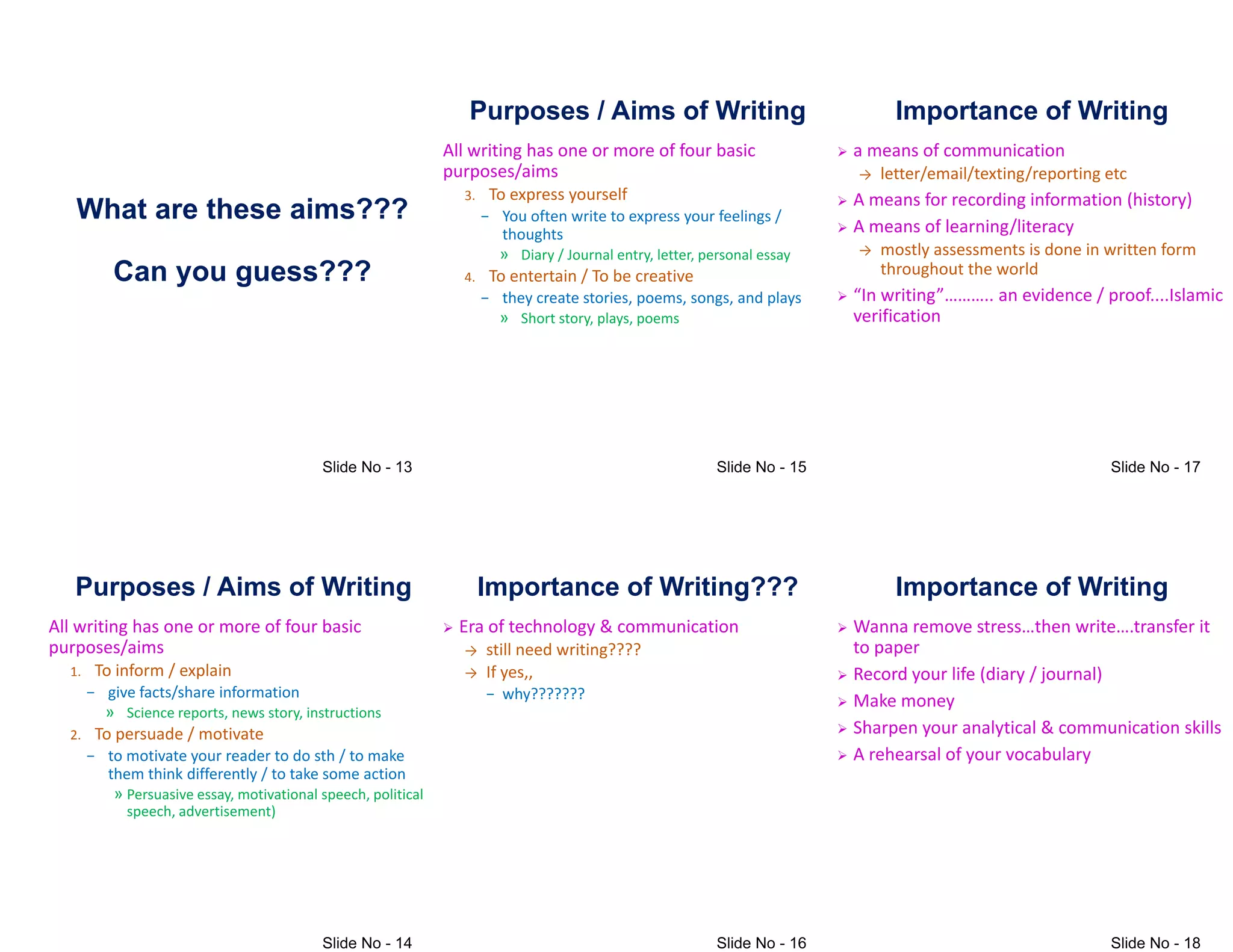
Purposes / Aims of Writing
 Writers always have some purpose in mind for
writing
 All writing has one or more of four basic
purposes/aims
What are these aims???
Can you guess???
Purposes / Aims of Writing
All writing has one or more of four basic
purposes/aims
1. To inform / explain
− give facts/share information
+ Science reports, news story, instructions
2. To persuade / motivate
− to motivate your reader to do sth / to make
them think differently / to take some action
+ Persuasive essay, motivational speech, political
speech, advertisement)
Purposes / Aims of Writing
All writing has one or more of four basic
purposes/aims
3. To express yourself
− You often write to express your feelings /
thoughts
thoughts
+ Diary / Journal entry, letter, personal essay
4. To entertain / To be creative
− they create stories, poems, songs, and plays
+ Short story, plays, poems
Importance of Writing???
 Era of technology & communication
→ still need writing????
→ If yes,,
− why???????
Importance of Writing
 a means of communication
→ letter/email/texting/reporting etc
 A means for recording information (history)
 A means of learning/literacy
A means of learning/literacy
→ mostly assessments is done in written form
throughout the world
 )In writing*'''&& an evidence , proof&&&&Islamic
verification
Importance of Writing
 Wanna remove stress'then write'&transfer it
to paper
 Record your life (diary / journal)
 Make money
 Sharpen your analytical & communication skills
 A rehearsal of your vocabulary
Importance of Writing
 To make to do lists/ reminders/events etc
 Revive/revise recently learned materials
 Write so you can be assessed
 Write for creativity / generating ideas and
exploration
 Write for Literature,drama,movie'so people
will know you..
Who writes??? Why???
 A Wali writes
→ to spread ways to Allah
 Scientists write
→ to share their inventions/discoveries
 Technical writers write
→ to explain how something works
 news reporters write
→ to share current updates
 Poets write
→ to spread feelings
Who writes??? Why???
 Business people write
→ to make profit
 Judges write
→ to do justice
 Doctors write
→ to cure you
→ to cure you
 Bankers write
→ to snatch your money bit by bit
 police write
→ to punish you
 Students write
→ for GPA
Will you write???
Will you write?
 Yes''''
HOW???
HOW???
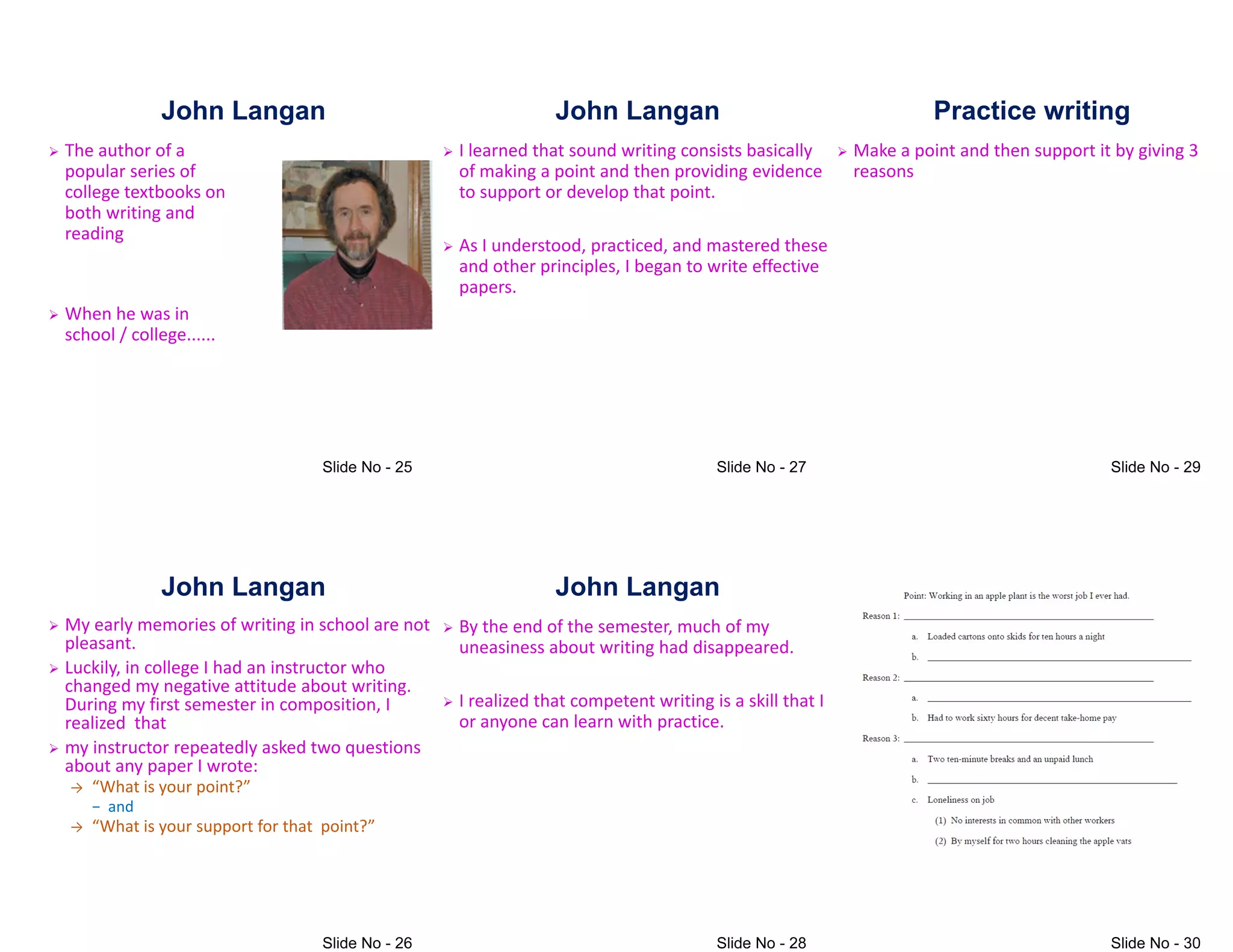
John Langan
 The author of a
popular series of
college textbooks on
both writing and
reading
reading
 When he was in
school / college......
John Langan
 My early memories of writing in school are not
pleasant.
 Luckily, in college I had an instructor who
changed my negative attitude about writing.
During my first semester in composition, I
realized that
During my first semester in composition, I
realized that
 my instructor repeatedly asked two questions
about any paper I wrote:
→ )What is your point"*
− and
→ )What is your support for that point"*
John Langan
 I learned that sound writing consists basically
of making a point and then providing evidence
to support or develop that point.
As I understood, practiced, and mastered these
 As I understood, practiced, and mastered these
and other principles, I began to write effective
papers.
John Langan
 By the end of the semester, much of my
uneasiness about writing had disappeared.
 I realized that competent writing is a skill that I
or anyone can learn with practice.
Practice writing
 Make a point and then support it by giving 3
reasons
Assignment 01
 Using the same pattern you will make 1 point
and will support by 3 supporting points'
 You have to make 10 sets'&
4 Questions to change your
attitude
 A good writer should be able to sit down and
write a paper straight through without
stopping.
→ ANSWER
− FALSE
− FALSE
 Writing is, in fact, a process. It is done not in
one easy step but in a series of steps, and
seldom at one sitting.
 It is harmful to carry around the false idea that
writing should be an easy matter.
4 Questions to change your
attitude
 Writing is a skill that anyone can learn with
practice.
→ TRUE
 Some people hold the false belief that writing is
a natural gift that some have and others do not.
 Because of this belief, they never make a truly
honest effort to learn to write—and so they
never learn.
4 Questions to change your
attitude
 I(ll never be good at writing because I make too
many mistakes in spelling, grammar, and
punctuation.
→ ANSWER (FALSE)
 The first concern in good writing should be
content —
→ what you have to say.
→ Your ideas and feelings are what matter most.
 You should not worry about spelling, grammar,
or punctuation while working on content.
4 Questions to change your
attitude
 I(ve always done poorly in English# and I don(t
expect that to change.
→ ANSWER (False)
 How you may have performed in the past does
not control how you can perform in the
present.
Attitude Matters
 In brief, your attitude is crucial.
 If you believe you are a poor writer and always
will be, chances are you will not improve.
 If you realize you can become a better writer,
chances are you will improve.
 Depending on how you allow yourself to think,
you can be your own best friend or your own
worst enemy.
WHAT IS WRITING PROCESS???
The writing process is a series of steps that most
writers follow to get from thinking about a topic
to preparing the final draft.
THINKING
FINAL DRAFT
THE WRITING PROCESS
THE WRITING PROCESS
STEP 1
THE WRITING PROCESS
THE WRITING PROCESS
STEP 2
THE WRITING PROCESS
THE WRITING PROCESS
STEP 3
WHAT IS EXPLORING???
 There are certain things before writing
that can help you FOCUS on your
topic.
 To find/trace these things is termed as
EXPLORING
 These things will help you to begin
your journey of writing.
WHAT IS EXPLORING???
 TOPIC
 AUDIENCE
 AUDIENCE
 PURPOSE
 EXPLORING STRATEGIES
Exploring
(TOPIC)
• Your topic is what you are writing
about ,,very important ... Think
about it….
about ,,very important ... Think
about it….
• A Topic can have many aspects/angles to be
looked at
TRAVELLING
TRAVELLING
Dangers of
travelling
of
in of
travelling
Travelling
(part of our
life)
Travelling
for
Adventures
in
Emergency
As every topic has
As every topic has many
many
aspects
aspects……Which
……Which aspect
aspect should I
should I
aspects
aspects……Which
……Which aspect
aspect should I
should I
choose for writing????
As every topic has many aspects……Which
aspect should I choose for writing????
• The aspect that interests you
• The aspect that you have sufficient
knowledge of
• The aspect that you can easily explain (you
find easy to make a point and then you can
support your point)
• The aspect that is relevant to your
field/experience
Exploring
(Audience)
• Your audience is your intended reader.
• Your audience might be your instructor, your
classmates, your boss, your coworkers, and so
on
on
• Remember to adapt your language and
vocabulary for a specific audience.
Exploring
(Audience)
• When you think about your audience, keep
the following points into your mind
– Prior knowledge of your audience about the topic
– Your readers expectations from this writing
– To know which way they will find more interesting
– Vocabulary & Sentences (Simple, difficult,
complex)
– Tone (formal, informal)
Exploring
(Audience)
INSTRUCTOR AS YOUR AUDIENCE
• He will expect you
– to use correct grammar
– to reveal what you have learned or understood
about the topic
– To present your ideas in a clear and organized manner
• Remember: Do not leave out information
because you assume that your instructor is an
expert in the field.
Exploring
(Purpose)
• Your purpose is your reason for writing
– To inform/explain
– To persuade / motivate
– To be creative
– To be creative
– To express yourself
• Sometimes you may have more than one
purposes, but be clear about your purpose
EXPLORING
EXPLORING STRATEGIES
STRATEGIES
• Why do we need exploring strategies???
– To generate ideas
EXPLORING
EXPLORING STRATEGIES
STRATEGIES
• After you determine your topic, audience, and
purpose, try some exploring strategies—also
known as prewriting strategies - to help get your
ideas flowing
• The four most common strategies are
– FREEWRITING / LOOPING
– BRAINSTORMING / LISTING
– QUESTIONING
– CLUSTERING / MIND MAPPING
EXPLORING
EXPLORING STRATEGIES
STRATEGIES
(Freewriting / Looping)
• Freewriting is writing for a limited period of
time without stopping
• The point is to record the first thoughts that
come to mind.
come to mind.
• If you have no ideas, you can indicate that in a
sentence such as “I don’t know what to
write.”
• As you write, do not be concerned with your
grammar or spelling.
Sample (Freewriting)
Work. I’ve only worked in a restaurant.
Schedules are good for college students. Can
work nights or weekends. Serving people so
different from studying. You can relax your
brain, go on automatic pilot. But you have to
remember people’s orders so it can be hard. And
some customer are rude, rude, RUDE. In some
jobs, you get tips in addition to the salary.
Should people always tip servers?
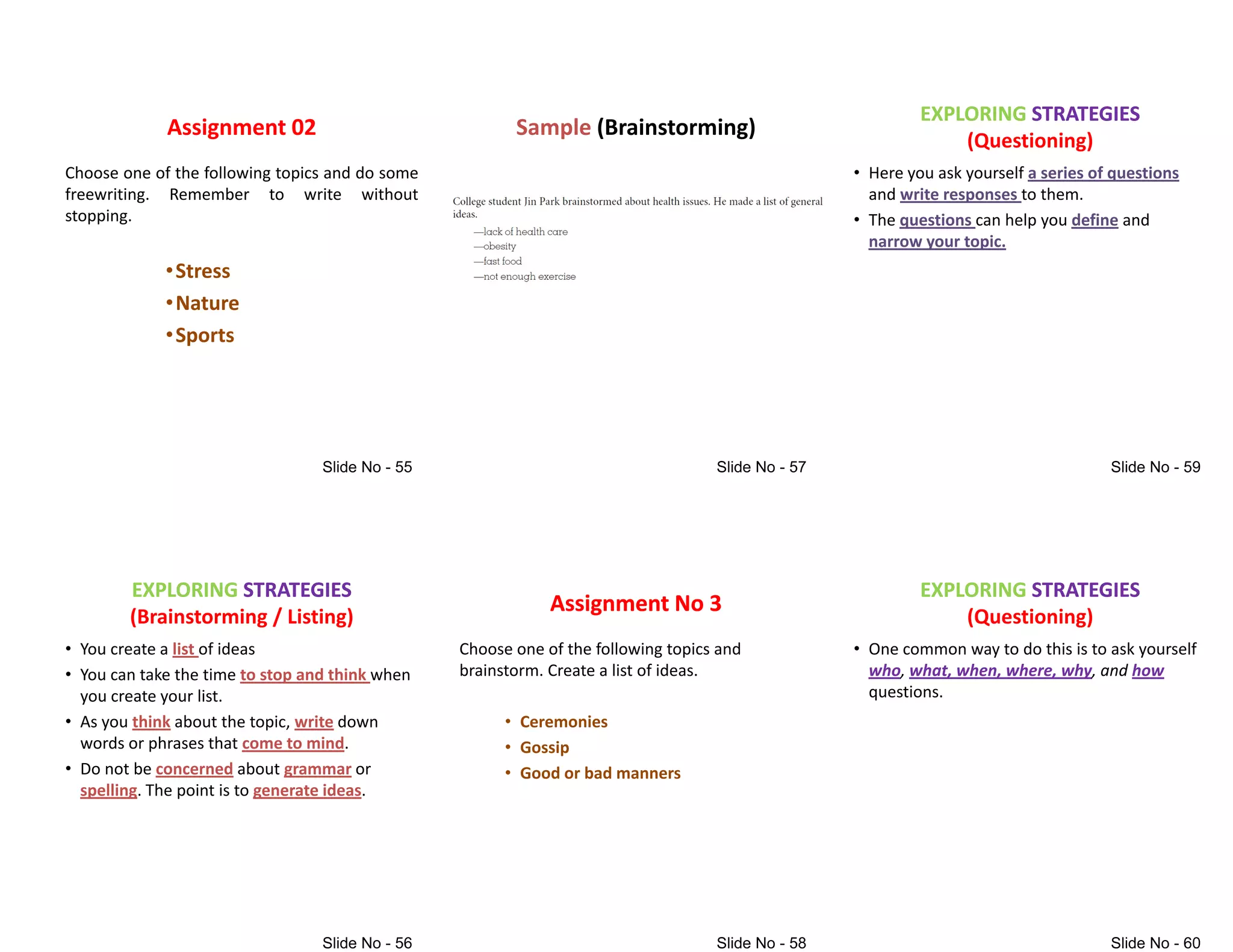
Assignment 02
Choose one of the following topics and do some
freewriting. Remember to write without
stopping.
•Stress
•Nature
•Sports
EXPLORING
EXPLORING STRATEGIES
STRATEGIES
(Brainstorming / Listing)
• You create a list of ideas
• You can take the time to stop and think when
you create your list.
• As you think about the topic, write down
words or phrases that come to mind.
• Do not be concerned about grammar or
spelling. The point is to generate ideas.
Sample (Brainstorming)
Assignment No 3
Assignment No 3
Choose one of the following topics and
brainstorm. Create a list of ideas.
• Ceremonies
• Ceremonies
• Gossip
• Good or bad manners
EXPLORING
EXPLORING STRATEGIES
STRATEGIES
(Questioning)
• Here you ask yourself a series of questions
and write responses to them.
• The questions can help you define and
narrow your topic.
narrow your topic.
EXPLORING
EXPLORING STRATEGIES
STRATEGIES
(Questioning)
• One common way to do this is to ask yourself
who, what, when, where, why, and how
questions.
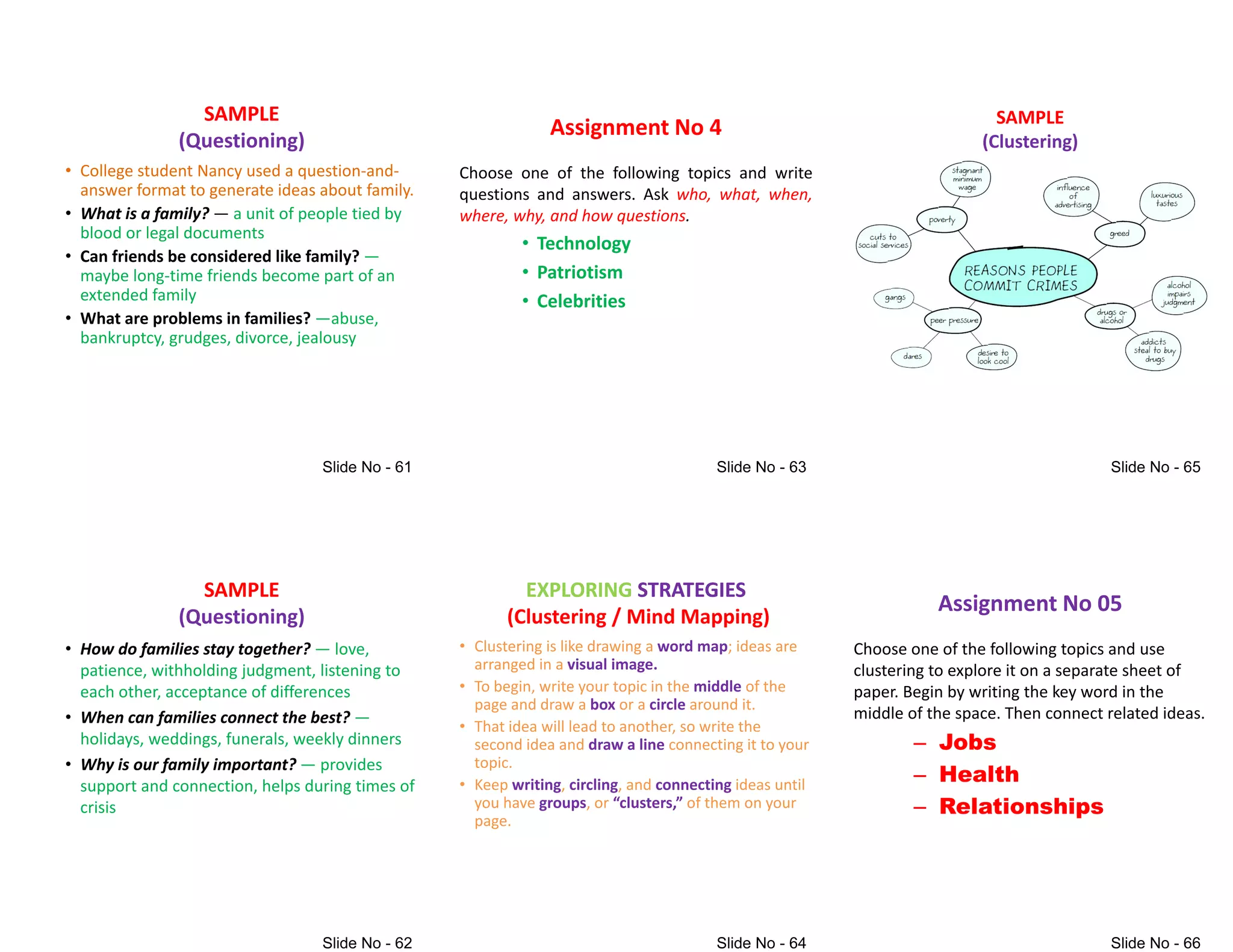
SAMPLE
(Questioning)
• College student Nancy used a question-and-
answer format to generate ideas about family.
• What is a family? — a unit of people tied by
blood or legal documents
• Can friends be considered like family? —
maybe long-time friends become part of an
extended family
• What are problems in families? —abuse,
bankruptcy, grudges, divorce, jealousy
SAMPLE
(Questioning)
• How do families stay together? — love,
patience, withholding judgment, listening to
each other, acceptance of differences
• When can families connect the best? —
holidays, weddings, funerals, weekly dinners
• Why is our family important? — provides
support and connection, helps during times of
crisis
Assignment No 4
Choose one of the following topics and write
questions and answers. Ask who, what, when,
where, why, and how questions.
• Technology
• Technology
• Patriotism
• Celebrities
EXPLORING
EXPLORING STRATEGIES
STRATEGIES
(Clustering / Mind Mapping)
• Clustering is like drawing a word map; ideas are
arranged in a visual image.
• To begin, write your topic in the middle of the
page and draw a box or a circle around it.
That idea will lead to another, so write the
• That idea will lead to another, so write the
second idea and draw a line connecting it to your
topic.
• Keep writing, circling, and connecting ideas until
you have groups, or “clusters,” of them on your
page.
SAMPLE
(Clustering)
Assignment No 05
Choose one of the following topics and use
clustering to explore it on a separate sheet of
paper. Begin by writing the key word in the
middle of the space. Then connect related ideas.
– Jobs
– Health
– Relationships
More about Exploring
• When you explore a topic using any of the
listed strategies, keep in mind that a lot of the
ideas you generate may not be useful.
• Later, when you develop your ideas, be
prepared to cut irrelevant information.
Chapter Summary
• Before you write, you should think about ???
• 3 Things
• 3 Things
Chapter Summary
Before you write, you should think about your
• topic, (What you are going to write
about)
• Audience (Your intended reader)
• purpose. (Your reason for writing)
Explain what each one is.
Chapter Summary
Before you write, you should think about your
topic, (What you are going to write
about)
about)
(As every topic has different
aspect, so which aspect???)
Chapter Summary
Before you write, you should think about your
topic, (What you are going to write
about)
(As every topic has different aspect)
• You find interesting,
• have sufficient knowledge,
• find easy to support,
• Relevant to you
• you can easily explain
Chapter Summary
Before you write, you should think about your
• Audience (Your intended reader)
• Points that you keep in mind???
Chapter Summary
Before you write, you should think about your
• Audience (Your intended reader)
• Points that you keep in mind???
– Prior knowledge of your audience about the topic
– Your readers expectations from this writing
– To know which way they will find more interesting
– Vocabulary & Sentences (Simple, difficult, complex)
– Tone (formal, informal)
Chapter Summary
Before you write, you should think about your
• Purpose (Your reason for writing)
• 4 basic purposes of writing???
Chapter Summary
Before you write, you should think about your
• Purpose (Your reason for writing)
• 4 basic purposes of writing???
 To inform/explain
 To persuade / motivate
 To be creative
 To express yourself
Chapter Summary
Briefly define each of the following exploring
styles.
• freewriting
• brainstorming
• questioning:
• Clustering:
Chapter Summary
Briefly define each of the following exploring styles.
• freewriting (writing without stopping)
• brainstorming (making a list)
• questioning: (asking & answering a
series of questions)
• clustering: (drawing a word map)
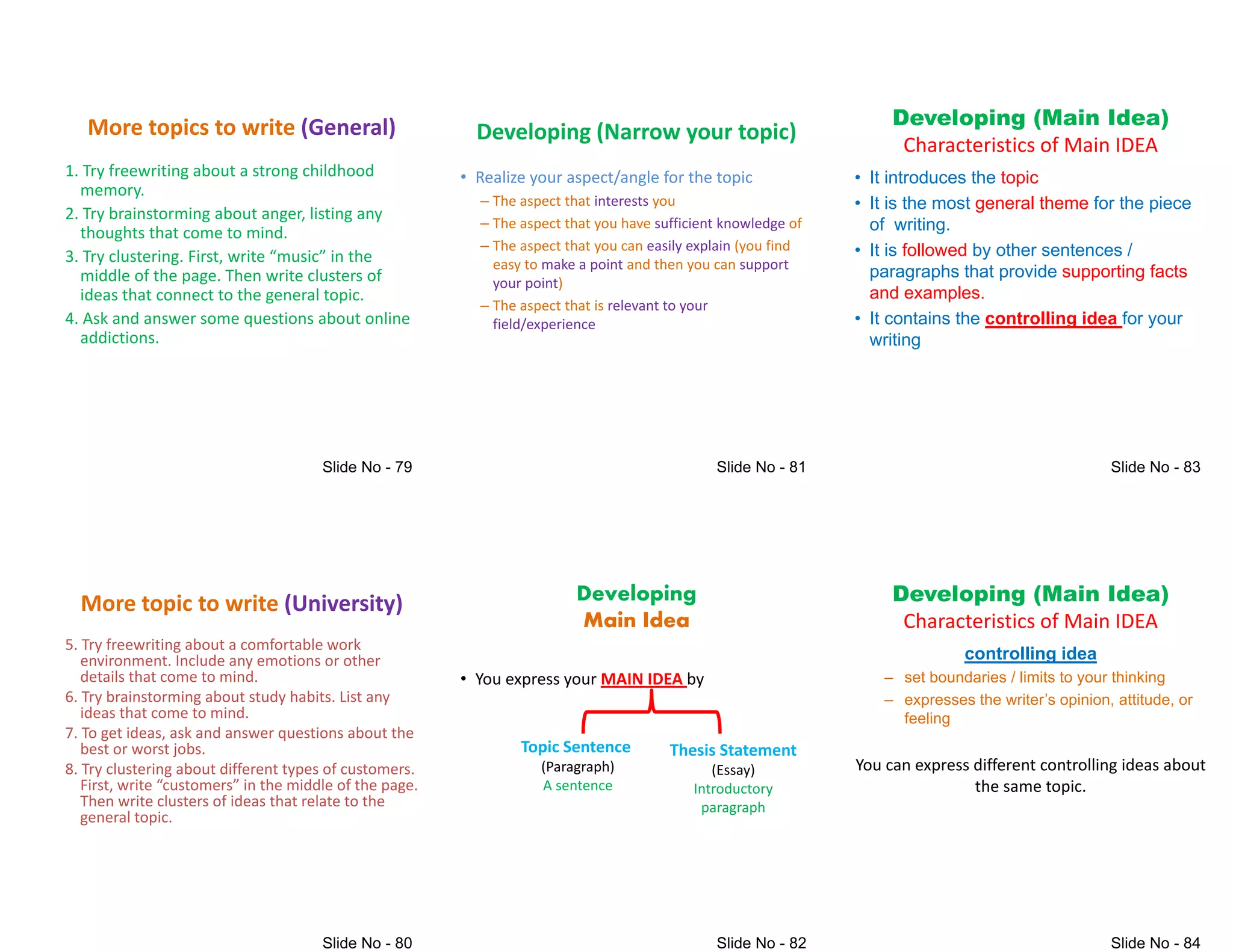
More topics to write (General)
1. Try freewriting about a strong childhood
memory.
2. Try brainstorming about anger, listing any
thoughts that come to mind.
3& Try clustering& First# write )music* in the
middle of the page. Then write clusters of
ideas that connect to the general topic.
4. Ask and answer some questions about online
addictions.
More topic to write (University)
5. Try freewriting about a comfortable work
environment. Include any emotions or other
details that come to mind.
6. Try brainstorming about study habits. List any
ideas that come to mind.
7. To get ideas, ask and answer questions about the
best or worst jobs.
8. Try clustering about different types of customers.
First# write )customers* in the middle of the page&
Then write clusters of ideas that relate to the
general topic.
Developing (Narrow your topic)
• Realize your aspect/angle for the topic
– The aspect that interests you
– The aspect that you have sufficient knowledge of
– The aspect that you can easily explain (you find
easy to make a point and then you can support
your point)
– The aspect that is relevant to your
field/experience
Developing
Main Idea
• You express your MAIN IDEA by
Topic Sentence
(Paragraph)
A sentence
Thesis Statement
(Essay)
Introductory
paragraph
Developing (Main Idea)
Characteristics of Main IDEA
• It introduces the topic
• It is the most general theme for the piece
of writing.
• It is followed by other sentences /
paragraphs that provide supporting facts
and examples.
• It contains the controlling idea for your
writing
Developing (Main Idea)
Characteristics of Main IDEA
controlling idea
– set boundaries / limits to your thinking
– expresses the writer’s opinion, attitude, or
feeling
feeling
You can express different controlling ideas about
the same topic.
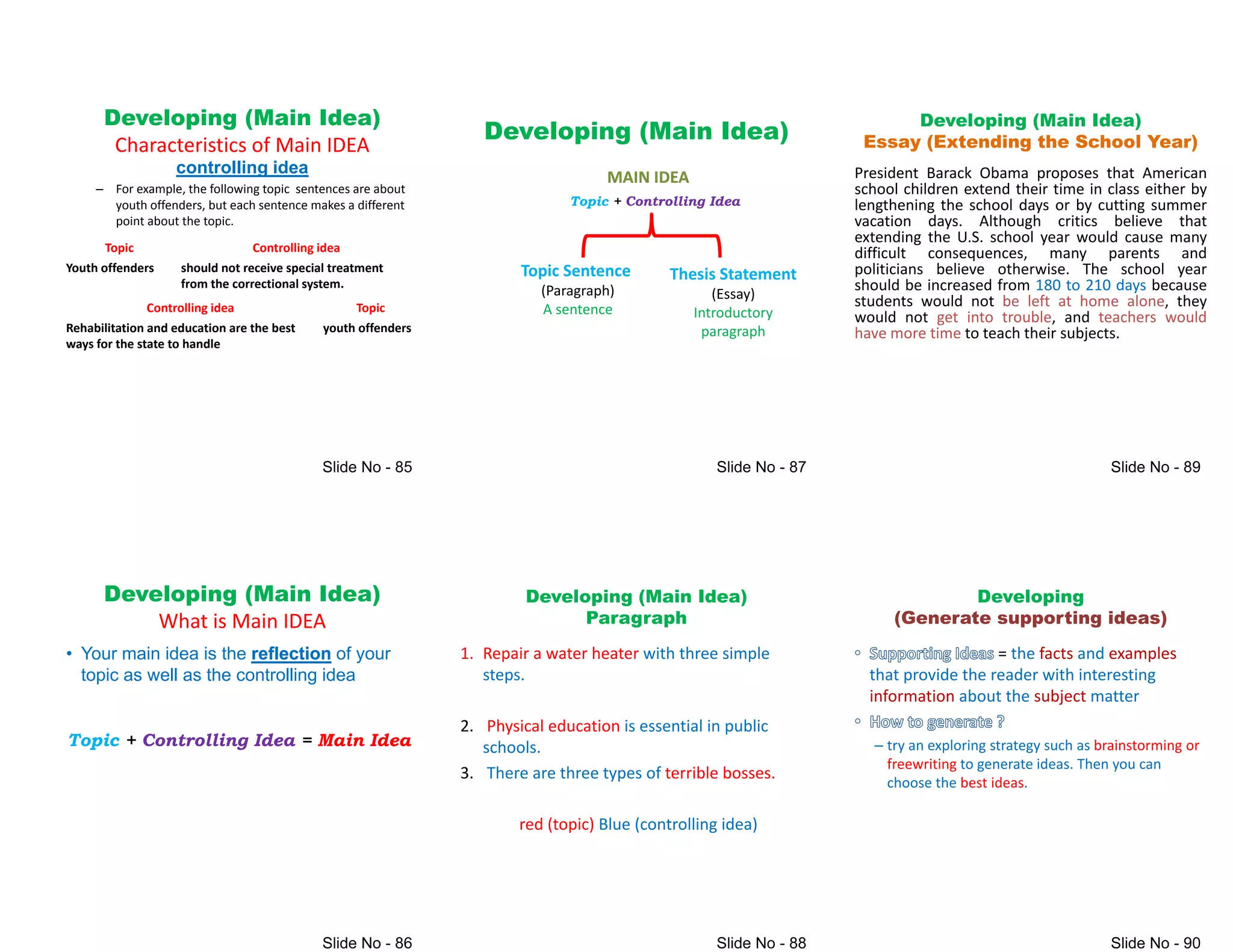
Developing (Main Idea)
Characteristics of Main IDEA
controlling idea
– For example, the following topic sentences are about
youth offenders, but each sentence makes a different
point about the topic.
Topic Controlling idea
Youth offenders should not receive special treatment
from the correctional system.
Controlling idea Topic
Rehabilitation and education are the best
ways for the state to handle
youth offenders
Developing (Main Idea)
What is Main IDEA
• Your main idea is the reflection
reflection of your
topic as well as the controlling idea
Topic + Controlling Idea = Main Idea
Developing (Main Idea)
MAIN IDEA
MAIN IDEA
Topic + Controlling Idea
Topic Sentence
(Paragraph)
A sentence
Thesis Statement
(Essay)
Introductory
paragraph
Developing (Main Idea)
Paragraph
1. Repair a water heater with three simple
steps.
2. Physical education is essential in public
schools.
3. There are three types of terrible bosses.
red (topic) Blue (controlling idea)
Developing (Main Idea)
Essay (Extending the School Year)
President Barack Obama proposes that American
school children extend their time in class either by
lengthening the school days or by cutting summer
vacation days. Although critics believe that
extending the U.S. school year would cause many
difficult consequences, many parents and
extending the U.S. school year would cause many
difficult consequences, many parents and
politicians believe otherwise. The school year
should be increased from 180 to 210 days because
students would not be left at home alone, they
would not get into trouble, and teachers would
have more time to teach their subjects.
Developing
(Generate supporting ideas)
= the facts and examples
that provide the reader with interesting
information about the subject matter
– try an exploring strategy such as brainstorming or
freewriting to generate ideas. Then you can
choose the best ideas.
Developing
(Generate supporting ideas)
• Crime (stealing, bribe, killing, kidnapping)
• Stealing
– How to save yourself from the thieves
– How do people steal
– Why people steal and so on
• Why people steal
– Topic sentence / main idea (people steal for many
reason)
– Brain Storming / Listing ( Supporting Ideas)
Developing
(Organizing Your Ideas)
Why should we organize our
ideas???
ideas???
Developing
(Organizing Your Ideas)
Why should we organize our ideas???
We organize our ideas for the following reasons
– the readers feel easy to follow the topic
– For better comprehension / understanding
– Requires less effort on part of the readers
– Can save readers( time
– Can retain readers( interest
Developing
(Organizing Your Ideas)
How to organize our ideas???
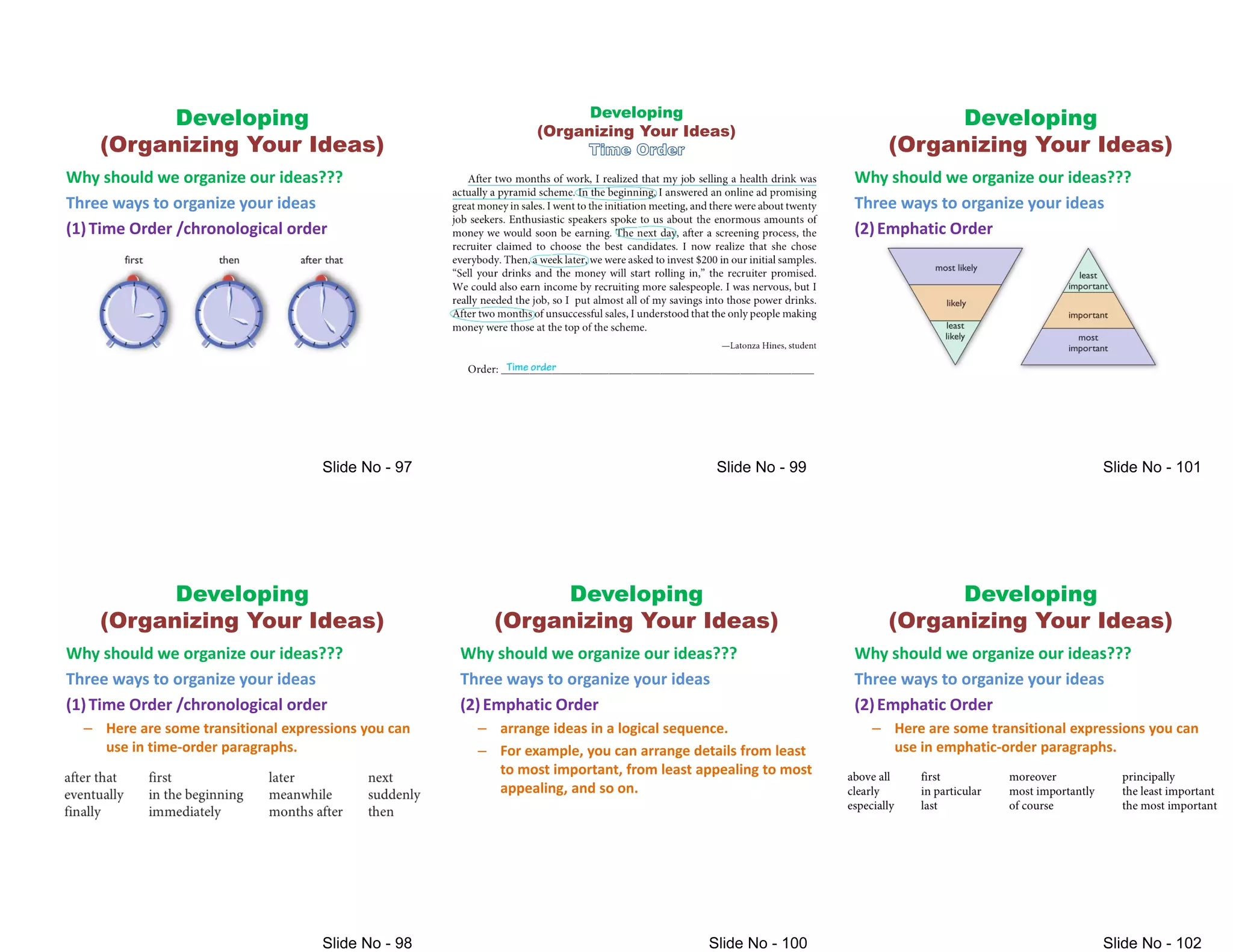
Three ways to organize your ideas
(1) Time Order / chronological
order
(2) Emphatic Order
(3) Space Order
Developing
(Organizing Your Ideas)
Why should we organize our ideas???
Three ways to organize your ideas
(1)Time Order /chronological order
– arrange the details according to the sequence in
which they have occurred
– When you narrate a story, explain how to do
something, or describe a historical event, you
generally use time order.
Developing
(Organizing Your Ideas)
Why should we organize our ideas???
Three ways to organize your ideas
(1)Time Order /chronological order
Developing
(Organizing Your Ideas)
Why should we organize our ideas???
Three ways to organize your ideas
(1)Time Order /chronological order
– Here are some transitional expressions you can
use in time-order paragraphs.
Developing
(Organizing Your Ideas)
Developing
(Organizing Your Ideas)
Why should we organize our ideas???
Three ways to organize your ideas
(2)Emphatic Order
– arrange ideas in a logical sequence.
– For example, you can arrange details from least
to most important, from least appealing to most
appealing, and so on.
Developing
(Organizing Your Ideas)
Why should we organize our ideas???
Three ways to organize your ideas
(2)Emphatic Order
Developing
(Organizing Your Ideas)
Why should we organize our ideas???
Three ways to organize your ideas
(2)Emphatic Order
– Here are some transitional expressions you can
use in emphatic-order paragraphs.
Developing
(Organizing Your Ideas)
Developing
(Organizing Your Ideas)
Why should we organize our ideas???
Three ways to organize your ideas
(3)Space order
– When you organize ideas using space order, you
help the reader visualize what you are
describing in a specific space.
– For example, you can describe something or
someone from top to bottom or bottom to top,
from left to right or right to left, or from far to
near or near to far.
Developing
(Organizing Your Ideas)
Why should we organize our ideas???
Three ways to organize your ideas
(3)Space order
Developing
(Organizing Your Ideas)
Why should we organize our ideas???
Three ways to organize your ideas
(3)Space order
– Here are some transitional expressions you can
use in space-order paragraphs.
Developing
(Organizing Your Ideas)
Why should we organize our ideas???
Three ways to organize your ideas
(3)Space order
– Here are some transitional expressions you can
use in space-order paragraphs.
Developing
(Organizing Your Ideas)
In the following paragraph, the writer describes a
location beginning at the beach and ending at
the front of the house.
Developing
(Organizing Your Ideas)
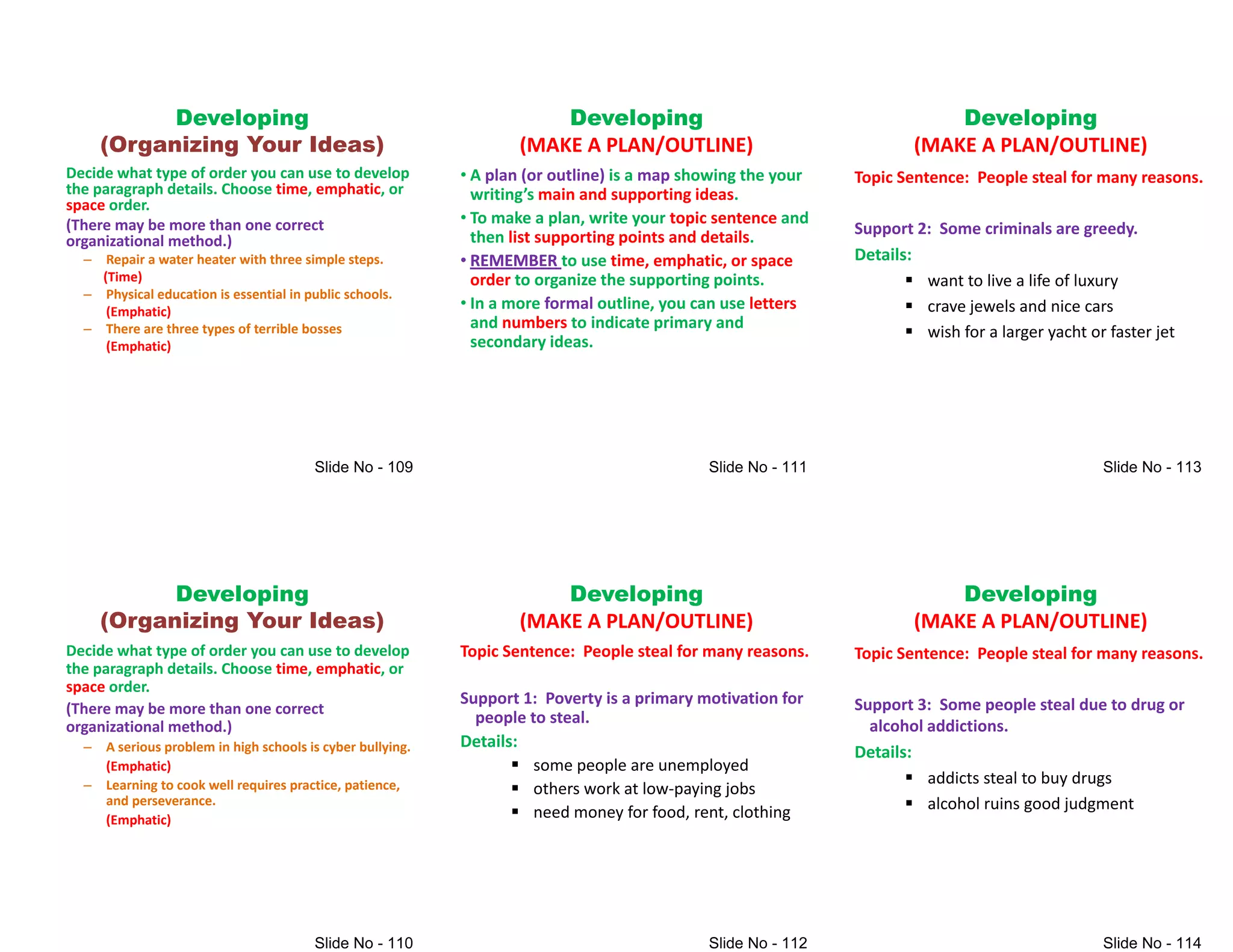
Decide what type of order you can use to develop
the paragraph details. Choose time, emphatic, or
space order.
(There may be more than one correct
organizational method.)
– Repair a water heater with three simple steps.
(Time)
– Physical education is essential in public schools.
(Emphatic)
– There are three types of terrible bosses
(Emphatic)
Developing
(Organizing Your Ideas)
Decide what type of order you can use to develop
the paragraph details. Choose time, emphatic, or
space order.
(There may be more than one correct
organizational method.)
– A serious problem in high schools is cyber bullying.
(Emphatic)
– Learning to cook well requires practice, patience,
and perseverance.
(Emphatic)
Developing
(MAKE A PLAN/OUTLINE)
• A plan (or outline) is a map showing the your
writing’s main and supporting ideas.
• To make a plan, write your topic sentence and
then list supporting points and details.
•
• REMEMBER
REMEMBER to use time, emphatic, or space
order to organize the supporting points.
• In a more formal outline, you can use letters
and numbers to indicate primary and
secondary ideas.
Developing
(MAKE A PLAN/OUTLINE)
Topic Sentence: People steal for many reasons.
Support 1: Poverty is a primary motivation for
people to steal.
people to steal.
Details:
 some people are unemployed
 others work at low-paying jobs
 need money for food, rent, clothing
Developing
(MAKE A PLAN/OUTLINE)
Topic Sentence: People steal for many reasons.
Support 2: Some criminals are greedy.
Details:
Details:
 want to live a life of luxury
 crave jewels and nice cars
 wish for a larger yacht or faster jet
Developing
(MAKE A PLAN/OUTLINE)
Topic Sentence: People steal for many reasons.
Support 3: Some people steal due to drug or
alcohol addictions.
alcohol addictions.
Details:
 addicts steal to buy drugs
 alcohol ruins good judgment
Developing
(MAKE A PLAN/OUTLINE)
Topic Sentence: People steal for many reasons.
Support 4: Some people steal for the kicks.
Details:
Details:
 experience the thrill
 receive an adrenaline rush when
stealing
DEVELOPING
(WRITE YOUR FIRST DRAFT)
• After making a plan, you are ready to
write your first draft, which is a very
important step in the writing process.
• Your first draft includes your topic
sentence, some supporting details, and
a concluding sentence.
DEVELOPING
(WRITE YOUR FIRST DRAFT)
• It is okay if your first draft is incomplete
or messy.
• Later, during the revising and editing
stages, you can clarify your ideas and
modify the organization of your piece of
writing.
DEVELOPING
FIRST DRAFT (SAMPLE)
WHY PEOPLE STEAL
People steal for many reasons. Poverty is a primary
motivation for people to steal. Because some people are
unemployed and others may be underemployed. They
may not have enough money for food, clothing rent.
Stealing money or food may be very tempting. As a
means of survival. Criminals do fraud because they are
greedy. In fact, some extremely wealthy people steal
simply because they want to acquire a larger yacht or a
more better jet. Another important reason that people
engage in stealing is to pay for their addictions. Finally,
people also steal for kicks. Criminals get an adrenaline
rush when you outwit the cops.
Assignment 06 (General)
Choose one topic and write your first
draft using the strategies you have
learned (Exploring to Developing)
• a childhood memory
• anger
• music
• online addictions
Assignment 07
(College and Work-related topics)
Choose one topic and write your first
draft using the strategies you have
learned (Exploring to Developing)
• A comfortable work environment
• Study or work habits
• College life
• Types of customers
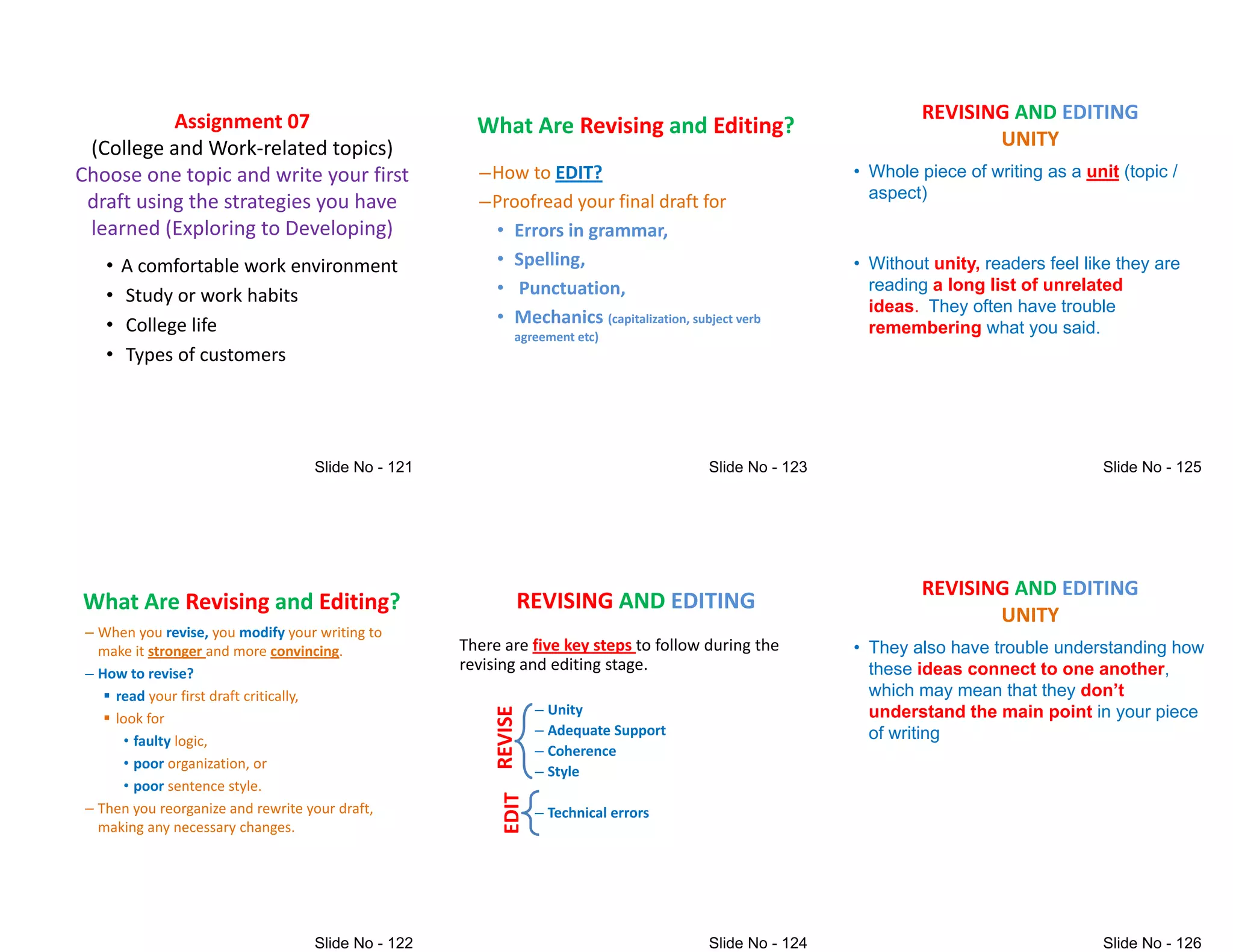
What Are Revising and Editing?
– When you revise, you modify your writing to
make it stronger and more convincing.
– How to revise?
 read your first draft critically,
 look for
 look for
• faulty logic,
• poor organization, or
• poor sentence style.
– Then you reorganize and rewrite your draft,
making any necessary changes.
What Are Revising and Editing?
–How to EDIT?
–Proofread your final draft for
• Errors in grammar,
• Spelling,
• Punctuation,
• Mechanics (capitalization, subject verb
agreement etc)
REVISING AND EDITING
There are five key steps to follow during the
revising and editing stage.
– Unity
– Unity
– Adequate Support
– Coherence
– Style
– Technical errors
REVISING AND EDITING
UNITY
• Whole piece of writing as a unit (topic /
aspect)
• Without unity, readers feel like they are
reading a long list of unrelated
ideas. They often have trouble
remembering what you said.
REVISING AND EDITING
UNITY
• They also have trouble understanding how
these ideas connect to one another,
which may mean that they don’t
understand the main point in your piece
of writing
REVISING AND EDITING
UNITY
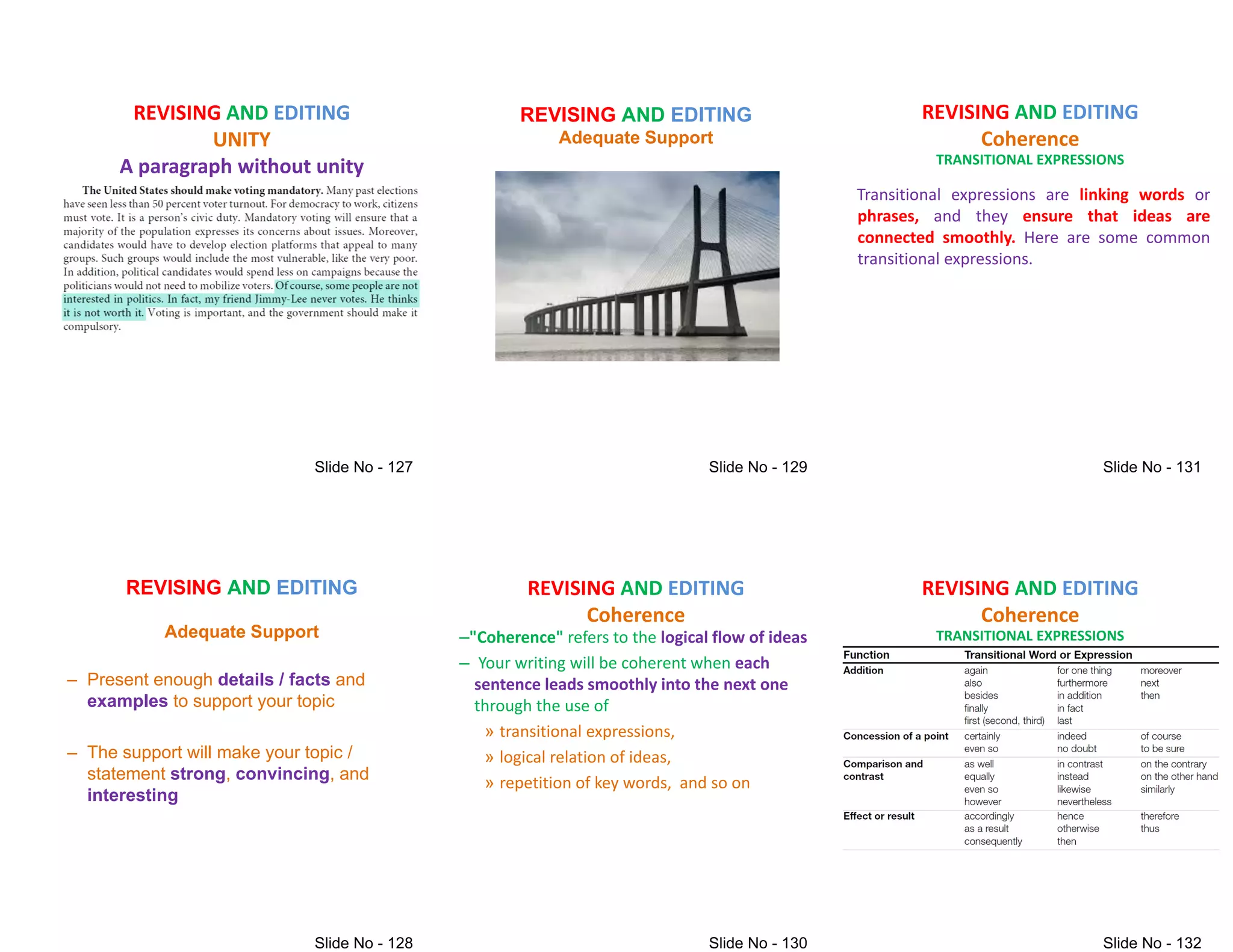
A paragraph without unity
REVISING AND EDITING
Adequate Support
– Present enough details / facts and
examples to support your topic
– The support will make your topic /
statement strong, convincing, and
interesting
REVISING AND EDITING
Adequate Support
REVISING AND EDITING
Coherence
–"Coherence" refers to the logical flow of ideas
– Your writing will be coherent when each
sentence leads smoothly into the next one
through the use of
through the use of
» transitional expressions,
» logical relation of ideas,
» repetition of key words, and so on
REVISING AND EDITING
Coherence
TRANSITIONAL EXPRESSIONS
Transitional expressions are linking words or
phrases, and they ensure that ideas are
connected smoothly. Here are some common
transitional expressions.
REVISING AND EDITING
Coherence
TRANSITIONAL EXPRESSIONS
REVISING AND EDITING
Coherence
TRANSITIONAL EXPRESSIONS
REVISING AND EDITING
Coherence
TRANSITIONAL EXPRESSIONS
REVISING AND EDITING
Coherence
TRANSITIONAL EXPRESSIONS
REVISING AND EDITING
Coherence
TRANSITIONAL EXPRESSIONS
REVISING AND EDITING
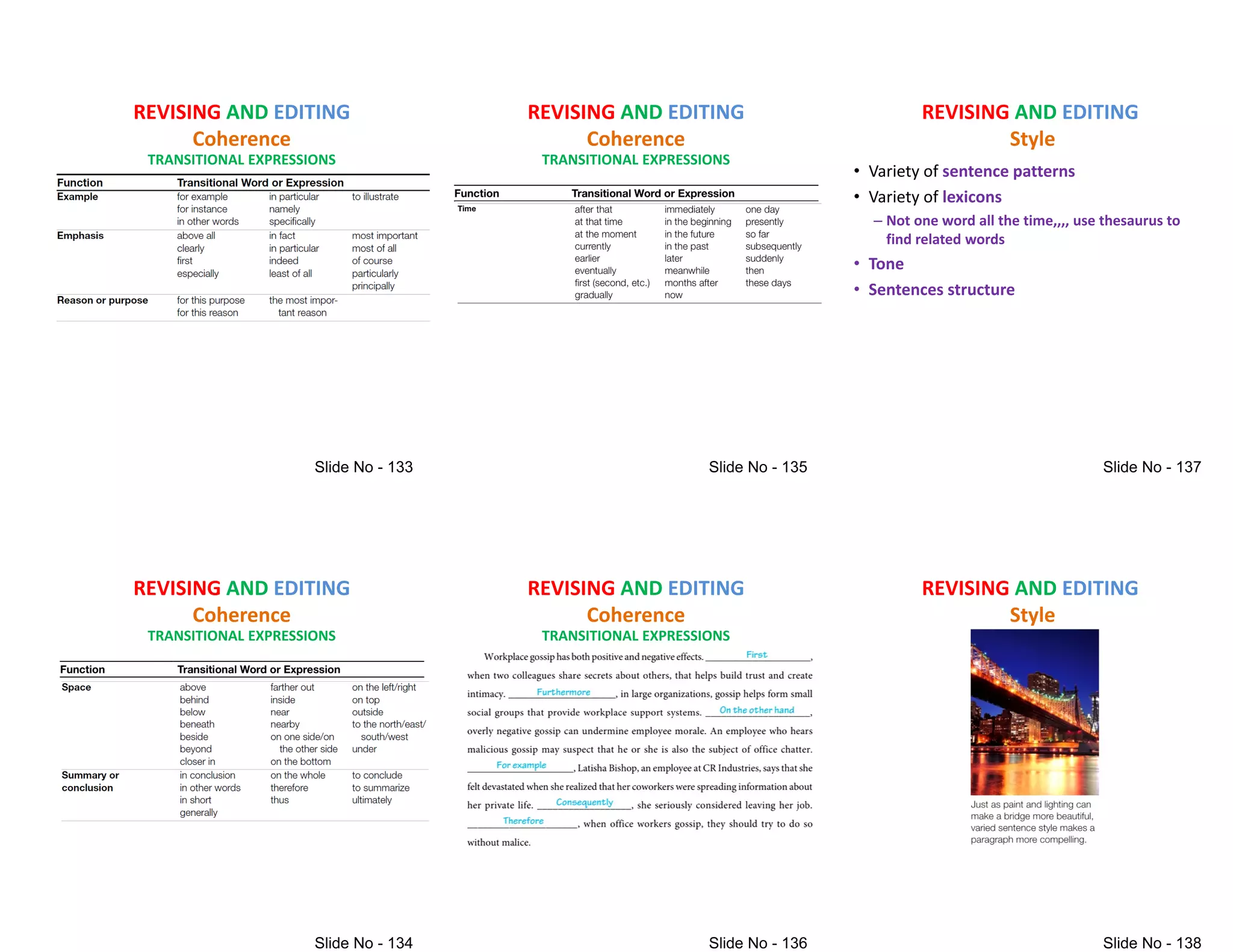
Style
• Variety of sentence patterns
• Variety of lexicons
– Not one word all the time,,,, use thesaurus to
find related words
find related words
• Tone
• Sentences structure
REVISING AND EDITING
Style
REVISING AND EDITING
Edit for Errors
• reread your writing and make sure that it is
free of errors
• focus on the language,
• look for mistakes
• look for mistakes
 grammar
 punctuation
 mechanics
 spelling
Write the Final Draft
When you have finished making revisions on the
first draft of your paragraph, write the final draft.
Include all of the changes that you have made
during the revision and editing phases.
Write the Final Draft
Before you hand in your final draft, proofread it
one last time to ensure that you have caught any
errors.
What should I do as I don’t know a
single word about the topic???
How many TYPES / PATTERNS OF
WRITING are there?
–People write for different
reasons or purposes.
to express yourself
to be creative / entertain
to persuade / motivate
to inform / explain
How many TYPES / PATTERNS OF
WRITING are there?
– People write for different
reasons or purposes.
 to express yourself
 to be creative / entertain
 Narrative
 Descriptive
 Persuasive /
 to persuade / motivate
 to inform / explain
 Persuasive /
Argumentative
 Expository
TYPES / PATTERNS
OF WRITING
01
Narrative Writing
Narrative Writing
Narrative Writing
–When you narrate, you tell a story
about what happened
–You generally explain events in the
order in which they occurred, and you
include information about when they
happened and who was involved in the
incidents.
Narrative Writing
–You use narration every day.
–You might send a postcard to a friend
detailing what you did during your
vacation.
vacation.
– At college, you may explain what
happened in a novel that you have read.
–At work, you might use narration to
explain an incident involving a customer
or coworker.
Narrative Writing
Narrative Writing
• There are two main types of
narrative
– Use first-person narration (autobiography)
Use first-person narration (autobiography)
– Use third-person narration
Narrative Writing
• Use first-person narration (autobiography)
–you describe a personal experience from
your point of view.
–You are directly involved in the story.
–You use the words I (first-person singular)
or we (first-person plural).
Narrative Writing
–For example:
–When I was a child, I thought that the
world began and ended with me. I didn(t
know, or care, how other children felt.
Narrative Writing
• Use third-person narration.
– you do not refer to your own experiences.
Instead, you describe what happened to
somebody else.
somebody else.
– The story is told in the third person using he,
she, it, or they.
Narrative Writing
• Use third-person narration.
– You might tell a story what happened during
the last election.
– In this type of narration, you are simply an
observer or storyteller; you are not a
participant in the action.
Narrative Writing
–It is a basic mode in journalistic
writing, it is used when
• reporting about an event or an incident,
describing an experience, or
• describing an experience, or
• telling a story
Narrative Writing
–The author recounts a personal
experience in the form of a story and
always includes characters, setting, and
plot
Narrative Writing
–Features
• Tells a story or event
• Has characters and dialogues
• Has definite and logical beginnings,
intervals and endings
• Chronological / time order and
sequence of events.
Narrative Writing
–Examples:
• short story,
• novel,
• novel,
• narrative poem,
• Journal
• Autobiographies or biographies
Narrative Writing
Assignment
TYPES / PATTERNS
OF WRITING
02
Descriptive Writing
Descriptive Writing
–Paints a picture in the readers( minds#
and that the writer uses colorful
language to tell what a person, place,
thing, event, or idea is like
–uses sensory / vivid images so that the
topic can be clearly )seen* in the
reader(s mind&
Descriptive Writing
–You use description every day.
–At home, you might describe a new friend
to your family, or you might describe an
object that you bought.
–At college, you might describe the
structure of a cell or the results of a lab
experiment.
–At work, you may describe a new product
to a client, or you could describe the
qualities of potential clients to your boss.
Descriptive Writing
• When you write a descriptive
paragraph, focus on three main
points.
points.
– Create a dominant impression
– Express your attitude toward the
subject
– Include concrete details
Descriptive Writing
• Create a dominant impression
– The dominant impression is the overall
atmosphere that you wish to convey.
– It can be a strong feeling, mood, or
image.
– For example, if you are describing a
business meeting, you can emphasize the
tension in the room.
Descriptive Writing
• Express your attitude toward the subject
– Do you feel positive, negative, or neutral
toward the subject?
– For example, if you feel positive about
your best friend, then the details of your
paragraph about him or her should
convey the good feelings you have.
Descriptive Writing
• Express your attitude toward the subject
– If you describe a place that you do not
like, then your details should express how
uncomfortable that place makes you feel.
– You might write a neutral description of a
science lab experiment.
Descriptive Writing
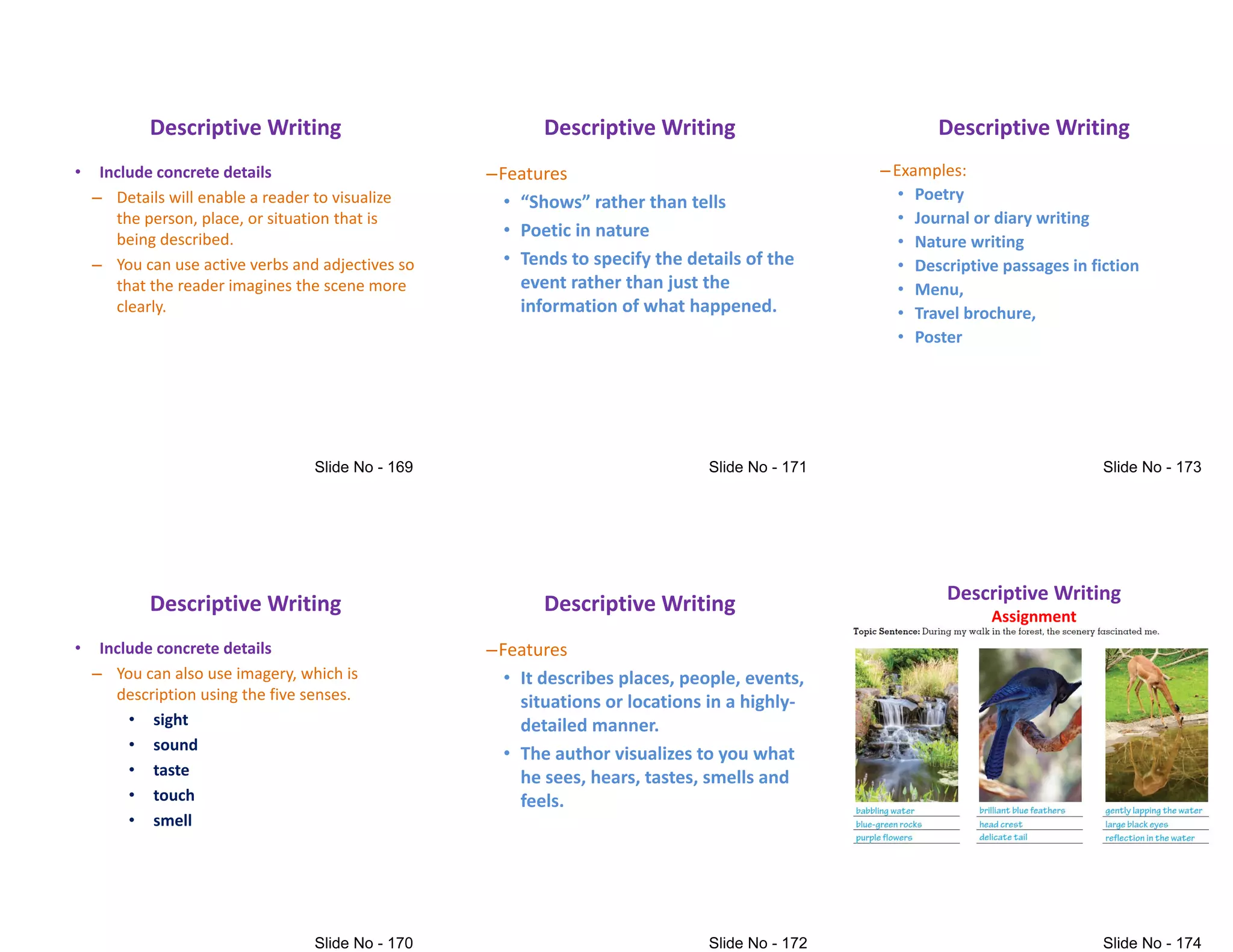
• Include concrete details
– Details will enable a reader to visualize
the person, place, or situation that is
being described.
being described.
– You can use active verbs and adjectives so
that the reader imagines the scene more
clearly.
Descriptive Writing
• Include concrete details
– You can also use imagery, which is
description using the five senses.
• sight
• sight
• sound
• taste
• touch
• smell
Descriptive Writing
–Features
• “Shows” rather than tells
• Poetic in nature
• Poetic in nature
• Tends to specify the details of the
event rather than just the
information of what happened.
Descriptive Writing
–Features
• It describes places, people, events,
situations or locations in a highly-
detailed manner.
detailed manner.
• The author visualizes to you what
he sees, hears, tastes, smells and
feels.
Descriptive Writing
–Examples:
• Poetry
• Journal or diary writing
• Nature writing
• Nature writing
• Descriptive passages in fiction
• Menu,
• Travel brochure,
• Poster
Descriptive Writing
Assignment
TYPES / PATTERNS
OF WRITING
03
03
Persuasive / Argumentative
Writing
Persuasive / Argumentative
Writing
Persuasive / Argumentative
Writing
Persuasive / Argumentative
Writing
–You are writing to convince others by
presenting solid, supported arguments.
–you take a stand and ask the reader to
believe your point of view.
Persuasive / Argumentative
Writing
• You use argument every day.
• At home, you may write a persuasive
letter to a newspaper to express your
views about public policy.
• At college, in a sociology class, you
might take a position on capital
punishment or on gun control.
• At work, you might have to convince
your manager to give you a raise.
Persuasive / Argumentative
Writing
• When you write an argument, remember the
following four points.
– Choose a subject that you know something about
(knowledge, experience)
– Consider your readers (beliefs, concerns, most
effective evidence)
– Know your purpose (know your specific purpose)
– Take a strong position and provide supporting
evidence (back up your point of view with a
combination of facts, statistics, examples, and
informed opinions)
Persuasive / Argumentative
Writing
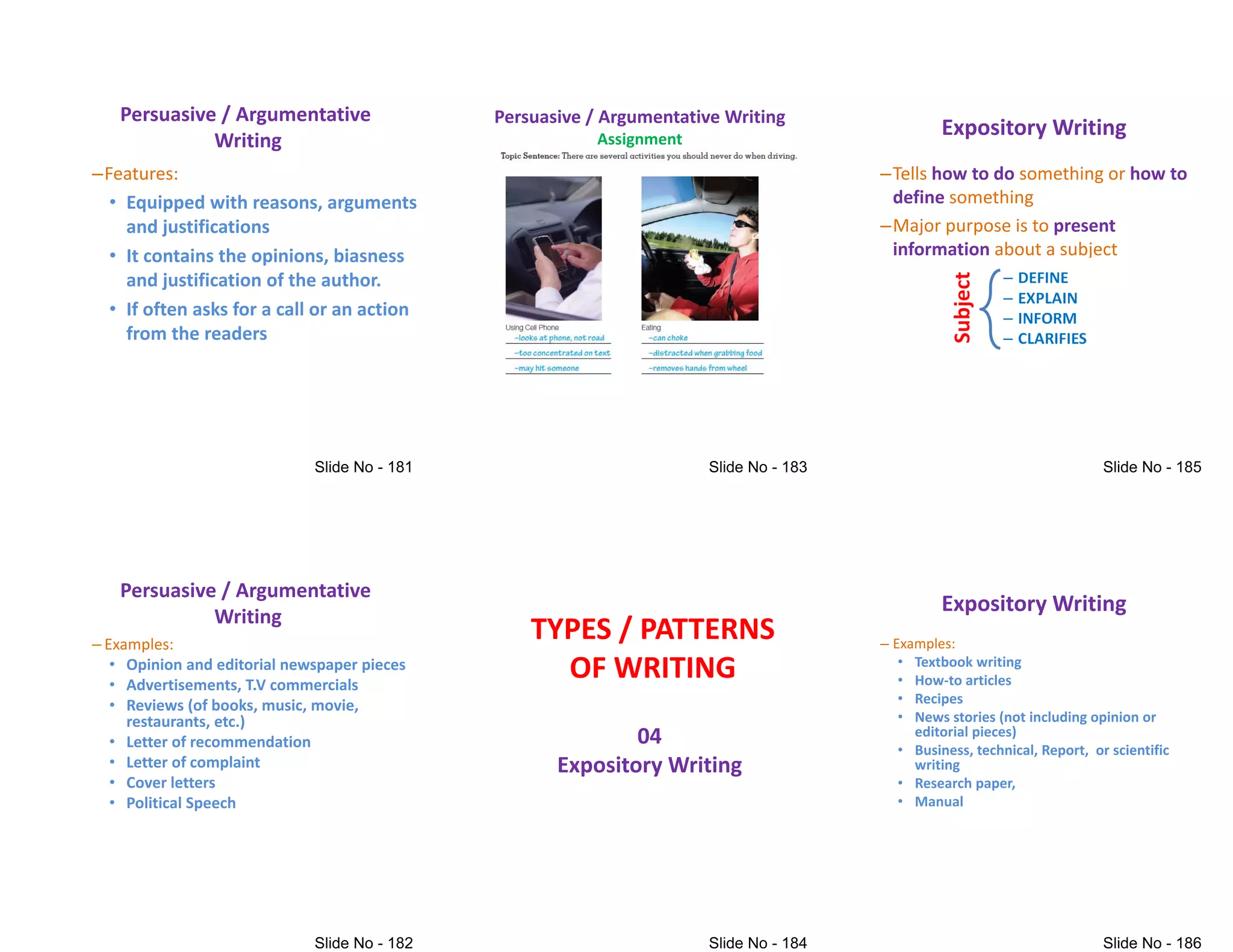
–Features:
• Equipped with reasons, arguments
and justifications
and justifications
• It contains the opinions, biasness
and justification of the author.
• If often asks for a call or an action
from the readers
Persuasive / Argumentative
Writing
– Examples:
• Opinion and editorial newspaper pieces
• Advertisements, T.V commercials
• Reviews (of books, music, movie,
restaurants, etc.)
• Reviews (of books, music, movie,
restaurants, etc.)
• Letter of recommendation
• Letter of complaint
• Cover letters
• Political Speech
Persuasive / Argumentative Writing
Assignment
TYPES / PATTERNS
OF WRITING
04
Expository Writing
Expository Writing
–Tells how to do something or how to
define something
–Major purpose is to present
information about a subject
Expository Writing
– Examples:
• Textbook writing
• How-to articles
• Recipes
• News stories (not including opinion or
editorial pieces)
• Business, technical, Report, or scientific
writing
• Research paper,
• Manual
Types / Patterns of
Expository Writing
Types / Patterns of Expository Writing
• Expository Writing (the writer provides
information about and explains a particular
subject)
1. Exemplification / Illustration
2. Process Analysis
3. Definition
4. Cause and effect
5. Comparison or contrast
6. Division & Classification
Types / Patterns of Expository
Writing
Writing
01- Exemplification / Illustration
Types / Patterns of Expository Writing
01- Exemplification / Illustration
Types / Patterns of Expository Writing
01- Exemplification / Illustration
Types / Patterns of Expository Writing
01- Exemplification / Illustration
• Travel agencies use examples of attractions to
sell tour packages.
• In illustration writing, you give examples to
support your point of view.
Types / Patterns of Expository Writing
01- Exemplification / Illustration
• When you write using illustration, you include
specific examples to clarify your main point.
• As a writer, you can use many different types
of examples to help your reader acquire a
deeper and clearer understanding of your
subject.
• Examples:-
 personal experience
 factual information
Types / Patterns of Expository Writing
01- Exemplification / Illustration
• In real Life, you give examples every day.
• When telling a friend why you had a good day
or a bad day,
• At college, you might give an oral presentation
using examples that will help your audience
better understand your point.
• At work, you might give examples to show
clients where or how they might market their
products.
Types / Patterns of Expository Writing
01- Exemplification / Illustration
• Physically, the job of a nurse is demanding. On a daily
basis, we must lift patients and move them. When
patients are bedridden for prolonged periods, we must
change their positions on their beds. When new
patients arrive, we transfer them from stretchers to
beds or from beds to wheelchairs. If patients fall, we
must be able to help them stand up. If patients have
difficulty walking, we must assist them. Patients who
have suffered paralysis/pəˈrælɪsɪs/ or stroke need to be
lifted and supported when they are bathed and
dressed. Keep in mind that some patients may be
quite heavy, so the job requires a good level of
physical strength.
Types / Patterns of Expository Writing
01- Exemplification / Illustration
Types / Patterns of Expository Writing
01- Exemplification / Illustration
• How to Write Illustration
– There are two ways to write an illustration
• Use a series of examples
• Use an extended example
Types / Patterns of Expository Writing
01- Exemplification / Illustration
• Assignment
Types / Patterns of Expository
Writing
Writing
02-Process Analysis
Types / Patterns of Expository Writing
02-Process Analysis
• A process is a series of steps done in
chronological order.
• In process writing, you explain
– how to do something,
– how an incident took place, or
– how something works.
Types / Patterns of Expository Writing
02-Process Analysis
• You explain processes every day.
– At home, you may explain to a family member
how to use an electronic appliance
– At college, you may explain how to perform a
scientific experiment
– At work, you may explain how to operate a
machine or how to do a particular job.
Types / Patterns of Expository Writing
02-Process Analysis
Types / Patterns of Expository Writing
02-Process Analysis
• There are two main types of process analysis
• Complete a process. (Do sth as told)
– contains directions on how to complete a
particular task.
particular task.
– For example, how to paint a picture, how to repair
a leaky faucet, or how to get a job.
– The reader should be able to follow the directions
and complete the task.
Types / Patterns of Expository Writing
02-Process Analysis
• There are two main types of process analysis
• Understand a process.
– explains how something works or how something
happens.
happens.
– In other words, the goal is to help the reader
understand a process rather than do a process.
– For example, a writer might explain how the heart
pumps blood to other organs in the body or how a
country elects its political leaders.
Types / Patterns of Expository Writing
02-Process Analysis
• Assignment
Types / Patterns of Expository
Writing
Writing
03-Definition
Types / Patterns of Expository Writing
03-Definition
• When you define, you explain the meaning of
a word.
• Some terms have concrete meanings, and you
can define them in a few words. For example,
a pebble is “a small stone.”
Types / Patterns of Expository Writing
03-Definition
• Other words, such as culture, happiness, or
evil, are more abstract and require longer
definitions.
• In fact, it is possible to write a paragraph, an
essay, or even an entire book on such
concepts.
Types / Patterns of Expository Writing
03-Definition
• The simplest way to define a term is to look it
up in a dictionary.
• However, many words have nuances that are
not necessarily discussed in dictionaries.
Types / Patterns of Expository Writing
03-Definition
• For example, suppose that your boss calls your
work “unsatisfactory.”
• You might need clarification of that term.
– Do you have poor work habits?
– Do you miss deadlines?
– Is your attitude problematic?
– What does your boss mean by )unsatisfactory*"
Types / Patterns of Expository Writing
03-Definition
• The ability to define difficult concepts is always
useful.
• At home, a friend may ask you to define
commitment.
• If you mention that a movie was great, you may
need to clarify what you mean by that word.
• In a political science class, you might define
socialism, capitalism, or communism.
• At work, you might define your company(s
winning strategy.
Types / Patterns of Expository Writing
03-Definition
Types / Patterns of Expository Writing
03-Definition
• When you write a definition, try to explain
what a term means to you.
• When you write a definition, remember the
following two points.
1. Choose a term that you know something about.
• understand a term
• say something relevant and interesting about
it
Types / Patterns of Expository Writing
03-Definition
2. Give a clear definition.
– In your first sentence, write a definition that is
understandable to your reader, and support your
definition with examples.
– Do not simply give a dictionary definition
because your readers are capable of looking up
the word themselves.
– Instead, describe what the word means to you.
Types / Patterns of Expository Writing
03-Definition
• How to define?
• There are three basic ways to define a term.
– By synonym
– By category
– By category
– By negation
Types / Patterns of Expository Writing
03-Definition
• How to define?
• There are three basic ways to define a term.
– By synonym
• The easiest way to define a term is to supply a
synonym
• Very useful if the original term is difficult to
understand and the synonym is a more
familiar word
• Tablet is like a smart phone.
Types / Patterns of Expository Writing
03-Definition
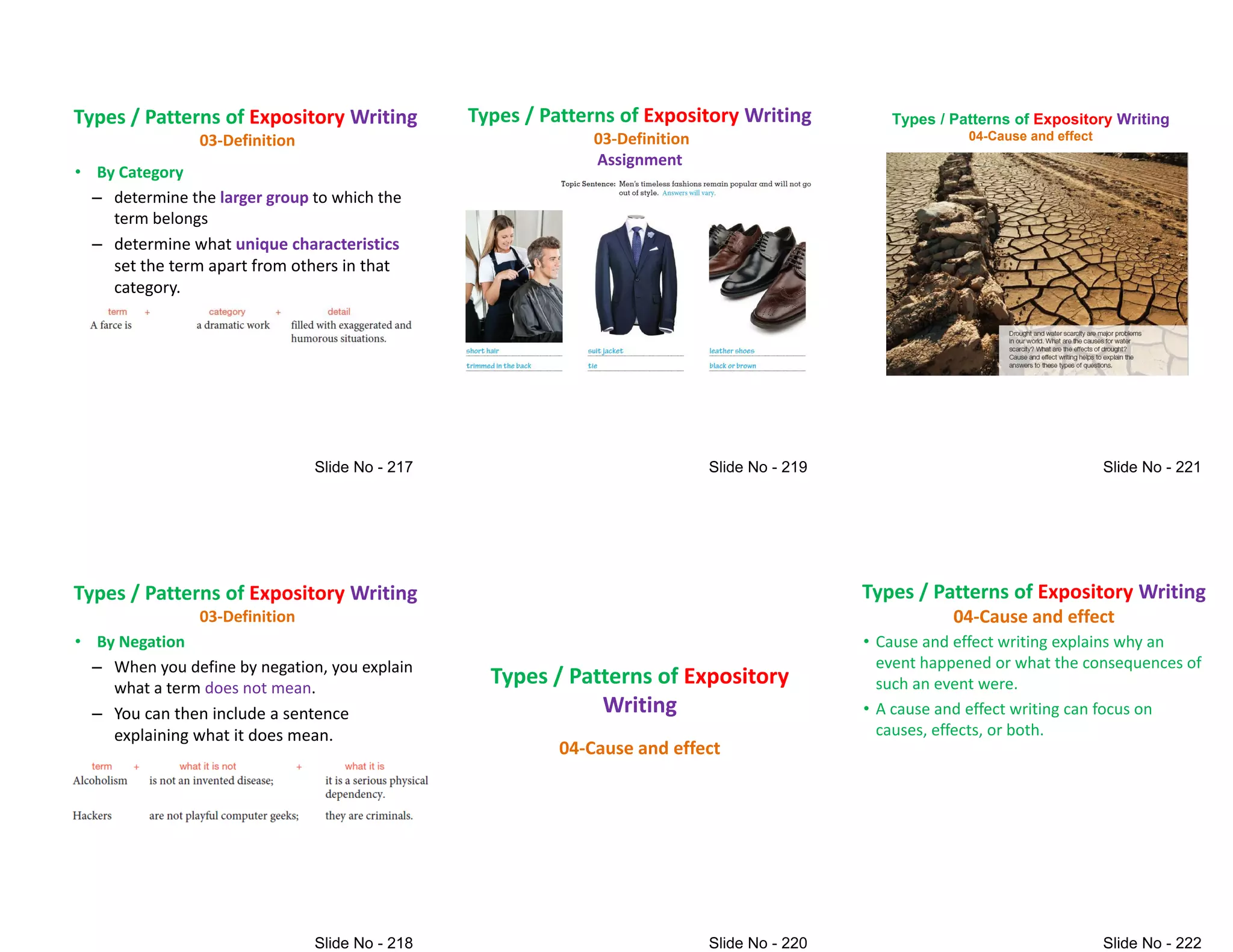
• By Category
– determine the larger group to which the
term belongs
– determine what unique characteristics
set the term apart from others in that
category.
Types / Patterns of Expository Writing
03-Definition
• By Negation
– When you define by negation, you explain
what a term does not mean.
– You can then include a sentence
explaining what it does mean.
Types / Patterns of Expository Writing
03-Definition
Assignment
Types / Patterns of Expository
Writing
Writing
04-Cause and effect
Types / Patterns of Expository Writing
04-Cause and effect
Types / Patterns of Expository Writing
04-Cause and effect
• Cause and effect writing explains why an
event happened or what the consequences of
such an event were.
• A cause and effect writing can focus on
causes, effects, or both.
Types / Patterns of Expository Writing
04-Cause and effect
• You often analyze the causes or effects of something.
• At home, you may worry about what causes your
siblings or your own children to behave in a certain
manner, or you may wonder about the effects of
certain foods on your health.
• In a U.S. history course, you might analyze the causes
of the Civil War, or you might write about the effects of
industrialization on American society.
• At work, you may wonder about the causes or effects
of a promotion or a pay cut.
Types / Patterns of Expository Writing
04-Cause and effect
• When you write a cause and effect paragraph,
focus on two main points.
1. Indicate whether you are focusing on causes,
effects, or both.
effects, or both.
– Because a paragraph is not very long, it is often
easier to focus on either causes or effects. If you
do decide to focus on both causes and effects,
make sure that your topic sentence announces
your purpose to the reader.
Types / Patterns of Expository Writing
04-Cause and effect
• When you write a cause and effect paragraph,
focus on two main points.
2. Ensure that your causes and effects are valid.
– Determine real causes and effects, and do not
simply list things that happened before or after
the event.
– Also verify that your assumptions are logical.
Types / Patterns of Expository Writing
04-Cause and effect
Types / Patterns of Expository Writing
04-Cause and effect
Types / Patterns of Expository
Writing
Writing
05-Comparison or Contrast
Types / Patterns of Expository Writing
05-Comparison or Contrast
• When you want to decide between options,
you compare and contrast.
• You compare to find similarities and contrast
to find differences.
• The exercise of comparing and contrasting can
help you make judgments about things.
• It can also help you better understand familiar
things.
Types / Patterns of Expository Writing
05-Comparison or Contrast
• You often compare and contrast.
• At home, when you watch TV, you might
compare and contrast different programs.
• At college, you might compare and contrast
different psychological or political theories.
• On the job, you might need to compare and
contrast computer operating systems,
shipping services, or sales figures.
Types / Patterns of Expository Writing
05-Comparison or Contrast
• Comparison and Contrast Patterns
• Point by Point
– Present one point about Topic A and then
one point about Topic B.
– Keep following this pattern until you have a few
points for each topic.
– You go back and forth from one side to the
other like tennis players hitting a ball back and
forth across a net.
Types / Patterns of Expository Writing
05-Comparison or Contrast
• Comparison and Contrast Patterns
• Topic by Topic
– Present all points related to Topic A in the first
few sentences, and then present all points related
to Topic B in the last few sentences.
– So, you present one side and then the other side,
just as lawyers might in the closing arguments of a
court case.
Types / Patterns of Expository Writing
05-Comparison or Contrast
Sample (Job A vs Job B)
Types / Patterns of Expository Writing
05-Comparison or Contrast
Types / Patterns of Expository
Writing
Writing
06-Division & Classification
Types / Patterns of Expository Writing
06-Division & Classification
Types / Patterns of Expository Writing
06-Division & Classification
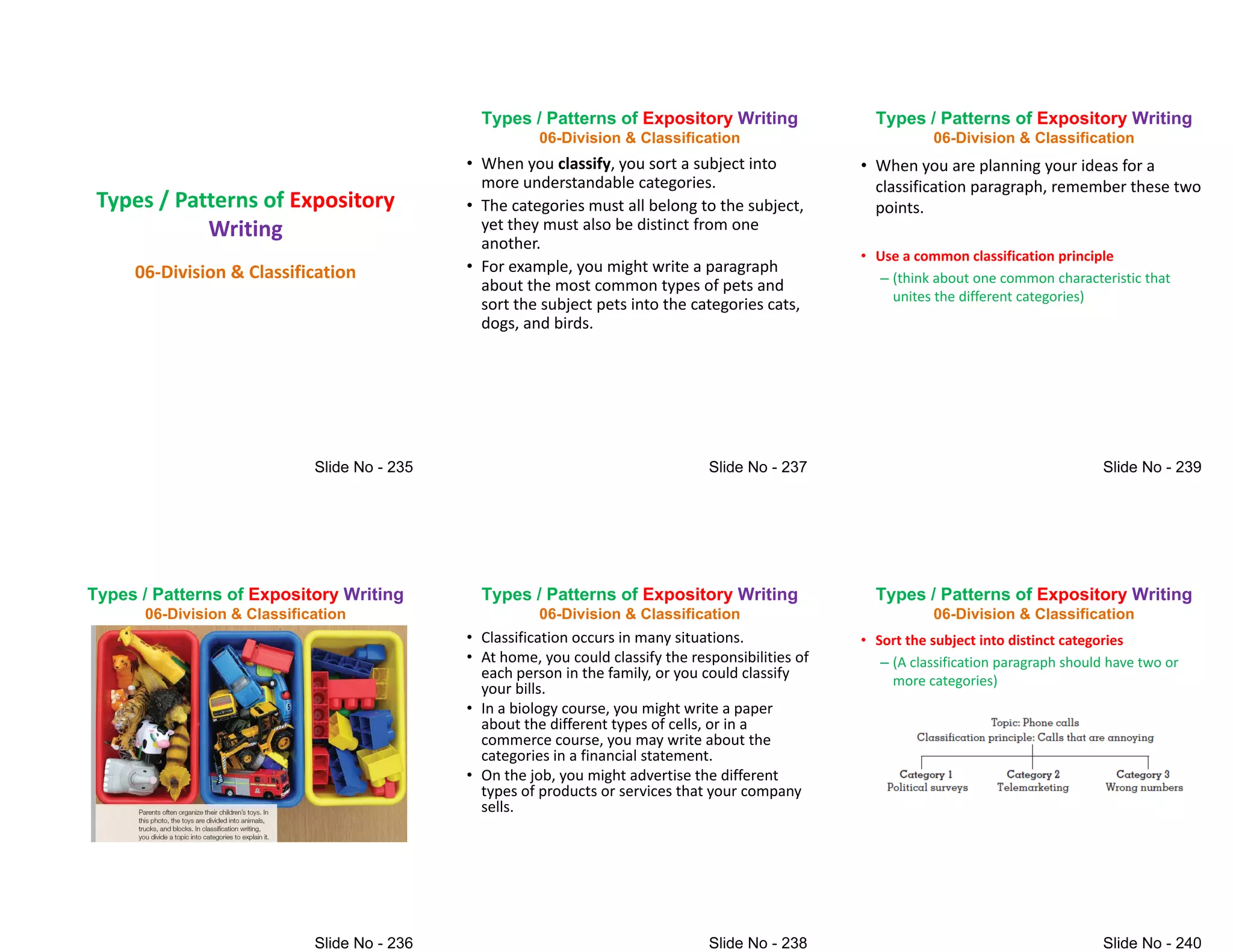
• When you classify, you sort a subject into
more understandable categories.
• The categories must all belong to the subject,
yet they must also be distinct from one
another.
another.
• For example, you might write a paragraph
about the most common types of pets and
sort the subject pets into the categories cats,
dogs, and birds.
Types / Patterns of Expository Writing
06-Division & Classification
• Classification occurs in many situations.
• At home, you could classify the responsibilities of
each person in the family, or you could classify
your bills.
• In a biology course, you might write a paper
about the different types of cells, or in a
• In a biology course, you might write a paper
about the different types of cells, or in a
commerce course, you may write about the
categories in a financial statement.
• On the job, you might advertise the different
types of products or services that your company
sells.
Types / Patterns of Expository Writing
06-Division & Classification
• When you are planning your ideas for a
classification paragraph, remember these two
points.
• Use a common classification principle
– (think about one common characteristic that
unites the different categories)
Types / Patterns of Expository Writing
06-Division & Classification
• Sort the subject into distinct categories
– (A classification paragraph should have two or
more categories)
Types / Patterns of Expository Writing
06-Division & Classification
Types / Patterns of Expository Writing
06-Division & Classification
What is technical writing?
1
'Technical writing' is any written form of
writing used in a variety of technical and
occupational fields, such as computer
hardware and software, engineering,
chemistry, aeronautics, robotics, finance,
consumer electronics, and biotechnology.
(Wikipedia)
What is technical writing?
2
Technical writing is writing done at the
workplace, although the workplace may be
– an office,
– an office,
–a construction site,
–or a kitchen table.
What is technical writing?
3
Technical writing is kind of writing done in
many fields of technology, science,
engineering, and medicine
What is technical writing?
4
Technical writing is communication written for
and about business and industry, focusing on
products and services:
•how to manufacture them,
•market them,
•manage them,
•deliver them, and
•use them.
What is technical writing?
Technical writing is written:
– in the work environment
– for supervisors, colleagues,
subordinates, vendors, and customers
Why Should I learn Technical Writing???
–As soon as you are get a job, you will have to
communicate at work,,,, sometimes upward
and sometimes downward,,,, but you have to
''
''
–For communication, you have two options
• Oral
• Written
–Whatever you write there,,, will be termed as
technical writing'.so learn it now
Examples Of Technical Writing
–Memos / emails / letters / Technical reports
–Instruction manuals
–Articles / Brochures / newsletters
–Papers / fliers / PowerPoint presentations
–Proposals
–Booklets
–Speeches for technical meetings and
conferences.
Types of Technical Writing
–The major types of documents in technical
writing can be grouped into four major
categories
• Reports and communications in day-to-day
business
business
• Technical papers, magazine articles, books, and
theses for purposes of education, teaching, and
the sharing of information and knowledge
• Patents (official rights for new inventions for a
specific time)
• Operational manuals, instructions, or
procedures
Types of Technical Writing
Nature of Technical Writing
–The subject is usually technical
–Written carefully for a specific audience
–The organization is predictable and apparent
–The style is concise (Short Sentences, Short to-
the-point paragraphs)
–Language is direct & simple
–The tone is objective , factual and businesslike
–Special features may include visual elements
(graphics, headings, subheadings, highlighting,
tables, various fonts, white spaces, bullets etc)
to enhance the message
Technical Vs Academic Writing
–Academic writing (personal essays,
research papers, analyses, and
arguments) is expository & persuasive
writing
writing
–Unified, coherent, well organized (both
technical & academic)
–The difference is in the presentation,
audience and approach
Technical Vs Academic Writing
–The difference between academic writing and
technical writing is in the presentation,
audience, and approach.
–Academic writing includes paragraphs—
usually an introductory paragraph,
paragraphs that develop a thesis (a statement
of purpose), and a concluding paragraph.
–Academic writing is written for an academic
audience—an instructor, classmates, or a
group of interested scholars.
Technical Vs Academic Writing
–Technical writing also includes
paragraphs.
–It, too, often begins with an introduction
and closes with a conclusion.
–But technical writing (with its headings,
itemized lists, boldfaced type, and
graphics) looks different from academic
writing.
Technical Vs Academic Writing
–Technical writing is written for a specific
audience.
–The subject is generally technical,
business-related, or scientifically
oriented.
–Generally, there is less flexibility in the
subject matter, style, and tone.
–Often the intent is to clarify and
consolidate rather than expand.
Technical Vs Creative Writing
–Imaginative writing is less academic and
more artistic and creative as compared to
technical and academic writing
–Imaginative writing includes novels, short
stories, drama, and poetry whose situations
grow out of fantasy or imagination.
–Events and people are fictional, although the
themes may reveal universal truths.
Technical Vs Creative Writing
–Imaginative writing is often ambiguous,
meaning that more than one
interpretation is possible and describing
writing that means different things to
different people.
–Imaginative writing also requires the
reader to draw inferences, which are
judgments about the reading that the
writer does not make for the reader.
Technical Vs Creative Writing
–Technical writing should be unambiguous
and direct.
–A work of literature may be rich because
it means different things to different
readers
–The technical writer tries to convey one
and only one meaning
Technical Vs Creative Writing
–The meaning of a sentence in technical
writing must be clear.
–)Turn there#* The word there can have
different meanings to different people.
–However# )Turn right at Bank Road# the
next paved road#* has only one meaning&
Technical Vs Creative Writing
People read
literature for pleasure,
essays for enlightenment,
and journalism for news.
People read
technical writing to accomplish a
job.
Formation of Technical Writing
–Technical people possess Technical
Knowledge, but they may lack writing
expertise
–Writers have writing skills but lack
technical knowledge
???
Formation of Technical Writing
–Merging is the solution
Technical Knowledge
+ Technical
+
Writing Skills
Technical
Writing
Importance of Technical Writing
– It allows readers to read and study at
their convenience, easily pass along
information to others, and keep a
permanent record for future reference.
– Today(s the era of information overload,
coming from every direction—television,
radio, newspapers, magazines, books, e-
mail, the Internet and many more
Importance of Technical Writing
– Because of information overload, you
must be able to read documents quickly
and efficiently, understand them the first
time you read them, and know that the
information is accurate.
time you read them, and know that the
information is accurate.
– Up-to-date information provides
companies with a competitive edge,
speeding critical decision making and
allowing job specialization.
Importance of Technical Writing
– Technical writers who help companies
manage the information overload are
vital resources.
– They understand that their readers must
be able to skim or skip text and find
important information quickly.
– As a professional in great demand, the
technical writer faces a challenging,
exciting, and rewarding future.
Importance of Technical Writing
– Different careers generate different kinds of
reports:
– Nurses chart a patient(s medical condition so
that the next shift(s nurses can continue
patient care.
patient care.
– Police accident reports record facts for later
use in court.
– Chemists and engineers document
procedures to comply with government
regulations.
Importance of Technical Writing
– Accountants prepare annual client reports.
– Sales representatives write sales proposals.
– HSE workers write safety precautions.
– Insurance claims adjusters write incident
reports.
– Travel agents design brochures.
– Public relations officers write news releases,
letters, and speeches.
Importance of Technical Writing
– All careers rely on technical
communication to get the job done.
– Technical writing is the great connector—
the written link—
the written link—
• Connecting technology to user
• Professional to client
• Colleague to colleague
• Supervisor to employee
• Individual to community
Importance of Technical Writing
– No matter what career you choose, you
can expect to read and compose e-mail,
send accompanying attachments, give
and receive phone messages, and explain
procedures
CHARACTERISTICS OF
TECHNICAL WRITING
TECHNICAL WRITING
CHARACTERISTICS OF TECHNICAL
WRITING
Clarity
–The most important criteria for
effective technical writing is clarity.
–If the audience responds to a memo,
letter, report, or manual with, )Huh"*
what has the writer accomplished?
CHARACTERISTICS OF TECHNICAL
WRITING
Clarity
– If the correspondence is not clearly
understood, the reader will either call
the writer for further clarification, or just
ignore the information.
– In either case, the writer(s time is
wasted; the reader(s time is wasted; the
message is lost.
CHARACTERISTICS OF TECHNICAL
WRITING
Clarity
– If somebody fails to clearly understand a
poem, a short story, a play, or a novel,
that is unfortunate; however, equipment
is not damaged, no one is physically hurt,
that is unfortunate; however, equipment
is not damaged, no one is physically hurt,
and no one is sued.
– But if somebody failed to clearly
understand how to operate a cutter
machine,,,,,,,,then''''.
CHARACTERISTICS OF TECHNICAL
WRITING
Conciseness
–Successful technical writing should
help the reader understand the text,
not present challenges to
understanding
CHARACTERISTICS OF TECHNICAL
WRITING
Conciseness
– If an individual reads literature, it is his or
her responsibility to under- stand the
writing.
writing.
– Creative writers seek to challenge us.
– However, technical writing is not
literature. We read technical writing
because it is a job requirement.
CHARACTERISTICS OF TECHNICAL
WRITING
Conciseness
– Good technical writing is concise. It is a
tool for the readers to use to accomplish
whatever job they are doing.
– Achieve conciseness through short
words, short sentences, and short
paragraphs.
CHARACTERISTICS OF TECHNICAL
WRITING
Accessible Document Design
–Technical writing must have
accessibility (page layout—the way
the text looks on the page)
–Try to organize in a way that your
reader can perceive the organization
at a single glance
CHARACTERISTICS OF TECHNICAL WRITING
Accessible Document Design
You can make your document accessible through
the following highlighting techniques:
• Graphics (table and
figures)
• Italics
• Underlining
figures)
• White space
• Boldface text
• Headings and
subheadings
• Underlining
• Varied Font sizes
• Bullets
• Numbered lists
• Varied Font types
CHARACTERISTICS OF TECHNICAL WRITING
Accuracy
– Effective technical writing must be correct,
whether grammatically, mathematically,
electronically, etc.
– Errors in technical writing make the company
and the employee look bad.
– More importantly, errors can lead to damages,
injuries, lawsuits, or just embarrassment and
misunderstandings.
CHARACTERISTICS OF TECHNICAL WRITING
Practical
– Technical writing is practical in nature
– Instead of presenting theories, technical
writing asks you to perform something, to
understand something
CHARACTERISTICS OF TECHNICAL WRITING
Style
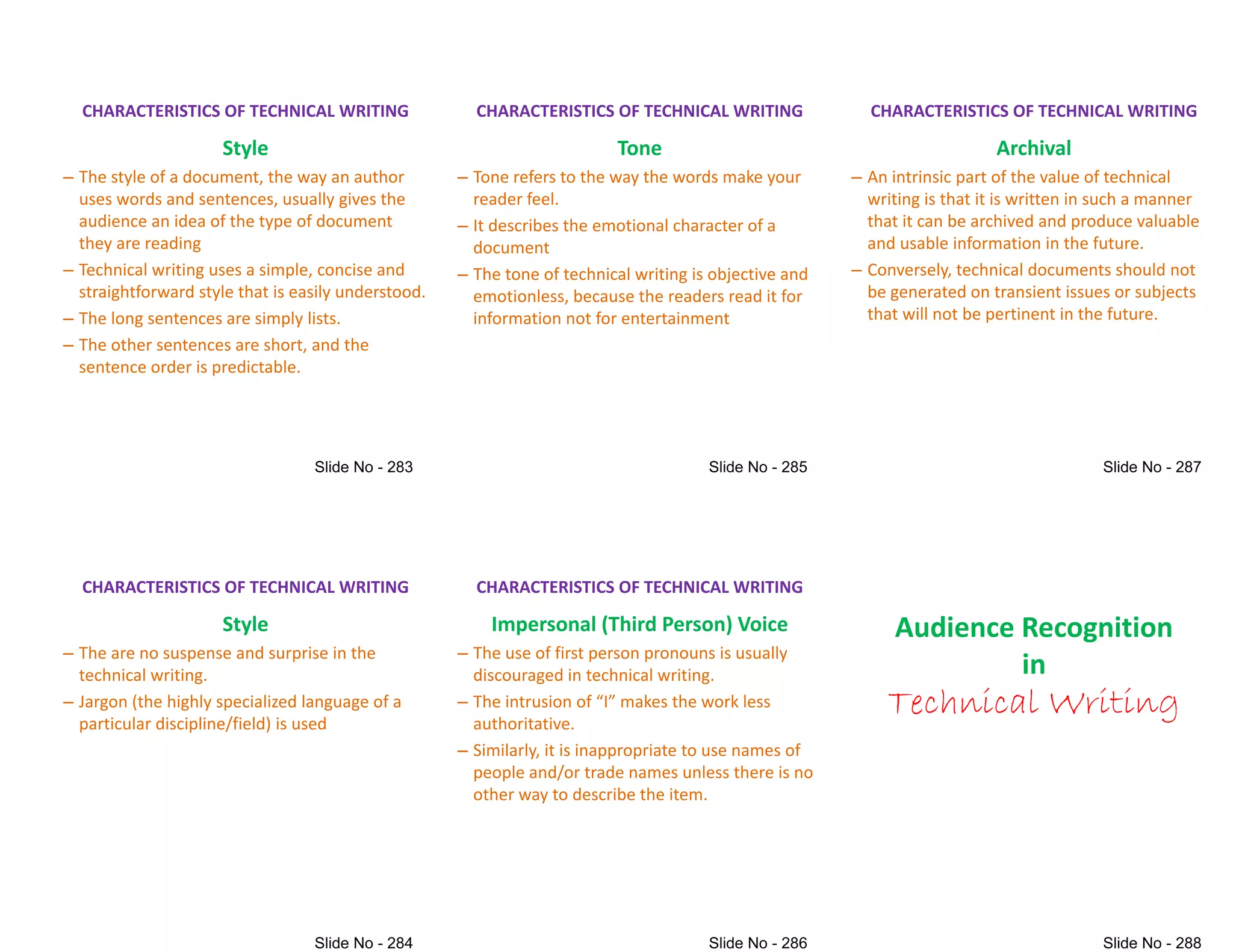
– The style of a document, the way an author
uses words and sentences, usually gives the
audience an idea of the type of document
they are reading
they are reading
– Technical writing uses a simple, concise and
straightforward style that is easily understood.
– The long sentences are simply lists.
– The other sentences are short, and the
sentence order is predictable.
CHARACTERISTICS OF TECHNICAL WRITING
Style
– The are no suspense and surprise in the
technical writing.
– Jargon (the highly specialized language of a
particular discipline/field) is used
CHARACTERISTICS OF TECHNICAL WRITING
Tone
– Tone refers to the way the words make your
reader feel.
– It describes the emotional character of a
document
document
– The tone of technical writing is objective and
emotionless, because the readers read it for
information not for entertainment
CHARACTERISTICS OF TECHNICAL WRITING
Impersonal (Third Person) Voice
– The use of first person pronouns is usually
discouraged in technical writing.
– The intrusion of )I* makes the work less
authoritative.
authoritative.
– Similarly, it is inappropriate to use names of
people and/or trade names unless there is no
other way to describe the item.
CHARACTERISTICS OF TECHNICAL WRITING
Archival
– An intrinsic part of the value of technical
writing is that it is written in such a manner
that it can be archived and produce valuable
and usable information in the future.
– Conversely, technical documents should not
be generated on transient issues or subjects
that will not be pertinent in the future.
Audience Recognition
in
Technical Writing
Technical Writing
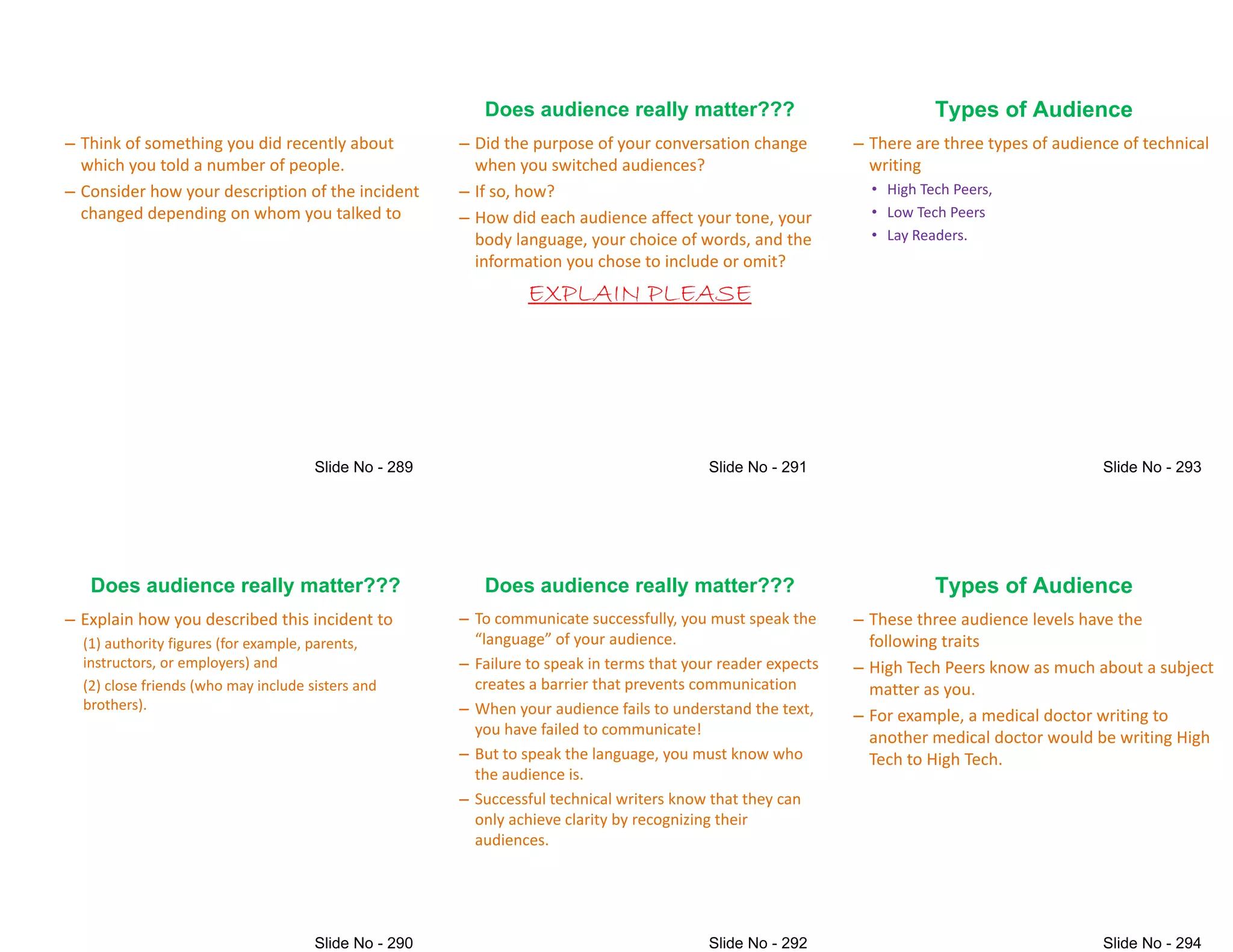
– Think of something you did recently about
which you told a number of people.
– Consider how your description of the incident
changed depending on whom you talked to
Does audience really matter???
– Explain how you described this incident to
(1) authority figures (for example, parents,
instructors, or employers) and
(2) close friends (who may include sisters and
brothers).
brothers).
Does audience really matter???
– Did the purpose of your conversation change
when you switched audiences?
– If so, how?
– How did each audience affect your tone, your
body language, your choice of words, and the
information you chose to include or omit?
EXPLAIN PLEASE
Does audience really matter???
– To communicate successfully, you must speak the
)language* of your audience&
– Failure to speak in terms that your reader expects
creates a barrier that prevents communication
– When your audience fails to understand the text,
you have failed to communicate!
– But to speak the language, you must know who
the audience is.
– Successful technical writers know that they can
only achieve clarity by recognizing their
audiences.
Types of Audience
– There are three types of audience of technical
writing
• High Tech Peers,
• Low Tech Peers
• Lay Readers.
• Lay Readers.
Types of Audience
– These three audience levels have the
following traits
– High Tech Peers know as much about a subject
matter as you.
– For example, a medical doctor writing to
another medical doctor would be writing High
Tech to High Tech.
Types of Audience
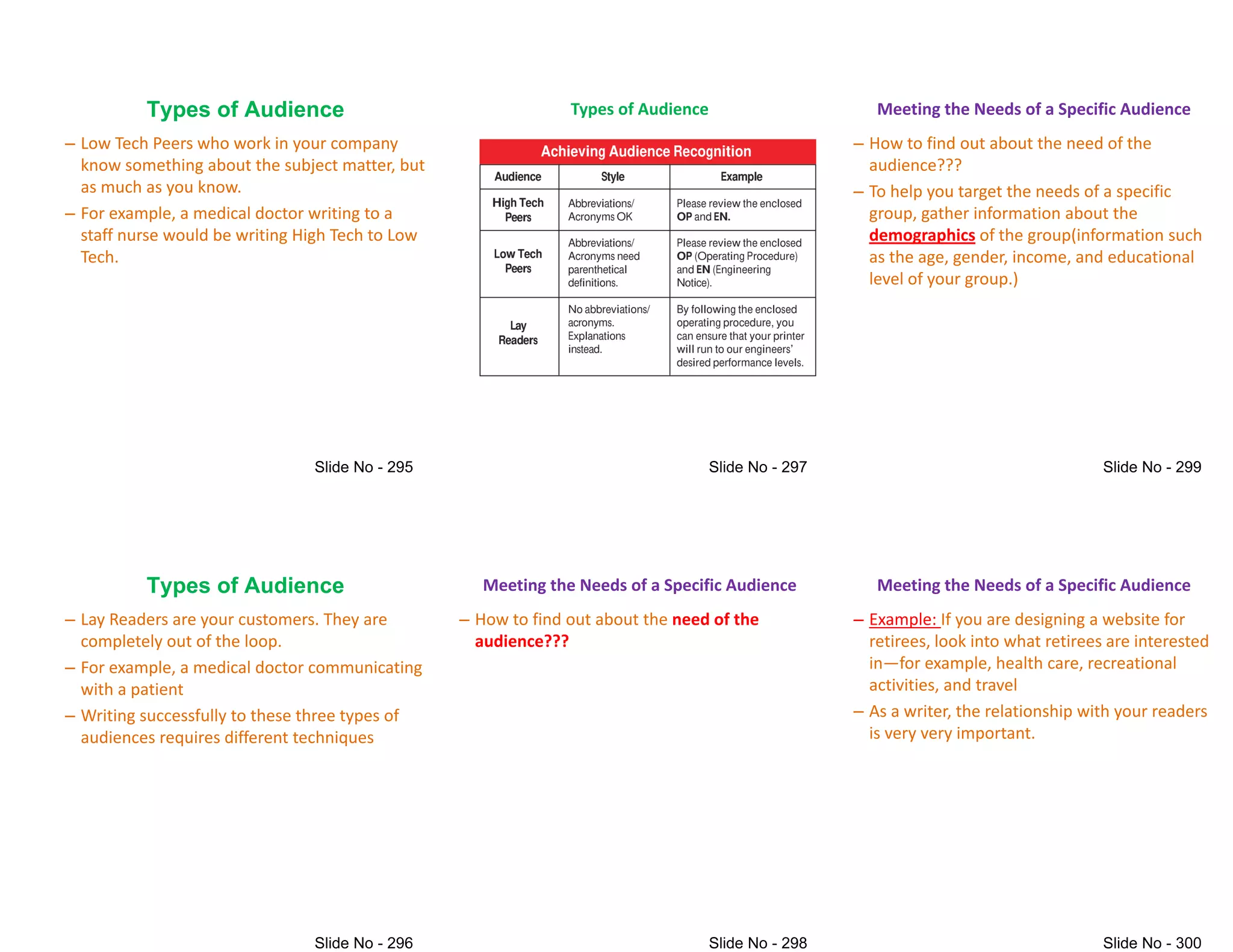
– Low Tech Peers who work in your company
know something about the subject matter, but
as much as you know.
– For example, a medical doctor writing to a
staff nurse would be writing High Tech to Low
Tech.
Types of Audience
– Lay Readers are your customers. They are
completely out of the loop.
– For example, a medical doctor communicating
with a patient
– Writing successfully to these three types of
audiences requires different techniques
Types of Audience
Meeting the Needs of a Specific Audience
– How to find out about the need of the
audience???
Meeting the Needs of a Specific Audience
– How to find out about the need of the
audience???
– To help you target the needs of a specific
group, gather information about the
demographics of the group(information such
as the age, gender, income, and educational
level of your group.)
Meeting the Needs of a Specific Audience
– Example: If you are designing a website for
retirees, look into what retirees are interested
in—for example, health care, recreational
activities, and travel
– As a writer, the relationship with your readers
is very very important.
Meeting the Needs of a Specific Audience
– Your relationship will determine how you
write your document—the tone you use, the
formality of your document, and its medium.
– The reader(s needs determine what kind of
information the writer supplies.
– When the audience is unsure of its needs, the
writer helps the audience think through the
communication situation.
Meeting the Needs of a Specific Audience
– In technical writing, one rule dominates: The
needs and wants of your audience dictate
every decision you make as a writer.
– The writer uses a skill to provide a valuable
service.
service.
– Think of it this way: The writer is the server,
and the audience is the person ordering from
the menu. If the person ordering requests a
salad with no tomatoes and Italian dressing on
the side, the server obliges!
Role of a writer in Technical Writing
– In technical writing, the writer is transparent.
– A technical writer is like a member of a stage
crew, a behind-the scenes operator, whose
primary obligation is to satisfy the audience(s
need for information.
– In a good play, the audience is barely aware of
the crew at work who is moving sets and
producing sound on cue, but without the
crew, the show would not go on.
Role of a writer in Technical Writing
– Similarly, good writers produce work without
drawing attention to their role.
Analyze Your Target Audience
– Sometimes your audience is a specific person
or group with a common interest.
– After you identify the readers in your target
audience, consider how their knowledge
level, roles, interests, cultural background,
and personalities may influence what you
write and how you write it.
– Age, experience, attitude, organizational
distance, income, and politics may affect the
language you choose to communicate
successfully.
Analyze Your Target Audience
– Understanding your audience(s knowledge
level, role, interests, cultural background, and
personality is the first step to successful
communication.
– Attending to the needs and wants of your
audience is much like attending to a special
guest in your home.
– You are aware of this person’s presence, and
you make every effort to make this person feel
welcomed.
Analyze Your Target Audience
– Targeting the special needs of a specific
audience requires a writer to consider several
factors at once.
• Knowledge level
• Roles
• Roles
• Interests
• Cultural background
• Personalities
Analyze Your Target Audience
– Knowledge level
• What people know and how well they know it
varies widely from one person to the next.
• As such, knowledge level can be high, low, or
moderate.
• It can be technical or nontechnical.
• Ask yourself what your readers know or do not
know about your subject.
• If you omit something they need to know, you
have not done your job.
• Experience, age, and expertise can affect how
much someone knows.
Analyze Your Target Audience
– Knowledge level
Analyze Your Target Audience
– Roles
• Consider your reader(s role or his or her
area of responsibility before you begin
writing.
• A role is the function or job that someone
performs at work.
performs at work.
• Role or job title affects not only
knowledge level, but also the information
your reader thinks is important.
• Understand your reader(s role and
accommodate it.
Analyze Your Target Audience
– Roles
• An accountant is concerned about her
company(s finances& If you write a memo to the
accounting office about a planned purchase,
you should accommodate the accountant(s role
by including information about cost.
• The technician who reads the same memo may
be more interested in how to operate
equipment being purchased, having little
concern about the cost. For the technician, you
should include sufficient information about the
technical aspects of the equipment.
Analyze Your Target Audience
– Roles
Analyze Your Target Audience
– Interests
• When your readers are interested in your
subject, they read with greater enthusiasm.
• Where you find common interest, take
advantage of it.
• Where there is none, try to create it.
• Some readers, however, will never be
interested in your subject.
• Accept those readers( lack of interest and focus
on giving them the information they need.
Analyze Your Target Audience
– Interests
• Interest can be affected by age, experience,
cultural background, and role.
• Your interests now are different from what they
were ten years ago because you have a wider
range of experiences.
• The camping and fishing trips you enjoyed as a
child may have been replaced by long motor
trips and concerts as a young adult.
• Right now your role is to be a student. When
you join the workforce, your interests will be
determined in part by your professional role.
Analyze Your Target Audience
– Interests
Analyze Your Target Audience
– Cultural Background
• Culture—the special beliefs, customs, and
values specific to a particular group of people
or to a particular region—affects what an
audience considers to be proper behavior.
• Many beliefs regarding human relations are
affected by an individual(s cultural background&
• By failing to consider someone(s cultural
background, you risk offending your reader and
creating barriers in the communication process.
• Your goal is to open the lines of communication
and reach out to all of your readers.
Analyze Your Target Audience
– Cultural Background
Analyze Your Target Audience
– Personality
• Personality can be affected by culture,
heredity, age, experience, and role.
• Also# someone(s personality can shape his
or her work habits.
or her work habits.
• When communicating, you may not know
your readers well enough to make
judgments about their personalities.
• But if you do, you can tailor your
communication style appropriately.
Analyze Your Target Audience
– Personality
→ Communication is essential for being able to act
and make decisions in the business world.
→ People must be able to share information.
→ Although some communication can take place
face-to-face, a great deal of communication is
Brief Correspondence
face-to-face, a great deal of communication is
conducted through
 text messages
 e-mails
 memos
 letters
Hard Form
Soft Form
→ All four of these may be used for brief
correspondence.
→ However, each one has its own distinguishing
characteristics.
Brief Correspondence
SOFT FORM HARD FORM
No stamps, postal / courier
service is required
Stamps, postal / courier
service is required
service is required service is required
→ Unlike electronic correspondence, memos and
letters take more time.
→ Of the two, memos are more efficient than
letters, primarily because memos have fewer
formal parts and because they are usually
Brief Correspondence
formal parts and because they are usually
directed to an audience in the same
organization as the sender.
→ Memos also invite a speedy response.
→ In some situations, receivers write a response
on the memo they have received and send it
back to the writers.
→ In contrast, letters may have many parts and
Brief Correspondence
→ In contrast, letters may have many parts and
may be sent by postal service or a commercial
carrier to readers outside the organization.
→ All brief correspondence seeks the goodwill of
readers.
→ Goodwill ( )
 friendly or helpful feelings towards other people
 is created by being honest and polite
Brief Correspondence
 is created by being honest and polite
 Effective business correspondence fosters
goodwill through its word choice and message.
→ In short, you generate goodwill by treating your
reader the same way you would like to be
treated.
Brief Correspondence
→ To ensure that the information in your
correspondence is well organized, complete,
and free of errors, reread the document before
you send it.
→ If you are unsure whether your message is clear
Brief Correspondence
→ If you are unsure whether your message is clear
and easy to understand, ask a colleague to read
your correspondence and to provide feedback.
→ Text messages, e-mails, memos, and letters not
only help get the job done, but also serve as a
way to evaluate the writer(s performance&
→ Managers and administrators can tell from an
employee(s correspondence whether that
Brief Correspondence
employee(s correspondence whether that
employee is solving or creating problems,
communicating with or confusing readers,
building or ruining relationships, and getting
the job done or making no progress.
Text Message
as
Business Communication Tool
Text Messaging
→ Texting messages are being used to correspond
in a business
→ The features of using text messages are:
 speedy information sharing is possible
 more acceptable as a form of business
communication
 effective & inexpensive as compare to
couriers/postal services
 a personal communication tool
Text Messaging
→ features of using text messages (Continued)
 Companies create brand loyalty by messaging
customers on their mobile devices and through
Twitter, Facebook, Pinterest and other social
media sites.
media sites.
 Texting lets businesses get customers involved in
interactive activities such as surveys, games and
contests.
 Businesses use the technology to send
customers and potential buyers instant product
updates and alerts, news feeds and blogs.
Text Messaging
→ vary your language according to the level of the
audience (B4 = before, TC=Take Care)
→ a text message may be brief and informal, but it
must be clear and meet the audience(s need
Emails in Business
Emails
→ = electronic mail
→ a system that allows you to send and receive
messages by computer
→ Features:
 Widely used as a form of business
communication
 Highly effective communication tool
 Readers may be inside or outside the writer(s
organization.
Emails
→ Features:
 allows a writer to instantly communicate with a
reader
 allows the writer and reader(s) to chat with
each other online
each other online
> A real-time dialogue is possible
 Helps companies save time and money
Formatting an Email
→ A successful e-mail contains
 a subject line with a topic and a focus,
 an introduction,
 a body,
 a conclusion.
→ Business emails should be concise and to the point.
→ Use plain text and common fonts with a simple
signature line.
→ Fancy graphics, fonts, and backgrounds can take up
unnecessary storage space in the recipient(s inbox
and may load slowly, or not at all.
Formatting an Email
→ Stick to one topic in a business email and write
only the things that are appropriate for anyone
to read, as email forwarding makes it possible
for originally unintended parties to receive the
email.
email.
→ Proper grammar and spelling is very important
in business emails because it reflects on you
and your abilities.
→ Attachments should be prepared in a format
that any recipient can easily access/download.
Formatting an Email
→ Because readers often receive a great deal of e-
mail in a day, they expect writers to focus on a
point and to keep the message brief without
omitting essential information.
→ Readers expect messages to be relevant and
clear. They will not waste their time with
messages that are incomplete, confusing, or
unclear.
Formatting an Email
→ Important information first.
 High-volume email users tend to lose interest or
patience quickly.
 Put the most important information at the
beginning of your message. Use subsequent
sentences for elaboration.
→ Do highlight, make headings/lists in order to
emphasize the things and for better
understanding
How to write MEMO
→ A memo (full form memorandum) is:
 a hard-copy (sent on paper) document
 Memos are used to correspond inside an
organization ( internal audience)
 A memo is part of an ongoing conversation
between colleagues
MEMO
 A memo is part of an ongoing conversation
between colleagues
 usually short / brief (but explains the topic fully)
 A memo should cover only one main point/idea
(For two messages for the same audience, two
different memos are preferred)
 May be formal / informal
 May (not) use abbreviations
→ A memo is used to:
 report results
 instruct employees
 announce policies
MEMO
 disseminate information
 delegate responsibilities
→ A memo begins with a standard format of
headings followed by the body, or message.
→ Headings make a document recognizable as a
memo.
→ Four elements appear at the top of a memo, as
MEMO
→ Four elements appear at the top of a memo, as
shown in the following figure
MEMO
→ However, in some cases, headings may not
appear in that order.
→ Does not need to be signed, but sometimes has
the sender's name at the bottom to be more
MEMO
the sender's name at the bottom to be more
friendly, or the sender's full name to be more
formal.
MEMO
→ To (Line)
 Add the name of your audience (may be one
person or a group)
 If one person, just write his name,
 If more than two,,, do the following
MEMO
→ To (Line)
MEMO
→ To (Line)
 When you are sending a memo to a large
number of people, use a distribution list. This
format is shown in the following
MEMO
→ To (Line)
MEMO
→ To (Line)
 When you list several people(s names# enter
them in alphabetical order or hierarchical
order, from the top to the bottom of the
organizational chart.
 In hierarchical order, the people of greatest
recognition and responsibility in the
organization, such as the president and vice
president, are listed first.
 Other employees are listed in decreasing
order of rank within the organization.
MEMO
→ To (Line)
 Remember, however, if the hierarchal list
contains two employees of the same rank, such
as two directors, you should place their names
in alphabetical order so as not to offend either
person.
MEMO
→ From (Line)
 Add the name of sender (may be one person or
a group)
 If more than two,,, joined by commas or in
columns, again in alphabetical or hierarchical
order.
 Initialing or signing memos is especially
important when they deal with important legal
or organizational matters.
MEMO
→ From (Line)
 Memos become legal documents that can be
used in a court of law when they are signed and
dated.
 Your initials or signature also tells the reader
that you have reviewed the memo and accept
responsibility for the message, particularly if
someone else keyed it.
MEMO
→ Date (Line)
 Two locations are possible
MEMO
→ Date (Line)
 Possible styles
> 12 May 2016 (no commas / full stop, International
Style, very common nowadays)
> April 1, 2016 (with a comma , US Traditional)
> 20-12-2015 (Pakistan)
MEMO
→ Subject (Line)
 Very important
 it reflects the main idea discussed in the body
 It allows the readers to predict the memo
 The subject line should not be a complete
sentence, but a phrase or a clause—more like a
newspaper headline.
Sample Memo
Sample Memo
How to write a LETTER
→ A letter is:
 a hard-copy (sent on paper) document used for
communicating OUTSIDE an organization
 Usually formal
 When letters are used for special circumstances
Letter
 When letters are used for special circumstances
such as promotions, dismissals,
recommendations, or disciplinary matters,
writers should plan for a higher level of
formality because of the importance of the
subject and the legal implications.
→ If the letter is well written, you will make a good
impression and inspire confidence in yourself
and your organization.
→ They are constructed using basic parts and may
be written in one of several styles.
Letter
be written in one of several styles.
→ Use a hardcopy letter
 When you want to make sure that the recipient
receives it, takes it seriously, studies it at length,
and acts appropriately upon it.
 When the communication is long and packed
Letter
 When the communication is long and packed
with information.
 When you want a permanent record of the
communication.
→ Every letter consists of a few basic parts and by
varying the position of these parts change the
style of your letter
→ The basic parts of a letter are
Formatting a Letter
 SENDER ADDRESS CLOSING
 SENDER ADDRESS
 DATELINE
 INSIDE/LETTER
ADDRESS
 SALUTATION
 SUBJECT LINE
 BODY
 CLOSING
 SIGNATURE LINE
 REFERENCE INITIALS
 ENCLOSURE
NOTATION
 COPY NOTATION
→ SENDER ADDRESS:
 Complete address of the sender as a return
address (personal business letter).
 A letterhead (company/ organization letter)
includes the company name, logo, address, and
Formatting a Letter
includes the company name, logo, address, and
other optional information such and telephone
and fax numbers.
 Spell out words such as street, avenue, first, and
west rather than abbreviating them.
→ DATE LINE:
 Date the letter was written.
 Possible styles
> 12 May 2016 (no commas / full stop, International
Style, very common nowadays)
Formatting a Letter
Style, very common nowadays)
> April 1, 2016 (with a comma , US Traditional)
> 20-12-2015 (Pakistan)
→ INSIDE / LETTER ADDRESS:
 address of the person to whom you are writing
(no abbreviations).
 Name here should match the name used in the
salutation.
Formatting a Letter
salutation.
 Professional (for example, Dr., Rev., Capt.)
 or courtesy title (Mr., Miss, Ms., or Mrs.),
correct name (first name/first initial and last
name), title, and
→ INSIDE / LETTER ADDRESS:
 The inside address should be aligned with the
left margin, and the left margin should be at
least one inch wide.
Formatting a Letter
→ SALUTATION:
 Name of the person you want to read your
letter.
 Typically uses professional (for example, Rev.,
Capt., Chief, Dr., Maj.,) or courtesy title (Mr.,
Formatting a Letter
Capt., Chief, Dr., Maj.,) or courtesy title (Mr.,
Miss, Ms., or Mrs.) and last name.
 In other circumstances in which you do not
know the recipient(s name# use a title
appropriate to the context of the letter, such as
Dear Customer or Dear IT Professional.
→ SUBJECT LINE (optional):
 Focuses on the topic of the letter.
Formatting a Letter
→ BODY:
 Usually two to five paragraphs long but can be
several pages
 The letter should look balanced on the page.
 The body of most letters is single-spaced with a
Formatting a Letter
 The body of most letters is single-spaced with a
double space (one blank line) between
paragraphs.
 Organization depends on the type of letter you
are writing.
→ BODY:
 In block letter style, all lines begin at the left
margin.
 In modified block letter style, all lines generally
begin at the left margin except the date and the
Formatting a Letter
begin at the left margin except the date and the
closing lines, which begin at the center of the
page.
→ CLOSING:
 Friendly but businesslike ending.
 Common closings include
> Yours Sincerely, Sincerely yours, Sincerely,
> Yours faithfully, Yours truly,
Formatting a Letter
> Yours faithfully, Yours truly,
→ SIGNATURE LINE:
 Keyed name and title with space for
handwritten signature above.
Formatting a Letter
→ REFERENCE INITIALS:
 Initials (in uppercase) of the person who
dictated the letter followed by the initials (in
lowercase) of the person who keyed the letter.
 The two sets of initials may be separated with a
Formatting a Letter
 The two sets of initials may be separated with a
slash or a colon.
 Sometimes only the lowercase initials are used.
→ ENCLOSURE NOTATION:
 Indicates additional documents in the envelope.
 Often the word Enclosure is followed by a colon
and the titles of the enclosed documents are
listed.
Formatting a Letter
listed.
 Write it in the following way:
> Enclosure: Final Safety Report
> Enclosures (2)
> Enc. or Encs.
→ COPY NOTATION:
 Indicates that a copy has been sent to another
person or to other people.
 Copy notation ()cc%*) tells the reader that a copy of
the letter is being sent to the named recipient(s)
Use a blind-copy notation ()bcc%*) when you do not
Formatting a Letter
 Use a blind-copy notation ()bcc%*) when you do not
want the addressee to know that a copy is being
sent to someone else.
 A blind-copy notation appears only on the copy, not
on the original
Jeīerson Gas and Appliance
HWY 17 South
P.O. Box 11
Washington, NC 27889-1107
13 July 2016
Ms. Rhea Tankard
Manager
Malloy(s Manufacturing
1023 West Main Street
Washington, NC 27889-5043
Dear Ms. Tankard
Subject: Contract for . . .
Xx xxxxx xxxxxxxxx xxx Xxxxxxx xxxxxxx xxxx
Sample Letter
Xx xxxxx xxxxxxxxx xxx Xxxxxxx xxxxxxx xxxx
Xxxxxxxxxxx xx xxxxxx x xxxxxx xxx Xx xxx xxxxx
xxxxxxxx xx xxx xxxx
X xxxx xxxxxxxx xxxxxx Xxx xxxx xxxxxxx xxxx Xxxxxx
xxx xxxxxxxxxx Xxxxx xxxxxx x xxxxxx x
Xxxxx xxxxxxxx xxx xxx Xx xxxxx xxxxxxx xxxx Xxx
xxxxxx x xxxxxxx Xxxxx xx
Sincerely yours
W. B. (Jeī)
Jeīerson
President
WBJ/pjm
Enclosures (3)
c: Sofia Arellano Jay Reardon
Jeīerson Gas and Appliance
HWY 17 South
P.O. Box 11
Washington, NC 27889-1107
13 July 2016
Ms. Rhea Tankard
Manager
Malloy(s Manufacturing
1023 West Main Street
Washington, NC 27889-5043
Dear Ms. Tankard
Subject: Contract for . . .
Xx xxxxx xxxxxxxxx xxx Xxxxxxx xxxxxxx xxxx
Sample Letter
SENDER ADDRESS
DATE LINE
LETTER ADDRESS
SALUTATION
SUBJECT LINE
Xx xxxxx xxxxxxxxx xxx Xxxxxxx xxxxxxx xxxx
Xxxxxxxxxxx xx xxxxxx x xxxxxx xxx Xx xxx xxxxx
xxxxxxxx xx xxx xxxx
X xxxx xxxxxxxx xxxxxx Xxx xxxx xxxxxxx xxxx Xxxxxx
xxx xxxxxxxxxx Xxxxx xxxxxx x xxxxxx x
Xxxxx xxxxxxxx xxx xxx Xx xxxxx xxxxxxx xxxx Xxx
xxxxxx x xxxxxxx Xxxxx xx
Sincerely yours
W. B. (Jeī)
Jeīerson
President
WBJ/pjm
Enclosures (3)
c: Sofia Arellano Jay Reardon
COPY NOTATION
SUBJECT LINE
BODY
CLOSING
SIGNATURE LINE
REFERENCE INITIALS
ENCLOSURE NOTATION
Letter Style
→ Letter styles vary.
→ Business letters are usually written on
letterhead stationery in block or modified block
letter style.
→ Personal letters include return addresses
instead of letterheads and may be written in
block or modified block letter style.
Letter Style
→ Block letter style
 aligns the return address, dateline, and closing at
the left margin.
 Paragraphs are not indented.
 It is easy to key but may look off-balance.
→ Modified block letter style
 the dateline and closing begin at the horizontal
center of the page.
 Paragraphs begin at the left margin.
 This style may be more difficult to key, but it looks
more symmetrical on the page.
Letter Style
→ The following figure illustrates basic differences
in block and modified block letter style.
Letter Style
Full Block Style
Letter Style
Modified Block Style
Letter Style
→ Two punctuation styles are used in business letters: open and
mixed.
→ Open punctuation
 means that no punctuation marks are used after the salutation
and the complimentary close.
 Open punctuation is considered a time-saving style and is used
with block letter style.
→ Mixed punctuation
 may be used with modified block letter style, in which case the
salutation and complimentary close are followed by
punctuation marks.
 The proper punctuation with this style is a comma after the
complimentary close and a colon (for business letters) or a
comma (for personal letters) after the salutation.
Strategies For Presenting
Different Messages
Strategies For Presenting Different Messages
→ We will learn how to present the following
messages
 Informative and Good News Messages
 Bad News
Persuasive Messages
 Persuasive Messages
Strategies For Presenting Different Messages
→ The most efficient strategy for most technical
documents is deductive organization where
writers frontload the most important
information at the beginning of the text.
→ In letters and memos, that is usually the most
efficient approach, but occasionally the receiver
might need to have the message softened.
→ For those situations, frontloading might not
work well.
Strategies For Presenting Different Messages
→ The Direct Approach
 The most common organization for effective
memos and letters is the direct approach,
 used when the audience you're writing to is
friendly (or neutral) to your message.
 In this organizational pattern,
> you begin right upfront with your main point.
Strategies For Presenting Different Messages
→ The direct approach has five elements:
 Introductory greeting (not necessary in some
memos)
 Main point of the letter or memo
 Details
 Details
 Action step (if necessary)
 Closing
Strategies For Presenting Different Messages
→ The Indirect Approach
 The indirect approach is the best strategy when
your audience is likely to resist your point or
when you have bad or unexpected news to
convey:
convey:
> rejection letters,
> notices of late payments,
> messages about increased costs, and so forth.
Strategies For Presenting Different Messages
→ The Indirect Approach
 In these situations, begin with buffer material that
will win your audience's trust and goodwill.
> A buffer is something positive written to soften bad
news.
> Sometimes a buffer states a point upon which the
writer and reader agree.
 One of the best ways to accomplish this task is to
start by showing that you understand the
audience's point of view and share its concerns.
 Usually, this technique encourages readers to be
more sympathetic to what you have to say.
Strategies For Presenting Different Messages
→ Here are a few of the most common types of
buffers:
 Agreement:
> Find a point on which you and the reader share
similar views.
similar views.
 Appreciation:
> Express sincere thanks.
 Cooperation:
> Convey your willingness to help
Strategies For Presenting Different Messages
→ Here are a few of the most common types of
buffers:
 Fairness:
> Assure readers that you've considered all aspects of
the situation.
 Good news:
 Good news:
> Start with the part of your message that's favorable.
 Praise:
> Compliment an achievement or an attribute.
 Understanding:
> Demonstrate that you understand the readers' needs.'
Strategies For Presenting Different Messages
→ Once you have gained the audience's trust,
introduce your own issues in a logical,
nonthreatening manner.
→ Present your opinions reasonably and clearly
without adding emotional rhetoric that might
spark an angry response.
→ Close with a reassurance that you have given
every possible consideration to the entire
situation and hope the reader can see your
point of view.
Strategies For Presenting Different Messages
→ The indirect approach looks like this:
 Introductory greeting
 Buffer: affirmation of readers' perspective
 Proof that you have looked at all sides of the
situation
situation
 Your opinion presented in a reasonable,
nonthreatening manner
 Action step (if necessary)
 Closing
Strategies For Presenting Different Messages
How to convey
Informative and Good
News Messages
News Messages
Strategies For Presenting Different Messages
→ Informative and Good News Messages
 Good News messages is direct:
> Present the main idea first (Direct Approach)
> Explanations, background information, and
supplementary ideas follow the main idea
Strategies For Presenting Different Messages
How to convey
Bad Messages
Strategies For Presenting Different Messages
→ Bad News
 Negative messages can range from serious to
mildly disappointing.
 If readers see the bad news immediately, the
disappointment may be so great that they miss
the explanation entirely.
 The strategy of bad news messages is indirect.
 You can soften bad news by surrounding it with
pleasant ideas by using buffer.
Strategies For Presenting Different Messages
→ There are two pieces of information, one is
good news and the other is bad. You have to
convey the same to a single audience.
 What will be your strategy here?
Strategies For Presenting Different Messages
How to convey
Persuasive Messages
Strategies For Presenting Different Messages
→ Persuasive Messages
 A persuasive message is any correspondence in
which the sender attempts to convince the
receiver to agree with the writer.
 Persuasive messages are often used to sell
products or services.
Strategies For Presenting Different Messages
→ Persuasive Messages
 The strategy for writing persuasive message is
> Hook
> Convince
> Motivate
> Motivate
Strategies For Presenting Different Messages
→ Persuasive Messages
 Hook
> Hooks are attention-getters.
> That is, they are words designed to engage the
reader.
reader.
> Hooks are designed to make the reader open the
message and begin to read.
Strategies For Presenting Different Messages
→ Persuasive Messages
 Hook
Strategies For Presenting Different Messages
→ Persuasive Messages
 Hook
> Can you give me the example of a hook that you
might see on a webpage?
Strategies For Presenting Different Messages
→ Persuasive Messages
 Convince
> Tell your audience of the advantages or benefits.
> Give facts / details / examples to supports your
point of view.
point of view.
Strategies For Presenting Different Messages
→ Persuasive Messages
 Motivate
> Make your reader to action!
> Use quotes
Things To Remember In Brief
Correspondence
Correspondence
Things To Remember In Brief Correspondence
→ Likewise, because people generally read e-mail
from a computer screen rather than printing
hard copies, keep your messages as brief as
possible so that people can read the text
without scrolling through several pages.
→ Short messages also allow for easier response.
Things To Remember In Brief Correspondence
→ Avoid e-mailing when you are angry.
→ Wait until you can handle the issue logically
rather than emotionally.
→ Learn about good manners and etiquette in
cyberspace, also known as netiquette.
Dos & Don'ts of Brief
Correspondence
Correspondence
Dos & Don(ts of Brief Correspondence
→ Dos
 Communicate as clearly and rationally as
possible. Remember that readers will not have
your tone of voice or body language to help
them interpret your meaning.
 Plan for handling emotions effectively.
 Represent yourself and others well and fairly.
 Develop a descriptive, precise subject line so
that readers can predict the message, file the
correspondence, and find it later.
Dos & Don(ts of Brief Correspondence
→ Don(ts
 Key in all capital letters (seen as shouting) or in all
lowercase letters (perceived as lazy).
 Do not flame. (When writers are harshly criticizing
each other, they are flaming.)
Write long, complex messages; readers expect e-
 Write long, complex messages; readers expect e-
mail to be brief.
 Include offensive, obscene, or illegal content.
 Quote large blocks of irrelevant text.
 Forward jokes and chain messages without being
certain that the recipient wants them.
Dos & Don(ts of Brief Correspondence
→ Don(ts
 Prolong your message, otherwise your will
frustrate your reader
Different Types of letters
→ Letters have different types, but common are:
 Cover Letter
 Sales Letter
 Letter of Inquiry
 Application Letters
 Reference Letters
 Refusal Letters
 Letter of Inquiry
 Acknowledgment
Letters
 Complaint Letters
 Adjustment Letters
 Refusal Letters
 Acceptance/Refusal
Letters (for
Employment)
 Resignation Letters
Different Types of letters
Document Design
&
Graphics
Graphics
– Purpose is defined as a specific end or
outcome to be obtained.
– It is what a writer wants a reader to do after
reading a document.
Purpose of your Document
reading a document.
– In technical writing, the purpose is to
inform/explain or persuade.
– Quite often the purpose is both.
– Because much technical writing is intended to
persuade, you need to consider your topic
from the readers( points of view&
– To determine the specific purpose of your
writing assignment, ask yourself a couple of
Purpose of your Document
writing assignment, ask yourself a couple of
basic questions:
• What do I want to inform my readers about?
• What do I want to persuade or convince them of?
• What do I want to happen as a result of this
document?
– Every written document has boundaries on
the depth and extent of coverage, and part of
a writing strategy should be the definition of
those boundaries.
– Putting limits on what is included in a
Scope of your Document
– Putting limits on what is included in a
technical document involves consideration of
the following factors
• Number of ideas/experiments/studies/subjects
• Depth of writing
• Level of detail
1) Number of ideas / experiments / studies /
subjects
• Most jobs that require written documentation
involve multiple tasks.
• The tasks that need to be addressed in reports
Scope of your Document
• The tasks that need to be addressed in reports
must be identified.
2) Depth of writing
• In the strategy phase of technical writing, you
must also decide on the desired depth of technical
discussions.
• How technical should you get?
Scope of your Document
• How technical should you get?
• The need for technical depth generally depends
on the complexity or difficulty of a subject.
3) Level of detail
• Give your reader what he wants, neither less nor
more
• The rule is )Don(t bore your reader*
Scope of your Document
– Finally, you need to choose a medium for delivering
your message.
– The medium is a means by which information is
conveyed
– Today technology gives you many options.
• Soft Form
– Email
Medium of your Document
– Email
– Power point presentation
– Documentary
– Commercial
• Hard Form
– Letter
– Memo
– Manual
– Flyer
– Brochure
– A cluttered room with poorly designed lighting
can make it difficult for people to find what
they are looking for.
– A cluttered document with poorly designed
elements can put readers in the same
Designing the document
elements can put readers in the same
predicament.
– The readers may be discouraged if they cannot
find the information they need quickly and
easily.
– When you write, you make many decisions—
• What to write,
• How to organize,
• Which words to use, and so on.
– Indeed, words are important to any writer, but
Designing the document
– Indeed, words are important to any writer, but
in technical writing, how the words look on the
page is just as important as what the words say.
– If they want readers to stay focused, good
technical writers must learn to design pages
that are visually friendly.
Designing the document
– You design your document by using design
elements
– Design Elements
• To aid the reader(s comprehension and keep the
reader(s interest&
Designing the document
reader(s interest&
• Elements to consider when designing a document
are
– White space
– Text
– Headings
– Graphics
– White space
• White space is space that is blank.
• It rests the eyes, separates chunks of information, and
makes a document look inviting.
• Writers can create white space
Designing the document
– in margins,
– between paragraphs,
– before itemized lists,
– between columns,
– around graphics.
– Text
• Text refers to the words printed on the page.
• Readers read text more quickly if it is left-justified
with ragged-right edges, meaning that the text is flush
with the left margin of the page and uneven along the
right margin.
Designing the document
right margin.
– Fonts
• Use such fonts that makes it easy for the reader to
differentiate among different letters
Designing the document
– Fonts
• Font size is measured in points,
• For headings (14 or 16)
• For paragraphs, use a 10- to 12-point font that mixes
capital and lowercase letters. Text in 10 or 12 points
can be seen easily.
Designing the document
can be seen easily.
• Do not write an entire document in all capital letters.
They are difficult to read and should be used only for
emphasis and for use in a title or major heading.
Why instructions or walls or roads are written
in caps???
– Highlighting features
• Highlighting features are print styles such as boldface,
underline, italics, and CAPITAL LETTERS that draw
attention to words and phrases.
• If overused, they distract instead of drawing attention
Designing the document
– Itemized List
• Another tool for focusing the reader(s attention is an
itemized list.
• To itemize a list, set up a list separate from the text.
• The list may be indented from the left margin.
Designing the document
• Bullets (• ■) or numbers often precede each item in
the list.
– Headings
• Headings are short titles that introduce the main idea
of a selected portion of text.
• Like a formal outline, headings help your reader see
the organization of a document in one glance.
• Most reports use a system of two headings (first
Designing the document
• Most reports use a system of two headings (first
degree headings and second-degree headings), but
they can use more.
– Graphics
• Graphics are visual representations of information.
• A picture is indeed worth a thousand words.
• Graphics can clarify information quickly.
• At one glance, your readers can perceive more
Designing the document
• At one glance, your readers can perceive more
information than they would with words alone.
• Most complex technical material can be simplified
with a graphic: a table, a drawing, a diagram, or a
graph.
• Where academic readers rely heavily on words to
understand meaning, technical readers often rely on
words and graphics to convey meaning.
– Graphics
• Sometimes a graphic is used by itself, as in the traffic
signs you see on your way to work or school.
Designing the document
What sort of graphics should I use?
– What sort of graphics should I use?
• Audience
• Purpose
» What kind of information do you want to covey?
• Good writers create a flow between words and
graphics that unifies a document, allowing readers to
Designing the document
graphics that unifies a document, allowing readers to
move along without interruption.
• To help your reader interpret graphics quickly and
easily, you should
– keep graphics simple and neat,
– integrate graphics with text,
– give credit for borrowed graphics,
– use color effectively
Different Types of Graphics
• Tables
– Informal Tables
– Formal Tables
– Verbal Tables
• Graphs
Different Types of Graphics
• Charts
– Flow Charts
– Decision Flow Charts
– Organizational Charts
– Gantt charts
• Diagrams
• Graphs
– Bar Graphs
– Multiple Bar Graphs
– Line Graphs
– Multiple Line Graphs
– Pictographs
– Pie Graphs/ Charts
• Diagrams
– Drawings
– Icons
– Photographs
– Tables
• Tables permit rapid access to and relatively easy
comparison of information (words / no)
– Types
• Informal Tables
Different Types of Graphics
• Informal Tables
• Formal Tables
• Verbal Tables
– Types (Tables)
• Informal Tables
– An informal table is a graphic that uses rows and columns drawn
without rules (lines) or stubs (column headings).
Different Types of Graphics
– Types (Tables)
• Formal Tables
– A formal table is an arrangement of information in rows and
columns with rules (lines drawn).
Different Types of Graphics
– Types (Tables)
• Verbal Tables
– is similar to a formal table with its rows and columns and rules
– It is different in the kinds of data included
– Formal tables use numerals; verbal tables use words
Different Types of Graphics
– Graphs
• A graph is a visual aid that shows the relationships
among numerical data.
– Types
• Bar Graphs
Different Types of Graphics
• Bar Graphs
• Multiple Bar Graphs
• Line Graphs
• Multiple Line Graphs
• Pictographs
– Types (Graphs)
• Bar graphs
– The bar graph is a graph that uses a horizontal axis and a vertical
axis to compare numerical data presented in rectangular bars
Different Types of Graphics
– Types (Graphs)
• Multiple Bar Graph,
– a bar graph with more than one bar for each measurement
Different Types of Graphics
– Types (Graphs)
• Line Graph
– The line graph is similar to a bar graph in that it uses a
horizontal axis and a vertical axis to compare numerical
data.
– Instead of bars, however, this graph uses a line that depicts
Different Types of Graphics
– Instead of bars, however, this graph uses a line that depicts
a trend
– Types (Graphs)
• Multiple Line Graph
– A multiple line graph uses more than one line to compare
data
Different Types of Graphics
– Pictograph
• A pictograph is a special kind of bar graph that uses
pictures instead of bars to represent data.
• Like bar graphs, pictographs show differences in
related data.
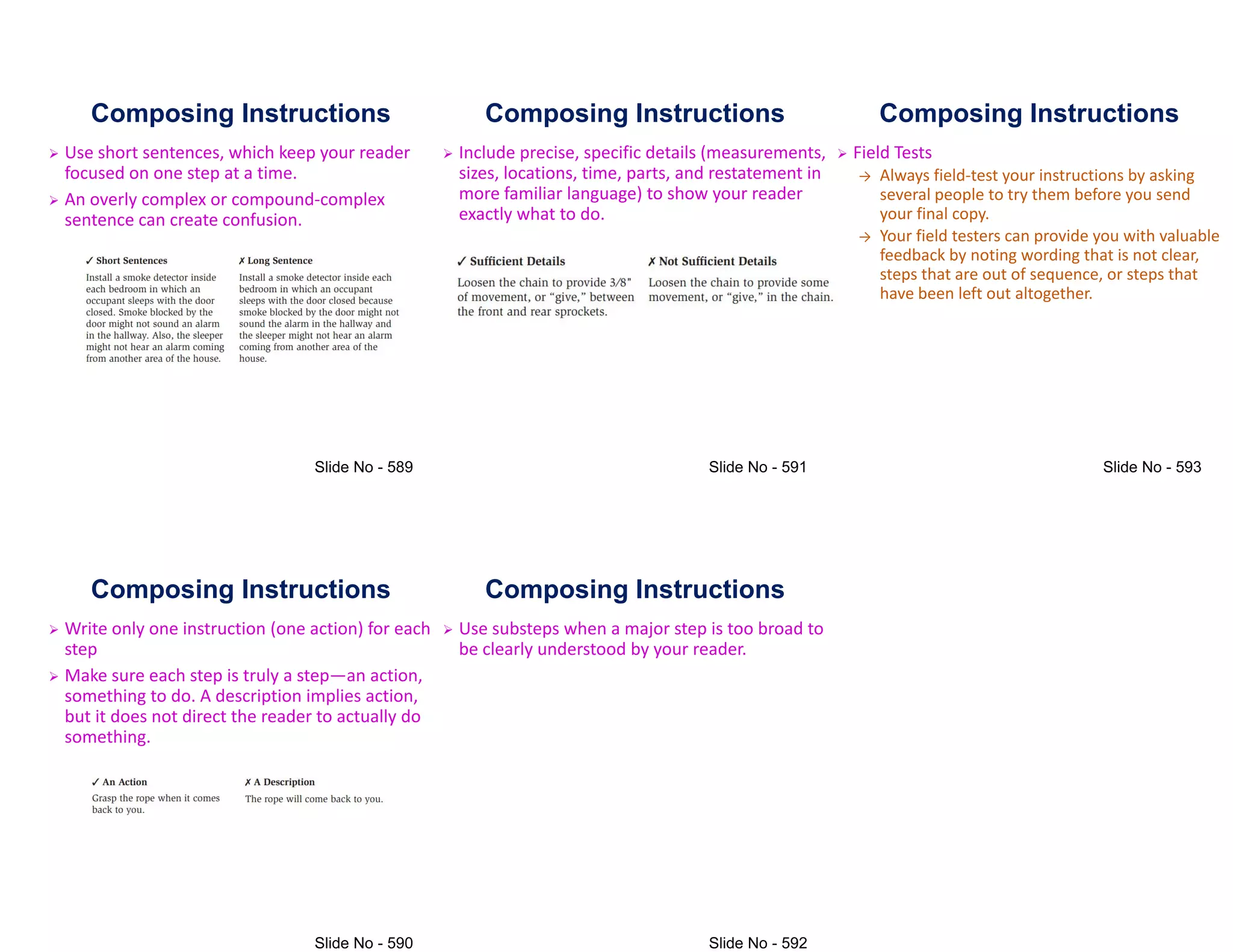
• In addition, pictographs add color and interest, are
Different Types of Graphics
• In addition, pictographs add color and interest, are
easy to read, and are especially appropriate for
nonnative speakers of English.
• To be clear, the pictures or icons must be easily
recognized and distinguishable from one another.
– Pictograph
Different Types of Graphics
– Pie Graph / Pie Chart
• A pie graph is a circular graphic that shows how parts
relate to the whole.
• The whole totals 100 percent, with each piece of the
pie representing a percentage of the whole.
• Notice that the pieces of the pie move clockwise from
Different Types of Graphics
• Notice that the pieces of the pie move clockwise from
the twelve o(clock position from largest to smallest&
• A pie graph should contain no more than seven
sections.
– Pie Graph / Pie Chart
Different Types of Graphics
– Charts
• A chart is a drawing with boxes, words, and lines to
show a process or an organizational structure.
• Popular charts include
– Flowchart
– Decision Flowchart
Different Types of Graphics
– Decision Flowchart
– Organizational Chart
– Gantt Chart
– Types (Charts)
• Flowchart
– a flowchart is used to illustrate a process
– In a flowchart, the lines and arrows show a process or series
of steps.
Different Types of Graphics
– Types (Charts)
• Decision Flowchart
– A decision flowchart is a special flowchart that uses symbols
to indicate critical parts of making a decision.
– Flowcharts should cover only the major steps.
– You want to save the details of the process to include in
Different Types of Graphics
– You want to save the details of the process to include in
your explanation in the text.
– Also, you should be careful not to confuse your reader with
too many symbols and to provide a key for the symbols if
necessary.
– Types (Charts)
• Decision Flowchart
Different Types of Graphics
– Types (Charts)
• Organizational Chart
– An organizational chart is a drawing with boxes, words, and
lines to show how an organization is structured (Hierarchy)
Different Types of Graphics
– Types (Charts)
• Gantt Chart
– A chart used for managing the tasks involved in a project
that shows when each stage should start and end and
compares the amount of work done with the amount
planned
Different Types of Graphics
planned
– To schedule the major tasks of a complex project
– Diagrams
• A diagram or drawing shows how something looks or
how it operates
• Types
– Line Drawing
– Icon
Different Types of Graphics
– Icon
– Photographs
– Types (Diagrams)
• Line Drawing
– How something looks
– You can use callouts
» names of specific parts of a diagram that are connected
to the diagram or drawing with lines
Different Types of Graphics
to the diagram or drawing with lines
– Types (Diagrams)
• Icon
– An icon is a simple picture or
drawing that represents an idea or a
concept.
– The icon is an easily recognizable
Different Types of Graphics
– The icon is an easily recognizable
symbol of an idea.
– Such symbols can be used as signs.
– For example, most people are
familiar with the no-smoking sign—a
red circle around a picture of a
cigarette with a red diagonal line
drawn through the cigarette.
– Types (Diagrams)
• Photograph
– A photograph can be inserted into a document when it is
important to show what something looks like.
– Photographs include a great deal of detail, however, and are
not always an appropriate graphic aid.
Different Types of Graphics
not always an appropriate graphic aid.
– To be effective, the photo should be clear and should focus
on a particular idea or message.
– Types (Diagrams)
• Photograph
Different Types of Graphics
– Purpose
• To present a small amount of numerical data
– Graphics
• Informal Table
Different Types of Graphics
– Purpose
• To present numbers in easy-to-read rows and columns
– Graphics
• Formal Table
Different Types of Graphics
– Purpose
• To explain an idea using words set up in rows and
columns
– Graphics
• verbal table
Different Types of Graphics
• verbal table
– Purpose
• To contrast data and focus on differences
– Graphics
• bar graph or pictograph
Different Types of Graphics
– Purpose
• To contrast several sets of data and focus on the
differences
– Graphics
• double or multiple bar graph
Different Types of Graphics
– Purpose
• To follow a trend over time
– Graphics
• line graph
Different Types of Graphics
– Purpose
• To compare several trends and show how data is related
– Graphics
• double or multiple line graph
Different Types of Graphics
– Purpose
• To show how the whole is divided into parts or how the
parts relate to the whole
– Graphics
• pie graph
Different Types of Graphics
– Purpose
• To present a process
– Graphics
• flowchart
Different Types of Graphics
– Purpose
• To tell how to make a decision
– Graphics
• decision flowchart
Different Types of Graphics
– Purpose
• To present the structure of an organization
– Graphics
• organizational flowchart
Different Types of Graphics
– Purpose
• To show a schedule of tasks
– Graphics
• Gantt chart
Different Types of Graphics
– Purpose
• To present an idea using a symbol
– Graphics
• icon
Different Types of Graphics
– Purpose
• To show representative details of an object or a
mechanism
– Graphics
• diagram or line drawing
Different Types of Graphics
– Purpose
• To show how something actually looks
– Graphics
• photo
Different Types of Graphics
Writing for the
Web
Web
Writing for the Web
 Although the terms the Web (for World Wide
Web, a collection of online resources) and the
Internet are often used interchangeably, they
are not synonymous.
 The Internet, a global system of networks, is
the infrastructure on which the World Wide
Web as well as other protocols, including e-mail
and instant messaging, travel.
 Think of the Internet as the train track and the
Web as one of the trains running on the track.
Writing for the Web
 As you are writing for the web, you must know
the answer to the following question
 How do people read Web Pages?
→ People read online material differently from
the way they read printed text.
→ Printed text is read in a linear fashion from one
page to the next
→ Web readers scan pages from the top center,
then down from left to right, looking for
keywords.
Writing for the Web
→ Instead of turning pages, readers follow links,
jumping from one page to another and one site
to another, wherever their interests take them.
Writing for the Web
→ Because of the interactive nature of the Internet,
readers control the flow of information
→ No two readers read a website the same way
→ Online readers want speed and convenience.
− Most people find that just ten seconds is too long
to wait for a page to load.
→ If the site glitters with animation but does not
give viewers the information they seek, they are
not likely to return.
Writing for the Web
→ Furthermore, readers prefer not to scroll
horizontally (to the right) or vertically (down) to
find information.
→ Because of their desire to navigate quickly,
readers pick up clues from one page to help
them understand the next page.
readers pick up clues from one page to help
them understand the next page.
 As a web writer, you must be familiar with
these clues and adjust your writing to this
different way of reading and accessing data.
Points to remember when writing for the web
 When planning your site, consider
→ Monitor settings,
→ Internet connection speeds,
→ Special requirements of hand-held devices,
→ Browsers used by your target audience.
 Plan for a variety of technology setups and test
your page in different browsers
 For example,
→ Google Chrome
→ Internet Explorer
→ Mozilla Firefox
Points to remember when writing for the web
 Remember, the Internet is always open to
anyone with a computer and an Internet
connection.
 Therefore, keep in mind that anyone anywhere
in the world can read whatever you put on a
web page.
How to organize web pages?
 To begin organizing your website, use sticky
notes or index cards to list everything you want
to include
→ No more than one item per note or card.
Group your items into similar categories,
 Group your items into similar categories,
considering the importance of each idea to
your users.
 Place your notes on a white board so you can
move them around until you have an outline
that works—with topics and subtopics.
How to organize web pages?
 Common ways to organize information on a
website are
→ By category
→ Task
→ Product
→ Product
→ Date/time
→ Department
How to organize web pages?
 A simple site may move forward
→ In a linear fashion
− from one page to the next
− Similar to a flowchart.
→ In a hierarchy
→ In a hierarchy
− Similar to an organizational chart.
− In the hierarchy, information flows progressively
from )top* to )bottom* from the home page to
a second or third tier in increasing levels of
detail.
How to organize web pages?
 Once you have an outline, you can decide how
to structure your website.
 Web design software such as ADOBE
DREAMWEAVER and MICROSOFT EXPRESSION
WEB 3 provides tools for setting up the
structure for a website.
How to organize web pages?
 When you organize your pages, you will need to
plan for a system of hyperlinks.
→ Hyperlinks, also called links,
− are a word, phrase, or graphic used to link, or
join, pages within a site or to an external site,
allowing viewers to move easily from page to
page.
− The goal is to make information accessible in
three or four mouse clicks.
− External links can enrich a subject with
information from another site and reduce
content on a page.
How to organize web pages?
 Points to remember for external links
→ Inform your readers that they are leaving
your site and moving to another one.
→ If you use an external link, make sure the
link works.
link works.
− Dead link frustrates
→ Not every site makes use of external links,
but every site should include a clear system
of links to take viewers to pages within the
site.
How to organize web pages?
 Points to remember for external links
→ Without clear navigation, readers can get
lost, wondering how to get back to a page
they found interesting.
Designing a web page
 In order to design a web page, keep the
following points in your mind
→ Usability
− the ease with which an audience can access and
use a site—as the top design principle.
− In addition to ease of use, web pages should
look attractive—uncluttered, symmetrical, and
inviting.
Designing a web page
 In order to design a web page, keep the
following points in your mind
→ Headings
− To help readers scan for relevant information,
organize information under relevant headings.
→ Divisions
− If your page is too long, divide the information
into multiple shorter pages with corresponding
links to those pages.
Designing a web page
 In order to design a web page, keep the
following points in your mind
→ Line Length
− A shorter line length reduces eye movement
needed to scan the text.
− The ideal line length is approximately half the
width of the screen, or between 50 and 70
characters (or 10 to 12 words) per line
Designing a web page
 In order to design a web page, keep the
following points in your mind
→ Graphics
− Graphics break up the text# attract the reader(s
attention
attention
− Use graphics to provide visual relief, to support
your content and image, and to make the site
attractive.
Designing a web page
 In order to design a web page, keep the
following points in your mind
→ Multimedia
− Use animation, audio, and video to make a page
more interesting.
more interesting.
− Too much movement may annoy the reader,
and if the extra graphics result in the page
taking a long time to load, you may lose visitors.
Designing a web page
 In order to design a web page, keep the
following points in your mind
→ Short sentences & Short Paragraphs
→ Every page should have a title
→ Standard Language
→ Standard Language
Special Web Pages
Special Web Pages
 Blogs
→ a blog (short for weblog) is a website with
periodic commentary or news posted in
reverse chronological order.
→ A blogger is usually an individual with special
knowledge or passion about a topic.
→ Because viewers can respond, a blog is not only
a source of information, but also an online
community.
Special Web Pages
 Blogs
→ In addition, a blog may include links and
graphics.
→ There are as many blogs as there are content
areas.
areas.
− A doctor posts her administrative struggles,
− A news reporter posts commentaries about the
day(s events#
− A businessperson posts progress on the
development of a new product.
→ The writing style used on a blog is informal.
FAQ
 FAQ short of
→ Frequently Asked Question (Generally)
→ Frequently Answered Question
 A list of questions with answers provided,
intended to help people understand or use
something, especially on the Internet
 The assumption is that
→ if a sufficient number of people have asked
these questions, the questions must be
common enough that others will have the
questions too.
Report Writing
Report Writing
Report Writing
 A report is a form of
organized/structured/systematic presentation
of factual information relating to an event,
progress of action or some business activity.
 It is a written statement of results, events,
qualities, conditions, progress or interpretation
 It is a written statement of results, events,
qualities, conditions, progress or interpretation
of records.
 A report is a basic management tool used in
decision-making.
 A report carries information from someone
who has it someone who need it.
Characteristics of a good report
 Objectivity
→ Your opinion and personality should not be there
→ Keep it impersonal
 Accuracy
→ Accuracy of presentation of facts, language and
information
→ Accuracy of presentation of facts, language and
information
 Clarity
→ Clarity of thought and substance/content
→ The contents of the report should easily be
assessable to the reader
→ Neither ambiguous nor challenging
Characteristics of a good report
 Through research / Thoroughness
→ Complete in itself / inclusion of all details
→ No aspect of a report should lack on any
account
→ It should reflect that you have done the hard
work
→ It should reflect that you have done the hard
work
 Structure
→ A report is very clearly structured / organized
→ It has particular sections
− They are clearly visibly, like headings /
subheadings
Types of reports
 Informative Reports
→ Periodic Reports
→ Progress and Activity Reports
→ News releases/ Press Releases
Investigative Reports
 Investigative Reports
→ Incident / Trouble / Accident Reports
→ Trip Reports
→ Laboratory Reports
→ Forensic Reports
 Feasibility Reports / Recommendation Reports
Periodic Reports
 Periodic reports explain accomplishments over
a specified time period
 Reflection of overall organization
 Periodic reports may cover different periods:
→ a week (weekly),
→ a month (monthly),
→ three months (quarterly), or
→ six months (semiannually)
→ Annually
Progress and Activity Reports
 Also called status reports
 These reports address progress for a period of
time.
 Unlike periodic reports, which cover all of an
organization(s work# a progress report describes
what has been done during a specified time on
only one project, such as work on the
construction of a building.
Progress and Activity Reports
 A progress report covers in detail all
achievements as well as plans for the upcoming
reporting period toward completing one
project.
 They are issued at regular intervals to describe
what has been done and what remains to be
done
News / Press Releases
 These are reports of events or facts prepared for the
media, which are systems or means of mass
communication.
 The goal of the release is to inform the public of, for
example, an employee promotion or a company
expansion.
 Public Relation Department
→ handles the communication between a company and
the outside world
→ It write news releases to help the company maintain a
positive image.
 ISPR
Incident / Trouble / Accident
Reports
 These reports describe an unusual incident or
occurrence.
 They are used to analyze the incident
 The incident could be an accident, a surprise
inspection, the outburst of an angry employee
or customer, or a near-accident.
 The report assesses the causes of the problem
and suggests changes necessary to prevent its
recurrence
Trip Reports
 A trip report provides a permanent record of a
business trip and its accomplishments.
 It provides managers with essential information
about the results of the trip and can enable
others staff members to benefit from the
information
 Trip reports are a condensed narrative.
 Often the report does not include everything
about the trip, only those parts that are most
useful to the organization.
Laboratory Report
 A laboratory report communicates information
acquired from laboratory testing or a major
investigation.
 It should begin by stating the reason that a
laboratory investigation was conducted;
 It should also list
→ the equipment and methods used during the
test,
→ the problems encountered,
→ the results and conclusions reached,
→ and any recommendations.
Laboratory Report
 A laboratory report emphasizes
→ the equipment
→ and procedures
 used in the investigation because those two
factors can be critical
→ in determining the accuracy of the data
→ even replicating the procedure if necessary.
Laboratory Report
 Lab reports answer these questions:
→ What was the purpose of the lab?
→ What materials were used?
→ What was the procedure?
→ What were the results?
→ What are the conclusions?
Feasibility Reports /
Recommendation Reports
 The recommendation report is a problem-and-
solution report, a written answer to a need that
arises in the workplace.
 Most problems, however, have more than one
solution. The recommendation report suggests the
best solution to a problem or need. It helps
readers make a choice.
 When organizations consider a new project—
developing a new product or service, expanding a
customer base, purchasing equipment, or moving
operations—they first try to determine the
project(s chances for success.
Feasibility Reports /
Recommendation Reports
 A feasibility report presents evidence about the
practicality of a proposed project based on
specific criteria.
Based on the findings of the analysis, the report
 Based on the findings of the analysis, the report
offers logical conclusions and recommends
whether the project should be carried out.
Components of a
Report
Report
Title Page
 The title page gives an overview of the report
 It also has the following things
→ Title
→ Date of submission
Author name
→ Author name
→ The person whom you will submit to
Sample Page
Executive Summary / Abstract
 An abstract summarizes and highlights the
major points of a report.
 Its primary used to help the reader quickly find
out the paper's purpose
An abstract is the summary of
 An abstract is the summary of
− Aims / Purpose
− Method & Scope
− Main findings
− (Conclusions & Recommendations)
Executive Summary / Abstract
 Types of abstracts
→ Descriptive Abstracts
→ Informative Abstracts
Executive Summary / Abstract
 Descriptive Abstracts
→ A descriptive abstract summarizes
− the purpose
− Scope
− Methods
− Methods
used to arrive at the reported findings.
→ It is a slightly expanded table of contents in
sentence and paragraph form.
→ A descriptive abstract need not be longer than
several sentences.
Executive Summary / Abstract
 Informative Abstracts
→ An informative abstract is an expanded version
of the descriptive abstract.
→ In addition to information about the purpose,
scope, and research methods used, the
informative abstract summarizes any results,
conclusions, and recommendations.
→ The informative abstract retains the tone and
essential scope of the original work, omitting
its details.
Executive Summary / Abstract
 Which abstract should I use?
→ It depends on
− your audience
− the organization
− publication for which you are writing.
→ Informative abstracts work best for wide
audiences that need to know conclusions and
recommendations
→ Descriptive abstracts work best for compilations,
such as proceedings and progress reports, that do
not contain conclusions or recommendations.
Executive Summary / Abstract
 Writing Strategies for Abstract
→ Write the abstract after finishing the report or
document. Otherwise, the abstract may not
accurately reflect the longer work.
→ Begin with a topic sentence that announces
the subject and scope of your original
document.
→ Then, using the major and minor headings of
your outline or table of contents to distinguish
primary ideas from secondary ones, decide
what material is relevant to your abstract
Executive Summary / Abstract
 Writing Strategies for Abstract
→ Write with clarity and conciseness, eliminating
unnecessary words and ideas.
→ Do not, however, become so terse that you
omit articles (a, an, the) and important
transitional words and phrases (however,
therefore, but, next).
Executive Summary / Abstract
 Writing Strategies for Abstract
→ Write complete sentences, but avoid stringing
together a group of short sentences end to
end; instead, combine ideas by using
subordination and parallel structure.
→ Spell out all but the most common
abbreviations. In a report, an abstract follows
the title page
Abstract Sample
Table of Contents
 A table of contents is typically included in a
document longer than ten pages.
 It previews what the work contains and how it
is organized, and it allows readers looking for
specific information to locate sections by page
number quickly and easily.
Table of Contents
 When creating a table of contents, use the
major headings and subheadings of your
document exactly as they appear in the text, as
shown in the entry formal reports.
 The table of contents is placed in the front
matter following the title page and abstract,
and precedes the list of tables or figures, the
foreword, and the preface.
Sample TOC
The Introduction
 Every document must have either an opening or
an introduction.
 In general, correspondence and routine reports
need only an opening; more complex reports and
other longer documents need an introduction.
An opening usually simply focuses the reader(s
 An opening usually simply focuses the reader(s
attention on your topic and then proceeds to the
body of your document.
 When your audience is familiar with your topic or
if what you are writing is brief or routine, then a
simple opening will provide adequate context to
begin
The Introduction
 A formal introduction sets the stage by
providing necessary information to understand
the discussion that follows in the body.
 Introductions are required for such documents
as formal reports
as formal reports
 The purpose of a full-scale introduction is to
give readers enough general information about
the subject to enable them to understand the
details in the body of the document.
and major proposals.
The Introduction
 Gives the big picture of the report
 It focuses on various things
→ State the subject
− Provide background information, such as definition,
history, or theory, to provide context for your
readers.
readers.
→ State the purpose
− Make your readers aware of why the document
exists and whether the material provides a new
perspective or clarifies an existing perspective
→ State the scope
− Tell readers the amount of detail you plan to cover.
The Introduction
→ Preview the structure/development of the
subject.
− Outline how you plan to develop the subject.
− It allows readers to anticipate
+ how the subject will be presented and
+ helps them evaluate your conclusions or
recommendations.
The Introduction
The following opening strategies can be used to
begin your piece of writing (report)
 Objective
 Problem Statement
 Definition
 Anecdote
Problem Statement
 Scope
 Background
 Summary
 Interesting Detail
 Anecdote
 Quotation
 Forecast
 Persuasive Hook
The Conclusion
 The conclusion of a document ties the main ideas
together and can clinch a final significant point.
 Features
→ It summaries the key findings
→ It relates to the objectives in introduction
→ No new material / concept in conclusion
− Reflection of discussion
− Follow logically from discussion
→ Precise and concise
− Use bullet points
− Emphatic Order where major conclusions come first
The Conclusion
 The way you conclude depends on your
purpose, the needs of your audience, and the
context.
 The following examples are typical concluding
strategies.
strategies.
→ Recommendation
→ Summary
→ Judgment
→ Implication
→ Prediction
The Recommendations
 The most important part of a report,
→ because the purpose of a report is to solve
problems or to take advantage of opportunities,
 The recommendations suggest actions to be taken
in response to the findings of a report
 Features:-
 Features:-
→ Focus on future
→ only point where you can give your subjective
opinion
→ Consider
− Cost, location, practicality, acceptability
→ Follow discussion logically
→ Not all reports have recommendations
The Recommendations
 Make sure about recommendations that they
are:
→ Feasible
→ Written as action statements without
justification
justification
→ Related to discussion and conclusions
→ Numbered / points
→ Ranked / emphatic order (most important first)
→ Brief and to the point
→ Stated in clear language
DISCUSSION / ANALYSIS
 To show the relationships among the observed
facts and to draw conclusions.
 Purpose
→ To give the answer to the research question
that was stated in the Introduction.
→ To explain how your results support the
answer.
→ To show the relationships among your
observations, and also to place them into the
context of other people's work.
DISCUSSION / ANALYSIS
 Features:-
→ The body of the report
→ + ¾ length of report
→ Discussion is subdivided into logical units
− Units with a heading and numbered
→ Fully explains conclusions
→ Justifies recommendations
→ Explains preferred solution
→ Provides evidence and examples
→ Links theory to practice
Results / Findings
 To present your results, but not to discuss
them.
References
 Details of published sources of material
referred to or quoted in the text
→ including any lecture notes and URL addresses
of any websites used.
 Any report that contains other people(s ideas or
findings must be referenced
Optional Components
Appendix / ə`pendɪks /
 Plural
→ Appendices / ə`pendɪsiːz/
 An appendix supplements or clarifies the
information in the body of the document.
Any further material which is essential for full
 Any further material which is essential for full
understanding of your report (e.g. large scale
diagrams, computer code, raw data,
specifications) but not required by a casual
reader
Appendix / ə`pendɪks /
 A document may have more than one
appendix, with each providing only one type of
information.
→ When you include more than one appendix,
arrange them in the order they are mentioned
in the body of the document.
Acknowledgements
 List of people who helped you research or
prepare the report, including your proofreaders
 You say thanks to them
Bibliography
 Other published sources of material, including
websites, not referred to in the text but useful
for background or further reading.
Glossary
 A glossary is an alphabetical list of definitions
of specialized terms used in a report.
 You may want to include a glossary if some
readers in your audience are not familiar with
specialized or technical terms you use.
 Keep glossary entries concise and be sure they
are written in language that all your readers
can understand.
List of Illustrations
 To give a listing - separate from the Table of
Contents - of the numbers, titles and
corresponding page numbers of all your figures
and tables.
 Required for Longer documents
Keywords
 A brief list of keywords relevant to your
document that will be used by electronic
indexing and abstracting services.
 Usually only for a journal paper
Objectives
 To describe the aims of your study.
Index
 Used in long documents
 At the end of the document, a list in
alphabetical order giving topics mentioned in
the book and the pages where they occur.
What to know
before writing a
report
report
What to know before writing a report
 Before writing a report you have to know
→ The type of report that you are going to write
→ Purpose of writing
− Why are you writing this report?
− Must have clear understanding
− So you can easily collect relevant data/material
→ Scope of your report
− What needs to go into the report?
− What elements are required?
− What to include and what to exclude?
The process of
writing a report
writing a report
The Process of Report Writing
 Step 1
→ Determine the purpose of the report
− Why are you writing this report?
→ Research methods
− How will you collect the DATA?
The Process of Report Writing
 Step 2
→ Determine your Audience
− Who are they
− What do they know
− What are there problems that need to be solved
The Process of Report Writing
 Step 3
→ Determine your role
− Who are you?
− What perspective will you focus on?
+ A bank manager
+ A bank manager
+ A consultant
The Process of Report Writing
 Step 4
→ Plan your report
− Make an outline
− Write a thesis statement
+ Pin point the topic and the focus of the report
− Use heading to set up sections and subsections
The Process of Report Writing
 Step 5
→ Brain storm the topic
− Write down everything you know about the
topic including you think something may be
important
important
The Process of Report Writing
 Step 6
→ List possible sources of information
 Step 7
Manage your time
→ Manage your time
− Time management is very critical
The Process of Report Writing
 Step 8
→ Research and read
− Data gathering Stage (huge component of the
report)
− Now you know
+ what you are looking for and where you can find
− Collect the data from every thing , from a TV
program to book, journals, research papers etc,
interview people
− Reserve a lot of time for this stage and do it
thoroughly
− Only read relevant, stick to the relevant material
+ Keep brief notes of what you need and read with
reference
The Process of Report Writing
 Step 9
→ Rework your outline
→ Organize your notes
→ Identify the gaps that need further research
 Reformulate heading / subheadings
 Think of tables and graphics and figures
The Process of Report Writing
 Step 10
→ Start writing
− Start with the discussion
− Develop conclusions and recommendations
− Write your introduction
+ An overview of what it is in the report
+ So you can(t write before your report is written
+ go back to your discussion, conclusion and
recommendations and summaries it
− Compile your reference list
− Proof-read and re-edit
The Process of Report Writing
 Check your clarity before you submit
Why Reads Instructions?
 People who read instructions need to perform a
task or understand how someone else performs
that task.
 Everything we do has a procedure and we need
instructions in order to understand the method /
procedure
Many readers are impatient, trying to go through
procedure
→ Many readers are impatient, trying to go through
the steps without reading them first.
→ Some readers, thinking they are familiar with the
procedure, read only a few steps and think they
know what to do.
→ Other readers rely more on the graphics than the
words for information.
Why Reads Instructions?
 Whatever their approach, readers trust the writer
to give them accurate, precise information in the
proper sequence.
 Some instructions—electrical installation and
medical procedures, for example—can be matters
of life or death.
For example, the instructions for installing a new
of life or death.
→ For example, the instructions for installing a new
light fixture can put a do-it-yourself home owner
in danger of electric shock if the instructions fail to
say )Before installing the fixture# turn off all
electrical power running to the light outlet&*
 In those cases, readers trust writers with their lives
and with the lives of others
Why Reads Instructions?
 Because your reader trusts you, you must make
sure that your instructions are accurate and
thorough.
 The amount of detail depends on how much
knowledge your audience has about the
process.
→ A beginner, for example, needs more detail
than someone with experience.
 Good instructions keep readers motivated to
read carefully.
Planning Instructions
 Use the following suggestions to analyze the
process and to better understand the steps, the
series of actions required to complete the process:
→ Create a flowchart with steps to the process.
− Write what someone should do first, second, third,
and so on.
and so on.
− Do not to skip any steps.
− Add and remove steps as needed.
 Work the process backward (In your mind)
→ What is the purpose of the procedure?
→ What is done last, next to last, third to last, and so
on?
Planning Instructions
 Watch a member of your target audience
performing the task for the first time.
→ Take notes.
→ What is the very first step?
→ What is the most difficult step?
→ Which steps does the person misunderstand?
→ Would additional information make things
clearer?
→ Interview this person after he or she has
completed the procedure.
→ Ask for suggestions to help you write a clear set of
instructions.
Planning Instructions
 Now that you have analyzed the steps for your
instructions, organize your information into
sections for your reader.
 Then place that information into a sequence of
chronological steps and an easy-to-read format.
All instructions include steps of procedures and
 All instructions include steps of procedures and
appropriate explanations along with additional
details to clarify the procedure.
→ However, instructions often contain other parts as
well.
 Whether to include these parts depends on the
audience and the purpose of the instructions.
Different Elements of Instructions
 Warnings / Cautions
→ Purpose
− Can damage the equipment or
− Hurt himself/herself
→ Place warnings / causations before the reader
is likely to do anything dangerous.
→ Often a symbol or graphic that represents
danger accompanies the warning / caution.
Different Elements of Instructions
 Definitions
→ Your reader must learn new terms to perform
the procedure.
→ Define six or more terms in a separate list or
glossary.
glossary.
Different Elements of Instructions
 Introduction
→ Your reader would benefit from any or all of the
following information:
− background,
− purpose (what readers will be able to do when they
finish),
− intended audience,
− scope (what the instructions do and do not cover),
− organization,
− best way to read the instructions,
− assumptions about readers( knowledge or abilities#
− and/or motivation to read the instructions carefully.
→ An introduction appears at the beginning of the
document.
Different Elements of Instructions
 Explanation
→ Less Explanation
− Your reader has performed the process before
or the process is an emergency procedure in
which reading explanations would prevent the
reader from acting quickly.
→ Detailed Explanation
− Your reader is performing the process for the
first time, the procedure is complicated, or the
reader needs to know more to perform the
procedure correctly.
Different Elements of Instructions
 Materials / Tools
→ Your reader should gather materials, tools, or
ingredients before following your instructions.
→ Place this list before the steps.
Different Elements of Instructions
 Notes / Tips
→ Additional but not essential information would
aid your reader(s understanding&
→ Include a note immediately after the step to
which it pertains.
which it pertains.
Different Elements of Instructions
 Graphics
→ A picture, diagram, or flowchart would make
the instructions easier to follow.
→ Place a graphic as close as possible to the step
it illustrates—above, below, or beside.
→ Avoid placing the graphic on another page or
at the end of the instructions.
Composing Instructions
 Organization, format, and graphics may vary,
but all instructions require chronological steps.
 Steps
→ A step is the action that a reader performs—
what the reader actually does.
→ Steps have a consistent and unique structure.
→ Use the following guidelines for writing steps:
Composing Instructions
 Make sure steps proceed forward in time—
numbered, or in some cases lettered—with no
backtracking to pick up a step that was
forgotten.
Composing Instructions
 Begin each step with an active-voice verb in the
imperative mood
→ (a command: verb + object)
→ Use second person (stated or understood
)you* as the subject)
Composing Instructions
 Use short sentences, which keep your reader
focused on one step at a time.
 An overly complex or compound-complex
sentence can create confusion.
Composing Instructions
 Write only one instruction (one action) for each
step
 Make sure each step is truly a step—an action,
something to do. A description implies action,
but it does not direct the reader to actually do
something.
Composing Instructions
 Include precise, specific details (measurements,
sizes, locations, time, parts, and restatement in
more familiar language) to show your reader
exactly what to do.
Composing Instructions
 Use substeps when a major step is too broad to
be clearly understood by your reader.
Composing Instructions
 Field Tests
→ Always field-test your instructions by asking
several people to try them before you send
your final copy.
→ Your field testers can provide you with valuable
feedback by noting wording that is not clear,
steps that are out of sequence, or steps that
have been left out altogether.

BEST LAWYER IN LIBYA ppt

  • 1.
    Language (OALD: 9thEdition)  The word language has 5 Senses → Language of a country − the system of communication in speech and writing that is used by people of a particular country, Germen Language, English Language etc etc → Communication − the use by humans of a system of sounds and words to communicate → style of speaking / writing − a particular style of speaking or writing, bad language, slang language, formal Lang Language (OALD: 9th Edition)  The word language has 5 Senses → movements / symbols / sound − a way of expressing ideas and feelings using movements, symbols and sound, the language of dolphin/bees of dolphin/bees → Computing − a system of symbols and rules that is used to operate a computer More Simplified Version  A means of communication  Communication → a human’s social need − No Language'''&& No communication'''no chance of survival in a society chance of survival in a society Why do we need to learn a foreign language?  Era of communication & technology''' → Now''world'&&& a global village'''competitive world''& Survival of the fittest''&& − Survival of fittest''&be the best from all − Survival of fittest''&be the best from all aspects'''know culture,traditional values,social values&&&&religion''language'  Why all this'' → to understand each other better'&&to facilitate,help each other'' only way of survival'''& English Language  International Language  Language of Science and technology  Good job'''  open door to knowledge'&  open door to knowledge'&  language of computer, mobile phone'''&  official language''  widely spoken all over the world
  • 2.
    English Language Skills Whyfour skills??? Why not English as over all  To facilitate the learning / teaching process (for teachers / students)  Easy to examine your weak area'and then to practice the area'& Grouping of Skills  Oral Skills & Written Skills → Listening & Speaking (Oral) → Reading & Writing (Written)  Active & Passive Skills Listening & Reading (Passive) → Listening & Reading (Passive) → Speaking & Writing (Active)  Receptive & Productive Skills → Listening & Reading (Receptive) → Speaking & Writing (Productive) Relation among the skills  All the skills are interdependence'&  But ' → The more you listen,,,,,, the better you speak → The more you read''&& The better your write Writing Skill Technical & Report Writing Purposes / Aims of Writing  Writers always have some purpose in mind for writing  All writing has one or more of four basic purposes/aims
  • 3.
    What are theseaims??? Can you guess??? Purposes / Aims of Writing All writing has one or more of four basic purposes/aims 1. To inform / explain − give facts/share information + Science reports, news story, instructions + Science reports, news story, instructions 2. To persuade / motivate − to motivate your reader to do sth / to make them think differently / to take some action + Persuasive essay, motivational speech, political speech, advertisement) Purposes / Aims of Writing All writing has one or more of four basic purposes/aims 3. To express yourself − You often write to express your feelings / thoughts thoughts + Diary / Journal entry, letter, personal essay 4. To entertain / To be creative − they create stories, poems, songs, and plays + Short story, plays, poems Importance of Writing???  Era of technology & communication → still need writing???? → If yes,, − why??????? Importance of Writing  a means of communication → letter/email/texting/reporting etc  A means for recording information (history)  A means of learning/literacy A means of learning/literacy → mostly assessments is done in written form throughout the world  )In writing*'''&& an evidence , proof&&&&Islamic verification Importance of Writing  Wanna remove stress'then write'&transfer it to paper  Record your life (diary / journal)  Make money  Sharpen your analytical & communication skills  A rehearsal of your vocabulary
  • 4.
    Importance of Writing To make to do lists/ reminders/events etc  Revive/revise recently learned materials  Write so you can be assessed  Write for creativity / generating ideas and  Write for creativity / generating ideas and exploration  Write for Literature,drama,movie'so people will know you.. Who writes??? Why??? Who writes??? Why???  A Wali writes → to spread ways to Allah  Scientists write → to share their inventions/discoveries  Technical writers write  Technical writers write → to explain how something works  news reporters write → to share current updates  Poets write → to spread feelings Who writes??? Why???  Business people write → to make profit  Judges write → to do justice  Doctors write → to cure you → to cure you  Bankers write → to snatch your money bit by bit  police write → to punish you  Students write → for GPA Will you write??? Will you write?  Yes'''' HOW??? HOW???
  • 5.
    John Langan  Theauthor of a popular series of college textbooks on both writing and reading reading  When he was in school / college...... John Langan  My early memories of writing in school are not pleasant.  Luckily, in college I had an instructor who changed my negative attitude about writing. During my first semester in composition, I realized that During my first semester in composition, I realized that  my instructor repeatedly asked two questions about any paper I wrote: → )What is your point"* − and → )What is your support for that point"* John Langan  I learned that sound writing consists basically of making a point and then providing evidence to support or develop that point. As I understood, practiced, and mastered these  As I understood, practiced, and mastered these and other principles, I began to write effective papers. John Langan  By the end of the semester, much of my uneasiness about writing had disappeared.  I realized that competent writing is a skill that I or anyone can learn with practice. or anyone can learn with practice. Practice writing  Make a point and then support it by giving 3 reasons
  • 6.
    Assignment 01  Usingthe same pattern you will make 1 point and will support by 3 supporting points'  You have to make 10 sets'& 4 Questions to change your attitude  A good writer should be able to sit down and write a paper straight through without stopping. → ANSWER − FALSE − FALSE  Writing is, in fact, a process. It is done not in one easy step but in a series of steps, and seldom at one sitting.  It is harmful to carry around the false idea that writing should be an easy matter. 4 Questions to change your attitude  Writing is a skill that anyone can learn with practice. → TRUE  Some people hold the false belief that writing is a natural gift that some have and others do not. a natural gift that some have and others do not.  Because of this belief, they never make a truly honest effort to learn to write—and so they never learn. 4 Questions to change your attitude  I(ll never be good at writing because I make too many mistakes in spelling, grammar, and punctuation. → ANSWER (FALSE)  The first concern in good writing should be  The first concern in good writing should be content — → what you have to say. → Your ideas and feelings are what matter most.  You should not worry about spelling, grammar, or punctuation while working on content. 4 Questions to change your attitude  I(ve always done poorly in English# and I don(t expect that to change. → ANSWER (False)  How you may have performed in the past does not control how you can perform in the not control how you can perform in the present. Attitude Matters  In brief, your attitude is crucial.  If you believe you are a poor writer and always will be, chances are you will not improve.  If you realize you can become a better writer, chances are you will improve. chances are you will improve.  Depending on how you allow yourself to think, you can be your own best friend or your own worst enemy.
  • 7.
    WHAT IS WRITINGPROCESS??? The writing process is a series of steps that most writers follow to get from thinking about a topic to preparing the final draft. THINKING FINAL DRAFT THE WRITING PROCESS THE WRITING PROCESS STEP 1 THE WRITING PROCESS THE WRITING PROCESS STEP 2 THE WRITING PROCESS THE WRITING PROCESS STEP 3 WHAT IS EXPLORING???  There are certain things before writing that can help you FOCUS on your topic.  To find/trace these things is termed as EXPLORING  These things will help you to begin your journey of writing. WHAT IS EXPLORING???  TOPIC  AUDIENCE  AUDIENCE  PURPOSE  EXPLORING STRATEGIES
  • 8.
    Exploring (TOPIC) • Your topicis what you are writing about ,,very important ... Think about it…. about ,,very important ... Think about it…. • A Topic can have many aspects/angles to be looked at TRAVELLING TRAVELLING Dangers of travelling of in of travelling Travelling (part of our life) Travelling for Adventures in Emergency As every topic has As every topic has many many aspects aspects……Which ……Which aspect aspect should I should I aspects aspects……Which ……Which aspect aspect should I should I choose for writing???? choose for writing???? As every topic has many aspects……Which As every topic has many aspects……Which aspect should I choose for writing???? aspect should I choose for writing???? • The aspect that interests you • The aspect that you have sufficient knowledge of • The aspect that you can easily explain (you • The aspect that you can easily explain (you find easy to make a point and then you can support your point) • The aspect that is relevant to your field/experience Exploring (Audience) • Your audience is your intended reader. • Your audience might be your instructor, your classmates, your boss, your coworkers, and so on on • Remember to adapt your language and vocabulary for a specific audience. Exploring (Audience) • When you think about your audience, keep the following points into your mind – Prior knowledge of your audience about the topic – Your readers expectations from this writing – Your readers expectations from this writing – To know which way they will find more interesting – Vocabulary & Sentences (Simple, difficult, complex) – Tone (formal, informal)
  • 9.
    Exploring (Audience) INSTRUCTOR AS YOURAUDIENCE • He will expect you – to use correct grammar – to reveal what you have learned or understood – to reveal what you have learned or understood about the topic – To present your ideas in a clear and organized manner • Remember: Do not leave out information because you assume that your instructor is an expert in the field. Exploring (Purpose) • Your purpose is your reason for writing – To inform/explain – To persuade / motivate – To be creative – To be creative – To express yourself • Sometimes you may have more than one purposes, but be clear about your purpose EXPLORING EXPLORING STRATEGIES STRATEGIES • Why do we need exploring strategies??? – To generate ideas EXPLORING EXPLORING STRATEGIES STRATEGIES • After you determine your topic, audience, and purpose, try some exploring strategies—also known as prewriting strategies - to help get your ideas flowing • The four most common strategies are • The four most common strategies are – FREEWRITING / LOOPING – BRAINSTORMING / LISTING – QUESTIONING – CLUSTERING / MIND MAPPING EXPLORING EXPLORING STRATEGIES STRATEGIES (Freewriting / Looping) • Freewriting is writing for a limited period of time without stopping • The point is to record the first thoughts that come to mind. come to mind. • If you have no ideas, you can indicate that in a sentence such as “I don’t know what to write.” • As you write, do not be concerned with your grammar or spelling. Sample (Freewriting) Work. I’ve only worked in a restaurant. Schedules are good for college students. Can work nights or weekends. Serving people so different from studying. You can relax your different from studying. You can relax your brain, go on automatic pilot. But you have to remember people’s orders so it can be hard. And some customer are rude, rude, RUDE. In some jobs, you get tips in addition to the salary. Should people always tip servers?
  • 10.
    Assignment 02 Choose oneof the following topics and do some freewriting. Remember to write without stopping. •Stress •Nature •Sports EXPLORING EXPLORING STRATEGIES STRATEGIES (Brainstorming / Listing) • You create a list of ideas • You can take the time to stop and think when you create your list. • As you think about the topic, write down • As you think about the topic, write down words or phrases that come to mind. • Do not be concerned about grammar or spelling. The point is to generate ideas. Sample (Brainstorming) Assignment No 3 Assignment No 3 Choose one of the following topics and brainstorm. Create a list of ideas. • Ceremonies • Ceremonies • Gossip • Good or bad manners EXPLORING EXPLORING STRATEGIES STRATEGIES (Questioning) • Here you ask yourself a series of questions and write responses to them. • The questions can help you define and narrow your topic. narrow your topic. EXPLORING EXPLORING STRATEGIES STRATEGIES (Questioning) • One common way to do this is to ask yourself who, what, when, where, why, and how questions.
  • 11.
    SAMPLE (Questioning) • College studentNancy used a question-and- answer format to generate ideas about family. • What is a family? — a unit of people tied by blood or legal documents blood or legal documents • Can friends be considered like family? — maybe long-time friends become part of an extended family • What are problems in families? —abuse, bankruptcy, grudges, divorce, jealousy SAMPLE (Questioning) • How do families stay together? — love, patience, withholding judgment, listening to each other, acceptance of differences • When can families connect the best? — • When can families connect the best? — holidays, weddings, funerals, weekly dinners • Why is our family important? — provides support and connection, helps during times of crisis Assignment No 4 Choose one of the following topics and write questions and answers. Ask who, what, when, where, why, and how questions. • Technology • Technology • Patriotism • Celebrities EXPLORING EXPLORING STRATEGIES STRATEGIES (Clustering / Mind Mapping) • Clustering is like drawing a word map; ideas are arranged in a visual image. • To begin, write your topic in the middle of the page and draw a box or a circle around it. That idea will lead to another, so write the • That idea will lead to another, so write the second idea and draw a line connecting it to your topic. • Keep writing, circling, and connecting ideas until you have groups, or “clusters,” of them on your page. SAMPLE (Clustering) Assignment No 05 Choose one of the following topics and use clustering to explore it on a separate sheet of paper. Begin by writing the key word in the middle of the space. Then connect related ideas. middle of the space. Then connect related ideas. – Jobs – Health – Relationships
  • 12.
    More about Exploring •When you explore a topic using any of the listed strategies, keep in mind that a lot of the ideas you generate may not be useful. • Later, when you develop your ideas, be prepared to cut irrelevant information. Chapter Summary • Before you write, you should think about ??? • 3 Things • 3 Things Chapter Summary Before you write, you should think about your • topic, (What you are going to write about) • Audience (Your intended reader) • purpose. (Your reason for writing) Explain what each one is. Chapter Summary Before you write, you should think about your topic, (What you are going to write about) about) (As every topic has different aspect, so which aspect???) Chapter Summary Before you write, you should think about your topic, (What you are going to write about) (As every topic has different aspect) (As every topic has different aspect) • You find interesting, • have sufficient knowledge, • find easy to support, • Relevant to you • you can easily explain Chapter Summary Before you write, you should think about your • Audience (Your intended reader) • Points that you keep in mind???
  • 13.
    Chapter Summary Before youwrite, you should think about your • Audience (Your intended reader) • Points that you keep in mind??? • Points that you keep in mind??? – Prior knowledge of your audience about the topic – Your readers expectations from this writing – To know which way they will find more interesting – Vocabulary & Sentences (Simple, difficult, complex) – Tone (formal, informal) Chapter Summary Before you write, you should think about your • Purpose (Your reason for writing) • 4 basic purposes of writing??? Chapter Summary Before you write, you should think about your • Purpose (Your reason for writing) • 4 basic purposes of writing??? • 4 basic purposes of writing???  To inform/explain  To persuade / motivate  To be creative  To express yourself Chapter Summary Briefly define each of the following exploring styles. • freewriting • brainstorming • questioning: • Clustering: Chapter Summary Briefly define each of the following exploring styles. • freewriting (writing without stopping) • brainstorming (making a list) • brainstorming (making a list) • questioning: (asking & answering a series of questions) • clustering: (drawing a word map)
  • 14.
    More topics towrite (General) 1. Try freewriting about a strong childhood memory. 2. Try brainstorming about anger, listing any thoughts that come to mind. thoughts that come to mind. 3& Try clustering& First# write )music* in the middle of the page. Then write clusters of ideas that connect to the general topic. 4. Ask and answer some questions about online addictions. More topic to write (University) 5. Try freewriting about a comfortable work environment. Include any emotions or other details that come to mind. 6. Try brainstorming about study habits. List any ideas that come to mind. ideas that come to mind. 7. To get ideas, ask and answer questions about the best or worst jobs. 8. Try clustering about different types of customers. First# write )customers* in the middle of the page& Then write clusters of ideas that relate to the general topic. Developing (Narrow your topic) • Realize your aspect/angle for the topic – The aspect that interests you – The aspect that you have sufficient knowledge of – The aspect that you can easily explain (you find – The aspect that you can easily explain (you find easy to make a point and then you can support your point) – The aspect that is relevant to your field/experience Developing Main Idea • You express your MAIN IDEA by Topic Sentence (Paragraph) A sentence Thesis Statement (Essay) Introductory paragraph Developing (Main Idea) Characteristics of Main IDEA • It introduces the topic • It is the most general theme for the piece of writing. • It is followed by other sentences / • It is followed by other sentences / paragraphs that provide supporting facts and examples. • It contains the controlling idea for your writing Developing (Main Idea) Characteristics of Main IDEA controlling idea – set boundaries / limits to your thinking – expresses the writer’s opinion, attitude, or feeling feeling You can express different controlling ideas about the same topic.
  • 15.
    Developing (Main Idea) Characteristicsof Main IDEA controlling idea – For example, the following topic sentences are about youth offenders, but each sentence makes a different point about the topic. Topic Controlling idea Topic Controlling idea Youth offenders should not receive special treatment from the correctional system. Controlling idea Topic Rehabilitation and education are the best ways for the state to handle youth offenders Developing (Main Idea) What is Main IDEA • Your main idea is the reflection reflection of your topic as well as the controlling idea Topic + Controlling Idea = Main Idea Developing (Main Idea) MAIN IDEA MAIN IDEA Topic + Controlling Idea Topic Sentence (Paragraph) A sentence Thesis Statement (Essay) Introductory paragraph Developing (Main Idea) Paragraph 1. Repair a water heater with three simple steps. 2. Physical education is essential in public 2. Physical education is essential in public schools. 3. There are three types of terrible bosses. red (topic) Blue (controlling idea) Developing (Main Idea) Essay (Extending the School Year) President Barack Obama proposes that American school children extend their time in class either by lengthening the school days or by cutting summer vacation days. Although critics believe that extending the U.S. school year would cause many difficult consequences, many parents and extending the U.S. school year would cause many difficult consequences, many parents and politicians believe otherwise. The school year should be increased from 180 to 210 days because students would not be left at home alone, they would not get into trouble, and teachers would have more time to teach their subjects. Developing (Generate supporting ideas) = the facts and examples that provide the reader with interesting information about the subject matter – try an exploring strategy such as brainstorming or freewriting to generate ideas. Then you can choose the best ideas.
  • 16.
    Developing (Generate supporting ideas) •Crime (stealing, bribe, killing, kidnapping) • Stealing – How to save yourself from the thieves – How do people steal – How do people steal – Why people steal and so on • Why people steal – Topic sentence / main idea (people steal for many reason) – Brain Storming / Listing ( Supporting Ideas) Developing (Organizing Your Ideas) Why should we organize our ideas??? ideas??? Developing (Organizing Your Ideas) Why should we organize our ideas??? We organize our ideas for the following reasons – the readers feel easy to follow the topic – For better comprehension / understanding – For better comprehension / understanding – Requires less effort on part of the readers – Can save readers( time – Can retain readers( interest Developing (Organizing Your Ideas) How to organize our ideas??? Three ways to organize your ideas (1) Time Order / chronological (1) Time Order / chronological order (2) Emphatic Order (3) Space Order Developing (Organizing Your Ideas) Why should we organize our ideas??? Three ways to organize your ideas (1)Time Order /chronological order – arrange the details according to the sequence in – arrange the details according to the sequence in which they have occurred – When you narrate a story, explain how to do something, or describe a historical event, you generally use time order.
  • 17.
    Developing (Organizing Your Ideas) Whyshould we organize our ideas??? Three ways to organize your ideas (1)Time Order /chronological order Developing (Organizing Your Ideas) Why should we organize our ideas??? Three ways to organize your ideas (1)Time Order /chronological order – Here are some transitional expressions you can – Here are some transitional expressions you can use in time-order paragraphs. Developing (Organizing Your Ideas) Developing (Organizing Your Ideas) Why should we organize our ideas??? Three ways to organize your ideas (2)Emphatic Order – arrange ideas in a logical sequence. – arrange ideas in a logical sequence. – For example, you can arrange details from least to most important, from least appealing to most appealing, and so on. Developing (Organizing Your Ideas) Why should we organize our ideas??? Three ways to organize your ideas (2)Emphatic Order Developing (Organizing Your Ideas) Why should we organize our ideas??? Three ways to organize your ideas (2)Emphatic Order – Here are some transitional expressions you can – Here are some transitional expressions you can use in emphatic-order paragraphs.
  • 18.
    Developing (Organizing Your Ideas) Developing (OrganizingYour Ideas) Why should we organize our ideas??? Three ways to organize your ideas (3)Space order – When you organize ideas using space order, you – When you organize ideas using space order, you help the reader visualize what you are describing in a specific space. – For example, you can describe something or someone from top to bottom or bottom to top, from left to right or right to left, or from far to near or near to far. Developing (Organizing Your Ideas) Why should we organize our ideas??? Three ways to organize your ideas (3)Space order Developing (Organizing Your Ideas) Why should we organize our ideas??? Three ways to organize your ideas (3)Space order – Here are some transitional expressions you can – Here are some transitional expressions you can use in space-order paragraphs. Developing (Organizing Your Ideas) Why should we organize our ideas??? Three ways to organize your ideas (3)Space order – Here are some transitional expressions you can – Here are some transitional expressions you can use in space-order paragraphs. Developing (Organizing Your Ideas) In the following paragraph, the writer describes a location beginning at the beach and ending at the front of the house.
  • 19.
    Developing (Organizing Your Ideas) Decidewhat type of order you can use to develop the paragraph details. Choose time, emphatic, or space order. (There may be more than one correct organizational method.) organizational method.) – Repair a water heater with three simple steps. (Time) – Physical education is essential in public schools. (Emphatic) – There are three types of terrible bosses (Emphatic) Developing (Organizing Your Ideas) Decide what type of order you can use to develop the paragraph details. Choose time, emphatic, or space order. (There may be more than one correct organizational method.) organizational method.) – A serious problem in high schools is cyber bullying. (Emphatic) – Learning to cook well requires practice, patience, and perseverance. (Emphatic) Developing (MAKE A PLAN/OUTLINE) • A plan (or outline) is a map showing the your writing’s main and supporting ideas. • To make a plan, write your topic sentence and then list supporting points and details. then list supporting points and details. • • REMEMBER REMEMBER to use time, emphatic, or space order to organize the supporting points. • In a more formal outline, you can use letters and numbers to indicate primary and secondary ideas. Developing (MAKE A PLAN/OUTLINE) Topic Sentence: People steal for many reasons. Support 1: Poverty is a primary motivation for people to steal. people to steal. Details:  some people are unemployed  others work at low-paying jobs  need money for food, rent, clothing Developing (MAKE A PLAN/OUTLINE) Topic Sentence: People steal for many reasons. Support 2: Some criminals are greedy. Details: Details:  want to live a life of luxury  crave jewels and nice cars  wish for a larger yacht or faster jet Developing (MAKE A PLAN/OUTLINE) Topic Sentence: People steal for many reasons. Support 3: Some people steal due to drug or alcohol addictions. alcohol addictions. Details:  addicts steal to buy drugs  alcohol ruins good judgment
  • 20.
    Developing (MAKE A PLAN/OUTLINE) TopicSentence: People steal for many reasons. Support 4: Some people steal for the kicks. Details: Details:  experience the thrill  receive an adrenaline rush when stealing DEVELOPING (WRITE YOUR FIRST DRAFT) • After making a plan, you are ready to write your first draft, which is a very important step in the writing process. • Your first draft includes your topic • Your first draft includes your topic sentence, some supporting details, and a concluding sentence. DEVELOPING (WRITE YOUR FIRST DRAFT) • It is okay if your first draft is incomplete or messy. • Later, during the revising and editing stages, you can clarify your ideas and stages, you can clarify your ideas and modify the organization of your piece of writing. DEVELOPING FIRST DRAFT (SAMPLE) WHY PEOPLE STEAL People steal for many reasons. Poverty is a primary motivation for people to steal. Because some people are unemployed and others may be underemployed. They may not have enough money for food, clothing rent. Stealing money or food may be very tempting. As a Stealing money or food may be very tempting. As a means of survival. Criminals do fraud because they are greedy. In fact, some extremely wealthy people steal simply because they want to acquire a larger yacht or a more better jet. Another important reason that people engage in stealing is to pay for their addictions. Finally, people also steal for kicks. Criminals get an adrenaline rush when you outwit the cops. Assignment 06 (General) Choose one topic and write your first draft using the strategies you have learned (Exploring to Developing) • a childhood memory • a childhood memory • anger • music • online addictions
  • 21.
    Assignment 07 (College andWork-related topics) Choose one topic and write your first draft using the strategies you have learned (Exploring to Developing) • A comfortable work environment • Study or work habits • College life • Types of customers What Are Revising and Editing? – When you revise, you modify your writing to make it stronger and more convincing. – How to revise?  read your first draft critically,  look for  look for • faulty logic, • poor organization, or • poor sentence style. – Then you reorganize and rewrite your draft, making any necessary changes. What Are Revising and Editing? –How to EDIT? –Proofread your final draft for • Errors in grammar, • Errors in grammar, • Spelling, • Punctuation, • Mechanics (capitalization, subject verb agreement etc) REVISING AND EDITING There are five key steps to follow during the revising and editing stage. – Unity – Unity – Adequate Support – Coherence – Style – Technical errors REVISING AND EDITING UNITY • Whole piece of writing as a unit (topic / aspect) • Without unity, readers feel like they are reading a long list of unrelated ideas. They often have trouble remembering what you said. REVISING AND EDITING UNITY • They also have trouble understanding how these ideas connect to one another, which may mean that they don’t understand the main point in your piece understand the main point in your piece of writing
  • 22.
    REVISING AND EDITING UNITY Aparagraph without unity REVISING AND EDITING Adequate Support – Present enough details / facts and examples to support your topic – The support will make your topic / statement strong, convincing, and interesting REVISING AND EDITING Adequate Support REVISING AND EDITING Coherence –"Coherence" refers to the logical flow of ideas – Your writing will be coherent when each sentence leads smoothly into the next one through the use of through the use of » transitional expressions, » logical relation of ideas, » repetition of key words, and so on REVISING AND EDITING Coherence TRANSITIONAL EXPRESSIONS Transitional expressions are linking words or phrases, and they ensure that ideas are connected smoothly. Here are some common connected smoothly. Here are some common transitional expressions. REVISING AND EDITING Coherence TRANSITIONAL EXPRESSIONS
  • 23.
    REVISING AND EDITING Coherence TRANSITIONALEXPRESSIONS REVISING AND EDITING Coherence TRANSITIONAL EXPRESSIONS REVISING AND EDITING Coherence TRANSITIONAL EXPRESSIONS REVISING AND EDITING Coherence TRANSITIONAL EXPRESSIONS REVISING AND EDITING Style • Variety of sentence patterns • Variety of lexicons – Not one word all the time,,,, use thesaurus to find related words find related words • Tone • Sentences structure REVISING AND EDITING Style
  • 24.
    REVISING AND EDITING Editfor Errors • reread your writing and make sure that it is free of errors • focus on the language, • look for mistakes • look for mistakes  grammar  punctuation  mechanics  spelling Write the Final Draft When you have finished making revisions on the first draft of your paragraph, write the final draft. Include all of the changes that you have made during the revision and editing phases. Write the Final Draft Before you hand in your final draft, proofread it one last time to ensure that you have caught any errors. What should I do as I don’t know a single word about the topic??? single word about the topic???
  • 25.
    How many TYPES/ PATTERNS OF WRITING are there? –People write for different reasons or purposes. to express yourself to express yourself to be creative / entertain to persuade / motivate to inform / explain How many TYPES / PATTERNS OF WRITING are there? – People write for different reasons or purposes.  to express yourself  to be creative / entertain  Narrative  Descriptive  Persuasive /  to persuade / motivate  to inform / explain  Persuasive / Argumentative  Expository TYPES / PATTERNS OF WRITING 01 Narrative Writing Narrative Writing Narrative Writing –When you narrate, you tell a story about what happened –You generally explain events in the order in which they occurred, and you order in which they occurred, and you include information about when they happened and who was involved in the incidents. Narrative Writing –You use narration every day. –You might send a postcard to a friend detailing what you did during your vacation. vacation. – At college, you may explain what happened in a novel that you have read. –At work, you might use narration to explain an incident involving a customer or coworker.
  • 26.
    Narrative Writing Narrative Writing •There are two main types of narrative – Use first-person narration (autobiography) Use first-person narration (autobiography) – Use third-person narration Narrative Writing • Use first-person narration (autobiography) –you describe a personal experience from your point of view. –You are directly involved in the story. –You are directly involved in the story. –You use the words I (first-person singular) or we (first-person plural). Narrative Writing –For example: –When I was a child, I thought that the world began and ended with me. I didn(t know, or care, how other children felt. know, or care, how other children felt. Narrative Writing • Use third-person narration. – you do not refer to your own experiences. Instead, you describe what happened to somebody else. somebody else. – The story is told in the third person using he, she, it, or they. Narrative Writing • Use third-person narration. – You might tell a story what happened during the last election. – In this type of narration, you are simply an – In this type of narration, you are simply an observer or storyteller; you are not a participant in the action.
  • 27.
    Narrative Writing –It isa basic mode in journalistic writing, it is used when • reporting about an event or an incident, describing an experience, or • describing an experience, or • telling a story Narrative Writing –The author recounts a personal experience in the form of a story and always includes characters, setting, and always includes characters, setting, and plot Narrative Writing –Features • Tells a story or event • Has characters and dialogues • Has characters and dialogues • Has definite and logical beginnings, intervals and endings • Chronological / time order and sequence of events. Narrative Writing –Examples: • short story, • novel, • novel, • narrative poem, • Journal • Autobiographies or biographies Narrative Writing Assignment TYPES / PATTERNS OF WRITING 02 Descriptive Writing
  • 28.
    Descriptive Writing –Paints apicture in the readers( minds# and that the writer uses colorful language to tell what a person, place, thing, event, or idea is like thing, event, or idea is like –uses sensory / vivid images so that the topic can be clearly )seen* in the reader(s mind& Descriptive Writing –You use description every day. –At home, you might describe a new friend to your family, or you might describe an object that you bought. –At college, you might describe the –At college, you might describe the structure of a cell or the results of a lab experiment. –At work, you may describe a new product to a client, or you could describe the qualities of potential clients to your boss. Descriptive Writing • When you write a descriptive paragraph, focus on three main points. points. – Create a dominant impression – Express your attitude toward the subject – Include concrete details Descriptive Writing • Create a dominant impression – The dominant impression is the overall atmosphere that you wish to convey. – It can be a strong feeling, mood, or – It can be a strong feeling, mood, or image. – For example, if you are describing a business meeting, you can emphasize the tension in the room. Descriptive Writing • Express your attitude toward the subject – Do you feel positive, negative, or neutral toward the subject? – For example, if you feel positive about – For example, if you feel positive about your best friend, then the details of your paragraph about him or her should convey the good feelings you have. Descriptive Writing • Express your attitude toward the subject – If you describe a place that you do not like, then your details should express how uncomfortable that place makes you feel. uncomfortable that place makes you feel. – You might write a neutral description of a science lab experiment.
  • 29.
    Descriptive Writing • Includeconcrete details – Details will enable a reader to visualize the person, place, or situation that is being described. being described. – You can use active verbs and adjectives so that the reader imagines the scene more clearly. Descriptive Writing • Include concrete details – You can also use imagery, which is description using the five senses. • sight • sight • sound • taste • touch • smell Descriptive Writing –Features • “Shows” rather than tells • Poetic in nature • Poetic in nature • Tends to specify the details of the event rather than just the information of what happened. Descriptive Writing –Features • It describes places, people, events, situations or locations in a highly- detailed manner. detailed manner. • The author visualizes to you what he sees, hears, tastes, smells and feels. Descriptive Writing –Examples: • Poetry • Journal or diary writing • Nature writing • Nature writing • Descriptive passages in fiction • Menu, • Travel brochure, • Poster Descriptive Writing Assignment
  • 30.
    TYPES / PATTERNS OFWRITING 03 03 Persuasive / Argumentative Writing Persuasive / Argumentative Writing Persuasive / Argumentative Writing Persuasive / Argumentative Writing –You are writing to convince others by presenting solid, supported arguments. –you take a stand and ask the reader to believe your point of view. Persuasive / Argumentative Writing • You use argument every day. • At home, you may write a persuasive letter to a newspaper to express your views about public policy. views about public policy. • At college, in a sociology class, you might take a position on capital punishment or on gun control. • At work, you might have to convince your manager to give you a raise. Persuasive / Argumentative Writing • When you write an argument, remember the following four points. – Choose a subject that you know something about (knowledge, experience) – Consider your readers (beliefs, concerns, most – Consider your readers (beliefs, concerns, most effective evidence) – Know your purpose (know your specific purpose) – Take a strong position and provide supporting evidence (back up your point of view with a combination of facts, statistics, examples, and informed opinions)
  • 31.
    Persuasive / Argumentative Writing –Features: •Equipped with reasons, arguments and justifications and justifications • It contains the opinions, biasness and justification of the author. • If often asks for a call or an action from the readers Persuasive / Argumentative Writing – Examples: • Opinion and editorial newspaper pieces • Advertisements, T.V commercials • Reviews (of books, music, movie, restaurants, etc.) • Reviews (of books, music, movie, restaurants, etc.) • Letter of recommendation • Letter of complaint • Cover letters • Political Speech Persuasive / Argumentative Writing Assignment TYPES / PATTERNS OF WRITING 04 Expository Writing Expository Writing –Tells how to do something or how to define something –Major purpose is to present information about a subject information about a subject Expository Writing – Examples: • Textbook writing • How-to articles • Recipes • News stories (not including opinion or • News stories (not including opinion or editorial pieces) • Business, technical, Report, or scientific writing • Research paper, • Manual
  • 32.
    Types / Patternsof Expository Writing Types / Patterns of Expository Writing • Expository Writing (the writer provides information about and explains a particular subject) 1. Exemplification / Illustration 1. Exemplification / Illustration 2. Process Analysis 3. Definition 4. Cause and effect 5. Comparison or contrast 6. Division & Classification Types / Patterns of Expository Writing Writing 01- Exemplification / Illustration Types / Patterns of Expository Writing 01- Exemplification / Illustration Types / Patterns of Expository Writing 01- Exemplification / Illustration Types / Patterns of Expository Writing 01- Exemplification / Illustration • Travel agencies use examples of attractions to sell tour packages. • In illustration writing, you give examples to • In illustration writing, you give examples to support your point of view.
  • 33.
    Types / Patternsof Expository Writing 01- Exemplification / Illustration • When you write using illustration, you include specific examples to clarify your main point. • As a writer, you can use many different types of examples to help your reader acquire a of examples to help your reader acquire a deeper and clearer understanding of your subject. • Examples:-  personal experience  factual information Types / Patterns of Expository Writing 01- Exemplification / Illustration • In real Life, you give examples every day. • When telling a friend why you had a good day or a bad day, • At college, you might give an oral presentation • At college, you might give an oral presentation using examples that will help your audience better understand your point. • At work, you might give examples to show clients where or how they might market their products. Types / Patterns of Expository Writing 01- Exemplification / Illustration • Physically, the job of a nurse is demanding. On a daily basis, we must lift patients and move them. When patients are bedridden for prolonged periods, we must change their positions on their beds. When new patients arrive, we transfer them from stretchers to beds or from beds to wheelchairs. If patients fall, we beds or from beds to wheelchairs. If patients fall, we must be able to help them stand up. If patients have difficulty walking, we must assist them. Patients who have suffered paralysis/pəˈrælɪsɪs/ or stroke need to be lifted and supported when they are bathed and dressed. Keep in mind that some patients may be quite heavy, so the job requires a good level of physical strength. Types / Patterns of Expository Writing 01- Exemplification / Illustration Types / Patterns of Expository Writing 01- Exemplification / Illustration • How to Write Illustration – There are two ways to write an illustration • Use a series of examples • Use an extended example • Use an extended example Types / Patterns of Expository Writing 01- Exemplification / Illustration • Assignment
  • 34.
    Types / Patternsof Expository Writing Writing 02-Process Analysis Types / Patterns of Expository Writing 02-Process Analysis • A process is a series of steps done in chronological order. • In process writing, you explain – how to do something, – how to do something, – how an incident took place, or – how something works. Types / Patterns of Expository Writing 02-Process Analysis • You explain processes every day. – At home, you may explain to a family member how to use an electronic appliance – At college, you may explain how to perform a – At college, you may explain how to perform a scientific experiment – At work, you may explain how to operate a machine or how to do a particular job. Types / Patterns of Expository Writing 02-Process Analysis Types / Patterns of Expository Writing 02-Process Analysis • There are two main types of process analysis • Complete a process. (Do sth as told) – contains directions on how to complete a particular task. particular task. – For example, how to paint a picture, how to repair a leaky faucet, or how to get a job. – The reader should be able to follow the directions and complete the task. Types / Patterns of Expository Writing 02-Process Analysis • There are two main types of process analysis • Understand a process. – explains how something works or how something happens. happens. – In other words, the goal is to help the reader understand a process rather than do a process. – For example, a writer might explain how the heart pumps blood to other organs in the body or how a country elects its political leaders.
  • 35.
    Types / Patternsof Expository Writing 02-Process Analysis • Assignment Types / Patterns of Expository Writing Writing 03-Definition Types / Patterns of Expository Writing 03-Definition • When you define, you explain the meaning of a word. • Some terms have concrete meanings, and you • Some terms have concrete meanings, and you can define them in a few words. For example, a pebble is “a small stone.” Types / Patterns of Expository Writing 03-Definition • Other words, such as culture, happiness, or evil, are more abstract and require longer definitions. • In fact, it is possible to write a paragraph, an essay, or even an entire book on such concepts. Types / Patterns of Expository Writing 03-Definition • The simplest way to define a term is to look it up in a dictionary. • However, many words have nuances that are • However, many words have nuances that are not necessarily discussed in dictionaries. Types / Patterns of Expository Writing 03-Definition • For example, suppose that your boss calls your work “unsatisfactory.” • You might need clarification of that term. – Do you have poor work habits? – Do you have poor work habits? – Do you miss deadlines? – Is your attitude problematic? – What does your boss mean by )unsatisfactory*"
  • 36.
    Types / Patternsof Expository Writing 03-Definition • The ability to define difficult concepts is always useful. • At home, a friend may ask you to define commitment. • If you mention that a movie was great, you may • If you mention that a movie was great, you may need to clarify what you mean by that word. • In a political science class, you might define socialism, capitalism, or communism. • At work, you might define your company(s winning strategy. Types / Patterns of Expository Writing 03-Definition Types / Patterns of Expository Writing 03-Definition • When you write a definition, try to explain what a term means to you. • When you write a definition, remember the following two points. following two points. 1. Choose a term that you know something about. • understand a term • say something relevant and interesting about it Types / Patterns of Expository Writing 03-Definition 2. Give a clear definition. – In your first sentence, write a definition that is understandable to your reader, and support your definition with examples. definition with examples. – Do not simply give a dictionary definition because your readers are capable of looking up the word themselves. – Instead, describe what the word means to you. Types / Patterns of Expository Writing 03-Definition • How to define? • There are three basic ways to define a term. – By synonym – By category – By category – By negation Types / Patterns of Expository Writing 03-Definition • How to define? • There are three basic ways to define a term. – By synonym • The easiest way to define a term is to supply a • The easiest way to define a term is to supply a synonym • Very useful if the original term is difficult to understand and the synonym is a more familiar word • Tablet is like a smart phone.
  • 37.
    Types / Patternsof Expository Writing 03-Definition • By Category – determine the larger group to which the term belongs – determine what unique characteristics – determine what unique characteristics set the term apart from others in that category. Types / Patterns of Expository Writing 03-Definition • By Negation – When you define by negation, you explain what a term does not mean. – You can then include a sentence – You can then include a sentence explaining what it does mean. Types / Patterns of Expository Writing 03-Definition Assignment Types / Patterns of Expository Writing Writing 04-Cause and effect Types / Patterns of Expository Writing 04-Cause and effect Types / Patterns of Expository Writing 04-Cause and effect • Cause and effect writing explains why an event happened or what the consequences of such an event were. • A cause and effect writing can focus on • A cause and effect writing can focus on causes, effects, or both.
  • 38.
    Types / Patternsof Expository Writing 04-Cause and effect • You often analyze the causes or effects of something. • At home, you may worry about what causes your siblings or your own children to behave in a certain manner, or you may wonder about the effects of certain foods on your health. • In a U.S. history course, you might analyze the causes of the Civil War, or you might write about the effects of industrialization on American society. • At work, you may wonder about the causes or effects of a promotion or a pay cut. Types / Patterns of Expository Writing 04-Cause and effect • When you write a cause and effect paragraph, focus on two main points. 1. Indicate whether you are focusing on causes, effects, or both. effects, or both. – Because a paragraph is not very long, it is often easier to focus on either causes or effects. If you do decide to focus on both causes and effects, make sure that your topic sentence announces your purpose to the reader. Types / Patterns of Expository Writing 04-Cause and effect • When you write a cause and effect paragraph, focus on two main points. 2. Ensure that your causes and effects are valid. – Determine real causes and effects, and do not – Determine real causes and effects, and do not simply list things that happened before or after the event. – Also verify that your assumptions are logical. Types / Patterns of Expository Writing 04-Cause and effect Types / Patterns of Expository Writing 04-Cause and effect Types / Patterns of Expository Writing Writing 05-Comparison or Contrast
  • 39.
    Types / Patternsof Expository Writing 05-Comparison or Contrast • When you want to decide between options, you compare and contrast. • You compare to find similarities and contrast to find differences. to find differences. • The exercise of comparing and contrasting can help you make judgments about things. • It can also help you better understand familiar things. Types / Patterns of Expository Writing 05-Comparison or Contrast • You often compare and contrast. • At home, when you watch TV, you might compare and contrast different programs. • At college, you might compare and contrast • At college, you might compare and contrast different psychological or political theories. • On the job, you might need to compare and contrast computer operating systems, shipping services, or sales figures. Types / Patterns of Expository Writing 05-Comparison or Contrast • Comparison and Contrast Patterns • Point by Point – Present one point about Topic A and then one point about Topic B. one point about Topic B. – Keep following this pattern until you have a few points for each topic. – You go back and forth from one side to the other like tennis players hitting a ball back and forth across a net. Types / Patterns of Expository Writing 05-Comparison or Contrast • Comparison and Contrast Patterns • Topic by Topic – Present all points related to Topic A in the first few sentences, and then present all points related few sentences, and then present all points related to Topic B in the last few sentences. – So, you present one side and then the other side, just as lawyers might in the closing arguments of a court case. Types / Patterns of Expository Writing 05-Comparison or Contrast Sample (Job A vs Job B) Types / Patterns of Expository Writing 05-Comparison or Contrast
  • 40.
    Types / Patternsof Expository Writing Writing 06-Division & Classification Types / Patterns of Expository Writing 06-Division & Classification Types / Patterns of Expository Writing 06-Division & Classification • When you classify, you sort a subject into more understandable categories. • The categories must all belong to the subject, yet they must also be distinct from one another. another. • For example, you might write a paragraph about the most common types of pets and sort the subject pets into the categories cats, dogs, and birds. Types / Patterns of Expository Writing 06-Division & Classification • Classification occurs in many situations. • At home, you could classify the responsibilities of each person in the family, or you could classify your bills. • In a biology course, you might write a paper about the different types of cells, or in a • In a biology course, you might write a paper about the different types of cells, or in a commerce course, you may write about the categories in a financial statement. • On the job, you might advertise the different types of products or services that your company sells. Types / Patterns of Expository Writing 06-Division & Classification • When you are planning your ideas for a classification paragraph, remember these two points. • Use a common classification principle – (think about one common characteristic that unites the different categories) Types / Patterns of Expository Writing 06-Division & Classification • Sort the subject into distinct categories – (A classification paragraph should have two or more categories)
  • 41.
    Types / Patternsof Expository Writing 06-Division & Classification Types / Patterns of Expository Writing 06-Division & Classification What is technical writing? 1 'Technical writing' is any written form of writing used in a variety of technical and occupational fields, such as computer occupational fields, such as computer hardware and software, engineering, chemistry, aeronautics, robotics, finance, consumer electronics, and biotechnology. (Wikipedia) What is technical writing? 2 Technical writing is writing done at the workplace, although the workplace may be – an office, – an office, –a construction site, –or a kitchen table. What is technical writing? 3 Technical writing is kind of writing done in many fields of technology, science, engineering, and medicine engineering, and medicine What is technical writing? 4 Technical writing is communication written for and about business and industry, focusing on products and services: •how to manufacture them, •market them, •manage them, •deliver them, and •use them.
  • 42.
    What is technicalwriting? Technical writing is written: – in the work environment – for supervisors, colleagues, subordinates, vendors, and customers Why Should I learn Technical Writing??? –As soon as you are get a job, you will have to communicate at work,,,, sometimes upward and sometimes downward,,,, but you have to '' '' –For communication, you have two options • Oral • Written –Whatever you write there,,, will be termed as technical writing'.so learn it now Examples Of Technical Writing –Memos / emails / letters / Technical reports –Instruction manuals –Articles / Brochures / newsletters –Papers / fliers / PowerPoint presentations –Papers / fliers / PowerPoint presentations –Proposals –Booklets –Speeches for technical meetings and conferences. Types of Technical Writing –The major types of documents in technical writing can be grouped into four major categories • Reports and communications in day-to-day business business • Technical papers, magazine articles, books, and theses for purposes of education, teaching, and the sharing of information and knowledge • Patents (official rights for new inventions for a specific time) • Operational manuals, instructions, or procedures Types of Technical Writing Nature of Technical Writing –The subject is usually technical –Written carefully for a specific audience –The organization is predictable and apparent –The style is concise (Short Sentences, Short to- the-point paragraphs) the-point paragraphs) –Language is direct & simple –The tone is objective , factual and businesslike –Special features may include visual elements (graphics, headings, subheadings, highlighting, tables, various fonts, white spaces, bullets etc) to enhance the message
  • 43.
    Technical Vs AcademicWriting –Academic writing (personal essays, research papers, analyses, and arguments) is expository & persuasive writing writing –Unified, coherent, well organized (both technical & academic) –The difference is in the presentation, audience and approach Technical Vs Academic Writing –The difference between academic writing and technical writing is in the presentation, audience, and approach. –Academic writing includes paragraphs— usually an introductory paragraph, usually an introductory paragraph, paragraphs that develop a thesis (a statement of purpose), and a concluding paragraph. –Academic writing is written for an academic audience—an instructor, classmates, or a group of interested scholars. Technical Vs Academic Writing –Technical writing also includes paragraphs. –It, too, often begins with an introduction and closes with a conclusion. and closes with a conclusion. –But technical writing (with its headings, itemized lists, boldfaced type, and graphics) looks different from academic writing. Technical Vs Academic Writing –Technical writing is written for a specific audience. –The subject is generally technical, business-related, or scientifically business-related, or scientifically oriented. –Generally, there is less flexibility in the subject matter, style, and tone. –Often the intent is to clarify and consolidate rather than expand. Technical Vs Creative Writing –Imaginative writing is less academic and more artistic and creative as compared to technical and academic writing –Imaginative writing includes novels, short –Imaginative writing includes novels, short stories, drama, and poetry whose situations grow out of fantasy or imagination. –Events and people are fictional, although the themes may reveal universal truths. Technical Vs Creative Writing –Imaginative writing is often ambiguous, meaning that more than one interpretation is possible and describing writing that means different things to writing that means different things to different people. –Imaginative writing also requires the reader to draw inferences, which are judgments about the reading that the writer does not make for the reader.
  • 44.
    Technical Vs CreativeWriting –Technical writing should be unambiguous and direct. –A work of literature may be rich because it means different things to different it means different things to different readers –The technical writer tries to convey one and only one meaning Technical Vs Creative Writing –The meaning of a sentence in technical writing must be clear. –)Turn there#* The word there can have different meanings to different people. different meanings to different people. –However# )Turn right at Bank Road# the next paved road#* has only one meaning& Technical Vs Creative Writing Technical Vs Creative Writing People read literature for pleasure, essays for enlightenment, and journalism for news. and journalism for news. People read technical writing to accomplish a job. Formation of Technical Writing –Technical people possess Technical Knowledge, but they may lack writing expertise –Writers have writing skills but lack –Writers have writing skills but lack technical knowledge ??? Formation of Technical Writing –Merging is the solution Technical Knowledge + Technical + Writing Skills Technical Writing
  • 45.
    Importance of TechnicalWriting – It allows readers to read and study at their convenience, easily pass along information to others, and keep a permanent record for future reference. permanent record for future reference. – Today(s the era of information overload, coming from every direction—television, radio, newspapers, magazines, books, e- mail, the Internet and many more Importance of Technical Writing – Because of information overload, you must be able to read documents quickly and efficiently, understand them the first time you read them, and know that the information is accurate. time you read them, and know that the information is accurate. – Up-to-date information provides companies with a competitive edge, speeding critical decision making and allowing job specialization. Importance of Technical Writing – Technical writers who help companies manage the information overload are vital resources. – They understand that their readers must – They understand that their readers must be able to skim or skip text and find important information quickly. – As a professional in great demand, the technical writer faces a challenging, exciting, and rewarding future. Importance of Technical Writing – Different careers generate different kinds of reports: – Nurses chart a patient(s medical condition so that the next shift(s nurses can continue patient care. patient care. – Police accident reports record facts for later use in court. – Chemists and engineers document procedures to comply with government regulations. Importance of Technical Writing – Accountants prepare annual client reports. – Sales representatives write sales proposals. – HSE workers write safety precautions. – Insurance claims adjusters write incident – Insurance claims adjusters write incident reports. – Travel agents design brochures. – Public relations officers write news releases, letters, and speeches. Importance of Technical Writing – All careers rely on technical communication to get the job done. – Technical writing is the great connector— the written link— the written link— • Connecting technology to user • Professional to client • Colleague to colleague • Supervisor to employee • Individual to community
  • 46.
    Importance of TechnicalWriting – No matter what career you choose, you can expect to read and compose e-mail, send accompanying attachments, give and receive phone messages, and explain and receive phone messages, and explain procedures CHARACTERISTICS OF TECHNICAL WRITING TECHNICAL WRITING CHARACTERISTICS OF TECHNICAL WRITING Clarity –The most important criteria for effective technical writing is clarity. effective technical writing is clarity. –If the audience responds to a memo, letter, report, or manual with, )Huh"* what has the writer accomplished? CHARACTERISTICS OF TECHNICAL WRITING Clarity – If the correspondence is not clearly understood, the reader will either call the writer for further clarification, or just the writer for further clarification, or just ignore the information. – In either case, the writer(s time is wasted; the reader(s time is wasted; the message is lost. CHARACTERISTICS OF TECHNICAL WRITING Clarity – If somebody fails to clearly understand a poem, a short story, a play, or a novel, that is unfortunate; however, equipment is not damaged, no one is physically hurt, that is unfortunate; however, equipment is not damaged, no one is physically hurt, and no one is sued. – But if somebody failed to clearly understand how to operate a cutter machine,,,,,,,,then''''. CHARACTERISTICS OF TECHNICAL WRITING Conciseness –Successful technical writing should help the reader understand the text, help the reader understand the text, not present challenges to understanding
  • 47.
    CHARACTERISTICS OF TECHNICAL WRITING Conciseness –If an individual reads literature, it is his or her responsibility to under- stand the writing. writing. – Creative writers seek to challenge us. – However, technical writing is not literature. We read technical writing because it is a job requirement. CHARACTERISTICS OF TECHNICAL WRITING Conciseness – Good technical writing is concise. It is a tool for the readers to use to accomplish whatever job they are doing. whatever job they are doing. – Achieve conciseness through short words, short sentences, and short paragraphs. CHARACTERISTICS OF TECHNICAL WRITING Accessible Document Design –Technical writing must have accessibility (page layout—the way accessibility (page layout—the way the text looks on the page) –Try to organize in a way that your reader can perceive the organization at a single glance CHARACTERISTICS OF TECHNICAL WRITING Accessible Document Design You can make your document accessible through the following highlighting techniques: • Graphics (table and figures) • Italics • Underlining figures) • White space • Boldface text • Headings and subheadings • Underlining • Varied Font sizes • Bullets • Numbered lists • Varied Font types CHARACTERISTICS OF TECHNICAL WRITING Accuracy – Effective technical writing must be correct, whether grammatically, mathematically, electronically, etc. – Errors in technical writing make the company – Errors in technical writing make the company and the employee look bad. – More importantly, errors can lead to damages, injuries, lawsuits, or just embarrassment and misunderstandings. CHARACTERISTICS OF TECHNICAL WRITING Practical – Technical writing is practical in nature – Instead of presenting theories, technical writing asks you to perform something, to understand something understand something
  • 48.
    CHARACTERISTICS OF TECHNICALWRITING Style – The style of a document, the way an author uses words and sentences, usually gives the audience an idea of the type of document they are reading they are reading – Technical writing uses a simple, concise and straightforward style that is easily understood. – The long sentences are simply lists. – The other sentences are short, and the sentence order is predictable. CHARACTERISTICS OF TECHNICAL WRITING Style – The are no suspense and surprise in the technical writing. – Jargon (the highly specialized language of a particular discipline/field) is used particular discipline/field) is used CHARACTERISTICS OF TECHNICAL WRITING Tone – Tone refers to the way the words make your reader feel. – It describes the emotional character of a document document – The tone of technical writing is objective and emotionless, because the readers read it for information not for entertainment CHARACTERISTICS OF TECHNICAL WRITING Impersonal (Third Person) Voice – The use of first person pronouns is usually discouraged in technical writing. – The intrusion of )I* makes the work less authoritative. authoritative. – Similarly, it is inappropriate to use names of people and/or trade names unless there is no other way to describe the item. CHARACTERISTICS OF TECHNICAL WRITING Archival – An intrinsic part of the value of technical writing is that it is written in such a manner that it can be archived and produce valuable and usable information in the future. and usable information in the future. – Conversely, technical documents should not be generated on transient issues or subjects that will not be pertinent in the future. Audience Recognition in Technical Writing Technical Writing
  • 49.
    – Think ofsomething you did recently about which you told a number of people. – Consider how your description of the incident changed depending on whom you talked to Does audience really matter??? – Explain how you described this incident to (1) authority figures (for example, parents, instructors, or employers) and (2) close friends (who may include sisters and brothers). brothers). Does audience really matter??? – Did the purpose of your conversation change when you switched audiences? – If so, how? – How did each audience affect your tone, your body language, your choice of words, and the body language, your choice of words, and the information you chose to include or omit? EXPLAIN PLEASE Does audience really matter??? – To communicate successfully, you must speak the )language* of your audience& – Failure to speak in terms that your reader expects creates a barrier that prevents communication – When your audience fails to understand the text, – When your audience fails to understand the text, you have failed to communicate! – But to speak the language, you must know who the audience is. – Successful technical writers know that they can only achieve clarity by recognizing their audiences. Types of Audience – There are three types of audience of technical writing • High Tech Peers, • Low Tech Peers • Lay Readers. • Lay Readers. Types of Audience – These three audience levels have the following traits – High Tech Peers know as much about a subject matter as you. – For example, a medical doctor writing to – For example, a medical doctor writing to another medical doctor would be writing High Tech to High Tech.
  • 50.
    Types of Audience –Low Tech Peers who work in your company know something about the subject matter, but as much as you know. – For example, a medical doctor writing to a staff nurse would be writing High Tech to Low staff nurse would be writing High Tech to Low Tech. Types of Audience – Lay Readers are your customers. They are completely out of the loop. – For example, a medical doctor communicating with a patient – Writing successfully to these three types of – Writing successfully to these three types of audiences requires different techniques Types of Audience Meeting the Needs of a Specific Audience – How to find out about the need of the audience??? Meeting the Needs of a Specific Audience – How to find out about the need of the audience??? – To help you target the needs of a specific group, gather information about the demographics of the group(information such demographics of the group(information such as the age, gender, income, and educational level of your group.) Meeting the Needs of a Specific Audience – Example: If you are designing a website for retirees, look into what retirees are interested in—for example, health care, recreational activities, and travel – As a writer, the relationship with your readers – As a writer, the relationship with your readers is very very important.
  • 51.
    Meeting the Needsof a Specific Audience – Your relationship will determine how you write your document—the tone you use, the formality of your document, and its medium. – The reader(s needs determine what kind of information the writer supplies. information the writer supplies. – When the audience is unsure of its needs, the writer helps the audience think through the communication situation. Meeting the Needs of a Specific Audience – In technical writing, one rule dominates: The needs and wants of your audience dictate every decision you make as a writer. – The writer uses a skill to provide a valuable service. service. – Think of it this way: The writer is the server, and the audience is the person ordering from the menu. If the person ordering requests a salad with no tomatoes and Italian dressing on the side, the server obliges! Role of a writer in Technical Writing – In technical writing, the writer is transparent. – A technical writer is like a member of a stage crew, a behind-the scenes operator, whose primary obligation is to satisfy the audience(s need for information. need for information. – In a good play, the audience is barely aware of the crew at work who is moving sets and producing sound on cue, but without the crew, the show would not go on. Role of a writer in Technical Writing – Similarly, good writers produce work without drawing attention to their role. Analyze Your Target Audience – Sometimes your audience is a specific person or group with a common interest. – After you identify the readers in your target audience, consider how their knowledge level, roles, interests, cultural background, and personalities may influence what you and personalities may influence what you write and how you write it. – Age, experience, attitude, organizational distance, income, and politics may affect the language you choose to communicate successfully. Analyze Your Target Audience – Understanding your audience(s knowledge level, role, interests, cultural background, and personality is the first step to successful communication. – Attending to the needs and wants of your – Attending to the needs and wants of your audience is much like attending to a special guest in your home. – You are aware of this person’s presence, and you make every effort to make this person feel welcomed.
  • 52.
    Analyze Your TargetAudience – Targeting the special needs of a specific audience requires a writer to consider several factors at once. • Knowledge level • Roles • Roles • Interests • Cultural background • Personalities Analyze Your Target Audience – Knowledge level • What people know and how well they know it varies widely from one person to the next. • As such, knowledge level can be high, low, or moderate. • It can be technical or nontechnical. • It can be technical or nontechnical. • Ask yourself what your readers know or do not know about your subject. • If you omit something they need to know, you have not done your job. • Experience, age, and expertise can affect how much someone knows. Analyze Your Target Audience – Knowledge level Analyze Your Target Audience – Roles • Consider your reader(s role or his or her area of responsibility before you begin writing. • A role is the function or job that someone performs at work. performs at work. • Role or job title affects not only knowledge level, but also the information your reader thinks is important. • Understand your reader(s role and accommodate it. Analyze Your Target Audience – Roles • An accountant is concerned about her company(s finances& If you write a memo to the accounting office about a planned purchase, you should accommodate the accountant(s role by including information about cost. by including information about cost. • The technician who reads the same memo may be more interested in how to operate equipment being purchased, having little concern about the cost. For the technician, you should include sufficient information about the technical aspects of the equipment. Analyze Your Target Audience – Roles
  • 53.
    Analyze Your TargetAudience – Interests • When your readers are interested in your subject, they read with greater enthusiasm. • Where you find common interest, take advantage of it. • Where there is none, try to create it. • Where there is none, try to create it. • Some readers, however, will never be interested in your subject. • Accept those readers( lack of interest and focus on giving them the information they need. Analyze Your Target Audience – Interests • Interest can be affected by age, experience, cultural background, and role. • Your interests now are different from what they were ten years ago because you have a wider range of experiences. range of experiences. • The camping and fishing trips you enjoyed as a child may have been replaced by long motor trips and concerts as a young adult. • Right now your role is to be a student. When you join the workforce, your interests will be determined in part by your professional role. Analyze Your Target Audience – Interests Analyze Your Target Audience – Cultural Background • Culture—the special beliefs, customs, and values specific to a particular group of people or to a particular region—affects what an audience considers to be proper behavior. • Many beliefs regarding human relations are • Many beliefs regarding human relations are affected by an individual(s cultural background& • By failing to consider someone(s cultural background, you risk offending your reader and creating barriers in the communication process. • Your goal is to open the lines of communication and reach out to all of your readers. Analyze Your Target Audience – Cultural Background Analyze Your Target Audience – Personality • Personality can be affected by culture, heredity, age, experience, and role. • Also# someone(s personality can shape his or her work habits. or her work habits. • When communicating, you may not know your readers well enough to make judgments about their personalities. • But if you do, you can tailor your communication style appropriately.
  • 54.
    Analyze Your TargetAudience – Personality → Communication is essential for being able to act and make decisions in the business world. → People must be able to share information. → Although some communication can take place face-to-face, a great deal of communication is Brief Correspondence face-to-face, a great deal of communication is conducted through  text messages  e-mails  memos  letters Hard Form Soft Form → All four of these may be used for brief correspondence. → However, each one has its own distinguishing characteristics. Brief Correspondence Brief Correspondence SOFT FORM HARD FORM No stamps, postal / courier service is required Stamps, postal / courier service is required service is required service is required → Unlike electronic correspondence, memos and letters take more time. → Of the two, memos are more efficient than letters, primarily because memos have fewer formal parts and because they are usually Brief Correspondence formal parts and because they are usually directed to an audience in the same organization as the sender. → Memos also invite a speedy response. → In some situations, receivers write a response on the memo they have received and send it back to the writers. → In contrast, letters may have many parts and Brief Correspondence → In contrast, letters may have many parts and may be sent by postal service or a commercial carrier to readers outside the organization.
  • 55.
    → All briefcorrespondence seeks the goodwill of readers. → Goodwill ( )  friendly or helpful feelings towards other people  is created by being honest and polite Brief Correspondence  is created by being honest and polite  Effective business correspondence fosters goodwill through its word choice and message. → In short, you generate goodwill by treating your reader the same way you would like to be treated. Brief Correspondence → To ensure that the information in your correspondence is well organized, complete, and free of errors, reread the document before you send it. → If you are unsure whether your message is clear Brief Correspondence → If you are unsure whether your message is clear and easy to understand, ask a colleague to read your correspondence and to provide feedback. → Text messages, e-mails, memos, and letters not only help get the job done, but also serve as a way to evaluate the writer(s performance& → Managers and administrators can tell from an employee(s correspondence whether that Brief Correspondence employee(s correspondence whether that employee is solving or creating problems, communicating with or confusing readers, building or ruining relationships, and getting the job done or making no progress. Text Message as Business Communication Tool Business Communication Tool Text Messaging → Texting messages are being used to correspond in a business → The features of using text messages are:  speedy information sharing is possible  more acceptable as a form of business communication  effective & inexpensive as compare to couriers/postal services  a personal communication tool
  • 56.
    Text Messaging → featuresof using text messages (Continued)  Companies create brand loyalty by messaging customers on their mobile devices and through Twitter, Facebook, Pinterest and other social media sites. media sites.  Texting lets businesses get customers involved in interactive activities such as surveys, games and contests.  Businesses use the technology to send customers and potential buyers instant product updates and alerts, news feeds and blogs. Text Messaging → vary your language according to the level of the audience (B4 = before, TC=Take Care) → a text message may be brief and informal, but it must be clear and meet the audience(s need Emails in Business Emails → = electronic mail → a system that allows you to send and receive messages by computer → Features:  Widely used as a form of business communication  Highly effective communication tool  Readers may be inside or outside the writer(s organization. Emails → Features:  allows a writer to instantly communicate with a reader  allows the writer and reader(s) to chat with each other online each other online > A real-time dialogue is possible  Helps companies save time and money Formatting an Email → A successful e-mail contains  a subject line with a topic and a focus,  an introduction,  a body,  a conclusion. → Business emails should be concise and to the point. → Use plain text and common fonts with a simple signature line. → Fancy graphics, fonts, and backgrounds can take up unnecessary storage space in the recipient(s inbox and may load slowly, or not at all.
  • 57.
    Formatting an Email →Stick to one topic in a business email and write only the things that are appropriate for anyone to read, as email forwarding makes it possible for originally unintended parties to receive the email. email. → Proper grammar and spelling is very important in business emails because it reflects on you and your abilities. → Attachments should be prepared in a format that any recipient can easily access/download. Formatting an Email → Because readers often receive a great deal of e- mail in a day, they expect writers to focus on a point and to keep the message brief without omitting essential information. → Readers expect messages to be relevant and → Readers expect messages to be relevant and clear. They will not waste their time with messages that are incomplete, confusing, or unclear. Formatting an Email → Important information first.  High-volume email users tend to lose interest or patience quickly.  Put the most important information at the beginning of your message. Use subsequent beginning of your message. Use subsequent sentences for elaboration. → Do highlight, make headings/lists in order to emphasize the things and for better understanding How to write MEMO → A memo (full form memorandum) is:  a hard-copy (sent on paper) document  Memos are used to correspond inside an organization ( internal audience)  A memo is part of an ongoing conversation between colleagues MEMO  A memo is part of an ongoing conversation between colleagues  usually short / brief (but explains the topic fully)  A memo should cover only one main point/idea (For two messages for the same audience, two different memos are preferred)  May be formal / informal  May (not) use abbreviations → A memo is used to:  report results  instruct employees  announce policies MEMO  disseminate information  delegate responsibilities
  • 58.
    → A memobegins with a standard format of headings followed by the body, or message. → Headings make a document recognizable as a memo. → Four elements appear at the top of a memo, as MEMO → Four elements appear at the top of a memo, as shown in the following figure MEMO → However, in some cases, headings may not appear in that order. → Does not need to be signed, but sometimes has the sender's name at the bottom to be more MEMO the sender's name at the bottom to be more friendly, or the sender's full name to be more formal. MEMO → To (Line)  Add the name of your audience (may be one person or a group)  If one person, just write his name,  If more than two,,, do the following  If more than two,,, do the following MEMO → To (Line) MEMO → To (Line)  When you are sending a memo to a large number of people, use a distribution list. This format is shown in the following
  • 59.
    MEMO → To (Line) MEMO →To (Line)  When you list several people(s names# enter them in alphabetical order or hierarchical order, from the top to the bottom of the organizational chart.  In hierarchical order, the people of greatest  In hierarchical order, the people of greatest recognition and responsibility in the organization, such as the president and vice president, are listed first.  Other employees are listed in decreasing order of rank within the organization. MEMO → To (Line)  Remember, however, if the hierarchal list contains two employees of the same rank, such as two directors, you should place their names in alphabetical order so as not to offend either in alphabetical order so as not to offend either person. MEMO → From (Line)  Add the name of sender (may be one person or a group)  If more than two,,, joined by commas or in columns, again in alphabetical or hierarchical columns, again in alphabetical or hierarchical order.  Initialing or signing memos is especially important when they deal with important legal or organizational matters. MEMO → From (Line)  Memos become legal documents that can be used in a court of law when they are signed and dated.  Your initials or signature also tells the reader  Your initials or signature also tells the reader that you have reviewed the memo and accept responsibility for the message, particularly if someone else keyed it. MEMO → Date (Line)  Two locations are possible
  • 60.
    MEMO → Date (Line) Possible styles > 12 May 2016 (no commas / full stop, International Style, very common nowadays) > April 1, 2016 (with a comma , US Traditional) > April 1, 2016 (with a comma , US Traditional) > 20-12-2015 (Pakistan) MEMO → Subject (Line)  Very important  it reflects the main idea discussed in the body  It allows the readers to predict the memo  The subject line should not be a complete sentence, but a phrase or a clause—more like a newspaper headline. Sample Memo Sample Memo How to write a LETTER → A letter is:  a hard-copy (sent on paper) document used for communicating OUTSIDE an organization  Usually formal  When letters are used for special circumstances Letter  When letters are used for special circumstances such as promotions, dismissals, recommendations, or disciplinary matters, writers should plan for a higher level of formality because of the importance of the subject and the legal implications.
  • 61.
    → If theletter is well written, you will make a good impression and inspire confidence in yourself and your organization. → They are constructed using basic parts and may be written in one of several styles. Letter be written in one of several styles. → Use a hardcopy letter  When you want to make sure that the recipient receives it, takes it seriously, studies it at length, and acts appropriately upon it.  When the communication is long and packed Letter  When the communication is long and packed with information.  When you want a permanent record of the communication. → Every letter consists of a few basic parts and by varying the position of these parts change the style of your letter → The basic parts of a letter are Formatting a Letter  SENDER ADDRESS CLOSING  SENDER ADDRESS  DATELINE  INSIDE/LETTER ADDRESS  SALUTATION  SUBJECT LINE  BODY  CLOSING  SIGNATURE LINE  REFERENCE INITIALS  ENCLOSURE NOTATION  COPY NOTATION → SENDER ADDRESS:  Complete address of the sender as a return address (personal business letter).  A letterhead (company/ organization letter) includes the company name, logo, address, and Formatting a Letter includes the company name, logo, address, and other optional information such and telephone and fax numbers.  Spell out words such as street, avenue, first, and west rather than abbreviating them. → DATE LINE:  Date the letter was written.  Possible styles > 12 May 2016 (no commas / full stop, International Style, very common nowadays) Formatting a Letter Style, very common nowadays) > April 1, 2016 (with a comma , US Traditional) > 20-12-2015 (Pakistan) → INSIDE / LETTER ADDRESS:  address of the person to whom you are writing (no abbreviations).  Name here should match the name used in the salutation. Formatting a Letter salutation.  Professional (for example, Dr., Rev., Capt.)  or courtesy title (Mr., Miss, Ms., or Mrs.), correct name (first name/first initial and last name), title, and
  • 62.
    → INSIDE /LETTER ADDRESS:  The inside address should be aligned with the left margin, and the left margin should be at least one inch wide. Formatting a Letter → SALUTATION:  Name of the person you want to read your letter.  Typically uses professional (for example, Rev., Capt., Chief, Dr., Maj.,) or courtesy title (Mr., Formatting a Letter Capt., Chief, Dr., Maj.,) or courtesy title (Mr., Miss, Ms., or Mrs.) and last name.  In other circumstances in which you do not know the recipient(s name# use a title appropriate to the context of the letter, such as Dear Customer or Dear IT Professional. → SUBJECT LINE (optional):  Focuses on the topic of the letter. Formatting a Letter → BODY:  Usually two to five paragraphs long but can be several pages  The letter should look balanced on the page.  The body of most letters is single-spaced with a Formatting a Letter  The body of most letters is single-spaced with a double space (one blank line) between paragraphs.  Organization depends on the type of letter you are writing. → BODY:  In block letter style, all lines begin at the left margin.  In modified block letter style, all lines generally begin at the left margin except the date and the Formatting a Letter begin at the left margin except the date and the closing lines, which begin at the center of the page. → CLOSING:  Friendly but businesslike ending.  Common closings include > Yours Sincerely, Sincerely yours, Sincerely, > Yours faithfully, Yours truly, Formatting a Letter > Yours faithfully, Yours truly,
  • 63.
    → SIGNATURE LINE: Keyed name and title with space for handwritten signature above. Formatting a Letter → REFERENCE INITIALS:  Initials (in uppercase) of the person who dictated the letter followed by the initials (in lowercase) of the person who keyed the letter.  The two sets of initials may be separated with a Formatting a Letter  The two sets of initials may be separated with a slash or a colon.  Sometimes only the lowercase initials are used. → ENCLOSURE NOTATION:  Indicates additional documents in the envelope.  Often the word Enclosure is followed by a colon and the titles of the enclosed documents are listed. Formatting a Letter listed.  Write it in the following way: > Enclosure: Final Safety Report > Enclosures (2) > Enc. or Encs. → COPY NOTATION:  Indicates that a copy has been sent to another person or to other people.  Copy notation ()cc%*) tells the reader that a copy of the letter is being sent to the named recipient(s) Use a blind-copy notation ()bcc%*) when you do not Formatting a Letter  Use a blind-copy notation ()bcc%*) when you do not want the addressee to know that a copy is being sent to someone else.  A blind-copy notation appears only on the copy, not on the original Jeīerson Gas and Appliance HWY 17 South P.O. Box 11 Washington, NC 27889-1107 13 July 2016 Ms. Rhea Tankard Manager Malloy(s Manufacturing 1023 West Main Street Washington, NC 27889-5043 Dear Ms. Tankard Subject: Contract for . . . Xx xxxxx xxxxxxxxx xxx Xxxxxxx xxxxxxx xxxx Sample Letter Xx xxxxx xxxxxxxxx xxx Xxxxxxx xxxxxxx xxxx Xxxxxxxxxxx xx xxxxxx x xxxxxx xxx Xx xxx xxxxx xxxxxxxx xx xxx xxxx X xxxx xxxxxxxx xxxxxx Xxx xxxx xxxxxxx xxxx Xxxxxx xxx xxxxxxxxxx Xxxxx xxxxxx x xxxxxx x Xxxxx xxxxxxxx xxx xxx Xx xxxxx xxxxxxx xxxx Xxx xxxxxx x xxxxxxx Xxxxx xx Sincerely yours W. B. (Jeī) Jeīerson President WBJ/pjm Enclosures (3) c: Sofia Arellano Jay Reardon Jeīerson Gas and Appliance HWY 17 South P.O. Box 11 Washington, NC 27889-1107 13 July 2016 Ms. Rhea Tankard Manager Malloy(s Manufacturing 1023 West Main Street Washington, NC 27889-5043 Dear Ms. Tankard Subject: Contract for . . . Xx xxxxx xxxxxxxxx xxx Xxxxxxx xxxxxxx xxxx Sample Letter SENDER ADDRESS DATE LINE LETTER ADDRESS SALUTATION SUBJECT LINE Xx xxxxx xxxxxxxxx xxx Xxxxxxx xxxxxxx xxxx Xxxxxxxxxxx xx xxxxxx x xxxxxx xxx Xx xxx xxxxx xxxxxxxx xx xxx xxxx X xxxx xxxxxxxx xxxxxx Xxx xxxx xxxxxxx xxxx Xxxxxx xxx xxxxxxxxxx Xxxxx xxxxxx x xxxxxx x Xxxxx xxxxxxxx xxx xxx Xx xxxxx xxxxxxx xxxx Xxx xxxxxx x xxxxxxx Xxxxx xx Sincerely yours W. B. (Jeī) Jeīerson President WBJ/pjm Enclosures (3) c: Sofia Arellano Jay Reardon COPY NOTATION SUBJECT LINE BODY CLOSING SIGNATURE LINE REFERENCE INITIALS ENCLOSURE NOTATION
  • 64.
    Letter Style → Letterstyles vary. → Business letters are usually written on letterhead stationery in block or modified block letter style. → Personal letters include return addresses → Personal letters include return addresses instead of letterheads and may be written in block or modified block letter style. Letter Style → Block letter style  aligns the return address, dateline, and closing at the left margin.  Paragraphs are not indented.  It is easy to key but may look off-balance.  It is easy to key but may look off-balance. → Modified block letter style  the dateline and closing begin at the horizontal center of the page.  Paragraphs begin at the left margin.  This style may be more difficult to key, but it looks more symmetrical on the page. Letter Style → The following figure illustrates basic differences in block and modified block letter style. Letter Style Full Block Style Letter Style Modified Block Style Modified Block Style Letter Style → Two punctuation styles are used in business letters: open and mixed. → Open punctuation  means that no punctuation marks are used after the salutation and the complimentary close.  Open punctuation is considered a time-saving style and is used with block letter style. with block letter style. → Mixed punctuation  may be used with modified block letter style, in which case the salutation and complimentary close are followed by punctuation marks.  The proper punctuation with this style is a comma after the complimentary close and a colon (for business letters) or a comma (for personal letters) after the salutation.
  • 65.
    Strategies For Presenting DifferentMessages Strategies For Presenting Different Messages → We will learn how to present the following messages  Informative and Good News Messages  Bad News Persuasive Messages  Persuasive Messages Strategies For Presenting Different Messages → The most efficient strategy for most technical documents is deductive organization where writers frontload the most important information at the beginning of the text. → In letters and memos, that is usually the most → In letters and memos, that is usually the most efficient approach, but occasionally the receiver might need to have the message softened. → For those situations, frontloading might not work well. Strategies For Presenting Different Messages → The Direct Approach  The most common organization for effective memos and letters is the direct approach,  used when the audience you're writing to is friendly (or neutral) to your message. friendly (or neutral) to your message.  In this organizational pattern, > you begin right upfront with your main point. Strategies For Presenting Different Messages → The direct approach has five elements:  Introductory greeting (not necessary in some memos)  Main point of the letter or memo  Details  Details  Action step (if necessary)  Closing Strategies For Presenting Different Messages → The Indirect Approach  The indirect approach is the best strategy when your audience is likely to resist your point or when you have bad or unexpected news to convey: convey: > rejection letters, > notices of late payments, > messages about increased costs, and so forth.
  • 66.
    Strategies For PresentingDifferent Messages → The Indirect Approach  In these situations, begin with buffer material that will win your audience's trust and goodwill. > A buffer is something positive written to soften bad news. > Sometimes a buffer states a point upon which the > Sometimes a buffer states a point upon which the writer and reader agree.  One of the best ways to accomplish this task is to start by showing that you understand the audience's point of view and share its concerns.  Usually, this technique encourages readers to be more sympathetic to what you have to say. Strategies For Presenting Different Messages → Here are a few of the most common types of buffers:  Agreement: > Find a point on which you and the reader share similar views. similar views.  Appreciation: > Express sincere thanks.  Cooperation: > Convey your willingness to help Strategies For Presenting Different Messages → Here are a few of the most common types of buffers:  Fairness: > Assure readers that you've considered all aspects of the situation.  Good news:  Good news: > Start with the part of your message that's favorable.  Praise: > Compliment an achievement or an attribute.  Understanding: > Demonstrate that you understand the readers' needs.' Strategies For Presenting Different Messages → Once you have gained the audience's trust, introduce your own issues in a logical, nonthreatening manner. → Present your opinions reasonably and clearly without adding emotional rhetoric that might without adding emotional rhetoric that might spark an angry response. → Close with a reassurance that you have given every possible consideration to the entire situation and hope the reader can see your point of view. Strategies For Presenting Different Messages → The indirect approach looks like this:  Introductory greeting  Buffer: affirmation of readers' perspective  Proof that you have looked at all sides of the situation situation  Your opinion presented in a reasonable, nonthreatening manner  Action step (if necessary)  Closing Strategies For Presenting Different Messages How to convey Informative and Good News Messages News Messages
  • 67.
    Strategies For PresentingDifferent Messages → Informative and Good News Messages  Good News messages is direct: > Present the main idea first (Direct Approach) > Explanations, background information, and supplementary ideas follow the main idea supplementary ideas follow the main idea Strategies For Presenting Different Messages How to convey Bad Messages Strategies For Presenting Different Messages → Bad News  Negative messages can range from serious to mildly disappointing.  If readers see the bad news immediately, the disappointment may be so great that they miss disappointment may be so great that they miss the explanation entirely.  The strategy of bad news messages is indirect.  You can soften bad news by surrounding it with pleasant ideas by using buffer. Strategies For Presenting Different Messages → There are two pieces of information, one is good news and the other is bad. You have to convey the same to a single audience.  What will be your strategy here? Strategies For Presenting Different Messages How to convey Persuasive Messages Strategies For Presenting Different Messages → Persuasive Messages  A persuasive message is any correspondence in which the sender attempts to convince the receiver to agree with the writer.  Persuasive messages are often used to sell  Persuasive messages are often used to sell products or services.
  • 68.
    Strategies For PresentingDifferent Messages → Persuasive Messages  The strategy for writing persuasive message is > Hook > Convince > Motivate > Motivate Strategies For Presenting Different Messages → Persuasive Messages  Hook > Hooks are attention-getters. > That is, they are words designed to engage the reader. reader. > Hooks are designed to make the reader open the message and begin to read. Strategies For Presenting Different Messages → Persuasive Messages  Hook Strategies For Presenting Different Messages → Persuasive Messages  Hook > Can you give me the example of a hook that you might see on a webpage? Strategies For Presenting Different Messages → Persuasive Messages  Convince > Tell your audience of the advantages or benefits. > Give facts / details / examples to supports your point of view. point of view. Strategies For Presenting Different Messages → Persuasive Messages  Motivate > Make your reader to action! > Use quotes
  • 69.
    Things To RememberIn Brief Correspondence Correspondence Things To Remember In Brief Correspondence → Likewise, because people generally read e-mail from a computer screen rather than printing hard copies, keep your messages as brief as possible so that people can read the text without scrolling through several pages. without scrolling through several pages. → Short messages also allow for easier response. Things To Remember In Brief Correspondence → Avoid e-mailing when you are angry. → Wait until you can handle the issue logically rather than emotionally. → Learn about good manners and etiquette in cyberspace, also known as netiquette. cyberspace, also known as netiquette. Dos & Don'ts of Brief Correspondence Correspondence Dos & Don(ts of Brief Correspondence → Dos  Communicate as clearly and rationally as possible. Remember that readers will not have your tone of voice or body language to help them interpret your meaning. them interpret your meaning.  Plan for handling emotions effectively.  Represent yourself and others well and fairly.  Develop a descriptive, precise subject line so that readers can predict the message, file the correspondence, and find it later. Dos & Don(ts of Brief Correspondence → Don(ts  Key in all capital letters (seen as shouting) or in all lowercase letters (perceived as lazy).  Do not flame. (When writers are harshly criticizing each other, they are flaming.) Write long, complex messages; readers expect e-  Write long, complex messages; readers expect e- mail to be brief.  Include offensive, obscene, or illegal content.  Quote large blocks of irrelevant text.  Forward jokes and chain messages without being certain that the recipient wants them.
  • 70.
    Dos & Don(tsof Brief Correspondence → Don(ts  Prolong your message, otherwise your will frustrate your reader Different Types of letters → Letters have different types, but common are:  Cover Letter  Sales Letter  Letter of Inquiry  Application Letters  Reference Letters  Refusal Letters  Letter of Inquiry  Acknowledgment Letters  Complaint Letters  Adjustment Letters  Refusal Letters  Acceptance/Refusal Letters (for Employment)  Resignation Letters Different Types of letters Document Design & Graphics Graphics – Purpose is defined as a specific end or outcome to be obtained. – It is what a writer wants a reader to do after reading a document. Purpose of your Document reading a document. – In technical writing, the purpose is to inform/explain or persuade. – Quite often the purpose is both. – Because much technical writing is intended to persuade, you need to consider your topic from the readers( points of view& – To determine the specific purpose of your writing assignment, ask yourself a couple of Purpose of your Document writing assignment, ask yourself a couple of basic questions: • What do I want to inform my readers about? • What do I want to persuade or convince them of? • What do I want to happen as a result of this document?
  • 71.
    – Every writtendocument has boundaries on the depth and extent of coverage, and part of a writing strategy should be the definition of those boundaries. – Putting limits on what is included in a Scope of your Document – Putting limits on what is included in a technical document involves consideration of the following factors • Number of ideas/experiments/studies/subjects • Depth of writing • Level of detail 1) Number of ideas / experiments / studies / subjects • Most jobs that require written documentation involve multiple tasks. • The tasks that need to be addressed in reports Scope of your Document • The tasks that need to be addressed in reports must be identified. 2) Depth of writing • In the strategy phase of technical writing, you must also decide on the desired depth of technical discussions. • How technical should you get? Scope of your Document • How technical should you get? • The need for technical depth generally depends on the complexity or difficulty of a subject. 3) Level of detail • Give your reader what he wants, neither less nor more • The rule is )Don(t bore your reader* Scope of your Document – Finally, you need to choose a medium for delivering your message. – The medium is a means by which information is conveyed – Today technology gives you many options. • Soft Form – Email Medium of your Document – Email – Power point presentation – Documentary – Commercial • Hard Form – Letter – Memo – Manual – Flyer – Brochure – A cluttered room with poorly designed lighting can make it difficult for people to find what they are looking for. – A cluttered document with poorly designed elements can put readers in the same Designing the document elements can put readers in the same predicament. – The readers may be discouraged if they cannot find the information they need quickly and easily.
  • 72.
    – When youwrite, you make many decisions— • What to write, • How to organize, • Which words to use, and so on. – Indeed, words are important to any writer, but Designing the document – Indeed, words are important to any writer, but in technical writing, how the words look on the page is just as important as what the words say. – If they want readers to stay focused, good technical writers must learn to design pages that are visually friendly. Designing the document – You design your document by using design elements – Design Elements • To aid the reader(s comprehension and keep the reader(s interest& Designing the document reader(s interest& • Elements to consider when designing a document are – White space – Text – Headings – Graphics – White space • White space is space that is blank. • It rests the eyes, separates chunks of information, and makes a document look inviting. • Writers can create white space Designing the document – in margins, – between paragraphs, – before itemized lists, – between columns, – around graphics. – Text • Text refers to the words printed on the page. • Readers read text more quickly if it is left-justified with ragged-right edges, meaning that the text is flush with the left margin of the page and uneven along the right margin. Designing the document right margin. – Fonts • Use such fonts that makes it easy for the reader to differentiate among different letters Designing the document
  • 73.
    – Fonts • Fontsize is measured in points, • For headings (14 or 16) • For paragraphs, use a 10- to 12-point font that mixes capital and lowercase letters. Text in 10 or 12 points can be seen easily. Designing the document can be seen easily. • Do not write an entire document in all capital letters. They are difficult to read and should be used only for emphasis and for use in a title or major heading. Why instructions or walls or roads are written in caps??? – Highlighting features • Highlighting features are print styles such as boldface, underline, italics, and CAPITAL LETTERS that draw attention to words and phrases. • If overused, they distract instead of drawing attention Designing the document – Itemized List • Another tool for focusing the reader(s attention is an itemized list. • To itemize a list, set up a list separate from the text. • The list may be indented from the left margin. Designing the document • Bullets (• ■) or numbers often precede each item in the list. – Headings • Headings are short titles that introduce the main idea of a selected portion of text. • Like a formal outline, headings help your reader see the organization of a document in one glance. • Most reports use a system of two headings (first Designing the document • Most reports use a system of two headings (first degree headings and second-degree headings), but they can use more. – Graphics • Graphics are visual representations of information. • A picture is indeed worth a thousand words. • Graphics can clarify information quickly. • At one glance, your readers can perceive more Designing the document • At one glance, your readers can perceive more information than they would with words alone. • Most complex technical material can be simplified with a graphic: a table, a drawing, a diagram, or a graph. • Where academic readers rely heavily on words to understand meaning, technical readers often rely on words and graphics to convey meaning. – Graphics • Sometimes a graphic is used by itself, as in the traffic signs you see on your way to work or school. Designing the document What sort of graphics should I use?
  • 74.
    – What sortof graphics should I use? • Audience • Purpose » What kind of information do you want to covey? • Good writers create a flow between words and graphics that unifies a document, allowing readers to Designing the document graphics that unifies a document, allowing readers to move along without interruption. • To help your reader interpret graphics quickly and easily, you should – keep graphics simple and neat, – integrate graphics with text, – give credit for borrowed graphics, – use color effectively Different Types of Graphics Different Types of Graphics • Tables – Informal Tables – Formal Tables – Verbal Tables • Graphs Different Types of Graphics • Charts – Flow Charts – Decision Flow Charts – Organizational Charts – Gantt charts • Diagrams • Graphs – Bar Graphs – Multiple Bar Graphs – Line Graphs – Multiple Line Graphs – Pictographs – Pie Graphs/ Charts • Diagrams – Drawings – Icons – Photographs – Tables • Tables permit rapid access to and relatively easy comparison of information (words / no) – Types • Informal Tables Different Types of Graphics • Informal Tables • Formal Tables • Verbal Tables – Types (Tables) • Informal Tables – An informal table is a graphic that uses rows and columns drawn without rules (lines) or stubs (column headings). Different Types of Graphics – Types (Tables) • Formal Tables – A formal table is an arrangement of information in rows and columns with rules (lines drawn). Different Types of Graphics
  • 75.
    – Types (Tables) •Verbal Tables – is similar to a formal table with its rows and columns and rules – It is different in the kinds of data included – Formal tables use numerals; verbal tables use words Different Types of Graphics – Graphs • A graph is a visual aid that shows the relationships among numerical data. – Types • Bar Graphs Different Types of Graphics • Bar Graphs • Multiple Bar Graphs • Line Graphs • Multiple Line Graphs • Pictographs – Types (Graphs) • Bar graphs – The bar graph is a graph that uses a horizontal axis and a vertical axis to compare numerical data presented in rectangular bars Different Types of Graphics – Types (Graphs) • Multiple Bar Graph, – a bar graph with more than one bar for each measurement Different Types of Graphics – Types (Graphs) • Line Graph – The line graph is similar to a bar graph in that it uses a horizontal axis and a vertical axis to compare numerical data. – Instead of bars, however, this graph uses a line that depicts Different Types of Graphics – Instead of bars, however, this graph uses a line that depicts a trend – Types (Graphs) • Multiple Line Graph – A multiple line graph uses more than one line to compare data Different Types of Graphics
  • 76.
    – Pictograph • Apictograph is a special kind of bar graph that uses pictures instead of bars to represent data. • Like bar graphs, pictographs show differences in related data. • In addition, pictographs add color and interest, are Different Types of Graphics • In addition, pictographs add color and interest, are easy to read, and are especially appropriate for nonnative speakers of English. • To be clear, the pictures or icons must be easily recognized and distinguishable from one another. – Pictograph Different Types of Graphics – Pie Graph / Pie Chart • A pie graph is a circular graphic that shows how parts relate to the whole. • The whole totals 100 percent, with each piece of the pie representing a percentage of the whole. • Notice that the pieces of the pie move clockwise from Different Types of Graphics • Notice that the pieces of the pie move clockwise from the twelve o(clock position from largest to smallest& • A pie graph should contain no more than seven sections. – Pie Graph / Pie Chart Different Types of Graphics – Charts • A chart is a drawing with boxes, words, and lines to show a process or an organizational structure. • Popular charts include – Flowchart – Decision Flowchart Different Types of Graphics – Decision Flowchart – Organizational Chart – Gantt Chart – Types (Charts) • Flowchart – a flowchart is used to illustrate a process – In a flowchart, the lines and arrows show a process or series of steps. Different Types of Graphics
  • 77.
    – Types (Charts) •Decision Flowchart – A decision flowchart is a special flowchart that uses symbols to indicate critical parts of making a decision. – Flowcharts should cover only the major steps. – You want to save the details of the process to include in Different Types of Graphics – You want to save the details of the process to include in your explanation in the text. – Also, you should be careful not to confuse your reader with too many symbols and to provide a key for the symbols if necessary. – Types (Charts) • Decision Flowchart Different Types of Graphics – Types (Charts) • Organizational Chart – An organizational chart is a drawing with boxes, words, and lines to show how an organization is structured (Hierarchy) Different Types of Graphics – Types (Charts) • Gantt Chart – A chart used for managing the tasks involved in a project that shows when each stage should start and end and compares the amount of work done with the amount planned Different Types of Graphics planned – To schedule the major tasks of a complex project – Diagrams • A diagram or drawing shows how something looks or how it operates • Types – Line Drawing – Icon Different Types of Graphics – Icon – Photographs – Types (Diagrams) • Line Drawing – How something looks – You can use callouts » names of specific parts of a diagram that are connected to the diagram or drawing with lines Different Types of Graphics to the diagram or drawing with lines
  • 78.
    – Types (Diagrams) •Icon – An icon is a simple picture or drawing that represents an idea or a concept. – The icon is an easily recognizable Different Types of Graphics – The icon is an easily recognizable symbol of an idea. – Such symbols can be used as signs. – For example, most people are familiar with the no-smoking sign—a red circle around a picture of a cigarette with a red diagonal line drawn through the cigarette. – Types (Diagrams) • Photograph – A photograph can be inserted into a document when it is important to show what something looks like. – Photographs include a great deal of detail, however, and are not always an appropriate graphic aid. Different Types of Graphics not always an appropriate graphic aid. – To be effective, the photo should be clear and should focus on a particular idea or message. – Types (Diagrams) • Photograph Different Types of Graphics – Purpose • To present a small amount of numerical data – Graphics • Informal Table Different Types of Graphics – Purpose • To present numbers in easy-to-read rows and columns – Graphics • Formal Table Different Types of Graphics – Purpose • To explain an idea using words set up in rows and columns – Graphics • verbal table Different Types of Graphics • verbal table
  • 79.
    – Purpose • Tocontrast data and focus on differences – Graphics • bar graph or pictograph Different Types of Graphics – Purpose • To contrast several sets of data and focus on the differences – Graphics • double or multiple bar graph Different Types of Graphics – Purpose • To follow a trend over time – Graphics • line graph Different Types of Graphics – Purpose • To compare several trends and show how data is related – Graphics • double or multiple line graph Different Types of Graphics – Purpose • To show how the whole is divided into parts or how the parts relate to the whole – Graphics • pie graph Different Types of Graphics – Purpose • To present a process – Graphics • flowchart Different Types of Graphics
  • 80.
    – Purpose • Totell how to make a decision – Graphics • decision flowchart Different Types of Graphics – Purpose • To present the structure of an organization – Graphics • organizational flowchart Different Types of Graphics – Purpose • To show a schedule of tasks – Graphics • Gantt chart Different Types of Graphics – Purpose • To present an idea using a symbol – Graphics • icon Different Types of Graphics – Purpose • To show representative details of an object or a mechanism – Graphics • diagram or line drawing Different Types of Graphics – Purpose • To show how something actually looks – Graphics • photo Different Types of Graphics
  • 81.
    Writing for the Web Web Writingfor the Web  Although the terms the Web (for World Wide Web, a collection of online resources) and the Internet are often used interchangeably, they are not synonymous.  The Internet, a global system of networks, is  The Internet, a global system of networks, is the infrastructure on which the World Wide Web as well as other protocols, including e-mail and instant messaging, travel.  Think of the Internet as the train track and the Web as one of the trains running on the track. Writing for the Web  As you are writing for the web, you must know the answer to the following question  How do people read Web Pages? → People read online material differently from the way they read printed text. the way they read printed text. → Printed text is read in a linear fashion from one page to the next → Web readers scan pages from the top center, then down from left to right, looking for keywords. Writing for the Web → Instead of turning pages, readers follow links, jumping from one page to another and one site to another, wherever their interests take them. Writing for the Web → Because of the interactive nature of the Internet, readers control the flow of information → No two readers read a website the same way → Online readers want speed and convenience. − Most people find that just ten seconds is too long − Most people find that just ten seconds is too long to wait for a page to load. → If the site glitters with animation but does not give viewers the information they seek, they are not likely to return. Writing for the Web → Furthermore, readers prefer not to scroll horizontally (to the right) or vertically (down) to find information. → Because of their desire to navigate quickly, readers pick up clues from one page to help them understand the next page. readers pick up clues from one page to help them understand the next page.  As a web writer, you must be familiar with these clues and adjust your writing to this different way of reading and accessing data.
  • 82.
    Points to rememberwhen writing for the web  When planning your site, consider → Monitor settings, → Internet connection speeds, → Special requirements of hand-held devices, → Browsers used by your target audience.  Plan for a variety of technology setups and test your page in different browsers  For example, → Google Chrome → Internet Explorer → Mozilla Firefox Points to remember when writing for the web  Remember, the Internet is always open to anyone with a computer and an Internet connection.  Therefore, keep in mind that anyone anywhere in the world can read whatever you put on a in the world can read whatever you put on a web page. How to organize web pages?  To begin organizing your website, use sticky notes or index cards to list everything you want to include → No more than one item per note or card. Group your items into similar categories,  Group your items into similar categories, considering the importance of each idea to your users.  Place your notes on a white board so you can move them around until you have an outline that works—with topics and subtopics. How to organize web pages?  Common ways to organize information on a website are → By category → Task → Product → Product → Date/time → Department How to organize web pages?  A simple site may move forward → In a linear fashion − from one page to the next − Similar to a flowchart. → In a hierarchy → In a hierarchy − Similar to an organizational chart. − In the hierarchy, information flows progressively from )top* to )bottom* from the home page to a second or third tier in increasing levels of detail. How to organize web pages?  Once you have an outline, you can decide how to structure your website.  Web design software such as ADOBE DREAMWEAVER and MICROSOFT EXPRESSION WEB 3 provides tools for setting up the WEB 3 provides tools for setting up the structure for a website.
  • 83.
    How to organizeweb pages?  When you organize your pages, you will need to plan for a system of hyperlinks. → Hyperlinks, also called links, − are a word, phrase, or graphic used to link, or join, pages within a site or to an external site, allowing viewers to move easily from page to allowing viewers to move easily from page to page. − The goal is to make information accessible in three or four mouse clicks. − External links can enrich a subject with information from another site and reduce content on a page. How to organize web pages?  Points to remember for external links → Inform your readers that they are leaving your site and moving to another one. → If you use an external link, make sure the link works. link works. − Dead link frustrates → Not every site makes use of external links, but every site should include a clear system of links to take viewers to pages within the site. How to organize web pages?  Points to remember for external links → Without clear navigation, readers can get lost, wondering how to get back to a page they found interesting. Designing a web page Designing a web page  In order to design a web page, keep the following points in your mind → Usability − the ease with which an audience can access and use a site—as the top design principle. use a site—as the top design principle. − In addition to ease of use, web pages should look attractive—uncluttered, symmetrical, and inviting. Designing a web page  In order to design a web page, keep the following points in your mind → Headings − To help readers scan for relevant information, organize information under relevant headings. organize information under relevant headings. → Divisions − If your page is too long, divide the information into multiple shorter pages with corresponding links to those pages.
  • 84.
    Designing a webpage  In order to design a web page, keep the following points in your mind → Line Length − A shorter line length reduces eye movement needed to scan the text. needed to scan the text. − The ideal line length is approximately half the width of the screen, or between 50 and 70 characters (or 10 to 12 words) per line Designing a web page  In order to design a web page, keep the following points in your mind → Graphics − Graphics break up the text# attract the reader(s attention attention − Use graphics to provide visual relief, to support your content and image, and to make the site attractive. Designing a web page  In order to design a web page, keep the following points in your mind → Multimedia − Use animation, audio, and video to make a page more interesting. more interesting. − Too much movement may annoy the reader, and if the extra graphics result in the page taking a long time to load, you may lose visitors. Designing a web page  In order to design a web page, keep the following points in your mind → Short sentences & Short Paragraphs → Every page should have a title → Standard Language → Standard Language Special Web Pages Special Web Pages  Blogs → a blog (short for weblog) is a website with periodic commentary or news posted in reverse chronological order. → A blogger is usually an individual with special → A blogger is usually an individual with special knowledge or passion about a topic. → Because viewers can respond, a blog is not only a source of information, but also an online community.
  • 85.
    Special Web Pages Blogs → In addition, a blog may include links and graphics. → There are as many blogs as there are content areas. areas. − A doctor posts her administrative struggles, − A news reporter posts commentaries about the day(s events# − A businessperson posts progress on the development of a new product. → The writing style used on a blog is informal. FAQ  FAQ short of → Frequently Asked Question (Generally) → Frequently Answered Question  A list of questions with answers provided, intended to help people understand or use intended to help people understand or use something, especially on the Internet  The assumption is that → if a sufficient number of people have asked these questions, the questions must be common enough that others will have the questions too. Report Writing Report Writing Report Writing  A report is a form of organized/structured/systematic presentation of factual information relating to an event, progress of action or some business activity.  It is a written statement of results, events, qualities, conditions, progress or interpretation  It is a written statement of results, events, qualities, conditions, progress or interpretation of records.  A report is a basic management tool used in decision-making.  A report carries information from someone who has it someone who need it. Characteristics of a good report  Objectivity → Your opinion and personality should not be there → Keep it impersonal  Accuracy → Accuracy of presentation of facts, language and information → Accuracy of presentation of facts, language and information  Clarity → Clarity of thought and substance/content → The contents of the report should easily be assessable to the reader → Neither ambiguous nor challenging Characteristics of a good report  Through research / Thoroughness → Complete in itself / inclusion of all details → No aspect of a report should lack on any account → It should reflect that you have done the hard work → It should reflect that you have done the hard work  Structure → A report is very clearly structured / organized → It has particular sections − They are clearly visibly, like headings / subheadings
  • 86.
    Types of reports Informative Reports → Periodic Reports → Progress and Activity Reports → News releases/ Press Releases Investigative Reports  Investigative Reports → Incident / Trouble / Accident Reports → Trip Reports → Laboratory Reports → Forensic Reports  Feasibility Reports / Recommendation Reports Periodic Reports  Periodic reports explain accomplishments over a specified time period  Reflection of overall organization  Periodic reports may cover different periods: → a week (weekly), → a month (monthly), → three months (quarterly), or → six months (semiannually) → Annually Progress and Activity Reports  Also called status reports  These reports address progress for a period of time.  Unlike periodic reports, which cover all of an organization(s work# a progress report describes organization(s work# a progress report describes what has been done during a specified time on only one project, such as work on the construction of a building. Progress and Activity Reports  A progress report covers in detail all achievements as well as plans for the upcoming reporting period toward completing one project.  They are issued at regular intervals to describe  They are issued at regular intervals to describe what has been done and what remains to be done News / Press Releases  These are reports of events or facts prepared for the media, which are systems or means of mass communication.  The goal of the release is to inform the public of, for example, an employee promotion or a company expansion.  Public Relation Department  Public Relation Department → handles the communication between a company and the outside world → It write news releases to help the company maintain a positive image.  ISPR Incident / Trouble / Accident Reports  These reports describe an unusual incident or occurrence.  They are used to analyze the incident  The incident could be an accident, a surprise inspection, the outburst of an angry employee inspection, the outburst of an angry employee or customer, or a near-accident.  The report assesses the causes of the problem and suggests changes necessary to prevent its recurrence
  • 87.
    Trip Reports  Atrip report provides a permanent record of a business trip and its accomplishments.  It provides managers with essential information about the results of the trip and can enable others staff members to benefit from the others staff members to benefit from the information  Trip reports are a condensed narrative.  Often the report does not include everything about the trip, only those parts that are most useful to the organization. Laboratory Report  A laboratory report communicates information acquired from laboratory testing or a major investigation.  It should begin by stating the reason that a laboratory investigation was conducted; laboratory investigation was conducted;  It should also list → the equipment and methods used during the test, → the problems encountered, → the results and conclusions reached, → and any recommendations. Laboratory Report  A laboratory report emphasizes → the equipment → and procedures  used in the investigation because those two factors can be critical factors can be critical → in determining the accuracy of the data → even replicating the procedure if necessary. Laboratory Report  Lab reports answer these questions: → What was the purpose of the lab? → What materials were used? → What was the procedure? → What were the results? → What were the results? → What are the conclusions? Feasibility Reports / Recommendation Reports  The recommendation report is a problem-and- solution report, a written answer to a need that arises in the workplace.  Most problems, however, have more than one solution. The recommendation report suggests the best solution to a problem or need. It helps best solution to a problem or need. It helps readers make a choice.  When organizations consider a new project— developing a new product or service, expanding a customer base, purchasing equipment, or moving operations—they first try to determine the project(s chances for success. Feasibility Reports / Recommendation Reports  A feasibility report presents evidence about the practicality of a proposed project based on specific criteria. Based on the findings of the analysis, the report  Based on the findings of the analysis, the report offers logical conclusions and recommends whether the project should be carried out.
  • 88.
    Components of a Report Report TitlePage  The title page gives an overview of the report  It also has the following things → Title → Date of submission Author name → Author name → The person whom you will submit to Sample Page Executive Summary / Abstract  An abstract summarizes and highlights the major points of a report.  Its primary used to help the reader quickly find out the paper's purpose An abstract is the summary of  An abstract is the summary of − Aims / Purpose − Method & Scope − Main findings − (Conclusions & Recommendations) Executive Summary / Abstract  Types of abstracts → Descriptive Abstracts → Informative Abstracts Executive Summary / Abstract  Descriptive Abstracts → A descriptive abstract summarizes − the purpose − Scope − Methods − Methods used to arrive at the reported findings. → It is a slightly expanded table of contents in sentence and paragraph form. → A descriptive abstract need not be longer than several sentences. Executive Summary / Abstract  Informative Abstracts → An informative abstract is an expanded version of the descriptive abstract. → In addition to information about the purpose, scope, and research methods used, the scope, and research methods used, the informative abstract summarizes any results, conclusions, and recommendations. → The informative abstract retains the tone and essential scope of the original work, omitting its details.
  • 89.
    Executive Summary /Abstract  Which abstract should I use? → It depends on − your audience − the organization − publication for which you are writing. − publication for which you are writing. → Informative abstracts work best for wide audiences that need to know conclusions and recommendations → Descriptive abstracts work best for compilations, such as proceedings and progress reports, that do not contain conclusions or recommendations. Executive Summary / Abstract  Writing Strategies for Abstract → Write the abstract after finishing the report or document. Otherwise, the abstract may not accurately reflect the longer work. → Begin with a topic sentence that announces → Begin with a topic sentence that announces the subject and scope of your original document. → Then, using the major and minor headings of your outline or table of contents to distinguish primary ideas from secondary ones, decide what material is relevant to your abstract Executive Summary / Abstract  Writing Strategies for Abstract → Write with clarity and conciseness, eliminating unnecessary words and ideas. → Do not, however, become so terse that you omit articles (a, an, the) and important omit articles (a, an, the) and important transitional words and phrases (however, therefore, but, next). Executive Summary / Abstract  Writing Strategies for Abstract → Write complete sentences, but avoid stringing together a group of short sentences end to end; instead, combine ideas by using subordination and parallel structure. subordination and parallel structure. → Spell out all but the most common abbreviations. In a report, an abstract follows the title page Abstract Sample Table of Contents  A table of contents is typically included in a document longer than ten pages.  It previews what the work contains and how it is organized, and it allows readers looking for specific information to locate sections by page specific information to locate sections by page number quickly and easily. Table of Contents  When creating a table of contents, use the major headings and subheadings of your document exactly as they appear in the text, as shown in the entry formal reports.  The table of contents is placed in the front  The table of contents is placed in the front matter following the title page and abstract, and precedes the list of tables or figures, the foreword, and the preface. Sample TOC
  • 90.
    The Introduction  Everydocument must have either an opening or an introduction.  In general, correspondence and routine reports need only an opening; more complex reports and other longer documents need an introduction. An opening usually simply focuses the reader(s  An opening usually simply focuses the reader(s attention on your topic and then proceeds to the body of your document.  When your audience is familiar with your topic or if what you are writing is brief or routine, then a simple opening will provide adequate context to begin The Introduction  A formal introduction sets the stage by providing necessary information to understand the discussion that follows in the body.  Introductions are required for such documents as formal reports as formal reports  The purpose of a full-scale introduction is to give readers enough general information about the subject to enable them to understand the details in the body of the document. and major proposals. The Introduction  Gives the big picture of the report  It focuses on various things → State the subject − Provide background information, such as definition, history, or theory, to provide context for your readers. readers. → State the purpose − Make your readers aware of why the document exists and whether the material provides a new perspective or clarifies an existing perspective → State the scope − Tell readers the amount of detail you plan to cover. The Introduction → Preview the structure/development of the subject. − Outline how you plan to develop the subject. − It allows readers to anticipate + how the subject will be presented and + how the subject will be presented and + helps them evaluate your conclusions or recommendations. The Introduction The following opening strategies can be used to begin your piece of writing (report)  Objective  Problem Statement  Definition  Anecdote Problem Statement  Scope  Background  Summary  Interesting Detail  Anecdote  Quotation  Forecast  Persuasive Hook The Conclusion  The conclusion of a document ties the main ideas together and can clinch a final significant point.  Features → It summaries the key findings → It relates to the objectives in introduction → It relates to the objectives in introduction → No new material / concept in conclusion − Reflection of discussion − Follow logically from discussion → Precise and concise − Use bullet points − Emphatic Order where major conclusions come first
  • 91.
    The Conclusion  Theway you conclude depends on your purpose, the needs of your audience, and the context.  The following examples are typical concluding strategies. strategies. → Recommendation → Summary → Judgment → Implication → Prediction The Recommendations  The most important part of a report, → because the purpose of a report is to solve problems or to take advantage of opportunities,  The recommendations suggest actions to be taken in response to the findings of a report  Features:-  Features:- → Focus on future → only point where you can give your subjective opinion → Consider − Cost, location, practicality, acceptability → Follow discussion logically → Not all reports have recommendations The Recommendations  Make sure about recommendations that they are: → Feasible → Written as action statements without justification justification → Related to discussion and conclusions → Numbered / points → Ranked / emphatic order (most important first) → Brief and to the point → Stated in clear language DISCUSSION / ANALYSIS  To show the relationships among the observed facts and to draw conclusions.  Purpose → To give the answer to the research question that was stated in the Introduction. that was stated in the Introduction. → To explain how your results support the answer. → To show the relationships among your observations, and also to place them into the context of other people's work. DISCUSSION / ANALYSIS  Features:- → The body of the report → + ¾ length of report → Discussion is subdivided into logical units − Units with a heading and numbered − Units with a heading and numbered → Fully explains conclusions → Justifies recommendations → Explains preferred solution → Provides evidence and examples → Links theory to practice Results / Findings  To present your results, but not to discuss them.
  • 92.
    References  Details ofpublished sources of material referred to or quoted in the text → including any lecture notes and URL addresses of any websites used.  Any report that contains other people(s ideas or  Any report that contains other people(s ideas or findings must be referenced Optional Components Appendix / ə`pendɪks /  Plural → Appendices / ə`pendɪsiːz/  An appendix supplements or clarifies the information in the body of the document. Any further material which is essential for full  Any further material which is essential for full understanding of your report (e.g. large scale diagrams, computer code, raw data, specifications) but not required by a casual reader Appendix / ə`pendɪks /  A document may have more than one appendix, with each providing only one type of information. → When you include more than one appendix, arrange them in the order they are mentioned arrange them in the order they are mentioned in the body of the document. Acknowledgements  List of people who helped you research or prepare the report, including your proofreaders  You say thanks to them Bibliography  Other published sources of material, including websites, not referred to in the text but useful for background or further reading.
  • 93.
    Glossary  A glossaryis an alphabetical list of definitions of specialized terms used in a report.  You may want to include a glossary if some readers in your audience are not familiar with specialized or technical terms you use. specialized or technical terms you use.  Keep glossary entries concise and be sure they are written in language that all your readers can understand. List of Illustrations  To give a listing - separate from the Table of Contents - of the numbers, titles and corresponding page numbers of all your figures and tables.  Required for Longer documents  Required for Longer documents Keywords  A brief list of keywords relevant to your document that will be used by electronic indexing and abstracting services.  Usually only for a journal paper Objectives  To describe the aims of your study. Index  Used in long documents  At the end of the document, a list in alphabetical order giving topics mentioned in the book and the pages where they occur. What to know before writing a report report
  • 94.
    What to knowbefore writing a report  Before writing a report you have to know → The type of report that you are going to write → Purpose of writing − Why are you writing this report? − Must have clear understanding − Must have clear understanding − So you can easily collect relevant data/material → Scope of your report − What needs to go into the report? − What elements are required? − What to include and what to exclude? The process of writing a report writing a report The Process of Report Writing  Step 1 → Determine the purpose of the report − Why are you writing this report? → Research methods − How will you collect the DATA? − How will you collect the DATA? The Process of Report Writing  Step 2 → Determine your Audience − Who are they − What do they know − What are there problems that need to be solved − What are there problems that need to be solved The Process of Report Writing  Step 3 → Determine your role − Who are you? − What perspective will you focus on? + A bank manager + A bank manager + A consultant The Process of Report Writing  Step 4 → Plan your report − Make an outline − Write a thesis statement + Pin point the topic and the focus of the report + Pin point the topic and the focus of the report − Use heading to set up sections and subsections
  • 95.
    The Process ofReport Writing  Step 5 → Brain storm the topic − Write down everything you know about the topic including you think something may be important important The Process of Report Writing  Step 6 → List possible sources of information  Step 7 Manage your time → Manage your time − Time management is very critical The Process of Report Writing  Step 8 → Research and read − Data gathering Stage (huge component of the report) − Now you know + what you are looking for and where you can find − Collect the data from every thing , from a TV − Collect the data from every thing , from a TV program to book, journals, research papers etc, interview people − Reserve a lot of time for this stage and do it thoroughly − Only read relevant, stick to the relevant material + Keep brief notes of what you need and read with reference The Process of Report Writing  Step 9 → Rework your outline → Organize your notes → Identify the gaps that need further research  Reformulate heading / subheadings  Think of tables and graphics and figures The Process of Report Writing  Step 10 → Start writing − Start with the discussion − Develop conclusions and recommendations − Write your introduction − Write your introduction + An overview of what it is in the report + So you can(t write before your report is written + go back to your discussion, conclusion and recommendations and summaries it − Compile your reference list − Proof-read and re-edit The Process of Report Writing  Check your clarity before you submit
  • 96.
    Why Reads Instructions? People who read instructions need to perform a task or understand how someone else performs that task.  Everything we do has a procedure and we need instructions in order to understand the method / procedure Many readers are impatient, trying to go through procedure → Many readers are impatient, trying to go through the steps without reading them first. → Some readers, thinking they are familiar with the procedure, read only a few steps and think they know what to do. → Other readers rely more on the graphics than the words for information. Why Reads Instructions?  Whatever their approach, readers trust the writer to give them accurate, precise information in the proper sequence.  Some instructions—electrical installation and medical procedures, for example—can be matters of life or death. For example, the instructions for installing a new of life or death. → For example, the instructions for installing a new light fixture can put a do-it-yourself home owner in danger of electric shock if the instructions fail to say )Before installing the fixture# turn off all electrical power running to the light outlet&*  In those cases, readers trust writers with their lives and with the lives of others Why Reads Instructions?  Because your reader trusts you, you must make sure that your instructions are accurate and thorough.  The amount of detail depends on how much knowledge your audience has about the knowledge your audience has about the process. → A beginner, for example, needs more detail than someone with experience.  Good instructions keep readers motivated to read carefully. Planning Instructions  Use the following suggestions to analyze the process and to better understand the steps, the series of actions required to complete the process: → Create a flowchart with steps to the process. − Write what someone should do first, second, third, and so on. and so on. − Do not to skip any steps. − Add and remove steps as needed.  Work the process backward (In your mind) → What is the purpose of the procedure? → What is done last, next to last, third to last, and so on? Planning Instructions  Watch a member of your target audience performing the task for the first time. → Take notes. → What is the very first step? → What is the most difficult step? → Which steps does the person misunderstand? → Which steps does the person misunderstand? → Would additional information make things clearer? → Interview this person after he or she has completed the procedure. → Ask for suggestions to help you write a clear set of instructions.
  • 97.
    Planning Instructions  Nowthat you have analyzed the steps for your instructions, organize your information into sections for your reader.  Then place that information into a sequence of chronological steps and an easy-to-read format. All instructions include steps of procedures and  All instructions include steps of procedures and appropriate explanations along with additional details to clarify the procedure. → However, instructions often contain other parts as well.  Whether to include these parts depends on the audience and the purpose of the instructions. Different Elements of Instructions  Warnings / Cautions → Purpose − Can damage the equipment or − Hurt himself/herself → Place warnings / causations before the reader → Place warnings / causations before the reader is likely to do anything dangerous. → Often a symbol or graphic that represents danger accompanies the warning / caution. Different Elements of Instructions  Definitions → Your reader must learn new terms to perform the procedure. → Define six or more terms in a separate list or glossary. glossary. Different Elements of Instructions  Introduction → Your reader would benefit from any or all of the following information: − background, − purpose (what readers will be able to do when they finish), − intended audience, − intended audience, − scope (what the instructions do and do not cover), − organization, − best way to read the instructions, − assumptions about readers( knowledge or abilities# − and/or motivation to read the instructions carefully. → An introduction appears at the beginning of the document. Different Elements of Instructions  Explanation → Less Explanation − Your reader has performed the process before or the process is an emergency procedure in which reading explanations would prevent the which reading explanations would prevent the reader from acting quickly. → Detailed Explanation − Your reader is performing the process for the first time, the procedure is complicated, or the reader needs to know more to perform the procedure correctly. Different Elements of Instructions  Materials / Tools → Your reader should gather materials, tools, or ingredients before following your instructions. → Place this list before the steps.
  • 98.
    Different Elements ofInstructions  Notes / Tips → Additional but not essential information would aid your reader(s understanding& → Include a note immediately after the step to which it pertains. which it pertains. Different Elements of Instructions  Graphics → A picture, diagram, or flowchart would make the instructions easier to follow. → Place a graphic as close as possible to the step it illustrates—above, below, or beside. it illustrates—above, below, or beside. → Avoid placing the graphic on another page or at the end of the instructions. Composing Instructions  Organization, format, and graphics may vary, but all instructions require chronological steps.  Steps → A step is the action that a reader performs— what the reader actually does. what the reader actually does. → Steps have a consistent and unique structure. → Use the following guidelines for writing steps: Composing Instructions  Make sure steps proceed forward in time— numbered, or in some cases lettered—with no backtracking to pick up a step that was forgotten. Composing Instructions  Begin each step with an active-voice verb in the imperative mood → (a command: verb + object) → Use second person (stated or understood )you* as the subject) )you* as the subject)
  • 99.
    Composing Instructions  Useshort sentences, which keep your reader focused on one step at a time.  An overly complex or compound-complex sentence can create confusion. Composing Instructions  Write only one instruction (one action) for each step  Make sure each step is truly a step—an action, something to do. A description implies action, but it does not direct the reader to actually do but it does not direct the reader to actually do something. Composing Instructions  Include precise, specific details (measurements, sizes, locations, time, parts, and restatement in more familiar language) to show your reader exactly what to do. Composing Instructions  Use substeps when a major step is too broad to be clearly understood by your reader. Composing Instructions  Field Tests → Always field-test your instructions by asking several people to try them before you send your final copy. → Your field testers can provide you with valuable → Your field testers can provide you with valuable feedback by noting wording that is not clear, steps that are out of sequence, or steps that have been left out altogether.