University of Medical Sciences and TechnologyFaculty of Administrative and Financial Sciences  MBA Program, Bach3 HRJob EvaluationPractical case study onPaterson PlanDecision Band™ Method (DBM)ByOmar Abd Al Wahab Mohd 1Omer  A.Wahab Mohammad  MBA2009 -164
Job EvaluationWhat is Job Evaluation“Systematic process for comparing different jobs systematically to assess their relative worth (value), so providing a basis for a gradingand reward structure on fair and sound judgements”.Technique for comparingand evaluating JOBS rather than employees.
It is about the internal Relativity of jobs.2OMER ABD AL WAHAB MOHD.........MBA2009-164
Job EvaluationAims and objectives of Job Evaluation(1): Establishes fair relative value of jobs based on fair judgement.
 Gives more information to design equitable and sound   pay and grade structure.
 Enables sound market comparison.OMER ABD AL WAHAB MOHD.........MBA2009-1643
Job EvaluationAims and objectives of Job Evaluation(2): Provides transparency.
 Reduces industrial disputes and legal claims.
 build right track for career path and succession planning.
 Boosts  the emotional ties between the job and the holder.4OMER ABD AL WAHAB MOHD.........MBA2009-164
Job EvaluationAims and objectives of Job Evaluation(3): Increases retention and decreases turnover.
 Build-up faithful and loyal calibres.
 provides fair pay regardless to any discriminating factors.
 Reflects positive external image that  increases attraction.5OMER ABD AL WAHAB MOHD.........MBA2009-164
Job EvaluationMethods of Job Evaluation:Analytical (e.g. points rating , factor comparison, Patterson ,HAY) analysing the level at which various defined factors or elements are presented in a job. Non-analytical (e.g. ranking, grading, paired comparison and classification) Comparing the whole jobs to place them in grades . They are not analysed by reference to their element factors. 6OMER ABD AL WAHAB MOHD.........MBA2009-164
Facts about Job Evaluations.In Uk and according to e-reward survey 2003, 44% of  the surveyed companies had introduced Job Evaluation.While 45% of those who did not have a scheme intended to introduce one.Source : Michael Armstrong (2007) A hand book of Human resources Management PP 666In Sudan it was introduced in the Civil Service in 1975. kenana is pioneering company in Job Evaluation. What is about others…. Any comments.7OMER ABD AL WAHAB MOHD.........MBA2009-164Job Evaluation
Job EvaluationProcedural steps of introducing Job Evaluation(1)Top Managementapprovaland commitment.
Unions agreement.
Communication.
Getting the reputable consultancies Firm.
Selecting the Job Evaluation method.
Staff training.
Job description.OMER ABD AL WAHAB MOHD.........MBA2009-1648
Job EvaluationProcedural steps of introducing Job Evaluation(2) Convene the grading committee.
Result acceptance from the senior Management.
communication.
Introduction & application
Anomalies and grievances committees
Updating & revising.9OMER ABD AL WAHAB MOHD.........MBA2009-164
Job EvaluationPaterson Plan  Decision Band™ Method (DBM)It is based on analytical method of Job Evaluation.
 It was developed over 30 years ago by professor Paterson when he was in the school of Business at the University of Strathclyde in Scotland while he was studying the relationship between work and pay.
The method is called the Patterson Plan or the Decision Bands Method (DBM).10OMER ABD AL WAHAB MOHD.........MBA2009-164
Job EvaluationThe Method Wide Spread:The method was recently developed and refined by Fox Lawson’s compensation consultants.
The method is used world wide in both the private and the public sectors organizations e.g.. South Africa , kenana Sugar Company , State of North Carolina USA  and provides good results.11OMER ABD AL WAHAB MOHD.........MBA2009-164
The Basic Concepts of the Method:The basic premise of the method is that , the value of any job is depend on the level of its responsibility.
Responsibility is reflected and measured by the Decision making requirements of the job.
Accordingly , decision making is a logical and equitable basis on which to compare jobs within an organization. OMER ABD AL WAHAB MOHD.........MBA2009-16412Job Evaluation
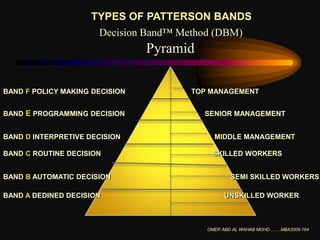
OMER ABD AL WAHAB MOHD.........MBA2009-164Job EvaluationThe Decision Bands :The Patterson Plan is based on six decision Bands:Band F policy MakingBand E programmingBand D InterpretiveBand C Band  RoutineBand B AutomaticBand A Defined13
TYPES OF PATTERSON BANDSDecision Band™ Method (DBM)PyramidBAND F POLICY MAKING DECISION                                 TOP MANAGEMENTBAND E PROGRAMMING DECISION                                        SENIOR MANAGEMENTBAND D INTERPRETIVE DECISION                                               MIDDLE MANAGEMENTBAND C ROUTINE DECISION                                                        SKILLED WORKERSBAND B AUTOMATIC DECISION                                                            SEMI SKILLED WORKERSBAND A DEDINED DECISION                                                              UNSKILLED WORKER14OMER ABD AL WAHAB MOHD.........MBA2009-16414
Job EvaluationThese are decisions that determine the scope, the direction, and the overall goals of the whole organization. Band F decisions are the kind typically made by a Board, Council, or CEO. BAND F-Policy Making DecisionOMER ABD AL WAHAB MOHD.........MBA2009-16415
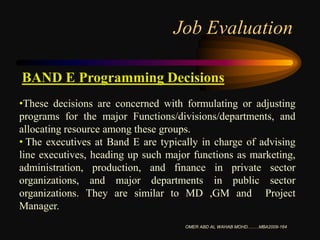
Job EvaluationBAND E Programming DecisionsThese decisions are concerned with formulating or adjusting programs for the major Functions/divisions/departments, and allocating resource among these groups.

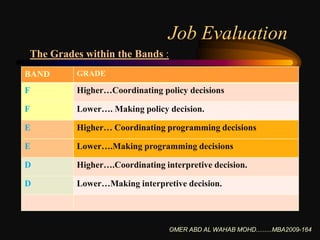
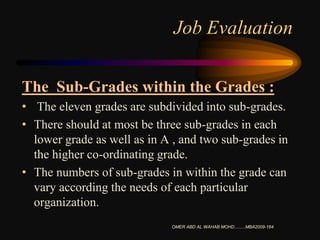
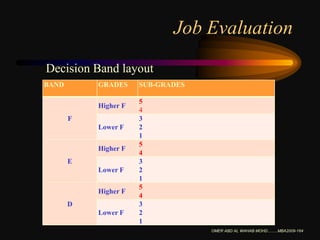
Paterson Grades

  • 1.
    University of MedicalSciences and TechnologyFaculty of Administrative and Financial Sciences MBA Program, Bach3 HRJob EvaluationPractical case study onPaterson PlanDecision Band™ Method (DBM)ByOmar Abd Al Wahab Mohd 1Omer A.Wahab Mohammad MBA2009 -164
  • 2.
    Job EvaluationWhat isJob Evaluation“Systematic process for comparing different jobs systematically to assess their relative worth (value), so providing a basis for a gradingand reward structure on fair and sound judgements”.Technique for comparingand evaluating JOBS rather than employees.
  • 3.
    It is aboutthe internal Relativity of jobs.2OMER ABD AL WAHAB MOHD.........MBA2009-164
  • 4.
    Job EvaluationAims andobjectives of Job Evaluation(1): Establishes fair relative value of jobs based on fair judgement.
  • 5.
    Gives moreinformation to design equitable and sound pay and grade structure.
  • 6.
    Enables soundmarket comparison.OMER ABD AL WAHAB MOHD.........MBA2009-1643
  • 7.
    Job EvaluationAims andobjectives of Job Evaluation(2): Provides transparency.
  • 8.
    Reduces industrialdisputes and legal claims.
  • 9.
    build righttrack for career path and succession planning.
  • 10.
    Boosts the emotional ties between the job and the holder.4OMER ABD AL WAHAB MOHD.........MBA2009-164
  • 11.
    Job EvaluationAims andobjectives of Job Evaluation(3): Increases retention and decreases turnover.
  • 12.
    Build-up faithfuland loyal calibres.
  • 13.
    provides fairpay regardless to any discriminating factors.
  • 14.
    Reflects positiveexternal image that increases attraction.5OMER ABD AL WAHAB MOHD.........MBA2009-164
  • 15.
    Job EvaluationMethods ofJob Evaluation:Analytical (e.g. points rating , factor comparison, Patterson ,HAY) analysing the level at which various defined factors or elements are presented in a job. Non-analytical (e.g. ranking, grading, paired comparison and classification) Comparing the whole jobs to place them in grades . They are not analysed by reference to their element factors. 6OMER ABD AL WAHAB MOHD.........MBA2009-164
  • 16.
    Facts about JobEvaluations.In Uk and according to e-reward survey 2003, 44% of the surveyed companies had introduced Job Evaluation.While 45% of those who did not have a scheme intended to introduce one.Source : Michael Armstrong (2007) A hand book of Human resources Management PP 666In Sudan it was introduced in the Civil Service in 1975. kenana is pioneering company in Job Evaluation. What is about others…. Any comments.7OMER ABD AL WAHAB MOHD.........MBA2009-164Job Evaluation
  • 17.
    Job EvaluationProcedural stepsof introducing Job Evaluation(1)Top Managementapprovaland commitment.
  • 18.
  • 19.
  • 20.
    Getting the reputableconsultancies Firm.
  • 21.
    Selecting the JobEvaluation method.
  • 22.
  • 23.
    Job description.OMER ABDAL WAHAB MOHD.........MBA2009-1648
  • 24.
    Job EvaluationProcedural stepsof introducing Job Evaluation(2) Convene the grading committee.
  • 25.
    Result acceptance fromthe senior Management.
  • 26.
  • 27.
  • 28.
  • 29.
    Updating & revising.9OMERABD AL WAHAB MOHD.........MBA2009-164
  • 30.
    Job EvaluationPaterson Plan Decision Band™ Method (DBM)It is based on analytical method of Job Evaluation.
  • 31.
    It wasdeveloped over 30 years ago by professor Paterson when he was in the school of Business at the University of Strathclyde in Scotland while he was studying the relationship between work and pay.
  • 32.
    The method iscalled the Patterson Plan or the Decision Bands Method (DBM).10OMER ABD AL WAHAB MOHD.........MBA2009-164
  • 33.
    Job EvaluationThe MethodWide Spread:The method was recently developed and refined by Fox Lawson’s compensation consultants.
  • 34.
    The method isused world wide in both the private and the public sectors organizations e.g.. South Africa , kenana Sugar Company , State of North Carolina USA and provides good results.11OMER ABD AL WAHAB MOHD.........MBA2009-164
  • 35.
    The Basic Conceptsof the Method:The basic premise of the method is that , the value of any job is depend on the level of its responsibility.
  • 36.
    Responsibility is reflectedand measured by the Decision making requirements of the job.
  • 37.
    Accordingly , decisionmaking is a logical and equitable basis on which to compare jobs within an organization. OMER ABD AL WAHAB MOHD.........MBA2009-16412Job Evaluation
  • 38.
    OMER ABD ALWAHAB MOHD.........MBA2009-164Job EvaluationThe Decision Bands :The Patterson Plan is based on six decision Bands:Band F policy MakingBand E programmingBand D InterpretiveBand C Band RoutineBand B AutomaticBand A Defined13
  • 39.
    TYPES OF PATTERSONBANDSDecision Band™ Method (DBM)PyramidBAND F POLICY MAKING DECISION TOP MANAGEMENTBAND E PROGRAMMING DECISION SENIOR MANAGEMENTBAND D INTERPRETIVE DECISION MIDDLE MANAGEMENTBAND C ROUTINE DECISION SKILLED WORKERSBAND B AUTOMATIC DECISION SEMI SKILLED WORKERSBAND A DEDINED DECISION UNSKILLED WORKER14OMER ABD AL WAHAB MOHD.........MBA2009-16414
  • 40.
    Job EvaluationThese aredecisions that determine the scope, the direction, and the overall goals of the whole organization. Band F decisions are the kind typically made by a Board, Council, or CEO. BAND F-Policy Making DecisionOMER ABD AL WAHAB MOHD.........MBA2009-16415
  • 41.
    Job EvaluationBAND EProgramming DecisionsThese decisions are concerned with formulating or adjusting programs for the major Functions/divisions/departments, and allocating resource among these groups.