Copyright © 2014 Pearson Canada Inc. 6 - 1
Personality and Lifestyles
Chapter 6
Copyright © 2014 Pearson Canada Inc. 6 - 2
Personality
• Personality: Person’s unique psychological makeup
and how it consistently influences the way a person
responds to his/her environment
Copyright © 2014 Pearson Canada Inc. 6 - 3
Freudian Systems
Personality = conflict between gratification and
responsibility
• Id: pleasure principle (the party animal)
• Superego: our conscience (the conscience)
• Ego: mediates between id and superego (the referee)
Copyright © 2014 Pearson Canada Inc. 6 - 4
Freudian Theory
Marketing Implications
• Unconscious motives underlying purchases
• Symbolism in products to compromise id and
superego
• Sports car as sexual gratification for men
• Phallic symbols, such as cigars
Copyright © 2014 Pearson Canada Inc. 6 - 5
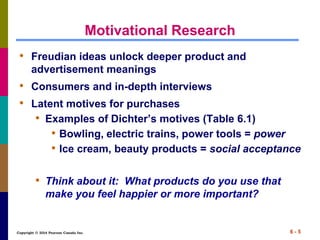
Motivational Research
• Freudian ideas unlock deeper product and
advertisement meanings
• Consumers and in-depth interviews
• Latent motives for purchases
• Examples of Dichter’s motives (Table 6.1)
• Bowling, electric trains, power tools = power
• Ice cream, beauty products = social acceptance
• Think about it: What products do you use that
make you feel happier or more important?
Copyright © 2014 Pearson Canada Inc. 6 - 6
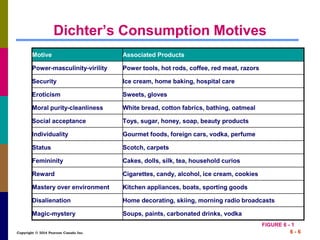
Dichter’s Consumption Motives
Motive Associated ProductsMotive Associated Products
Power-masculinity-virility Power tools, hot rods, coffee, red meat, razors
Security Ice cream, home baking, hospital care
Eroticism Sweets, gloves
Moral purity-cleanliness White bread, cotton fabrics, bathing, oatmeal
Social acceptance Toys, sugar, honey, soap, beauty products
Individuality Gourmet foods, foreign cars, vodka, perfume
Status Scotch, carpets
Femininity Cakes, dolls, silk, tea, household curios
Reward Cigarettes, candy, alcohol, ice cream, cookies
Mastery over environment Kitchen appliances, boats, sporting goods
Disalienation Home decorating, skiing, morning radio broadcasts
Magic-mystery Soups, paints, carbonated drinks, vodka
FIGURE 6 - 1
Copyright © 2014 Pearson Canada Inc. 6 - 7
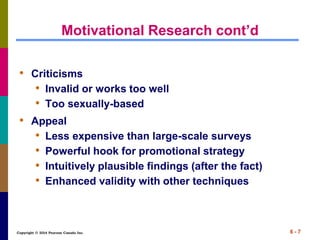
Motivational Research cont’d
• Criticisms
• Invalid or works too well
• Too sexually-based
• Appeal
• Less expensive than large-scale surveys
• Powerful hook for promotional strategy
• Intuitively plausible findings (after the fact)
• Enhanced validity with other techniques
Copyright © 2014 Pearson Canada Inc. 6 - 8
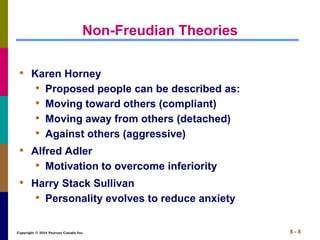
Non-Freudian Theories
• Karen Horney
• Proposed people can be described as:
• Moving toward others (compliant)
• Moving away from others (detached)
• Against others (aggressive)
• Alfred Adler
• Motivation to overcome inferiority
• Harry Stack Sullivan
• Personality evolves to reduce anxiety
Copyright © 2014 Pearson Canada Inc. 6 - 9
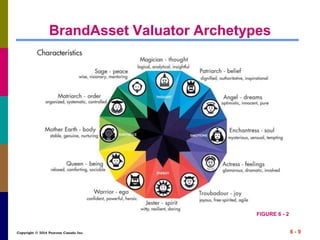
BrandAsset Valuator Archetypes
FIGURE 6 - 2
Copyright © 2014 Pearson Canada Inc. 6 - 10
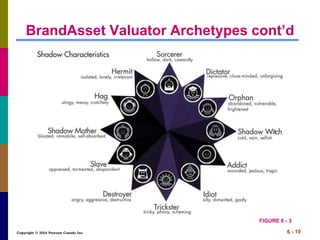
BrandAsset Valuator Archetypes cont’d
FIGURE 6 - 3
Copyright © 2014 Pearson Canada Inc. 6 - 11
Non-Freudian Theories cont’d
• Carl Jung: Analytical psychology
• Collective unconscious
• Archetypes in advertising (shared ideas and
behaviour)
• Images: Old wise man; earth mother
• BrandAsset Valuator® : measuring brand
personality
Copyright © 2014 Pearson Canada Inc. 6 - 12
Trait Theory
• Personality traits: Identifiable characteristics that
define a person
• Traits relevant to consumer behaviour:
• Innovativeness
• Public self-consciousness
• Need for cognition
• Need for uniqueness
Copyright © 2014 Pearson Canada Inc. 6 - 13
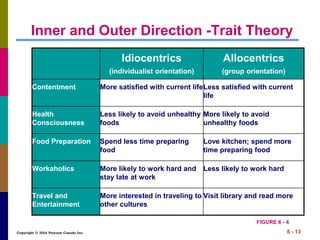
Inner and Outer Direction -Trait Theory
Idiocentrics
(individualist orientation)
Allocentrics
(group orientation)
Contentment More satisfied with current lifeLess satisfied with current
life
Health
Consciousness
Less likely to avoid unhealthy
foods
More likely to avoid
unhealthy foods
Food Preparation Spend less time preparing
food
Love kitchen; spend more
time preparing food
Workaholics More likely to work hard and
stay late at work
Less likely to work hard
Travel and
Entertainment
More interested in traveling to
other cultures
Visit library and read more
FIGURE 6 - 4
Copyright © 2014 Pearson Canada Inc. 6 - 14
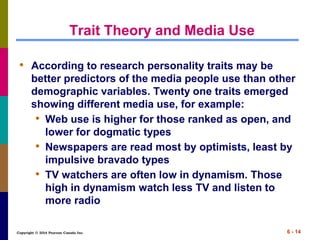
Trait Theory and Media Use
• According to research personality traits may be
better predictors of the media people use than other
demographic variables. Twenty one traits emerged
showing different media use, for example:
• Web use is higher for those ranked as open, and
lower for dogmatic types
• Newspapers are read most by optimists, least by
impulsive bravado types
• TV watchers are often low in dynamism. Those
high in dynamism watch less TV and listen to
more radio
Copyright © 2014 Pearson Canada Inc. 6 - 15
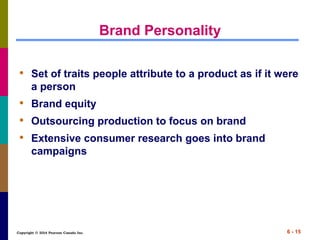
Brand Personality
• Set of traits people attribute to a product as if it were
a person
• Brand equity
• Outsourcing production to focus on brand
• Extensive consumer research goes into brand
campaigns
Copyright © 2014 Pearson Canada Inc. 6 - 16
Brand Behaviours and
Personality Trait Inferences
Brand Action Trait Inference
Brand is repositioned several times or changes
slogan repeatedly
Flighty, schizophrenic
Brand uses continuing character in advertising Familiar, comfortable
Brand charges high prices and uses exclusive
distribution
Snobbish, sophisticated
Brand frequently available on deal Cheap, uncultured
Brand offers many line extensions Versatile, adaptable
Copyright © 2014 Pearson Canada Inc. 6 - 17
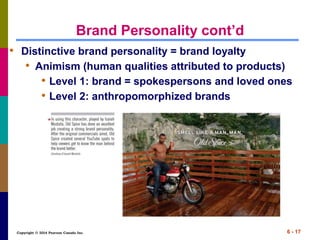
Brand Personality cont’d
• Distinctive brand personality = brand loyalty
• Animism (human qualities attributed to products)
• Level 1: brand = spokespersons and loved ones
• Level 2: anthropomorphized brands
Copyright © 2014 Pearson Canada Inc. 6 - 18
Personality of Positioning
• Brand personality is a statement of brand
positioning
• Some brands re-position to gain new interest in their
products
• Think about it: Do you respond to re-positioned
products as if they were new?
Copyright © 2014 Pearson Canada Inc. 6 - 19
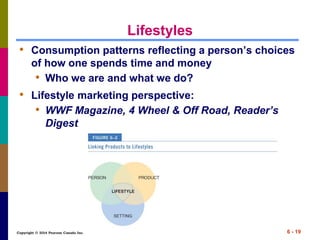
Lifestyles
• Consumption patterns reflecting a person’s choices
of how one spends time and money
• Who we are and what we do?
• Lifestyle marketing perspective:
• WWF Magazine, 4 Wheel & Off Road, Reader’s
Digest
Copyright © 2014 Pearson Canada Inc. 6 - 20
Lifestyles as Group Identities
• Forms of expressive symbolism
• Self-definition of group members = common symbol
system
• Terms include lifestyle, taste public, consumer
group, symbolic community, status culture
• Each person provides a unique “twist” to be an
“individual”
• Tastes/preferences evolve over time
Copyright © 2014 Pearson Canada Inc. 6 - 21
Building Blocks of Lifestyles
• Product usage in desirable social settings
• Consumption style
• Patterns of behaviour:
• Co-branding strategies: Brands team up with
other companies to promote products
• Product complements: Symbolic meanings of
different products relate to one another
• Consumption constellations: Define,
communicate, and perform social roles
Copyright © 2014 Pearson Canada Inc. 6 - 22
Psychographics
• Use of psychological, sociological, and
anthropological factors to:
• Determine market segments
• Determine their reasons for choosing products
• Fine-tune offerings to meet needs of different
segments
• Consumers can share the same demographics and
still be very different!
Copyright © 2014 Pearson Canada Inc. 6 - 23
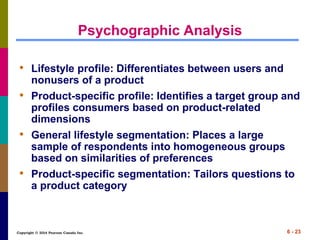
Psychographic Analysis
• Lifestyle profile: Differentiates between users and
nonusers of a product
• Product-specific profile: Identifies a target group and
profiles consumers based on product-related
dimensions
• General lifestyle segmentation: Places a large
sample of respondents into homogeneous groups
based on similarities of preferences
• Product-specific segmentation: Tailors questions to
a product category
Copyright © 2014 Pearson Canada Inc. 6 - 24
AIO
• Grouping consumers according to:
• Activities
• Interests
• Opinions
• Identifying heavy, moderate, and light users
• Targeting heavy users and the benefits they
derive from product
Copyright © 2014 Pearson Canada Inc. 6 - 25
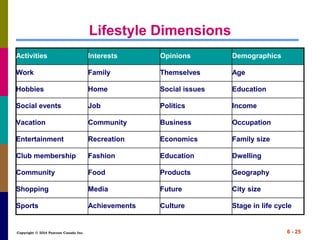
Lifestyle Dimensions
Activities Interests Opinions Demographics
Work Family Themselves Age
Hobbies Home Social issues Education
Social events Job Politics Income
Vacation Community Business Occupation
Entertainment Recreation Economics Family size
Club membership Fashion Education Dwelling
Community Food Products Geography
Shopping Media Future City size
Sports Achievements Culture Stage in life cycle
Copyright © 2014 Pearson Canada Inc. 6 - 26
Psychographic Segmentation Uses
• To define target market
• To create new view of market
• To position product
• To better communicate product attributes
• To develop overall strategy
• To market social/political issues
Copyright © 2014 Pearson Canada Inc. 6 - 27
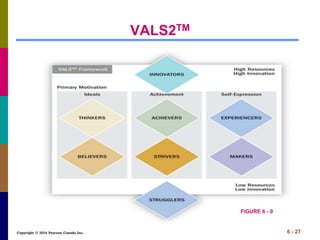
VALS2TM
FIGURE 6 - 9
Copyright © 2014 Pearson Canada Inc. 6 - 28
Geodemography
• Consumer expenditures/socioeconomic factors +
geographic information
• “Birds of a feature flock together”
• Can be reached more economically (by city and
postal code)
• Think about it: Are you just like all of the people
who live in your neighbourhood?
Copyright © 2014 Pearson Canada Inc. 6 - 29
Values
• A value is a belief that some condition is preferable
to its opposite
• Values are central to what makes a consumer
distinct in their consumption and in society
• Two people can believe in the same behaviour
(e.g., vegetarianism), but their underlying belief
systems may be quite different (e.g., animal
activism versus health concerns).
Copyright © 2014 Pearson Canada Inc. 6 - 30
Core Values
Every culture has a set of values that it imparts to its
members.
• Many values vary by country and culture and
change over time
• Core values define a culture and are taught to us
by socialization agents (parents, friends,
teachers) through enculturation
• Differences in values explain why marketing
campaigns may be a hit in one country and flop in
another
Some Values are universal – health, wisdom etc
Copyright © 2014 Pearson Canada Inc. 6 - 31
Classifying Values
• Rokeach Value Survey
• terminal values/desired end states –applicable to
various cultures
• List of Values (LOV) Scale
• Developed specifically for marketing use
• Nine consumer segments that endorse values
such as sense of belonging, and security
Copyright © 2014 Pearson Canada Inc.
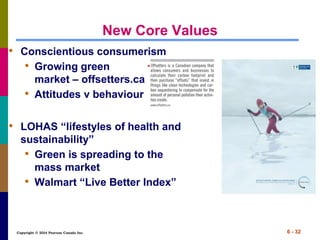
New Core Values
• Conscientious consumerism
• Growing green
market – offsetters.ca
• Attitudes v behaviour
• LOHAS “lifestyles of health and
sustainability”
• Green is spreading to the
mass market
• Walmart “Live Better Index”
6 - 32
Copyright © 2014 Pearson Canada Inc. 6 - 33
Materialism
• Materialism refers to the importance people attach to
worldly possessions - “He who dies with most toys,
wins”
• Modern Living – expectation of “the good life” a
world of material comforts, like cell phones, ipads
etc.
• Materialism = unhappiness?
• Materialistic tendencies = dislike of school, poor
grades

Personality and Lifestyles

  • 1.
    Copyright © 2014Pearson Canada Inc. 6 - 1 Personality and Lifestyles Chapter 6
  • 2.
    Copyright © 2014Pearson Canada Inc. 6 - 2 Personality • Personality: Person’s unique psychological makeup and how it consistently influences the way a person responds to his/her environment
  • 3.
    Copyright © 2014Pearson Canada Inc. 6 - 3 Freudian Systems Personality = conflict between gratification and responsibility • Id: pleasure principle (the party animal) • Superego: our conscience (the conscience) • Ego: mediates between id and superego (the referee)
  • 4.
    Copyright © 2014Pearson Canada Inc. 6 - 4 Freudian Theory Marketing Implications • Unconscious motives underlying purchases • Symbolism in products to compromise id and superego • Sports car as sexual gratification for men • Phallic symbols, such as cigars
  • 5.
    Copyright © 2014Pearson Canada Inc. 6 - 5 Motivational Research • Freudian ideas unlock deeper product and advertisement meanings • Consumers and in-depth interviews • Latent motives for purchases • Examples of Dichter’s motives (Table 6.1) • Bowling, electric trains, power tools = power • Ice cream, beauty products = social acceptance • Think about it: What products do you use that make you feel happier or more important?
  • 6.
    Copyright © 2014Pearson Canada Inc. 6 - 6 Dichter’s Consumption Motives Motive Associated ProductsMotive Associated Products Power-masculinity-virility Power tools, hot rods, coffee, red meat, razors Security Ice cream, home baking, hospital care Eroticism Sweets, gloves Moral purity-cleanliness White bread, cotton fabrics, bathing, oatmeal Social acceptance Toys, sugar, honey, soap, beauty products Individuality Gourmet foods, foreign cars, vodka, perfume Status Scotch, carpets Femininity Cakes, dolls, silk, tea, household curios Reward Cigarettes, candy, alcohol, ice cream, cookies Mastery over environment Kitchen appliances, boats, sporting goods Disalienation Home decorating, skiing, morning radio broadcasts Magic-mystery Soups, paints, carbonated drinks, vodka FIGURE 6 - 1
  • 7.
    Copyright © 2014Pearson Canada Inc. 6 - 7 Motivational Research cont’d • Criticisms • Invalid or works too well • Too sexually-based • Appeal • Less expensive than large-scale surveys • Powerful hook for promotional strategy • Intuitively plausible findings (after the fact) • Enhanced validity with other techniques
  • 8.
    Copyright © 2014Pearson Canada Inc. 6 - 8 Non-Freudian Theories • Karen Horney • Proposed people can be described as: • Moving toward others (compliant) • Moving away from others (detached) • Against others (aggressive) • Alfred Adler • Motivation to overcome inferiority • Harry Stack Sullivan • Personality evolves to reduce anxiety
  • 9.
    Copyright © 2014Pearson Canada Inc. 6 - 9 BrandAsset Valuator Archetypes FIGURE 6 - 2
  • 10.
    Copyright © 2014Pearson Canada Inc. 6 - 10 BrandAsset Valuator Archetypes cont’d FIGURE 6 - 3
  • 11.
    Copyright © 2014Pearson Canada Inc. 6 - 11 Non-Freudian Theories cont’d • Carl Jung: Analytical psychology • Collective unconscious • Archetypes in advertising (shared ideas and behaviour) • Images: Old wise man; earth mother • BrandAsset Valuator® : measuring brand personality
  • 12.
    Copyright © 2014Pearson Canada Inc. 6 - 12 Trait Theory • Personality traits: Identifiable characteristics that define a person • Traits relevant to consumer behaviour: • Innovativeness • Public self-consciousness • Need for cognition • Need for uniqueness
  • 13.
    Copyright © 2014Pearson Canada Inc. 6 - 13 Inner and Outer Direction -Trait Theory Idiocentrics (individualist orientation) Allocentrics (group orientation) Contentment More satisfied with current lifeLess satisfied with current life Health Consciousness Less likely to avoid unhealthy foods More likely to avoid unhealthy foods Food Preparation Spend less time preparing food Love kitchen; spend more time preparing food Workaholics More likely to work hard and stay late at work Less likely to work hard Travel and Entertainment More interested in traveling to other cultures Visit library and read more FIGURE 6 - 4
  • 14.
    Copyright © 2014Pearson Canada Inc. 6 - 14 Trait Theory and Media Use • According to research personality traits may be better predictors of the media people use than other demographic variables. Twenty one traits emerged showing different media use, for example: • Web use is higher for those ranked as open, and lower for dogmatic types • Newspapers are read most by optimists, least by impulsive bravado types • TV watchers are often low in dynamism. Those high in dynamism watch less TV and listen to more radio
  • 15.
    Copyright © 2014Pearson Canada Inc. 6 - 15 Brand Personality • Set of traits people attribute to a product as if it were a person • Brand equity • Outsourcing production to focus on brand • Extensive consumer research goes into brand campaigns
  • 16.
    Copyright © 2014Pearson Canada Inc. 6 - 16 Brand Behaviours and Personality Trait Inferences Brand Action Trait Inference Brand is repositioned several times or changes slogan repeatedly Flighty, schizophrenic Brand uses continuing character in advertising Familiar, comfortable Brand charges high prices and uses exclusive distribution Snobbish, sophisticated Brand frequently available on deal Cheap, uncultured Brand offers many line extensions Versatile, adaptable
  • 17.
    Copyright © 2014Pearson Canada Inc. 6 - 17 Brand Personality cont’d • Distinctive brand personality = brand loyalty • Animism (human qualities attributed to products) • Level 1: brand = spokespersons and loved ones • Level 2: anthropomorphized brands
  • 18.
    Copyright © 2014Pearson Canada Inc. 6 - 18 Personality of Positioning • Brand personality is a statement of brand positioning • Some brands re-position to gain new interest in their products • Think about it: Do you respond to re-positioned products as if they were new?
  • 19.
    Copyright © 2014Pearson Canada Inc. 6 - 19 Lifestyles • Consumption patterns reflecting a person’s choices of how one spends time and money • Who we are and what we do? • Lifestyle marketing perspective: • WWF Magazine, 4 Wheel & Off Road, Reader’s Digest
  • 20.
    Copyright © 2014Pearson Canada Inc. 6 - 20 Lifestyles as Group Identities • Forms of expressive symbolism • Self-definition of group members = common symbol system • Terms include lifestyle, taste public, consumer group, symbolic community, status culture • Each person provides a unique “twist” to be an “individual” • Tastes/preferences evolve over time
  • 21.
    Copyright © 2014Pearson Canada Inc. 6 - 21 Building Blocks of Lifestyles • Product usage in desirable social settings • Consumption style • Patterns of behaviour: • Co-branding strategies: Brands team up with other companies to promote products • Product complements: Symbolic meanings of different products relate to one another • Consumption constellations: Define, communicate, and perform social roles
  • 22.
    Copyright © 2014Pearson Canada Inc. 6 - 22 Psychographics • Use of psychological, sociological, and anthropological factors to: • Determine market segments • Determine their reasons for choosing products • Fine-tune offerings to meet needs of different segments • Consumers can share the same demographics and still be very different!
  • 23.
    Copyright © 2014Pearson Canada Inc. 6 - 23 Psychographic Analysis • Lifestyle profile: Differentiates between users and nonusers of a product • Product-specific profile: Identifies a target group and profiles consumers based on product-related dimensions • General lifestyle segmentation: Places a large sample of respondents into homogeneous groups based on similarities of preferences • Product-specific segmentation: Tailors questions to a product category
  • 24.
    Copyright © 2014Pearson Canada Inc. 6 - 24 AIO • Grouping consumers according to: • Activities • Interests • Opinions • Identifying heavy, moderate, and light users • Targeting heavy users and the benefits they derive from product
  • 25.
    Copyright © 2014Pearson Canada Inc. 6 - 25 Lifestyle Dimensions Activities Interests Opinions Demographics Work Family Themselves Age Hobbies Home Social issues Education Social events Job Politics Income Vacation Community Business Occupation Entertainment Recreation Economics Family size Club membership Fashion Education Dwelling Community Food Products Geography Shopping Media Future City size Sports Achievements Culture Stage in life cycle
  • 26.
    Copyright © 2014Pearson Canada Inc. 6 - 26 Psychographic Segmentation Uses • To define target market • To create new view of market • To position product • To better communicate product attributes • To develop overall strategy • To market social/political issues
  • 27.
    Copyright © 2014Pearson Canada Inc. 6 - 27 VALS2TM FIGURE 6 - 9
  • 28.
    Copyright © 2014Pearson Canada Inc. 6 - 28 Geodemography • Consumer expenditures/socioeconomic factors + geographic information • “Birds of a feature flock together” • Can be reached more economically (by city and postal code) • Think about it: Are you just like all of the people who live in your neighbourhood?
  • 29.
    Copyright © 2014Pearson Canada Inc. 6 - 29 Values • A value is a belief that some condition is preferable to its opposite • Values are central to what makes a consumer distinct in their consumption and in society • Two people can believe in the same behaviour (e.g., vegetarianism), but their underlying belief systems may be quite different (e.g., animal activism versus health concerns).
  • 30.
    Copyright © 2014Pearson Canada Inc. 6 - 30 Core Values Every culture has a set of values that it imparts to its members. • Many values vary by country and culture and change over time • Core values define a culture and are taught to us by socialization agents (parents, friends, teachers) through enculturation • Differences in values explain why marketing campaigns may be a hit in one country and flop in another Some Values are universal – health, wisdom etc
  • 31.
    Copyright © 2014Pearson Canada Inc. 6 - 31 Classifying Values • Rokeach Value Survey • terminal values/desired end states –applicable to various cultures • List of Values (LOV) Scale • Developed specifically for marketing use • Nine consumer segments that endorse values such as sense of belonging, and security
  • 32.
    Copyright © 2014Pearson Canada Inc. New Core Values • Conscientious consumerism • Growing green market – offsetters.ca • Attitudes v behaviour • LOHAS “lifestyles of health and sustainability” • Green is spreading to the mass market • Walmart “Live Better Index” 6 - 32
  • 33.
    Copyright © 2014Pearson Canada Inc. 6 - 33 Materialism • Materialism refers to the importance people attach to worldly possessions - “He who dies with most toys, wins” • Modern Living – expectation of “the good life” a world of material comforts, like cell phones, ipads etc. • Materialism = unhappiness? • Materialistic tendencies = dislike of school, poor grades