Copyright © 2006
Pearson Education Canada Inc.
Chapter 3
Motivation and Involvement
Consumer Behaviour
Canadian Edition
Schiffman/Kanuk/Das
3-2
Copyright © 2006 Pearson Education Canada Inc.
Opening Vignette
 Why do people go to boutique hotels?
 Personalized service
 Unique experience
 Also satisfies consumer’s ego needs
 ‘as unique as I am’
3-3
Copyright © 2006 Pearson Education Canada Inc.
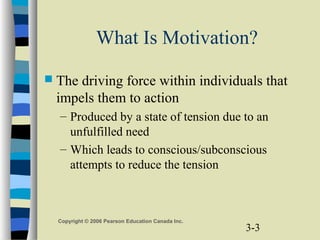
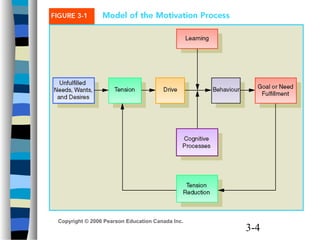
What Is Motivation?
 The driving force within individuals that
impels them to action
– Produced by a state of tension due to an
unfulfilled need
– Which leads to conscious/subconscious
attempts to reduce the tension
3-4
Copyright © 2006 Pearson Education Canada Inc.
3-5
Copyright © 2006 Pearson Education Canada Inc.
Types of Needs
 Innate Needs
– Physiological (or biogenic) needs that are
considered primary needs or motives
 Acquired needs
– Generally psychological (or psychogenic) needs
that are considered secondary needs or motives
3-6
Copyright © 2006 Pearson Education Canada Inc.
Types of Motives
 Rational Motives
– Goals chosen according to objective criteria
(e.g., price)
 Emotional Motives
– Goals chosen according to personal or
subjective criteria (e.g., desire for social status)
» continued
3-7
Copyright © 2006 Pearson Education Canada Inc.
Types of Motives
 Latent Motives
– Motives that the consumer is unaware of or
unwilling to recognize
– Harder to identify
– Require projective techniques to identify
 Manifest Motives
– Motives that the consumer is aware of and
willing to express
3-8
Copyright © 2006 Pearson Education Canada Inc.
Goals
 Generic Goals
– the general categories of goals that
consumers see as a way to fulfill their needs
– e.g., “I want to get a graduate degree”
 Product-Specific Goals
– the specifically branded products or services
that consumers select as their goals
– e.g., “I want to get an MBA in Marketing
from Kellogg School of Management.”
3-9
Copyright © 2006 Pearson Education Canada Inc.
The Selection of Goals
 The goals selected by an individual depend
on their:
– Personal experiences
– Physical capacity
– Prevailing cultural norms and values
– Goal’s accessibility in the physical and social
environment
3-10
Copyright © 2006 Pearson Education Canada Inc.
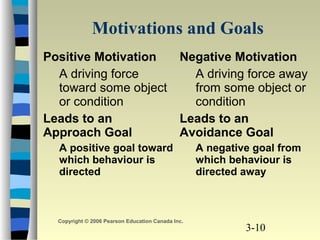
Motivations and Goals
Positive Motivation
A driving force
toward some object
or condition
Leads to an
Approach Goal
A positive goal toward
which behaviour is
directed
Negative Motivation
A driving force away
from some object or
condition
Leads to an
Avoidance Goal
A negative goal from
which behaviour is
directed away
3-11
Copyright © 2006 Pearson Education Canada Inc.
The Dynamic Nature of
Motivation
 Needs are never fully satisfied
 New needs emerge as old needs are
satisfied
 A given need may lead totally different
goals
 Consumers are more aware of their goals
than their needs
» continued
3-12
Copyright © 2006 Pearson Education Canada Inc.
The Dynamic Nature of
Motivation
 Consumer values, personality and self-concept
influence consumer goals
 Consumers have multiple needs
– Pre-potent need
 Motives are difficult to infer from behaviour
 Past experiences (success/failure) influence goals
– Defence Mechanisms
» continued
3-13
Copyright © 2006 Pearson Education Canada Inc.
The Dynamic Nature of
Motivation
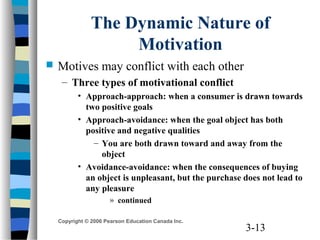
 Motives may conflict with each other
– Three types of motivational conflict
• Approach-approach: when a consumer is drawn towards
two positive goals
• Approach-avoidance: when the goal object has both
positive and negative qualities
– You are both drawn toward and away from the
object
• Avoidance-avoidance: when the consequences of buying
an object is unpleasant, but the purchase does not lead to
any pleasure
» continued
3-14
Copyright © 2006 Pearson Education Canada Inc.
The Dynamic Nature of
Motivation
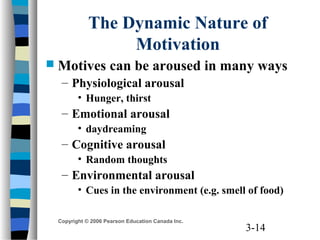
 Motives can be aroused in many ways
– Physiological arousal
• Hunger, thirst
– Emotional arousal
• daydreaming
– Cognitive arousal
• Random thoughts
– Environmental arousal
• Cues in the environment (e.g. smell of food)
3-15
Copyright © 2006 Pearson Education Canada Inc.
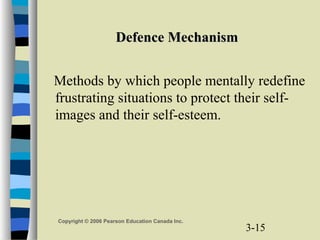
Defence MechanismDefence Mechanism
Methods by which people mentally redefine
frustrating situations to protect their self-
images and their self-esteem.
3-16
Copyright © 2006 Pearson Education Canada Inc.
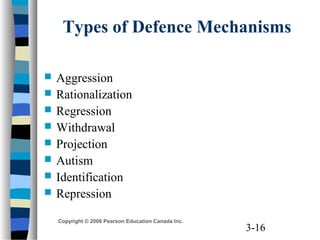
Types of Defence Mechanisms
 Aggression
 Rationalization
 Regression
 Withdrawal
 Projection
 Autism
 Identification
 Repression
3-17
Copyright © 2006 Pearson Education Canada Inc.
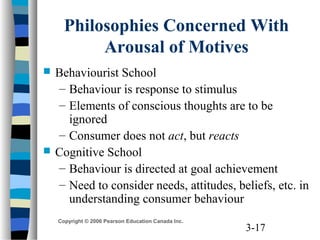
Philosophies Concerned With
Arousal of Motives
 Behaviourist School
– Behaviour is response to stimulus
– Elements of conscious thoughts are to be
ignored
– Consumer does not act, but reacts
 Cognitive School
– Behaviour is directed at goal achievement
– Need to consider needs, attitudes, beliefs, etc. in
understanding consumer behaviour
3-18
Copyright © 2006 Pearson Education Canada Inc.
3-19
Copyright © 2006 Pearson Education Canada Inc.
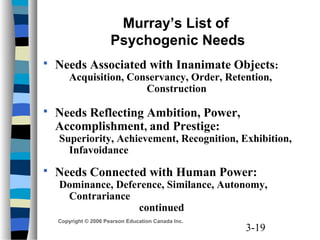
Murray’s List of
Psychogenic Needs
 Needs Associated with Inanimate Objects:
Acquisition, Conservancy, Order, Retention,
Construction
 Needs Reflecting Ambition, Power,
Accomplishment, and Prestige:
Superiority, Achievement, Recognition, Exhibition,
Infavoidance
 Needs Connected with Human Power:
Dominance, Deference, Similance, Autonomy,
Contrariance
continued
3-20
Copyright © 2006 Pearson Education Canada Inc.
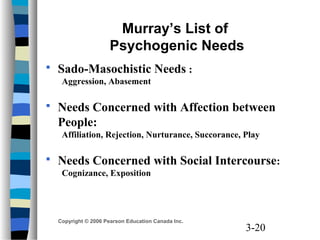
Murray’s List of
Psychogenic Needs
 Sado-Masochistic Needs :
Aggression, Abasement
 Needs Concerned with Affection between
People:
Affiliation, Rejection, Nurturance, Succorance, Play
 Needs Concerned with Social Intercourse:
Cognizance, Exposition
3-21
Copyright © 2006 Pearson Education Canada Inc.
McClelland’s Trio of Needs
 Power
– individual’s desire to control environment
 Affiliation
– need for friendship, acceptance, and belonging
 Achievement
– need for personal accomplishment
– closely related to egoistic and self-
actualization needs
3-22
Copyright © 2006 Pearson Education Canada Inc.
Mid-range Theories of
Motivation
 Psychological Reactance
– Motivational arousal due to threat of
behavioural freedom
 Opponent Process Theory
– Extreme initial reactions may be followed by
extreme opposite reaction
– Priming
• Small amounts of initial stimuli will lead to desire for
more
• extreme amounts of exposure to same stimulus will
lead to withdrawal
» continued
3-23
Copyright © 2006 Pearson Education Canada Inc.
Mid-range theories
 Hedonic Consumption
– Need to gain pleasure through the senses
– Explains attraction to scary rides,
adventure tours, etc
 Optimum Stimulation Level
– Desire to maintain a certain level of
stimulation that the consumer considers to
be optimal
3-24
Copyright © 2006 Pearson Education Canada Inc.
Motivational ResearchMotivational Research
Qualitative research designed to uncover
consumers’ subconscious or hidden
motivations. Consumers are not always
aware of, or may not wish to recognize, the
basic reasons underlying their actions.
3-25
Copyright © 2006 Pearson Education Canada Inc.
Projective Techniques
 Metaphor analysis
 Story telling
 Picture drawing
 Photo sorts
 Thematic Apperception Tests
 Word Association
 Sentence Completion
 Third-person technique
3-26
Copyright © 2006 Pearson Education Canada Inc.
Motivation and Marketing
Strategy
 Identify the needs and goals of the
target market
– Identify both latent and manifest motives
 Use knowledge of needs to segment
the market and to position the product
 Use knowledge of needs to develop
promotional strategies
 Reduce motivational conflict
3-27
Copyright © 2006 Pearson Education Canada Inc.
Consumer Involvement
The level of personal relevance that a
consumer sees in a product
3-28
Copyright © 2006 Pearson Education Canada Inc.
Types of Involvement
 Enduring Involvement
– long-lasting involvement that arises out of
a sense of high personal relevance
 Situational involvement
 Short-term involvement in a product of low
personal relevance
3-29
Copyright © 2006 Pearson Education Canada Inc.
Types of Involvement- Cont’d
 Cognitive Involvement
– Rational level involvement in products that
are considered to be major purchases
 Affective Involvement
– Emotional level involvement in products
3-30
Copyright © 2006 Pearson Education Canada Inc.
Factors Leading to High
Involvement
 Level of perceived risk (social, financial or
physical)
 Level of personal interest in product category
 Probability of making a mistake or buying the
wrong product
 Extent of pleasure in buying and using a
product
 Number and similarity of competitive brands
available
3-31
Copyright © 2006 Pearson Education Canada Inc.
Measures of Involvement
 Brand involvement
 Ego involvement
 Importance of purchase
 Product involvement
 Situational Vs Enduring Vs Response
involvement
 Involvement Profile
3-32
Copyright © 2006 Pearson Education Canada Inc.
Involvement and Marketing
Strategy
 Choose media according to level of
involvement
– Print media for high involvement
– Television for low involvement
 Choose messages according to level of
involvement
 Find ways to raise level of involvement

Schiff cb ce_03

  • 1.
    Copyright © 2006 PearsonEducation Canada Inc. Chapter 3 Motivation and Involvement Consumer Behaviour Canadian Edition Schiffman/Kanuk/Das
  • 2.
    3-2 Copyright © 2006Pearson Education Canada Inc. Opening Vignette  Why do people go to boutique hotels?  Personalized service  Unique experience  Also satisfies consumer’s ego needs  ‘as unique as I am’
  • 3.
    3-3 Copyright © 2006Pearson Education Canada Inc. What Is Motivation?  The driving force within individuals that impels them to action – Produced by a state of tension due to an unfulfilled need – Which leads to conscious/subconscious attempts to reduce the tension
  • 4.
    3-4 Copyright © 2006Pearson Education Canada Inc.
  • 5.
    3-5 Copyright © 2006Pearson Education Canada Inc. Types of Needs  Innate Needs – Physiological (or biogenic) needs that are considered primary needs or motives  Acquired needs – Generally psychological (or psychogenic) needs that are considered secondary needs or motives
  • 6.
    3-6 Copyright © 2006Pearson Education Canada Inc. Types of Motives  Rational Motives – Goals chosen according to objective criteria (e.g., price)  Emotional Motives – Goals chosen according to personal or subjective criteria (e.g., desire for social status) » continued
  • 7.
    3-7 Copyright © 2006Pearson Education Canada Inc. Types of Motives  Latent Motives – Motives that the consumer is unaware of or unwilling to recognize – Harder to identify – Require projective techniques to identify  Manifest Motives – Motives that the consumer is aware of and willing to express
  • 8.
    3-8 Copyright © 2006Pearson Education Canada Inc. Goals  Generic Goals – the general categories of goals that consumers see as a way to fulfill their needs – e.g., “I want to get a graduate degree”  Product-Specific Goals – the specifically branded products or services that consumers select as their goals – e.g., “I want to get an MBA in Marketing from Kellogg School of Management.”
  • 9.
    3-9 Copyright © 2006Pearson Education Canada Inc. The Selection of Goals  The goals selected by an individual depend on their: – Personal experiences – Physical capacity – Prevailing cultural norms and values – Goal’s accessibility in the physical and social environment
  • 10.
    3-10 Copyright © 2006Pearson Education Canada Inc. Motivations and Goals Positive Motivation A driving force toward some object or condition Leads to an Approach Goal A positive goal toward which behaviour is directed Negative Motivation A driving force away from some object or condition Leads to an Avoidance Goal A negative goal from which behaviour is directed away
  • 11.
    3-11 Copyright © 2006Pearson Education Canada Inc. The Dynamic Nature of Motivation  Needs are never fully satisfied  New needs emerge as old needs are satisfied  A given need may lead totally different goals  Consumers are more aware of their goals than their needs » continued
  • 12.
    3-12 Copyright © 2006Pearson Education Canada Inc. The Dynamic Nature of Motivation  Consumer values, personality and self-concept influence consumer goals  Consumers have multiple needs – Pre-potent need  Motives are difficult to infer from behaviour  Past experiences (success/failure) influence goals – Defence Mechanisms » continued
  • 13.
    3-13 Copyright © 2006Pearson Education Canada Inc. The Dynamic Nature of Motivation  Motives may conflict with each other – Three types of motivational conflict • Approach-approach: when a consumer is drawn towards two positive goals • Approach-avoidance: when the goal object has both positive and negative qualities – You are both drawn toward and away from the object • Avoidance-avoidance: when the consequences of buying an object is unpleasant, but the purchase does not lead to any pleasure » continued
  • 14.
    3-14 Copyright © 2006Pearson Education Canada Inc. The Dynamic Nature of Motivation  Motives can be aroused in many ways – Physiological arousal • Hunger, thirst – Emotional arousal • daydreaming – Cognitive arousal • Random thoughts – Environmental arousal • Cues in the environment (e.g. smell of food)
  • 15.
    3-15 Copyright © 2006Pearson Education Canada Inc. Defence MechanismDefence Mechanism Methods by which people mentally redefine frustrating situations to protect their self- images and their self-esteem.
  • 16.
    3-16 Copyright © 2006Pearson Education Canada Inc. Types of Defence Mechanisms  Aggression  Rationalization  Regression  Withdrawal  Projection  Autism  Identification  Repression
  • 17.
    3-17 Copyright © 2006Pearson Education Canada Inc. Philosophies Concerned With Arousal of Motives  Behaviourist School – Behaviour is response to stimulus – Elements of conscious thoughts are to be ignored – Consumer does not act, but reacts  Cognitive School – Behaviour is directed at goal achievement – Need to consider needs, attitudes, beliefs, etc. in understanding consumer behaviour
  • 18.
    3-18 Copyright © 2006Pearson Education Canada Inc.
  • 19.
    3-19 Copyright © 2006Pearson Education Canada Inc. Murray’s List of Psychogenic Needs  Needs Associated with Inanimate Objects: Acquisition, Conservancy, Order, Retention, Construction  Needs Reflecting Ambition, Power, Accomplishment, and Prestige: Superiority, Achievement, Recognition, Exhibition, Infavoidance  Needs Connected with Human Power: Dominance, Deference, Similance, Autonomy, Contrariance continued
  • 20.
    3-20 Copyright © 2006Pearson Education Canada Inc. Murray’s List of Psychogenic Needs  Sado-Masochistic Needs : Aggression, Abasement  Needs Concerned with Affection between People: Affiliation, Rejection, Nurturance, Succorance, Play  Needs Concerned with Social Intercourse: Cognizance, Exposition
  • 21.
    3-21 Copyright © 2006Pearson Education Canada Inc. McClelland’s Trio of Needs  Power – individual’s desire to control environment  Affiliation – need for friendship, acceptance, and belonging  Achievement – need for personal accomplishment – closely related to egoistic and self- actualization needs
  • 22.
    3-22 Copyright © 2006Pearson Education Canada Inc. Mid-range Theories of Motivation  Psychological Reactance – Motivational arousal due to threat of behavioural freedom  Opponent Process Theory – Extreme initial reactions may be followed by extreme opposite reaction – Priming • Small amounts of initial stimuli will lead to desire for more • extreme amounts of exposure to same stimulus will lead to withdrawal » continued
  • 23.
    3-23 Copyright © 2006Pearson Education Canada Inc. Mid-range theories  Hedonic Consumption – Need to gain pleasure through the senses – Explains attraction to scary rides, adventure tours, etc  Optimum Stimulation Level – Desire to maintain a certain level of stimulation that the consumer considers to be optimal
  • 24.
    3-24 Copyright © 2006Pearson Education Canada Inc. Motivational ResearchMotivational Research Qualitative research designed to uncover consumers’ subconscious or hidden motivations. Consumers are not always aware of, or may not wish to recognize, the basic reasons underlying their actions.
  • 25.
    3-25 Copyright © 2006Pearson Education Canada Inc. Projective Techniques  Metaphor analysis  Story telling  Picture drawing  Photo sorts  Thematic Apperception Tests  Word Association  Sentence Completion  Third-person technique
  • 26.
    3-26 Copyright © 2006Pearson Education Canada Inc. Motivation and Marketing Strategy  Identify the needs and goals of the target market – Identify both latent and manifest motives  Use knowledge of needs to segment the market and to position the product  Use knowledge of needs to develop promotional strategies  Reduce motivational conflict
  • 27.
    3-27 Copyright © 2006Pearson Education Canada Inc. Consumer Involvement The level of personal relevance that a consumer sees in a product
  • 28.
    3-28 Copyright © 2006Pearson Education Canada Inc. Types of Involvement  Enduring Involvement – long-lasting involvement that arises out of a sense of high personal relevance  Situational involvement  Short-term involvement in a product of low personal relevance
  • 29.
    3-29 Copyright © 2006Pearson Education Canada Inc. Types of Involvement- Cont’d  Cognitive Involvement – Rational level involvement in products that are considered to be major purchases  Affective Involvement – Emotional level involvement in products
  • 30.
    3-30 Copyright © 2006Pearson Education Canada Inc. Factors Leading to High Involvement  Level of perceived risk (social, financial or physical)  Level of personal interest in product category  Probability of making a mistake or buying the wrong product  Extent of pleasure in buying and using a product  Number and similarity of competitive brands available
  • 31.
    3-31 Copyright © 2006Pearson Education Canada Inc. Measures of Involvement  Brand involvement  Ego involvement  Importance of purchase  Product involvement  Situational Vs Enduring Vs Response involvement  Involvement Profile
  • 32.
    3-32 Copyright © 2006Pearson Education Canada Inc. Involvement and Marketing Strategy  Choose media according to level of involvement – Print media for high involvement – Television for low involvement  Choose messages according to level of involvement  Find ways to raise level of involvement