Copyright © 2014 Pearson Canada Inc. 5 - 1
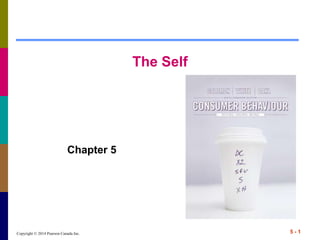
The Self
Chapter 5
Copyright © 2014 Pearson Canada Inc. 5 - 2
Perspectives of Self
• We buy products to highlight/hide aspects of the self
• Eastern and Western cultures see the self as a an
inner private self and the outer public self.
• In the era of Facebook and Twitter everyone is able
to share their thoughts with millions of friends and
strangers
• Each of us is a separate, unique individual
• Think about it: Do you behave differently in a
group than with just a single friend?
Copyright © 2014 Pearson Canada Inc. 5 - 3
Self-Concept
• Self-concept: Beliefs a person holds about his/her
own attributes, and how he/she evaluates these
qualities
• Attribute dimensions: Content, positivity, intensity,
stability over time, and accuracy
Copyright © 2014 Pearson Canada Inc. 5 - 4
Self-Esteem
• Self-esteem: Positivity of a person’s self-concept
• Low self-esteem: Think they will not perform well
• High self-esteem: Think they will be successful
and will take risks
• Ads can trigger social comparison
• Attractive models using products
Copyright © 2014 Pearson Canada Inc. 5 - 5
Real and Ideal Selves
• Ideal self: Conception of how we would like to be
• Actual self: More realistic appraisal of the qualities
we have
• Products can:
• Help us reach ideal self
• Be consistent with actual self
• Think about it: Can a product really make us
satisfied with our real selves?
Copyright © 2014 Pearson Canada Inc. 5 - 6
Real and Ideal Selves cont’d
• We are constantly faced with images of the “ideal”
person in media
• Each of us has more than one self concept - one for
attractiveness, work ethic, friend etc.
• We engage in impression management - strategically
engaging in products and behaviours to impress
Copyright © 2014 Pearson Canada Inc. 5 - 7
Multiple Selves
• Each of us have many selves and roles
• Marketers pitch products to facilitate active role
identity
• Sister
• Friend
• Spokesperson
• Athlete
• Mother
• Wife
• Canadian citizen
Copyright © 2014 Pearson Canada Inc. 5 - 8
Virtual Identity
• People are assuming virtual identities in cyberspace
• Avatars represent visual identity
• How do online “selves” affect consumer behaviour?
Copyright © 2014 Pearson Canada Inc. 5 - 9
Symbolic Interactionism
• Symbolic interactionism: Relationships with others
play a large part in forming the self
• We exist in a symbolic world creating shared
meanings
• “Who am I in this situation?”
• “Who do other people think I am?”
• We pattern our behaviour on the perceived
expectation of others—a self-fulfilling prophecy
Copyright © 2014 Pearson Canada Inc. 5 - 10
Looking Glass Self
• “Taking the role of the other”
• Can vary depending on…
• …Whose perspective we are taking
• …How accurate our predictions are of their
evaluations of us
• Self-fulfilling prophecy
Copyright © 2014 Pearson Canada Inc. 5 - 11
Self-Consciousness
• Can be painfully aware of one-self
• Public self-consciousness
• Self-monitoring
• High vs. low self-monitors
• Think about it: What makes you more self-
conscious… walking into a crowded room or
meeting with someone you don’t know well?
Copyright © 2014 Pearson Canada Inc. 5 - 12
Consumption and Self-Concept
• Identity marketing: Consumers alter aspects of their
selves to advertise a branded product
• Product consumption = definition of self
• Product as extended self
Copyright © 2014 Pearson Canada Inc. 5 - 13
You Are What You Consume
• Social identity as individual consumption behaviours
• Question: Who am I now?
• Answer: To some extent, your possessions!
• Inference of personality based on consumption
patterns
• Consumers may attach themselves to product to
maintain self-concept
• Symbolic self-completion theory: People who have
an incomplete self-definition complete identity by
acquiring and displaying associated symbols.
Copyright © 2014 Pearson Canada Inc. 5 - 14
Self/Product Congruence
• Consumers demonstrate their values through their
purchase behaviour
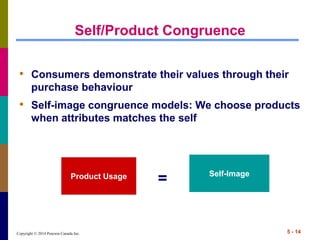
• Self-image congruence models: We choose products
when attributes matches the self
Product Usage Self-Image
=
Copyright © 2014 Pearson Canada Inc. 5 - 15
The Extended Self
•Extended self: External objects considered a part of us
•Levels of extended self:
•Individual: personal possessions (cars, clothing)
•Family: residence and furnishings
•Community: neighbourhood or town where you live
•Group: social or other groups
Copyright © 2014 Pearson Canada Inc. 5 - 16
Gender Differences
• Gender roles vary by culture but are changing
• Many societies still expect traditional roles:
• Agenic roles: Men are expected to be assertive
and have certain skills
• Communal roles: Women are taught to foster
harmonious relationships
Copyright © 2014 Pearson Canada Inc. 5 - 17
Gender versus Sexual Identity
•Sex-typed traits: characteristics we
stereotypically associate with one gender or the
other.
•Sex-types products: masculine or feminine
attributes
•Pink Princess telephones
•Jack Daniels Whisky
Copyright © 2014 Pearson Canada Inc. 5 - 18
Androgyny
• Androgyny: possession of both masculine and
feminine traits
• Androgynous people function well in social
situations
• Sex-typed people: stereotypically masculine or
feminine
• Females more detail oriented
• Men consider overall themes
• Think about it: The “metrosexual” is a big
buzzword in marketing, but is it real or just media
hype?
Copyright © 2014 Pearson Canada Inc. 5 - 19
Gender Benders
• Gender-bending products: Selling a sex-typed item
to the opposite sex
• Rubbermaid introduced grooming tools such as
tweezers and clippers for men
• Harley Davidson backed a world record attempt for
female motorcycle riders
• Sarah Palin and her hunting adventures could catch
on with other women
Copyright © 2014 Pearson Canada Inc. 5 - 20
Body Image
• Body image: Consumer’s subjective evaluation of
his/her physical self
• Body cathexis: person’s feelings about his or her
own body
• Strong body cathexis = frequent purchases of
“preening” products
Copyright © 2014 Pearson Canada Inc. 5 - 21
Ideals of Beauty
• Exemplar of appearance
• “What is beautiful is good” stereotype
• Favourable physical features
• Attractive faces
• Good health and youth
• Balance/symmetry
• Feminine curves/hourglass body shape
Copyright © 2014 Pearson Canada Inc. 5 - 22
Male Ideals of Beauty
• Strongly masculine, muscled body
• Fashion houses are using models who look like
“regular guys”
• Men and women “work on the body” from exercise
to cosmetic surgery
• Think about it: Would you have plastic surgery to
increase your self concept? Why?
Copyright © 2014 Pearson Canada Inc. 5 - 23
The Western Ideal
• Skin color and eye shape = status, sophistication,
and social desirability
• Less powerful cultures adopt standards of beauty in
Waist-Hip Ratio dominant cultures
• Plastic surgery to obtain big round eyes, tiny waists,
large breasts, blond hair, and blue eyes
Copyright © 2014 Pearson Canada Inc. 5 - 24
Waist-Hip Ratio
Copyright © 2014 Pearson Canada Inc.
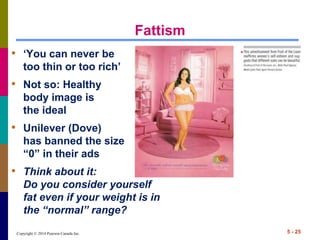
Fattism
• ‘You can never be
too thin or too rich’
• Not so: Healthy
body image is
the ideal
• Unilever (Dove)
has banned the size
“0” in their ads
• Think about it:
Do you consider yourself
fat even if your weight is in
the “normal” range?
5 - 25
Copyright © 2014 Pearson Canada Inc. 5 - 26
Ideals of Beauty Over Time
• Specific “looks”/ideals of beauty
• Early 1800s: delicate/looking ill appearance, 18-
inch waistline (use of corsets)
• 1890s: voluptuous, lusty woman
• Bad economy: mature features vs. good
economy: babyish features
• 1990s: “waif” look
• Modern women: high heels, body waxing, eyelifts,
liposuction
Copyright © 2014 Pearson Canada Inc. 5 - 27
Ideals of Beauty Over Time cont’d
• Media and marketing communicate standards of
beauty
• Plus-sized apparel market
• Strongly masculine, muscled body for men
Copyright © 2014 Pearson Canada Inc. 5 - 28
Body Image Distortions
• To some, body quality reflects self-worth
(particularly among women)
• Distorted body image is linked to eating disorders
among females
• Body dysmorphic disorder (obsession with
perceived flaws in appearance) becoming more
common among young men
• Steroid scandals
Copyright © 2014 Pearson Canada Inc. 5 - 29
Cosmetic Surgery
• Changing a poor body image or to enhance
appearance
• Men account for 20% of surgeries
• Breast Augmentation
• Perception that breast size = sex appeal
Copyright © 2014 Pearson Canada Inc.
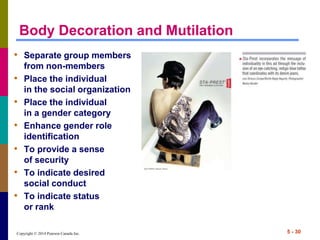
Body Decoration and Mutilation
• Separate group members
from non-members
• Place the individual
in the social organization
• Place the individual
in a gender category
• Enhance gender role
identification
• To provide a sense
of security
• To indicate desired
social conduct
• To indicate status
or rank
5 - 30

The self

  • 1.
    Copyright © 2014Pearson Canada Inc. 5 - 1 The Self Chapter 5
  • 2.
    Copyright © 2014Pearson Canada Inc. 5 - 2 Perspectives of Self • We buy products to highlight/hide aspects of the self • Eastern and Western cultures see the self as a an inner private self and the outer public self. • In the era of Facebook and Twitter everyone is able to share their thoughts with millions of friends and strangers • Each of us is a separate, unique individual • Think about it: Do you behave differently in a group than with just a single friend?
  • 3.
    Copyright © 2014Pearson Canada Inc. 5 - 3 Self-Concept • Self-concept: Beliefs a person holds about his/her own attributes, and how he/she evaluates these qualities • Attribute dimensions: Content, positivity, intensity, stability over time, and accuracy
  • 4.
    Copyright © 2014Pearson Canada Inc. 5 - 4 Self-Esteem • Self-esteem: Positivity of a person’s self-concept • Low self-esteem: Think they will not perform well • High self-esteem: Think they will be successful and will take risks • Ads can trigger social comparison • Attractive models using products
  • 5.
    Copyright © 2014Pearson Canada Inc. 5 - 5 Real and Ideal Selves • Ideal self: Conception of how we would like to be • Actual self: More realistic appraisal of the qualities we have • Products can: • Help us reach ideal self • Be consistent with actual self • Think about it: Can a product really make us satisfied with our real selves?
  • 6.
    Copyright © 2014Pearson Canada Inc. 5 - 6 Real and Ideal Selves cont’d • We are constantly faced with images of the “ideal” person in media • Each of us has more than one self concept - one for attractiveness, work ethic, friend etc. • We engage in impression management - strategically engaging in products and behaviours to impress
  • 7.
    Copyright © 2014Pearson Canada Inc. 5 - 7 Multiple Selves • Each of us have many selves and roles • Marketers pitch products to facilitate active role identity • Sister • Friend • Spokesperson • Athlete • Mother • Wife • Canadian citizen
  • 8.
    Copyright © 2014Pearson Canada Inc. 5 - 8 Virtual Identity • People are assuming virtual identities in cyberspace • Avatars represent visual identity • How do online “selves” affect consumer behaviour?
  • 9.
    Copyright © 2014Pearson Canada Inc. 5 - 9 Symbolic Interactionism • Symbolic interactionism: Relationships with others play a large part in forming the self • We exist in a symbolic world creating shared meanings • “Who am I in this situation?” • “Who do other people think I am?” • We pattern our behaviour on the perceived expectation of others—a self-fulfilling prophecy
  • 10.
    Copyright © 2014Pearson Canada Inc. 5 - 10 Looking Glass Self • “Taking the role of the other” • Can vary depending on… • …Whose perspective we are taking • …How accurate our predictions are of their evaluations of us • Self-fulfilling prophecy
  • 11.
    Copyright © 2014Pearson Canada Inc. 5 - 11 Self-Consciousness • Can be painfully aware of one-self • Public self-consciousness • Self-monitoring • High vs. low self-monitors • Think about it: What makes you more self- conscious… walking into a crowded room or meeting with someone you don’t know well?
  • 12.
    Copyright © 2014Pearson Canada Inc. 5 - 12 Consumption and Self-Concept • Identity marketing: Consumers alter aspects of their selves to advertise a branded product • Product consumption = definition of self • Product as extended self
  • 13.
    Copyright © 2014Pearson Canada Inc. 5 - 13 You Are What You Consume • Social identity as individual consumption behaviours • Question: Who am I now? • Answer: To some extent, your possessions! • Inference of personality based on consumption patterns • Consumers may attach themselves to product to maintain self-concept • Symbolic self-completion theory: People who have an incomplete self-definition complete identity by acquiring and displaying associated symbols.
  • 14.
    Copyright © 2014Pearson Canada Inc. 5 - 14 Self/Product Congruence • Consumers demonstrate their values through their purchase behaviour • Self-image congruence models: We choose products when attributes matches the self Product Usage Self-Image =
  • 15.
    Copyright © 2014Pearson Canada Inc. 5 - 15 The Extended Self •Extended self: External objects considered a part of us •Levels of extended self: •Individual: personal possessions (cars, clothing) •Family: residence and furnishings •Community: neighbourhood or town where you live •Group: social or other groups
  • 16.
    Copyright © 2014Pearson Canada Inc. 5 - 16 Gender Differences • Gender roles vary by culture but are changing • Many societies still expect traditional roles: • Agenic roles: Men are expected to be assertive and have certain skills • Communal roles: Women are taught to foster harmonious relationships
  • 17.
    Copyright © 2014Pearson Canada Inc. 5 - 17 Gender versus Sexual Identity •Sex-typed traits: characteristics we stereotypically associate with one gender or the other. •Sex-types products: masculine or feminine attributes •Pink Princess telephones •Jack Daniels Whisky
  • 18.
    Copyright © 2014Pearson Canada Inc. 5 - 18 Androgyny • Androgyny: possession of both masculine and feminine traits • Androgynous people function well in social situations • Sex-typed people: stereotypically masculine or feminine • Females more detail oriented • Men consider overall themes • Think about it: The “metrosexual” is a big buzzword in marketing, but is it real or just media hype?
  • 19.
    Copyright © 2014Pearson Canada Inc. 5 - 19 Gender Benders • Gender-bending products: Selling a sex-typed item to the opposite sex • Rubbermaid introduced grooming tools such as tweezers and clippers for men • Harley Davidson backed a world record attempt for female motorcycle riders • Sarah Palin and her hunting adventures could catch on with other women
  • 20.
    Copyright © 2014Pearson Canada Inc. 5 - 20 Body Image • Body image: Consumer’s subjective evaluation of his/her physical self • Body cathexis: person’s feelings about his or her own body • Strong body cathexis = frequent purchases of “preening” products
  • 21.
    Copyright © 2014Pearson Canada Inc. 5 - 21 Ideals of Beauty • Exemplar of appearance • “What is beautiful is good” stereotype • Favourable physical features • Attractive faces • Good health and youth • Balance/symmetry • Feminine curves/hourglass body shape
  • 22.
    Copyright © 2014Pearson Canada Inc. 5 - 22 Male Ideals of Beauty • Strongly masculine, muscled body • Fashion houses are using models who look like “regular guys” • Men and women “work on the body” from exercise to cosmetic surgery • Think about it: Would you have plastic surgery to increase your self concept? Why?
  • 23.
    Copyright © 2014Pearson Canada Inc. 5 - 23 The Western Ideal • Skin color and eye shape = status, sophistication, and social desirability • Less powerful cultures adopt standards of beauty in Waist-Hip Ratio dominant cultures • Plastic surgery to obtain big round eyes, tiny waists, large breasts, blond hair, and blue eyes
  • 24.
    Copyright © 2014Pearson Canada Inc. 5 - 24 Waist-Hip Ratio
  • 25.
    Copyright © 2014Pearson Canada Inc. Fattism • ‘You can never be too thin or too rich’ • Not so: Healthy body image is the ideal • Unilever (Dove) has banned the size “0” in their ads • Think about it: Do you consider yourself fat even if your weight is in the “normal” range? 5 - 25
  • 26.
    Copyright © 2014Pearson Canada Inc. 5 - 26 Ideals of Beauty Over Time • Specific “looks”/ideals of beauty • Early 1800s: delicate/looking ill appearance, 18- inch waistline (use of corsets) • 1890s: voluptuous, lusty woman • Bad economy: mature features vs. good economy: babyish features • 1990s: “waif” look • Modern women: high heels, body waxing, eyelifts, liposuction
  • 27.
    Copyright © 2014Pearson Canada Inc. 5 - 27 Ideals of Beauty Over Time cont’d • Media and marketing communicate standards of beauty • Plus-sized apparel market • Strongly masculine, muscled body for men
  • 28.
    Copyright © 2014Pearson Canada Inc. 5 - 28 Body Image Distortions • To some, body quality reflects self-worth (particularly among women) • Distorted body image is linked to eating disorders among females • Body dysmorphic disorder (obsession with perceived flaws in appearance) becoming more common among young men • Steroid scandals
  • 29.
    Copyright © 2014Pearson Canada Inc. 5 - 29 Cosmetic Surgery • Changing a poor body image or to enhance appearance • Men account for 20% of surgeries • Breast Augmentation • Perception that breast size = sex appeal
  • 30.
    Copyright © 2014Pearson Canada Inc. Body Decoration and Mutilation • Separate group members from non-members • Place the individual in the social organization • Place the individual in a gender category • Enhance gender role identification • To provide a sense of security • To indicate desired social conduct • To indicate status or rank 5 - 30