Selling  and  Salespeople Chapter 1
Important Questions about Selling What is selling? Why should you learn about selling even if you do not plan to be a salesperson? What is the role of personal selling in a firm? What are the different types of sales people? What are the rewards of a selling career?
“ Relationship building is definitely the key to business-to-business selling.” ~Jeffrey P. Lynn
Selling The exchange of products for an agreed sum of money  Part of the process by which organisations persuade customers to purchase their goods and services  Selling is the process of helping someone discover something of value
Sales people Nowadays buying the cheapest is not important to many companies, they prefer to develop relationships to be able to do business on ethical grounds. Sales people play a pivotal role here.  Sales people identify opportunities to create value and organise resources of their company that the company can exploit.
Why Learn About Personal Selling? Time to knock at the door gone The principles of selling are useful to everyone, not just people with the title of salesperson.  Sales means more to give potential solutions to the customers rather than beat the drum of what the company sells Internet and other latest technologies involved in selling and all the possible resources of the company (support people etc)
Why Learn About Personal Selling? Selling is a team activity Rules of Selling are to be followed by all Very much similar to convincing as we do in our daily lives (with the parents, teachers, employers and friends) The term Selling was not taken to be a good one, while now every one tries to engage directly/indirectly business development personnel to flourish. Developing mutually beneficial, long-term  relationships is vital to all of us. People in business use selling principles all the time.
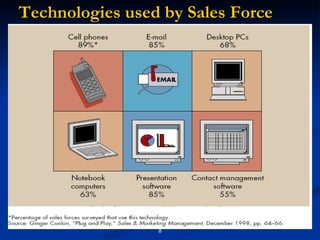
Technologies used by Sales Force
Personal Selling Personal selling  is a person-to-person business activity in which a salesperson uncovers and satisfies the needs of a buyer to the mutual, long-term benefit of both parties. Personal selling is oral communication with potential buyers of a product with the intention of making a sale. The personal selling may focus initially on developing a relationship with the potential buyer, but will always ultimately end with an attempt to "close the sale"
PERSONAL SELLING  Definition Seeking out people who have a particular need. Assisting them to recognize the existence of needs they have that could be met through your offering. Demonstrating how your offering fills that need.  Persuading qualified prospects that your product will fill their needs.
Objectives of Personal Selling Building Product Awareness  Creating Interest  Providing Information  Stimulating Demand  Reinforcing the Brand
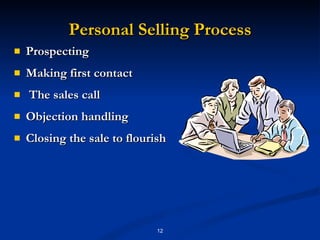
Personal Selling Process Prospecting Making first contact The sales call Objection handling Closing the sale  to flourish
Comparison to other marketing communications tools Use fewer resources Products tend to be fairly complex (e.g. financial services or new cars).  There is some contact between buyer and seller after the sale so that an ongoing relationship is built.  Client/prospects need specific information.  The purchase tends to involve large sums of money.
Advantages of using personal selling  Personal selling is a face-to-face activity; customers therefore obtain a relatively high degree of personal attention The sales message can be customised to meet the needs  of the customer The two-way nature of the sales process allows the sales team to respond directly and promptly to customer questions and concerns P ersonal selling is a good way of getting across large amounts of technical or complex product information The face-to-face sales meeting gives the sales force  chance to demonstrate the product Frequent meetings between sales force and customer provide an opportunity to build good long-term relationships
Main disadvantages of using personal selling The cost of employing a sales force. Sales people are expensive. In addition to the basic pay package, a business needs to provide incentives to achieve sales  A sales person can only call on one customer at a time. This is not a cost-effective way of reaching a large audience.
Selling and Marketing Marketing cycle is completed once the feedback is received and salespeople play an important role in bring the feedback Efforts of the company to provide solutions to the people could be accomplished through sales people only People are informed about the services and products of a company through the sales people only
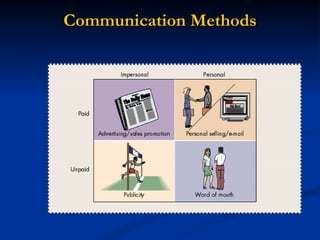
Communication Methods
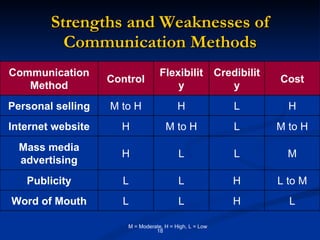
Strengths and Weaknesses of Communication Methods M = Moderate, H = High, L = Low Communication Method Control Flexibility Credibility Cost Personal selling M to H H L H Internet website H M to H L M to H Mass media advertising H L L M Publicity L L H L to M Word of Mouth L L H L
Integrated Marketing Communications Many companies use a combination of various communication techniques to be able to communicate better and balance out the pros and cons of each communication technique
Sales people and Marketing Mix Sales people are eyes and ears of a company in the marketplace Learning organisations acquire information from the sales people about environment  and make organisational decisions based on them
Types of Organisational Learning Adaptive Learning To develop knowledge to do present activities better Generative Learning To go beyond the present products, markets, policies and procedures to develop new insights Sales people contribute to both by providing in critical information to the firm’s strategic system
Main Roles of the Sales Force   Prospecting  Communicating Selling  Servicing   Information gathering  Allocating
Contribution from Sales people Strategy development New product development Pricing Channel management
Qualities of High Sales Performers  Sell to people  Know when to close  Exchange Information  Regularly establish trust  Engage in certain behaviors  Provide value added to the customer  Be perceived as a genuine advocates of prospects’ needs
Salespeople are made not born  They are made with  Concentrated attention  repeated practice goal oriented direction  The skills required to be a successful salesperson can be learned. Become a student of your profession  Learn throughout your career  Innate characteristics such as personality traits, gender, and height are largely unrelated to sales performance. Companies spend billions of dollars each year on training.
THE SALES EDGE - EVERYBODY SELLS  Human relation skills are basic selling skills.  Skills are learned and practiced from birth.  Everyone has a base upon which to build their selling abilities.
Activities of Salespeople Selling Servicing Customer Reporting
Selling Prospecting for new customers Increasing sales to existing customers Making sales presentations Demonstrating products Negotiating prices and delivery terms Writing orders and many more
Servicing Customer To work with employees of other departments to make sure that the customers get full benefit of what they have bought Coordinate during meetings to resolve the problems of the customers
Reporting Time and money spent Future schedules Activities of competitors Business conditions Unsatisfied needs of the customers
What do Salespeople do? Client relationship manager Account team manager Vendor and channel manager Information provider to their firm
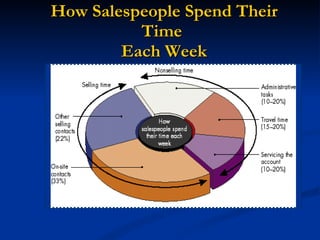
How Salespeople Spend Their Time  Each Week
Types of salespeople Selling products to the customers over the counter Selling products to the customers in the showrooms Selling parts to producers to make the products Selling material to the producers to make parts this chain could be very long…..
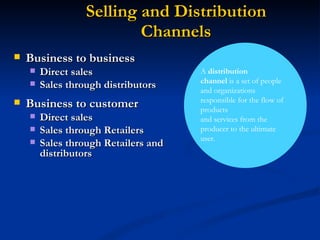
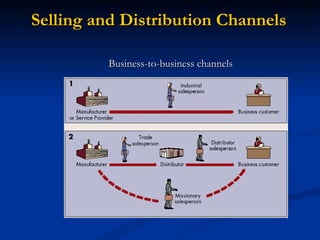
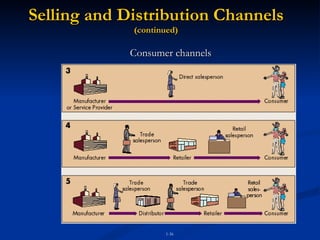
Selling and Distribution Channels A  distribution channel  is a set of people and organizations responsible for the flow of products and services from the producer to the ultimate user. Business to business Direct sales Sales through distributors Business to customer Direct sales Sales through Retailers Sales through Retailers and distributors
Selling and Distribution Channels Business-to-business channels
Selling and Distribution Channels  (continued) Consumer channels 1-
CLASSIFICATION OF SALES JOBS  Trade selling   Missionary selling Technical selling
Trade selling Taking orders and field service.  Largely involves delivering orders and replenishing inventory.  Expected to persuade customers to provide additional shelf space or more favorable placement of stock.  Opportunity to increase sales comes most often through assisting the customer to move a larger volume of inventory.  Often actually set up product displays in retail stores
Missionary selling Educate those who ultimately decide what product will be used by the consumer. Often does not see immediate results from their efforts in the way of products sold.  Still accountable for sales.
Technical selling Salespeople must also be competent in some technical specialty related to the products being sold.  Usually called in by another salesperson who has already contacted the prospect and stimulated some interest.  Often conducted by a sales team.  Still need real sales skills because their role is more than just explaining the technical aspects of the product.
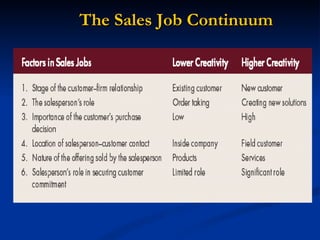
The Sales Job Continuum
 
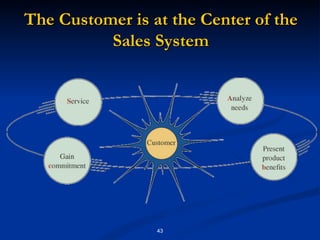
The Customer is at the Center of the Sales System
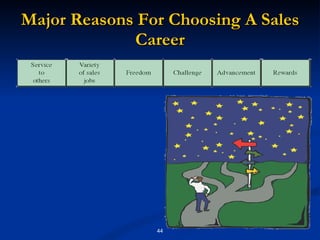
Major Reasons For Choosing A Sales Career
PERSONAL SELLING Definition
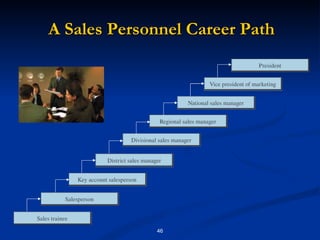
A Sales Personnel Career Path
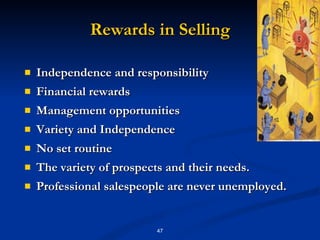
Rewards in Selling Independence and responsibility Financial rewards Management opportunities Variety and Independence  No set routine  The variety of prospects and their needs.  Professional salespeople are never unemployed.
Average Annual Compensation for  Salespeople and Managers Source: 2004 Salary Survey,  Sales & Marketing Management,  May 2004, p. 29.
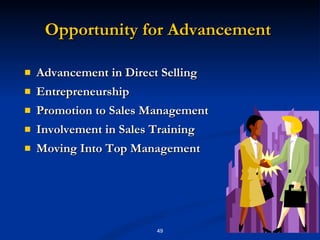
Opportunity for Advancement  Advancement in Direct Selling  Entrepreneurship  Promotion to Sales Management  Involvement in Sales Training  Moving Into Top Management
DISADVANTAGES OF A SALES CAREER Variable income Long hours Travel
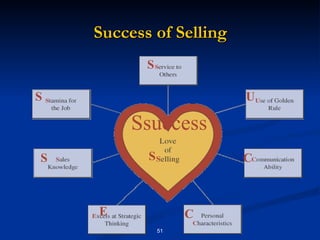
Success of Selling S S U C C Ssuccess E S S
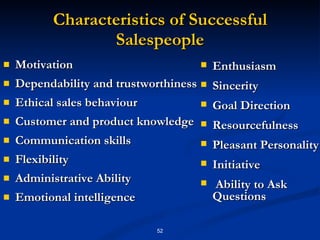
Characteristics of Successful Salespeople Motivation Dependability and trustworthiness Ethical sales behaviour Customer and product knowledge Communication skills Flexibility Administrative Ability  Emotional intelligence Enthusiasm  Sincerity  Goal Direction  Resourcefulness  Pleasant Personality Initiative  Ability to Ask Questions
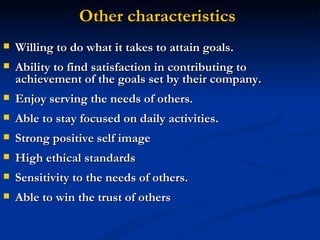
Other characteristics Willing to do what it takes to attain goals.  Ability to find satisfaction in contributing to achievement of the goals set by their company.  Enjoy serving the needs of others.  Able to stay focused on daily activities.  Strong positive self image  High ethical standards  Sensitivity to the needs of others.  Able to win the trust of others
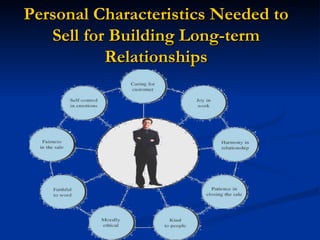
Personal Characteristics Needed to Sell for Building Long-term Relationships
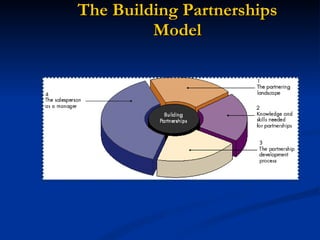
The Building Partnerships Model
You should study personal selling because we all use selling techniques. Salespeople play a vital role in business activities. Salespeople engage in a wide range of activities. The specific duties and responsibilities of salespeople depend on the type of selling position. Research on the characteristics of effective salespeople indicates that many different personality types can be successful in sales. Summary
End of Chapter 1
Thank you

Personal Selling - Chapter 1

  • 1.
    Selling and Salespeople Chapter 1
  • 2.
    Important Questions aboutSelling What is selling? Why should you learn about selling even if you do not plan to be a salesperson? What is the role of personal selling in a firm? What are the different types of sales people? What are the rewards of a selling career?
  • 3.
    “ Relationship buildingis definitely the key to business-to-business selling.” ~Jeffrey P. Lynn
  • 4.
    Selling The exchangeof products for an agreed sum of money Part of the process by which organisations persuade customers to purchase their goods and services Selling is the process of helping someone discover something of value
  • 5.
    Sales people Nowadaysbuying the cheapest is not important to many companies, they prefer to develop relationships to be able to do business on ethical grounds. Sales people play a pivotal role here. Sales people identify opportunities to create value and organise resources of their company that the company can exploit.
  • 6.
    Why Learn AboutPersonal Selling? Time to knock at the door gone The principles of selling are useful to everyone, not just people with the title of salesperson. Sales means more to give potential solutions to the customers rather than beat the drum of what the company sells Internet and other latest technologies involved in selling and all the possible resources of the company (support people etc)
  • 7.
    Why Learn AboutPersonal Selling? Selling is a team activity Rules of Selling are to be followed by all Very much similar to convincing as we do in our daily lives (with the parents, teachers, employers and friends) The term Selling was not taken to be a good one, while now every one tries to engage directly/indirectly business development personnel to flourish. Developing mutually beneficial, long-term relationships is vital to all of us. People in business use selling principles all the time.
  • 8.
  • 9.
    Personal Selling Personalselling is a person-to-person business activity in which a salesperson uncovers and satisfies the needs of a buyer to the mutual, long-term benefit of both parties. Personal selling is oral communication with potential buyers of a product with the intention of making a sale. The personal selling may focus initially on developing a relationship with the potential buyer, but will always ultimately end with an attempt to "close the sale"
  • 10.
    PERSONAL SELLING Definition Seeking out people who have a particular need. Assisting them to recognize the existence of needs they have that could be met through your offering. Demonstrating how your offering fills that need. Persuading qualified prospects that your product will fill their needs.
  • 11.
    Objectives of PersonalSelling Building Product Awareness Creating Interest Providing Information Stimulating Demand Reinforcing the Brand
  • 12.
    Personal Selling ProcessProspecting Making first contact The sales call Objection handling Closing the sale to flourish
  • 13.
    Comparison to othermarketing communications tools Use fewer resources Products tend to be fairly complex (e.g. financial services or new cars). There is some contact between buyer and seller after the sale so that an ongoing relationship is built. Client/prospects need specific information. The purchase tends to involve large sums of money.
  • 14.
    Advantages of usingpersonal selling Personal selling is a face-to-face activity; customers therefore obtain a relatively high degree of personal attention The sales message can be customised to meet the needs of the customer The two-way nature of the sales process allows the sales team to respond directly and promptly to customer questions and concerns P ersonal selling is a good way of getting across large amounts of technical or complex product information The face-to-face sales meeting gives the sales force chance to demonstrate the product Frequent meetings between sales force and customer provide an opportunity to build good long-term relationships
  • 15.
    Main disadvantages ofusing personal selling The cost of employing a sales force. Sales people are expensive. In addition to the basic pay package, a business needs to provide incentives to achieve sales A sales person can only call on one customer at a time. This is not a cost-effective way of reaching a large audience.
  • 16.
    Selling and MarketingMarketing cycle is completed once the feedback is received and salespeople play an important role in bring the feedback Efforts of the company to provide solutions to the people could be accomplished through sales people only People are informed about the services and products of a company through the sales people only
  • 17.
  • 18.
    Strengths and Weaknessesof Communication Methods M = Moderate, H = High, L = Low Communication Method Control Flexibility Credibility Cost Personal selling M to H H L H Internet website H M to H L M to H Mass media advertising H L L M Publicity L L H L to M Word of Mouth L L H L
  • 19.
    Integrated Marketing CommunicationsMany companies use a combination of various communication techniques to be able to communicate better and balance out the pros and cons of each communication technique
  • 20.
    Sales people andMarketing Mix Sales people are eyes and ears of a company in the marketplace Learning organisations acquire information from the sales people about environment and make organisational decisions based on them
  • 21.
    Types of OrganisationalLearning Adaptive Learning To develop knowledge to do present activities better Generative Learning To go beyond the present products, markets, policies and procedures to develop new insights Sales people contribute to both by providing in critical information to the firm’s strategic system
  • 22.
    Main Roles ofthe Sales Force Prospecting Communicating Selling Servicing Information gathering Allocating
  • 23.
    Contribution from Salespeople Strategy development New product development Pricing Channel management
  • 24.
    Qualities of HighSales Performers Sell to people Know when to close Exchange Information Regularly establish trust Engage in certain behaviors Provide value added to the customer Be perceived as a genuine advocates of prospects’ needs
  • 25.
    Salespeople are madenot born They are made with Concentrated attention repeated practice goal oriented direction The skills required to be a successful salesperson can be learned. Become a student of your profession Learn throughout your career Innate characteristics such as personality traits, gender, and height are largely unrelated to sales performance. Companies spend billions of dollars each year on training.
  • 26.
    THE SALES EDGE- EVERYBODY SELLS Human relation skills are basic selling skills. Skills are learned and practiced from birth. Everyone has a base upon which to build their selling abilities.
  • 27.
    Activities of SalespeopleSelling Servicing Customer Reporting
  • 28.
    Selling Prospecting fornew customers Increasing sales to existing customers Making sales presentations Demonstrating products Negotiating prices and delivery terms Writing orders and many more
  • 29.
    Servicing Customer Towork with employees of other departments to make sure that the customers get full benefit of what they have bought Coordinate during meetings to resolve the problems of the customers
  • 30.
    Reporting Time andmoney spent Future schedules Activities of competitors Business conditions Unsatisfied needs of the customers
  • 31.
    What do Salespeopledo? Client relationship manager Account team manager Vendor and channel manager Information provider to their firm
  • 32.
    How Salespeople SpendTheir Time Each Week
  • 33.
    Types of salespeopleSelling products to the customers over the counter Selling products to the customers in the showrooms Selling parts to producers to make the products Selling material to the producers to make parts this chain could be very long…..
  • 34.
    Selling and DistributionChannels A distribution channel is a set of people and organizations responsible for the flow of products and services from the producer to the ultimate user. Business to business Direct sales Sales through distributors Business to customer Direct sales Sales through Retailers Sales through Retailers and distributors
  • 35.
    Selling and DistributionChannels Business-to-business channels
  • 36.
    Selling and DistributionChannels (continued) Consumer channels 1-
  • 37.
    CLASSIFICATION OF SALESJOBS Trade selling Missionary selling Technical selling
  • 38.
    Trade selling Takingorders and field service. Largely involves delivering orders and replenishing inventory. Expected to persuade customers to provide additional shelf space or more favorable placement of stock. Opportunity to increase sales comes most often through assisting the customer to move a larger volume of inventory. Often actually set up product displays in retail stores
  • 39.
    Missionary selling Educatethose who ultimately decide what product will be used by the consumer. Often does not see immediate results from their efforts in the way of products sold. Still accountable for sales.
  • 40.
    Technical selling Salespeoplemust also be competent in some technical specialty related to the products being sold. Usually called in by another salesperson who has already contacted the prospect and stimulated some interest. Often conducted by a sales team. Still need real sales skills because their role is more than just explaining the technical aspects of the product.
  • 41.
    The Sales JobContinuum
  • 42.
  • 43.
    The Customer isat the Center of the Sales System
  • 44.
    Major Reasons ForChoosing A Sales Career
  • 45.
  • 46.
    A Sales PersonnelCareer Path
  • 47.
    Rewards in SellingIndependence and responsibility Financial rewards Management opportunities Variety and Independence No set routine The variety of prospects and their needs. Professional salespeople are never unemployed.
  • 48.
    Average Annual Compensationfor Salespeople and Managers Source: 2004 Salary Survey, Sales & Marketing Management, May 2004, p. 29.
  • 49.
    Opportunity for Advancement Advancement in Direct Selling Entrepreneurship Promotion to Sales Management Involvement in Sales Training Moving Into Top Management
  • 50.
    DISADVANTAGES OF ASALES CAREER Variable income Long hours Travel
  • 51.
    Success of SellingS S U C C Ssuccess E S S
  • 52.
    Characteristics of SuccessfulSalespeople Motivation Dependability and trustworthiness Ethical sales behaviour Customer and product knowledge Communication skills Flexibility Administrative Ability Emotional intelligence Enthusiasm Sincerity Goal Direction Resourcefulness Pleasant Personality Initiative Ability to Ask Questions
  • 53.
    Other characteristics Willingto do what it takes to attain goals. Ability to find satisfaction in contributing to achievement of the goals set by their company. Enjoy serving the needs of others. Able to stay focused on daily activities. Strong positive self image High ethical standards Sensitivity to the needs of others. Able to win the trust of others
  • 54.
    Personal Characteristics Neededto Sell for Building Long-term Relationships
  • 55.
  • 56.
    You should studypersonal selling because we all use selling techniques. Salespeople play a vital role in business activities. Salespeople engage in a wide range of activities. The specific duties and responsibilities of salespeople depend on the type of selling position. Research on the characteristics of effective salespeople indicates that many different personality types can be successful in sales. Summary
  • 57.
  • 58.

Editor's Notes