Managing the Sales Force Chapter 01
Sales Representative McMurry distinguished six sales positions Deliverer : whose major task is the delivery of product (milk, fuel, oil, bread) Order taker : who act predominantly as an inside order taker (the salesperson standing behind the counter) or outside order taker (the soap sales person calling on the supermarket manager) Missionary : who is expected or permitted to take an order but whose major task is to build goodwill or to educate the actual or potential user (the medical “detailer” representing an ethical pharmaceutical companies) Technician : with a high level of technical knowledge (the engineering salesperson who is primarily a consultant to the client companies) Demand creator : who relies on creative methods for selling tangible products (vacuum cleaners, refrigerators, siding, encyclopedias) or intangibles (insurance, advertising services, or education) Solution vendor : whose expertise is in the solving of a customer’s problem, often with a system of the company’s products and services (computer and communication system) Chapter 01 –
Designing The Sales Force
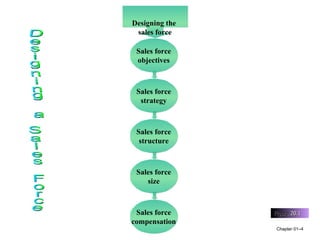
Chapter 01 – Designing the  sales force Sales force compensation Figure  20.1 Designing a Sales Force Sales force objectives Sales force strategy Sales force structure Sales force size
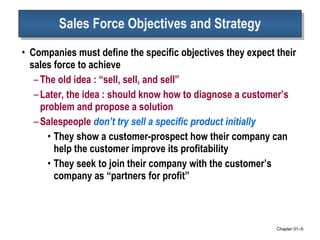
Sales Force Objectives and Strategy Companies must define the specific objectives they expect their sales force to achieve The old idea : “sell, sell, and sell” Later, the idea : should know how to diagnose a customer’s problem and propose a solution Salespeople  don’t try sell a specific product initially They show a customer-prospect how their company can help the customer improve its profitability They seek to join their company with the customer’s company as “partners for profit” Chapter 01 –
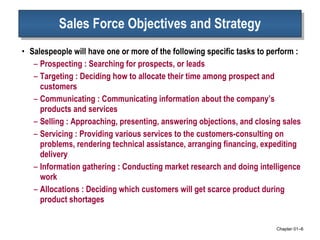
Sales Force Objectives and Strategy Salespeople will have one or more of the following specific tasks to perform : Prospecting : Searching for prospects, or leads Targeting : Deciding how to allocate their time among prospect and customers Communicating : Communicating information about the company’s products and services Selling : Approaching, presenting, answering objections, and closing sales Servicing : Providing various services to the customers-consulting on  problems, rendering technical assistance, arranging financing, expediting delivery  Information gathering : Conducting market research and doing intelligence work Allocations : Deciding which customers will get scarce product during product shortages Chapter 01 –
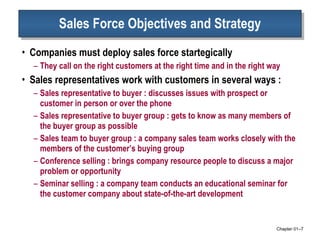
Sales Force Objectives and Strategy Companies must deploy sales force startegically They call on the right customers at the right time and in the right way Sales representatives work with customers in several ways : Sales representative to buyer : discusses issues with prospect or customer in person or over the phone  Sales representative to buyer group : gets to know as many members of the buyer group as possible Sales team to buyer group : a company sales team works closely with the members of the customer’s buying group  Conference selling : brings company resource people to discuss a major problem or opportunity Seminar selling : a company team conducts an educational seminar for the customer company about state-of-the-art development Chapter 01 –
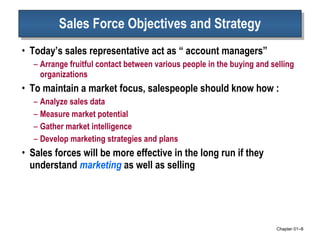
Sales Force Objectives and Strategy Today’s sales representative act as “ account managers” Arrange fruitful contact between various people in the buying and selling organizations To maintain a market focus, salespeople should know how : Analyze sales data Measure market potential Gather market intelligence Develop marketing strategies and plans Sales forces will be more effective in the long run if they understand  marketing  as well as selling Chapter 01 –
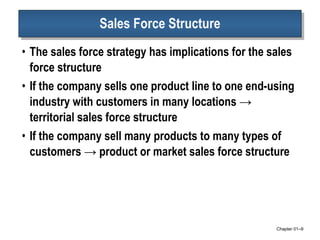
Sales Force Structure The sales force strategy has implications for the sales force structure If the company sells one product line to one end-using industry with customers in many locations  -> territorial sales force structure If the company sell many products to many types of customers -> product or market sales force structure Chapter 01 –
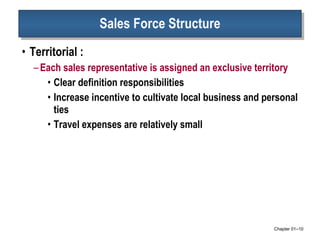
Sales Force Structure Territorial :  Each sales representative is assigned an exclusive territory Clear definition responsibilities Increase incentive to cultivate local business and personal ties Travel expenses are relatively small  Chapter 01 –
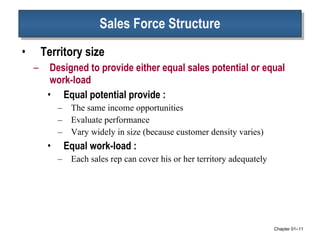
Sales Force Structure Territory size Designed to provide either equal sales potential or equal work-load Equal potential provide : The same income opportunities Evaluate performance Vary widely in size (because customer density varies) Equal work-load : Each sales rep can cover his or her territory adequately Chapter 01 –
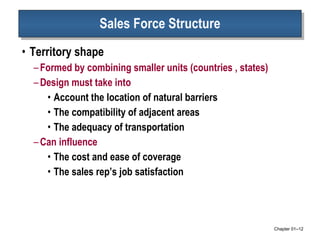
Sales Force Structure Territory shape Formed by combining smaller units (countries , states) Design must take into Account the location of natural barriers The compatibility of adjacent areas The adequacy of transportation Can influence  The cost and ease of coverage The sales rep’s job satisfaction  Chapter 01 –
Sales Force Structure Product The importance of sales reps’ knowing their products Together with the development of product divisions and product management,  Has led many companies to structure their sales forces along product lines Product specialization is particularly useful for product lines that are technically complex, highly unrelated, or very numerous.  Chapter 01 –
Sales Force Structure Market Companies often specialize their sales forces along industry or customer lines.  Complex When a company sells a diverse product line to many types of customers over a broad geographical area It often combines several structures, with sales forces specialized by territory-product, territory-market, product-market, and so on. A sales representative might then report to one or more line and staff managers.  Chapter 01 –
Sales Force Size and Compensation The company clarifies its strategy and structure = consider sales force size The company establishes the number of customers it wants to reach =  workload approach  to establish sales force size Following 5 steps : Group customers into size classes by annual sales volume Establish call frequencies, the number of calls to be made per year on each account in a size class Multiply the number of accounts in each size class by the call frequency to arrive at the total yearly sales call workload;  Determine the average number of calls a sales rep can make per year Divide the total annual calls (calculated in step 3) required by the average annual calls made by a rep (calculated in step 4) to see how many reps are needed. Chapter 01 –
Sales Force Size and Compensation The company must next determine the four components of sales force compensation : Fixed amount Variable amount Expense allowances Benefits 70 % total income sales reps is fixed and 30 % other elements 3 basic types of fixed and variable compensation plans : Straight salary Straight commission Combination salary and commission. ¼ use either and ¾ firms use combination Chapter 01 –
Sales Force Size and Compensation Straight-salary plans : Provide sales reps with a secure income Make them more willing to perform nonselling activities Give them less incentive to overstock customers. From the company’s perspective they provide administrative simplicity and lower turnover Straight-commission plans : Attract higher sales performers Provide more motivation Require less supervision Control selling costs. Combination plans offer the benefits of both plans : While reducing their disadvantages. Chapter 01 –
Sales Force Size and Compensation The fixed amount : a salary, is intended to satisfy the sales reps’ need for income stability. The variable amount : which might be commissions, a bonus or profit sharing is intended to stimulate and reward greater effort) Expense allowances : enable sales reps to meet the expenses involved in travel, lodging, dining, and entertaining Benefits : such as paid vacations, sickness or accident benefits, pensions, and life insurance, are intended to provide security and job satisfaction.  Chapter 01 –
Managing The Sales Force
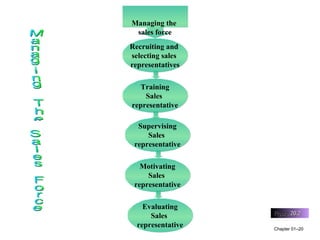
Chapter 01 – Managing the  sales force Figure  20.2 Managing The Sales Force Evaluating Sales  representative Recruiting and  selecting sales  representatives Training Sales  representative Supervising Sales  representative Motivating Sales  representative
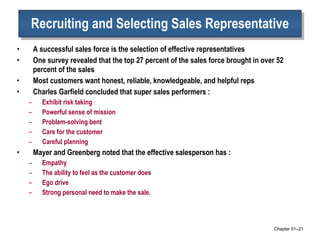
Recruiting and Selecting Sales Representative A successful sales force is the selection of effective representatives One survey revealed that the top 27 percent of the sales force brought in over 52 percent of the sales Most customers want honest, reliable, knowledgeable, and helpful reps  Charles Garfield concluded that super sales performers : Exhibit risk taking Powerful sense of mission Problem-solving bent Care for the customer Careful planning Mayer and Greenberg noted that the effective salesperson has : Empathy The ability to feel as the customer does Ego drive Strong personal need to make the sale. Chapter 01 –
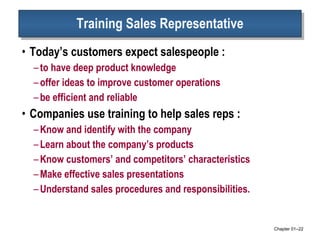
Training Sales Representative Today’s customers expect salespeople : to have deep product knowledge offer ideas to improve customer operations be efficient and reliable Companies use training to help sales reps :  Know and identify with the company Learn about the company’s products Know customers’ and competitors’ characteristics Make effective sales presentations Understand sales procedures and responsibilities.  Chapter 01 –
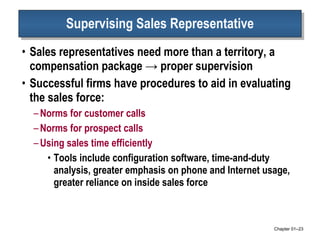
Supervising Sales Representative Sales representatives need more than a territory, a compensation package -> proper supervision Successful firms have procedures to aid in evaluating the sales force: Norms for customer calls Norms for prospect calls Using sales time efficiently Tools include configuration software, time-and-duty analysis, greater emphasis on phone and Internet usage, greater reliance on inside sales force Chapter 01 –
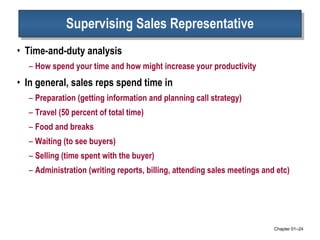
Supervising Sales Representative Time-and-duty analysis How spend your time and how might increase your productivity In general, sales reps spend time in  Preparation (getting information and planning call strategy) Travel (50 percent of total time) Food and breaks  Waiting (to see buyers) Selling (time spent with the buyer) Administration (writing reports, billing, attending sales meetings and etc) Chapter 01 –
Supervising Sales Representative 3 types to increased the size and responsibilities of their inside sales force : Technical support people : provide technical information and answers to customers’ questions Sales assistants : provide clerical backup for the outside reps confirming appointments carrying out credit checks following up on deliveries answering customers’ questions Telemarketers : use the phone  find new leads qualify and sell to them reactivate former accounts give more attention to neglected accounts. Chapter 01 –
Motivating Sales Representative Some ambitious sales representatives are self-starters Most people ,moreover, require incentives, such as financial gain or social recognition, to operate at full capacity Greater effort will lead to greater performance Greater performance will lead to greater rewards Greater rewards will lead to greater satisfaction Greater satisfaction will reinforce motivation That sales managers must be able to convince salespeople that :  They can sell more by working harder or by being trained to work smarter The rewards for better performance are worth the extra effort Chapter 01 –
Motivating Sales Representative Most valued rewards Pay, promotion, personal growth, sense of accomplishment Least valued rewards Liking and respect, security, recognition Sales quotas as motivation tools Supplementary motivators Chapter 01 –
Evaluating Sales Representative The feed-forward aspects of sales supervision— how management communicates what sales reps should be doing and motivates them to do it Source of Information Formal evaluation Sources of information Sales reports Personal observation  Customer letters and complaints Customer surveys Conversations with other sales representatives Many Companies require their representatives to develop an annual  territory marketing plan   Program for developing new accounts and increasing business from existing accounts This report casts sales reps into the role of market managers and profit centers Chapter 01 –
Evaluating Sales Representative Sales reps write up completed activities : Call reports  Expense reports New-business reports Lost-business reports Reports on local business and economic conditions Sales managers can extract key indicators of sales performance :  Average number of sales calls per rep per day Average sales call time per contact Average revenue per sales call Average cost per sales call Entertainment cost per sales call Percentage of orders per hundred sales calls Number of new customers per period Number of lost customers per period Sales force cost as a percentage of total sales Chapter 01 –
Formal evaluation Performance comparisons Knowledge assessments Chapter 01 –
Chapter 01 – THANK YOU

Chapter01 Managing The Sales Force

  • 1.
    Managing the SalesForce Chapter 01
  • 2.
    Sales Representative McMurrydistinguished six sales positions Deliverer : whose major task is the delivery of product (milk, fuel, oil, bread) Order taker : who act predominantly as an inside order taker (the salesperson standing behind the counter) or outside order taker (the soap sales person calling on the supermarket manager) Missionary : who is expected or permitted to take an order but whose major task is to build goodwill or to educate the actual or potential user (the medical “detailer” representing an ethical pharmaceutical companies) Technician : with a high level of technical knowledge (the engineering salesperson who is primarily a consultant to the client companies) Demand creator : who relies on creative methods for selling tangible products (vacuum cleaners, refrigerators, siding, encyclopedias) or intangibles (insurance, advertising services, or education) Solution vendor : whose expertise is in the solving of a customer’s problem, often with a system of the company’s products and services (computer and communication system) Chapter 01 –
  • 3.
  • 4.
    Chapter 01 –Designing the sales force Sales force compensation Figure 20.1 Designing a Sales Force Sales force objectives Sales force strategy Sales force structure Sales force size
  • 5.
    Sales Force Objectivesand Strategy Companies must define the specific objectives they expect their sales force to achieve The old idea : “sell, sell, and sell” Later, the idea : should know how to diagnose a customer’s problem and propose a solution Salespeople don’t try sell a specific product initially They show a customer-prospect how their company can help the customer improve its profitability They seek to join their company with the customer’s company as “partners for profit” Chapter 01 –
  • 6.
    Sales Force Objectivesand Strategy Salespeople will have one or more of the following specific tasks to perform : Prospecting : Searching for prospects, or leads Targeting : Deciding how to allocate their time among prospect and customers Communicating : Communicating information about the company’s products and services Selling : Approaching, presenting, answering objections, and closing sales Servicing : Providing various services to the customers-consulting on problems, rendering technical assistance, arranging financing, expediting delivery Information gathering : Conducting market research and doing intelligence work Allocations : Deciding which customers will get scarce product during product shortages Chapter 01 –
  • 7.
    Sales Force Objectivesand Strategy Companies must deploy sales force startegically They call on the right customers at the right time and in the right way Sales representatives work with customers in several ways : Sales representative to buyer : discusses issues with prospect or customer in person or over the phone Sales representative to buyer group : gets to know as many members of the buyer group as possible Sales team to buyer group : a company sales team works closely with the members of the customer’s buying group Conference selling : brings company resource people to discuss a major problem or opportunity Seminar selling : a company team conducts an educational seminar for the customer company about state-of-the-art development Chapter 01 –
  • 8.
    Sales Force Objectivesand Strategy Today’s sales representative act as “ account managers” Arrange fruitful contact between various people in the buying and selling organizations To maintain a market focus, salespeople should know how : Analyze sales data Measure market potential Gather market intelligence Develop marketing strategies and plans Sales forces will be more effective in the long run if they understand marketing as well as selling Chapter 01 –
  • 9.
    Sales Force StructureThe sales force strategy has implications for the sales force structure If the company sells one product line to one end-using industry with customers in many locations -> territorial sales force structure If the company sell many products to many types of customers -> product or market sales force structure Chapter 01 –
  • 10.
    Sales Force StructureTerritorial : Each sales representative is assigned an exclusive territory Clear definition responsibilities Increase incentive to cultivate local business and personal ties Travel expenses are relatively small Chapter 01 –
  • 11.
    Sales Force StructureTerritory size Designed to provide either equal sales potential or equal work-load Equal potential provide : The same income opportunities Evaluate performance Vary widely in size (because customer density varies) Equal work-load : Each sales rep can cover his or her territory adequately Chapter 01 –
  • 12.
    Sales Force StructureTerritory shape Formed by combining smaller units (countries , states) Design must take into Account the location of natural barriers The compatibility of adjacent areas The adequacy of transportation Can influence The cost and ease of coverage The sales rep’s job satisfaction Chapter 01 –
  • 13.
    Sales Force StructureProduct The importance of sales reps’ knowing their products Together with the development of product divisions and product management, Has led many companies to structure their sales forces along product lines Product specialization is particularly useful for product lines that are technically complex, highly unrelated, or very numerous. Chapter 01 –
  • 14.
    Sales Force StructureMarket Companies often specialize their sales forces along industry or customer lines. Complex When a company sells a diverse product line to many types of customers over a broad geographical area It often combines several structures, with sales forces specialized by territory-product, territory-market, product-market, and so on. A sales representative might then report to one or more line and staff managers. Chapter 01 –
  • 15.
    Sales Force Sizeand Compensation The company clarifies its strategy and structure = consider sales force size The company establishes the number of customers it wants to reach = workload approach to establish sales force size Following 5 steps : Group customers into size classes by annual sales volume Establish call frequencies, the number of calls to be made per year on each account in a size class Multiply the number of accounts in each size class by the call frequency to arrive at the total yearly sales call workload; Determine the average number of calls a sales rep can make per year Divide the total annual calls (calculated in step 3) required by the average annual calls made by a rep (calculated in step 4) to see how many reps are needed. Chapter 01 –
  • 16.
    Sales Force Sizeand Compensation The company must next determine the four components of sales force compensation : Fixed amount Variable amount Expense allowances Benefits 70 % total income sales reps is fixed and 30 % other elements 3 basic types of fixed and variable compensation plans : Straight salary Straight commission Combination salary and commission. ¼ use either and ¾ firms use combination Chapter 01 –
  • 17.
    Sales Force Sizeand Compensation Straight-salary plans : Provide sales reps with a secure income Make them more willing to perform nonselling activities Give them less incentive to overstock customers. From the company’s perspective they provide administrative simplicity and lower turnover Straight-commission plans : Attract higher sales performers Provide more motivation Require less supervision Control selling costs. Combination plans offer the benefits of both plans : While reducing their disadvantages. Chapter 01 –
  • 18.
    Sales Force Sizeand Compensation The fixed amount : a salary, is intended to satisfy the sales reps’ need for income stability. The variable amount : which might be commissions, a bonus or profit sharing is intended to stimulate and reward greater effort) Expense allowances : enable sales reps to meet the expenses involved in travel, lodging, dining, and entertaining Benefits : such as paid vacations, sickness or accident benefits, pensions, and life insurance, are intended to provide security and job satisfaction. Chapter 01 –
  • 19.
  • 20.
    Chapter 01 –Managing the sales force Figure 20.2 Managing The Sales Force Evaluating Sales representative Recruiting and selecting sales representatives Training Sales representative Supervising Sales representative Motivating Sales representative
  • 21.
    Recruiting and SelectingSales Representative A successful sales force is the selection of effective representatives One survey revealed that the top 27 percent of the sales force brought in over 52 percent of the sales Most customers want honest, reliable, knowledgeable, and helpful reps Charles Garfield concluded that super sales performers : Exhibit risk taking Powerful sense of mission Problem-solving bent Care for the customer Careful planning Mayer and Greenberg noted that the effective salesperson has : Empathy The ability to feel as the customer does Ego drive Strong personal need to make the sale. Chapter 01 –
  • 22.
    Training Sales RepresentativeToday’s customers expect salespeople : to have deep product knowledge offer ideas to improve customer operations be efficient and reliable Companies use training to help sales reps : Know and identify with the company Learn about the company’s products Know customers’ and competitors’ characteristics Make effective sales presentations Understand sales procedures and responsibilities. Chapter 01 –
  • 23.
    Supervising Sales RepresentativeSales representatives need more than a territory, a compensation package -> proper supervision Successful firms have procedures to aid in evaluating the sales force: Norms for customer calls Norms for prospect calls Using sales time efficiently Tools include configuration software, time-and-duty analysis, greater emphasis on phone and Internet usage, greater reliance on inside sales force Chapter 01 –
  • 24.
    Supervising Sales RepresentativeTime-and-duty analysis How spend your time and how might increase your productivity In general, sales reps spend time in Preparation (getting information and planning call strategy) Travel (50 percent of total time) Food and breaks Waiting (to see buyers) Selling (time spent with the buyer) Administration (writing reports, billing, attending sales meetings and etc) Chapter 01 –
  • 25.
    Supervising Sales Representative3 types to increased the size and responsibilities of their inside sales force : Technical support people : provide technical information and answers to customers’ questions Sales assistants : provide clerical backup for the outside reps confirming appointments carrying out credit checks following up on deliveries answering customers’ questions Telemarketers : use the phone find new leads qualify and sell to them reactivate former accounts give more attention to neglected accounts. Chapter 01 –
  • 26.
    Motivating Sales RepresentativeSome ambitious sales representatives are self-starters Most people ,moreover, require incentives, such as financial gain or social recognition, to operate at full capacity Greater effort will lead to greater performance Greater performance will lead to greater rewards Greater rewards will lead to greater satisfaction Greater satisfaction will reinforce motivation That sales managers must be able to convince salespeople that : They can sell more by working harder or by being trained to work smarter The rewards for better performance are worth the extra effort Chapter 01 –
  • 27.
    Motivating Sales RepresentativeMost valued rewards Pay, promotion, personal growth, sense of accomplishment Least valued rewards Liking and respect, security, recognition Sales quotas as motivation tools Supplementary motivators Chapter 01 –
  • 28.
    Evaluating Sales RepresentativeThe feed-forward aspects of sales supervision— how management communicates what sales reps should be doing and motivates them to do it Source of Information Formal evaluation Sources of information Sales reports Personal observation Customer letters and complaints Customer surveys Conversations with other sales representatives Many Companies require their representatives to develop an annual territory marketing plan Program for developing new accounts and increasing business from existing accounts This report casts sales reps into the role of market managers and profit centers Chapter 01 –
  • 29.
    Evaluating Sales RepresentativeSales reps write up completed activities : Call reports Expense reports New-business reports Lost-business reports Reports on local business and economic conditions Sales managers can extract key indicators of sales performance : Average number of sales calls per rep per day Average sales call time per contact Average revenue per sales call Average cost per sales call Entertainment cost per sales call Percentage of orders per hundred sales calls Number of new customers per period Number of lost customers per period Sales force cost as a percentage of total sales Chapter 01 –
  • 30.
    Formal evaluation Performancecomparisons Knowledge assessments Chapter 01 –
  • 31.
    Chapter 01 –THANK YOU