Chapter  19 Management of Personal Selling Sommers     Barnes Ninth Canadian Edition Presentation by Karen A. Blotnicky Mount Saint Vincent University, Halifax, NS Copyright © 200 1  by McGraw-Hill Ryerson Limited
Chapter  Goals To gain an understanding of: The role that personal selling plays in the economy and the marketing program The variety of jobs in selling The changing patterns in personal selling Major tasks in staffing and operating a sales force
Personal Selling  Personal (one-to-one/one-to-small group) communication of information designed to persuade someone to buy  In many companies, personal selling is the largest single operating expense-- often 8 to 15% of sales.
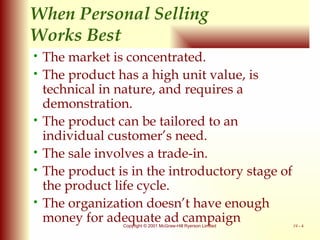
When Personal Selling  Works Best The market is concentrated. The product has a high unit value, is technical in nature, and requires a demonstration. The product can be tailored to an individual customer’s need. The sale involves a trade-in. The product is in the introductory stage of the product life cycle. The organization doesn’t have enough money for adequate ad campaign
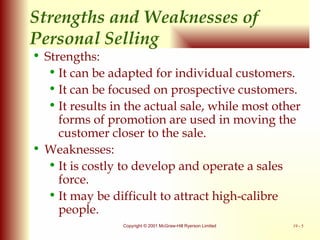
Strengths and Weaknesses of  Personal Selling Strengths: It can be adapted for individual customers. It can be focused on prospective customers. It results in the actual sale, while most other forms of promotion are used in moving the customer closer to the sale. Weaknesses: It is costly to develop and operate a sales force. It may be difficult to attract high-calibre people.
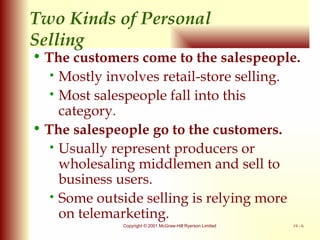
Two Kinds of Personal  Selling The customers come to the salespeople. Mostly involves retail-store selling. Most salespeople fall into this category . The salespeople go to the customers. Usually represent producers or wholesaling middlemen and sell to business users. Some outside selling is relying more on telemarketing.
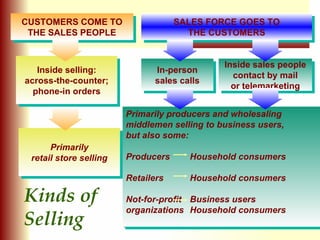
CUSTOMERS COME TO THE SALES PEOPLE SALES FORCE GOES TO THE CUSTOMERS Inside selling: across-the-counter; phone-in orders Primarily retail store selling In-person sales calls Inside sales people contact by mail or telemarketing Primarily producers and wholesaling middlemen selling to business users, but also some: Producers Household consumers Retailers Household consumers Not-for-profit Business users organizations Household consumers Kinds of  Selling
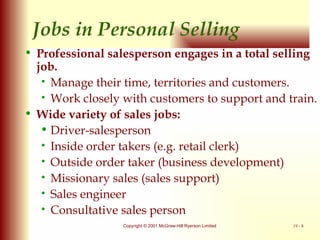
Jobs in Personal Selling Professional salesperson engages in a total selling job. Manage their time, territories and customers. Work closely with customers to support and train. Wide variety of sales jobs: Driver-salesperson Inside order takers (e.g. retail clerk) Outside order taker (business development)  Missionary sales (sales support) Sales engineer Consultative sales person
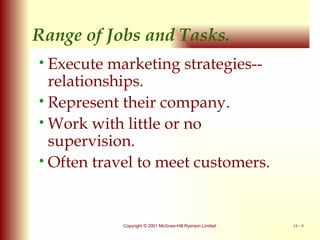
Range of Jobs and Tasks. Execute marketing strategies-- relationships. Represent their company. Work with little or no supervision. Often travel to meet customers.
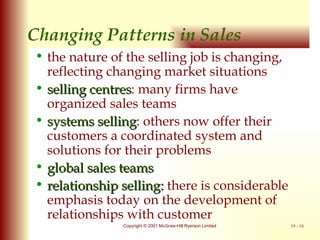
Changing Patterns in Sales the nature of the selling job is changing, reflecting changing market situations  selling centres : many firms have organized sales teams systems selling : others now offer their customers a coordinated system and solutions for their problems  global sales teams relationship selling:  there is considerable emphasis today on the development of relationships with customer
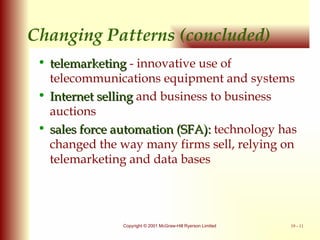
Changing Patterns (concluded) telemarketing  - innovative use of telecommunications equipment and systems Internet selling  and business to business auctions sales force automation (SFA):  technology has changed the way many firms sell, relying on telemarketing and data bases
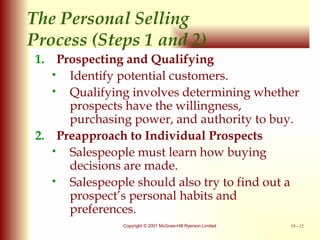
The Personal Selling  Process (Steps 1 and 2) Prospecting and Qualifying Identify potential customers. Qualifying involves determining whether prospects have the willingness, purchasing power, and authority to buy. Preapproach to Individual Prospects Salespeople must learn how buying decisions are made. Salespeople should also try to find out a prospect’s personal habits and preferences.
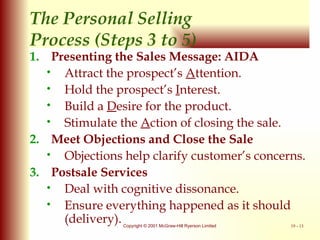
The Personal Selling  Process (Steps 3 to 5) Presenting the Sales Message: AIDA Attract the prospect’s  A ttention. Hold the prospect’s  I nterest. Build a  D esire for the product. Stimulate the  A ction of closing the sale. Meet Objections and Close the Sale Objections help clarify customer’s concerns. Postsale Services Deal with cognitive dissonance. Ensure everything happened as it should (delivery).
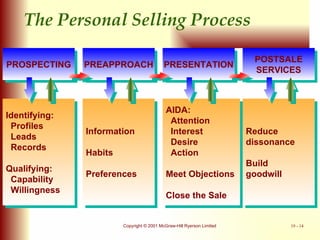
PROSPECTING PREAPPROACH PRESENTATION POSTSALE SERVICES Identifying: Profiles Leads Records Qualifying: Capability Willingness Information Habits Preferences AIDA: Attention Interest Desire Action Meet Objections Close the Sale Reduce  dissonance Build goodwill The Personal Selling Process
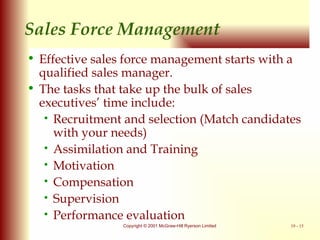
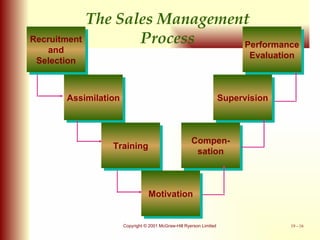
Sales Force Management Effective sales force management starts with a qualified sales manager. The tasks that take up the bulk of sales executives’ time include: Recruitment and selection  ( Match candidates with your needs ) Assimilation and Training Motivation Compensation Supervision Performance evaluation
Recruitment and Selection Assimilation Training Motivation Compen- sation Performance Evaluation Supervision The Sales Management Process
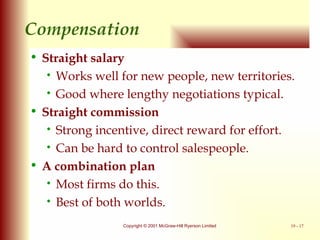
Compensation Straight salary Works well for new people, new territories. Good where lengthy negotiations typical. Straight commission Strong incentive, direct reward for effort. Can be hard to control salespeople. A combination plan Most firms do this. Best of both worlds.
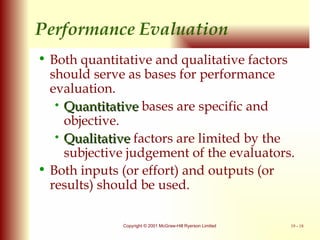
Performance Evaluation Both quantitative and qualitative factors should serve as bases for performance evaluation. Quantitative  bases are specific and objective. Qualitative  factors are limited by the subjective judgement of the evaluators. Both inputs (or effort) and outputs (or results) should be used.

9fms pp19

  • 1.
    Chapter 19Management of Personal Selling Sommers  Barnes Ninth Canadian Edition Presentation by Karen A. Blotnicky Mount Saint Vincent University, Halifax, NS Copyright © 200 1 by McGraw-Hill Ryerson Limited
  • 2.
    Chapter GoalsTo gain an understanding of: The role that personal selling plays in the economy and the marketing program The variety of jobs in selling The changing patterns in personal selling Major tasks in staffing and operating a sales force
  • 3.
    Personal Selling Personal (one-to-one/one-to-small group) communication of information designed to persuade someone to buy In many companies, personal selling is the largest single operating expense-- often 8 to 15% of sales.
  • 4.
    When Personal Selling Works Best The market is concentrated. The product has a high unit value, is technical in nature, and requires a demonstration. The product can be tailored to an individual customer’s need. The sale involves a trade-in. The product is in the introductory stage of the product life cycle. The organization doesn’t have enough money for adequate ad campaign
  • 5.
    Strengths and Weaknessesof Personal Selling Strengths: It can be adapted for individual customers. It can be focused on prospective customers. It results in the actual sale, while most other forms of promotion are used in moving the customer closer to the sale. Weaknesses: It is costly to develop and operate a sales force. It may be difficult to attract high-calibre people.
  • 6.
    Two Kinds ofPersonal Selling The customers come to the salespeople. Mostly involves retail-store selling. Most salespeople fall into this category . The salespeople go to the customers. Usually represent producers or wholesaling middlemen and sell to business users. Some outside selling is relying more on telemarketing.
  • 7.
    CUSTOMERS COME TOTHE SALES PEOPLE SALES FORCE GOES TO THE CUSTOMERS Inside selling: across-the-counter; phone-in orders Primarily retail store selling In-person sales calls Inside sales people contact by mail or telemarketing Primarily producers and wholesaling middlemen selling to business users, but also some: Producers Household consumers Retailers Household consumers Not-for-profit Business users organizations Household consumers Kinds of Selling
  • 8.
    Jobs in PersonalSelling Professional salesperson engages in a total selling job. Manage their time, territories and customers. Work closely with customers to support and train. Wide variety of sales jobs: Driver-salesperson Inside order takers (e.g. retail clerk) Outside order taker (business development) Missionary sales (sales support) Sales engineer Consultative sales person
  • 9.
    Range of Jobsand Tasks. Execute marketing strategies-- relationships. Represent their company. Work with little or no supervision. Often travel to meet customers.
  • 10.
    Changing Patterns inSales the nature of the selling job is changing, reflecting changing market situations selling centres : many firms have organized sales teams systems selling : others now offer their customers a coordinated system and solutions for their problems global sales teams relationship selling: there is considerable emphasis today on the development of relationships with customer
  • 11.
    Changing Patterns (concluded)telemarketing - innovative use of telecommunications equipment and systems Internet selling and business to business auctions sales force automation (SFA): technology has changed the way many firms sell, relying on telemarketing and data bases
  • 12.
    The Personal Selling Process (Steps 1 and 2) Prospecting and Qualifying Identify potential customers. Qualifying involves determining whether prospects have the willingness, purchasing power, and authority to buy. Preapproach to Individual Prospects Salespeople must learn how buying decisions are made. Salespeople should also try to find out a prospect’s personal habits and preferences.
  • 13.
    The Personal Selling Process (Steps 3 to 5) Presenting the Sales Message: AIDA Attract the prospect’s A ttention. Hold the prospect’s I nterest. Build a D esire for the product. Stimulate the A ction of closing the sale. Meet Objections and Close the Sale Objections help clarify customer’s concerns. Postsale Services Deal with cognitive dissonance. Ensure everything happened as it should (delivery).
  • 14.
    PROSPECTING PREAPPROACH PRESENTATIONPOSTSALE SERVICES Identifying: Profiles Leads Records Qualifying: Capability Willingness Information Habits Preferences AIDA: Attention Interest Desire Action Meet Objections Close the Sale Reduce dissonance Build goodwill The Personal Selling Process
  • 15.
    Sales Force ManagementEffective sales force management starts with a qualified sales manager. The tasks that take up the bulk of sales executives’ time include: Recruitment and selection ( Match candidates with your needs ) Assimilation and Training Motivation Compensation Supervision Performance evaluation
  • 16.
    Recruitment and SelectionAssimilation Training Motivation Compen- sation Performance Evaluation Supervision The Sales Management Process
  • 17.
    Compensation Straight salaryWorks well for new people, new territories. Good where lengthy negotiations typical. Straight commission Strong incentive, direct reward for effort. Can be hard to control salespeople. A combination plan Most firms do this. Best of both worlds.
  • 18.
    Performance Evaluation Bothquantitative and qualitative factors should serve as bases for performance evaluation. Quantitative bases are specific and objective. Qualitative factors are limited by the subjective judgement of the evaluators. Both inputs (or effort) and outputs (or results) should be used.