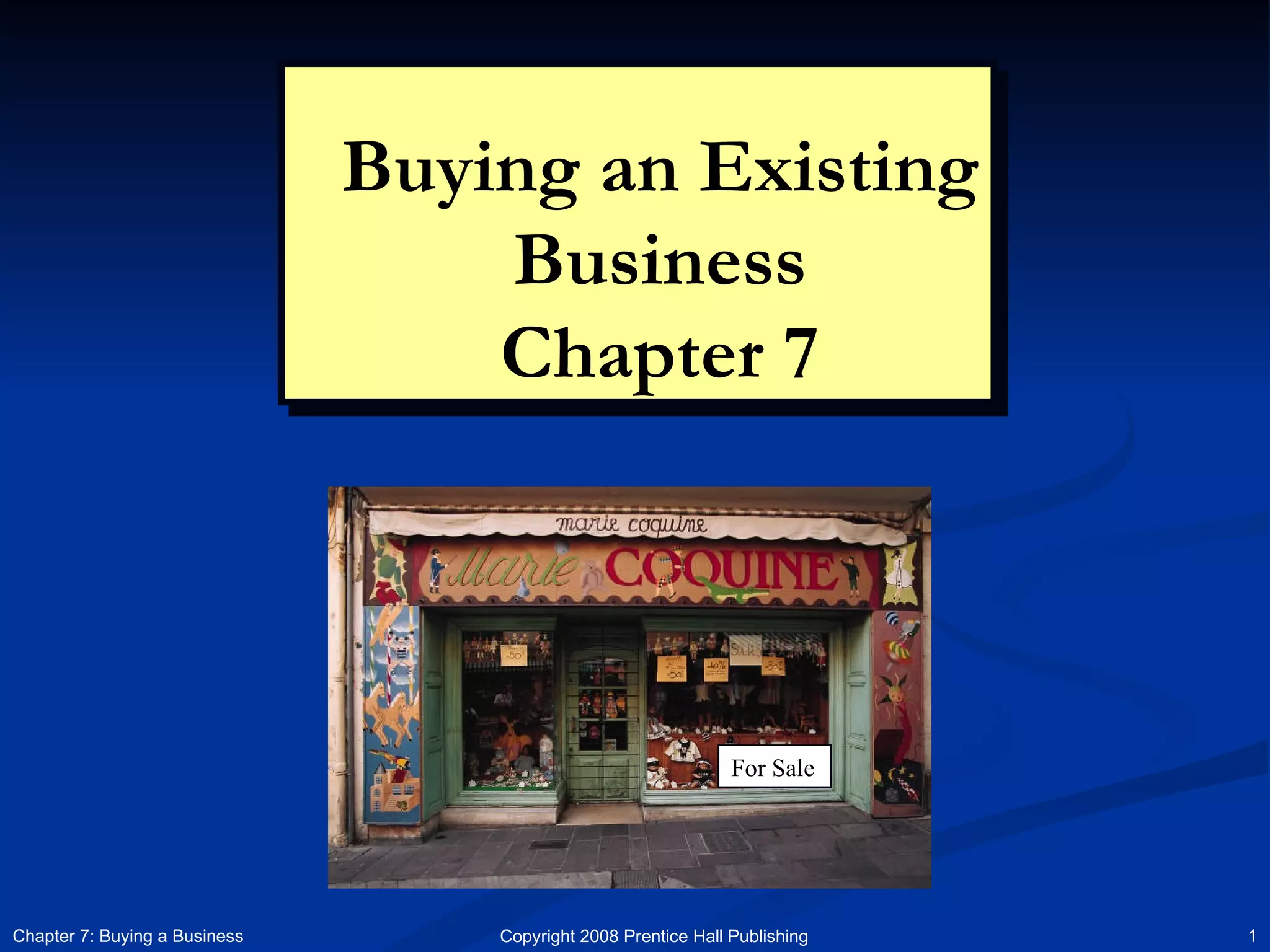
Buying an Existing Business Chapter 7 Chapter 7: Buying a Business For Sale
Key Questions to Consider  Before  Buying a Business Is the right type of business for sale in the market in which you want to operate? What experience do you have in this particular business and the industry in which it operates? How critical is experience in the business to your ultimate success? What is the company’s potential for success? What changes will you have to make – and how extensive will they have to be – to realize the business’s full potential? Chapter 7: Buying a Business
Key Questions to Consider  Before  Buying a Business What price and payment method are reasonable for you and acceptable to the seller? Will the company generate sufficient cash to pay for itself and leave you with a suitable rate of return on your investment? Should you be starting a business and building it from the ground up rather than buying an existing one? Chapter 7: Buying a Business
Advantages of Buying a Business It may continue to be successful It may already have the best location Employees and suppliers are established Equipment is already installed Inventory is in place and trade credit is established Chapter 7: Buying a Business
Advantages of Buying a Business You can “hit the ground running” You can use the previous owner’s experience Easier financing It’s a bargain Chapter 7: Buying a Business (Continued)
Disadvantages of Buying a Business “ It’s a loser” Previous owner may have created ill will “ Inherited” employees may be unsuitable Location may have become unsatisfactory Equipment may be obsolete or inefficient Chapter 7: Buying a Business
Disadvantages of Buying a Business (Continued) Change and innovation can be difficult to implement Inventory may be stale Accounts receivable may be worth less than face value Chapter 7: Buying a Business
Valuing Accounts Receivable Age of Accounts (days)   Amount   Probability   of Collection   Value   0-30 31-60 61-90 91-120 121-150 151+   Total $40,000 $25,000 $14,000 $10,000 $7,000 $5,000   $101,000 . 95 .88 .70 .40 .25 .10 $38,000 $22,000 $9,800 $4,000 $1,750 $500   $76,050        
Disadvantages of Buying a Business (Continued) Changes can be difficult to implement Inventory may be stale Accounts receivable may be worth less than face value Chapter 7: Buying a Business It may be overpriced
Acquiring a Business More than 50 percent of all business acquisitions fail to meet buyers’ expectations.  The right way: Analyze your skills, abilities, and interest. Prepare a list of potential candidates. Remember the “hidden market.” Chapter 7: Buying a Business Kwik-Mart
Acquiring a Business Investigate and evaluate candidate businesses and select the best one. Explore financing options. Potential source: the seller. Ensure a smooth transition. Communicate with employees. Be honest. Listen. Consider asking the seller to serve as a consultant through the transition. Chapter 7: Buying a Business Kwik-Mart
Five Critical Areas for Analyzing an Existing Business Why does the owner want to sell.... the  real  reason? What is the physical condition of the business? What is the potential for the company's products or services? Customer characteristics and composition Competitor analysis What legal aspects must I consider? Is the business financially sound? Chapter 7: Buying a Business
The Legal Aspects of Buying a Business Contract assignment  - buyer’s ability to assume rights under seller’s existing contracts. Chapter 7: Buying a Business Lien  - creditors’ claims against an asset. Bulk transfer  - protects business buyer from the claims unpaid creditors might have against a company’s assets.
The Legal Aspects of Buying a Business Restrictive covenant  (covenant not to compete) - contract in which a business seller agrees not to compete with the buyer within a specific time and geographic area. Ongoing legal liabilities  - physical premises, product liability, and labor relations. Chapter 7: Buying a Business
Determining the Value of a Business Balance Sheet Technique  Variation: Adjusted Balance Sheet Technique Earnings Approach Variation 1: Excess Earnings Approach Variation 2: Capitalized Earnings Approach Variation 3: Discounted Future Earnings Approach Market Approach Chapter 7: Buying a Business
Understanding the Seller’s Side Study: 64 percent of owners of closely held companies within three years.  Exit Strategies:  Straight business sale Business sale with an agreement from the founder to stay on Form a family limited partnership Sell a controlling interest Restructure the company Chapter 7: Buying a Business
Understanding the Seller’s Side Exit Strategies:  Straight business sale Business sale with an agreement from the founder to stay on Form a family limited partnership Sell a controlling interest Restructure the company Chapter 7: Buying a Business Sell to an international buyer Use a two-step sale Establish an ESOP
The Five Ps of Negotiating. Preparation  - Examine the needs of both parties and all of the  relevant external factors affecting the negotiation before you sit  down to talk. Poise  - Remain calm during the negotiation.  Never raise your voice or lose your temper, even if the  situation gets difficult or emotional. It’s better to walk away and calm  down than to blow up and blow  the deal. Persuasiveness  - Know what your most important positions are, articulate them, and offer support for your position. Persistence  - Don’t give in at the first sign of resistance to your position, especially if it is an issue  that ranks high in your list of priorities.  Patience  - Don’t be in such a hurry to close the deal that you end up giving up much of what  you hoped to get. Impatience is a major weakness in  a negotiation.

Chapter 7

  • 1.
    Buying an ExistingBusiness Chapter 7 Chapter 7: Buying a Business For Sale
  • 2.
    Key Questions toConsider Before Buying a Business Is the right type of business for sale in the market in which you want to operate? What experience do you have in this particular business and the industry in which it operates? How critical is experience in the business to your ultimate success? What is the company’s potential for success? What changes will you have to make – and how extensive will they have to be – to realize the business’s full potential? Chapter 7: Buying a Business
  • 3.
    Key Questions toConsider Before Buying a Business What price and payment method are reasonable for you and acceptable to the seller? Will the company generate sufficient cash to pay for itself and leave you with a suitable rate of return on your investment? Should you be starting a business and building it from the ground up rather than buying an existing one? Chapter 7: Buying a Business
  • 4.
    Advantages of Buyinga Business It may continue to be successful It may already have the best location Employees and suppliers are established Equipment is already installed Inventory is in place and trade credit is established Chapter 7: Buying a Business
  • 5.
    Advantages of Buyinga Business You can “hit the ground running” You can use the previous owner’s experience Easier financing It’s a bargain Chapter 7: Buying a Business (Continued)
  • 6.
    Disadvantages of Buyinga Business “ It’s a loser” Previous owner may have created ill will “ Inherited” employees may be unsuitable Location may have become unsatisfactory Equipment may be obsolete or inefficient Chapter 7: Buying a Business
  • 7.
    Disadvantages of Buyinga Business (Continued) Change and innovation can be difficult to implement Inventory may be stale Accounts receivable may be worth less than face value Chapter 7: Buying a Business
  • 8.
    Valuing Accounts ReceivableAge of Accounts (days)   Amount   Probability of Collection   Value   0-30 31-60 61-90 91-120 121-150 151+   Total $40,000 $25,000 $14,000 $10,000 $7,000 $5,000   $101,000 . 95 .88 .70 .40 .25 .10 $38,000 $22,000 $9,800 $4,000 $1,750 $500   $76,050        
  • 9.
    Disadvantages of Buyinga Business (Continued) Changes can be difficult to implement Inventory may be stale Accounts receivable may be worth less than face value Chapter 7: Buying a Business It may be overpriced
  • 10.
    Acquiring a BusinessMore than 50 percent of all business acquisitions fail to meet buyers’ expectations. The right way: Analyze your skills, abilities, and interest. Prepare a list of potential candidates. Remember the “hidden market.” Chapter 7: Buying a Business Kwik-Mart
  • 11.
    Acquiring a BusinessInvestigate and evaluate candidate businesses and select the best one. Explore financing options. Potential source: the seller. Ensure a smooth transition. Communicate with employees. Be honest. Listen. Consider asking the seller to serve as a consultant through the transition. Chapter 7: Buying a Business Kwik-Mart
  • 12.
    Five Critical Areasfor Analyzing an Existing Business Why does the owner want to sell.... the real reason? What is the physical condition of the business? What is the potential for the company's products or services? Customer characteristics and composition Competitor analysis What legal aspects must I consider? Is the business financially sound? Chapter 7: Buying a Business
  • 13.
    The Legal Aspectsof Buying a Business Contract assignment - buyer’s ability to assume rights under seller’s existing contracts. Chapter 7: Buying a Business Lien - creditors’ claims against an asset. Bulk transfer - protects business buyer from the claims unpaid creditors might have against a company’s assets.
  • 14.
    The Legal Aspectsof Buying a Business Restrictive covenant (covenant not to compete) - contract in which a business seller agrees not to compete with the buyer within a specific time and geographic area. Ongoing legal liabilities - physical premises, product liability, and labor relations. Chapter 7: Buying a Business
  • 15.
    Determining the Valueof a Business Balance Sheet Technique Variation: Adjusted Balance Sheet Technique Earnings Approach Variation 1: Excess Earnings Approach Variation 2: Capitalized Earnings Approach Variation 3: Discounted Future Earnings Approach Market Approach Chapter 7: Buying a Business
  • 16.
    Understanding the Seller’sSide Study: 64 percent of owners of closely held companies within three years. Exit Strategies: Straight business sale Business sale with an agreement from the founder to stay on Form a family limited partnership Sell a controlling interest Restructure the company Chapter 7: Buying a Business
  • 17.
    Understanding the Seller’sSide Exit Strategies: Straight business sale Business sale with an agreement from the founder to stay on Form a family limited partnership Sell a controlling interest Restructure the company Chapter 7: Buying a Business Sell to an international buyer Use a two-step sale Establish an ESOP
  • 18.
    The Five Psof Negotiating. Preparation - Examine the needs of both parties and all of the relevant external factors affecting the negotiation before you sit down to talk. Poise - Remain calm during the negotiation. Never raise your voice or lose your temper, even if the situation gets difficult or emotional. It’s better to walk away and calm down than to blow up and blow the deal. Persuasiveness - Know what your most important positions are, articulate them, and offer support for your position. Persistence - Don’t give in at the first sign of resistance to your position, especially if it is an issue that ranks high in your list of priorities. Patience - Don’t be in such a hurry to close the deal that you end up giving up much of what you hoped to get. Impatience is a major weakness in a negotiation.

Editor's Notes

  • #2 This "Deco" border was drawn on the Slide master using PowerPoint's Rectangle and Line tools. A smaller version was placed on the Notes Master by selecting all of the elements (using Select All from the Edit menu), deselecting the unwanted elements such as the Title (holding down the Shift key and clicking on the unwanted elements), and then using Paste as Picture from the Edit menu to place the border on the Notes Master. After pasting as a picture, we used the resize handles (with Shift to maintain the proportions) to reduce it to the size you see. Be sure to delete this word processing box before using this template for your own presentation.