Sales Management & Personal SellingChapter 1.Concept, Nature, Role of Sales Management in Marketing, Salesmanship, Specific characteristics of a successful salesman, the evolving face of personal selling
What is sales management?An earlier explanation/ definition of sales management was, directing the sales force personnel.Later as the responsibilities taken up by the sales team grew and as the sales function evolved into a more holistic function a new definition has emerged :Sales Management is management of all marketing activities including advertising, sales promotion, marketing research, physical distribution, pricing and product merchandising.
Current   day   definition   of Sales    ManagementThe American Marketing Association has given a current day definition of sales Management as:The planning, direction and control of personnel selling, including recruiting, selecting, equipping, assigning, routing, supervising, paying and motivating as these tasks apply to the personnel sales force
Objectives of Sales managementFrom the Organizations Viewpoint there are three general objectives of sales managementAchieving the desired sales volumeContribution to profits in the organizationContinuing growth
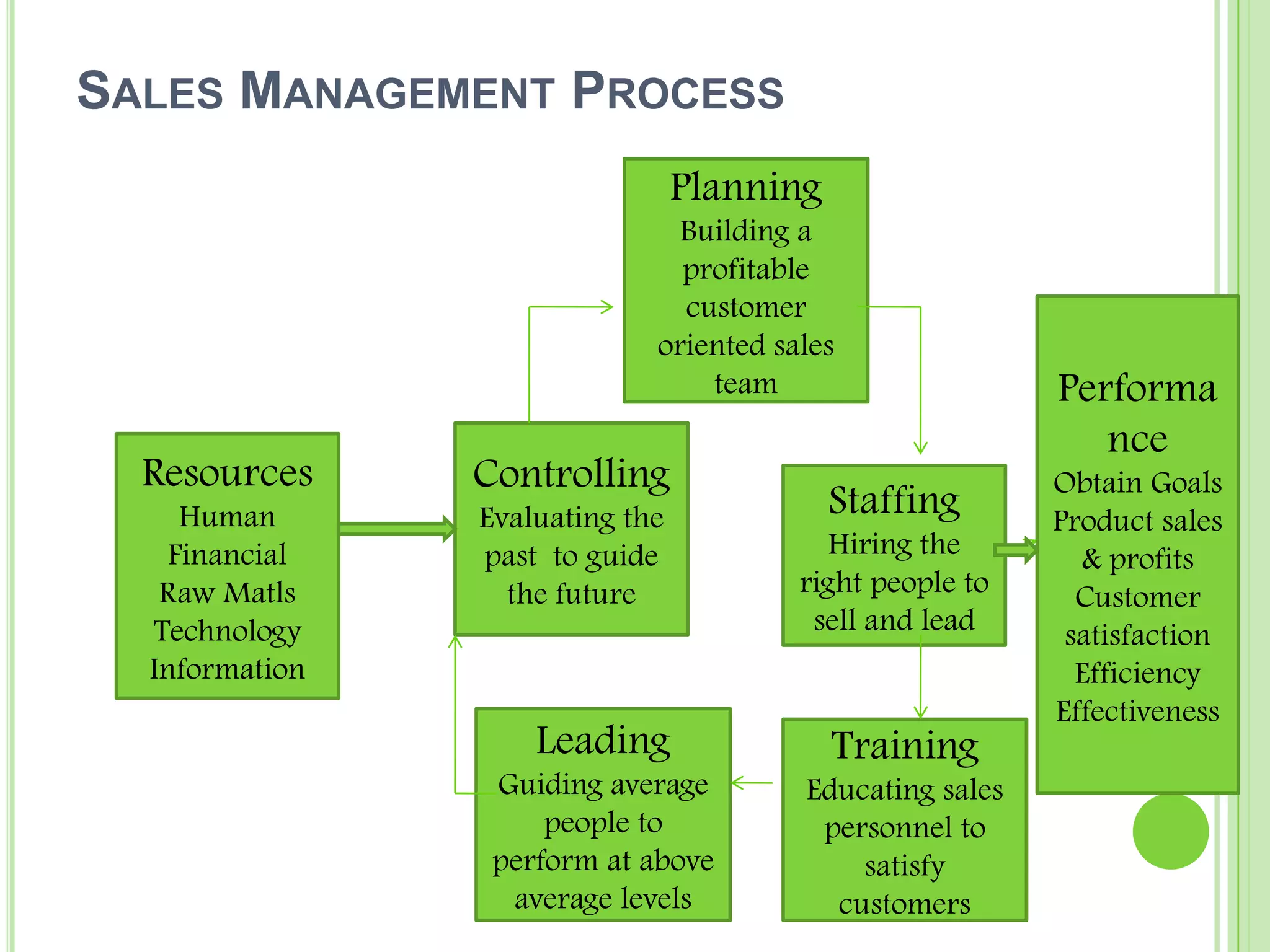
Sales Management ProcessPlanningBuilding a profitable customer oriented sales teamPerformanceObtain GoalsProduct sales & profitsCustomer satisfactionEfficiencyEffectivenessControllingEvaluating the past  to guide  the futureResourcesHumanFinancialRaw MatlsTechnologyInformationStaffing Hiring the right people to sell and leadLeadingGuiding average people to perform at above average levelsTrainingEducating sales personnel to satisfy customers
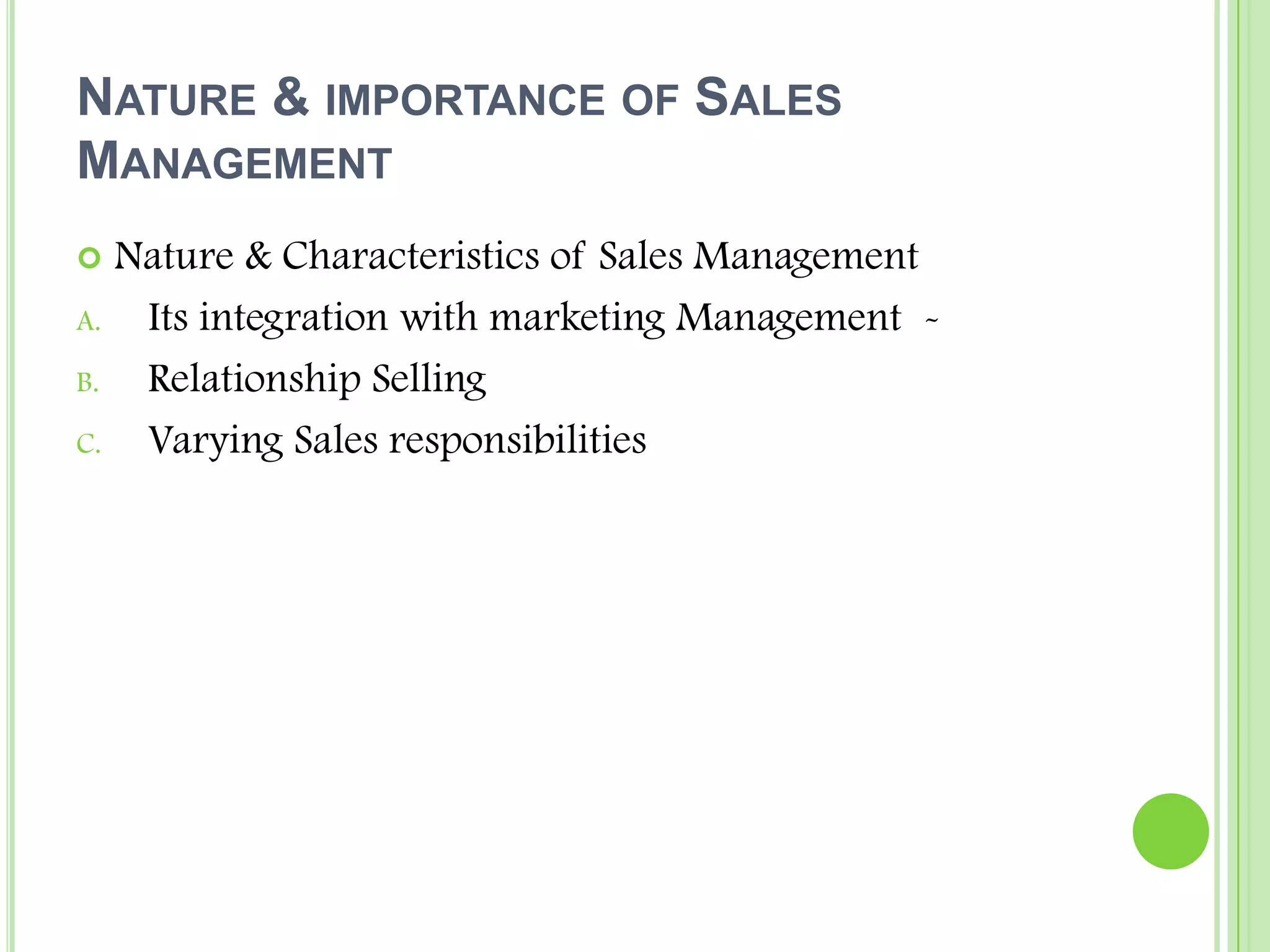
Nature & importance of Sales ManagementNature & Characteristics of Sales ManagementIts integration with marketing Management  -Relationship SellingVarying Sales responsibilities
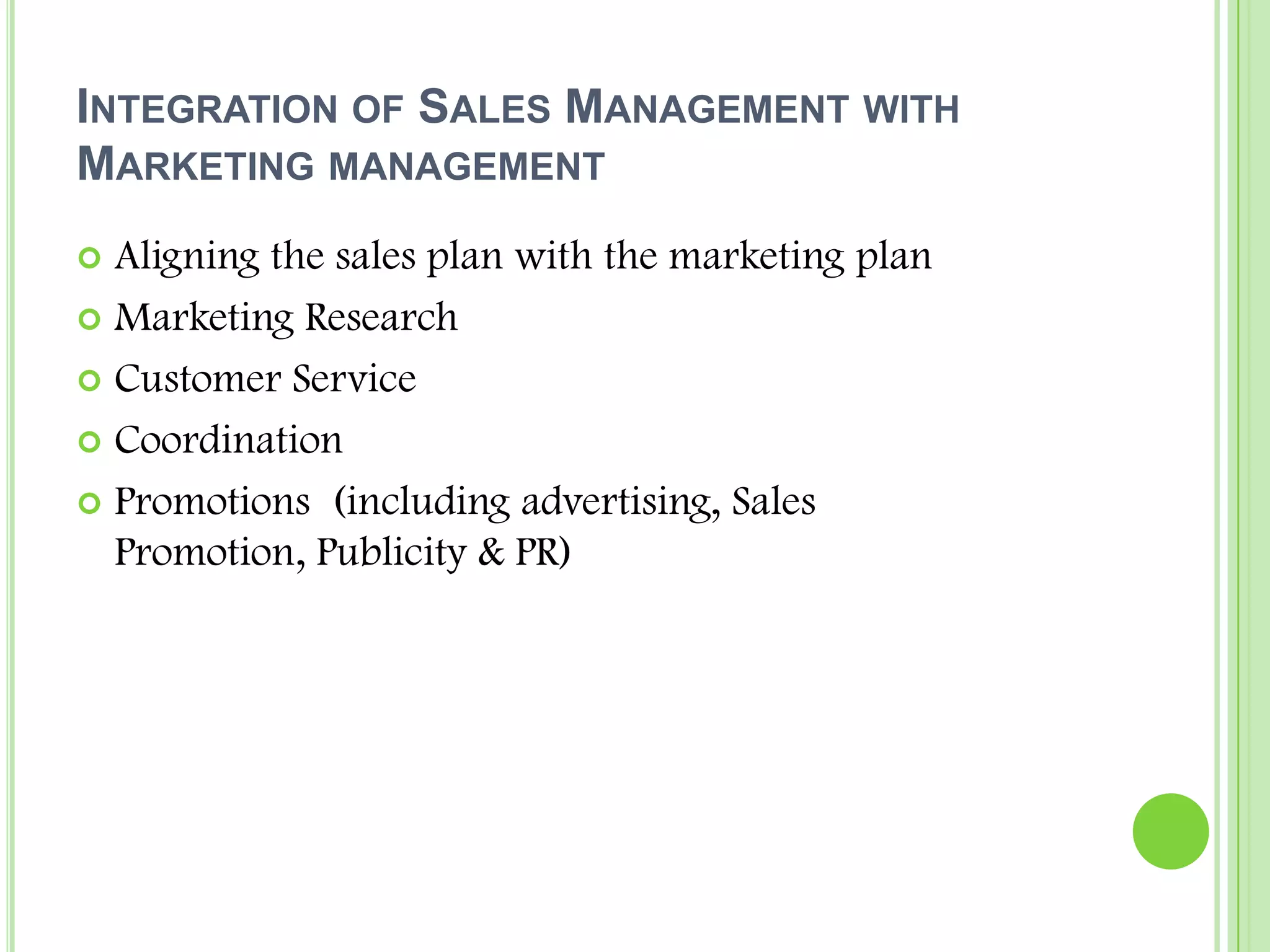
Integration of Sales Management with Marketing managementAligning the sales plan with the marketing planMarketing ResearchCustomer ServiceCoordinationPromotions  (including advertising, Sales Promotion, Publicity & PR)
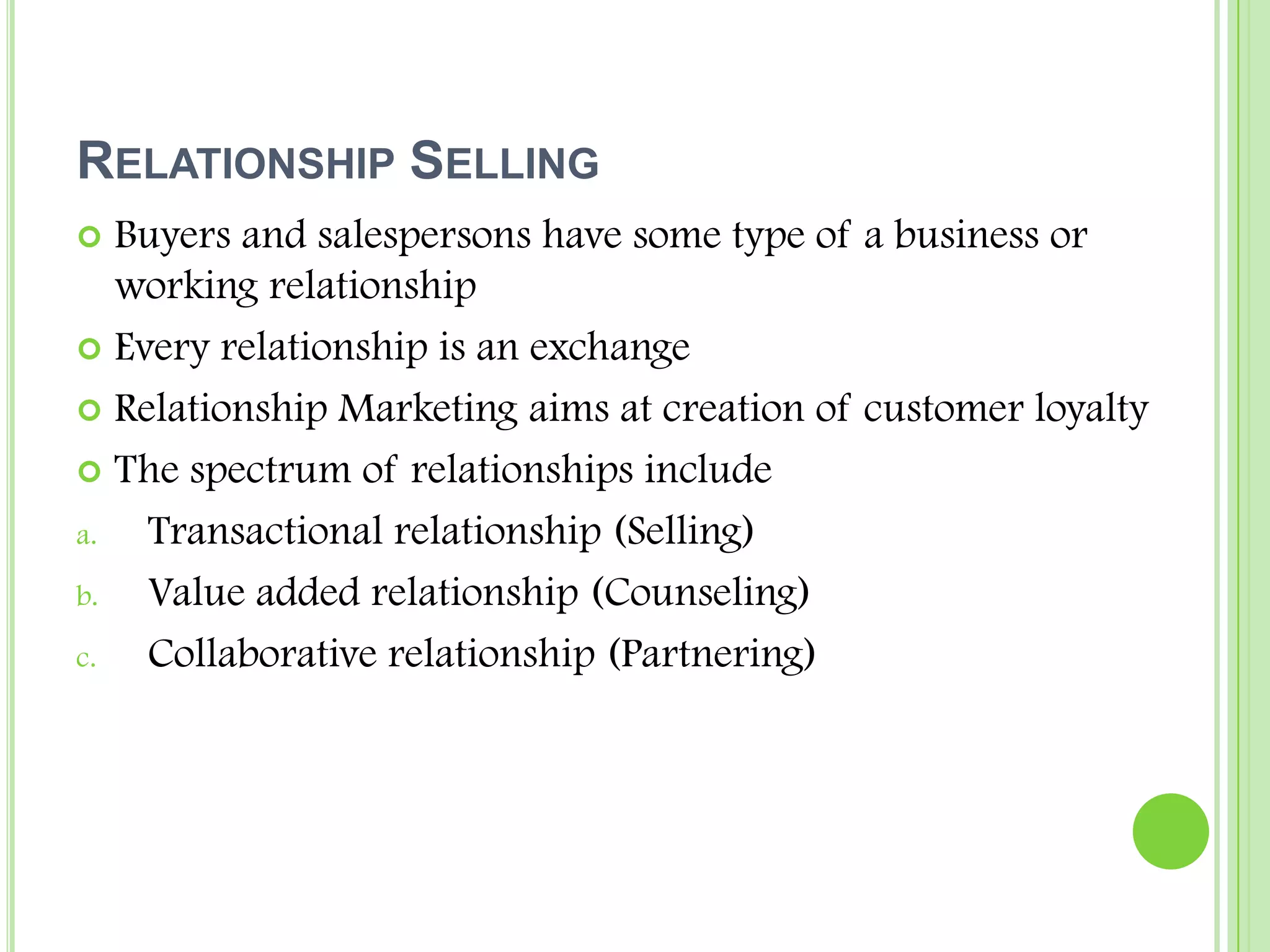
Relationship SellingBuyers and salespersons have some type of a business or working relationshipEvery relationship is an exchangeRelationship Marketing aims at creation of customer loyaltyThe spectrum of relationships includeTransactional relationship (Selling)Value added relationship (Counseling)Collaborative relationship (Partnering)
Varying    Sales responsibilitiesResponse SellingSales SupportTechnical Sales SupportDemand Creator or business developerSolution vendor
SalesmanshipSales Management, Personal Selling and Salesmanship are all related. Sales management directs the personal selling effort which is turn is implemented largely through salesmanshipSalesmanship is one aspect of personal selling and never all of it.It is one of the skills used in personal selling
Salesmanship DefinitionSalesmanship is the art of successfully persuading prospects or customers to buy products or services from which they can derive suitable benefits, thereby increasing their total satisfaction.It is also defined as a seller initiated effort that provides prospective buyers with information and other benefits, motivating or persuading them to decide in favour of the sellers products or services
Specific Characteristics of a successful salesmanPeople Skills – Ability to motivate, lead, communicate and coordinate effectivelyManaging Skills- Administrative skills like planning, organizing, controlling & decision makingTechnical Skills – Training, Selling skills, negotiating skills, use of IT, problem solving abilities, Product knowledge
Personal SellingIt is a direct presentation of a product to a prospective customer by a representative of the organization selling it.It takes place face to face  or over the phone and it may be directed to a business, person or a final consumer
Types of Objectives of Personal SellingSome of the Objectives of personal selling are:To shoulder the entire responsibility of the promotion mix (when no other element of Promotion mix is used)To maintain contact with existing customers, take orders etc (also known as servicing existing accounts)To search and obtain new customers
Objectives ….contd…To secure customers cooperation in stocking and promoting the product lineTo inform and educate customersTo assist customers in selection To provide technical assistanceTo assist with training the middlemen’s sales personnelTo collect market information
Diversity of personal selling situations  Personal Selling situations -Service Selling	     Inside Order Taker , Delivery Salesperson ,Merchandising Salesperson, Missionary, technical Sales personDevelopmental Selling	Creative sales person of tangibles, Creative salesperson of intangibles  Creative Selling	 Political, Indirect, Back door      Salesperson  in multiple  Sales
Service SellingInside Order taker – here the salesperson waits on customers (e.g Sales Counter person)Delivery Salesperson – Engaged in delivering the product (Person who delivers Milk, Eggs)Merchandising/Route Sales Person – Works as an order taker on field mainly with retailersMissionary _Works only to create goodwill and disseminate information . Does not do any order takingTechnical Sales Person – Emphasizes technical Knowledge and educates customer
Developmental SellingCreative sales person of tangibles – Sales person selling vacuum cleaners , encyclopediasCreative sales person of intangibles- Sales person selling Insurance, advertising services, Educational programs
Creative Selling (Basically Developmental)Political /Indirect/Back Door – Selling big ticket items by catering to the other interests of the customers (which have no connection with the product)Salespersons engaged in multiple sales- Where the sales person is required to make presentation to various entities of an organization (Ad agency salespersons making presentations to selection committee, creative department, product department etc)
Theories of sellingIs selling a science which can be taught and has several basic concepts?ORIs it an art which can be learned through experience?This has led to two contrasting approaches to theories of sellingThe first approach relies on Experiential learningThe second approach draws from fundamental concepts of behavioral sciences
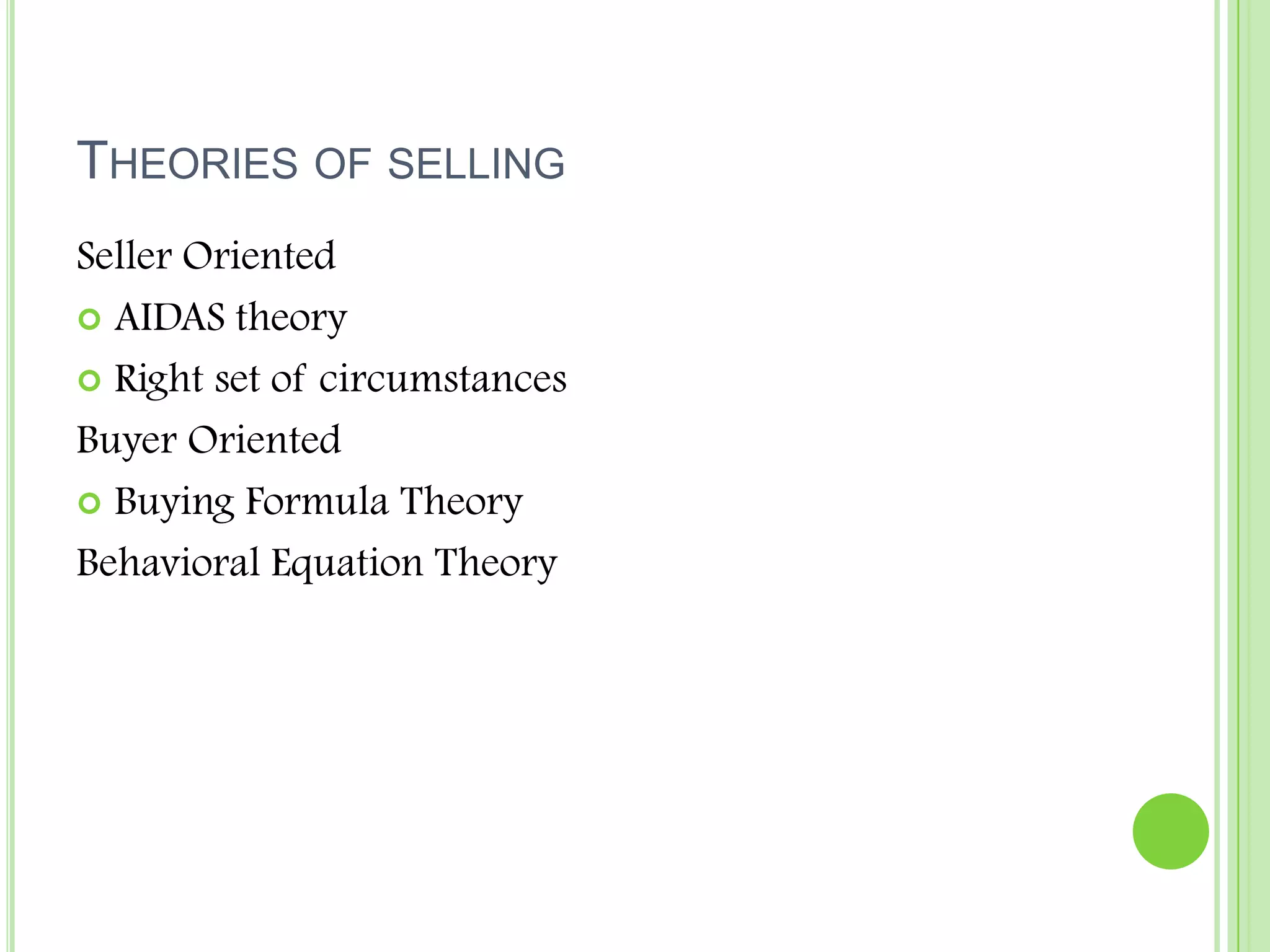
Theories of sellingSeller OrientedAIDAS theoryRight set of circumstancesBuyer OrientedBuying Formula TheoryBehavioral Equation Theory
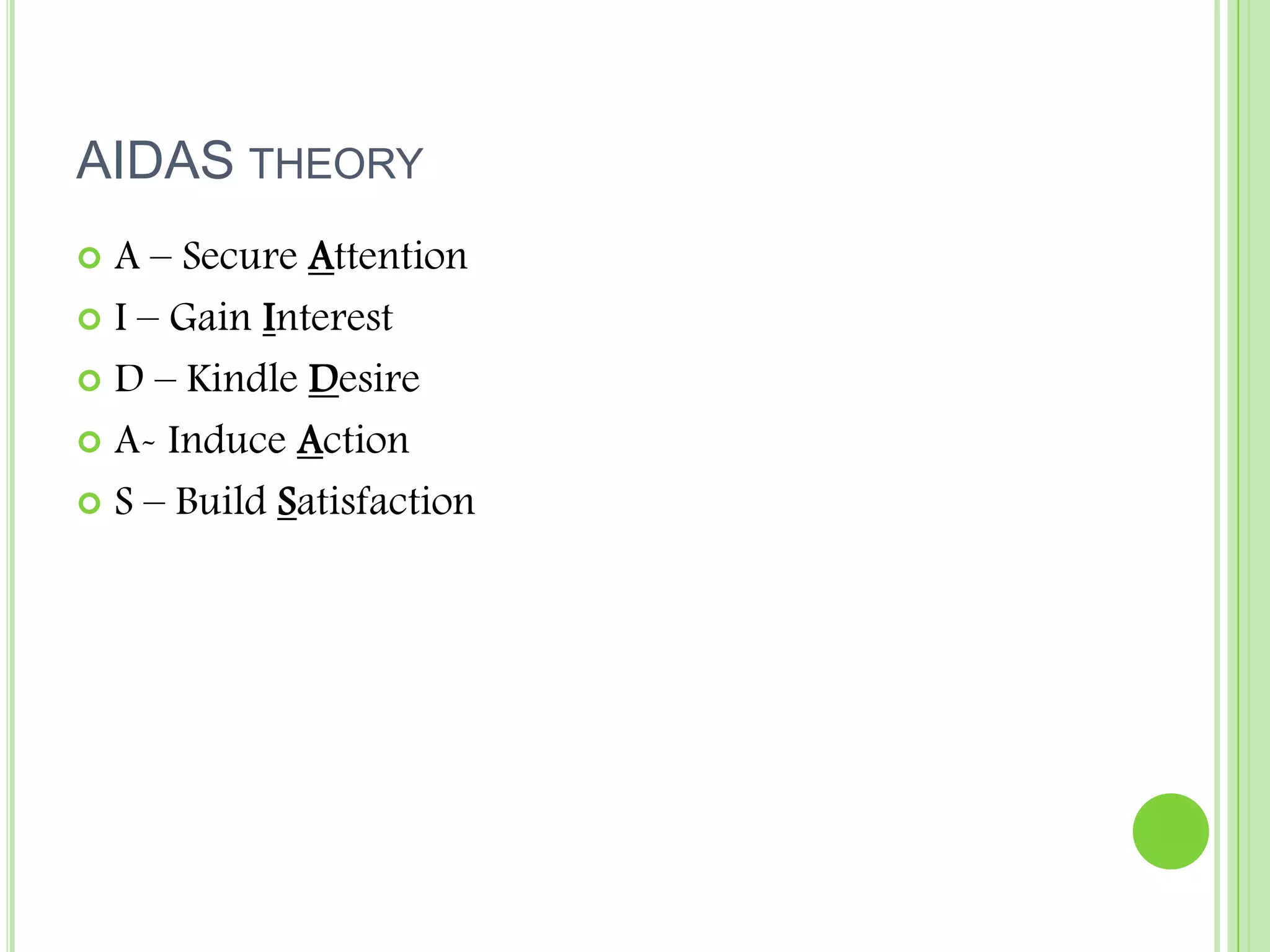
AIDAS theoryA – Secure AttentionI – Gain InterestD – Kindle DesireA- Induce ActionS – Build Satisfaction
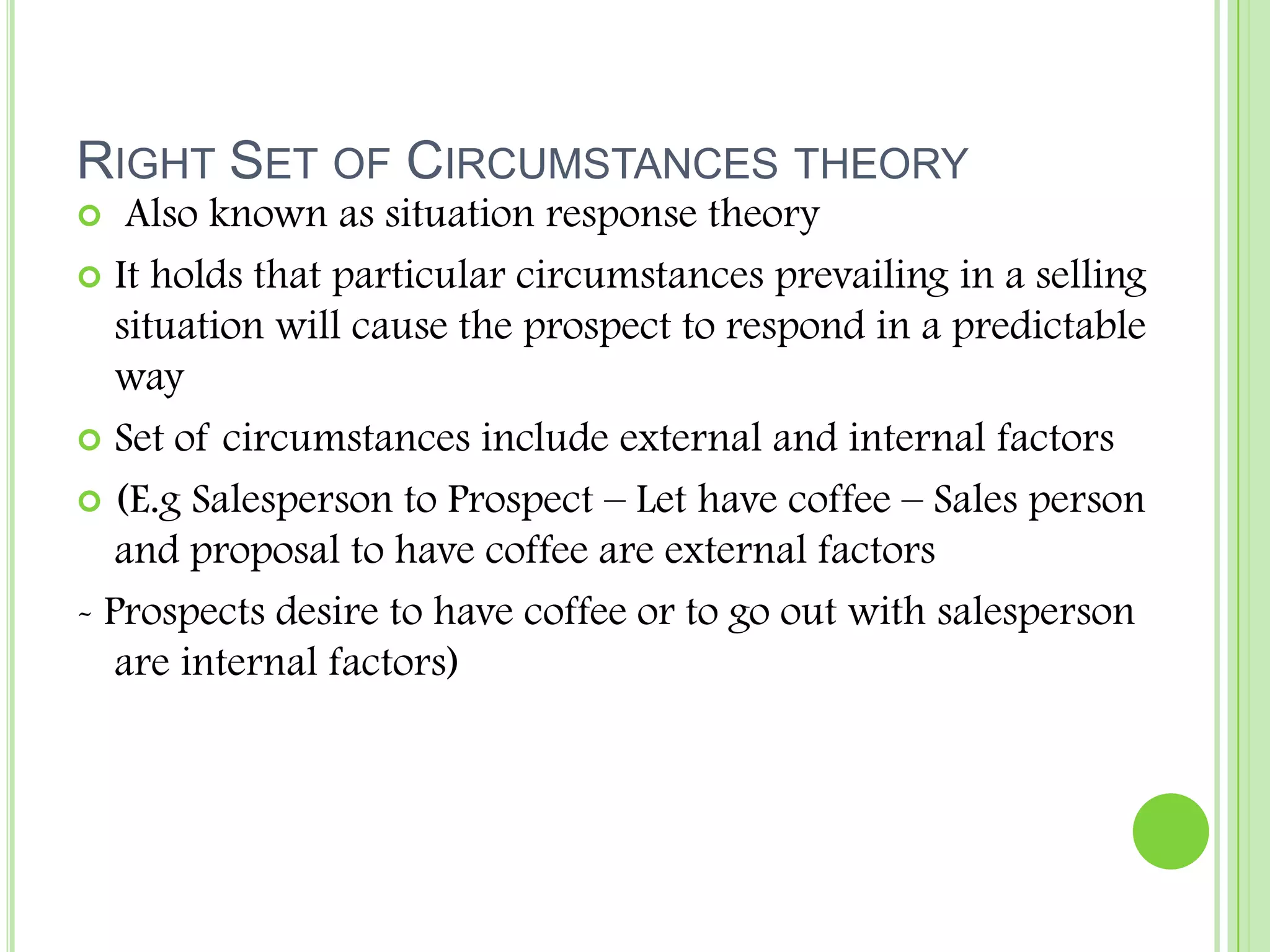
Right Set of Circumstances theory Also known as situation response theoryIt holds that particular circumstances prevailing in a selling situation will cause the prospect to respond in a predictable waySet of circumstances include external and internal factors(E.g Salesperson to Prospect – Let have coffee – Sales person and proposal to have coffee are external factors- Prospects desire to have coffee or to go out with salesperson are internal factors)
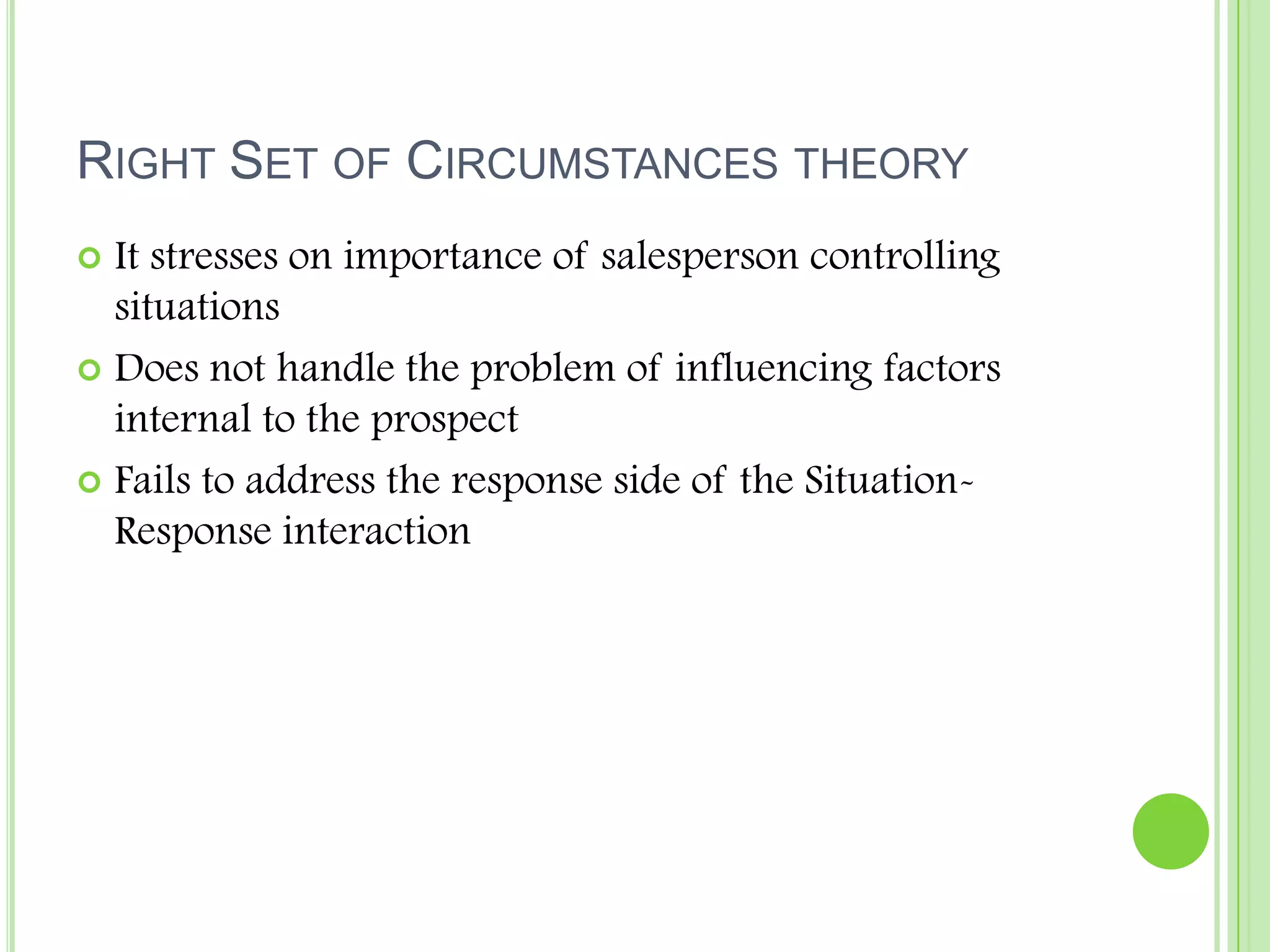
Right Set of Circumstances theoryIt stresses on importance of salesperson controlling situationsDoes not handle the problem of influencing factors internal to the prospectFails to address the response side of the Situation-Response interaction
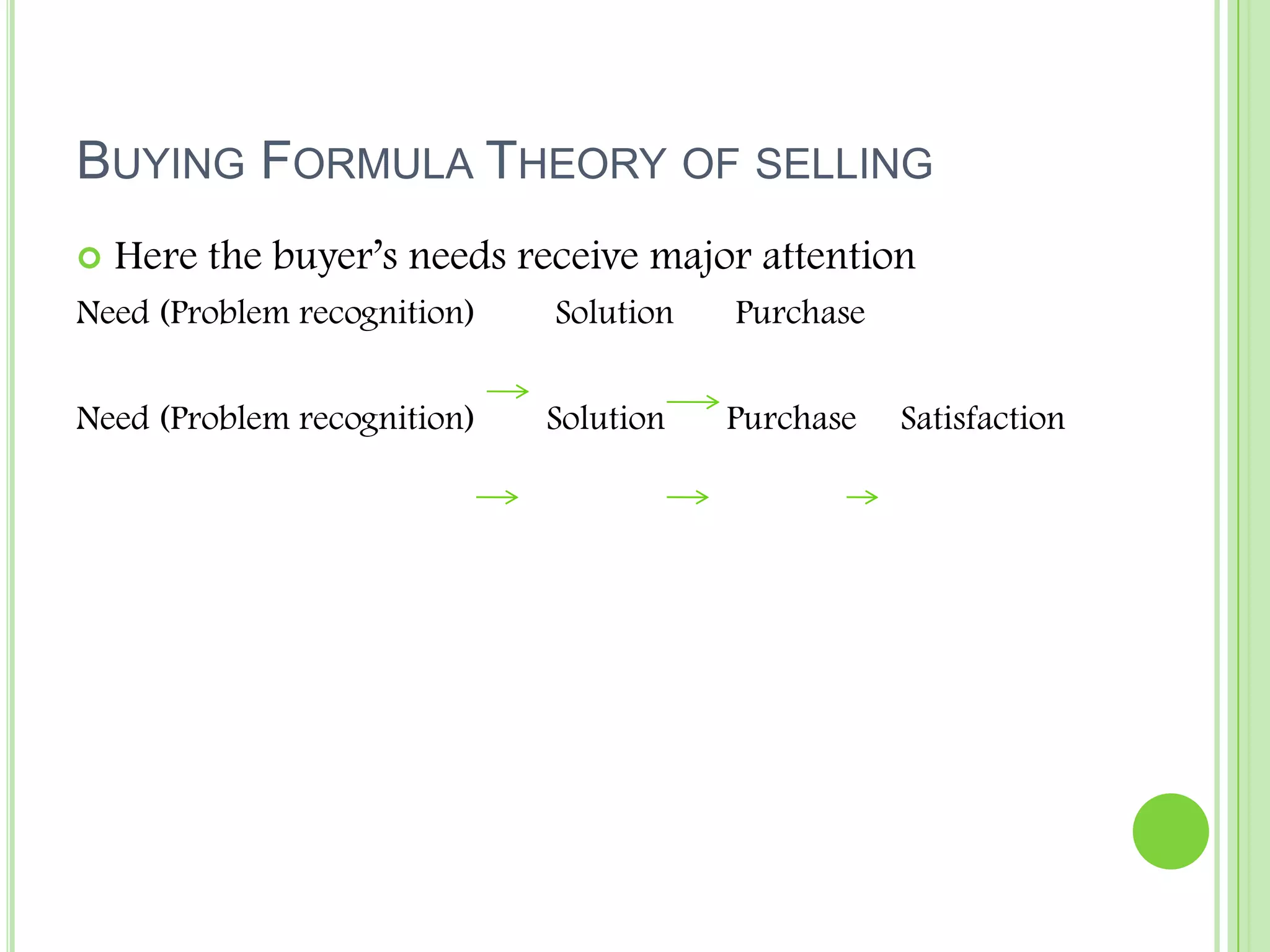
Buying Formula Theory of sellingHere the buyer’s needs receive major attentionNeed (Problem recognition)         Solution       PurchaseNeed (Problem recognition)        Solution       Purchase     Satisfaction
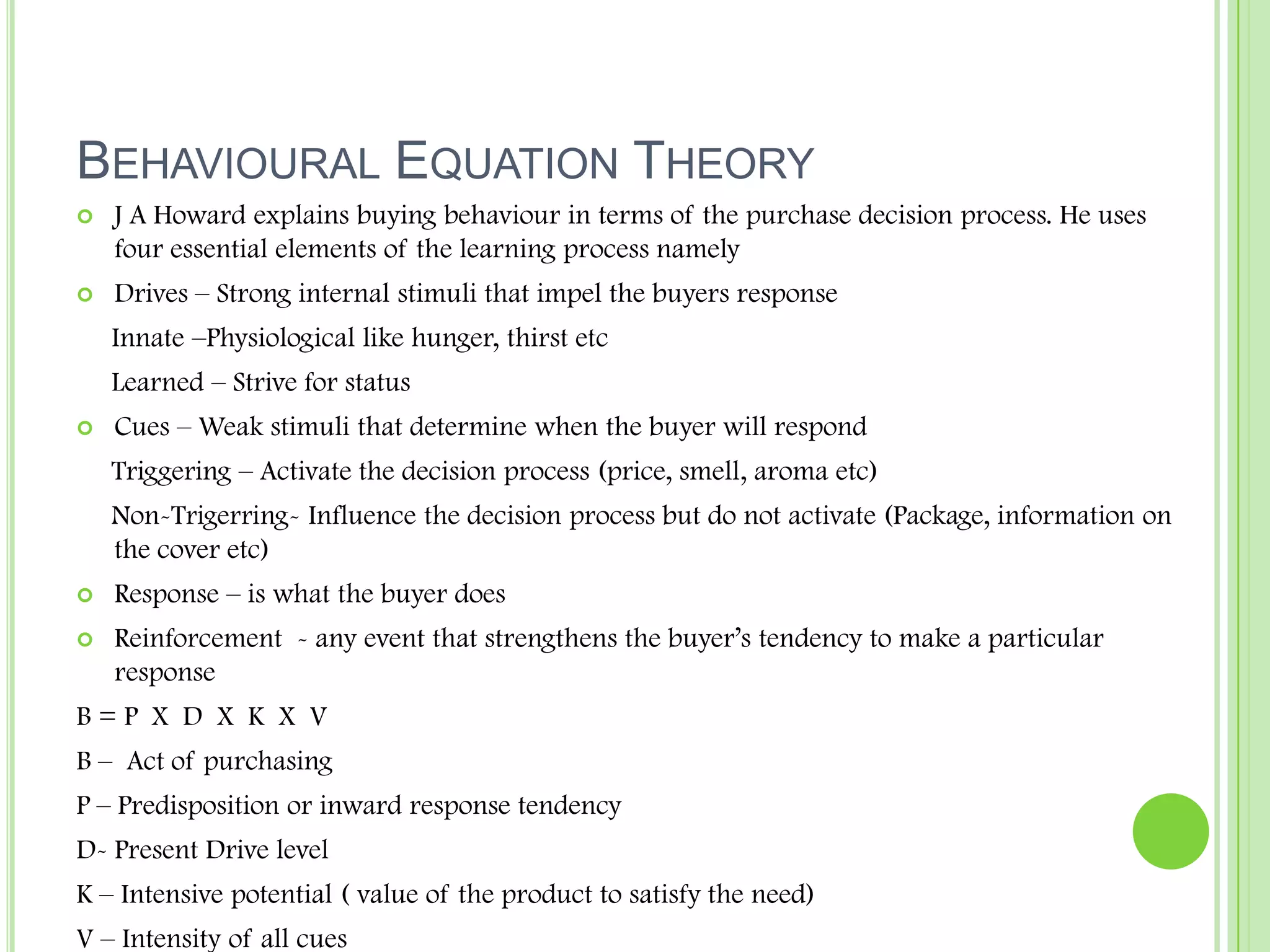
Behavioural Equation TheoryJ A Howard explains buying behaviour in terms of the purchase decision process. He uses four essential elements of the learning process namely Drives – Strong internal stimuli that impel the buyers response      Innate –Physiological like hunger, thirst etc     Learned – Strive for statusCues – Weak stimuli that determine when the buyer will respond     Triggering – Activate the decision process (price, smell, aroma etc)     Non-Trigerring- Influence the decision process but do not activate (Package, information on the cover etc)Response – is what the buyer doesReinforcement  - any event that strengthens the buyer’s tendency to make a particular responseB = P  X  D  X  K  X  VB –  Act of purchasingP – Predisposition or inward response tendencyD- Present Drive levelK – Intensive potential ( value of the product to satisfy the need)V – Intensity of all cues
ProspectingThe planning work which is essential in eliminating calls on non buyers is called as prospectingStepsFormulating prospect definitions Searching out potential accountsQualifying prospects and searching out Relating company products to each prospects requirement
Obstacles to salesSales ObjectionsRealInsincere
Closing SalesIndirect CloseDirect Close
ExerciseAs a seller of cosmetics, do a role play for selling a bag of the newly launched Revlon lipsticks to me (Roll Nos. 1-5, 6-10,11-15, 16 -20)Consider that you are a company manufacturing Photocopiers. Carry out the prospecting exercise for a new range of office automation product like  a facsimile (fax) machine (Roll Nos. 21 – 25, 26-30, 31-35, 36-40)Write down at least two examples of various types of personal selling situations (41-60)
Case Study

Chapter 1

  • 1.
    Sales Management &Personal SellingChapter 1.Concept, Nature, Role of Sales Management in Marketing, Salesmanship, Specific characteristics of a successful salesman, the evolving face of personal selling
  • 2.
    What is salesmanagement?An earlier explanation/ definition of sales management was, directing the sales force personnel.Later as the responsibilities taken up by the sales team grew and as the sales function evolved into a more holistic function a new definition has emerged :Sales Management is management of all marketing activities including advertising, sales promotion, marketing research, physical distribution, pricing and product merchandising.
  • 3.
    Current day definition of Sales ManagementThe American Marketing Association has given a current day definition of sales Management as:The planning, direction and control of personnel selling, including recruiting, selecting, equipping, assigning, routing, supervising, paying and motivating as these tasks apply to the personnel sales force
  • 4.
    Objectives of SalesmanagementFrom the Organizations Viewpoint there are three general objectives of sales managementAchieving the desired sales volumeContribution to profits in the organizationContinuing growth
  • 5.
    Sales Management ProcessPlanningBuildinga profitable customer oriented sales teamPerformanceObtain GoalsProduct sales & profitsCustomer satisfactionEfficiencyEffectivenessControllingEvaluating the past to guide the futureResourcesHumanFinancialRaw MatlsTechnologyInformationStaffing Hiring the right people to sell and leadLeadingGuiding average people to perform at above average levelsTrainingEducating sales personnel to satisfy customers
  • 6.
    Nature & importanceof Sales ManagementNature & Characteristics of Sales ManagementIts integration with marketing Management -Relationship SellingVarying Sales responsibilities
  • 7.
    Integration of SalesManagement with Marketing managementAligning the sales plan with the marketing planMarketing ResearchCustomer ServiceCoordinationPromotions (including advertising, Sales Promotion, Publicity & PR)
  • 8.
    Relationship SellingBuyers andsalespersons have some type of a business or working relationshipEvery relationship is an exchangeRelationship Marketing aims at creation of customer loyaltyThe spectrum of relationships includeTransactional relationship (Selling)Value added relationship (Counseling)Collaborative relationship (Partnering)
  • 9.
    Varying Sales responsibilitiesResponse SellingSales SupportTechnical Sales SupportDemand Creator or business developerSolution vendor
  • 10.
    SalesmanshipSales Management, PersonalSelling and Salesmanship are all related. Sales management directs the personal selling effort which is turn is implemented largely through salesmanshipSalesmanship is one aspect of personal selling and never all of it.It is one of the skills used in personal selling
  • 11.
    Salesmanship DefinitionSalesmanship isthe art of successfully persuading prospects or customers to buy products or services from which they can derive suitable benefits, thereby increasing their total satisfaction.It is also defined as a seller initiated effort that provides prospective buyers with information and other benefits, motivating or persuading them to decide in favour of the sellers products or services
  • 12.
    Specific Characteristics ofa successful salesmanPeople Skills – Ability to motivate, lead, communicate and coordinate effectivelyManaging Skills- Administrative skills like planning, organizing, controlling & decision makingTechnical Skills – Training, Selling skills, negotiating skills, use of IT, problem solving abilities, Product knowledge
  • 13.
    Personal SellingIt isa direct presentation of a product to a prospective customer by a representative of the organization selling it.It takes place face to face or over the phone and it may be directed to a business, person or a final consumer
  • 14.
    Types of Objectivesof Personal SellingSome of the Objectives of personal selling are:To shoulder the entire responsibility of the promotion mix (when no other element of Promotion mix is used)To maintain contact with existing customers, take orders etc (also known as servicing existing accounts)To search and obtain new customers
  • 15.
    Objectives ….contd…To securecustomers cooperation in stocking and promoting the product lineTo inform and educate customersTo assist customers in selection To provide technical assistanceTo assist with training the middlemen’s sales personnelTo collect market information
  • 16.
    Diversity of personalselling situations Personal Selling situations -Service Selling Inside Order Taker , Delivery Salesperson ,Merchandising Salesperson, Missionary, technical Sales personDevelopmental Selling Creative sales person of tangibles, Creative salesperson of intangibles Creative Selling Political, Indirect, Back door Salesperson in multiple Sales
  • 17.
    Service SellingInside Ordertaker – here the salesperson waits on customers (e.g Sales Counter person)Delivery Salesperson – Engaged in delivering the product (Person who delivers Milk, Eggs)Merchandising/Route Sales Person – Works as an order taker on field mainly with retailersMissionary _Works only to create goodwill and disseminate information . Does not do any order takingTechnical Sales Person – Emphasizes technical Knowledge and educates customer
  • 18.
    Developmental SellingCreative salesperson of tangibles – Sales person selling vacuum cleaners , encyclopediasCreative sales person of intangibles- Sales person selling Insurance, advertising services, Educational programs
  • 19.
    Creative Selling (BasicallyDevelopmental)Political /Indirect/Back Door – Selling big ticket items by catering to the other interests of the customers (which have no connection with the product)Salespersons engaged in multiple sales- Where the sales person is required to make presentation to various entities of an organization (Ad agency salespersons making presentations to selection committee, creative department, product department etc)
  • 20.
    Theories of sellingIsselling a science which can be taught and has several basic concepts?ORIs it an art which can be learned through experience?This has led to two contrasting approaches to theories of sellingThe first approach relies on Experiential learningThe second approach draws from fundamental concepts of behavioral sciences
  • 21.
    Theories of sellingSellerOrientedAIDAS theoryRight set of circumstancesBuyer OrientedBuying Formula TheoryBehavioral Equation Theory
  • 22.
    AIDAS theoryA –Secure AttentionI – Gain InterestD – Kindle DesireA- Induce ActionS – Build Satisfaction
  • 23.
    Right Set ofCircumstances theory Also known as situation response theoryIt holds that particular circumstances prevailing in a selling situation will cause the prospect to respond in a predictable waySet of circumstances include external and internal factors(E.g Salesperson to Prospect – Let have coffee – Sales person and proposal to have coffee are external factors- Prospects desire to have coffee or to go out with salesperson are internal factors)
  • 24.
    Right Set ofCircumstances theoryIt stresses on importance of salesperson controlling situationsDoes not handle the problem of influencing factors internal to the prospectFails to address the response side of the Situation-Response interaction
  • 25.
    Buying Formula Theoryof sellingHere the buyer’s needs receive major attentionNeed (Problem recognition) Solution PurchaseNeed (Problem recognition) Solution Purchase Satisfaction
  • 26.
    Behavioural Equation TheoryJA Howard explains buying behaviour in terms of the purchase decision process. He uses four essential elements of the learning process namely Drives – Strong internal stimuli that impel the buyers response Innate –Physiological like hunger, thirst etc Learned – Strive for statusCues – Weak stimuli that determine when the buyer will respond Triggering – Activate the decision process (price, smell, aroma etc) Non-Trigerring- Influence the decision process but do not activate (Package, information on the cover etc)Response – is what the buyer doesReinforcement - any event that strengthens the buyer’s tendency to make a particular responseB = P X D X K X VB – Act of purchasingP – Predisposition or inward response tendencyD- Present Drive levelK – Intensive potential ( value of the product to satisfy the need)V – Intensity of all cues
  • 27.
    ProspectingThe planning workwhich is essential in eliminating calls on non buyers is called as prospectingStepsFormulating prospect definitions Searching out potential accountsQualifying prospects and searching out Relating company products to each prospects requirement
  • 28.
    Obstacles to salesSalesObjectionsRealInsincere
  • 29.
  • 30.
    ExerciseAs a sellerof cosmetics, do a role play for selling a bag of the newly launched Revlon lipsticks to me (Roll Nos. 1-5, 6-10,11-15, 16 -20)Consider that you are a company manufacturing Photocopiers. Carry out the prospecting exercise for a new range of office automation product like a facsimile (fax) machine (Roll Nos. 21 – 25, 26-30, 31-35, 36-40)Write down at least two examples of various types of personal selling situations (41-60)
  • 31.