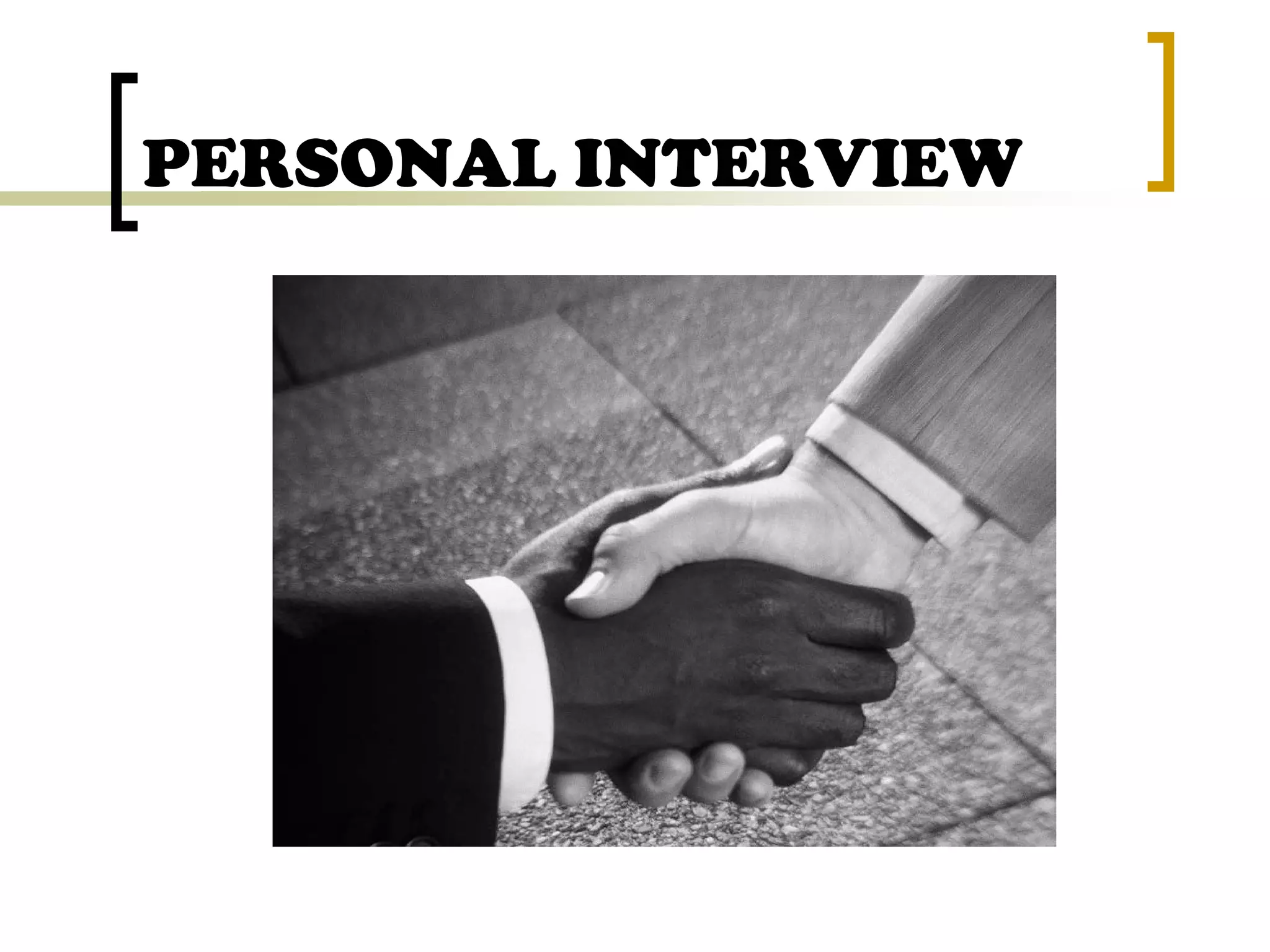
PERSONAL INTERVIEW


NOTE:
use these skills with caution…
you could end up getting every job
you apply for !
Interview goals: Job
candidate


Obtain information about position and organization



Determine whether position is suitable for you



Communicate important information about yourself



Favorably impress the employer
Tailoring your curriculum vitae:


What does the company need?



You may need to make the dates a little vague if there are
gaps in your career



Summarize ambitions and key achievements at the top ; keep
personal details to a minimum



Employment details in date order with the most recent at the
top



List your personal selling points (punctuality, honesty, ability to
communicate ,loyalty, efficiency-consciousness)
Before the interview


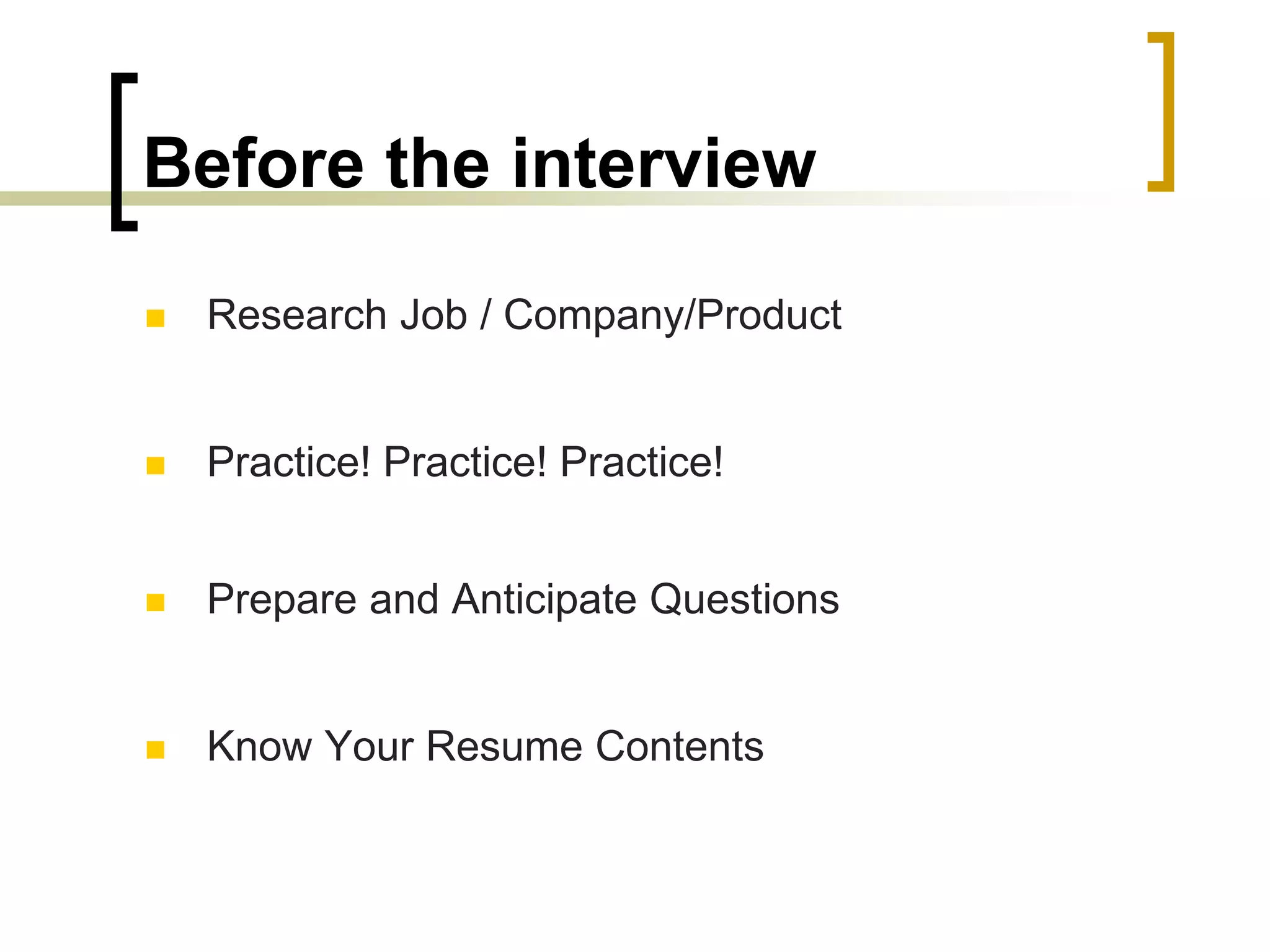
Research Job / Company/Product



Practice! Practice! Practice!



Prepare and Anticipate Questions



Know Your Resume Contents
Before the interview


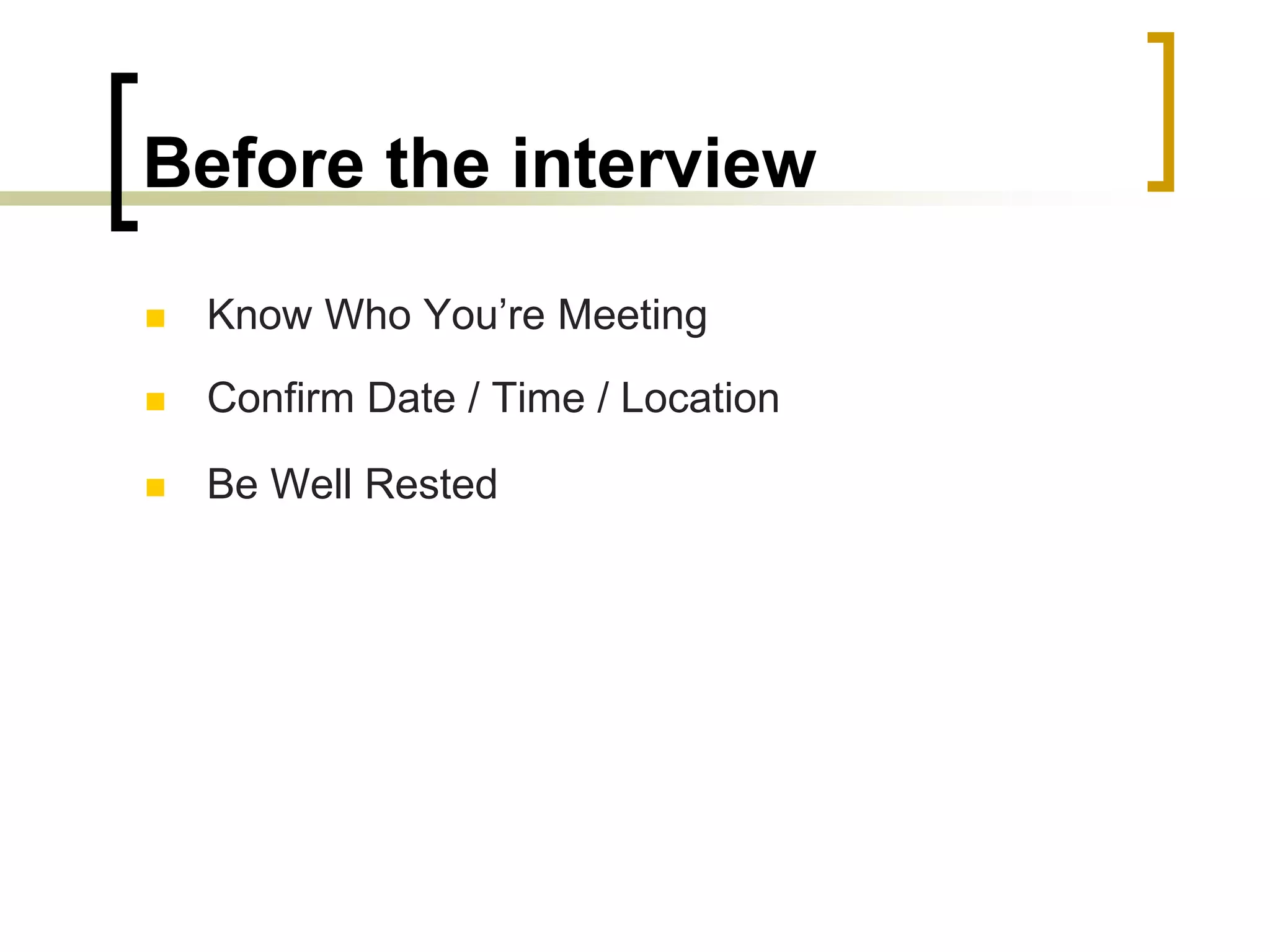
Know Who You’re Meeting



Confirm Date / Time / Location



Be Well Rested
Day of the interview


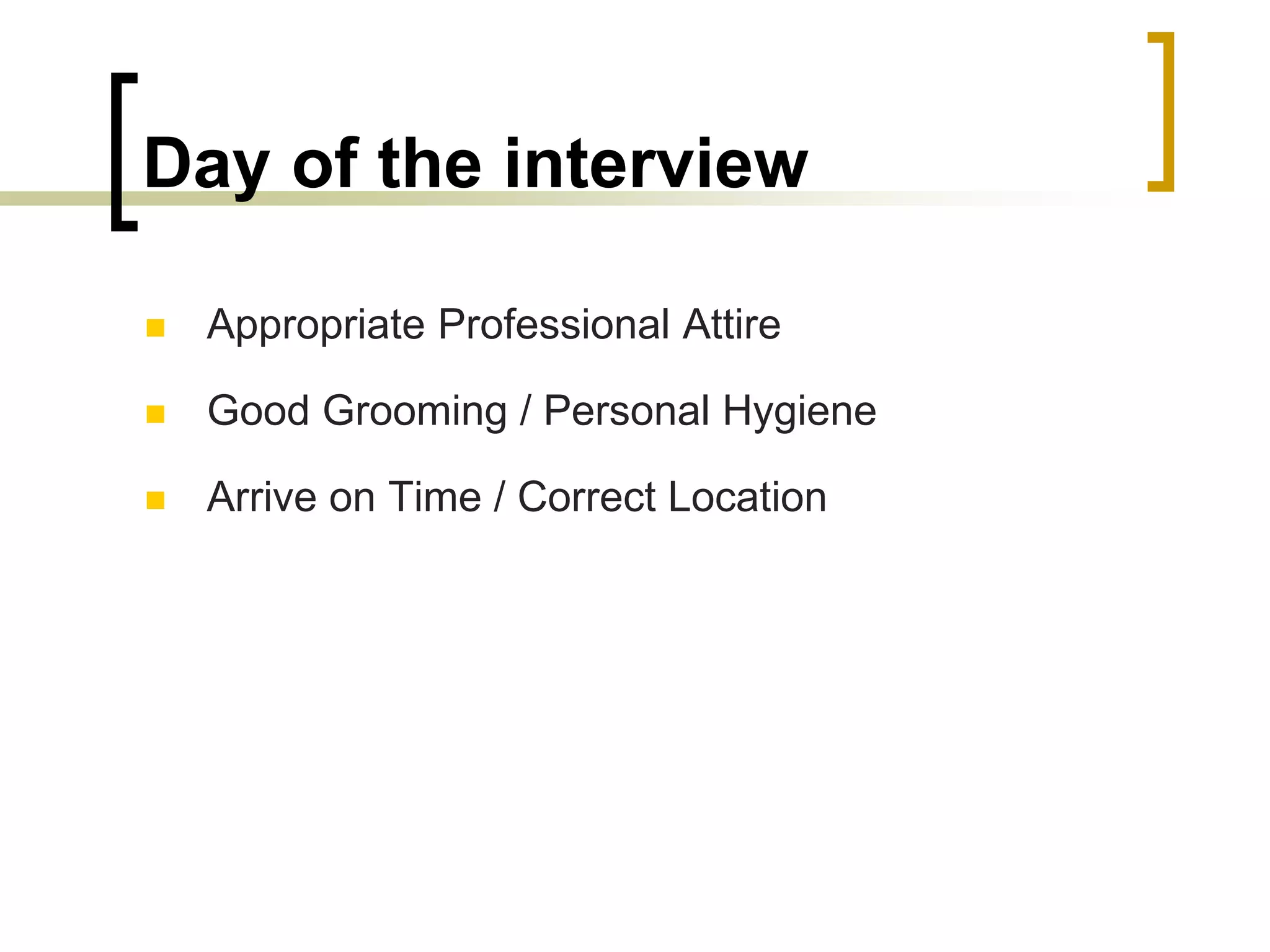
Appropriate Professional Attire



Good Grooming / Personal Hygiene



Arrive on Time / Correct Location
Day of the interview


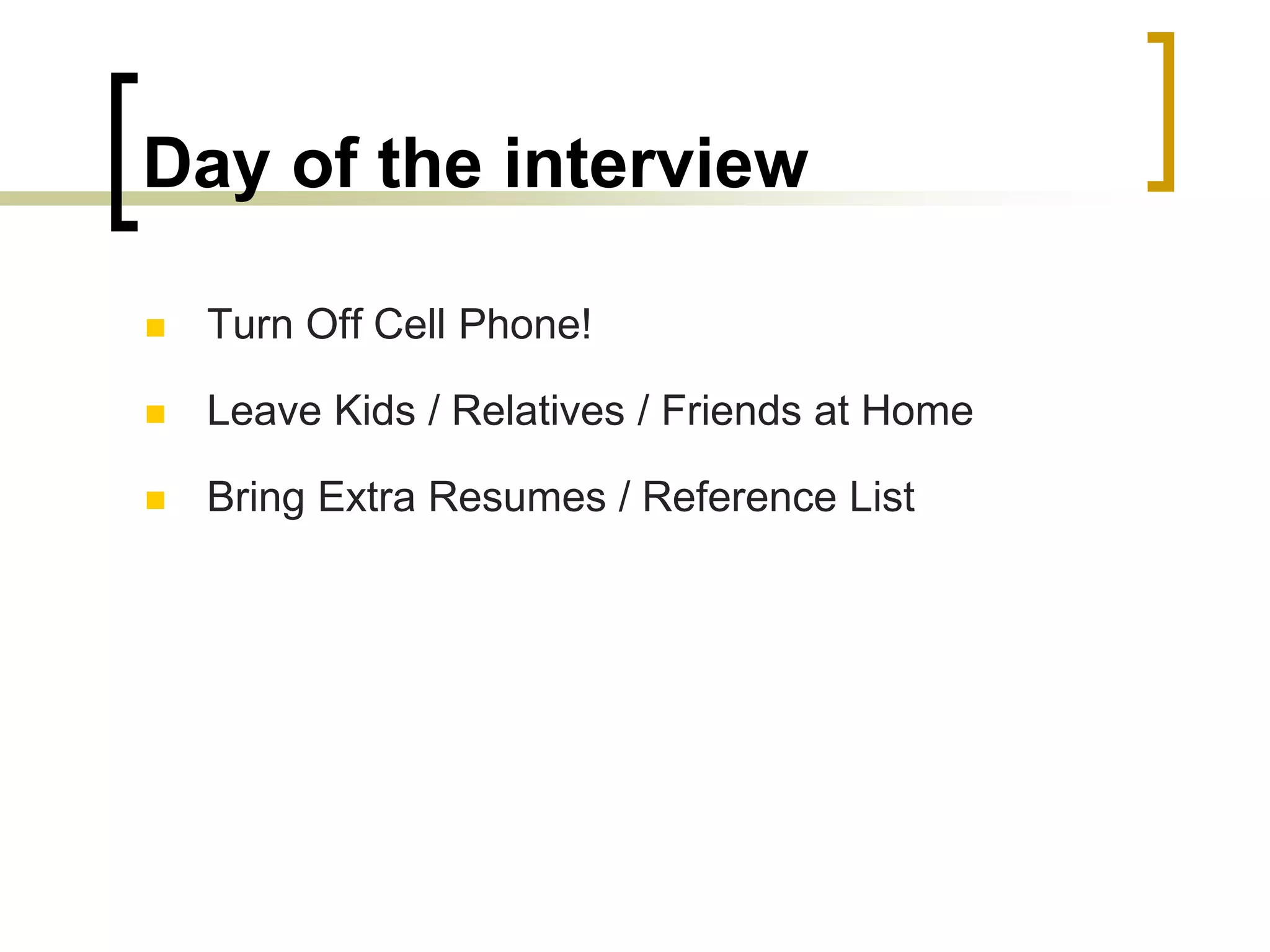
Turn Off Cell Phone!



Leave Kids / Relatives / Friends at Home



Bring Extra Resumes / Reference List
Establishing rapport with the
interviewer:( things that really matter)


Who do they choose? At the end of the day, they choose the
guy they like best.


Are you comfortable with people who are senior to you in
status?



Do you find it difficult to relax and be open with authority
figures?



Are you stiff and even sometimes a little aggressive?



Or excessively quiet and unassertive?
Opening moves:


Be aware of your surroundings and people waiting
for you



Take you out of yourself and be less self conscious

You are a “celebrity” for whom people are waiting for, so walk
with confidence
Opening moves:


Smile



Make eye contact



Wait to be invited to sit



Address the interviewer formally unless invited to
use first names



Speak clearly ( don’t be nervous)
Pacing and leading:


Don’t assume that the interviewer controls your
pace



Take it to a level which enables you to make your
best impression



Match the speed of your gestures and voice and
ease down to a manageable speed



Interviewer’s level of interest will rise with your own
if you can moderate the pace
During the interview


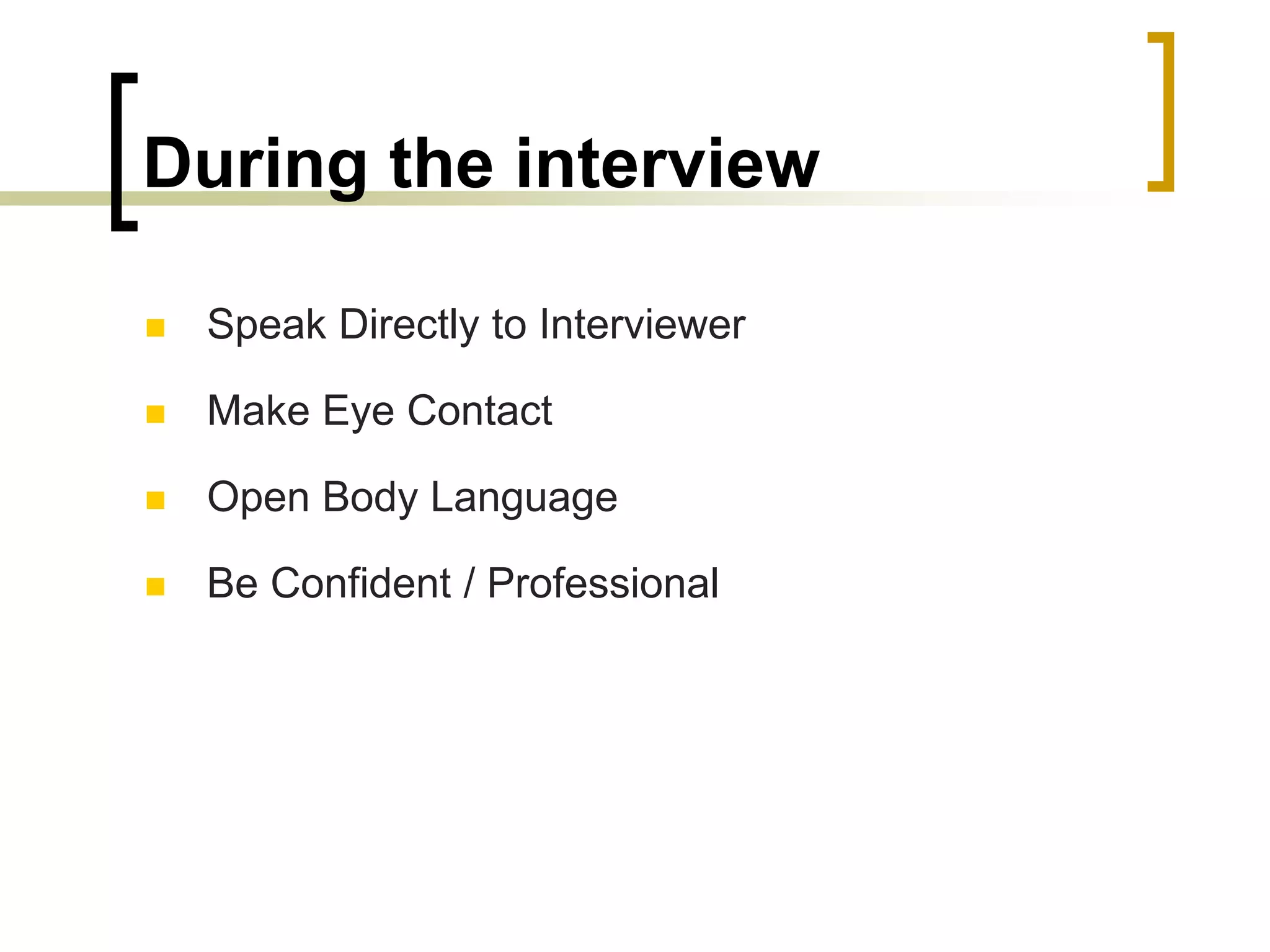
Speak Directly to Interviewer



Make Eye Contact



Open Body Language



Be Confident / Professional
During the interview


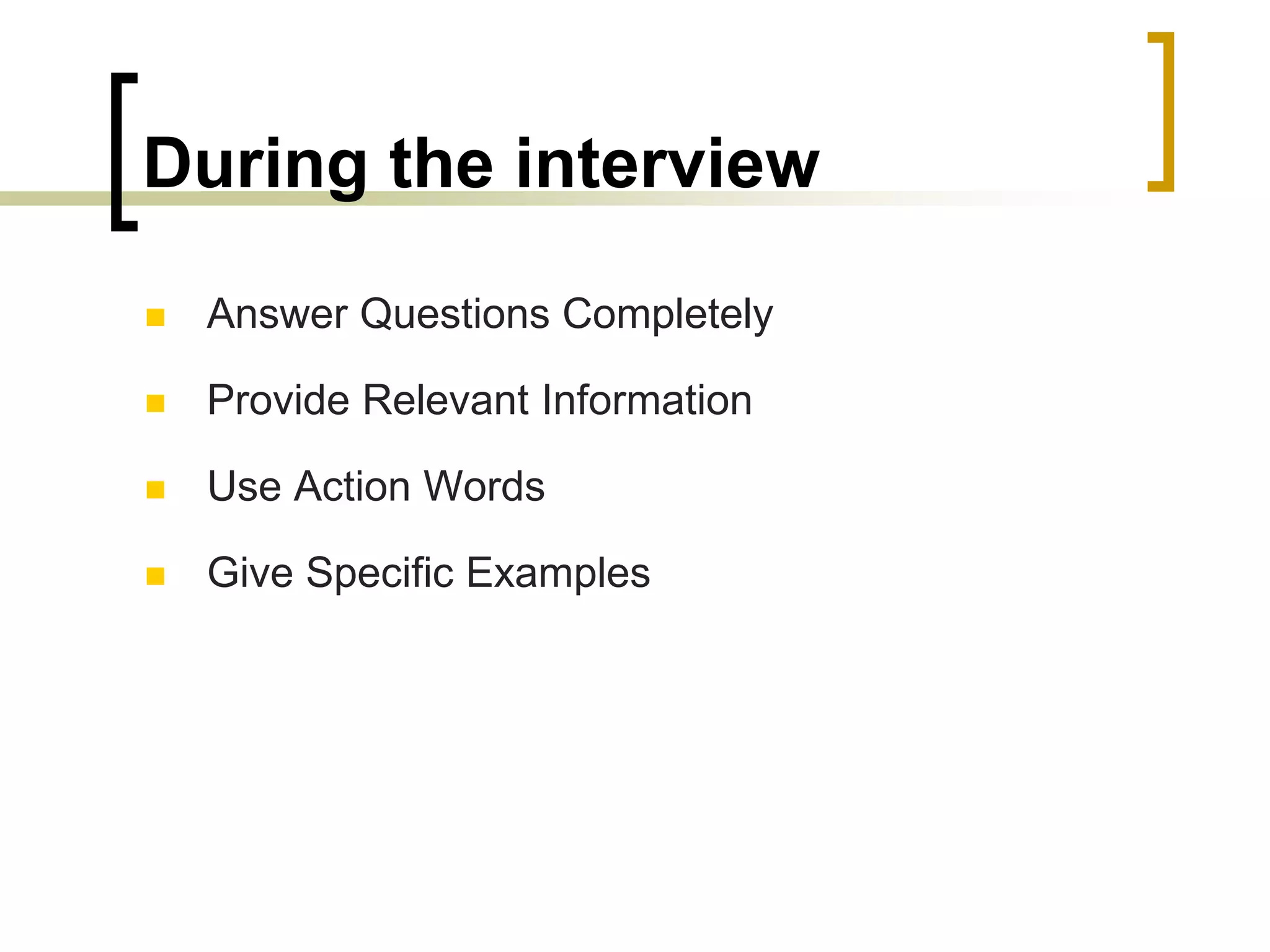
Answer Questions Completely



Provide Relevant Information



Use Action Words



Give Specific Examples
During the interview


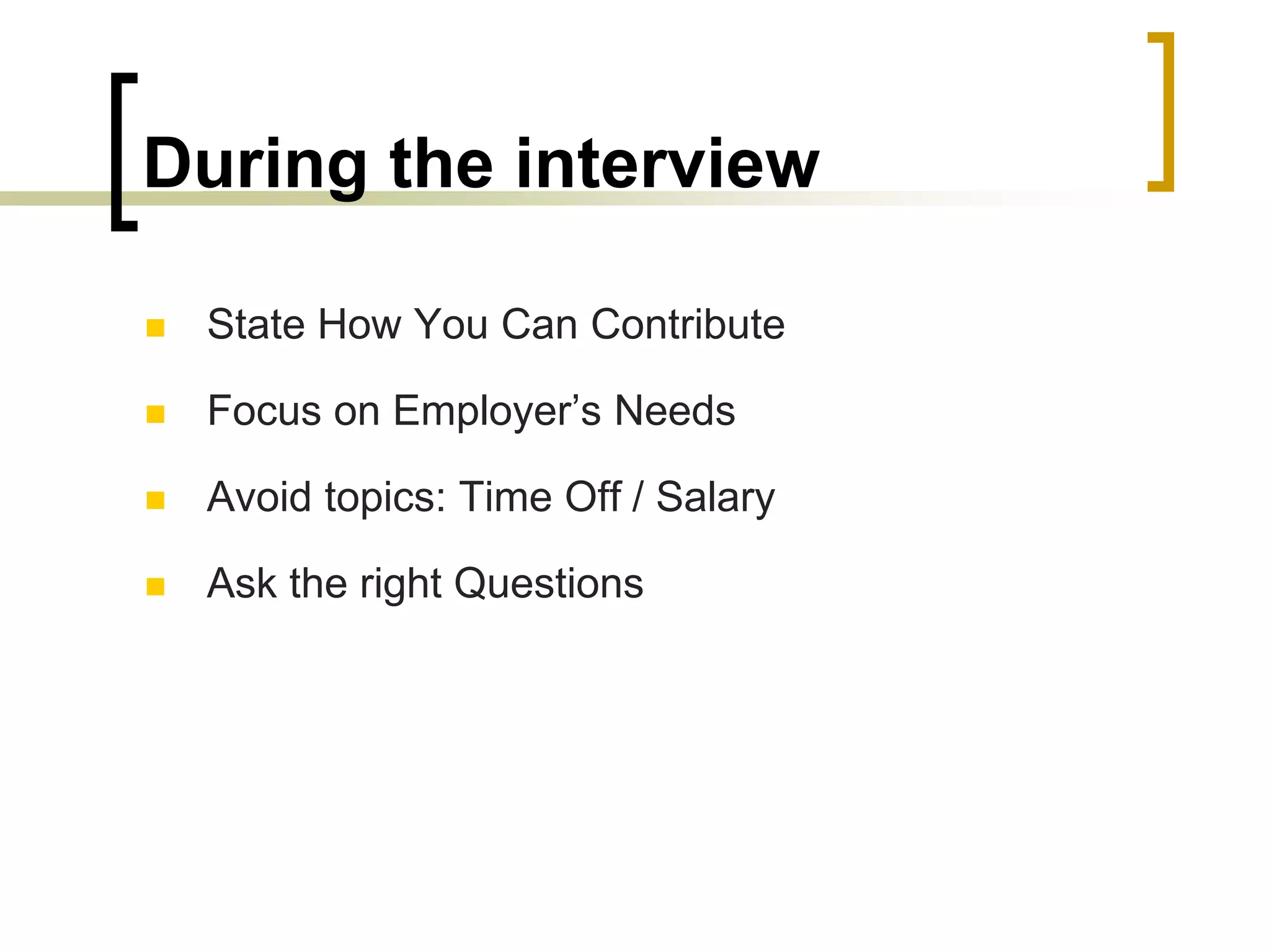
State How You Can Contribute



Focus on Employer’s Needs



Avoid topics: Time Off / Salary



Ask the right Questions
Thinking on your feet
Buying signals:


The interviewer is trying to fit you into a slot in the
organisation



Demonstrate that you are the right size and shape
for that particular slot



Analyze the job criteria and decide what to sell
Asking questions:


Asking right questions are as important as answering the
questions right



Asking questions gives you control and breathing space

Eg: What kind of performance appraisal questions do you have?
What would be the opportunities of growth in the organisation?


Save the worst till the last (about pay, conditions, equal rights,
benefits etc)



There is no rule against asking direct questions and no prize
for being unnecessarily devious
Controlling the content:


Focus your mind on your strong points



Let go the part of your experience, which is
irrelevant to your potential employer



A well written CV gives you lots of hooks for focus
on your good points and achievements



Make sure you at least have an informed opinion on
any books, films that you may refer to in the
interview
Listening skills:


Your interviewer will tell you exactly what they want to hear-if u listen
carefully



Active listening prompts the person you are listening to and help
them relax



It builds rapport



You can use the following carefully:



Nodding



Interested facial expression



Attentive body language, leaning forward, alert
Being remembered for right
reasons:


Looking good



Feeling good



Sounding good



Seeing eye to eye
Looking good:


Concentrate on looking clean and smart than glamorous



Make sure you are:



Clean: shower and wear clean clothes and shoes, minimize
perfume and aftershave



Covered



Checked: for smudges and dandruff



creaseless: do not wear linen
Feeling good:


Charm is the quality in others that makes us more satisfied
with ourselves



Smile



If you find yourself in an interview situation where stress or an
aggressive interviewer is winding you up like a spring then you
may use the following:



Breath deeply and slowly



Imagine your interviewer as a cartoon character (use this only
if someone is seriously threatening)
Sounding good:


Clear



Polite



Mature



fluent
Seeing eye to eye:


Don’t gaze for too long and make the interviewer
uncomfortable



Don’t be too shifty



Don’t look directly at the person’s eyes (focusing on
their nose or forehead may be comfortable)



The sincerity triangle runs between the eyes and
down to the nose



Avoid the triangle which includes the nose and
mouth
After the interview


Send Thank You Letter



Emphasize Your Interest



Follow Up With Phone Call
Interview mistakes


Arrive Late / Wrong Time / Place



Too Much Cologne / Makeup



Monotone Voice
Interview mistakes


Use Interviewer’s First Name



Without Permission



Talk About Personal Problems



Use Street Slang
Interview mistakes


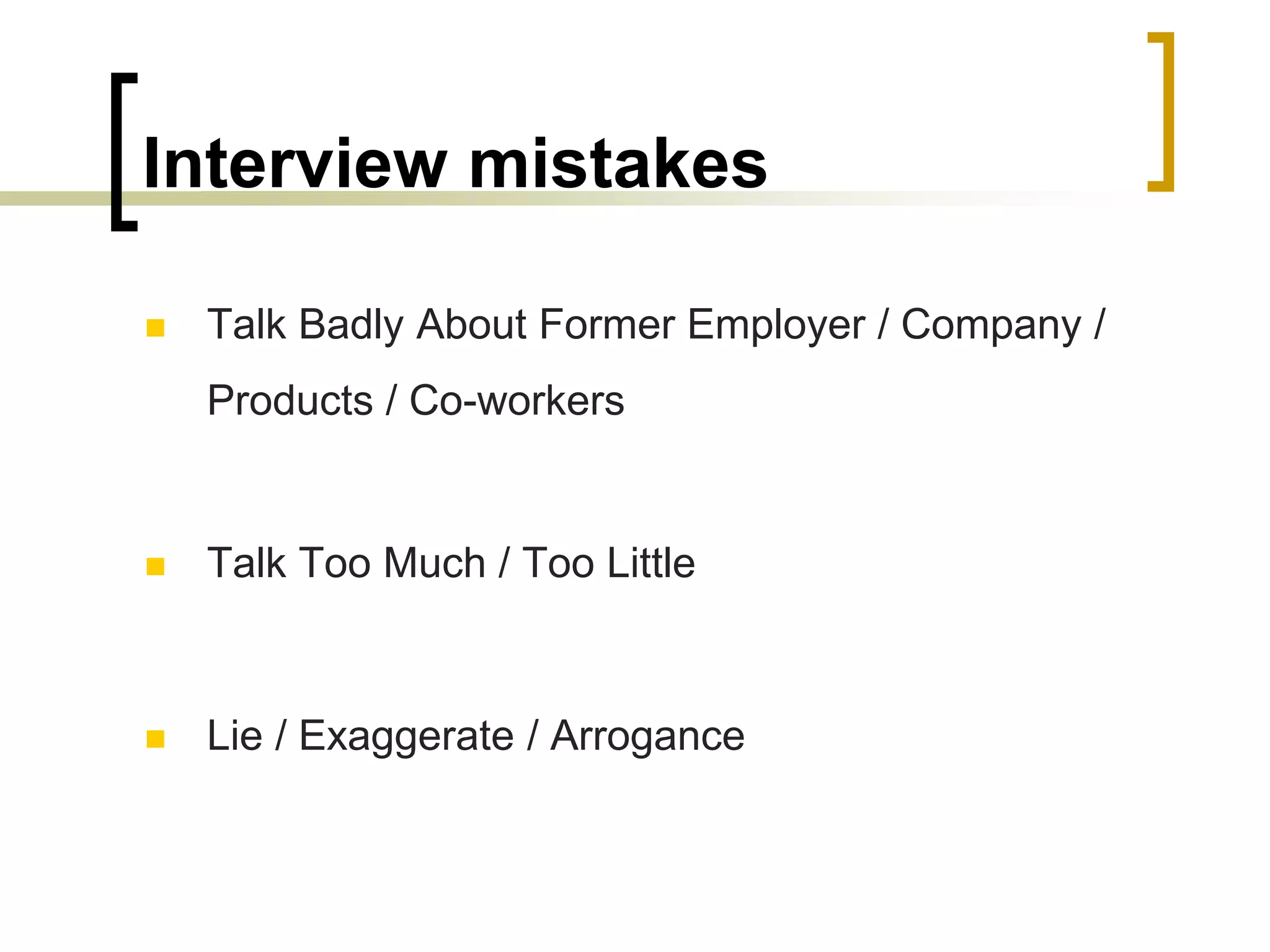
Talk Badly About Former Employer / Company /
Products / Co-workers



Talk Too Much / Too Little



Lie / Exaggerate / Arrogance
Interview mistakes


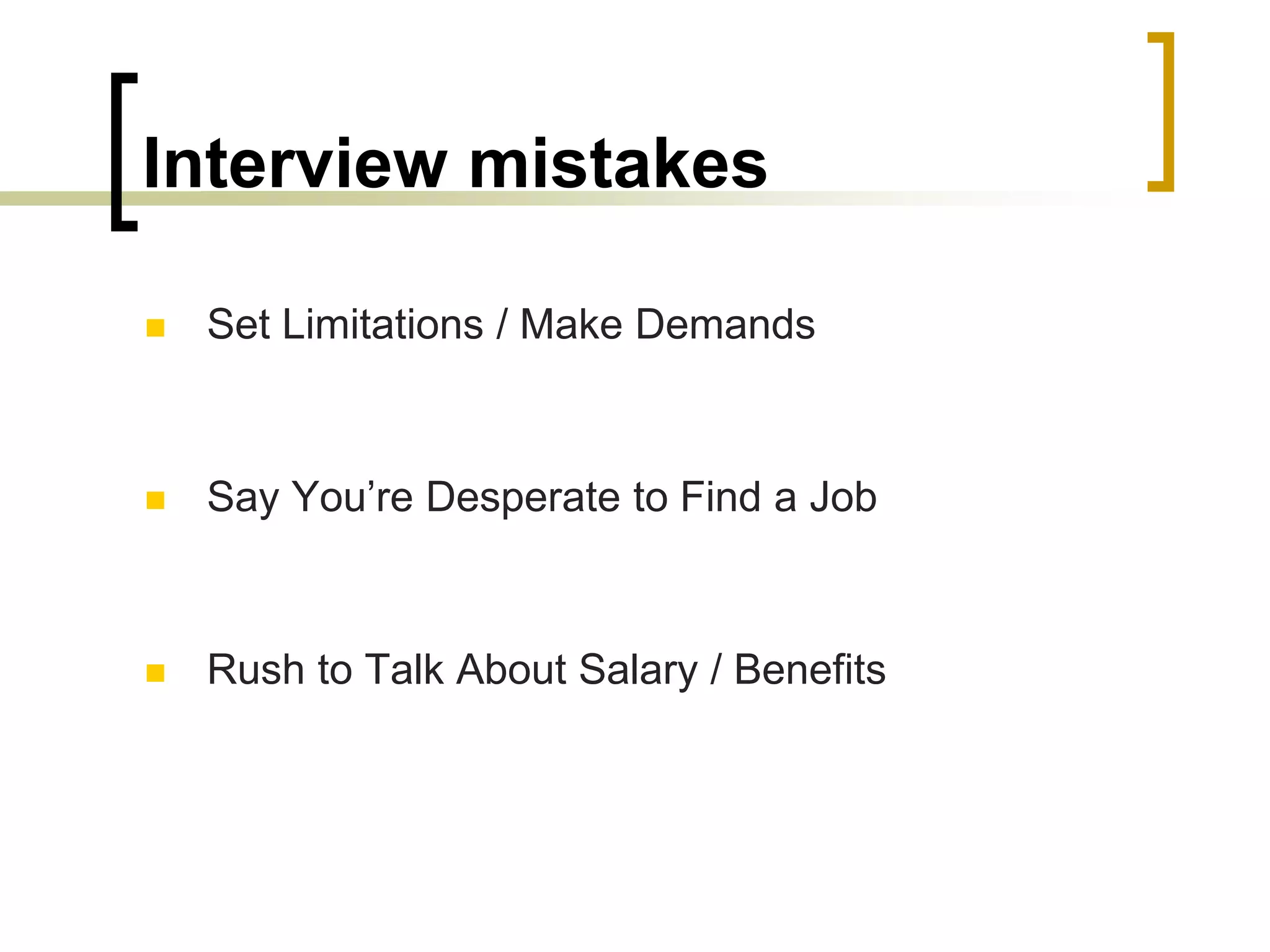
Set Limitations / Make Demands



Say You’re Desperate to Find a Job



Rush to Talk About Salary / Benefits
Common dreaded questions


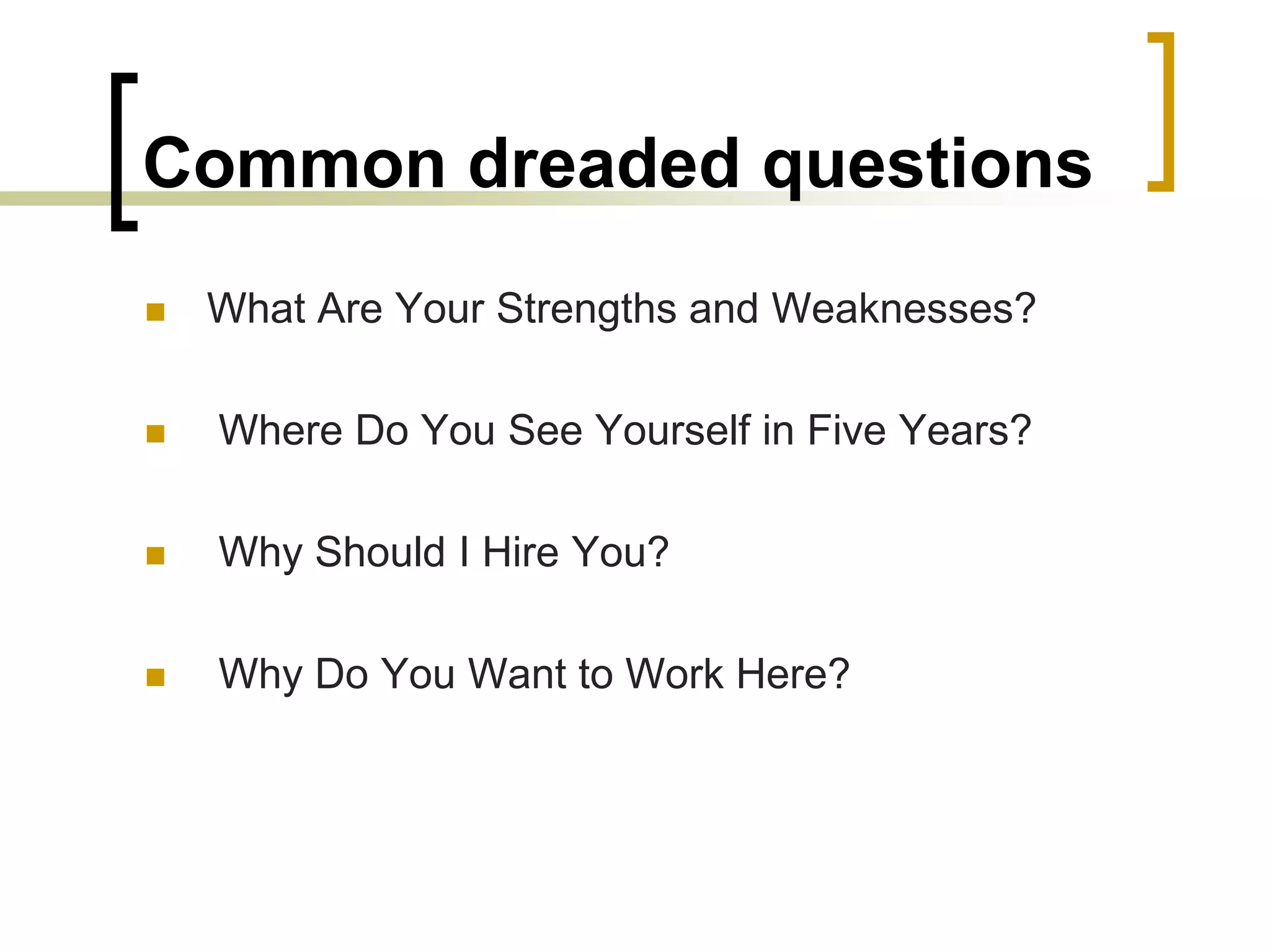
What Are Your Strengths and Weaknesses?



Where Do You See Yourself in Five Years?



Why Should I Hire You?



Why Do You Want to Work Here?
Common dreaded questions


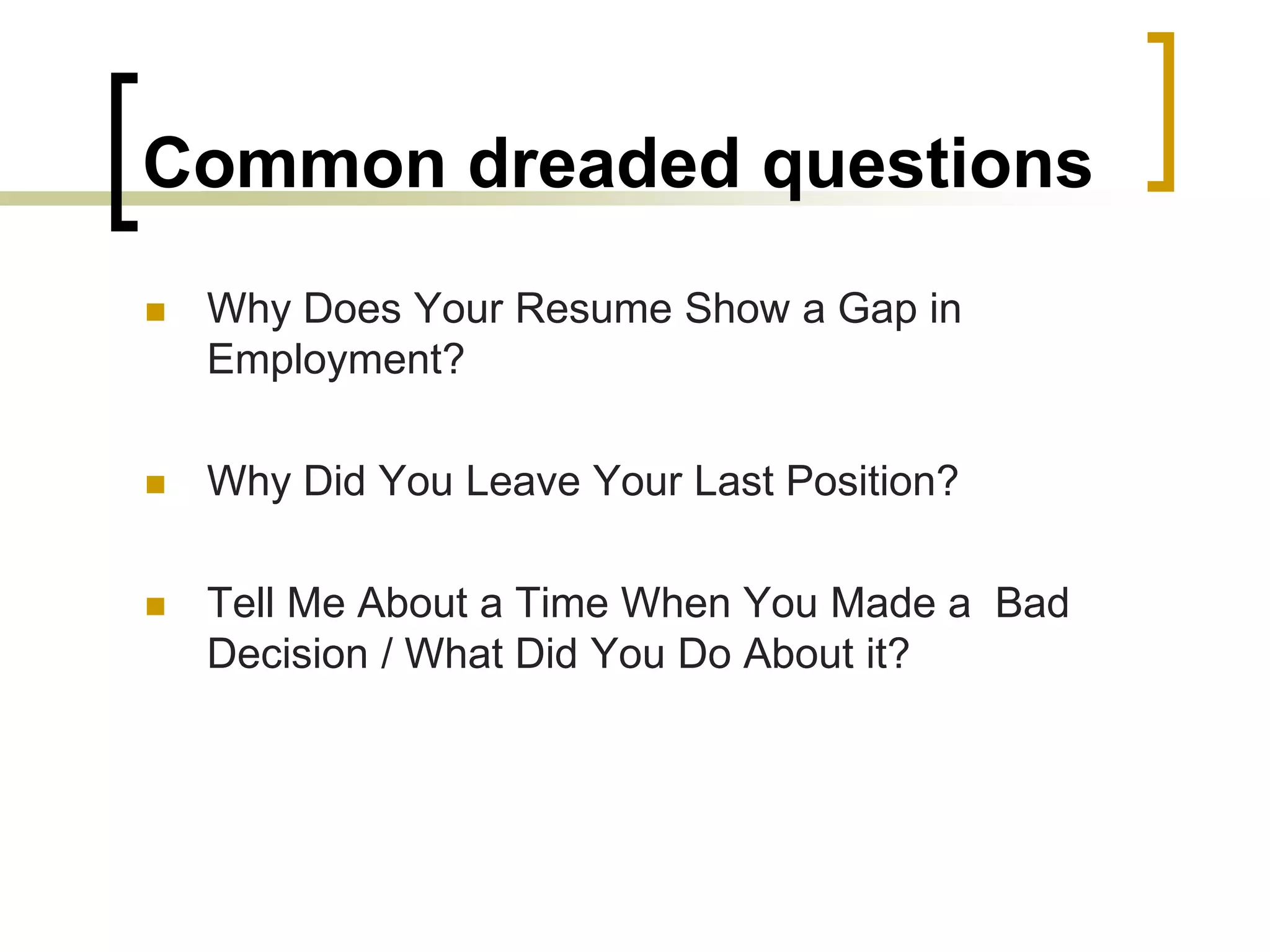
Why Does Your Resume Show a Gap in
Employment?



Why Did You Leave Your Last Position?



Tell Me About a Time When You Made a Bad
Decision / What Did You Do About it?
Human resources tips:







Be prepared
Location and punctuality
Be professional
Be polite
Be positive
Be practical
Typical questions and
suggested answers:


Tell me about yourself?
I am down-to-earth, smart, creative, industrious,
and thorough
Prepare a customized write up based on what kind
of interview you are about to appear for and
rehearse it many times
Why should we employ you?








I have good co-ordination skills
Good analytical skills
Ability to motivate people
I don’t lose my cool even during emergencies
Good entrepreneurial skills
Good team player
Ability to work in difficult conditions
(try to give appropriate examples)
What do you know about our
company?


Do not give your opinions about the company



Stick to reported facts that you have gathered from
newspapers and so on



Talk about the product portfolio, size, income, and
market perceptions of the company
Why should we choose you
over someone else?


Talk clearly about problems that you have solved in
your College/Project Team and highlight the quality
required
How much do you think you
are worth?


you would know how much other people in similar
jobs are paid. Quote the range upfront



If you can bring some extra skills to the table, do
not hesitate to ask for more than the market value
Which is more important to you-salary,
perks or growth opportunities?


be true to yourself



If you think this is a negotiation move, then say
clearly that you will never sell yourself short
What do you expect to be doing five
years from now? Ten years from now?


The interviewer is looking for evidence of career
goals and ambitions



The interviewer wants to see your thought process
and the criteria that are important to you
Criteria based questions:












These are the likely criteria for which the interviewer may be
looking for:
Initiative
Stress tolerance
Adaptability
Leadership
Problem analysis
Interpersonal skills
Team attitude
Reliability
Persuasiveness
Innovation
How do you plan your day?




By asking this question the interviewer might be
trying to find how well organised you are
“I review the day before I go to sleep at night and make
some final notes in my diary about anything that’s left
over. Then in the morning I am always on the early train,
so I go through my detailed list. I prioritise my tasks and
estimate how long each one is likely to take, allowing
some leeway for emergencies. The last thing I do before I
go home at night is review what’s been done and what
hasn’t.”
Do’s of an interview:


Do take a practice run to the location where you are having the
interview -- or be sure you know exactly where it is and how long it
takes to get there



Do your research and know the type of job interview you will be
encountering



do prepare and practice for the interview, but don't memorize or
over-rehearse your answers



Do dress the part for the job, the company, the industry. And do err
on the side of conservatism
Do’s of an interview:


Do plan to arrive about 10 minutes early. Late arrival for a job
interview is never excusable. If you are running late, do phone
the company



Do bring extra resumes to the interview



Do shake hands firmly. Don't have a limp or clammy
handshake!



Do wait until you are offered a chair before sitting. And do
remember body language and posture: sit upright and look
alert and interested at all times. Don't fidget or slouch



Do make good eye contact with your interviewers
Do’s of an interview:


Do show enthusiasm in the post and the company



Do avoid using poor language, slang, and pause words
(such as "like," "uh," and "um")



Do have a high confidence and energy level, but don't be
overly aggressive



Do avoid controversial topics



Do make sure that your good points come across to the
interviewer in a factual, sincere manner
Do’s of an interview:


Do stress your achievements. And don't offer any negative
information about yourself



Do show off the research you have done on the company and
industry when responding to questions



Do always conduct yourself as if you are determined to get the
job you are discussing. Never close the door on an opportunity
until you are sure about it



Do show what you can do for the company rather than what
the company can do for you
Don’ts of an interview:


Don't rely on your application or resume alone to do the
selling for you. No matter how qualified you are for the
position, you will need to sell yourself to the interviewer



Don't be soft-spoken. A forceful voice projects confidence



Don't act as though you would take any job or are desperate
for employment



Don't say anything negative about former colleagues,
supervisors, or employers
Don’ts of an interview:


Don't ever lie. Answer questions truthfully, frankly and
succinctly. And don't over-answer questions



Don't bring up or discuss personal issues or family problems



Don't go to extremes with your posture; don't slouch, and
don't sit rigidly on the edge of your chair



Don't assume that a female interviewer is "Mrs." or "Miss."
Address her as "Ms." unless told otherwise
“Being the best you can be in three

quarters of an hour isn’t easy
but…planning and practice can work
out miracles for you”
Thank you
&
All the Best

Personal Interview 020909

  • 1.
  • 2.
     NOTE: use these skillswith caution… you could end up getting every job you apply for !
  • 3.
    Interview goals: Job candidate  Obtaininformation about position and organization  Determine whether position is suitable for you  Communicate important information about yourself  Favorably impress the employer
  • 4.
    Tailoring your curriculumvitae:  What does the company need?  You may need to make the dates a little vague if there are gaps in your career  Summarize ambitions and key achievements at the top ; keep personal details to a minimum  Employment details in date order with the most recent at the top  List your personal selling points (punctuality, honesty, ability to communicate ,loyalty, efficiency-consciousness)
  • 5.
    Before the interview  ResearchJob / Company/Product  Practice! Practice! Practice!  Prepare and Anticipate Questions  Know Your Resume Contents
  • 6.
    Before the interview  KnowWho You’re Meeting  Confirm Date / Time / Location  Be Well Rested
  • 7.
    Day of theinterview  Appropriate Professional Attire  Good Grooming / Personal Hygiene  Arrive on Time / Correct Location
  • 8.
    Day of theinterview  Turn Off Cell Phone!  Leave Kids / Relatives / Friends at Home  Bring Extra Resumes / Reference List
  • 9.
    Establishing rapport withthe interviewer:( things that really matter)  Who do they choose? At the end of the day, they choose the guy they like best.  Are you comfortable with people who are senior to you in status?  Do you find it difficult to relax and be open with authority figures?  Are you stiff and even sometimes a little aggressive?  Or excessively quiet and unassertive?
  • 10.
    Opening moves:  Be awareof your surroundings and people waiting for you  Take you out of yourself and be less self conscious You are a “celebrity” for whom people are waiting for, so walk with confidence
  • 11.
    Opening moves:  Smile  Make eyecontact  Wait to be invited to sit  Address the interviewer formally unless invited to use first names  Speak clearly ( don’t be nervous)
  • 12.
    Pacing and leading:  Don’tassume that the interviewer controls your pace  Take it to a level which enables you to make your best impression  Match the speed of your gestures and voice and ease down to a manageable speed  Interviewer’s level of interest will rise with your own if you can moderate the pace
  • 13.
    During the interview  SpeakDirectly to Interviewer  Make Eye Contact  Open Body Language  Be Confident / Professional
  • 14.
    During the interview  AnswerQuestions Completely  Provide Relevant Information  Use Action Words  Give Specific Examples
  • 15.
    During the interview  StateHow You Can Contribute  Focus on Employer’s Needs  Avoid topics: Time Off / Salary  Ask the right Questions
  • 16.
  • 17.
    Buying signals:  The intervieweris trying to fit you into a slot in the organisation  Demonstrate that you are the right size and shape for that particular slot  Analyze the job criteria and decide what to sell
  • 18.
    Asking questions:  Asking rightquestions are as important as answering the questions right  Asking questions gives you control and breathing space Eg: What kind of performance appraisal questions do you have? What would be the opportunities of growth in the organisation?  Save the worst till the last (about pay, conditions, equal rights, benefits etc)  There is no rule against asking direct questions and no prize for being unnecessarily devious
  • 19.
    Controlling the content:  Focusyour mind on your strong points  Let go the part of your experience, which is irrelevant to your potential employer  A well written CV gives you lots of hooks for focus on your good points and achievements  Make sure you at least have an informed opinion on any books, films that you may refer to in the interview
  • 20.
    Listening skills:  Your interviewerwill tell you exactly what they want to hear-if u listen carefully  Active listening prompts the person you are listening to and help them relax  It builds rapport  You can use the following carefully:  Nodding  Interested facial expression  Attentive body language, leaning forward, alert
  • 21.
    Being remembered forright reasons:  Looking good  Feeling good  Sounding good  Seeing eye to eye
  • 22.
    Looking good:  Concentrate onlooking clean and smart than glamorous  Make sure you are:  Clean: shower and wear clean clothes and shoes, minimize perfume and aftershave  Covered  Checked: for smudges and dandruff  creaseless: do not wear linen
  • 23.
    Feeling good:  Charm isthe quality in others that makes us more satisfied with ourselves  Smile  If you find yourself in an interview situation where stress or an aggressive interviewer is winding you up like a spring then you may use the following:  Breath deeply and slowly  Imagine your interviewer as a cartoon character (use this only if someone is seriously threatening)
  • 24.
  • 25.
    Seeing eye toeye:  Don’t gaze for too long and make the interviewer uncomfortable  Don’t be too shifty  Don’t look directly at the person’s eyes (focusing on their nose or forehead may be comfortable)  The sincerity triangle runs between the eyes and down to the nose  Avoid the triangle which includes the nose and mouth
  • 26.
    After the interview  SendThank You Letter  Emphasize Your Interest  Follow Up With Phone Call
  • 27.
    Interview mistakes  Arrive Late/ Wrong Time / Place  Too Much Cologne / Makeup  Monotone Voice
  • 28.
    Interview mistakes  Use Interviewer’sFirst Name  Without Permission  Talk About Personal Problems  Use Street Slang
  • 29.
    Interview mistakes  Talk BadlyAbout Former Employer / Company / Products / Co-workers  Talk Too Much / Too Little  Lie / Exaggerate / Arrogance
  • 30.
    Interview mistakes  Set Limitations/ Make Demands  Say You’re Desperate to Find a Job  Rush to Talk About Salary / Benefits
  • 31.
    Common dreaded questions  WhatAre Your Strengths and Weaknesses?  Where Do You See Yourself in Five Years?  Why Should I Hire You?  Why Do You Want to Work Here?
  • 32.
    Common dreaded questions  WhyDoes Your Resume Show a Gap in Employment?  Why Did You Leave Your Last Position?  Tell Me About a Time When You Made a Bad Decision / What Did You Do About it?
  • 33.
    Human resources tips:       Beprepared Location and punctuality Be professional Be polite Be positive Be practical
  • 34.
    Typical questions and suggestedanswers:  Tell me about yourself? I am down-to-earth, smart, creative, industrious, and thorough Prepare a customized write up based on what kind of interview you are about to appear for and rehearse it many times
  • 35.
    Why should weemploy you?        I have good co-ordination skills Good analytical skills Ability to motivate people I don’t lose my cool even during emergencies Good entrepreneurial skills Good team player Ability to work in difficult conditions (try to give appropriate examples)
  • 36.
    What do youknow about our company?  Do not give your opinions about the company  Stick to reported facts that you have gathered from newspapers and so on  Talk about the product portfolio, size, income, and market perceptions of the company
  • 37.
    Why should wechoose you over someone else?  Talk clearly about problems that you have solved in your College/Project Team and highlight the quality required
  • 38.
    How much doyou think you are worth?  you would know how much other people in similar jobs are paid. Quote the range upfront  If you can bring some extra skills to the table, do not hesitate to ask for more than the market value
  • 39.
    Which is moreimportant to you-salary, perks or growth opportunities?  be true to yourself  If you think this is a negotiation move, then say clearly that you will never sell yourself short
  • 40.
    What do youexpect to be doing five years from now? Ten years from now?  The interviewer is looking for evidence of career goals and ambitions  The interviewer wants to see your thought process and the criteria that are important to you
  • 41.
    Criteria based questions:            Theseare the likely criteria for which the interviewer may be looking for: Initiative Stress tolerance Adaptability Leadership Problem analysis Interpersonal skills Team attitude Reliability Persuasiveness Innovation
  • 42.
    How do youplan your day?   By asking this question the interviewer might be trying to find how well organised you are “I review the day before I go to sleep at night and make some final notes in my diary about anything that’s left over. Then in the morning I am always on the early train, so I go through my detailed list. I prioritise my tasks and estimate how long each one is likely to take, allowing some leeway for emergencies. The last thing I do before I go home at night is review what’s been done and what hasn’t.”
  • 43.
    Do’s of aninterview:  Do take a practice run to the location where you are having the interview -- or be sure you know exactly where it is and how long it takes to get there  Do your research and know the type of job interview you will be encountering  do prepare and practice for the interview, but don't memorize or over-rehearse your answers  Do dress the part for the job, the company, the industry. And do err on the side of conservatism
  • 44.
    Do’s of aninterview:  Do plan to arrive about 10 minutes early. Late arrival for a job interview is never excusable. If you are running late, do phone the company  Do bring extra resumes to the interview  Do shake hands firmly. Don't have a limp or clammy handshake!  Do wait until you are offered a chair before sitting. And do remember body language and posture: sit upright and look alert and interested at all times. Don't fidget or slouch  Do make good eye contact with your interviewers
  • 45.
    Do’s of aninterview:  Do show enthusiasm in the post and the company  Do avoid using poor language, slang, and pause words (such as "like," "uh," and "um")  Do have a high confidence and energy level, but don't be overly aggressive  Do avoid controversial topics  Do make sure that your good points come across to the interviewer in a factual, sincere manner
  • 46.
    Do’s of aninterview:  Do stress your achievements. And don't offer any negative information about yourself  Do show off the research you have done on the company and industry when responding to questions  Do always conduct yourself as if you are determined to get the job you are discussing. Never close the door on an opportunity until you are sure about it  Do show what you can do for the company rather than what the company can do for you
  • 47.
    Don’ts of aninterview:  Don't rely on your application or resume alone to do the selling for you. No matter how qualified you are for the position, you will need to sell yourself to the interviewer  Don't be soft-spoken. A forceful voice projects confidence  Don't act as though you would take any job or are desperate for employment  Don't say anything negative about former colleagues, supervisors, or employers
  • 48.
    Don’ts of aninterview:  Don't ever lie. Answer questions truthfully, frankly and succinctly. And don't over-answer questions  Don't bring up or discuss personal issues or family problems  Don't go to extremes with your posture; don't slouch, and don't sit rigidly on the edge of your chair  Don't assume that a female interviewer is "Mrs." or "Miss." Address her as "Ms." unless told otherwise
  • 49.
    “Being the bestyou can be in three quarters of an hour isn’t easy but…planning and practice can work out miracles for you”
  • 50.