TEAM BUILDING 
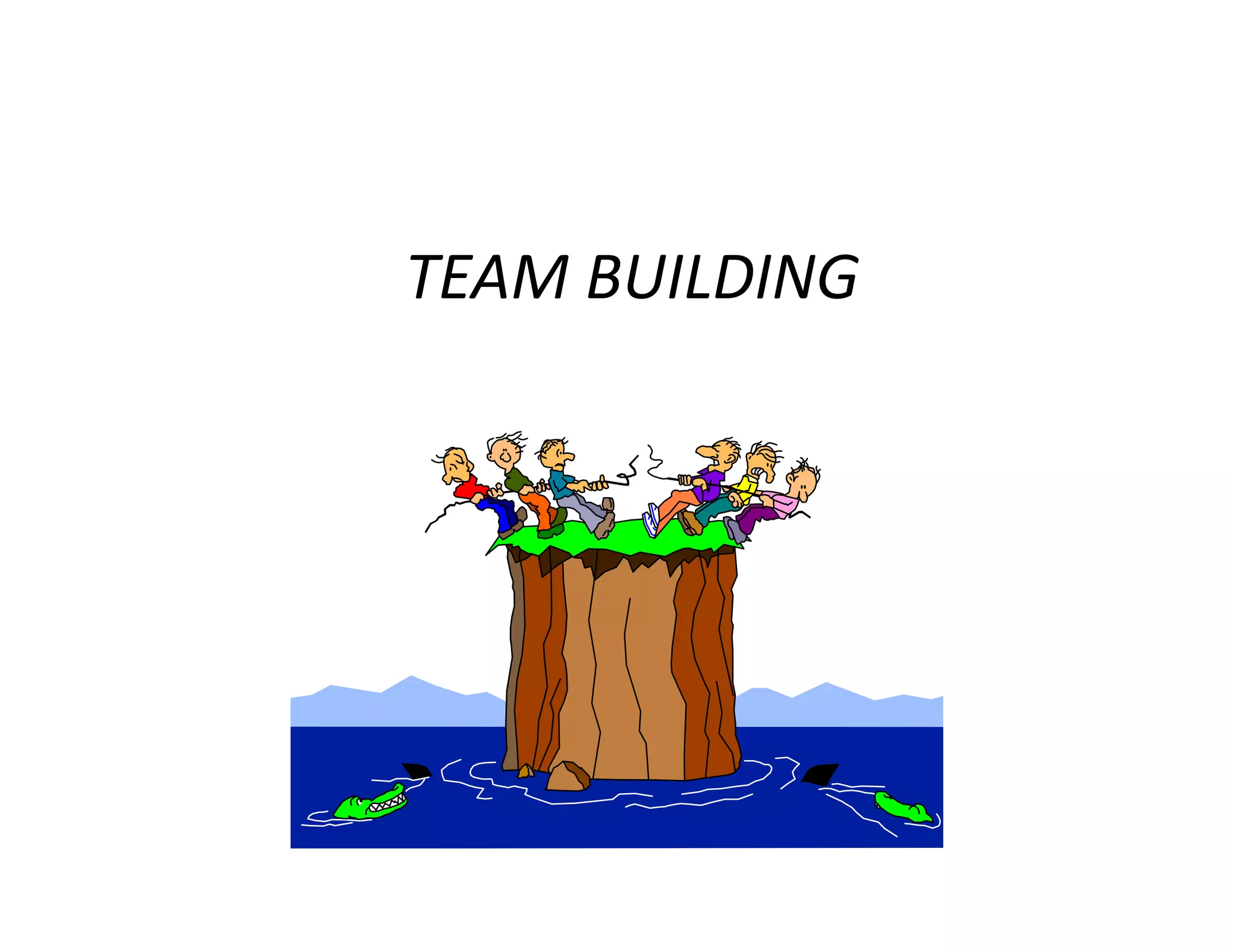
TEAM BUILDING
Lets play a Game.
p y
AB v/s SRK !
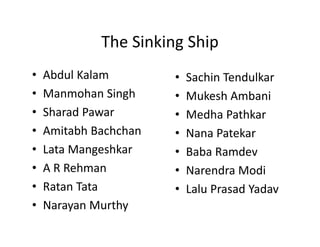
The Sinking Ship
The Sinking Ship
•
•
•
•
•
•
•
•

Abdul Kalam
Abdul Kalam
Manmohan Singh
Sharad Pawar
Sh d
Amitabh Bachchan
Lata Mangeshkar
A R Rehman
A R Rehman
Ratan Tata
Narayan Murthy
N
M h

•
•
•
•
•
•
•

Sachin Tendulkar
Mukesh Ambani
Medha Pathkar
Nana Patekar
Baba Ramdev
Narendra Modi
Lalu Prasad Yadav
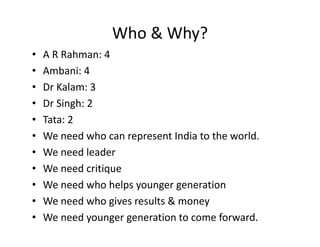
Who & Why?
•
•
•
•
•
•
•
•
•
•
•

A R Rahman: 4
Ambani: 4
Dr Kalam: 3
g
Dr Singh: 2
Tata: 2
We need who can represent India to the world. 
We need who can represent India to the world.
We need leader
We need critique 
We need critique
We need who helps younger generation
We need who gives results & money
We need who gives results & money
We need younger generation to come forward.
What are the Course Objectives
What are the Course Objectives
•I am aware that my people have great ideas of how we can do better. I 
•I am aware that my people have great ideas of how we can do better I
am keen to learn how to help them open up so they make suggestions 
and I can act upon them.
•I believe that the work in my firm could be organized in a better, more 
efficient manner. How do I plan and organize everything more 
effectively? This is something that I wish to learn.
effectively? This is something that I wish to learn
•I need to learn how to get my people to work together as a team 
without to back biting.
•My organization performs well, but I want to find out how well we are 
doing against our competitors performance and how to become the 
best.
best
What You Will Learn:
What You Will Learn:
What a team is ?
Why organize teams ?
Characteristics of effective teams ?
Characteristics of effective teams ?
Good leadership ?
Identify what style of team best suits your 
Id tif h t t l f t
b t it
project.
• Discuss how to turn your Colleagues into a 
High Performing Team
•
•
•
•
•
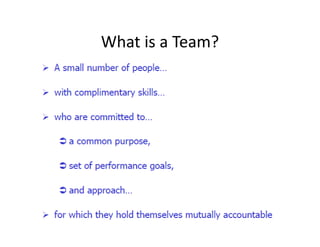
What is a Team?
What is a Team?
Team Definition
Team Definition
A team is a group of people in which the 
members assume specialized roles i
b
i li d l in 
performing work toward achieving a goal
or an objective.
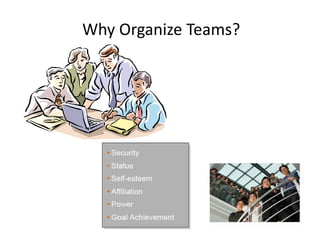
Why Organize Teams? 
Why have Teams become so popular? 
Lets play a Game
Lets play a Game.
Push !
Push !
Lets play a Game.
Lets play a Game.
Push !
Push !
When you push, what does the partner do to 
maintain equilibrium?
Lets play a Game.
Lets play a Game.
Push !
Push !
When you push, what does the partner do to 
maintain equilibrium?

Push back.
Push back.
Lets play a Game.
Lets play a Game.
When you push, what does the partner do to 
Wh
h h td
th
t
d t
maintain equilibrium?
Push back.

When a partner proposes, don’t 
p
p p
oppose, but ask neutral questions.
Let us Remember…
Let us Remember…
Coming together is a beginning
Keeping together is progress
p g g
p g
Working together is success
Working together is success
Reasons to Organize Teams
Reasons to Organize Teams
•
•
•
•
•

Synergy
Consensus building
Consensus building
Innovative solutions
Productivity
Meet goal.
Meet goal
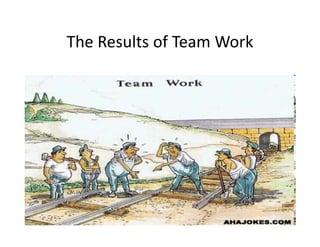
The Results of Team Work
The Results of Team Work
Lets play another Game.
Lets play another Game.
Can you touch the ceiling?
Can you touch the ceiling?
Lets play a Game.
Lets play a Game.
Can you touch the ceiling with 10% 
C
h h
ili
i h 10%
stretch?
Every minute is important (Late?).
Every push is important (Sleep?).
E
hi i
t t (Sl ?)
Every attention is important (Lights?)
y
p
( g
)
Every stretch is important (5S?)
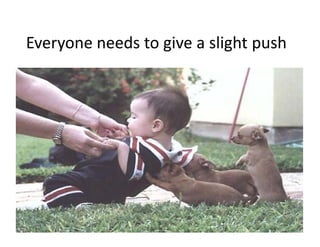
Everyone needs to give a slight push
Everyone needs to give a slight push
Lets play a Game.
Lets play a Game.
Can a team touch the ceiling?
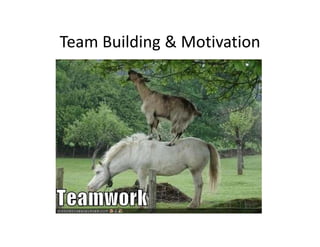
Team Building & Motivation
Team Building & Motivation
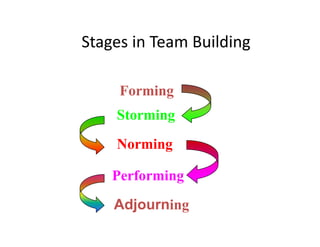
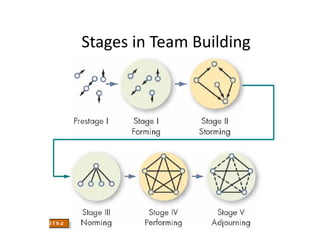
Stages in Team Building
Stages in Team Building
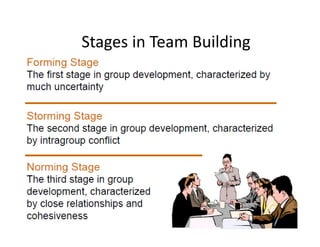
Forming
Storming
Norming
i
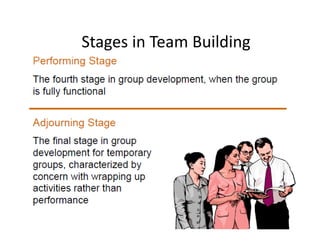
Performing
Adjourning
Adjourni
Adj
ing
Stages in Team Building
Stages in Team Building
Stages in Team Building
Stages in Team Building
Stages in Team Building
Stages in Team Building
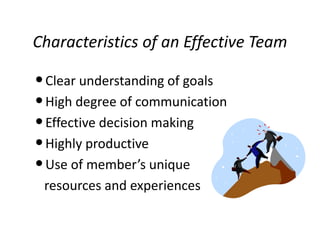
Characteristics of an Effective Team
Characteristics of an Effective Team

• Cl
Clear understanding of goals
d
di
f
l
• High degree of communication
g
g
• Effective decision making
• Hi hl
Highly productive
d i
• Use of member’s unique 
q
resources and experiences
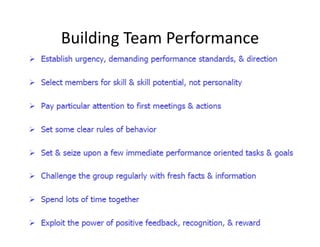
Building Team Performance
g
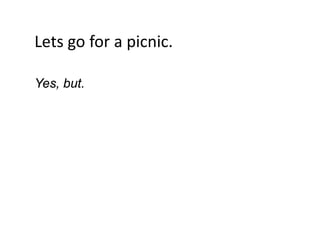
Lets go for a picnic.
Lets go for a picnic.
Yes, but.
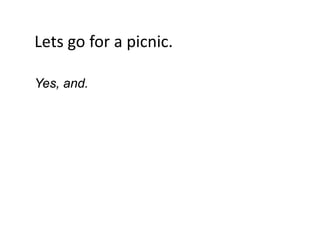
Lets go for a picnic.
Lets go for a picnic.
Yes, and.
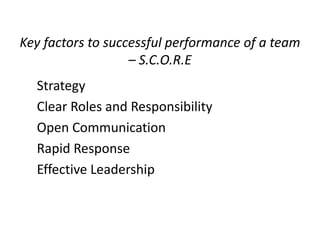
Key factors to successful performance of a team 
Key factors to successful performance of a team
– S.C.O.R.E
Strategy
Clear Roles and Responsibility
Clear Roles and Responsibility
Open Communication
Rapid Response
Effective Leadership
Effective Leadership
Lets play another game
Lets play another game
Lets make aircraft…
Lets make aircraft…
Lets play another game
Lets play another game
Lets make aircraft…
Lets make aircraft…
Lessons learnt
1. We  must plan with some additional time in hand, 
1 We must plan with some additional time in hand
never expect to get the full quota.
2. Don t compromise on quality, when time/resources  
2. Don’t compromise on quality, when time/resources
are limited work harder to maintain goals and level.
3. When given additional time make sure you use it 
g
y
effectively, if you have finished, make improvements… 
if  you haven’t, don’t give up, try to beat competition, 
you know what they already have.
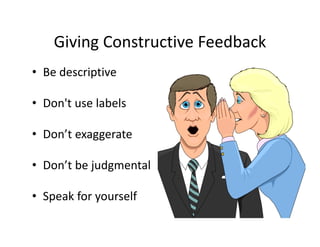
Giving Constructive Feedback
Giving Constructive Feedback
• Be descriptive 
p
• Don't use labels
• Don’t exaggerate
gg
• Don’t be judgmental
j g
• Speak for yourself
p
y
Helpful Team Behaviour
Helpful Team Behaviour
•
•
•
•
•
•
•
•
•
•

Keeping the peace
Being a friend
Being enthusiastic
Giving opinions
Generating ideas
Initiating
Solving problems logically
Relieving tension with humour
Seeking approval
Encouraging others
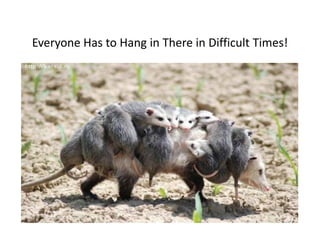
Everyone Has to Hang in There in Difficult Times!
Everyone Has to Hang in There in Difficult Times!
The 17 Essential Qualities of a Team Player
The 17 Essential Qualities of a Team Player
•
•
•
•
•
•
•
•
•

Adaptable
daptab e
Collaborative
Committed    
Communicative
Competent
p
Dependable
Disciplined
p
Enlarging 
Enthusiastic 

•
•
•
•
•
•
•
•

Intentional
Mission conscious
Prepared
Relational                          
Self‐improving 
Self improving
Selfless
Solution‐oriented
S l i
i
d
Tenacious
1. Adaptable:
1. Adaptable:
• If you won't change for the team, the team may 
change you. Team players who are adaptable 
change you. Team players who are adaptable
possess: 
• a) they are highly teachable
)
y
g y
• b) they are emotionally secure
c) they are creative 
• c) they are creative
• d) they are service‐minded individuals
To achieve such characteristic 
• a) get into the habit of learning
• b) reevaluate your role on the team
b) reevaluate your role on the team 
• c) think outside the lines.
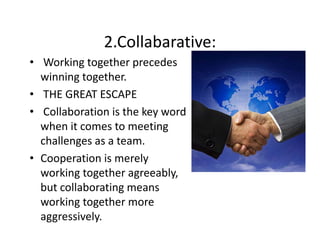
2.Collabarative:
• Working together precedes 
winning together.
winning together
• THE GREAT ESCAPE
• C ll b
Collaboration is the key word 
i i h k
d
when it comes to meeting 
challenges as a team.
challenges as a team
• Cooperation is merely 
working together agreeably, 
ki t th
bl
but collaborating means 
working together more 
working together more
aggressively. 
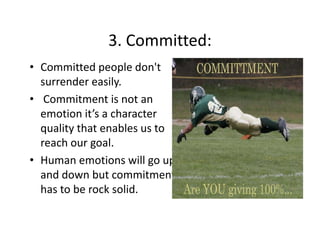
3. Committed:
3. Committed:
• Committed people don't 
surrender easily.
• Commitment is not an 
emotion it’s a character 
quality that enables us to 
reach our goal.
h
l
• Human emotions will go up 
and down but commitment 
has to be rock solid.
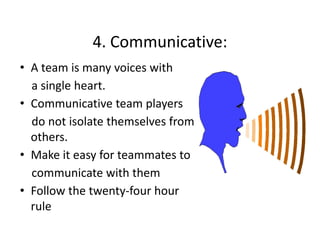
4. Communicative:
4. Communicative:
• A team is many voices with 
a single heart. 
p y
• Communicative team players
do not isolate themselves from 
others.
others
• Make it easy for teammates to 
communicate with them 
i t ith th
• Follow the twenty‐four hour 
rule 
5. Competent:
5. Competent:
• If you can't, your team won't .
• Competent does not mean simply having 
d
l h
adequate skills to perform a job. It means the 
individual must be highly qualified to do the job 
d d l
b h hl
lf d d h b
well. 
• Ex: Bob Taylor ( building guitar).
• To improve the level of competence, one must: 
p
p
,
• a) focus yourself professional
• b) give more attention to implementation
b) give more attention to implementation.
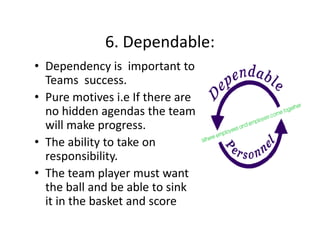
6. Dependable:
6. Dependable:
• Dependency is  important to 
Teams  success.
• Pure motives i.e If there are 
no hidden agendas the team 
hidd
d th t
will make progress. 
• Th bilit t t k
The ability to take on 
responsibility. 
• Th t
The team player must want 
l
t
t
the ball and be able to sink 
it in the basket and score
it in the basket and score
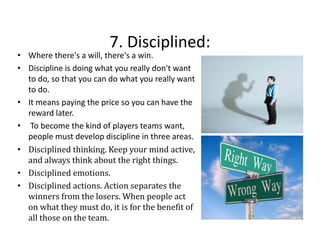
7. Disciplined:
7. Disciplined:

• Where there's a will, there's a win.
• Discipline is doing what you really don't want 
to do, so that you can do what you really want 
t d
th t
d h t
ll
t
to do. 
• It means paying the price so you can have the 
reward later.
• To become the kind of players teams want, 
people must develop discipline in three areas.
people must develop discipline in three areas.
• Disciplined thinking. Keep your mind active, 
and always think about the right things.
• Di i li d
Disciplined emotions. 
i
• Disciplined actions. Action separates the 
winners from the losers. When people act 
on what they must do, it is for the benefit of 
all those on the team.
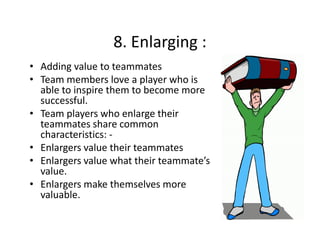
8. Enlarging :
8. Enlarging :
• Adding value to teammates 
• T
Team members love a player who is 
b l
l
h i
able to inspire them to become more 
successful. 
• Team players who enlarge their 
teammates share common 
characteristics: ‐
• Enlargers value their teammates 
• Enlargers value what their teammate’s 
value.
value
• Enlargers make themselves more 
valuable.
How do we become Enlargers?
How do we become Enlargers?
• Believe in others before they believe in
Believe in others before they believe in 
you.  
• Serve others before they serve you.  
• Add value to others before they add
Add value to others before they add 
value to you.
• P i t t
Point out your teammates' strengths, 
t
t ' t
th
encourage and motivate them out of 
their comfort zone, but within their gift 
zone
9. Enthusiastic:
9. Enthusiastic:
• Your heart is the source of energy for the 
team People  who bring an enthusiastic 
attitude to team work often. 
• Harley Davidson.
• Take responsibility for their own enthusiasm.
• Act their way into feeling. The only way to 
begin is simply to begin! 
• B li
Believe in what they are doing. 
i h h
d i
• Spend time with enthusiastic people. 
10. Intentional:
10. Intentional:
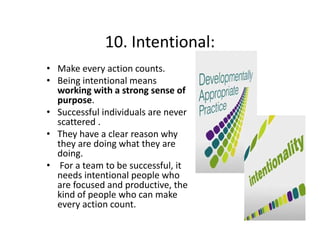
• Make every action counts.
• Being intentional means 
working with a strong sense of 
purpose. 
• Successful individuals are never 
scattered . 
• They have a clear reason why 
they are doing what they are 
doing.
• For a team to be successful, it 
needs intentional people who 
are focused and productive, the 
kind of people who can make 
every action count.
i
11. Mission Conscious:
11 Mission Conscious:
• The Big Picture is coming in loud and clear. The four
The Big Picture is coming in loud and clear. The four 
qualities of mission‐conscious team players are:
• 1) They know where the team is going.
)
y
g g
• 2) They let the leader of the team lead.
3) They place team accomplishment ahead of their 
• 3) They place team accomplishment ahead of their
own. 
• 4) They do whatever is necessary to achieve the 
)
y
y
mission
12. Prepared:
12 Prepared:

• Preparation can mean the difference 
between winning and losing To be a 
more prepared team, think about the 
following: 
• a) assessment
a) assessment
• b) alignment
• c) attitude
c) attitude   
• d) action. 
To improve preparedness you must: 
To improve preparedness you must:
• a) become a process thinker
b) do more research
• b) do more research
• c) learn from your mistakes.
13. Relational:
13. Relational:
• If you get along, others will go 
along .
along
• Teams want people who are 
relational. 
l i
l
• Look for the following in your 
team relationships:
• a) respect
• b) Shared experiences
c) Trust
• c) Trust
• d) mutual enjoyment
14. Self improving:
14 Self‐improving:
• T i
To improve the team, 
th t
improve yourself .
• P
People who are constantly 
l h
t tl
improving themselves make 
three processes an ongoing 
three processes an ongoing
cycle in their lives: 
Preparation, Concentration, 
Preparation Concentration
and Application.
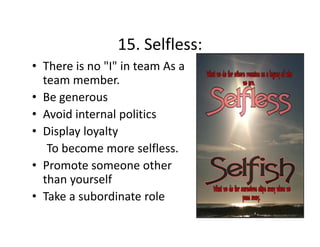
15. Selfless:
15 Selfless:
• There is no "I" in team As a 
team member.
t
b
• Be generous
• Avoid internal politics
• Display loyalty 
To become more selfless.  
• Promote someone other 
than yourself 
• Take a subordinate role
16. Solution oriented:
16. Solution‐oriented:
• Anyone can become solution‐
Anyone can become solution
oriented.
•S l i
Solution oriented people recognize 
i
d
l
i
these truths: 
• Problems are a matter of perspective
• All problems are solvable
All problems are solvable. 
• Problems either stop us or stretch us.
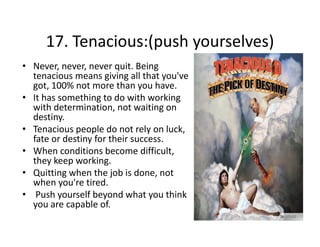
17. Tenacious:(push yourselves)
17. Tenacious:(push yourselves)
• Never, never, never quit. Being 
tenacious means giving all that you ve 
tenacious means giving all that you've
got, 100% not more than you have. 
• It has something to do with working 
with determination, not waiting on 
with determination not waiting on
destiny. 
• Tenacious people do not rely on luck, 
fate or destiny for their success. 
fate or destiny for their success
• When conditions become difficult, 
they keep working. 
• Q itti
Quitting when the job is done, not 
h th j b i d
t
when you're tired.
• Push yourself beyond what you think 
you are capable of.
bl f
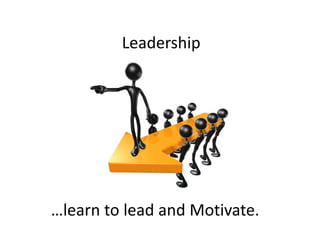
Leadership

…learn to lead and Motivate.
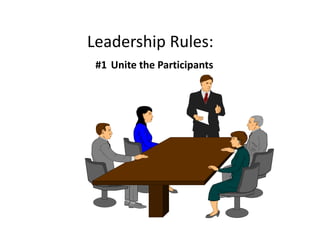
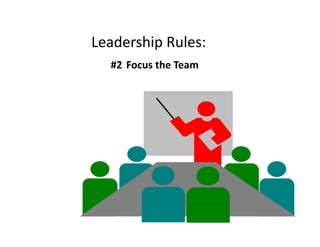
Leadership Rules:
Leadership Rules:
#1 Unite the Participants
Leadership Rules: 
Leadership Rules:
#2 Focus the Team 
Leadership Rules:
Leadership Rules:
#3 Get the Team Moving 
Team building for prof devp 201110

Team building for prof devp 201110