INTERVIEW SKILLS
Overview
• Preparing for interviews
• The interview experience
• Questions to expect and to ask
• Different types of interview
• Assessment Centres
• Psychometric Tests
• Interview resources
Interview
• A meeting of minimum two expert- candidate
• Arranged to examine the suitability of the
candidate
• Tested for subject knowledge, skills and desired
behavior in a very limited time
Preparation is the key to
success
Types of Interview
• Panel Interview: three or more experts sit across table
from the candidate.
• Face-to-Face Interviews: one interviewer one
candidate.
• in formal in nature
• less distance between interviewer and candidate
• less stressful and relaxed environment compared to
panel interview
Telephone Interviews
• Prepare as thoroughly as for ‘real’ interview
• Select comfortable, private, quiet place
• Advise flat mates re answering phone
• Have copy of CV and company information
• Have pen and paper at hand
• Prepare for usual interview questions
• Practice on phone
• Record answers
• Try standing
• Smile and use gestures
• Avoid monotones
• Be yourself
Prior Interview
 Read your CV/ application and skills
demanded
 Know the company
 Go to the company web site
 Annual reports
 Business news papers, magazines
 Directly contact the employees
Do’s
• Do take a practice run to the location where you are
having the interview
• If presented with a job application, do fill it out neatly,
completely and accurately
• Do bring extra resumes to the interview
• Do greet the interviewer & do shake hands firmly
• Do wait until you are offered a chair before sitting.
Do’s
• Do make good eye contact with your
interviewer(s)
• Do show enthusiasm in the position and the
company
• Do make sure that your good points come across
to the interviewer in a factual sincere manner
• Do stress your achievements
DON’TS
• Do avoid controversial topics
• Don’t ever lie. Answer questions truthfully, frankly and
succinctly
• Don’t say anything negative about former colleagues,
supervisors, or employers
• Don’t answer questions with a simple ‘yes’ or ‘no’.
Explain whenever possible. Describe those things about
yourself that showcase your talents, skills and
determination. Give examples
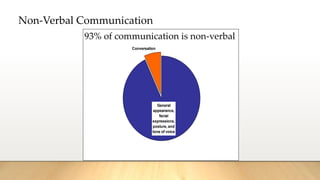
Non-Verbal Communication
Conversation
General
appearance,
facial
expressions,
posture, and
tone of voice
93% of communication is non-verbal
Watch the Body Language
• First impressions very powerful
• Halo effect or Devil effect
• Allow time to relax
• Dress appropriately
• Entrance, introductions & handshake
• Smile and make eye contact
• Be aware of own movements
• Watch body language of interviewer
Know the Company
•Main production / service
•Annual sales, profit, dividend
•Competitors
•Area of operation
•New product/service launched
During an interview Employers Evaluate
• Self Confidence – you should be confident while
appearing for interview
• Interpersonal skills – fluency in English, listen
attentively and answer to the questions asked by the
interviewer
• Be honest – While answering in the interview, even if you
don’t know the answer for certain question, be honest in
answer to the interviewer.
Non- verbal or Body Language
• Posture: sit erect without learning on the desk or
slouching in the chair, but don’t be stiff and tense
• Always make eye contact when you speak, but avoid
continuous staring
• Don’t use too many hand movements and frequent
change of facial expressions not in relation to words
you have expressed
Dress outlook
•Dress formally and well groomed
•You will never get a second chance to make
a good impression
•Wear something that make you feel
comfortable
•Use simple accessories like simple jewelry,
watches, ties, etc
•Scents, perfumes and after shaves lotion
should be avoided
Expected qualities of the candidate
Effective Verbal communication
• If it is English language without M.T Influence
• Natural delivery, fluency
• Pronounce sentence clearly
• Speak little more loudly or lower your voice to
draw attention of the experts if there is an
important point or opinion
Rejected by the committees
• Vague and irrelevant answers to the questions
• Very fidgety: little eye contact; nervous
mannerism, such as playing with hair, nail biting
etc.
• Lack of sincerity
• Utter superficial remarks to impress the
interviewer – project work
After Interview
• Thank them for calling you for the interview
through a letter
• Indicate that you look forward to hear from them
• Tell me about yourself
• Why did you leave your previous job?
• What sort of job you are looking for?
• What appeals to you about this job?
• Why do you think you’d be good at this job?
• What are your strengths?
• What are your weaknesses?
• Would you accept this job if it were offered to you?
• What do you know about this company?
• If you take this job, how long would you stay?
• Don’t you think you may be too old/young/inexperienced?
INTERVIEW QUESTIONS
The most often asked question in interviews
Tell your academic record
Your skills
Your qualification etc.
Talk about things you have done and jobs you have held
that relate to the position you are interviewing for
Time: 3 minutes
Prepare written answer for this question and rehearse
Tell me about yourself
What do you think you do be good at this job?
• The best is to say general and say something like: A job
where I love to work, like the people, can contribute more
to the company
• A job which is challenging, a job which gives me
opportunities to prove knowledge and skills
What appeals to you about this job?
• To achieve through heights and also to learn, work
hard and quench my thirst of knowledge in the
related field, which I am going to work
• To be unique in decision making skills in the
future
What are your strengths ?
• Strength of your subject knowledge
• Your ability to prioritize,
• Your problem –solving skills,
• Your ability to work under pressure,
• Your ability to focus on projects,
• Your professional expertise,
• Your leadership skills and
• your positive attitude.
What are your weakness ?
• Here you have to tell your weakness As strength
• Eg Always I will be committed to the assigned work, which
I expect from my co-workers, this leads to affects the
interpersonal relationship but the outcome of the work will
be satisfied. This eg suits to the team leader.
Would accept this job, if were offered to you ?
•Yes, certainly I will accept this job do the
best to the company or organization.
•No, you have give reason.
What do you know about this company ?
• You have to go to the website and look for the details
like company, products, services, year of starting the
company, their annual reports, agenda.
• How many workers are working in that company,
volume of the business future plan of business and
other specific details .
If you take this job,how long would you stay ?
• You set high standards for yourself and meet them.
• Your outcomes are a success and tell them about you stay
in that company.
What creates a bad impression
• Poor personal appearance
• Negative attitude – evasive, using excuses
• Lack of interest and enthusiasm
• Lack of preparation
• Poor knowledge of role
• Failure to give concrete examples of skills
• Over emphasis on money/rewards
• Lack of career plan
Important Job Sites
• www.naukri.com
• www.winentrance.com
• www.jobsahead.com
• www.digitalbhoomi.com
• www.cybermediadice.com
• www.careerbuilder.com
• hotjobs.yahoo.com
• www.jobs.net
• www.timesjobs.com
• www.computerjobs
• www.totaljobs.com
• www.sciencejobs.com
• www.career.com
• www.computerwork.com
• www.topjobs.net
• www.bankjobs.com
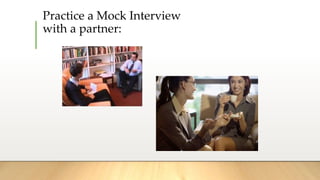
Practice a Mock Interview
with a partner:
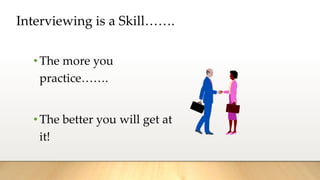
Interviewing is a Skill…….
•The more you
practice…….
•The better you will get at
it!
THANK YOU

Interview skills

  • 1.
  • 2.
    Overview • Preparing forinterviews • The interview experience • Questions to expect and to ask • Different types of interview • Assessment Centres • Psychometric Tests • Interview resources
  • 3.
    Interview • A meetingof minimum two expert- candidate • Arranged to examine the suitability of the candidate • Tested for subject knowledge, skills and desired behavior in a very limited time
  • 4.
    Preparation is thekey to success
  • 5.
    Types of Interview •Panel Interview: three or more experts sit across table from the candidate. • Face-to-Face Interviews: one interviewer one candidate. • in formal in nature • less distance between interviewer and candidate • less stressful and relaxed environment compared to panel interview
  • 6.
    Telephone Interviews • Prepareas thoroughly as for ‘real’ interview • Select comfortable, private, quiet place • Advise flat mates re answering phone • Have copy of CV and company information • Have pen and paper at hand • Prepare for usual interview questions • Practice on phone • Record answers • Try standing • Smile and use gestures • Avoid monotones • Be yourself
  • 7.
    Prior Interview  Readyour CV/ application and skills demanded  Know the company  Go to the company web site  Annual reports  Business news papers, magazines  Directly contact the employees
  • 8.
    Do’s • Do takea practice run to the location where you are having the interview • If presented with a job application, do fill it out neatly, completely and accurately • Do bring extra resumes to the interview • Do greet the interviewer & do shake hands firmly • Do wait until you are offered a chair before sitting.
  • 9.
    Do’s • Do makegood eye contact with your interviewer(s) • Do show enthusiasm in the position and the company • Do make sure that your good points come across to the interviewer in a factual sincere manner • Do stress your achievements
  • 10.
    DON’TS • Do avoidcontroversial topics • Don’t ever lie. Answer questions truthfully, frankly and succinctly • Don’t say anything negative about former colleagues, supervisors, or employers • Don’t answer questions with a simple ‘yes’ or ‘no’. Explain whenever possible. Describe those things about yourself that showcase your talents, skills and determination. Give examples
  • 11.
  • 12.
    Watch the BodyLanguage • First impressions very powerful • Halo effect or Devil effect • Allow time to relax • Dress appropriately • Entrance, introductions & handshake • Smile and make eye contact • Be aware of own movements • Watch body language of interviewer
  • 13.
    Know the Company •Mainproduction / service •Annual sales, profit, dividend •Competitors •Area of operation •New product/service launched
  • 14.
    During an interviewEmployers Evaluate • Self Confidence – you should be confident while appearing for interview • Interpersonal skills – fluency in English, listen attentively and answer to the questions asked by the interviewer • Be honest – While answering in the interview, even if you don’t know the answer for certain question, be honest in answer to the interviewer.
  • 15.
    Non- verbal orBody Language • Posture: sit erect without learning on the desk or slouching in the chair, but don’t be stiff and tense • Always make eye contact when you speak, but avoid continuous staring • Don’t use too many hand movements and frequent change of facial expressions not in relation to words you have expressed
  • 16.
    Dress outlook •Dress formallyand well groomed •You will never get a second chance to make a good impression •Wear something that make you feel comfortable •Use simple accessories like simple jewelry, watches, ties, etc •Scents, perfumes and after shaves lotion should be avoided
  • 17.
    Expected qualities ofthe candidate Effective Verbal communication • If it is English language without M.T Influence • Natural delivery, fluency • Pronounce sentence clearly • Speak little more loudly or lower your voice to draw attention of the experts if there is an important point or opinion
  • 18.
    Rejected by thecommittees • Vague and irrelevant answers to the questions • Very fidgety: little eye contact; nervous mannerism, such as playing with hair, nail biting etc. • Lack of sincerity • Utter superficial remarks to impress the interviewer – project work
  • 19.
    After Interview • Thankthem for calling you for the interview through a letter • Indicate that you look forward to hear from them
  • 20.
    • Tell meabout yourself • Why did you leave your previous job? • What sort of job you are looking for? • What appeals to you about this job? • Why do you think you’d be good at this job? • What are your strengths? • What are your weaknesses? • Would you accept this job if it were offered to you? • What do you know about this company? • If you take this job, how long would you stay? • Don’t you think you may be too old/young/inexperienced? INTERVIEW QUESTIONS
  • 21.
    The most oftenasked question in interviews Tell your academic record Your skills Your qualification etc. Talk about things you have done and jobs you have held that relate to the position you are interviewing for Time: 3 minutes Prepare written answer for this question and rehearse Tell me about yourself
  • 22.
    What do youthink you do be good at this job? • The best is to say general and say something like: A job where I love to work, like the people, can contribute more to the company • A job which is challenging, a job which gives me opportunities to prove knowledge and skills
  • 23.
    What appeals toyou about this job? • To achieve through heights and also to learn, work hard and quench my thirst of knowledge in the related field, which I am going to work • To be unique in decision making skills in the future
  • 24.
    What are yourstrengths ? • Strength of your subject knowledge • Your ability to prioritize, • Your problem –solving skills, • Your ability to work under pressure, • Your ability to focus on projects, • Your professional expertise, • Your leadership skills and • your positive attitude.
  • 25.
    What are yourweakness ? • Here you have to tell your weakness As strength • Eg Always I will be committed to the assigned work, which I expect from my co-workers, this leads to affects the interpersonal relationship but the outcome of the work will be satisfied. This eg suits to the team leader.
  • 26.
    Would accept thisjob, if were offered to you ? •Yes, certainly I will accept this job do the best to the company or organization. •No, you have give reason.
  • 27.
    What do youknow about this company ? • You have to go to the website and look for the details like company, products, services, year of starting the company, their annual reports, agenda. • How many workers are working in that company, volume of the business future plan of business and other specific details .
  • 28.
    If you takethis job,how long would you stay ? • You set high standards for yourself and meet them. • Your outcomes are a success and tell them about you stay in that company.
  • 29.
    What creates abad impression • Poor personal appearance • Negative attitude – evasive, using excuses • Lack of interest and enthusiasm • Lack of preparation • Poor knowledge of role • Failure to give concrete examples of skills • Over emphasis on money/rewards • Lack of career plan
  • 30.
    Important Job Sites •www.naukri.com • www.winentrance.com • www.jobsahead.com • www.digitalbhoomi.com • www.cybermediadice.com • www.careerbuilder.com • hotjobs.yahoo.com • www.jobs.net • www.timesjobs.com • www.computerjobs • www.totaljobs.com • www.sciencejobs.com • www.career.com • www.computerwork.com • www.topjobs.net • www.bankjobs.com
  • 31.
    Practice a MockInterview with a partner:
  • 32.
    Interviewing is aSkill……. •The more you practice……. •The better you will get at it!
  • 33.