TanDEM-X: Mission Status &  Scientific Contribution Irena Hajnsek 1/2 , Gerhard Krieger 1 , Kostas Papathanassiou 1 , Stefan Baumgartner 1 , Marc Rodriguez-Cassola 1 , Pau Prats 1,  Maria Sanjuan Ferrer 1 , Florian Kugler 1  & TanDEM-X Team 1 Microwaves and Radar Institute & ²Institute of Environmental Engineering, ETH Zurich
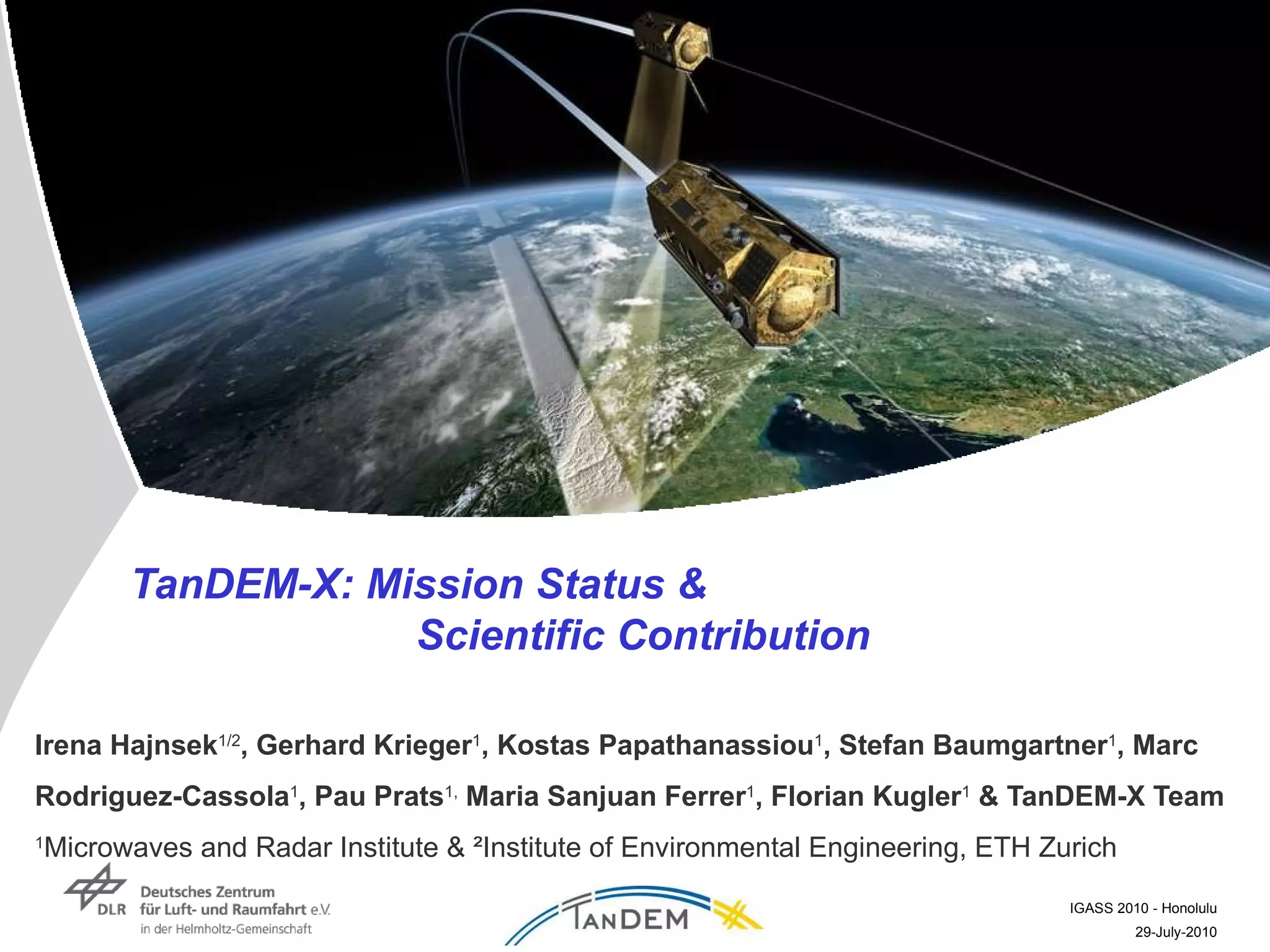
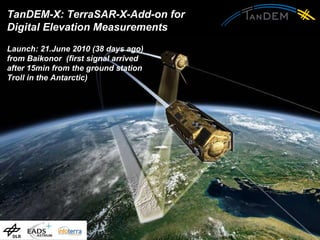
TanDEM-X: TerraSAR-X-Add-on for  Digital Elevation Measurements Launch: 21.June 2010 (38 days ago)  from Baikonor   (first signal arrived after 15min from the ground station Troll in the Antarctic)
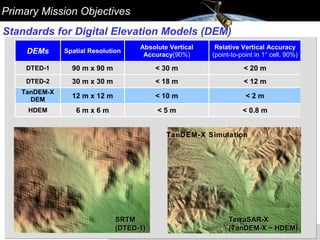
Standards for Digital Elevation Models (DEM) SRTM / X-SAR SRTM (DTED-1) TerraSAR-X (TanDEM-X ~ HDEM) TanDEM-X Simulation Primary Mission Objectives
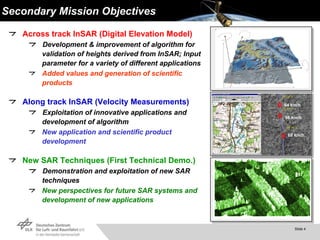
Secondary Mission Objectives Across track InSAR (Digital Elevation Model) Development & improvement of algorithm for validation of heights derived from InSAR; Input parameter for a variety of different applications Added values and generation of scientific products Along track InSAR (Velocity Measurements) Exploitation of innovative applications   and development of algorithm  New application and scientific product development New SAR Techniques (First Technical Demo.) Demonstration and exploitation of new SAR techniques New perspectives for future SAR systems and development of new applications 64 km/h 56 km/h 68 km/h
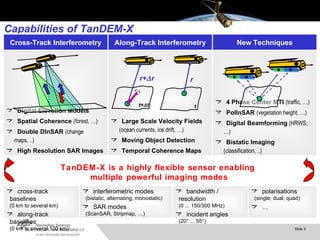
Capabilities of TanDEM-X TanDEM-X is a highly flexible sensor enabling  multiple powerful imaging modes r+  r r t+  t t 4 Phase Center MTI  (traffic, …)   PolInSAR  (vegetation height, …) Digital Beamforming   (HRWS, …) Bistatic Imaging   (classification, ..) Large Scale Velocity Fields  (ocean currents, ice drift, …) Moving Object Detection Temporal Coherence Maps Digital Elevation Models Spatial Coherence  (forest, …) Double DInSAR  (change maps, ..) High Resolution SAR Images New Techniques Along-Track Interferometry Cross-Track Interferometry interferometric modes  (bistatic, alternating, monostatic) SAR modes (ScanSAR, Stripmap, …) cross-track baselines (0 km to several km) along-track baselines (0 km to several 100 km)  polarisations (single, dual, quad) …  bandwidth / resolution (0 ... 150/300 MHz)  incident angles (20° ... 55°)
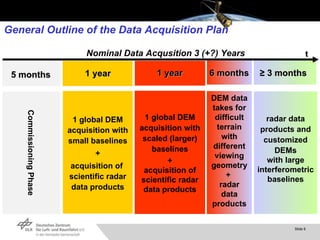
General Outline of the Data Acquisition Plan 1 global DEM acquisition with small baselines + acquisition of  scientific radar data products 1 global DEM acquisition with scaled (larger) baselines + acquisition of scientific radar data products Commissioning Phase DEM data takes for difficult terrain with different viewing geometry +  radar data products radar data products and customized DEMs with large interferometric baselines t 1 year 1 year 6 months ≥  3 months 5 months Nominal Data Acqusition 3 (+?) Years
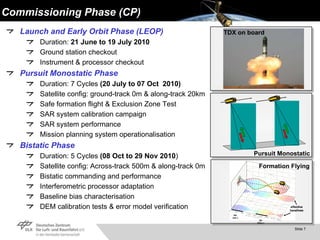
Commissioning Phase (CP) Launch and Early Orbit Phase (LEOP) Duration:  21 June to 19 July 2010 Ground station checkout Instrument & processor checkout Pursuit Monostatic Phase Duration: 7 Cycles  (20 July to 07 Oct  2010) Satellite config: ground-track 0m & along-track 20km Safe formation flight & Exclusion Zone Test SAR system calibration campaign SAR system performance Mission planning system operationalisation Bistatic Phase Duration: 5 Cycles  (08 Oct to 29 Nov 2010 ) Satellite config: Across-track 500m & along-track 0m Bistatic commanding and performance Interferometric processor adaptation Baseline bias characterisation DEM calibration tests & error model verification Pursuit Monostatic Formation Flying TDX on board
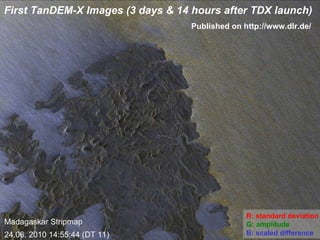
First TanDEM-X Images (3 days & 14 hours after TDX launch) Madagaskar Stripmap 24.06. 2010 14:55:44 (DT 11) R: standard deviation G: amplitude B: scaled difference Published on http://www.dlr.de/
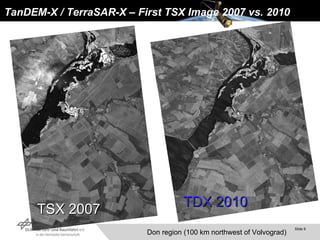
TanDEM-X / TerraSAR-X – First TSX Image 2007 vs. 2010  TSX 2007 TDX 2010 Don region (100 km northwest of Volvograd)
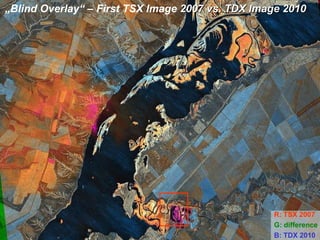
„ Blind Overlay“ – First TSX Image  2007 vs. TDX Image 2010   R: TSX 2007 G: difference   B: TDX 2010
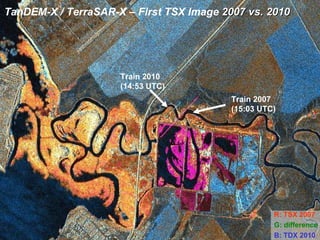
TanDEM-X / TerraSAR-X – First TSX Image  2007 vs. 2010   Train 2007 (15:03 UTC) Train 2010 (14:53 UTC) R: TSX 2007 G: difference   B: TDX 2010
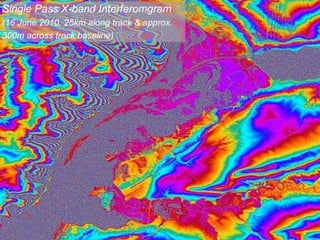
Phase Single Pass X-band Interferomgram  (16 June 2010: 25km along track & approx.  300m across track baseline)
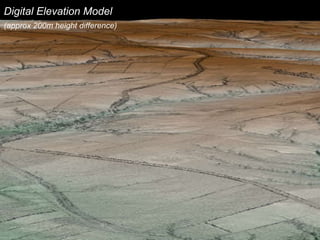
Digital Elevation Model  (approx 200m height difference)
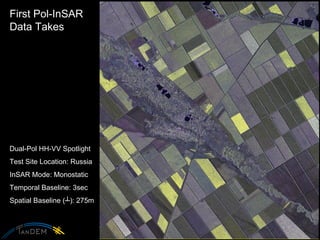
First Pol-InSAR  Data Takes Dual-Pol HH-VV Spotlight Test Site Location: Russia InSAR Mode: Monostatic Temporal Baseline: 3sec Spatial Baseline ( ┴ ): 275m
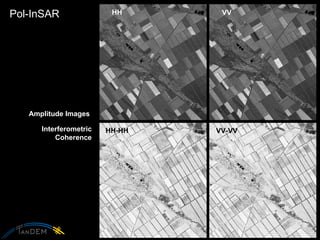
Pol-InSAR HH-HH VV-VV HH VV Interferometric Coherence Amplitude Images
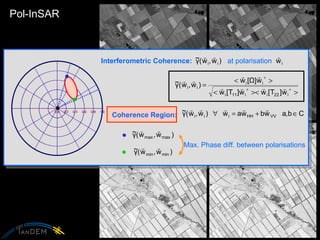
Pol-InSAR Interferometric Coherence:   at polarisation  Coherence Region:  Max. Phase diff. between polarisations
Pol-InSAR 0  1  2  [m]  3
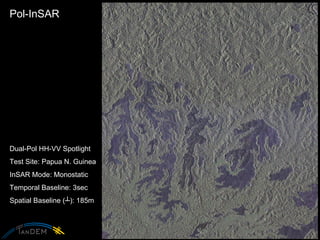
Pol-InSAR Dual-Pol HH-VV Spotlight Test Site: Papua N. Guinea InSAR Mode: Monostatic Temporal Baseline: 3sec Spatial Baseline ( ┴ ): 185m
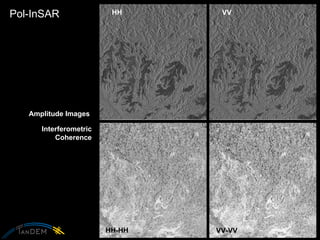
Pol-InSAR HH-HH VV-VV HH VV Interferometric Coherence Amplitude Images
Pol-InSAR 0  2  6  [m]  8
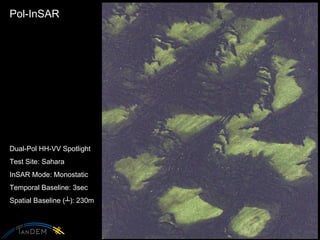
Pol-InSAR Dual-Pol HH-VV Spotlight Test Site: Sahara InSAR Mode: Monostatic Temporal Baseline: 3sec Spatial Baseline ( ┴ ): 230m
Pol-InSAR 0  1  2  3  4  [m]  5
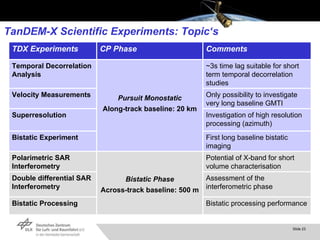
TanDEM-X Scientific Experiments: Topic‘s ~3s time lag suitable for short term temporal decorrelation studies Pursuit Monostatic Along-track baseline: 20 km Temporal Decorrelation Analysis Only possibility to investigate very long baseline GMTI Velocity Measurements Investigation of high resolution processing (azimuth) Superresolution First long baseline bistatic imaging Bistatic Experiment Potential of X-band for short volume characterisation Bistatic Phase Across-track baseline: 500 m Polarimetric SAR Interferometry Assessment of the interferometric phase Double differential SAR Interferometry Bistatic processing performance Bistatic Processing Comments CP Phase TDX Experiments
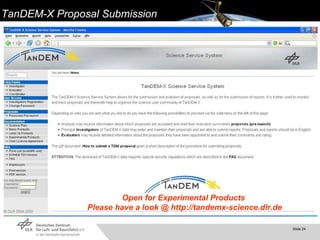
TanDEM-X Proposal Submission Open for Experimental Products  Please have a look @ http://tandemx-science.dlr.de
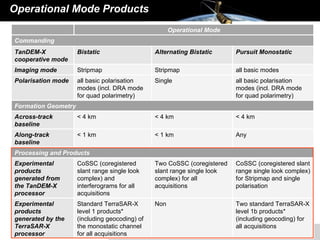
Operational Mode Products Two standard TerraSAR-X level 1b products* (including geocoding) for all acquisitions Non Standard TerraSAR-X level 1 products* (including geocoding) of the monostatic channel for all acquisitions  Experimental products generated by the TerraSAR-X processor CoSSC (coregistered slant range single look complex) for Stripmap and single polarisation  Two CoSSC (coregistered slant range single look complex) for all acquisitions CoSSC (coregistered slant range single look complex) and interferograms for all acquisitions Experimental products generated from the TanDEM-X processor Processing and Products Any < 1 km < 1 km Along-track baseline < 4 km < 4 km < 4 km Across-track baseline Formation Geometry all basic polarisation modes (incl. DRA mode for quad polarimetry) Single all basic polarisation modes (incl. DRA mode for quad polarimetry) Polarisation mode all basic modes  Stripmap Stripmap Imaging mode Pursuit Monostatic Alternating Bistatic Bistatic TanDEM-X cooperative mode Commanding Operational Mode
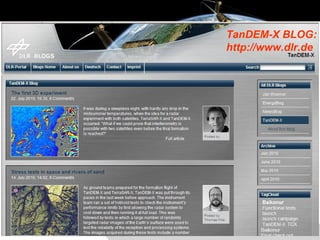
TanDEM-X BLOG: http://www.dlr.de
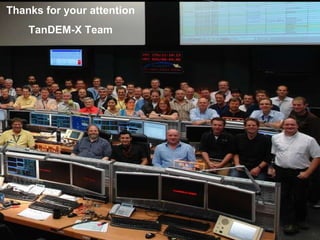
Thanks for your attention TanDEM-X Team
TanDEM-X Session TH1.L10: TanDEM-X Mission Session Type: Oral Time: Thursday, July 29, 08:20 - 10:00 Location:  Coral  2  Session Chairs: Irena Hajnsek, ETH Zurich, Institute of Environmental Engineering / German Aerospace Center, Microwaves and Radar Institute and Alberto Moreira, German Aerospace Center, Microwaves and Radar Institute   TH1.L10.1:  TANDEM-X: SCIENTIFIC CONTRIBUTIONS          Irena Hajnsek;  ETH Zürich / DLR          Gerhard Krieger;  German Aerospace Center (DLR)          Konstantinos Papathanassiou;  German Aerospace Center (DLR)          Stefan V. Baumgartner;  German Aerospace Center (DLR)          Marc Rodriguez-Cassola;  German Aerospace Center (DLR)          Pau Prats;  German Aerospace Center (DLR)   TH1.L10.2:  TANDEM-X COMMISSIONING PHASE STATUS          Jaime Hueso Gonzalez;  German Aerospace Center (DLR)          Markus Bachmann;  German Aerospace Center (DLR)          Harald Hofmann;  German Aerospace Center (DLR)   TH1.L10.3:  MONOSTATIC CALIBRATION OF BOTH TANDEM-X SATELLITES          Marco Schwerdt;  German Aerospace Center (DLR)          Jaime Hueso Gonzalez;  German Aerospace Center (DLR)          Markus Bachmann;  German Aerospace Center (DLR)          Dirk Schrank;  German Aerospace Center (DLR)          Clemens Schulz;  German Aerospace Center (DLR)          Björn Döring;  German Aerospace Center (DLR)   TH1.L10.4:  PROCESSING OF BISTATIC TANDEM-X DATA          Helko Breit;  German Aerospace Center (DLR)          Thomas Fritz;  German Aerospace Center (DLR)          Ulrich Balss;  German Aerospace Center (DLR)          Andreas Niedermeier;  German Aerospace Center (DLR)          Michael Eineder;  German Aerospace Center (DLR)          Nestor Yague-Martinez;  German Aerospace Center (DLR)          Cristian Rossi;  German Aerospace Center (DLR)   TH1.L10.5:  VALIDATION OF TIE-POINT CONCEPTS BY THE DEM ADJUSTMENT APPROACH OF TANDEM-X          Martin Huber;  German Aerospace Center (DLR)          Astrid Gruber;  German Aerospace Center (DLR)          Birgit Wessel;  German Aerospace Center (DLR)          Markus Breunig;  German Aerospace Center (DLR)          Anna Wendleder;  German Aerospace Center (DLR)

TH1.L10.1: TANDEM-X: SCIENTIFIC CONTRIBUTIONS

  • 1.
    TanDEM-X: Mission Status& Scientific Contribution Irena Hajnsek 1/2 , Gerhard Krieger 1 , Kostas Papathanassiou 1 , Stefan Baumgartner 1 , Marc Rodriguez-Cassola 1 , Pau Prats 1, Maria Sanjuan Ferrer 1 , Florian Kugler 1 & TanDEM-X Team 1 Microwaves and Radar Institute & ²Institute of Environmental Engineering, ETH Zurich
  • 2.
    TanDEM-X: TerraSAR-X-Add-on for Digital Elevation Measurements Launch: 21.June 2010 (38 days ago) from Baikonor (first signal arrived after 15min from the ground station Troll in the Antarctic)
  • 3.
    Standards for DigitalElevation Models (DEM) SRTM / X-SAR SRTM (DTED-1) TerraSAR-X (TanDEM-X ~ HDEM) TanDEM-X Simulation Primary Mission Objectives
  • 4.
    Secondary Mission ObjectivesAcross track InSAR (Digital Elevation Model) Development & improvement of algorithm for validation of heights derived from InSAR; Input parameter for a variety of different applications Added values and generation of scientific products Along track InSAR (Velocity Measurements) Exploitation of innovative applications and development of algorithm New application and scientific product development New SAR Techniques (First Technical Demo.) Demonstration and exploitation of new SAR techniques New perspectives for future SAR systems and development of new applications 64 km/h 56 km/h 68 km/h
  • 5.
    Capabilities of TanDEM-XTanDEM-X is a highly flexible sensor enabling multiple powerful imaging modes r+  r r t+  t t 4 Phase Center MTI (traffic, …) PolInSAR (vegetation height, …) Digital Beamforming (HRWS, …) Bistatic Imaging (classification, ..) Large Scale Velocity Fields (ocean currents, ice drift, …) Moving Object Detection Temporal Coherence Maps Digital Elevation Models Spatial Coherence (forest, …) Double DInSAR (change maps, ..) High Resolution SAR Images New Techniques Along-Track Interferometry Cross-Track Interferometry interferometric modes (bistatic, alternating, monostatic) SAR modes (ScanSAR, Stripmap, …) cross-track baselines (0 km to several km) along-track baselines (0 km to several 100 km) polarisations (single, dual, quad) … bandwidth / resolution (0 ... 150/300 MHz) incident angles (20° ... 55°)
  • 6.
    General Outline ofthe Data Acquisition Plan 1 global DEM acquisition with small baselines + acquisition of scientific radar data products 1 global DEM acquisition with scaled (larger) baselines + acquisition of scientific radar data products Commissioning Phase DEM data takes for difficult terrain with different viewing geometry + radar data products radar data products and customized DEMs with large interferometric baselines t 1 year 1 year 6 months ≥ 3 months 5 months Nominal Data Acqusition 3 (+?) Years
  • 7.
    Commissioning Phase (CP)Launch and Early Orbit Phase (LEOP) Duration: 21 June to 19 July 2010 Ground station checkout Instrument & processor checkout Pursuit Monostatic Phase Duration: 7 Cycles (20 July to 07 Oct 2010) Satellite config: ground-track 0m & along-track 20km Safe formation flight & Exclusion Zone Test SAR system calibration campaign SAR system performance Mission planning system operationalisation Bistatic Phase Duration: 5 Cycles (08 Oct to 29 Nov 2010 ) Satellite config: Across-track 500m & along-track 0m Bistatic commanding and performance Interferometric processor adaptation Baseline bias characterisation DEM calibration tests & error model verification Pursuit Monostatic Formation Flying TDX on board
  • 8.
    First TanDEM-X Images(3 days & 14 hours after TDX launch) Madagaskar Stripmap 24.06. 2010 14:55:44 (DT 11) R: standard deviation G: amplitude B: scaled difference Published on http://www.dlr.de/
  • 9.
    TanDEM-X / TerraSAR-X– First TSX Image 2007 vs. 2010 TSX 2007 TDX 2010 Don region (100 km northwest of Volvograd)
  • 10.
    „ Blind Overlay“– First TSX Image 2007 vs. TDX Image 2010 R: TSX 2007 G: difference B: TDX 2010
  • 11.
    TanDEM-X / TerraSAR-X– First TSX Image 2007 vs. 2010 Train 2007 (15:03 UTC) Train 2010 (14:53 UTC) R: TSX 2007 G: difference B: TDX 2010
  • 12.
    Phase Single PassX-band Interferomgram (16 June 2010: 25km along track & approx. 300m across track baseline)
  • 13.
    Digital Elevation Model (approx 200m height difference)
  • 14.
    First Pol-InSAR Data Takes Dual-Pol HH-VV Spotlight Test Site Location: Russia InSAR Mode: Monostatic Temporal Baseline: 3sec Spatial Baseline ( ┴ ): 275m
  • 15.
    Pol-InSAR HH-HH VV-VVHH VV Interferometric Coherence Amplitude Images
  • 16.
    Pol-InSAR Interferometric Coherence: at polarisation Coherence Region: Max. Phase diff. between polarisations
  • 17.
    Pol-InSAR 0 1 2 [m] 3
  • 18.
    Pol-InSAR Dual-Pol HH-VVSpotlight Test Site: Papua N. Guinea InSAR Mode: Monostatic Temporal Baseline: 3sec Spatial Baseline ( ┴ ): 185m
  • 19.
    Pol-InSAR HH-HH VV-VVHH VV Interferometric Coherence Amplitude Images
  • 20.
    Pol-InSAR 0 2 6 [m] 8
  • 21.
    Pol-InSAR Dual-Pol HH-VVSpotlight Test Site: Sahara InSAR Mode: Monostatic Temporal Baseline: 3sec Spatial Baseline ( ┴ ): 230m
  • 22.
    Pol-InSAR 0 1 2 3 4 [m] 5
  • 23.
    TanDEM-X Scientific Experiments:Topic‘s ~3s time lag suitable for short term temporal decorrelation studies Pursuit Monostatic Along-track baseline: 20 km Temporal Decorrelation Analysis Only possibility to investigate very long baseline GMTI Velocity Measurements Investigation of high resolution processing (azimuth) Superresolution First long baseline bistatic imaging Bistatic Experiment Potential of X-band for short volume characterisation Bistatic Phase Across-track baseline: 500 m Polarimetric SAR Interferometry Assessment of the interferometric phase Double differential SAR Interferometry Bistatic processing performance Bistatic Processing Comments CP Phase TDX Experiments
  • 24.
    TanDEM-X Proposal SubmissionOpen for Experimental Products Please have a look @ http://tandemx-science.dlr.de
  • 25.
    Operational Mode ProductsTwo standard TerraSAR-X level 1b products* (including geocoding) for all acquisitions Non Standard TerraSAR-X level 1 products* (including geocoding) of the monostatic channel for all acquisitions Experimental products generated by the TerraSAR-X processor CoSSC (coregistered slant range single look complex) for Stripmap and single polarisation Two CoSSC (coregistered slant range single look complex) for all acquisitions CoSSC (coregistered slant range single look complex) and interferograms for all acquisitions Experimental products generated from the TanDEM-X processor Processing and Products Any < 1 km < 1 km Along-track baseline < 4 km < 4 km < 4 km Across-track baseline Formation Geometry all basic polarisation modes (incl. DRA mode for quad polarimetry) Single all basic polarisation modes (incl. DRA mode for quad polarimetry) Polarisation mode all basic modes Stripmap Stripmap Imaging mode Pursuit Monostatic Alternating Bistatic Bistatic TanDEM-X cooperative mode Commanding Operational Mode
  • 26.
  • 27.
    Thanks for yourattention TanDEM-X Team
  • 28.
    TanDEM-X Session TH1.L10:TanDEM-X Mission Session Type: Oral Time: Thursday, July 29, 08:20 - 10:00 Location:  Coral 2 Session Chairs: Irena Hajnsek, ETH Zurich, Institute of Environmental Engineering / German Aerospace Center, Microwaves and Radar Institute and Alberto Moreira, German Aerospace Center, Microwaves and Radar Institute   TH1.L10.1: TANDEM-X: SCIENTIFIC CONTRIBUTIONS          Irena Hajnsek; ETH Zürich / DLR          Gerhard Krieger; German Aerospace Center (DLR)          Konstantinos Papathanassiou; German Aerospace Center (DLR)          Stefan V. Baumgartner; German Aerospace Center (DLR)          Marc Rodriguez-Cassola; German Aerospace Center (DLR)          Pau Prats; German Aerospace Center (DLR)   TH1.L10.2: TANDEM-X COMMISSIONING PHASE STATUS          Jaime Hueso Gonzalez; German Aerospace Center (DLR)          Markus Bachmann; German Aerospace Center (DLR)          Harald Hofmann; German Aerospace Center (DLR)   TH1.L10.3: MONOSTATIC CALIBRATION OF BOTH TANDEM-X SATELLITES          Marco Schwerdt; German Aerospace Center (DLR)          Jaime Hueso Gonzalez; German Aerospace Center (DLR)          Markus Bachmann; German Aerospace Center (DLR)          Dirk Schrank; German Aerospace Center (DLR)          Clemens Schulz; German Aerospace Center (DLR)          Björn Döring; German Aerospace Center (DLR)   TH1.L10.4: PROCESSING OF BISTATIC TANDEM-X DATA          Helko Breit; German Aerospace Center (DLR)          Thomas Fritz; German Aerospace Center (DLR)          Ulrich Balss; German Aerospace Center (DLR)          Andreas Niedermeier; German Aerospace Center (DLR)          Michael Eineder; German Aerospace Center (DLR)          Nestor Yague-Martinez; German Aerospace Center (DLR)          Cristian Rossi; German Aerospace Center (DLR)   TH1.L10.5: VALIDATION OF TIE-POINT CONCEPTS BY THE DEM ADJUSTMENT APPROACH OF TANDEM-X          Martin Huber; German Aerospace Center (DLR)          Astrid Gruber; German Aerospace Center (DLR)          Birgit Wessel; German Aerospace Center (DLR)          Markus Breunig; German Aerospace Center (DLR)          Anna Wendleder; German Aerospace Center (DLR)