Pau Prats , Paco López-Dekker, Francesco De Zan, Steffen Wollstadt,  Markus Bachmann, Ulrich Steinbrecher, Rolf Scheiber,  Andreas Reigber, Gerhard Krieger Microwaves and Radar Institute (HR) German Aerospace Center [email_address] Distributed Imaging with TSX and TDX
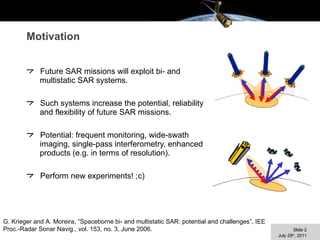
Motivation Future SAR missions will exploit bi- and multistatic SAR systems. Such systems increase the potential, reliability and flexibility of future SAR missions. Potential: frequent monitoring, wide-swath imaging, single-pass interferometry, enhanced products (e.g. in terms of resolution). Perform new experiments! ;c) G. Krieger and A. Moreira, “Spaceborne bi- and multistatic SAR: potential and challenges”, IEE Proc.-Radar Sonar Navig., vol. 153, no. 3, June 2006.
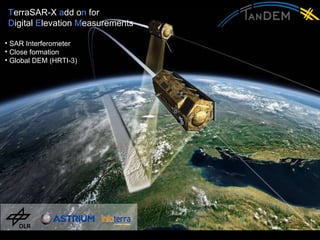
VU   > Alberto Moreira SAR Interferometer Close formation Global DEM (HRTI-3) T erraSAR-X  a dd o n  for  D igital  E levation  M easurements
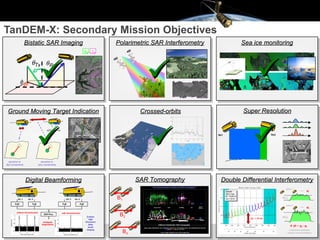
TanDEM-X: Secondary Mission Objectives VU   > Alberto Moreira Bistatic SAR Imaging Super Resolution Polarimetric SAR Interferometry Ground Moving Target Indication SAR Tomography Sea  ice monitoring B 1 B 2 B 3     Crossed-orbits   Double Differential Interferometry Digital Beamforming
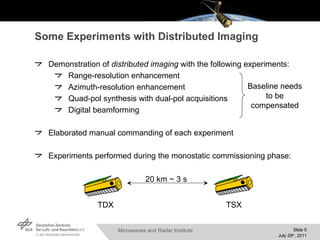
Some Experiments with Distributed Imaging Demonstration of  distributed imaging  with the following experiments: Range-resolution enhancement Azimuth-resolution enhancement Quad-pol synthesis with dual-pol acquisitions Digital beamforming Elaborated manual commanding of each experiment Experiments performed during the monostatic commissioning phase: 20 km ~ 3 s TSX TDX Baseline needs to be compensated
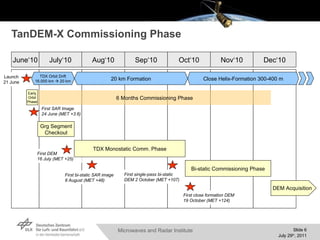
TanDEM-X Commissioning Phase June‘10 July‘10 Aug‘10 Sep‘10 Oct‘10 Nov‘10 Dec‘10 Early Orbit Phase Grg Segment Checkout Bi-static Commissioning Phase 20 km Formation TDX Orbit Drift 16.000 km    20 km Close Helix-Formation 300-400 m Launch 21 June DEM Acquisition First SAR Image  24 June (MET +3.6) First DEM  16 July (MET +25) TDX Monostatic Comm. Phase 6 Months Commissioning Phase First close formation DEM  19 October (MET +124) First bi-static SAR image  8 August (MET +48) First single-pass bi-static DEM 2 October (MET +107)
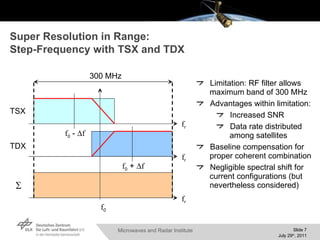
Super Resolution in Range:  Step-Frequency with TSX and TDX Limitation: RF filter allows maximum band of 300 MHz Advantages within limitation: Increased SNR Data rate distributed among satellites Baseline compensation for proper coherent combination Negligible spectral shift for current configurations (but nevertheless considered) f 0  -   f f 0  +   f f 0 f r f r f r  TSX TDX 300 MHz
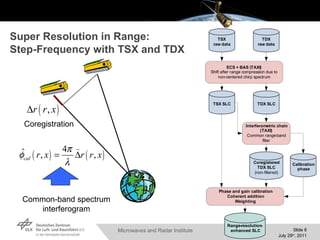
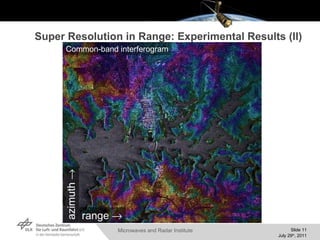
Super Resolution in Range:  Step-Frequency with TSX and TDX Coregistration Common-band spectrum interferogram
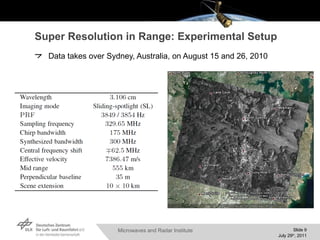
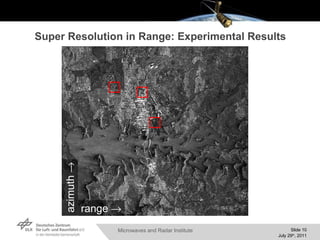
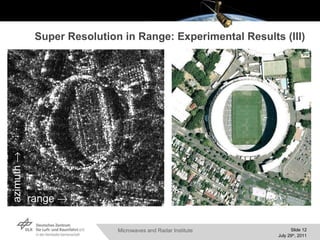
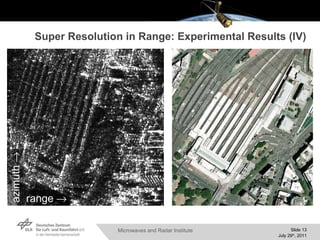
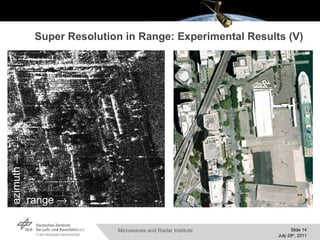
Super Resolution in Range: Experimental Setup Data takes over Sydney, Australia, on August 15 and 26, 2010
Super Resolution in Range: Experimental Results azimuth  range 
Super Resolution in Range: Experimental Results (II) Common-band interferogram azimuth  range 
Super Resolution in Range: Experimental Results  (III) azimuth  range 
Super Resolution in Range: Experimental Results  (IV) azimuth  range 
Super Resolution in Range: Experimental Results (V) azimuth  range 
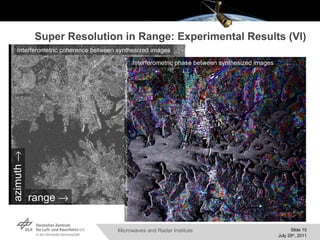
Super Resolution in Range: Experimental Results (VI) Interferometric coherence between synthesized images Interferometric phase between synthesized images azimuth  range 
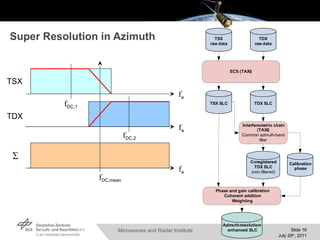
Super Resolution in Azimuth f DC,1 f DC,2 f DC,mean f a f a f a  TSX TDX
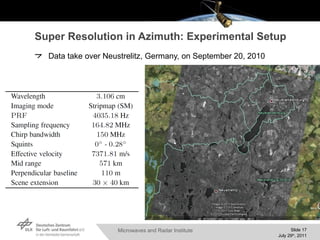
Super Resolution in Azimuth: Experimental Setup Data take over Neustrelitz, Germany, on September 20, 2010
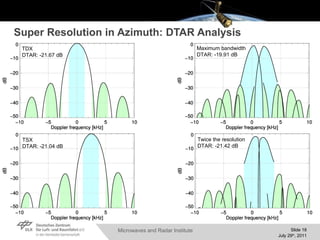
Super Resolution in Azimuth: DTAR Analysis TDX DTAR: -21.67 dB TSX DTAR: -21.04 dB Maximum bandwidth DTAR: -19.91 dB Twice the resolution DTAR: -21.42 dB
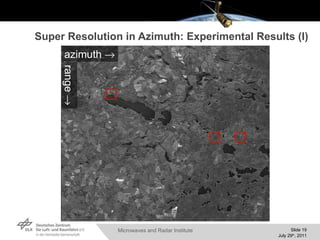
Super Resolution in Azimuth: Experimental Results (I) azimuth  range 
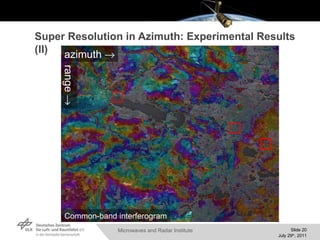
Super Resolution in Azimuth: Experimental Results (II) Common-band interferogram azimuth  range 
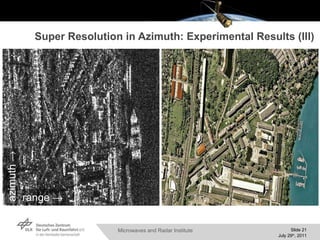
Super Resolution in Azimuth: Experimental Results  (III) azimuth  range 
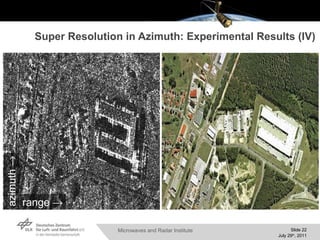
Super Resolution in Azimuth: Experimental Results  (IV) azimuth  range 
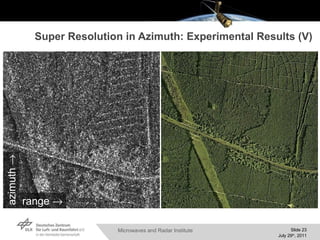
Super Resolution in Azimuth: Experimental Results  (V) azimuth  range  azimuth  range 
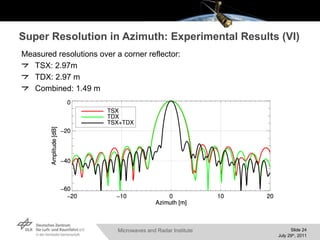
Super Resolution in Azimuth: Experimental Results (VI) Measured resolutions over a corner reflector: TSX: 2.97m TDX: 2.97 m Combined: 1.49 m
Quad-Pol Synthesis with Dual-Pol Acquisitions Each satellite acquires a co-pol and a cross-pol channel, e.g. HH-VH and HV-VV The cross-pol channel is used to estimate the calibration phase Better SNR and DTAR when compared to the experimental quad-pol product using the dual receive antenna (DRA) mode DLR’s E-SAR example: quad-pol synthesis at C-band with repeat-pass dual-pol acquisitions [1] E-SAR [1] R. Scheiber  et al. , “Radar data processing, quality analysis and level-1b product generation for AGRISAR and EAGLE campaigns,” in AGRISAR and EAGLE Campaigns Final Workshop, Noordwijk, The Netherlands, Oct. 15-16 2007.
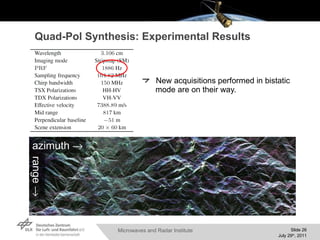
Quad-Pol Synthesis: Experimental Results New acquisitions performed in bistatic mode are on their way. azimuth  range 
Conclusion & Future Work Proof of concept of several experiments with TSX and TDX Range-resolution enhancement Azimuth-resolution enhancement Quad-pol synthesis with dual-pol acquisitions Qual-pol synthesis with dual-pol acquisitions using bistatic data (close formation) Further performance analyses, especially for the azimuth case By doubling the PRF one can obtain simultaneously a resolution improvement in both dimensions Digital beamforming with an interferometric baseline
Thank you for your attention! VU   > Alberto Moreira

2_prats_IGARSS2011_distributed_imaging_v4.ppt

  • 1.
    Pau Prats ,Paco López-Dekker, Francesco De Zan, Steffen Wollstadt, Markus Bachmann, Ulrich Steinbrecher, Rolf Scheiber, Andreas Reigber, Gerhard Krieger Microwaves and Radar Institute (HR) German Aerospace Center [email_address] Distributed Imaging with TSX and TDX
  • 2.
    Motivation Future SARmissions will exploit bi- and multistatic SAR systems. Such systems increase the potential, reliability and flexibility of future SAR missions. Potential: frequent monitoring, wide-swath imaging, single-pass interferometry, enhanced products (e.g. in terms of resolution). Perform new experiments! ;c) G. Krieger and A. Moreira, “Spaceborne bi- and multistatic SAR: potential and challenges”, IEE Proc.-Radar Sonar Navig., vol. 153, no. 3, June 2006.
  • 3.
    VU > Alberto Moreira SAR Interferometer Close formation Global DEM (HRTI-3) T erraSAR-X a dd o n for D igital E levation M easurements
  • 4.
    TanDEM-X: Secondary MissionObjectives VU > Alberto Moreira Bistatic SAR Imaging Super Resolution Polarimetric SAR Interferometry Ground Moving Target Indication SAR Tomography Sea ice monitoring B 1 B 2 B 3     Crossed-orbits   Double Differential Interferometry Digital Beamforming
  • 5.
    Some Experiments withDistributed Imaging Demonstration of distributed imaging with the following experiments: Range-resolution enhancement Azimuth-resolution enhancement Quad-pol synthesis with dual-pol acquisitions Digital beamforming Elaborated manual commanding of each experiment Experiments performed during the monostatic commissioning phase: 20 km ~ 3 s TSX TDX Baseline needs to be compensated
  • 6.
    TanDEM-X Commissioning PhaseJune‘10 July‘10 Aug‘10 Sep‘10 Oct‘10 Nov‘10 Dec‘10 Early Orbit Phase Grg Segment Checkout Bi-static Commissioning Phase 20 km Formation TDX Orbit Drift 16.000 km  20 km Close Helix-Formation 300-400 m Launch 21 June DEM Acquisition First SAR Image 24 June (MET +3.6) First DEM 16 July (MET +25) TDX Monostatic Comm. Phase 6 Months Commissioning Phase First close formation DEM 19 October (MET +124) First bi-static SAR image 8 August (MET +48) First single-pass bi-static DEM 2 October (MET +107)
  • 7.
    Super Resolution inRange: Step-Frequency with TSX and TDX Limitation: RF filter allows maximum band of 300 MHz Advantages within limitation: Increased SNR Data rate distributed among satellites Baseline compensation for proper coherent combination Negligible spectral shift for current configurations (but nevertheless considered) f 0 -  f f 0 +  f f 0 f r f r f r  TSX TDX 300 MHz
  • 8.
    Super Resolution inRange: Step-Frequency with TSX and TDX Coregistration Common-band spectrum interferogram
  • 9.
    Super Resolution inRange: Experimental Setup Data takes over Sydney, Australia, on August 15 and 26, 2010
  • 10.
    Super Resolution inRange: Experimental Results azimuth  range 
  • 11.
    Super Resolution inRange: Experimental Results (II) Common-band interferogram azimuth  range 
  • 12.
    Super Resolution inRange: Experimental Results (III) azimuth  range 
  • 13.
    Super Resolution inRange: Experimental Results (IV) azimuth  range 
  • 14.
    Super Resolution inRange: Experimental Results (V) azimuth  range 
  • 15.
    Super Resolution inRange: Experimental Results (VI) Interferometric coherence between synthesized images Interferometric phase between synthesized images azimuth  range 
  • 16.
    Super Resolution inAzimuth f DC,1 f DC,2 f DC,mean f a f a f a  TSX TDX
  • 17.
    Super Resolution inAzimuth: Experimental Setup Data take over Neustrelitz, Germany, on September 20, 2010
  • 18.
    Super Resolution inAzimuth: DTAR Analysis TDX DTAR: -21.67 dB TSX DTAR: -21.04 dB Maximum bandwidth DTAR: -19.91 dB Twice the resolution DTAR: -21.42 dB
  • 19.
    Super Resolution inAzimuth: Experimental Results (I) azimuth  range 
  • 20.
    Super Resolution inAzimuth: Experimental Results (II) Common-band interferogram azimuth  range 
  • 21.
    Super Resolution inAzimuth: Experimental Results (III) azimuth  range 
  • 22.
    Super Resolution inAzimuth: Experimental Results (IV) azimuth  range 
  • 23.
    Super Resolution inAzimuth: Experimental Results (V) azimuth  range  azimuth  range 
  • 24.
    Super Resolution inAzimuth: Experimental Results (VI) Measured resolutions over a corner reflector: TSX: 2.97m TDX: 2.97 m Combined: 1.49 m
  • 25.
    Quad-Pol Synthesis withDual-Pol Acquisitions Each satellite acquires a co-pol and a cross-pol channel, e.g. HH-VH and HV-VV The cross-pol channel is used to estimate the calibration phase Better SNR and DTAR when compared to the experimental quad-pol product using the dual receive antenna (DRA) mode DLR’s E-SAR example: quad-pol synthesis at C-band with repeat-pass dual-pol acquisitions [1] E-SAR [1] R. Scheiber et al. , “Radar data processing, quality analysis and level-1b product generation for AGRISAR and EAGLE campaigns,” in AGRISAR and EAGLE Campaigns Final Workshop, Noordwijk, The Netherlands, Oct. 15-16 2007.
  • 26.
    Quad-Pol Synthesis: ExperimentalResults New acquisitions performed in bistatic mode are on their way. azimuth  range 
  • 27.
    Conclusion & FutureWork Proof of concept of several experiments with TSX and TDX Range-resolution enhancement Azimuth-resolution enhancement Quad-pol synthesis with dual-pol acquisitions Qual-pol synthesis with dual-pol acquisitions using bistatic data (close formation) Further performance analyses, especially for the azimuth case By doubling the PRF one can obtain simultaneously a resolution improvement in both dimensions Digital beamforming with an interferometric baseline
  • 28.
    Thank you foryour attention! VU > Alberto Moreira

Editor's Notes

  • #5 Auf dieser Folie sehen Sie ein Zusammenfassung der vielfältigen Potenziale bi- und multistatischer SAR Systeme.