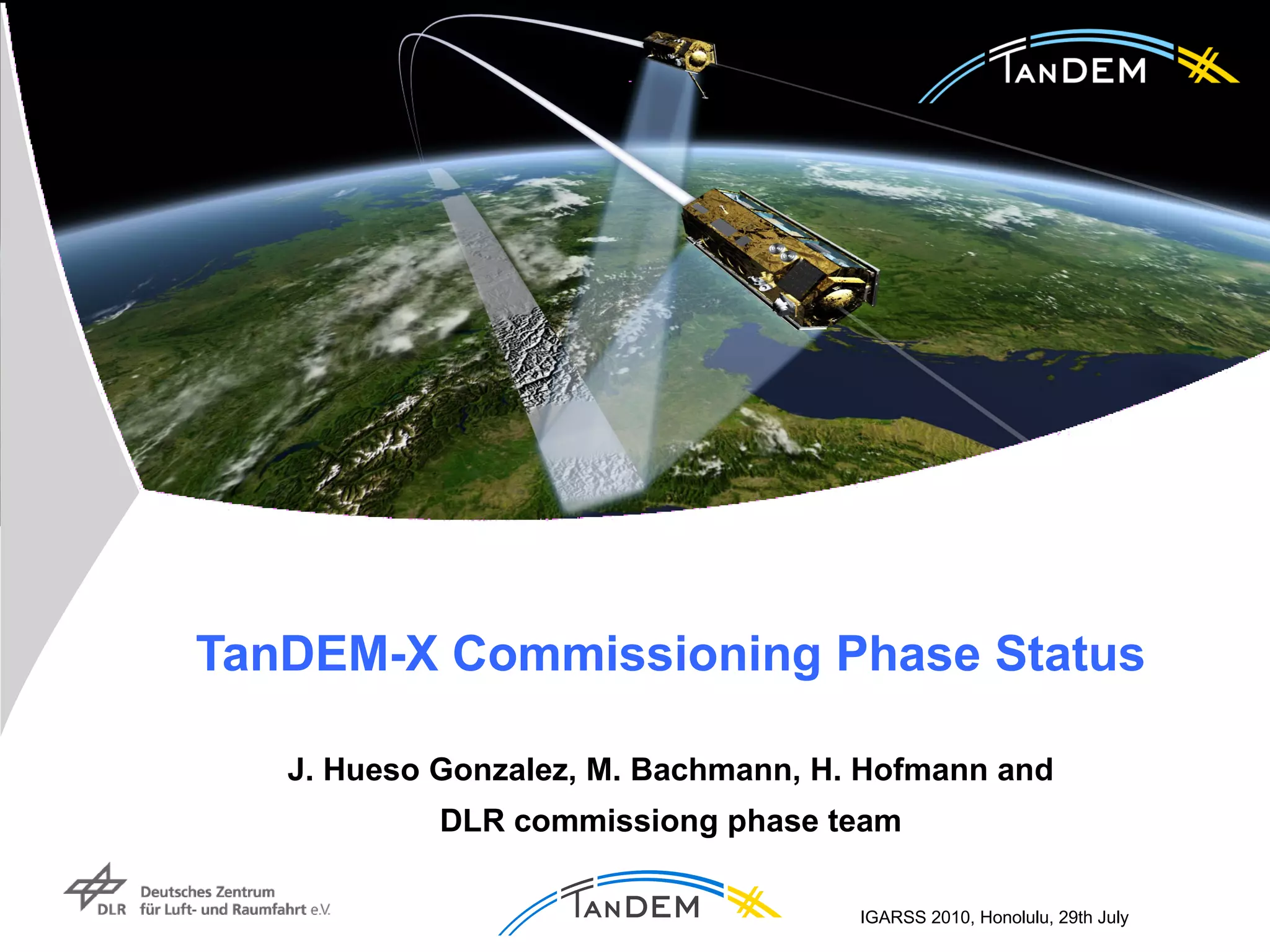
TanDEM-X Commissioning Phase Status   J. Hueso Gonzalez, M. Bachmann,   H. Hofmann and  DLR commissiong phase team
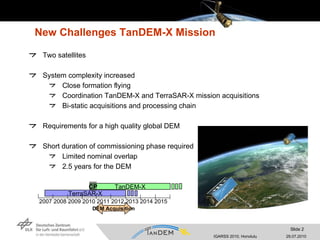
New Challenges TanDEM-X Mission Two satellites System complexity increased Close formation flying  Coordination TanDEM-X and TerraSAR-X mission acquisitions Bi-static acquisitions and processing chain Requirements for a high quality global DEM Short duration of commissioning phase required Limited nominal overlap 2.5 years for the DEM CP TerraSAR-X 2007 2008 2009 2010 2011 2012 2013 2014 2015 TanDEM-X DEM Acquisition
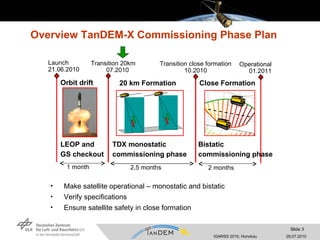
Overview TanDEM-X Commissioning Phase Plan Make satellite operational – monostatic and bistatic Verify specifications Ensure satellite safety in close formation 20 km Formation Close Formation TDX monostatic commissioning phase LEOP and  GS checkout Orbit drift 1 month 2,5 months Launch 21.06.2010 Transition 20km  07.2010 Transition close formation 10.2010 2 months Operational01.2011 Bistatic commissioning phase
Launch and Early Orbit Phase (LEOP) & Ground Segment Checkout
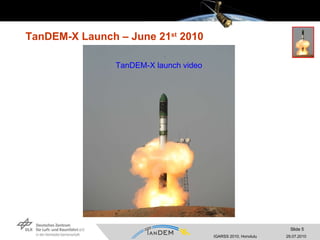
TanDEM-X Launch – June 21 st  2010 TanDEM-X launch video
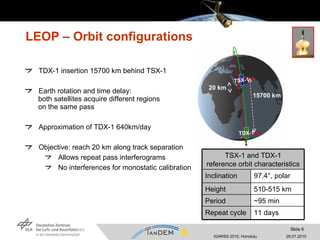
LEOP – Orbit configurations TDX-1 insertion 15700 km behind TSX-1 Earth rotation and time delay:  both satellites acquire different regions on the same pass Approximation of TDX-1 640km/day Objective: reach 20 km along track separation Allows repeat pass interferograms No interferences for monostatic calibration 15700 km 20 km 510-515 km Height ~95 min Period 11 days Repeat cycle 97.4°, polar Inclination TSX-1 and TDX-1 reference orbit characteristics TSX-1 TDX-1
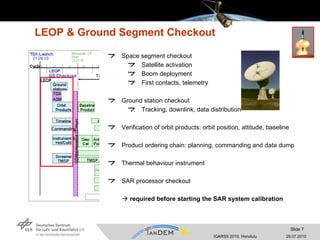
LEOP & Ground Segment Checkout Space segment checkout Satellite activation Boom deployment First contacts, telemetry Ground station checkout Tracking, downlink, data distribution Verification of orbit products: orbit position, attitude, baseline Product ordering chain: planning, commanding and data dump Thermal behaviour instrument SAR processor checkout    required before starting the SAR system calibration
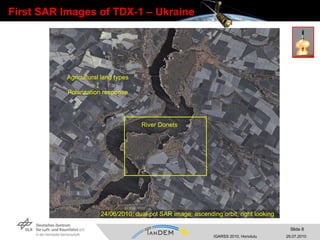
First SAR Images of TDX-1 – Ukraine River Donets Agricultural land types ↕ Polarization response 24/06/2010; dual-pol SAR image; ascending orbit, right looking
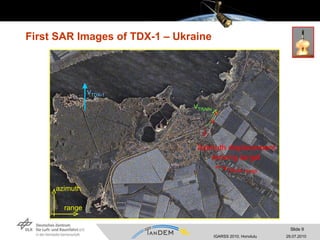
First SAR Images of TDX-1 – Ukraine v TDX-1 v TRAIN Azimuth displacement moving target ~  v TRAIN range azimuth range
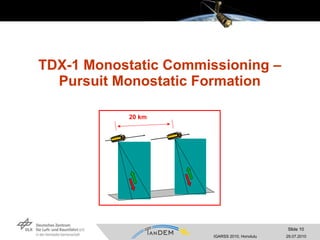
TDX-1 Monostatic Commissioning – Pursuit Monostatic Formation 20 km
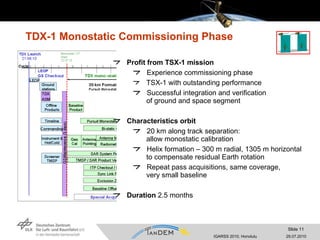
TDX-1 Monostatic Commissioning Phase Profit from TSX-1 mission Experience commissioning phase TSX-1 with outstanding performance Successful integration and verification  of ground and space segment Characteristics orbit 20 km along track separation:  allow monostatic calibration Helix formation – 300 m radial, 1305 m horizontal to compensate residual Earth rotation Repeat pass acquisitions, same coverage, very small baseline Duration  2.5 months
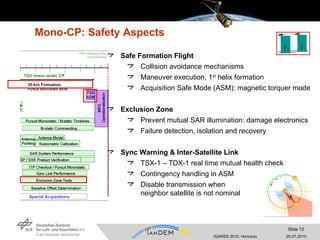
Mono-CP: Safety Aspects Safe Formation Flight Collision avoidance mechanisms Maneuver execution, 1 st  helix formation Acquisition Safe Mode (ASM): magnetic torquer mode Exclusion Zone Prevent mutual SAR illumination: damage electronics Failure detection, isolation and recovery Sync Warning & Inter-Satellite Link TSX-1 – TDX-1 real time mutual health check Contingency handling in ASM Disable transmission when  neighbor satellite is not nominal
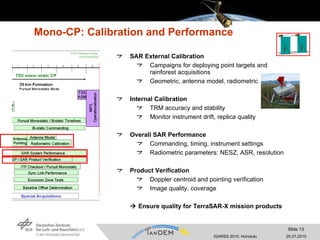
Mono-CP: Calibration and Performance SAR External Calibration Campaigns for deploying point targets and  rainforest acquisitions Geometric, antenna model, radiometric Internal Calibration TRM accuracy and stability  Monitor instrument drift, replica quality Overall SAR Performance Commanding, timing, instrument settings Radiometric parameters: NESZ, ASR, resolution Product Verification Doppler centroid and pointing verification Image quality, coverage    Ensure quality for TerraSAR-X mission products
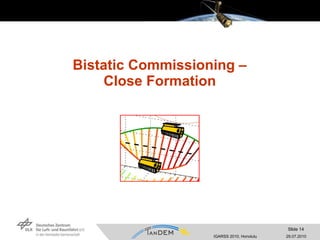
Bistatic Commissioning – Close Formation
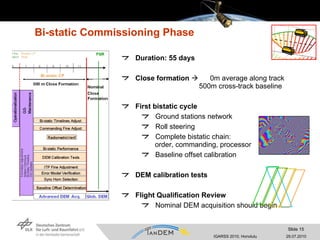
Bi-static Commissioning Phase Duration: 55 days Close formation      0m average along track   500m cross-track baseline First bistatic cycle Ground stations network Roll steering Complete bistatic chain:  order, commanding, processor Baseline offset calibration DEM calibration tests Flight Qualification Review Nominal DEM acquisition should begin
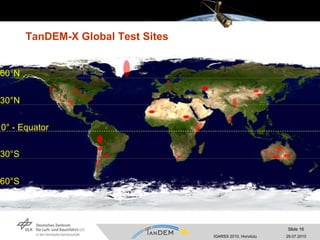
TanDEM-X Global Test Sites 0° - Equator 30°N 60°N 30°S 60°S
Highlights
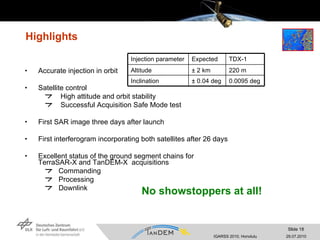
Highlights Accurate injection in orbit Satellite control  High attitude and orbit stability Successful Acquisition Safe Mode test First SAR image three days after launch First interferogram incorporating both satellites after 26 days Excellent status of the ground segment chains for  TerraSAR-X and TanDEM-X  acquisitions Commanding Processing Downlink No showstoppers at all! 220 m ±  2 km Altitude TDX-1 Expected Injection parameter 0.0095 deg ±  0.04 deg Inclination
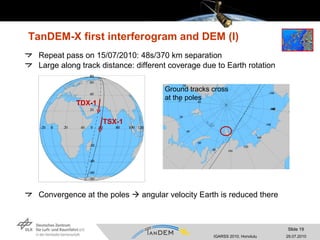
TanDEM-X first interferogram and DEM (I) Repeat pass on 15/07/2010: 48s/370 km separation Large along track distance: different coverage due to Earth rotation Convergence at the poles    angular velocity Earth is reduced there TSX-1 TDX-1 Ground tracks cross at the poles
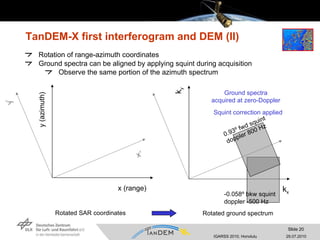
TanDEM-X first interferogram and DEM (II) Rotation of range-azimuth coordinates Ground spectra can be aligned by applying squint during acquisition Observe the same portion of the azimuth spectrum   k x k y Ground spectra acquired at zero-Doppler Squint correction applied Rotated SAR coordinates Rotated ground spectrum -0.058º bkw squint doppler -500 Hz 0.93º fwd squint doppler 800 Hz x (range) y (azimuth) x‘ y‘
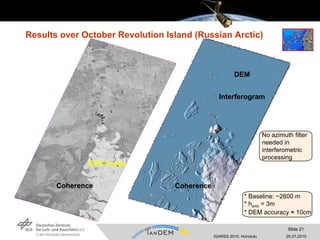
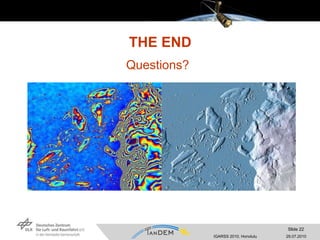
Results over October Revolution Island (Russian Arctic) Coherence DEM SAR Image Coherence Interferogram * Baseline: ~2600 m * h amb  = 3m * DEM accuracy  ≈  10cm No azimuth filter  needed in  interferometric processing
Questions? THE END

TH1.L10.2: TANDEM-X COMMISSIONING PHASE STATUS

  • 1.
    TanDEM-X Commissioning PhaseStatus J. Hueso Gonzalez, M. Bachmann, H. Hofmann and DLR commissiong phase team
  • 2.
    New Challenges TanDEM-XMission Two satellites System complexity increased Close formation flying Coordination TanDEM-X and TerraSAR-X mission acquisitions Bi-static acquisitions and processing chain Requirements for a high quality global DEM Short duration of commissioning phase required Limited nominal overlap 2.5 years for the DEM CP TerraSAR-X 2007 2008 2009 2010 2011 2012 2013 2014 2015 TanDEM-X DEM Acquisition
  • 3.
    Overview TanDEM-X CommissioningPhase Plan Make satellite operational – monostatic and bistatic Verify specifications Ensure satellite safety in close formation 20 km Formation Close Formation TDX monostatic commissioning phase LEOP and GS checkout Orbit drift 1 month 2,5 months Launch 21.06.2010 Transition 20km 07.2010 Transition close formation 10.2010 2 months Operational01.2011 Bistatic commissioning phase
  • 4.
    Launch and EarlyOrbit Phase (LEOP) & Ground Segment Checkout
  • 5.
    TanDEM-X Launch –June 21 st 2010 TanDEM-X launch video
  • 6.
    LEOP – Orbitconfigurations TDX-1 insertion 15700 km behind TSX-1 Earth rotation and time delay: both satellites acquire different regions on the same pass Approximation of TDX-1 640km/day Objective: reach 20 km along track separation Allows repeat pass interferograms No interferences for monostatic calibration 15700 km 20 km 510-515 km Height ~95 min Period 11 days Repeat cycle 97.4°, polar Inclination TSX-1 and TDX-1 reference orbit characteristics TSX-1 TDX-1
  • 7.
    LEOP & GroundSegment Checkout Space segment checkout Satellite activation Boom deployment First contacts, telemetry Ground station checkout Tracking, downlink, data distribution Verification of orbit products: orbit position, attitude, baseline Product ordering chain: planning, commanding and data dump Thermal behaviour instrument SAR processor checkout  required before starting the SAR system calibration
  • 8.
    First SAR Imagesof TDX-1 – Ukraine River Donets Agricultural land types ↕ Polarization response 24/06/2010; dual-pol SAR image; ascending orbit, right looking
  • 9.
    First SAR Imagesof TDX-1 – Ukraine v TDX-1 v TRAIN Azimuth displacement moving target ~ v TRAIN range azimuth range
  • 10.
    TDX-1 Monostatic Commissioning– Pursuit Monostatic Formation 20 km
  • 11.
    TDX-1 Monostatic CommissioningPhase Profit from TSX-1 mission Experience commissioning phase TSX-1 with outstanding performance Successful integration and verification of ground and space segment Characteristics orbit 20 km along track separation: allow monostatic calibration Helix formation – 300 m radial, 1305 m horizontal to compensate residual Earth rotation Repeat pass acquisitions, same coverage, very small baseline Duration 2.5 months
  • 12.
    Mono-CP: Safety AspectsSafe Formation Flight Collision avoidance mechanisms Maneuver execution, 1 st helix formation Acquisition Safe Mode (ASM): magnetic torquer mode Exclusion Zone Prevent mutual SAR illumination: damage electronics Failure detection, isolation and recovery Sync Warning & Inter-Satellite Link TSX-1 – TDX-1 real time mutual health check Contingency handling in ASM Disable transmission when neighbor satellite is not nominal
  • 13.
    Mono-CP: Calibration andPerformance SAR External Calibration Campaigns for deploying point targets and rainforest acquisitions Geometric, antenna model, radiometric Internal Calibration TRM accuracy and stability Monitor instrument drift, replica quality Overall SAR Performance Commanding, timing, instrument settings Radiometric parameters: NESZ, ASR, resolution Product Verification Doppler centroid and pointing verification Image quality, coverage  Ensure quality for TerraSAR-X mission products
  • 14.
  • 15.
    Bi-static Commissioning PhaseDuration: 55 days Close formation  0m average along track 500m cross-track baseline First bistatic cycle Ground stations network Roll steering Complete bistatic chain: order, commanding, processor Baseline offset calibration DEM calibration tests Flight Qualification Review Nominal DEM acquisition should begin
  • 16.
    TanDEM-X Global TestSites 0° - Equator 30°N 60°N 30°S 60°S
  • 17.
  • 18.
    Highlights Accurate injectionin orbit Satellite control High attitude and orbit stability Successful Acquisition Safe Mode test First SAR image three days after launch First interferogram incorporating both satellites after 26 days Excellent status of the ground segment chains for TerraSAR-X and TanDEM-X acquisitions Commanding Processing Downlink No showstoppers at all! 220 m ± 2 km Altitude TDX-1 Expected Injection parameter 0.0095 deg ± 0.04 deg Inclination
  • 19.
    TanDEM-X first interferogramand DEM (I) Repeat pass on 15/07/2010: 48s/370 km separation Large along track distance: different coverage due to Earth rotation Convergence at the poles  angular velocity Earth is reduced there TSX-1 TDX-1 Ground tracks cross at the poles
  • 20.
    TanDEM-X first interferogramand DEM (II) Rotation of range-azimuth coordinates Ground spectra can be aligned by applying squint during acquisition Observe the same portion of the azimuth spectrum k x k y Ground spectra acquired at zero-Doppler Squint correction applied Rotated SAR coordinates Rotated ground spectrum -0.058º bkw squint doppler -500 Hz 0.93º fwd squint doppler 800 Hz x (range) y (azimuth) x‘ y‘
  • 21.
    Results over OctoberRevolution Island (Russian Arctic) Coherence DEM SAR Image Coherence Interferogram * Baseline: ~2600 m * h amb = 3m * DEM accuracy ≈ 10cm No azimuth filter needed in interferometric processing
  • 22.

Editor's Notes

  • #3 Komplexitit ät um ein vielfaches erhöht im Gegensatz zu TerraSAR-X
  • #4 Ich möchte mit dieser Folie nur einen kurzen Überblick zeigen, man muß die einzelen tasks nicht genau lesen können. Darauf gehe ich später ein. Was hier wichtig ist, sind die 3 Phase aus denen die Commissioning Phase besteht:
  • #13 Das also die TDX aufnahmen in der TerraSAR-X Spezifikation sind Um die Bestrahlung des einen Satelliten mit dem anderen zu verhindern.
  • #14 Das also die TDX aufnahmen in der TerraSAR-X Spezifikation sind Um die Bestrahlung des einen Satelliten mit dem anderen zu verhindern.