Marc Rodriguez-Cassola , Pau Prats, Daniel Schulze, Núria Tous-Ramón, Ulrich Steinbrecher, Luca Marotti, Matteo Nannini, Marwan Younis, Paco López-Dekker, Manfred Zink, Andreas Reigber, Gerhard Krieger, Alberto Moreira Microwaves and Radar Institute (HR) German Aerospace Center [email_address] First Bistatic Spaceborne SAR Experiments with TanDEM-X
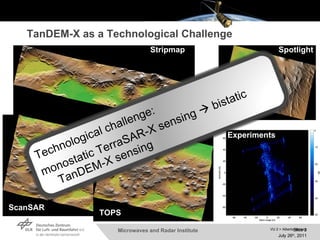
TanDEM-X as a Technological Challenge VU   > Alberto Moreira ScanSAR TOPS Experiments Spotlight Stripmap Technological challenge:  monostatic TerraSAR-X sensing    bistatic TanDEM-X sensing
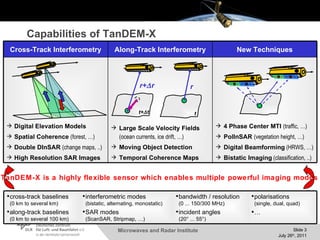
Capabilities of TanDEM-X VU   > Alberto Moreira TanDEM-X is a highly flexible sensor which enables multiple powerful imaging modes r+  r r t+  t t Cross-Track Interferometry Along-Track Interferometry New Techniques Digital Elevation Models Spatial Coherence  (forest, …) Double DInSAR  (change maps, ..) High Resolution SAR Images Large Scale Velocity Fields  (ocean currents, ice drift, …) Moving Object Detection Temporal Coherence Maps 4 Phase Center MTI  (traffic, …)   PolInSAR  (vegetation height, …) Digital Beamforming   (HRWS, …) Bistatic Imaging   (classification, ..) cross-track baselines (0 km to several km) along-track baselines (0 km to several 100 km)  interferometric modes  (bistatic, alternating, monostatic) SAR modes (ScanSAR, Stripmap, …) bandwidth / resolution (0 ... 150/300 MHz)  incident angles (20° ... 55°) polarisations (single, dual, quad) …
TanDEM-X Commissioning Phase June‘10 July‘10 Aug‘10 Sep‘10 Oct‘10 Nov‘10 Dec‘10 Early Orbit Phase Grg Segment Checkout Bi-static Commissioning Phase 20 km Formation TDX Orbit Drift 16.000 km    20 km Close Helix-Formation 300-400 m Launch 21 June DEM Acquisition First SAR Image  24 June (MET +3.6) First DEM  16 July (MET +25) TDX Monostatic Comm. Phase 6 Months Commissioning Phase First close formation DEM  19 October (MET +124) First bi-static SAR image  8 August (MET +48) First single-pass DEM 8 October (MET +115) 20 km
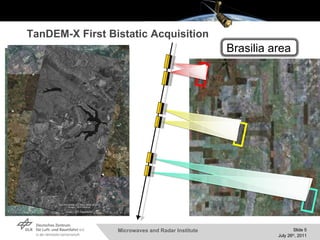
TanDEM-X First Bistatic Acquisition Brasilia area
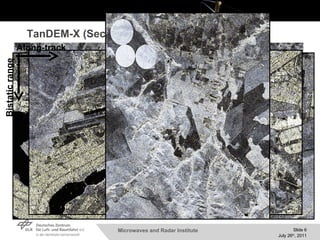
TanDEM-X (Second) First Bistatic Image Stripmap acquisition (~3 m resolution) 100 MHz transmitted bandwidth 36.6 deg incident angle Polarisation: VV Along-track Bistatic range
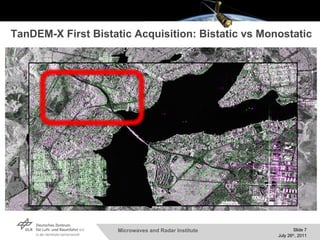
TanDEM-X First Bistatic Acquisition: Bistatic vs Monostatic
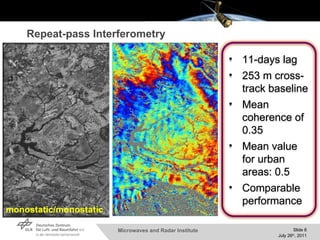
Repeat-pass Interferometry monostatic/monostatic 11-days lag 253 m cross-track baseline Mean coherence of 0.35 Mean value for urban areas: 0.5 Comparable performance
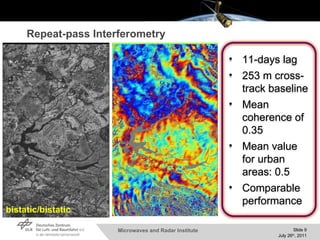
Repeat-pass Interferometry bistatic/bistatic 11-days lag 253 m cross-track baseline Mean coherence of 0.35 Mean value for urban areas: 0.5 Comparable performance
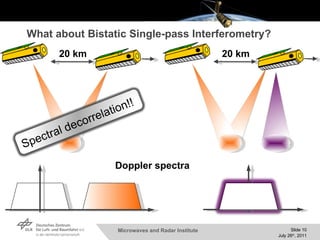
What about Bistatic Single-pass Interferometry? 20 km Doppler spectra 20 km Spectral decorrelation!!
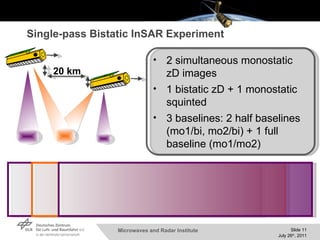
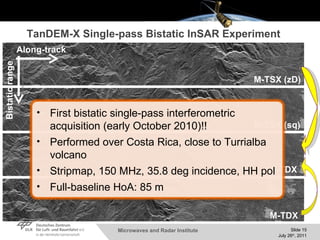
Single-pass Bistatic InSAR Experiment 20 km 2 simultaneous monostatic zD images 1 bistatic zD + 1 monostatic  squinted 3 baselines: 2 half baselines (mo1/bi, mo2/bi) + 1 full baseline (mo1/mo2)
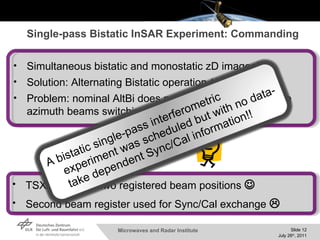
Single-pass Bistatic InSAR Experiment: Commanding Simultaneous bistatic and monostatic zD images!!! Solution: Alternating Bistatic operation (AltBi)!!! Problem: nominal AltBi does not consider pulse-to-pulse azimuth beams switching!!! TSX/TDX have two registered beam positions     Second beam register used for Sync/Cal exchange   A bistatic single-pass interferometric experiment was scheduled but with no data-take dependent Sync/Cal information!!
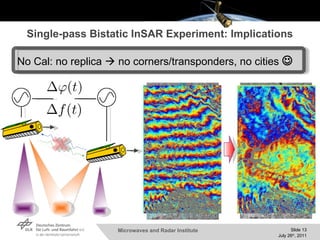
Single-pass Bistatic InSAR Experiment: Implications No Cal: no replica    no corners/transponders, no cities  
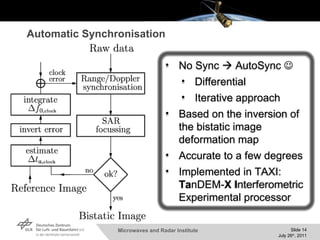
Automatic Synchronisation No Sync    AutoSync   Differential Iterative approach Based on the inversion of the bistatic image deformation map Accurate to a few degrees Implemented in TAXI:  Ta nDEM- X I nterferometric Experimental processor
TanDEM-X Single-pass Bistatic InSAR Experiment M-TSX (zD) M-TSX (sq) B-TDX M-TDX Along-track Bistatic range First bistatic single-pass interferometric acquisition (early October 2010)!! Performed over Costa Rica, close to Turrialba volcano Stripmap, 150 MHz, 35.8 deg incidence, HH pol Full-baseline HoA: 85 m
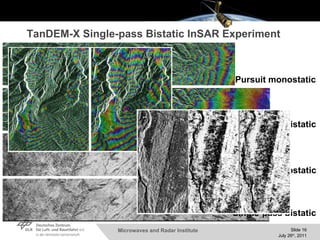
TanDEM-X Single-pass Bistatic InSAR Experiment Pursuit monostatic Single-pass bistatic Pursuit monostatic Single-pass bistatic
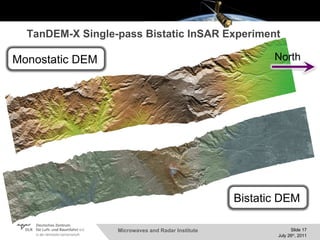
TanDEM-X Single-pass Bistatic InSAR Experiment North Monostatic DEM Bistatic DEM
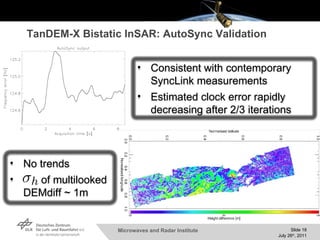
TanDEM-X Bistatic InSAR: AutoSync Validation Consistent with contemporary SyncLink measurements Estimated clock error rapidly decreasing after 2/3 iterations No trends of multilooked DEMdiff ~ 1m
Summary The  first bistatic acquisitions  were already performed during the  pursuit monostatic commissioning phase  with the system operated in non-nominal configurations and with an  along-track baseline of 20 km First demonstration of spaceborne bistatic SAR imaging and bistatic interferometry
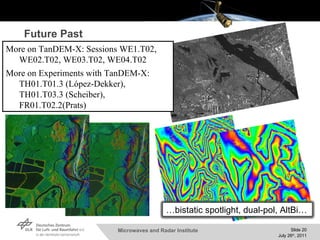
Future Past More on TanDEM-X: Sessions WE1.T02, WE02.T02, WE03.T02, WE04.T02 More on Experiments with TanDEM-X: TH01.T01.3 (López-Dekker), TH01.T03.3 (Scheiber), FR01.T02.2(Prats) … bistatic spotlight, dual-pol, AltBi…

FIRST BISTATIC SPACEBORNE SAR EXPERIMENTS WITH TANDEM-X.ppt

  • 1.
    Marc Rodriguez-Cassola ,Pau Prats, Daniel Schulze, Núria Tous-Ramón, Ulrich Steinbrecher, Luca Marotti, Matteo Nannini, Marwan Younis, Paco López-Dekker, Manfred Zink, Andreas Reigber, Gerhard Krieger, Alberto Moreira Microwaves and Radar Institute (HR) German Aerospace Center [email_address] First Bistatic Spaceborne SAR Experiments with TanDEM-X
  • 2.
    TanDEM-X as aTechnological Challenge VU > Alberto Moreira ScanSAR TOPS Experiments Spotlight Stripmap Technological challenge: monostatic TerraSAR-X sensing  bistatic TanDEM-X sensing
  • 3.
    Capabilities of TanDEM-XVU > Alberto Moreira TanDEM-X is a highly flexible sensor which enables multiple powerful imaging modes r+  r r t+  t t Cross-Track Interferometry Along-Track Interferometry New Techniques Digital Elevation Models Spatial Coherence (forest, …) Double DInSAR (change maps, ..) High Resolution SAR Images Large Scale Velocity Fields (ocean currents, ice drift, …) Moving Object Detection Temporal Coherence Maps 4 Phase Center MTI (traffic, …) PolInSAR (vegetation height, …) Digital Beamforming (HRWS, …) Bistatic Imaging (classification, ..) cross-track baselines (0 km to several km) along-track baselines (0 km to several 100 km) interferometric modes (bistatic, alternating, monostatic) SAR modes (ScanSAR, Stripmap, …) bandwidth / resolution (0 ... 150/300 MHz) incident angles (20° ... 55°) polarisations (single, dual, quad) …
  • 4.
    TanDEM-X Commissioning PhaseJune‘10 July‘10 Aug‘10 Sep‘10 Oct‘10 Nov‘10 Dec‘10 Early Orbit Phase Grg Segment Checkout Bi-static Commissioning Phase 20 km Formation TDX Orbit Drift 16.000 km  20 km Close Helix-Formation 300-400 m Launch 21 June DEM Acquisition First SAR Image 24 June (MET +3.6) First DEM 16 July (MET +25) TDX Monostatic Comm. Phase 6 Months Commissioning Phase First close formation DEM 19 October (MET +124) First bi-static SAR image 8 August (MET +48) First single-pass DEM 8 October (MET +115) 20 km
  • 5.
    TanDEM-X First BistaticAcquisition Brasilia area
  • 6.
    TanDEM-X (Second) FirstBistatic Image Stripmap acquisition (~3 m resolution) 100 MHz transmitted bandwidth 36.6 deg incident angle Polarisation: VV Along-track Bistatic range
  • 7.
    TanDEM-X First BistaticAcquisition: Bistatic vs Monostatic
  • 8.
    Repeat-pass Interferometry monostatic/monostatic11-days lag 253 m cross-track baseline Mean coherence of 0.35 Mean value for urban areas: 0.5 Comparable performance
  • 9.
    Repeat-pass Interferometry bistatic/bistatic11-days lag 253 m cross-track baseline Mean coherence of 0.35 Mean value for urban areas: 0.5 Comparable performance
  • 10.
    What about BistaticSingle-pass Interferometry? 20 km Doppler spectra 20 km Spectral decorrelation!!
  • 11.
    Single-pass Bistatic InSARExperiment 20 km 2 simultaneous monostatic zD images 1 bistatic zD + 1 monostatic squinted 3 baselines: 2 half baselines (mo1/bi, mo2/bi) + 1 full baseline (mo1/mo2)
  • 12.
    Single-pass Bistatic InSARExperiment: Commanding Simultaneous bistatic and monostatic zD images!!! Solution: Alternating Bistatic operation (AltBi)!!! Problem: nominal AltBi does not consider pulse-to-pulse azimuth beams switching!!! TSX/TDX have two registered beam positions  Second beam register used for Sync/Cal exchange  A bistatic single-pass interferometric experiment was scheduled but with no data-take dependent Sync/Cal information!!
  • 13.
    Single-pass Bistatic InSARExperiment: Implications No Cal: no replica  no corners/transponders, no cities 
  • 14.
    Automatic Synchronisation NoSync  AutoSync  Differential Iterative approach Based on the inversion of the bistatic image deformation map Accurate to a few degrees Implemented in TAXI: Ta nDEM- X I nterferometric Experimental processor
  • 15.
    TanDEM-X Single-pass BistaticInSAR Experiment M-TSX (zD) M-TSX (sq) B-TDX M-TDX Along-track Bistatic range First bistatic single-pass interferometric acquisition (early October 2010)!! Performed over Costa Rica, close to Turrialba volcano Stripmap, 150 MHz, 35.8 deg incidence, HH pol Full-baseline HoA: 85 m
  • 16.
    TanDEM-X Single-pass BistaticInSAR Experiment Pursuit monostatic Single-pass bistatic Pursuit monostatic Single-pass bistatic
  • 17.
    TanDEM-X Single-pass BistaticInSAR Experiment North Monostatic DEM Bistatic DEM
  • 18.
    TanDEM-X Bistatic InSAR:AutoSync Validation Consistent with contemporary SyncLink measurements Estimated clock error rapidly decreasing after 2/3 iterations No trends of multilooked DEMdiff ~ 1m
  • 19.
    Summary The first bistatic acquisitions were already performed during the pursuit monostatic commissioning phase with the system operated in non-nominal configurations and with an along-track baseline of 20 km First demonstration of spaceborne bistatic SAR imaging and bistatic interferometry
  • 20.
    Future Past Moreon TanDEM-X: Sessions WE1.T02, WE02.T02, WE03.T02, WE04.T02 More on Experiments with TanDEM-X: TH01.T01.3 (López-Dekker), TH01.T03.3 (Scheiber), FR01.T02.2(Prats) … bistatic spotlight, dual-pol, AltBi…

Editor's Notes

  • #11 Now a lot of you will wonder: that’s what TDX is about, n’est-ce pas? Yes, but not in the monostatic CP Plot spectral decorrelation What does monostatic/bistatic correlation mean? v
  • #12 Now a lot of you will wonder: that’s what TDX is about, n’est-ce pas? Yes, but not in the monostatic CP Plot spectral decorrelation What does monostatic/bistatic correlation mean? v