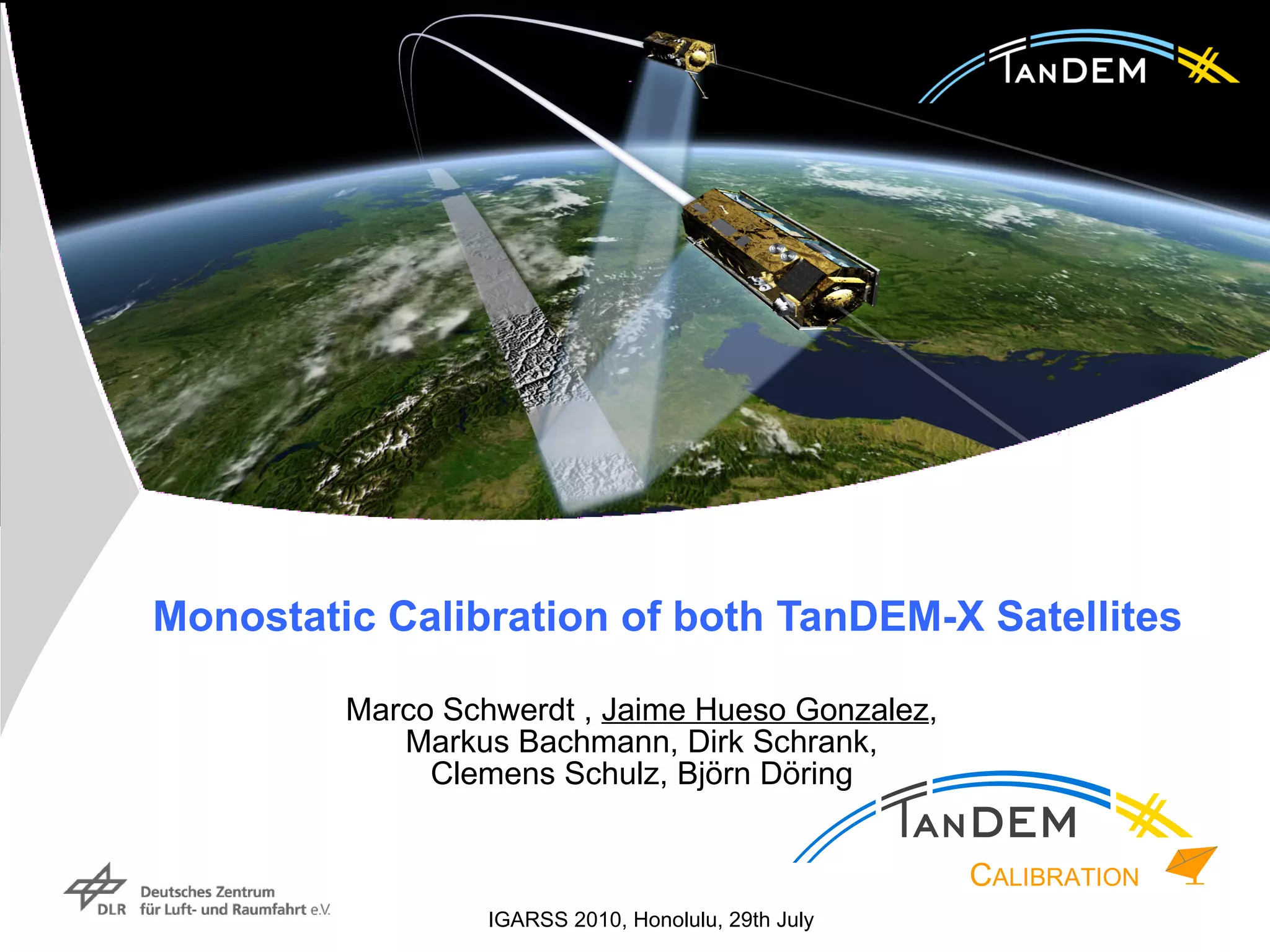
Monostatic Calibration of both TanDEM-X Satellites Marco Schwerdt   ,  Jaime Hueso Gonzalez , Markus Bachmann, Dirk Schrank, Clemens Schulz, Björn Döring
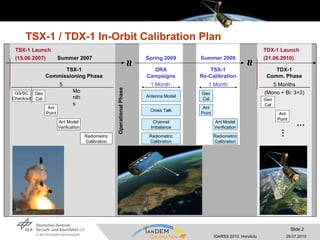
TSX-1 / TDX-1 In-Orbit Calibration Plan Operational Phase Ant Point Geo Cal GS/SC Checkout TSX-1 Launch  (15.06.2007) Radiometric Calibration Ant Model Verification TSX-1 Commissioning Phase 5 Months Summer 2007 TDX-1 Comm. Phase TDX-1 Launch  (21.06.2010) 5 Months (Mono + Bi: 3+2) Geo Cal Ant Point • • • • • • Channel Imbalance DRA Campaigns 1 Month  Spring 2009 Radiometric Calibration Antenna Model Cross Talk Radiometric Calibration Ant Model Verification Geo Cal TSX-1 Re-Calibration 1 Month Ant Point Summer 2009 ≈ ≈
TSX-1 Calibration
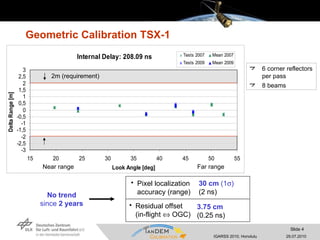
Geometric Calibration TSX-1 6 corner reflectors per pass 8 beams Near range  Far range - Azimuth shift - Instrument delay - Tropospheric effects Time annotation of source packets Range delay Connection between SAR data and geographic position on Earth surface is calibrated 2m ( requirement ) 30 cm  (1  ) (2 ns) Pixel localization accuracy (range) No trend since  2 years 3.75 cm (0.25 ns) Residual offset (in-flight    OGC)
Pointing Determination in Azimuth TSX-1 Updates Improved ground receiver position Re-adjustment between star trackers Improvements   2007   2009 Measurement accuracy ≤ 7.9 Hz   ≤ 2.6 Hz (1  )  per pass < 1.0 mdeg   < 0.33 mdeg   Mean doppler   16 Hz   5.9 Hz Residual pointing error   2 mdeg   0.74 mdeg Notch patterns with different look angles 4 ground receivers per pass Near range  Elevation look angle [degree]  Far range Frequency shift due to mispointing [Hz]
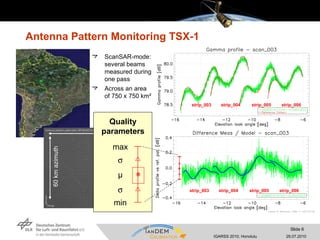
Antenna Pattern Monitoring TSX-1  ScanSAR-mode: several beams measured during one pass Across an area of 750 x 750 km² Purpose Detect changes in the antenna front end and waveguides 120 km range 60 km azimuth strip_003 strip_004 strip_005 strip_006 Quality parameters *  max µ  min strip_003 strip_004 strip_005 strip_006
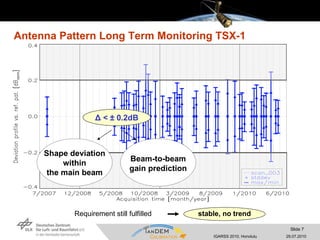
Antenna Pattern Long Term Monitoring TSX-1 Shape deviation within the main beam Beam-to-beam gain prediction stable, no trend Requirement still fulfilled Δ  < ± 0.2dB
Radiometric Calibration TSX-1 µ 2009  = -56.53dB + 0.10dB (CR) = -56.43dB µ ≤ ± 0.2dB within scene TerraSAR-X is extremely stable 0.15dB over 2 years µ ≤ ± 0.2dB within full performance range Requirement 0.5 dB (1  ) over 6 months ! CR: corner reflector 6 corner reflectors across the swath 3 beams (low, mid, high inc.) -57,6 -57,4 -57,2 -57 -56,8 -56,6 -56,4 -56,2 -56 -55,8 -55,6 10 15 20 25 30 35 40 45 Look Angle [deg] Abs Cal Factor [dB] strip_002 strip_007 strip_013  = -56.50 dB  =  0.21 dB   = -56.76 dB  =  0.24 dB   = -56.45 dB  =  0.16 dB  strip_007 -57,6 -57,4 -57,2 -57 -56,8 -56,6 -56,4 -56,2 -56 -55,8 -55,6 Abs Cal Factor [dB] near mid far  = -56.73 dB  =  0.22 dB  = -56.65 dB  =  0.17 dB  = -56.62 dB  =  0.18 dB  = -56.67 dB  =  0.18 dB Radiometric Stability   Abs. Cal Factor 2007   - 56.58 dB 2009   - 56.43 dB ≤  ± 0.2dB Antenna Model
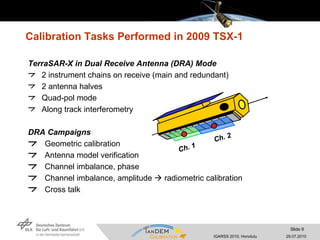
Calibration Tasks Performed in 2009 TSX-1 TerraSAR-X in Dual Receive Antenna (DRA) Mode 2 instrument chains on receive (main and redundant) 2 antenna halves Quad-pol mode Along track interferometry DRA Campaigns Geometric calibration Antenna model verification Channel imbalance, phase Channel imbalance, amplitude    radiometric calibration  Cross talk Ch. 2 Ch. 1
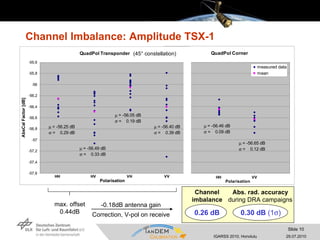
Channel Imbalance: Amplitude TSX-1 -0.18dB antenna gain Correction, V-pol on receive max. offset 0.44dB Channel imbalance 0.26 dB Abs. rad. accuracy  during DRA campaigns 0.30 dB  (1  ) (45° constellation)
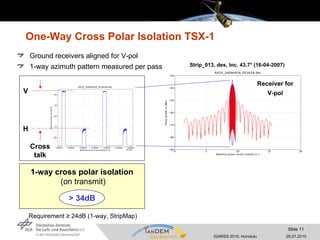
One-Way Cross Polar Isolation TSX-1 Ground receivers aligned for V-pol 1-way azimuth pattern measured per pass Cross talk Requirement ≥ 24dB (1-way, StripMap) Receiver for V-pol Strip_013, des, Inc. 43.7° (16-04-2007) H V 1-way cross polar isolation   (on transmit) > 34dB
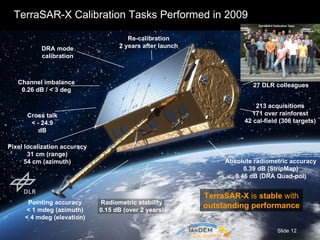
TerraSAR-X Calibration Tasks Performed in 2009 C ALIBRATION  TerraSAR-X  is  stable  with  outstanding performance Slide 12 27 DLR colleagues DRA mode calibration Radiometric stability 0.15 dB (over 2 years) Absolute radiometric accuracy 0.39 dB (StripMap) 0.46 dB (DRA Quad-pol) Channel imbalance 0.26 dB / < 3 deg Cross talk < - 24.9 dB 213 acquisitions 171 over rainforest 42 cal-field (306 targets) Re-calibration 2 years after launch Pointing accuracy < 1 mdeg (azimuth) < 4 mdeg (elevation) Pixel localization accuracy 31 cm (range) 54 cm (azimuth)
TDX-1 Calibration
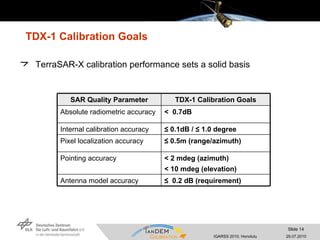
TDX-1 Calibration Goals TerraSAR-X calibration performance sets a solid basis ≤   0.1dB /  ≤  1.0 degree Internal calibration accuracy <  0.7dB Absolute radiometric accuracy ≤   0.5m (range/azimuth) Pixel localization accuracy ≤   0.2 dB (requirement) Antenna model accuracy < 2 mdeg (azimuth) < 10 mdeg (elevation) Pointing accuracy TDX-1 Calibration Goals SAR Quality Parameter
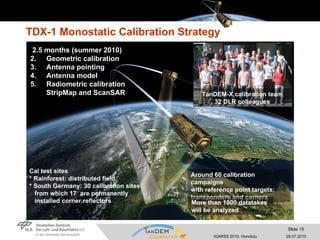
TDX-1 Monostatic Calibration Strategy 2.5 months (summer 2010) Geometric calibration Antenna pointing Antenna model Radiometric calibration StripMap and ScanSAR Cal test sites * Rainforest: distributed field * South Germany: 30 calibration sites   from which 17  are permanently    installed corner reflectors TanDEM-X calibration team 32 DLR colleagues Around 60 calibration campaigns with reference point targets: transponders and corners More than 1000 datatakes will be analyzed
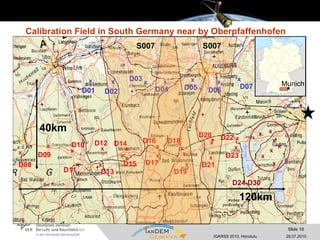
Calibration Field in South Germany near by Oberpfaffenhofen Munich D01 x D02 x D03 x D04 x D05 x D06 x D07 x D24-D30 x x x x x x x D08 x D09 x D10 x D12 x D14 x D17 x D18 x D19 x D20 x D22 x D11 x D13 x D15 x D16 x D21 x D23 x 40km 120km S007 S007
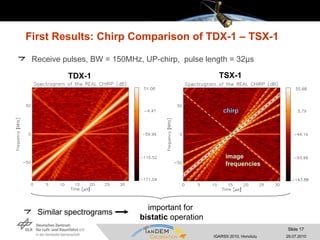
First Results: Chirp Comparison of TDX-1 – TSX-1 Receive pulses, BW = 150MHz, UP-chirp,  pulse length = 32µs Similar spectrograms image frequencies chirp TSX-1 TDX-1 important for bistatic  operation
First results TDX-1: TRM Characterization – PN Gating blue: measured in flight cold red: measured in flight hot black: on ground characterization Receive Phase [degrees] Amplitude [dB] Transmit Phase [degrees] Amplitude [dB] Warm instrument stability
First Results TDX-1: Antenna Pattern over Rainforest Within requirements strip_003 strip_004 strip_005 strip_006 strip_003 strip_004 strip_005 strip_006
First Results TDX-1: Antenna Pattern by Ground Receivers  Ground Receiver Position Vector Measurements confirm simulated reference pattern Within requirements Transmit pattern only   Relative accuracy <  ±  0.1dB
First Sequential Ground Receiver Acquisition Direct measurement of the satellite separation in along track   Pursuit monostatic phase 1 st  absolute comparative measurement of transmitted power   <0.5dB difference TDX-1 – TSX-1 3s azimuth separation  ≈ 20 km TSX-1 TDX-1 RX
Questions? THE END TSX-1 DLR logo  experiment : Oberpfaffenhofen, Bayern, Germany (19 th  June 2008)

TH1.L10.3: MONOSTATIC CALIBRATION OF BOTH TANDEM-X SATELLITES

  • 1.
    Monostatic Calibration ofboth TanDEM-X Satellites Marco Schwerdt , Jaime Hueso Gonzalez , Markus Bachmann, Dirk Schrank, Clemens Schulz, Björn Döring
  • 2.
    TSX-1 / TDX-1In-Orbit Calibration Plan Operational Phase Ant Point Geo Cal GS/SC Checkout TSX-1 Launch (15.06.2007) Radiometric Calibration Ant Model Verification TSX-1 Commissioning Phase 5 Months Summer 2007 TDX-1 Comm. Phase TDX-1 Launch (21.06.2010) 5 Months (Mono + Bi: 3+2) Geo Cal Ant Point • • • • • • Channel Imbalance DRA Campaigns 1 Month Spring 2009 Radiometric Calibration Antenna Model Cross Talk Radiometric Calibration Ant Model Verification Geo Cal TSX-1 Re-Calibration 1 Month Ant Point Summer 2009 ≈ ≈
  • 3.
  • 4.
    Geometric Calibration TSX-16 corner reflectors per pass 8 beams Near range Far range - Azimuth shift - Instrument delay - Tropospheric effects Time annotation of source packets Range delay Connection between SAR data and geographic position on Earth surface is calibrated 2m ( requirement ) 30 cm (1  ) (2 ns) Pixel localization accuracy (range) No trend since 2 years 3.75 cm (0.25 ns) Residual offset (in-flight  OGC)
  • 5.
    Pointing Determination inAzimuth TSX-1 Updates Improved ground receiver position Re-adjustment between star trackers Improvements 2007 2009 Measurement accuracy ≤ 7.9 Hz ≤ 2.6 Hz (1  ) per pass < 1.0 mdeg < 0.33 mdeg Mean doppler 16 Hz 5.9 Hz Residual pointing error 2 mdeg 0.74 mdeg Notch patterns with different look angles 4 ground receivers per pass Near range Elevation look angle [degree] Far range Frequency shift due to mispointing [Hz]
  • 6.
    Antenna Pattern MonitoringTSX-1 ScanSAR-mode: several beams measured during one pass Across an area of 750 x 750 km² Purpose Detect changes in the antenna front end and waveguides 120 km range 60 km azimuth strip_003 strip_004 strip_005 strip_006 Quality parameters *  max µ  min strip_003 strip_004 strip_005 strip_006
  • 7.
    Antenna Pattern LongTerm Monitoring TSX-1 Shape deviation within the main beam Beam-to-beam gain prediction stable, no trend Requirement still fulfilled Δ < ± 0.2dB
  • 8.
    Radiometric Calibration TSX-1µ 2009 = -56.53dB + 0.10dB (CR) = -56.43dB µ ≤ ± 0.2dB within scene TerraSAR-X is extremely stable 0.15dB over 2 years µ ≤ ± 0.2dB within full performance range Requirement 0.5 dB (1  ) over 6 months ! CR: corner reflector 6 corner reflectors across the swath 3 beams (low, mid, high inc.) -57,6 -57,4 -57,2 -57 -56,8 -56,6 -56,4 -56,2 -56 -55,8 -55,6 10 15 20 25 30 35 40 45 Look Angle [deg] Abs Cal Factor [dB] strip_002 strip_007 strip_013  = -56.50 dB  = 0.21 dB  = -56.76 dB  = 0.24 dB  = -56.45 dB  = 0.16 dB strip_007 -57,6 -57,4 -57,2 -57 -56,8 -56,6 -56,4 -56,2 -56 -55,8 -55,6 Abs Cal Factor [dB] near mid far  = -56.73 dB  = 0.22 dB  = -56.65 dB  = 0.17 dB  = -56.62 dB  = 0.18 dB  = -56.67 dB  = 0.18 dB Radiometric Stability Abs. Cal Factor 2007 - 56.58 dB 2009 - 56.43 dB ≤ ± 0.2dB Antenna Model
  • 9.
    Calibration Tasks Performedin 2009 TSX-1 TerraSAR-X in Dual Receive Antenna (DRA) Mode 2 instrument chains on receive (main and redundant) 2 antenna halves Quad-pol mode Along track interferometry DRA Campaigns Geometric calibration Antenna model verification Channel imbalance, phase Channel imbalance, amplitude  radiometric calibration Cross talk Ch. 2 Ch. 1
  • 10.
    Channel Imbalance: AmplitudeTSX-1 -0.18dB antenna gain Correction, V-pol on receive max. offset 0.44dB Channel imbalance 0.26 dB Abs. rad. accuracy during DRA campaigns 0.30 dB (1  ) (45° constellation)
  • 11.
    One-Way Cross PolarIsolation TSX-1 Ground receivers aligned for V-pol 1-way azimuth pattern measured per pass Cross talk Requirement ≥ 24dB (1-way, StripMap) Receiver for V-pol Strip_013, des, Inc. 43.7° (16-04-2007) H V 1-way cross polar isolation (on transmit) > 34dB
  • 12.
    TerraSAR-X Calibration TasksPerformed in 2009 C ALIBRATION TerraSAR-X is stable with outstanding performance Slide 12 27 DLR colleagues DRA mode calibration Radiometric stability 0.15 dB (over 2 years) Absolute radiometric accuracy 0.39 dB (StripMap) 0.46 dB (DRA Quad-pol) Channel imbalance 0.26 dB / < 3 deg Cross talk < - 24.9 dB 213 acquisitions 171 over rainforest 42 cal-field (306 targets) Re-calibration 2 years after launch Pointing accuracy < 1 mdeg (azimuth) < 4 mdeg (elevation) Pixel localization accuracy 31 cm (range) 54 cm (azimuth)
  • 13.
  • 14.
    TDX-1 Calibration GoalsTerraSAR-X calibration performance sets a solid basis ≤ 0.1dB / ≤ 1.0 degree Internal calibration accuracy < 0.7dB Absolute radiometric accuracy ≤ 0.5m (range/azimuth) Pixel localization accuracy ≤ 0.2 dB (requirement) Antenna model accuracy < 2 mdeg (azimuth) < 10 mdeg (elevation) Pointing accuracy TDX-1 Calibration Goals SAR Quality Parameter
  • 15.
    TDX-1 Monostatic CalibrationStrategy 2.5 months (summer 2010) Geometric calibration Antenna pointing Antenna model Radiometric calibration StripMap and ScanSAR Cal test sites * Rainforest: distributed field * South Germany: 30 calibration sites from which 17 are permanently installed corner reflectors TanDEM-X calibration team 32 DLR colleagues Around 60 calibration campaigns with reference point targets: transponders and corners More than 1000 datatakes will be analyzed
  • 16.
    Calibration Field inSouth Germany near by Oberpfaffenhofen Munich D01 x D02 x D03 x D04 x D05 x D06 x D07 x D24-D30 x x x x x x x D08 x D09 x D10 x D12 x D14 x D17 x D18 x D19 x D20 x D22 x D11 x D13 x D15 x D16 x D21 x D23 x 40km 120km S007 S007
  • 17.
    First Results: ChirpComparison of TDX-1 – TSX-1 Receive pulses, BW = 150MHz, UP-chirp, pulse length = 32µs Similar spectrograms image frequencies chirp TSX-1 TDX-1 important for bistatic operation
  • 18.
    First results TDX-1:TRM Characterization – PN Gating blue: measured in flight cold red: measured in flight hot black: on ground characterization Receive Phase [degrees] Amplitude [dB] Transmit Phase [degrees] Amplitude [dB] Warm instrument stability
  • 19.
    First Results TDX-1:Antenna Pattern over Rainforest Within requirements strip_003 strip_004 strip_005 strip_006 strip_003 strip_004 strip_005 strip_006
  • 20.
    First Results TDX-1:Antenna Pattern by Ground Receivers Ground Receiver Position Vector Measurements confirm simulated reference pattern Within requirements Transmit pattern only Relative accuracy < ± 0.1dB
  • 21.
    First Sequential GroundReceiver Acquisition Direct measurement of the satellite separation in along track  Pursuit monostatic phase 1 st absolute comparative measurement of transmitted power  <0.5dB difference TDX-1 – TSX-1 3s azimuth separation ≈ 20 km TSX-1 TDX-1 RX
  • 22.
    Questions? THE ENDTSX-1 DLR logo experiment : Oberpfaffenhofen, Bayern, Germany (19 th June 2008)

Editor's Notes

  • #7 - the name was too long for the slide - Very homogenious, no logging paths, no deforestation, just pure rain forest
  • #8 Antenna Excitation Generator : Berechnung der Anregungskoeffizienten , d. h. Amplituden- und Phasenbelegung =&gt; Schwenkung des Beams Einhaltung der Maske, Slope, Ripple Antenna Pattern Generator: Wie der Name schon sagt: Generiert der Antennenpattern. Problem nämlich: Umgebung auf Erde anders als im All, Gesamtantenne zu groß für Messkammer Optimale Vermessung der Antenna auf der Erde nicht möglich Antennenmodell um das Pattern möglichst genau nachbilden zu können Wofür? Prozessierung (PGS) -&gt; Rausrechnen der Antennencharakteristik aus dem Bild Da zwei getrennte Module =&gt; Zwei Assemblies =&gt; vor den Test cases : Überblick über Inputs/Outputs
  • #9 Überleitung: - unabhängig von Position innerhalb des Swath - und vom jeweilighen Beam 1 Cal Faktor für alle Beams, d.h. der Cal Faktor kann aus allen Messungen die zur Re-Cal durchgeführt wurden abgeleitet werden und im Vergleich zu dem Cal-Faktor am Ende der CP, läßt sich die radiometrische Stabilität nach 2 Jahren erstmals aus realen Messungen ableiten
  • #13 Nicht auf alle Punkte eingehen in 20min =&gt; daher Präsentation nur der wesentlichen Ergebnisse, insbesondere wo es Veränderungen gegeben hat! ICAL keine weiteren Auffälligkeiten =&gt; stabil, Top-Down Philosophie, solange absCal konstant, keine Notwendigkeit ICAL im Detail zu untersuchen
  • #16 Nicht auf alle Punkte eingehen in 20min =&gt; daher Präsentation nur der wesentlichen Ergebnisse, insbesondere wo es Veränderungen gegeben hat! ICAL keine weiteren Auffälligkeiten =&gt; stabil, Top-Down Philosophie, solange absCal konstant, keine Notwendigkeit ICAL im Detail zu untersuchen
  • #23 29.07.10