Peripheral neuropathy.
Turki M. Alanazi
Objectives
• Enumerate sites of peripheral nerve compression and
discuss features of carpal tunnel syndrome.
Sites of peripheral nerve compression
Carpal Tunnel Syndrome.
• Most common entrapment neuropathy.
• Female to Male ration = 4:1
• Compression of the Median Nerve at the wrist by the
Transverse Carpal Ligament.
Carpal Tunnel Syndrome.
• Idiopathic cause but it is associated with ..
▫ Occupation.
▫ Hypothyroidism
▫ Diabetes mellitus
▫ Pregnancy (third trimester)
▫ Obesity.
▫ Rheumatoid disease
▫ Acromegaly
▫ amyloid
▫ Renal dialysis patients.
Clinical Features
• Pain or paresthesia (numbness and tingling) in the first
three digits and the radial half of the fourth digit ( 3.5)
 patient awakened at night, the pain is relieved by shaking or
rubbing.
• Sensory loss in median nerve distribution i.e. radial 3.5
digits.
• Weakness and wasting of Thenar muscles ( late
feature).
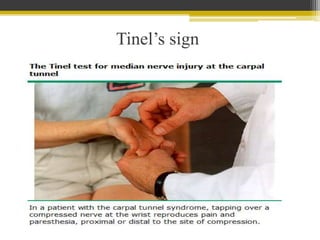
• Positive Tinel’s sign.
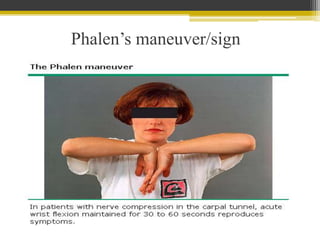
• Positive Phalen’s sign.
Tinel’s sign
Phalen’s maneuver/sign
CTS Treatment
• Most cases of CTS can be adequately treated with
conservative (i.e. non-surgical) management.
▫ Rest
 avoid repetitive wrist and hand motion, wrist splints when
repetitive wrist motion required.
▫ Wrest splint
 night time splinting to keep wrist in neutral position.
▫ Medications
 NSAIDs, local corticosteroids injection, oral
corticosteroids
Surgical treatment of CTS
• Indications for surgery:
 Numbness and tingling ± sensory loss.
 Weakness ± muscle atrophy.
 Unresponsive to conservative measures.
Open Endoscopic
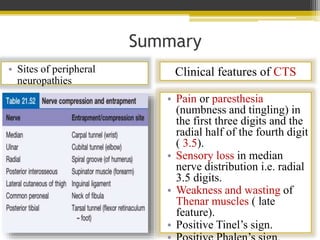
Summary
• Sites of peripheral
neuropathies
• Pain or paresthesia
(numbness and tingling) in
the first three digits and the
radial half of the fourth digit
( 3.5).
• Sensory loss in median
nerve distribution i.e. radial
3.5 digits.
• Weakness and wasting of
Thenar muscles ( late
feature).
• Positive Tinel’s sign.
Clinical features of CTS
References
Peripheral neuropathy objective 3 (cts)

Peripheral neuropathy objective 3 (cts)

  • 1.
  • 2.
    Objectives • Enumerate sitesof peripheral nerve compression and discuss features of carpal tunnel syndrome.
  • 3.
    Sites of peripheralnerve compression
  • 4.
    Carpal Tunnel Syndrome. •Most common entrapment neuropathy. • Female to Male ration = 4:1 • Compression of the Median Nerve at the wrist by the Transverse Carpal Ligament.
  • 5.
    Carpal Tunnel Syndrome. •Idiopathic cause but it is associated with .. ▫ Occupation. ▫ Hypothyroidism ▫ Diabetes mellitus ▫ Pregnancy (third trimester) ▫ Obesity. ▫ Rheumatoid disease ▫ Acromegaly ▫ amyloid ▫ Renal dialysis patients.
  • 6.
    Clinical Features • Painor paresthesia (numbness and tingling) in the first three digits and the radial half of the fourth digit ( 3.5)  patient awakened at night, the pain is relieved by shaking or rubbing. • Sensory loss in median nerve distribution i.e. radial 3.5 digits. • Weakness and wasting of Thenar muscles ( late feature). • Positive Tinel’s sign. • Positive Phalen’s sign.
  • 8.
  • 9.
  • 11.
    CTS Treatment • Mostcases of CTS can be adequately treated with conservative (i.e. non-surgical) management. ▫ Rest  avoid repetitive wrist and hand motion, wrist splints when repetitive wrist motion required. ▫ Wrest splint  night time splinting to keep wrist in neutral position. ▫ Medications  NSAIDs, local corticosteroids injection, oral corticosteroids
  • 12.
    Surgical treatment ofCTS • Indications for surgery:  Numbness and tingling ± sensory loss.  Weakness ± muscle atrophy.  Unresponsive to conservative measures. Open Endoscopic
  • 13.
    Summary • Sites ofperipheral neuropathies • Pain or paresthesia (numbness and tingling) in the first three digits and the radial half of the fourth digit ( 3.5). • Sensory loss in median nerve distribution i.e. radial 3.5 digits. • Weakness and wasting of Thenar muscles ( late feature). • Positive Tinel’s sign. Clinical features of CTS
  • 14.