Malaria
Turki M. Alanazi
Objective
• Clinical picture of malaria.
• Complication of acute sever malaria.
Malaria
• Malaria is caused by Plasmodium parasites.
• P. falciparum is the most prevalent malaria parasite
on the African continent. It is responsible for most
malaria-related deaths globally.
• P. vivax,P.ovale & P.malariae are benign .. Rarely
progress to severe malaria.
Clinical features
• Initially ; flue like symptoms
 headache,
 Fatigue.
 abdominal discomfort.
 muscle aches.
 Arthralgia.
 FEVER
 Splenomegaly.
 Mild jaundice.
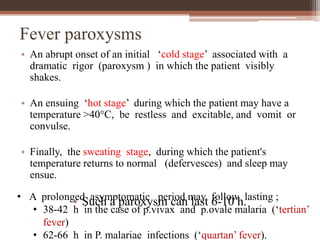
Fever paroxysms
• An abrupt onset of an initial ‘cold stage’ associated with a
dramatic rigor (paroxysm ) in which the patient visibly
shakes.
• An ensuing ‘hot stage’ during which the patient may have a
temperature >40°C, be restless and excitable, and vomit or
convulse.
• Finally, the sweating stage, during which the patient's
temperature returns to normal (defervesces) and sleep may
ensue.
• Such a paroxysm can last 6-10 h.• A prolonged asymptomatic period may follow lasting ;
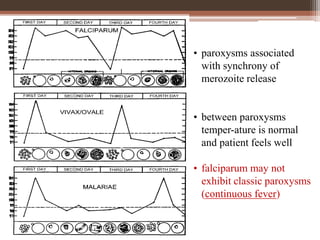
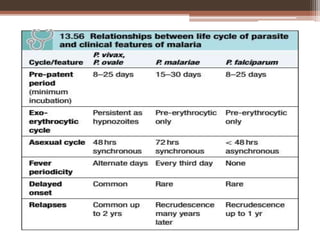
• 38-42 h in the case of p.vivax and p.ovale malaria (‘tertian’
fever)
• 62-66 h in P. malariae infections (‘quartan’ fever).
• paroxysms associated
with synchrony of
merozoite release
• between paroxysms
temper-ature is normal
and patient feels well
• falciparum may not
exhibit classic paroxysms
(continuous fever)
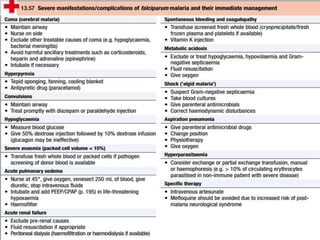
Complication of Acute Sever
Falciparum Malaria
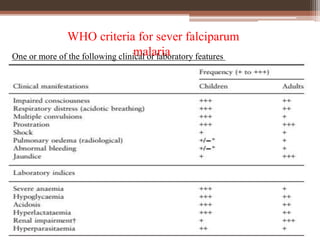
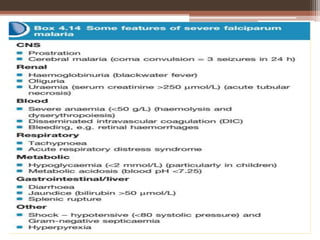
WHO criteria for sever falciparum
malariaOne or more of the following clinical or laboratory features
1- Cerebral malaria (CM):
• ‘unrousable coma in the presence of peripheral
parasitaemia where other causes of encephalopathy
have been excluded'.
▫ Febrile convulsion in children , hypoglycemia.
• Most important complication of flaciparum malaria.
• Mortality rates of 20% among adults and 15%among
children.
• Focal deficits are uncommon
• Retinal hemorrhages may be observed ;30 to 40
percent of cases.
2- Hypoglycemia
• Hypoglycemia is a common complication of severe malaria,
although the usual signs (sweating, tachycardia, neurologic
impairment) are difficult to distinguish from systemic
symptoms due to severe malaria.
• Hypoglycemia occurs as a result of the following
factors:
I. Diminished hepatic gluconeogenesis
II. Depletion of liver glycogen stores
III. Increase in the consumption of glucose by the host (and, to
a much lesser extent, the parasite)
IV. Quinine-induced hyperinsulinemia
• Hypoglycemia is associated with a poor prognosis, particularly
in children and pregnant women.
3- Acidosis
• Acidosis is an important cause of death from severe
malaria; it is caused by several factors, including:
▫ Anaerobic glycolysis in host tissues where sequestered
parasites interfere with microcirculatory flow
▫ Parasite lactate production
▫ Hypovolemia
▫ Insufficient hepatic and renal lactate clearance
• The prognosis of severe acidosis is poor.
4- Hematological abnormalities
• Anemia in the setting of malaria occurs as a result of
the following factors: ( common in children )
 Hemolysis of parasitized red cells
 Increased splenic sequestration and clearance of
erythrocytes with diminished deformability
 Cytokine suppression of hematopoiesis
 Shortened erythrocyte survival
 Repeated infections and ineffective treatments
• Disseminated intravascular coagulation (DIC)
5-LIVER DYSFUNCTION
• Mild hemolytic jaundice is common in malaria.
• Severe jaundice is associated with P. falciparum
infections; is more common among adults than
among children;
• Results from
▫ hemolysis,
▫ hepatocyte injury
▫ cholestasis.
• When accompanied by other vital-organ dysfunction
(often renal impairment), liver dysfunction carries a
poor prognosis.
• 6- NONCARDIOGENIC PULMONARY EDEM A;
 Adults w ith severe falciparum malaria may develop
noncardiogenic pulmonary edema even after several days
of antimalarial therapy .
 Pathogenesis unclear.
• 7- RENAL IMPAIRM ENT
 Renal impairment is common among adults w ith severe
falciparum malaria but rare among children.
 Pathogenesis unclear.
References

Malaria

  • 1.
  • 2.
    Objective • Clinical pictureof malaria. • Complication of acute sever malaria.
  • 3.
    Malaria • Malaria iscaused by Plasmodium parasites. • P. falciparum is the most prevalent malaria parasite on the African continent. It is responsible for most malaria-related deaths globally. • P. vivax,P.ovale & P.malariae are benign .. Rarely progress to severe malaria.
  • 4.
    Clinical features • Initially; flue like symptoms  headache,  Fatigue.  abdominal discomfort.  muscle aches.  Arthralgia.  FEVER  Splenomegaly.  Mild jaundice.
  • 5.
    Fever paroxysms • Anabrupt onset of an initial ‘cold stage’ associated with a dramatic rigor (paroxysm ) in which the patient visibly shakes. • An ensuing ‘hot stage’ during which the patient may have a temperature >40°C, be restless and excitable, and vomit or convulse. • Finally, the sweating stage, during which the patient's temperature returns to normal (defervesces) and sleep may ensue. • Such a paroxysm can last 6-10 h.• A prolonged asymptomatic period may follow lasting ; • 38-42 h in the case of p.vivax and p.ovale malaria (‘tertian’ fever) • 62-66 h in P. malariae infections (‘quartan’ fever).
  • 6.
    • paroxysms associated withsynchrony of merozoite release • between paroxysms temper-ature is normal and patient feels well • falciparum may not exhibit classic paroxysms (continuous fever)
  • 8.
    Complication of AcuteSever Falciparum Malaria
  • 9.
    WHO criteria forsever falciparum malariaOne or more of the following clinical or laboratory features
  • 10.
    1- Cerebral malaria(CM): • ‘unrousable coma in the presence of peripheral parasitaemia where other causes of encephalopathy have been excluded'. ▫ Febrile convulsion in children , hypoglycemia. • Most important complication of flaciparum malaria. • Mortality rates of 20% among adults and 15%among children. • Focal deficits are uncommon • Retinal hemorrhages may be observed ;30 to 40 percent of cases.
  • 11.
    2- Hypoglycemia • Hypoglycemiais a common complication of severe malaria, although the usual signs (sweating, tachycardia, neurologic impairment) are difficult to distinguish from systemic symptoms due to severe malaria. • Hypoglycemia occurs as a result of the following factors: I. Diminished hepatic gluconeogenesis II. Depletion of liver glycogen stores III. Increase in the consumption of glucose by the host (and, to a much lesser extent, the parasite) IV. Quinine-induced hyperinsulinemia • Hypoglycemia is associated with a poor prognosis, particularly in children and pregnant women.
  • 12.
    3- Acidosis • Acidosisis an important cause of death from severe malaria; it is caused by several factors, including: ▫ Anaerobic glycolysis in host tissues where sequestered parasites interfere with microcirculatory flow ▫ Parasite lactate production ▫ Hypovolemia ▫ Insufficient hepatic and renal lactate clearance • The prognosis of severe acidosis is poor.
  • 13.
    4- Hematological abnormalities •Anemia in the setting of malaria occurs as a result of the following factors: ( common in children )  Hemolysis of parasitized red cells  Increased splenic sequestration and clearance of erythrocytes with diminished deformability  Cytokine suppression of hematopoiesis  Shortened erythrocyte survival  Repeated infections and ineffective treatments • Disseminated intravascular coagulation (DIC)
  • 14.
    5-LIVER DYSFUNCTION • Mildhemolytic jaundice is common in malaria. • Severe jaundice is associated with P. falciparum infections; is more common among adults than among children; • Results from ▫ hemolysis, ▫ hepatocyte injury ▫ cholestasis. • When accompanied by other vital-organ dysfunction (often renal impairment), liver dysfunction carries a poor prognosis.
  • 15.
    • 6- NONCARDIOGENICPULMONARY EDEM A;  Adults w ith severe falciparum malaria may develop noncardiogenic pulmonary edema even after several days of antimalarial therapy .  Pathogenesis unclear. • 7- RENAL IMPAIRM ENT  Renal impairment is common among adults w ith severe falciparum malaria but rare among children.  Pathogenesis unclear.
  • 19.