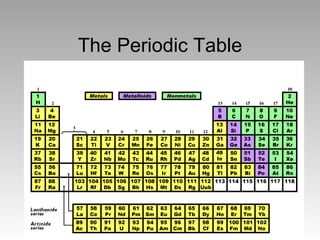
The Periodic Table
Introduction The periodic table is made up of rows of elements and columns. An element is identified by its chemical symbol. The number above the symbol is the atomic number The number below the symbol is the rounded atomic weight of the element. A row is called a  period A column is called a  group
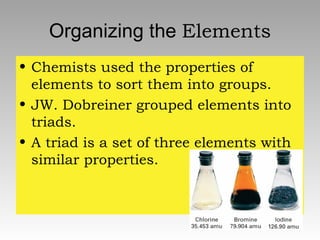
Organizing the  Elements Chemists used the properties of elements to sort them into groups. JW. Dobreiner grouped elements into triads. A triad is a set of three elements with similar properties.
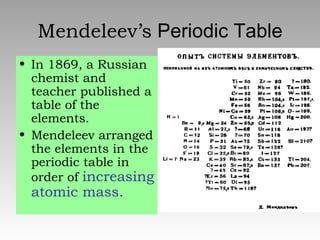
Mendeleev’s  Periodic Table In 1869, a Russian chemist and teacher published a table of the elements. Mendeleev arranged the elements in the periodic table in order of  increasing atomic mass.
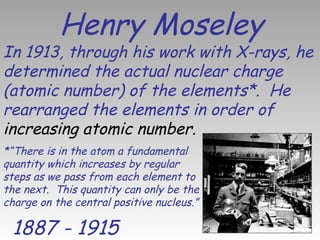
Henry Moseley 1887 - 1915 In 1913, through his work with X-rays, he determined the actual nuclear charge (atomic number) of the elements*.  He rearranged the elements in order of  increasing atomic number. *“There is in the atom a fundamental quantity which increases by regular steps as we pass from each element to the next.  This quantity can only be the charge on the central positive nucleus.”
The Periodic Law In the modern periodic table elements are arranged in order of  increasing atomic number. Periodic Law states:  When elements are arranged in order of increasing atomic number, there is a periodic repetition of their physical and chemical properties.
Periodictable2

  • 1.
  • 2.
    Introduction The periodictable is made up of rows of elements and columns. An element is identified by its chemical symbol. The number above the symbol is the atomic number The number below the symbol is the rounded atomic weight of the element. A row is called a period A column is called a group
  • 3.
    Organizing the Elements Chemists used the properties of elements to sort them into groups. JW. Dobreiner grouped elements into triads. A triad is a set of three elements with similar properties.
  • 4.
    Mendeleev’s PeriodicTable In 1869, a Russian chemist and teacher published a table of the elements. Mendeleev arranged the elements in the periodic table in order of increasing atomic mass.
  • 5.
    Henry Moseley 1887- 1915 In 1913, through his work with X-rays, he determined the actual nuclear charge (atomic number) of the elements*. He rearranged the elements in order of increasing atomic number. *“There is in the atom a fundamental quantity which increases by regular steps as we pass from each element to the next. This quantity can only be the charge on the central positive nucleus.”
  • 6.
    The Periodic LawIn the modern periodic table elements are arranged in order of increasing atomic number. Periodic Law states: When elements are arranged in order of increasing atomic number, there is a periodic repetition of their physical and chemical properties.