






Dr. Laxmi Shrikhande MD; FICOG; FICMU;FICMCH
• Medical Director-Shrikhande Fertility Clinic, Nagpur
• Chairperson Designate Indian College of OB/GY ICOG
• National Corresponding Editor-The Journal of Obstetrics &Gynecology of India
• Senior Vice President FOGSI 2012
• Patron & President -Vidarbha Chapter ISOPARB
• Received Nagpur Ratan Award at the hands of Union Minister Shri Nitinji Gadkari
• Received Bharat excellence Award for women’s health
• Received Mehroo Dara Hansotia award for Best Committee of FOGSI
• National Governing Council member ICOG 2012-2017
• National Governing Council Member ISAR 2014-2019
• National Governing Council Member IAGE for 3 terms
• Chairperson-HIV/AIDS Committee, FOGSI (2007-09)
• President Nagpur OB/GY Society 2005-06
• Immediate Past President Menopause Society, Nagpur
• Associate member of RCOG & ESHRE
• Member of European Society of Human Reproduction
• Visited 96 FOGSI Societies as invited faculty
• Delivered 11 orations and 450 guest lectures
• Publications-Twenty National & eleven International
• Presented Papers in FIGO, AICOG, SAFOG, AICC-RCOG conferences
• Conducted adolescent health programme for more than 15,000 adolescent girls
• Conducted health awareness programme for more than 10,000 women
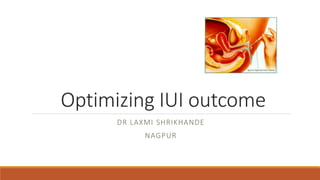
Optimizing IUI outcome
DR LAXMI SHRIKHANDE
NAGPUR
IUI is the 1st Line of treatment in sub fertility
 simple,
 effective
 inexpensive
 Can be performed by all the gynecs
 Even in remote areas
Why talk so much about IUI ?
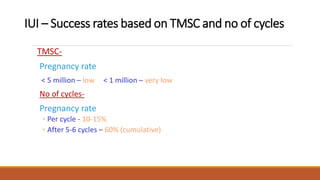
IUI – Success rates based on TMSC and no of cycles
TMSC-
Pregnancy rate
< 5 million – low < 1 million – very low
No of cycles-
Pregnancy rate
◦ Per cycle - 10-15%
◦ After 5-6 cycles – 60% (cumulative)
IUI-HUSBAND
In women <40 years of age, ----PR is 12.6% per procedure.
In women at >40 years, PR-- 7.4%.
IUI-DONOR
In women <40 years of age, PR per insemination is 18.9%.
In women at 40 years or above PR is 9.2%.
Anderson, Hum. Reprod. (2009)
IUI Success rate – Age of women
ESHRE registry 2005
IUISuccessrate
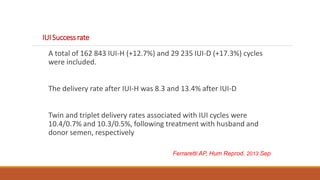
A total of 162 843 IUI-H (+12.7%) and 29 235 IUI-D (+17.3%) cycles
were included.
The delivery rate after IUI-H was 8.3 and 13.4% after IUI-D
Twin and triplet delivery rates associated with IUI cycles were
10.4/0.7% and 10.3/0.5%, following treatment with husband and
donor semen, respectively
Ferraretti AP, Hum Reprod. 2013 Sep
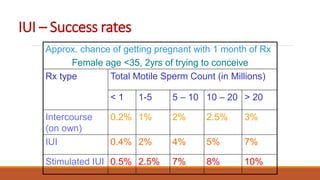
Approx. chance of getting pregnant with 1 month of Rx
Female age <35, 2yrs of trying to conceive
Rx type Total Motile Sperm Count (in Millions)
< 1 1-5 5 – 10 10 – 20 > 20
Intercourse
(on own)
0.2% 1% 2% 2.5% 3%
IUI 0.4% 2% 4% 5% 7%
Stimulated IUI 0.5% 2.5% 7% 8% 10%
IUI – Success rates
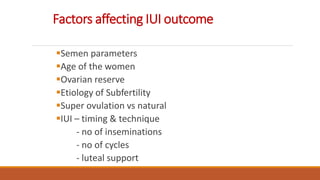
Factors affecting IUI outcome
Semen parameters
Age of the women
Ovarian reserve
Etiology of Subfertility
Super ovulation vs natural
IUI – timing & technique
- no of inseminations
- no of cycles
- luteal support
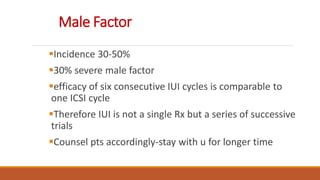
Male Factor
Incidence 30-50%
30% severe male factor
efficacy of six consecutive IUI cycles is comparable to
one ICSI cycle
Therefore IUI is not a single Rx but a series of successive
trials
Counsel pts accordingly-stay with u for longer time
Insemination parameters
-semen collection
-fresh vs cryopreserved
-semen processing technique
-motile sperm count
-volume of insemination
Insemination technique
Factors affecting pregnancy rate
When IUI should not be offered
The study was divided into 6 groups according to TMSC. Group 1: ≤ 2.0
million, Group 2: 2.1-4.0 million, Group 3: 4.1-6.0 million, Group 4: 6.1-
8.0 million, Group 5: 8.1-10.0 million, and Group 6: >10.0 million.
The total clinical pregnancy rate of AIH was 10.81 % and AID was 27.52 %.
Among the 6 groups, the clinical pregnancy rate was the lowest in Group
1 (P < 0.05) in both AIH-IUI and AID-IUI.
With the increased TMSC, the clinical pregnancy rate of IUI was
improved. However, a statistical difference between groups was only
observed for Group 1. When TMSC is ≤ 2 × 10(6) the clinical pregnancy
rate of IUI is significantly decreased. In this case ICSI should be offered.
Dong F. Syst Biol Reprod Med.Oct 2011
Proper sample collection at IUI Lab
Privacy
Clean, proper & TOTAL collection
No lubricant
No spillage-if yes-which part-1st, last or general
Provide sterile pre labeled sealed container
Home collection
within 30 min,
do not refrigerate,
protected from sunlight,
sterile container from the lab
Consent of both parteners
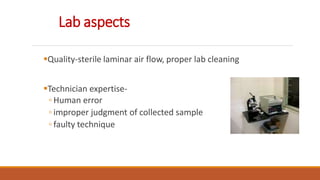
Lab aspects
Quality-sterile laminar air flow, proper lab cleaning
Technician expertise-
◦ Human error
◦ improper judgment of collected sample
◦ faulty technique
Semen preparation techniques
Swim up
Swim down
Gradient separation
Simple layering
Which method of sperm preparation
Normospermia-
◦viscous-pellet swim up
◦Non viscus-direct overlay
Oligospermia-
◦TMSC < 3 pellet swim up,
◦TMSC > 3 gradient centrifugation
Which female factors affect IUI success rate ?
856 cycles of 352 couples was studied.
Live-birth showed a strong negative correlation with
female age but no correlation with male age.
AMH and AFC correlated negatively with female age, and
FSH correlated positively..
Calculating miscarriages, showed a strong correlation with
increasing female age. Male age had no effect on rate of
pregnancy loss.
Speyer BE, J Obstet Gynaecol. 2013
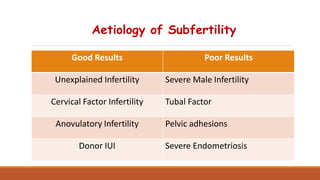
Aetiology of Subfertility
Good Results Poor Results
Unexplained Infertility Severe Male Infertility
Cervical Factor Infertility Tubal Factor
Anovulatory Infertility Pelvic adhesions
Donor IUI Severe Endometriosis
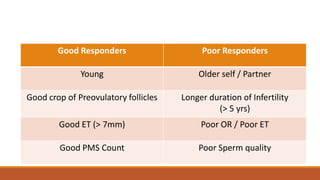
Good Responders Poor Responders
Young Older self / Partner
Good crop of Preovulatory follicles Longer duration of Infertility
(> 5 yrs)
Good ET (> 7mm) Poor OR / Poor ET
Good PMS Count Poor Sperm quality
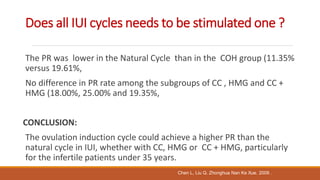
Does all IUI cycles needs to be stimulated one ?
The PR was lower in the Natural Cycle than in the COH group (11.35%
versus 19.61%,
No difference in PR rate among the subgroups of CC , HMG and CC +
HMG (18.00%, 25.00% and 19.35%,
CONCLUSION:
The ovulation induction cycle could achieve a higher PR than the
natural cycle in IUI, whether with CC, HMG or CC + HMG, particularly
for the infertile patients under 35 years.
Chen L, Liu Q. Zhonghua Nan Ke Xue. 2009 .
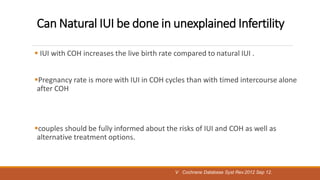
Can Natural IUI be done in unexplained Infertility
 IUI with COH increases the live birth rate compared to natural IUI .
Pregnancy rate is more with IUI in COH cycles than with timed intercourse alone
after COH
couples should be fully informed about the risks of IUI and COH as well as
alternative treatment options.
V Cochrane Database Syst Rev.2012 Sep 12.
Natural cycle IUI
Donor Inseminations
Mild/Moderate male factor infertility
Cervical factor infertility
Especially if female age is < 30
◦Very critical
◦Survival of germ cells within the body
◦Sperms – 3 - 5 days
◦Ovum – 24 hours
Timing
 Timing is more important for IUI than it is for intercourse.
 The reason is that, during intercourse, sperm travels
through the cervical canal.
 There are glands and mucous in the cervix that sustains the
sperm and acts as a reservoir that releases sperm into the
uterus slowly over several days.
Timing
 During an intrauterine insemination, the sperm are
released into the uterus.
 The sperm do not remain viable for as long a period of
time.
 Consequently, the sperm must be inseminated close to
the time of ovulation.
Timing
One method to time an IUI is with an ovulation predictor kit.
The kit measure a woman's LH surge.
The surge peaks about 12-24 hours before the egg is released.
A woman will test her urine in the morning.
 If the test is positive, she would have the intrauterine insemination
the next day.
Timing
Another method for timing an insemination is to
artificially trigger ovulation.
◦ IUI – 34 – 36 hours after hCG injection
Timing
When IUI should be done ??
after 36 hours of HCG
or
after documented ovulation
or
along with HCG?
After how many hours of HCG ??
Pregnancy rates are same if IUI is done after short 32-
34 hrs interval
or
long (38-40 hr interval after HCG)
Paul et al, Fertil Steril, 2004
Should we wait for follicle rupture before doing IUI ?
Clinical pregnancy rate was 23.5% in the group when
follicle rupture was evident by transvaginal
ultrasonography, while it was only 8.8% when follicle
rupture was not evident
CONCLUSION: Postponing IUI until observation of follicle
rupture may yield a higher pregnancy rate.
Kucuk T.
Can IUI be done with simultaneous HCG ??
Randomized study
 Two groups: IUI at 34-36h after hCG injection (group I) and IUI simultaneously with hCG
administration (group II) .
RESULTS:
Clinical pregnancy rates were 9.4% and 12.2% in group I and group II, respectively
(p=0.523). Although group II had better outcomes there was no statistically significant
difference in clinical pregnancy rates: IUI simultaneously with hCG versus IUI at 34-36h
after hCG (OR)=1.35.
CONCLUSION(S):
There is no difference in simultaneous use of hCG injection compared to cycles in which
IUI is performed after 34-36h following hCG injection.
Aydin Y, Eur J Obstet Gynecol Reprod Biol. 2013
Timing and Frequency of IUI
Fixed protocol:
• Single insemination:
36 – 40 hrs post – hCG
• double insemination:
within 12 & 48 hrs post - hCG
Variable protocol:
• TVS 36 h post hCG:- Ovulated  single IUI
- Not Ovulated IUI at once
 IUI 24 hrs later
Single or double insemination ??
IUI was timed for 36 ± 2 h after HCG.. Post-ovulatory cases received single IUI, while pre-
ovulatory cases were randomized to receive either single or double IUI.
When ovulation was present before IUI, CPR was 11.7% compared with 6.7% when ovulation
was absent.
Comparing the CPR for double versus single IUI in pre-ovulatory cases, the OR for all cycles was
1.9 but according to etiology, it was 4.667 in male factor and 1.2 for non-male factors.
CONCLUSIONS:
Single IUI timed post-ovulation gives a better CPR when compared with single
pre-ovulation IUI for non-male infertility,
For male factor, pre-ovulation, double IUI gives a better CPR when compared
with single IUI.
Ghanem ME, Hum Reprod. 2011
Single vs double intrauterine insemination ;
Double versus single intrauterine insemination for
unexplained infertility: a meta-analysis of randomized trials.
Despite the 36th hour being the preferred timing for IUI,
there was no difference regarding pregnancy rates between
single 24th hour and double 12th- and 36th-hour
inseminations..
Rahman SM Fertil Steril. 2010 Dec
Tongue E, Fertil Steril. 2010 Sep
Bagis T et al., Hum Reprod. 2010 Jul
Polyzos NP Fertil Steril. 2010 Sept
Ghanem Mlet al,Hum Reprod. 2011 Mar.
Abstinence before IUI?
It is not necessary to abstain from intercourse before doing an IUI.
Sperm counts vary in all men.
The frequency of ejaculation does not have any consistent effect on sperm
numbers.
sometimes there will be more sperm on a second or third ejaculate and
sometimes there will be less sperm.
recommendation is to have intercourse on the day that an ovulation kit turns
positive or on the day that an hCG trigger injection is given.
The IUI is then timed as indicated above.
The highest PR was seen with abstinence interval of ≤ 3 days
(14%) and the lowest PR with abstinence of≥ 10 days(3 %)
Reason ? Sperm senescence and functional damage
Marshburn PB et al ,Fertil Steril. 2010
Jurema MW. Fertil steril 2005
Abstinence before IUI?
Where to do and how to do IUI ?
Sample is maintained at 37 C in a tube warmer or held in fist
Identity of semen sample is cross checked
Waiting between loading the syringe and procedure should be avoided
(Belker, Cook et al)
Carried out in theatre or similarly equipped room
Clinician should wear a cap mask and all routine aseptic precautions are taken.
Gloves should be sterile and powder free
Consent
Must-ICMR website
Verify yourself
Adhar card of both, marriage certificate
IUI-D
No fresh sample
Reputed Semen banks
Not from known donor
No mixing of donor samples
Preserve records
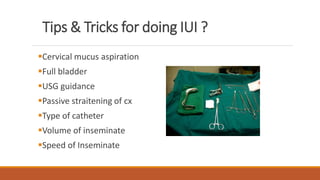
Tips & Tricks for doing IUI ?
Cervical mucus aspiration
Full bladder
USG guidance
Passive straitening of cx
Type of catheter
Volume of inseminate
Speed of Inseminate
cervical mucus aspiration before IUI ??
PR was 15% in the cervical mucus aspiration group and 9.9% in the
control group.
Mucus aspiration led to significantly increased pregnancy rates for
women with unexplained infertility
Int J Gynaecol Obstet. 2008
Does Full Bladder makes IUI easy ?
Interventions were IUI by passive straightening of the uterus by bladder filling, or IUI on an empty
bladder
 The PR was higher in the full bladder group than in the empty bladder group 13.5% vs 7.4.
The risk of undergoing difficult IUI was higher in the empty bladder group than the full bladder group
10.0% vs 37.8%,
The clinical pregnancy rate was also higher in the group of patients who had easy IUI than in the group of
patients who had difficult IUI -12.7% vs 5.5%
Conclusion:
Passive straightening of the uterus makes the procedure less difficult and improves the clinical
pregnancy rate.
Ayas S J Obstet Gynaecol Res. 2011
Atraumatic Allies forceps
No locking
Passive uterine straightening
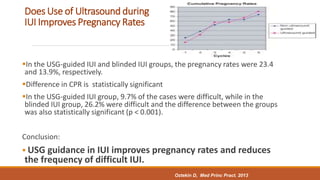
Does Use of Ultrasound during
IUI Improves Pregnancy Rates
In the USG-guided IUI and blinded IUI groups, the pregnancy rates were 23.4
and 13.9%, respectively.
Difference in CPR is statistically significant
In the USG-guided IUI group, 9.7% of the cases were difficult, while in the
blinded IUI group, 26.2% were difficult and the difference between the groups
was also statistically significant (p < 0.001).
Conclusion:
 USG guidance in IUI improves pregnancy rates and reduces
the frequency of difficult IUI.
Oztekin D, Med Princ Pract. 2013
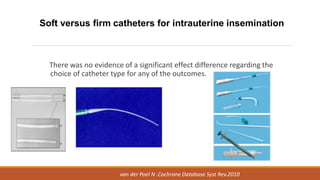
Does Type of catheter affects IUI outcome ?
Ideal insemination device should deposit the small volume without
requiring a dead space in the injection system,
 it should be easy to use,
 made of non-toxic material,
Semi rigid that fit the curvature of the uterus and have a non
traumatic entry past the cervical canal into uterine cavity and
 it should provide mechanism to prevent backflow of injected
contents
There was no evidence of a significant effect difference regarding the
choice of catheter type for any of the outcomes.
Soft versus firm catheters for intrauterine insemination
van der Poel N .Cochrane Database Syst Rev.2010
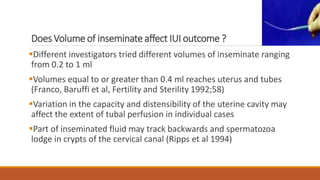
Does Volume of inseminate affect IUI outcome ?
Different investigators tried different volumes of inseminate ranging
from 0.2 to 1 ml
Volumes equal to or greater than 0.4 ml reaches uterus and tubes
(Franco, Baruffi et al, Fertility and Sterility 1992;58)
Variation in the capacity and distensibility of the uterine cavity may
affect the extent of tubal perfusion in individual cases
Part of inseminated fluid may track backwards and spermatozoa
lodge in crypts of the cervical canal (Ripps et al 1994)
Catheter introduction
◦ Without touching walls of vagina
◦ IUI catheter is gently introduced into the uterus
◦ without force
◦ Without damaging the endometrium
◦ Stiffer catheter if cervical stenosis
◦ Allies forceps –
◦ Only for marked degree of ante or retro flexion
◦ Always try to avoid, don’t lock
Does Speed and technique of insemination affect IUI outcome ?
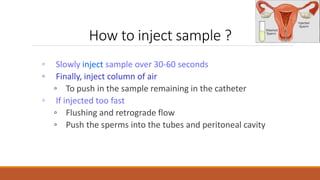
◦ Slowly inject sample over 30-60 seconds
◦ Finally, inject column of air
◦ To push in the sample remaining in the catheter
◦ If injected too fast
◦ Flushing and retrograde flow
◦ Push the sperms into the tubes and peritoneal cavity
How to inject sample ?
How to Remove catheter ?
Catheter is gently removed taking about 60 seconds.
Patient lies flat and still for 15 mins.
NO NEED to elevate the patients leg to keep the sperm in the uterus
What to do if catheter is not going in ?
Full bladder
Non traumatic Allis can be used to grab the cervix and
straighten the angle between the cervix and uterus. Don’t
lock
USG guided
Metal Canula
Alternative sites for IUI
Does Bed rest affect IUI outcome ?
A 10 minutes bed rest after IUI has a positive
effect on PR (Saleh et al, 2000)
Luteal Phase Support
Natural Micronized Progesterone
Dydrogesterone is equally effective
Different routes of administration
Oral, intramuscular or vaginal
Efficacy of luteal phase supportwith vaginal progesteronein IUI: review
and meta-analysis
Five RCT s. 1,271 patients.
Women treated with vaginal progesterone achieved significantly higher live birth rate (confidence interval
1.36 to 2.77,), and clinical pregnancy rate ( CI 1.14 to 1.76)
This beneficial effect of receiving progesterone was only observed in the group stimulated with
gonadotropins compared to the group stimulated with CC. No differences were observed in the miscarriage
and multiple pregnancy rates.
CONCLUSIONS:
The supplementation of luteal phase with vaginal progesterone significantly
increases live birth among women undergoing IUI when receiving gonadotropins
for ovulation induction.
Women receiving CC to induce ovulation do not seem to benefit from this
treatment.
Miralpeix E, J Assist Reprod Genet. 2013
Does Endometrial thickness affect IUI outcome-
experience of 2,929 patients with unexplained infertility
Patients with IUI using CC with FSH stimulation followed by IUI.
RESULTS.
 15.9 % achieved a clinical pregnancy.
 Pregnancy rates (PRs) increased significantly with increasing endometrial
thickness on the day of hCG and with increasing serum E2 level, but were not
significantly related to age, BMI, or follicle numbers .
CONCLUSION(S):
The impact of "endometrial factor" infertility may be underappreciated in IUI
Wolff EF ,Fertil Steril.2013
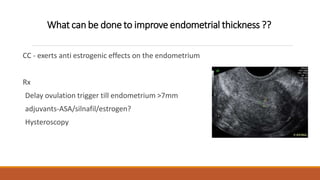
What can be done to improve endometrial thickness ??
CC - exerts anti estrogenic effects on the endometrium
Rx
Delay ovulation trigger till endometrium >7mm
adjuvants-ASA/silnafil/estrogen?
Hysteroscopy
Does Endometrial sampling affect IUI outcome ?
RCT was performed in 150 patients
 Group 1- control group.
 Group 2 underwent Tao Brush endometrial sampling on day 8-9 of the uterine cycle that
preceded the stimulation cycle, and finally,
 Group 3 underwent endometrial sampling on day 8-9 of the same IUI cycle
RESULTS:
 Pregnancy percentages were 18, 38, and 36 % for group 1, group 2, and group 3, respectively.
CONCLUSION:
 Endometrial sampling significantly increases pregnancy rates in IUI procedures
when it is done in the proliferative phase of the IUI cycle, or the cycle prior to IUI,
than pregnancy rates with IUI alone.

Abdelhamid AM, Arch Gynecol Obstet.2013
Intercourse after IUI
It is OK for a couple to have intercourse at any point after an IUI is
performed.
In fact, for men who have very low sperm counts, having intercourse
in addition to the IUI will increase the total amount of sperm in the
uterus and may improve the chance for pregnancy.
◦ Normal life
◦ Luteal phase support
◦ Instructed to call if,
◦ Abdominal pain
◦ Fever
◦ Onset of menses
◦ Menses is 3 – 5 days late
After care
Optimizing IUI Outcome
When to cancel the cycle ?
How to prevent OHSS and Multiple pregnancy ?
How many IUI Cycles ??
Cumulative probability of conception after 6 cycles is 50-60 %%
Best results in first 3-4 attempts
Average monthly fecundity rates – 19%
Predictive factors for pregnancy after IUI: Summary
The couple with the best chance of pregnancy can be described as follows:
an under 30 woman
with cervical or anovulatory infertility and
a man with a TMSC >/=5 million spermatozoa.
The "ideal" stimulation cycle enables the recruitment of two follicles measuring
>16 mm with an E(2) concentration >500 pg/mL on the day of hCG
The best results are obtained when IUI is performed using a soft catheter
Merviel P, Fertil Steril.2010
IUI is a team work
Clinician - gynecologist
Ultrasonologist
Dedicated & trained lab staff
Trained nursing staff
Receptionist / record keeper
Take Home Message
Proper Patient selection
Appropriate stimulation protocol
Good quality lab work
Meticulous Procedure
Luteal Phase support
IS THE KEY TO INCREASE IUI SUCCESS RATE
“No matter how good you get
you can always get better
and that's the exciting part”.
~ Tiger Woods ~
Questions
The Art of Living
Anything that
helps you to
become
unconditionally
happy and loving
is what is called
spirituality.
H. H. Sri Sri Ravishakar

Presentation on Optimizing IUI Outcome by Dr. Laxmi Shrikhande

  • 1.
    Dr. Laxmi ShrikhandeMD; FICOG; FICMU;FICMCH • Medical Director-Shrikhande Fertility Clinic, Nagpur • Chairperson Designate Indian College of OB/GY ICOG • National Corresponding Editor-The Journal of Obstetrics &Gynecology of India • Senior Vice President FOGSI 2012 • Patron & President -Vidarbha Chapter ISOPARB • Received Nagpur Ratan Award at the hands of Union Minister Shri Nitinji Gadkari • Received Bharat excellence Award for women’s health • Received Mehroo Dara Hansotia award for Best Committee of FOGSI • National Governing Council member ICOG 2012-2017 • National Governing Council Member ISAR 2014-2019 • National Governing Council Member IAGE for 3 terms • Chairperson-HIV/AIDS Committee, FOGSI (2007-09) • President Nagpur OB/GY Society 2005-06 • Immediate Past President Menopause Society, Nagpur • Associate member of RCOG & ESHRE • Member of European Society of Human Reproduction • Visited 96 FOGSI Societies as invited faculty • Delivered 11 orations and 450 guest lectures • Publications-Twenty National & eleven International • Presented Papers in FIGO, AICOG, SAFOG, AICC-RCOG conferences • Conducted adolescent health programme for more than 15,000 adolescent girls • Conducted health awareness programme for more than 10,000 women
  • 2.
    Optimizing IUI outcome DRLAXMI SHRIKHANDE NAGPUR
  • 3.
    IUI is the1st Line of treatment in sub fertility  simple,  effective  inexpensive  Can be performed by all the gynecs  Even in remote areas Why talk so much about IUI ?
  • 4.
    IUI – Successrates based on TMSC and no of cycles TMSC- Pregnancy rate < 5 million – low < 1 million – very low No of cycles- Pregnancy rate ◦ Per cycle - 10-15% ◦ After 5-6 cycles – 60% (cumulative)
  • 5.
    IUI-HUSBAND In women <40years of age, ----PR is 12.6% per procedure. In women at >40 years, PR-- 7.4%. IUI-DONOR In women <40 years of age, PR per insemination is 18.9%. In women at 40 years or above PR is 9.2%. Anderson, Hum. Reprod. (2009) IUI Success rate – Age of women ESHRE registry 2005
  • 6.
    IUISuccessrate A total of162 843 IUI-H (+12.7%) and 29 235 IUI-D (+17.3%) cycles were included. The delivery rate after IUI-H was 8.3 and 13.4% after IUI-D Twin and triplet delivery rates associated with IUI cycles were 10.4/0.7% and 10.3/0.5%, following treatment with husband and donor semen, respectively Ferraretti AP, Hum Reprod. 2013 Sep
  • 7.
    Approx. chance ofgetting pregnant with 1 month of Rx Female age <35, 2yrs of trying to conceive Rx type Total Motile Sperm Count (in Millions) < 1 1-5 5 – 10 10 – 20 > 20 Intercourse (on own) 0.2% 1% 2% 2.5% 3% IUI 0.4% 2% 4% 5% 7% Stimulated IUI 0.5% 2.5% 7% 8% 10% IUI – Success rates
  • 8.
    Factors affecting IUIoutcome Semen parameters Age of the women Ovarian reserve Etiology of Subfertility Super ovulation vs natural IUI – timing & technique - no of inseminations - no of cycles - luteal support
  • 9.
    Male Factor Incidence 30-50% 30%severe male factor efficacy of six consecutive IUI cycles is comparable to one ICSI cycle Therefore IUI is not a single Rx but a series of successive trials Counsel pts accordingly-stay with u for longer time
  • 10.
    Insemination parameters -semen collection -freshvs cryopreserved -semen processing technique -motile sperm count -volume of insemination Insemination technique Factors affecting pregnancy rate
  • 11.
    When IUI shouldnot be offered The study was divided into 6 groups according to TMSC. Group 1: ≤ 2.0 million, Group 2: 2.1-4.0 million, Group 3: 4.1-6.0 million, Group 4: 6.1- 8.0 million, Group 5: 8.1-10.0 million, and Group 6: >10.0 million. The total clinical pregnancy rate of AIH was 10.81 % and AID was 27.52 %. Among the 6 groups, the clinical pregnancy rate was the lowest in Group 1 (P < 0.05) in both AIH-IUI and AID-IUI. With the increased TMSC, the clinical pregnancy rate of IUI was improved. However, a statistical difference between groups was only observed for Group 1. When TMSC is ≤ 2 × 10(6) the clinical pregnancy rate of IUI is significantly decreased. In this case ICSI should be offered. Dong F. Syst Biol Reprod Med.Oct 2011
  • 12.
    Proper sample collectionat IUI Lab Privacy Clean, proper & TOTAL collection No lubricant No spillage-if yes-which part-1st, last or general Provide sterile pre labeled sealed container
  • 13.
    Home collection within 30min, do not refrigerate, protected from sunlight, sterile container from the lab Consent of both parteners
  • 14.
    Lab aspects Quality-sterile laminarair flow, proper lab cleaning Technician expertise- ◦ Human error ◦ improper judgment of collected sample ◦ faulty technique
  • 15.
    Semen preparation techniques Swimup Swim down Gradient separation Simple layering
  • 16.
    Which method ofsperm preparation Normospermia- ◦viscous-pellet swim up ◦Non viscus-direct overlay Oligospermia- ◦TMSC < 3 pellet swim up, ◦TMSC > 3 gradient centrifugation
  • 17.
    Which female factorsaffect IUI success rate ? 856 cycles of 352 couples was studied. Live-birth showed a strong negative correlation with female age but no correlation with male age. AMH and AFC correlated negatively with female age, and FSH correlated positively.. Calculating miscarriages, showed a strong correlation with increasing female age. Male age had no effect on rate of pregnancy loss. Speyer BE, J Obstet Gynaecol. 2013
  • 18.
    Aetiology of Subfertility GoodResults Poor Results Unexplained Infertility Severe Male Infertility Cervical Factor Infertility Tubal Factor Anovulatory Infertility Pelvic adhesions Donor IUI Severe Endometriosis
  • 19.
    Good Responders PoorResponders Young Older self / Partner Good crop of Preovulatory follicles Longer duration of Infertility (> 5 yrs) Good ET (> 7mm) Poor OR / Poor ET Good PMS Count Poor Sperm quality
  • 20.
    Does all IUIcycles needs to be stimulated one ? The PR was lower in the Natural Cycle than in the COH group (11.35% versus 19.61%, No difference in PR rate among the subgroups of CC , HMG and CC + HMG (18.00%, 25.00% and 19.35%, CONCLUSION: The ovulation induction cycle could achieve a higher PR than the natural cycle in IUI, whether with CC, HMG or CC + HMG, particularly for the infertile patients under 35 years. Chen L, Liu Q. Zhonghua Nan Ke Xue. 2009 .
  • 21.
    Can Natural IUIbe done in unexplained Infertility  IUI with COH increases the live birth rate compared to natural IUI . Pregnancy rate is more with IUI in COH cycles than with timed intercourse alone after COH couples should be fully informed about the risks of IUI and COH as well as alternative treatment options. V Cochrane Database Syst Rev.2012 Sep 12.
  • 22.
    Natural cycle IUI DonorInseminations Mild/Moderate male factor infertility Cervical factor infertility Especially if female age is < 30
  • 23.
    ◦Very critical ◦Survival ofgerm cells within the body ◦Sperms – 3 - 5 days ◦Ovum – 24 hours Timing
  • 24.
     Timing ismore important for IUI than it is for intercourse.  The reason is that, during intercourse, sperm travels through the cervical canal.  There are glands and mucous in the cervix that sustains the sperm and acts as a reservoir that releases sperm into the uterus slowly over several days. Timing
  • 25.
     During anintrauterine insemination, the sperm are released into the uterus.  The sperm do not remain viable for as long a period of time.  Consequently, the sperm must be inseminated close to the time of ovulation. Timing
  • 26.
    One method totime an IUI is with an ovulation predictor kit. The kit measure a woman's LH surge. The surge peaks about 12-24 hours before the egg is released. A woman will test her urine in the morning.  If the test is positive, she would have the intrauterine insemination the next day. Timing
  • 27.
    Another method fortiming an insemination is to artificially trigger ovulation. ◦ IUI – 34 – 36 hours after hCG injection Timing
  • 28.
    When IUI shouldbe done ?? after 36 hours of HCG or after documented ovulation or along with HCG?
  • 29.
    After how manyhours of HCG ?? Pregnancy rates are same if IUI is done after short 32- 34 hrs interval or long (38-40 hr interval after HCG) Paul et al, Fertil Steril, 2004
  • 30.
    Should we waitfor follicle rupture before doing IUI ? Clinical pregnancy rate was 23.5% in the group when follicle rupture was evident by transvaginal ultrasonography, while it was only 8.8% when follicle rupture was not evident CONCLUSION: Postponing IUI until observation of follicle rupture may yield a higher pregnancy rate. Kucuk T.
  • 31.
    Can IUI bedone with simultaneous HCG ?? Randomized study  Two groups: IUI at 34-36h after hCG injection (group I) and IUI simultaneously with hCG administration (group II) . RESULTS: Clinical pregnancy rates were 9.4% and 12.2% in group I and group II, respectively (p=0.523). Although group II had better outcomes there was no statistically significant difference in clinical pregnancy rates: IUI simultaneously with hCG versus IUI at 34-36h after hCG (OR)=1.35. CONCLUSION(S): There is no difference in simultaneous use of hCG injection compared to cycles in which IUI is performed after 34-36h following hCG injection. Aydin Y, Eur J Obstet Gynecol Reprod Biol. 2013
  • 32.
    Timing and Frequencyof IUI Fixed protocol: • Single insemination: 36 – 40 hrs post – hCG • double insemination: within 12 & 48 hrs post - hCG Variable protocol: • TVS 36 h post hCG:- Ovulated  single IUI - Not Ovulated IUI at once  IUI 24 hrs later
  • 33.
    Single or doubleinsemination ?? IUI was timed for 36 ± 2 h after HCG.. Post-ovulatory cases received single IUI, while pre- ovulatory cases were randomized to receive either single or double IUI. When ovulation was present before IUI, CPR was 11.7% compared with 6.7% when ovulation was absent. Comparing the CPR for double versus single IUI in pre-ovulatory cases, the OR for all cycles was 1.9 but according to etiology, it was 4.667 in male factor and 1.2 for non-male factors. CONCLUSIONS: Single IUI timed post-ovulation gives a better CPR when compared with single pre-ovulation IUI for non-male infertility, For male factor, pre-ovulation, double IUI gives a better CPR when compared with single IUI. Ghanem ME, Hum Reprod. 2011
  • 34.
    Single vs doubleintrauterine insemination ; Double versus single intrauterine insemination for unexplained infertility: a meta-analysis of randomized trials. Despite the 36th hour being the preferred timing for IUI, there was no difference regarding pregnancy rates between single 24th hour and double 12th- and 36th-hour inseminations.. Rahman SM Fertil Steril. 2010 Dec Tongue E, Fertil Steril. 2010 Sep Bagis T et al., Hum Reprod. 2010 Jul Polyzos NP Fertil Steril. 2010 Sept Ghanem Mlet al,Hum Reprod. 2011 Mar.
  • 35.
    Abstinence before IUI? Itis not necessary to abstain from intercourse before doing an IUI. Sperm counts vary in all men. The frequency of ejaculation does not have any consistent effect on sperm numbers. sometimes there will be more sperm on a second or third ejaculate and sometimes there will be less sperm. recommendation is to have intercourse on the day that an ovulation kit turns positive or on the day that an hCG trigger injection is given. The IUI is then timed as indicated above.
  • 36.
    The highest PRwas seen with abstinence interval of ≤ 3 days (14%) and the lowest PR with abstinence of≥ 10 days(3 %) Reason ? Sperm senescence and functional damage Marshburn PB et al ,Fertil Steril. 2010 Jurema MW. Fertil steril 2005 Abstinence before IUI?
  • 37.
    Where to doand how to do IUI ? Sample is maintained at 37 C in a tube warmer or held in fist Identity of semen sample is cross checked Waiting between loading the syringe and procedure should be avoided (Belker, Cook et al) Carried out in theatre or similarly equipped room Clinician should wear a cap mask and all routine aseptic precautions are taken. Gloves should be sterile and powder free
  • 38.
  • 39.
    IUI-D No fresh sample ReputedSemen banks Not from known donor No mixing of donor samples Preserve records
  • 40.
    Tips & Tricksfor doing IUI ? Cervical mucus aspiration Full bladder USG guidance Passive straitening of cx Type of catheter Volume of inseminate Speed of Inseminate
  • 41.
    cervical mucus aspirationbefore IUI ?? PR was 15% in the cervical mucus aspiration group and 9.9% in the control group. Mucus aspiration led to significantly increased pregnancy rates for women with unexplained infertility Int J Gynaecol Obstet. 2008
  • 42.
    Does Full Bladdermakes IUI easy ? Interventions were IUI by passive straightening of the uterus by bladder filling, or IUI on an empty bladder  The PR was higher in the full bladder group than in the empty bladder group 13.5% vs 7.4. The risk of undergoing difficult IUI was higher in the empty bladder group than the full bladder group 10.0% vs 37.8%, The clinical pregnancy rate was also higher in the group of patients who had easy IUI than in the group of patients who had difficult IUI -12.7% vs 5.5% Conclusion: Passive straightening of the uterus makes the procedure less difficult and improves the clinical pregnancy rate. Ayas S J Obstet Gynaecol Res. 2011
  • 43.
    Atraumatic Allies forceps Nolocking Passive uterine straightening
  • 44.
    Does Use ofUltrasound during IUI Improves Pregnancy Rates In the USG-guided IUI and blinded IUI groups, the pregnancy rates were 23.4 and 13.9%, respectively. Difference in CPR is statistically significant In the USG-guided IUI group, 9.7% of the cases were difficult, while in the blinded IUI group, 26.2% were difficult and the difference between the groups was also statistically significant (p < 0.001). Conclusion:  USG guidance in IUI improves pregnancy rates and reduces the frequency of difficult IUI. Oztekin D, Med Princ Pract. 2013
  • 45.
    Does Type ofcatheter affects IUI outcome ? Ideal insemination device should deposit the small volume without requiring a dead space in the injection system,  it should be easy to use,  made of non-toxic material, Semi rigid that fit the curvature of the uterus and have a non traumatic entry past the cervical canal into uterine cavity and  it should provide mechanism to prevent backflow of injected contents
  • 46.
    There was noevidence of a significant effect difference regarding the choice of catheter type for any of the outcomes. Soft versus firm catheters for intrauterine insemination van der Poel N .Cochrane Database Syst Rev.2010
  • 47.
    Does Volume ofinseminate affect IUI outcome ? Different investigators tried different volumes of inseminate ranging from 0.2 to 1 ml Volumes equal to or greater than 0.4 ml reaches uterus and tubes (Franco, Baruffi et al, Fertility and Sterility 1992;58) Variation in the capacity and distensibility of the uterine cavity may affect the extent of tubal perfusion in individual cases Part of inseminated fluid may track backwards and spermatozoa lodge in crypts of the cervical canal (Ripps et al 1994)
  • 48.
    Catheter introduction ◦ Withouttouching walls of vagina ◦ IUI catheter is gently introduced into the uterus ◦ without force ◦ Without damaging the endometrium ◦ Stiffer catheter if cervical stenosis ◦ Allies forceps – ◦ Only for marked degree of ante or retro flexion ◦ Always try to avoid, don’t lock Does Speed and technique of insemination affect IUI outcome ?
  • 49.
    ◦ Slowly injectsample over 30-60 seconds ◦ Finally, inject column of air ◦ To push in the sample remaining in the catheter ◦ If injected too fast ◦ Flushing and retrograde flow ◦ Push the sperms into the tubes and peritoneal cavity How to inject sample ?
  • 50.
    How to Removecatheter ? Catheter is gently removed taking about 60 seconds. Patient lies flat and still for 15 mins. NO NEED to elevate the patients leg to keep the sperm in the uterus
  • 51.
    What to doif catheter is not going in ? Full bladder Non traumatic Allis can be used to grab the cervix and straighten the angle between the cervix and uterus. Don’t lock USG guided Metal Canula
  • 52.
  • 53.
    Does Bed restaffect IUI outcome ? A 10 minutes bed rest after IUI has a positive effect on PR (Saleh et al, 2000)
  • 54.
    Luteal Phase Support NaturalMicronized Progesterone Dydrogesterone is equally effective Different routes of administration Oral, intramuscular or vaginal
  • 55.
    Efficacy of lutealphase supportwith vaginal progesteronein IUI: review and meta-analysis Five RCT s. 1,271 patients. Women treated with vaginal progesterone achieved significantly higher live birth rate (confidence interval 1.36 to 2.77,), and clinical pregnancy rate ( CI 1.14 to 1.76) This beneficial effect of receiving progesterone was only observed in the group stimulated with gonadotropins compared to the group stimulated with CC. No differences were observed in the miscarriage and multiple pregnancy rates. CONCLUSIONS: The supplementation of luteal phase with vaginal progesterone significantly increases live birth among women undergoing IUI when receiving gonadotropins for ovulation induction. Women receiving CC to induce ovulation do not seem to benefit from this treatment. Miralpeix E, J Assist Reprod Genet. 2013
  • 56.
    Does Endometrial thicknessaffect IUI outcome- experience of 2,929 patients with unexplained infertility Patients with IUI using CC with FSH stimulation followed by IUI. RESULTS.  15.9 % achieved a clinical pregnancy.  Pregnancy rates (PRs) increased significantly with increasing endometrial thickness on the day of hCG and with increasing serum E2 level, but were not significantly related to age, BMI, or follicle numbers . CONCLUSION(S): The impact of "endometrial factor" infertility may be underappreciated in IUI Wolff EF ,Fertil Steril.2013
  • 57.
    What can bedone to improve endometrial thickness ?? CC - exerts anti estrogenic effects on the endometrium Rx Delay ovulation trigger till endometrium >7mm adjuvants-ASA/silnafil/estrogen? Hysteroscopy
  • 58.
    Does Endometrial samplingaffect IUI outcome ? RCT was performed in 150 patients  Group 1- control group.  Group 2 underwent Tao Brush endometrial sampling on day 8-9 of the uterine cycle that preceded the stimulation cycle, and finally,  Group 3 underwent endometrial sampling on day 8-9 of the same IUI cycle RESULTS:  Pregnancy percentages were 18, 38, and 36 % for group 1, group 2, and group 3, respectively. CONCLUSION:  Endometrial sampling significantly increases pregnancy rates in IUI procedures when it is done in the proliferative phase of the IUI cycle, or the cycle prior to IUI, than pregnancy rates with IUI alone.  Abdelhamid AM, Arch Gynecol Obstet.2013
  • 59.
    Intercourse after IUI Itis OK for a couple to have intercourse at any point after an IUI is performed. In fact, for men who have very low sperm counts, having intercourse in addition to the IUI will increase the total amount of sperm in the uterus and may improve the chance for pregnancy.
  • 60.
    ◦ Normal life ◦Luteal phase support ◦ Instructed to call if, ◦ Abdominal pain ◦ Fever ◦ Onset of menses ◦ Menses is 3 – 5 days late After care
  • 61.
    Optimizing IUI Outcome Whento cancel the cycle ? How to prevent OHSS and Multiple pregnancy ?
  • 62.
    How many IUICycles ?? Cumulative probability of conception after 6 cycles is 50-60 %% Best results in first 3-4 attempts Average monthly fecundity rates – 19%
  • 63.
    Predictive factors forpregnancy after IUI: Summary The couple with the best chance of pregnancy can be described as follows: an under 30 woman with cervical or anovulatory infertility and a man with a TMSC >/=5 million spermatozoa. The "ideal" stimulation cycle enables the recruitment of two follicles measuring >16 mm with an E(2) concentration >500 pg/mL on the day of hCG The best results are obtained when IUI is performed using a soft catheter Merviel P, Fertil Steril.2010
  • 64.
    IUI is ateam work Clinician - gynecologist Ultrasonologist Dedicated & trained lab staff Trained nursing staff Receptionist / record keeper
  • 65.
    Take Home Message ProperPatient selection Appropriate stimulation protocol Good quality lab work Meticulous Procedure Luteal Phase support IS THE KEY TO INCREASE IUI SUCCESS RATE
  • 66.
    “No matter howgood you get you can always get better and that's the exciting part”. ~ Tiger Woods ~
  • 67.
  • 69.
    The Art ofLiving Anything that helps you to become unconditionally happy and loving is what is called spirituality. H. H. Sri Sri Ravishakar