PERFORMANCE
BASED
CRMEF-INZEGANE
(G2 - MS)
ASSESSMENT
S
TRAINER : Prof. AYAD CHRAA
MODULE: TESTING AND
ASSESSMENT
PRESENTED BY: BRAHIM
AMEZOUAR
MOHAMED
OUBELLA
LAHOUCINE
ELLOULI
BRAHIM
IHMAMANE
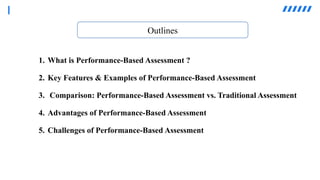
1. What is Performance-Based Assessment ?
2. Key Features & Examples of Performance-Based Assessment
3. Comparison: Performance-Based Assessment vs. Traditional Assessment
4. Advantages of Performance-Based Assessment
5. Challenges of Performance-Based Assessment
Outlines
Road
m
ap
of PBA
01
What is Performance-Based
Assessment ?
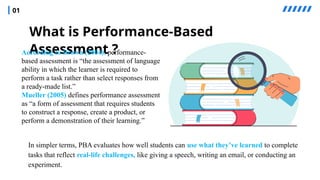
According to Brown (2004), performance-
based assessment is “the assessment of language
ability in which the learner is required to
perform a task rather than select responses from
a ready-made list.”
Mueller (2005) defines performance assessment
as “a form of assessment that requires students
to construct a response, create a product, or
perform a demonstration of their learning.”
In simpler terms, PBA evaluates how well students can use what they’ve learned to complete
tasks that reflect real-life challenges, like giving a speech, writing an email, or conducting an
experiment.
02
Key Features & Examples of
Performance-Based Assessment
Authentic, real-world tasks: Students complete activities that mirror
real-life situations.
Example: Instead of filling in blanks about giving directions, students
actually give directions to a classmate as if they were outside.
Focus on skill application, not just recall: PBA tests how well
students can apply knowledge in real contexts.
Example: Role-play a restaurant scenario
Emphasis on both the process and the product: Teachers observe
how the student completes the task and what they produce.
Example: When students write an essay, both their writing process
(brainstorming, drafting) and the final essay are evaluated.
Use of clear rubrics: Performance is judged using detailed criteria to
ensure fairness.
Example: A teacher uses a rubric to grade a student’s presentation
based on clarity, organization, language use, and delivery.
Student centered and engaging: Students take an active role
in their learning and demonstrate their strengths in different
ways.
Example: Learners create a group poster on environmental
issues and present it to the class.
Flexible in format: Can include oral, written, visual, or hands-on
activities.
Examples:
 Role-Plays
 Portfolios
 Project-Based Learning (PBL)
 Simulations
 Debates
 Learning Journals
 Podcasts/Radio Shows
08
04
Comparison: Performance-Based
Assessment vs. Traditional
Assessment
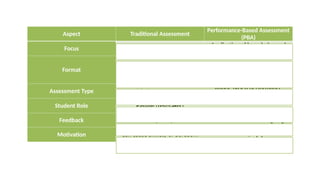
Aspect Traditional Assessment
Performance-Based Assessment
(PBA)
Focus Memorization, recall
Application of knowledge and
skills
Format
Multiple-choice, true/false, fill-in-
the-blank
Tasks, projects, presentations,
real-world scenarios
Assessment Type Right/wrong answers
Rubric-based performance
judgment
Student Role Passive (test-taker)
Active (performer, creator,
problem-solver)
Feedback Usually delayed Often immediate or ongoing
Motivation Can cause anxiety or boredom
Often more engaging and
meaningful
05
Advantages of Performance-Based
Assessment
06
Challenges of Performance-Based
Assessment
Brown, H. D., & Abeywickrama, P. (2004). Language assessment. Principles and Classroom Practices. White
Plains, NY: Pearson Education, 20.
Mueller, J. (2005). The authentic assessment toolbox: enhancing student learning through online faculty
development. Journal of Online Learning and Teaching, 1(1), 1-7.
Ministry of National Education, Morocco. (2010). Circular No. 182: Framework for continuous assessment of
second foreign languages (English, Spanish, German, Italian). Official Gazette of the Ministry of National Education.
Pappas, C. (2023, June 24). What is performance-based assessment?. eLearning Industry.
https://elearningindustry.com/what-is-performance-based-assessment
What is Performance Based Assessment (PBA): Uopeople. University of the People. (2024, November 28).
https://www.uopeople.edu/blog/what-is-performance-based-assessment-pba/
08
References:

THANKS FOR
YOUR
ATTENTION
www.reallygreatsite.co
m

PERFORMANCE BASED ASSESSMENT (CRMEF-SM))

  • 1.
    PERFORMANCE BASED CRMEF-INZEGANE (G2 - MS) ASSESSMENT S TRAINER: Prof. AYAD CHRAA MODULE: TESTING AND ASSESSMENT PRESENTED BY: BRAHIM AMEZOUAR MOHAMED OUBELLA LAHOUCINE ELLOULI BRAHIM IHMAMANE
  • 2.
    1. What isPerformance-Based Assessment ? 2. Key Features & Examples of Performance-Based Assessment 3. Comparison: Performance-Based Assessment vs. Traditional Assessment 4. Advantages of Performance-Based Assessment 5. Challenges of Performance-Based Assessment Outlines
  • 3.
  • 4.
    01 What is Performance-Based Assessment? According to Brown (2004), performance- based assessment is “the assessment of language ability in which the learner is required to perform a task rather than select responses from a ready-made list.” Mueller (2005) defines performance assessment as “a form of assessment that requires students to construct a response, create a product, or perform a demonstration of their learning.” In simpler terms, PBA evaluates how well students can use what they’ve learned to complete tasks that reflect real-life challenges, like giving a speech, writing an email, or conducting an experiment.
  • 5.
    02 Key Features &Examples of Performance-Based Assessment
  • 6.
    Authentic, real-world tasks:Students complete activities that mirror real-life situations. Example: Instead of filling in blanks about giving directions, students actually give directions to a classmate as if they were outside. Focus on skill application, not just recall: PBA tests how well students can apply knowledge in real contexts. Example: Role-play a restaurant scenario
  • 7.
    Emphasis on boththe process and the product: Teachers observe how the student completes the task and what they produce. Example: When students write an essay, both their writing process (brainstorming, drafting) and the final essay are evaluated. Use of clear rubrics: Performance is judged using detailed criteria to ensure fairness. Example: A teacher uses a rubric to grade a student’s presentation based on clarity, organization, language use, and delivery.
  • 8.
    Student centered andengaging: Students take an active role in their learning and demonstrate their strengths in different ways. Example: Learners create a group poster on environmental issues and present it to the class.
  • 9.
    Flexible in format:Can include oral, written, visual, or hands-on activities. Examples:  Role-Plays  Portfolios  Project-Based Learning (PBL)  Simulations  Debates  Learning Journals  Podcasts/Radio Shows
  • 10.
  • 11.
  • 12.
    Aspect Traditional Assessment Performance-BasedAssessment (PBA) Focus Memorization, recall Application of knowledge and skills Format Multiple-choice, true/false, fill-in- the-blank Tasks, projects, presentations, real-world scenarios Assessment Type Right/wrong answers Rubric-based performance judgment Student Role Passive (test-taker) Active (performer, creator, problem-solver) Feedback Usually delayed Often immediate or ongoing Motivation Can cause anxiety or boredom Often more engaging and meaningful
  • 13.
  • 15.
  • 17.
    Brown, H. D.,& Abeywickrama, P. (2004). Language assessment. Principles and Classroom Practices. White Plains, NY: Pearson Education, 20. Mueller, J. (2005). The authentic assessment toolbox: enhancing student learning through online faculty development. Journal of Online Learning and Teaching, 1(1), 1-7. Ministry of National Education, Morocco. (2010). Circular No. 182: Framework for continuous assessment of second foreign languages (English, Spanish, German, Italian). Official Gazette of the Ministry of National Education. Pappas, C. (2023, June 24). What is performance-based assessment?. eLearning Industry. https://elearningindustry.com/what-is-performance-based-assessment What is Performance Based Assessment (PBA): Uopeople. University of the People. (2024, November 28). https://www.uopeople.edu/blog/what-is-performance-based-assessment-pba/ 08 References:
  • 18.