PERFORMATIVE-
BASED
ASSESSMENT
Trainer: Ayad Chraa
Crmef
SM
Our Team
Asmae Khaya
Nouhaila laouina Ayyoub Benaissa
“Tell me and I forget, teach me and I
may remember, involve me and I
learn.”
— Benjamin Franklin
Quote
“an approach to assessment that seeks to
measure student learning based on how
well the learner can perform on a practical
real task.” (Richards and Schmidt, 2002, p.
392)
Definition
why founded?
Performative-based
assessment emerged as a
response to the limitations
of standardized tests.
Examples
• Role-play
• interviews
• designing posters
• storytelling
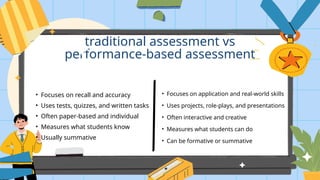
traditional assessment vs
performance-based assessment
• Focuses on recall and accuracy
• Uses tests, quizzes, and written tasks
• Often paper-based and individual
• Measures what students know
• Usually summative
• Focuses on application and real-world skills
• Uses projects, role-plays, and presentations
• Often interactive and creative
• Measures what students can do
• Can be formative or summative
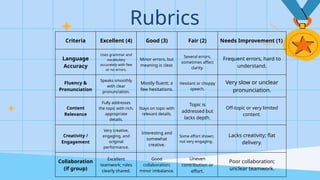
Criteria Excellent (4) Good (3) Fair (2) Needs Improvement (1)
Language
Accuracy
Uses grammar and
vocabulary
accurately with few
or no errors.
Minor errors, but
meaning is clear.
Several errors,
sometimes affect
clarity.
Frequent errors, hard to
understand.
Fluency &
Pronunciation
Speaks smoothly
with clear
pronunciation.
Mostly fluent; a
few hesitations.
Hesitant or choppy
speech.
Very slow or unclear
pronunciation.
Content
Relevance
Fully addresses
the topic with rich,
appropriate
details.
Stays on topic with
relevant details.
Topic is
addressed but
lacks depth.
Off-topic or very limited
content.
Creativity /
Engagement
Very creative,
engaging, and
original
performance.
Interesting and
somewhat
creative.
Some effort shown;
not very engaging.
Lacks creativity; flat
delivery.
Collaboration
(if group)
Excellent
teamwork; roles
clearly shared.
Good
collaboration;
minor imbalance.
Uneven
contribution or
effort.
Poor collaboration;
unclear teamwork.
Rubrics
Advantages
• Positive Backwash Effect
• Authenticity & Validity
• Predictive Validity
• Alignment with Communicative
Competence
DisAdvantages
• Reliability Challenges
• Rater Subjectivity
• Practicality Issues
• Limited Content Coverage
QCM TEST
CORRECTION
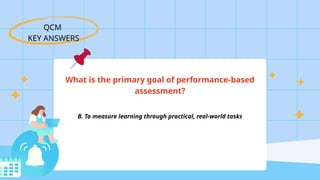
QCM
KEY ANSWERS
What is the primary goal of performance-based
assessment?
B. To measure learning through practical, real-world tasks
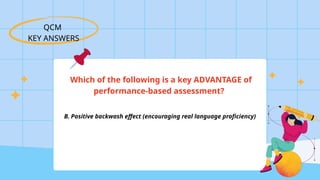
QCM
KEY ANSWERS
Which of the following is a key ADVANTAGE of
performance-based assessment?
B. Positive backwash effect (encouraging real language proficiency)
QCM
KEY ANSWERS
What is a common CRITICISM of performance-based
assessment?
C. Subjectivity in scoring and lower reliability
QCM
KEY ANSWERS
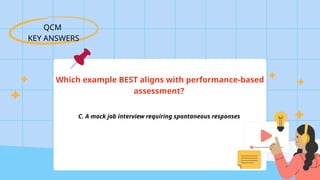
Which example BEST aligns with performance-based
assessment?
C. A mock job interview requiring spontaneous responses
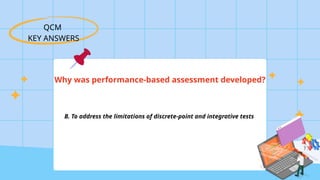
QCM
KEY ANSWERS
Why was performance-based assessment developed?
B. To address the limitations of discrete-point and integrative tests
Kahoot
references
• Richards, J. C., & Schmidt, R. W. (2013). Longman Dictionary of Language Teaching and Applied
Linguistics. https://doi.org/10.4324/9781315833835
• Richards, J. C. (2015). Key issues in language teaching. https://doi.org/10.1017/9781009024600
• Yousefpoori-Naeim, M. (2014). Performance-based assessment: What we should know about it.
ROSHD FLT Journal, 29(2), 40-47
Thank You

Blue Illustrative Group Project Presentation (1).pptx

  • 1.
  • 2.
    Our Team Asmae Khaya Nouhailalaouina Ayyoub Benaissa
  • 3.
    “Tell me andI forget, teach me and I may remember, involve me and I learn.” — Benjamin Franklin Quote
  • 4.
    “an approach toassessment that seeks to measure student learning based on how well the learner can perform on a practical real task.” (Richards and Schmidt, 2002, p. 392) Definition
  • 5.
    why founded? Performative-based assessment emergedas a response to the limitations of standardized tests.
  • 6.
    Examples • Role-play • interviews •designing posters • storytelling
  • 7.
    traditional assessment vs performance-basedassessment • Focuses on recall and accuracy • Uses tests, quizzes, and written tasks • Often paper-based and individual • Measures what students know • Usually summative • Focuses on application and real-world skills • Uses projects, role-plays, and presentations • Often interactive and creative • Measures what students can do • Can be formative or summative
  • 8.
    Criteria Excellent (4)Good (3) Fair (2) Needs Improvement (1) Language Accuracy Uses grammar and vocabulary accurately with few or no errors. Minor errors, but meaning is clear. Several errors, sometimes affect clarity. Frequent errors, hard to understand. Fluency & Pronunciation Speaks smoothly with clear pronunciation. Mostly fluent; a few hesitations. Hesitant or choppy speech. Very slow or unclear pronunciation. Content Relevance Fully addresses the topic with rich, appropriate details. Stays on topic with relevant details. Topic is addressed but lacks depth. Off-topic or very limited content. Creativity / Engagement Very creative, engaging, and original performance. Interesting and somewhat creative. Some effort shown; not very engaging. Lacks creativity; flat delivery. Collaboration (if group) Excellent teamwork; roles clearly shared. Good collaboration; minor imbalance. Uneven contribution or effort. Poor collaboration; unclear teamwork. Rubrics
  • 9.
    Advantages • Positive BackwashEffect • Authenticity & Validity • Predictive Validity • Alignment with Communicative Competence
  • 10.
    DisAdvantages • Reliability Challenges •Rater Subjectivity • Practicality Issues • Limited Content Coverage
  • 11.
  • 12.
    QCM KEY ANSWERS What isthe primary goal of performance-based assessment? B. To measure learning through practical, real-world tasks
  • 13.
    QCM KEY ANSWERS Which ofthe following is a key ADVANTAGE of performance-based assessment? B. Positive backwash effect (encouraging real language proficiency)
  • 14.
    QCM KEY ANSWERS What isa common CRITICISM of performance-based assessment? C. Subjectivity in scoring and lower reliability
  • 15.
    QCM KEY ANSWERS Which exampleBEST aligns with performance-based assessment? C. A mock job interview requiring spontaneous responses
  • 16.
    QCM KEY ANSWERS Why wasperformance-based assessment developed? B. To address the limitations of discrete-point and integrative tests
  • 17.
  • 18.
    references • Richards, J.C., & Schmidt, R. W. (2013). Longman Dictionary of Language Teaching and Applied Linguistics. https://doi.org/10.4324/9781315833835 • Richards, J. C. (2015). Key issues in language teaching. https://doi.org/10.1017/9781009024600 • Yousefpoori-Naeim, M. (2014). Performance-based assessment: What we should know about it. ROSHD FLT Journal, 29(2), 40-47
  • 19.