Herman Aguinis, University of Colorado at Denver
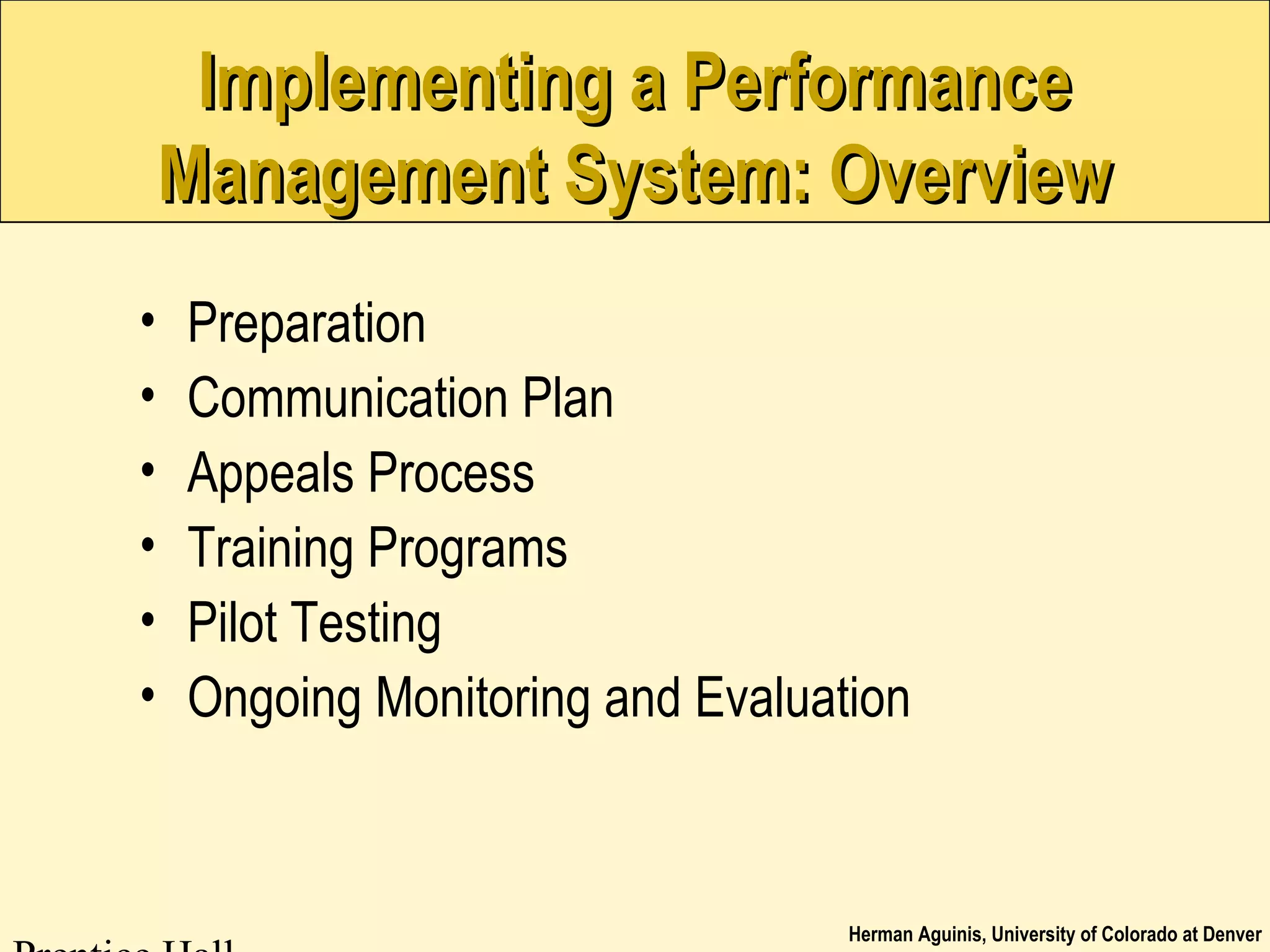
Implementing a PerformanceImplementing a Performance
Management System: OverviewManagement System: Overview
• Preparation
• Communication Plan
• Appeals Process
• Training Programs
• Pilot Testing
• Ongoing Monitoring and Evaluation
Herman Aguinis, University of Colorado at Denver
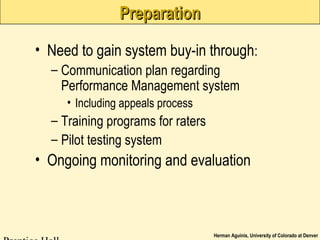
PreparationPreparation
• Need to gain system buy-in through:
– Communication plan regarding
Performance Management system
• Including appeals process
– Training programs for raters
– Pilot testing system
• Ongoing monitoring and evaluation
Herman Aguinis, University of Colorado at Denver
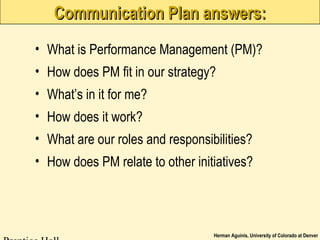
Communication Plan answers:Communication Plan answers:
• What is Performance Management (PM)?
• How does PM fit in our strategy?
• What’s in it for me?
• How does it work?
• What are our roles and responsibilities?
• How does PM relate to other initiatives?
Herman Aguinis, University of Colorado at Denver
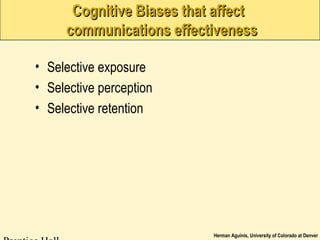
Cognitive Biases that affectCognitive Biases that affect
communications effectivenesscommunications effectiveness
• Selective exposure
• Selective perception
• Selective retention
Herman Aguinis, University of Colorado at Denver
To minimize effects of cognitive biases:To minimize effects of cognitive biases:
A. Consider employees:
• Involve employees in system design
• Show how employee needs are met
Herman Aguinis, University of Colorado at Denver
To minimize effects of cognitive biases:To minimize effects of cognitive biases:
B. Emphasize the positive
• Use credible communicators
• Strike first – create positive attitude
• Provide facts and conclusions
Herman Aguinis, University of Colorado at Denver
To minimize effects of cognitive biases:To minimize effects of cognitive biases:
C. Repeat, document, be consistent
• Put it in writing
• Use multiple channels of communication
• Say it, and then – say it again
Herman Aguinis, University of Colorado at Denver
Appeals ProcessAppeals Process
• Promote Employee buy-in to PM system
– Amicable/Non-retaliatory
– Resolution of disagreements
Herman Aguinis, University of Colorado at Denver
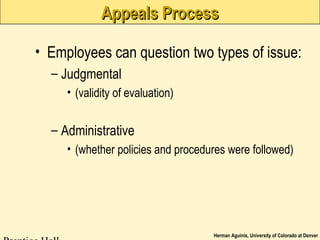
Appeals ProcessAppeals Process
• Employees can question two types of issue:
– Judgmental
• (validity of evaluation)
– Administrative
• (whether policies and procedures were followed)
Herman Aguinis, University of Colorado at Denver
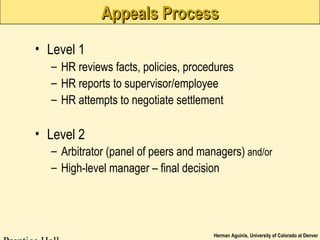
Appeals ProcessAppeals Process
• Level 1
– HR reviews facts, policies, procedures
– HR reports to supervisor/employee
– HR attempts to negotiate settlement
• Level 2
– Arbitrator (panel of peers and managers) and/or
– High-level manager – final decision
Herman Aguinis, University of Colorado at Denver
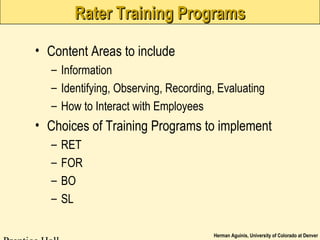
Rater Training ProgramsRater Training Programs
• Content Areas to include
– Information
– Identifying, Observing, Recording, Evaluating
– How to Interact with Employees
• Choices of Training Programs to implement
– RET
– FOR
– BO
– SL
Herman Aguinis, University of Colorado at Denver
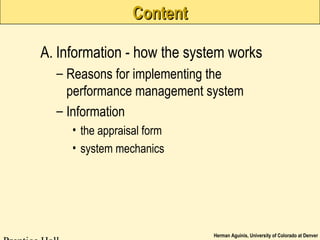
ContentContent
A. Information - how the system works
– Reasons for implementing the
performance management system
– Information
• the appraisal form
• system mechanics
Herman Aguinis, University of Colorado at Denver
ContentContent
B. Identifying, observing, recording, and
evaluating performance
– How to identify and rank job activities
– How to observe, record, and measure
performance
– How to minimize rating errors
Herman Aguinis, University of Colorado at Denver
ContentContent
C. How to interact with employees when
they receive performance information
– How to conduct an appraisal interview
– How to train, counsel, and coach
Herman Aguinis, University of Colorado at Denver
Choices of Training ProgramsChoices of Training Programs
• Rater Error Training (RET)
• Frame of Reference Training (FOR)
• Behavioral Observation Training (BO)
• Self-leadership Training (SL)
Herman Aguinis, University of Colorado at Denver
Rater Error Training (RET)Rater Error Training (RET)
• Goals of Rater Error Training (RET)
– Make raters aware of types of rating errors
– Help raters minimize errors
– Increase rating accuracy
Herman Aguinis, University of Colorado at Denver
Intentional rating errorsIntentional rating errors
• Leniency (inflation)
• Severity (deflation)
• Central tendency
Herman Aguinis, University of Colorado at Denver
Unintentional rating errorsUnintentional rating errors
• Similar to Me
• Halo
• Primacy
• First impression
• Contrast
• Stereotype
• Negativity
• Recency
• Spillover
Herman Aguinis, University of Colorado at Denver
Possible Solutions for Types of Rating ErrorsPossible Solutions for Types of Rating Errors
• Intentional
– Focus on motivation
– Demonstrate benefits of providing accurate
ratings
• Unintentional
– Alert raters to different errors and their
causes
Herman Aguinis, University of Colorado at Denver
Frame of Reference Training (FOR)Frame of Reference Training (FOR)
• Goal of Frame of Reference Training
(FOR)*
– Raters develop common frame of reference
• Observing performance
• Evaluating performance
*Most appropriate when PM appraisal system focuses on behaviors
Herman Aguinis, University of Colorado at Denver
Expected Results of Frame of Reference Training (FOR)Expected Results of Frame of Reference Training (FOR)
• Raters provide consistent, more accurate
ratings
• Raters help employees design effective
development plans
Herman Aguinis, University of Colorado at Denver
Behavioral Observation Training (BO)Behavioral Observation Training (BO)
• Goals of Behavioral Observation Training
(BO)
– Minimize unintentional rating errors
– Improve rater skills by focusing on how
raters:
• Observe performance
• Store information about performance
• Recall information about performance
• Use information about performance
Herman Aguinis, University of Colorado at Denver
Self-leadership Training (SL)Self-leadership Training (SL)
• Goals of Self-leadership Training (SL)
– Improve rater confidence in ability to
manage performance
– Enhance mental processes
– Increase self-efficacy
Herman Aguinis, University of Colorado at Denver
Pilot TestingPilot Testing
• Provides ability to
– Discover potential problems
– Fix them
Herman Aguinis, University of Colorado at Denver
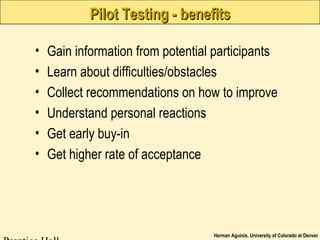
Pilot Testing - benefitsPilot Testing - benefits
• Gain information from potential participants
• Learn about difficulties/obstacles
• Collect recommendations on how to improve
• Understand personal reactions
• Get early buy-in
• Get higher rate of acceptance
Herman Aguinis, University of Colorado at Denver
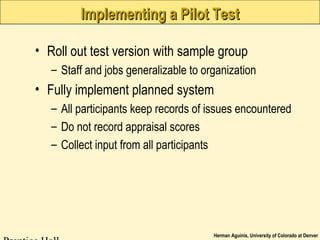
Implementing a Pilot TestImplementing a Pilot Test
• Roll out test version with sample group
– Staff and jobs generalizable to organization
• Fully implement planned system
– All participants keep records of issues encountered
– Do not record appraisal scores
– Collect input from all participants
Herman Aguinis, University of Colorado at Denver
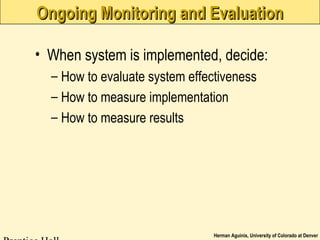
Ongoing Monitoring and EvaluationOngoing Monitoring and Evaluation
• When system is implemented, decide:
– How to evaluate system effectiveness
– How to measure implementation
– How to measure results
Herman Aguinis, University of Colorado at Denver
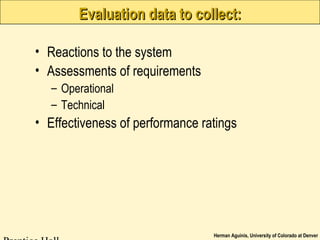
Evaluation data to collect:Evaluation data to collect:
• Reactions to the system
• Assessments of requirements
– Operational
– Technical
• Effectiveness of performance ratings
Herman Aguinis, University of Colorado at Denver
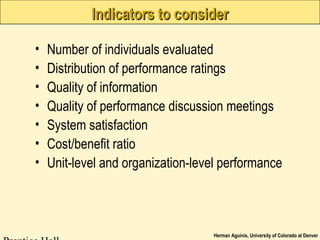
Indicators to considerIndicators to consider
• Number of individuals evaluated
• Distribution of performance ratings
• Quality of information
• Quality of performance discussion meetings
• System satisfaction
• Cost/benefit ratio
• Unit-level and organization-level performance

Implementing A Performance Management System {Lecture Notes}

  • 1.
    Herman Aguinis, Universityof Colorado at Denver Implementing a PerformanceImplementing a Performance Management System: OverviewManagement System: Overview • Preparation • Communication Plan • Appeals Process • Training Programs • Pilot Testing • Ongoing Monitoring and Evaluation
  • 2.
    Herman Aguinis, Universityof Colorado at Denver PreparationPreparation • Need to gain system buy-in through: – Communication plan regarding Performance Management system • Including appeals process – Training programs for raters – Pilot testing system • Ongoing monitoring and evaluation
  • 3.
    Herman Aguinis, Universityof Colorado at Denver Communication Plan answers:Communication Plan answers: • What is Performance Management (PM)? • How does PM fit in our strategy? • What’s in it for me? • How does it work? • What are our roles and responsibilities? • How does PM relate to other initiatives?
  • 4.
    Herman Aguinis, Universityof Colorado at Denver Cognitive Biases that affectCognitive Biases that affect communications effectivenesscommunications effectiveness • Selective exposure • Selective perception • Selective retention
  • 5.
    Herman Aguinis, Universityof Colorado at Denver To minimize effects of cognitive biases:To minimize effects of cognitive biases: A. Consider employees: • Involve employees in system design • Show how employee needs are met
  • 6.
    Herman Aguinis, Universityof Colorado at Denver To minimize effects of cognitive biases:To minimize effects of cognitive biases: B. Emphasize the positive • Use credible communicators • Strike first – create positive attitude • Provide facts and conclusions
  • 7.
    Herman Aguinis, Universityof Colorado at Denver To minimize effects of cognitive biases:To minimize effects of cognitive biases: C. Repeat, document, be consistent • Put it in writing • Use multiple channels of communication • Say it, and then – say it again
  • 8.
    Herman Aguinis, Universityof Colorado at Denver Appeals ProcessAppeals Process • Promote Employee buy-in to PM system – Amicable/Non-retaliatory – Resolution of disagreements
  • 9.
    Herman Aguinis, Universityof Colorado at Denver Appeals ProcessAppeals Process • Employees can question two types of issue: – Judgmental • (validity of evaluation) – Administrative • (whether policies and procedures were followed)
  • 10.
    Herman Aguinis, Universityof Colorado at Denver Appeals ProcessAppeals Process • Level 1 – HR reviews facts, policies, procedures – HR reports to supervisor/employee – HR attempts to negotiate settlement • Level 2 – Arbitrator (panel of peers and managers) and/or – High-level manager – final decision
  • 11.
    Herman Aguinis, Universityof Colorado at Denver Rater Training ProgramsRater Training Programs • Content Areas to include – Information – Identifying, Observing, Recording, Evaluating – How to Interact with Employees • Choices of Training Programs to implement – RET – FOR – BO – SL
  • 12.
    Herman Aguinis, Universityof Colorado at Denver ContentContent A. Information - how the system works – Reasons for implementing the performance management system – Information • the appraisal form • system mechanics
  • 13.
    Herman Aguinis, Universityof Colorado at Denver ContentContent B. Identifying, observing, recording, and evaluating performance – How to identify and rank job activities – How to observe, record, and measure performance – How to minimize rating errors
  • 14.
    Herman Aguinis, Universityof Colorado at Denver ContentContent C. How to interact with employees when they receive performance information – How to conduct an appraisal interview – How to train, counsel, and coach
  • 15.
    Herman Aguinis, Universityof Colorado at Denver Choices of Training ProgramsChoices of Training Programs • Rater Error Training (RET) • Frame of Reference Training (FOR) • Behavioral Observation Training (BO) • Self-leadership Training (SL)
  • 16.
    Herman Aguinis, Universityof Colorado at Denver Rater Error Training (RET)Rater Error Training (RET) • Goals of Rater Error Training (RET) – Make raters aware of types of rating errors – Help raters minimize errors – Increase rating accuracy
  • 17.
    Herman Aguinis, Universityof Colorado at Denver Intentional rating errorsIntentional rating errors • Leniency (inflation) • Severity (deflation) • Central tendency
  • 18.
    Herman Aguinis, Universityof Colorado at Denver Unintentional rating errorsUnintentional rating errors • Similar to Me • Halo • Primacy • First impression • Contrast • Stereotype • Negativity • Recency • Spillover
  • 19.
    Herman Aguinis, Universityof Colorado at Denver Possible Solutions for Types of Rating ErrorsPossible Solutions for Types of Rating Errors • Intentional – Focus on motivation – Demonstrate benefits of providing accurate ratings • Unintentional – Alert raters to different errors and their causes
  • 20.
    Herman Aguinis, Universityof Colorado at Denver Frame of Reference Training (FOR)Frame of Reference Training (FOR) • Goal of Frame of Reference Training (FOR)* – Raters develop common frame of reference • Observing performance • Evaluating performance *Most appropriate when PM appraisal system focuses on behaviors
  • 21.
    Herman Aguinis, Universityof Colorado at Denver Expected Results of Frame of Reference Training (FOR)Expected Results of Frame of Reference Training (FOR) • Raters provide consistent, more accurate ratings • Raters help employees design effective development plans
  • 22.
    Herman Aguinis, Universityof Colorado at Denver Behavioral Observation Training (BO)Behavioral Observation Training (BO) • Goals of Behavioral Observation Training (BO) – Minimize unintentional rating errors – Improve rater skills by focusing on how raters: • Observe performance • Store information about performance • Recall information about performance • Use information about performance
  • 23.
    Herman Aguinis, Universityof Colorado at Denver Self-leadership Training (SL)Self-leadership Training (SL) • Goals of Self-leadership Training (SL) – Improve rater confidence in ability to manage performance – Enhance mental processes – Increase self-efficacy
  • 24.
    Herman Aguinis, Universityof Colorado at Denver Pilot TestingPilot Testing • Provides ability to – Discover potential problems – Fix them
  • 25.
    Herman Aguinis, Universityof Colorado at Denver Pilot Testing - benefitsPilot Testing - benefits • Gain information from potential participants • Learn about difficulties/obstacles • Collect recommendations on how to improve • Understand personal reactions • Get early buy-in • Get higher rate of acceptance
  • 26.
    Herman Aguinis, Universityof Colorado at Denver Implementing a Pilot TestImplementing a Pilot Test • Roll out test version with sample group – Staff and jobs generalizable to organization • Fully implement planned system – All participants keep records of issues encountered – Do not record appraisal scores – Collect input from all participants
  • 27.
    Herman Aguinis, Universityof Colorado at Denver Ongoing Monitoring and EvaluationOngoing Monitoring and Evaluation • When system is implemented, decide: – How to evaluate system effectiveness – How to measure implementation – How to measure results
  • 28.
    Herman Aguinis, Universityof Colorado at Denver Evaluation data to collect:Evaluation data to collect: • Reactions to the system • Assessments of requirements – Operational – Technical • Effectiveness of performance ratings
  • 29.
    Herman Aguinis, Universityof Colorado at Denver Indicators to considerIndicators to consider • Number of individuals evaluated • Distribution of performance ratings • Quality of information • Quality of performance discussion meetings • System satisfaction • Cost/benefit ratio • Unit-level and organization-level performance