MANAGING HUMAN
RESOURCE
MBA, Fall 2014
Unit 1: Human Resource
Planning
Course Instructor:
B. G. Bhattacharya
HUMAN RESOURCE PLANNING
S-1
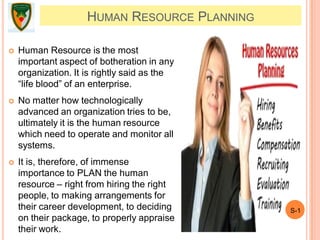
 Human Resource is the most
important aspect of botheration in any
organization. It is rightly said as the
“life blood” of an enterprise.
 No matter how technologically
advanced an organization tries to be,
ultimately it is the human resource
which need to operate and monitor all
systems.
 It is, therefore, of immense
importance to PLAN the human
resource – right from hiring the right
people, to making arrangements for
their career development, to deciding
on their package, to properly appraise
their work.
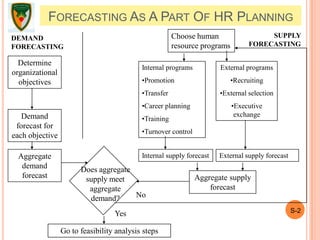
FORECASTING AS A PART OF HR PLANNING
S-2
DEMAND
FORECASTING
SUPPLY
FORECASTING
Determine
organizational
objectives
Demand
forecast for
each objective
Aggregate
demand
forecast
Does aggregate
supply meet
aggregate
demand?
Go to feasibility analysis steps
Choose human
resource programs
External programs
•Recruiting
•External selection
•Executive
exchange
Internal programs
•Promotion
•Transfer
•Career planning
•Training
•Turnover control
Internal supply forecast External supply forecast
Aggregate supply
forecast
No
Yes
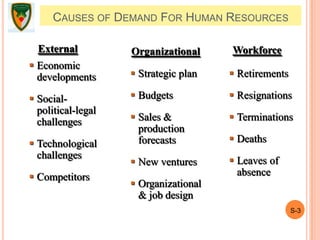
CAUSES OF DEMAND FOR HUMAN RESOURCES
S-3
 Economic
developments
 Social-
political-legal
challenges
 Technological
challenges
 Competitors
 Strategic plan
 Budgets
 Sales &
production
forecasts
 New ventures
 Organizational
& job design
 Retirements
 Resignations
 Terminations
 Deaths
 Leaves of
absence
External Organizational Workforce
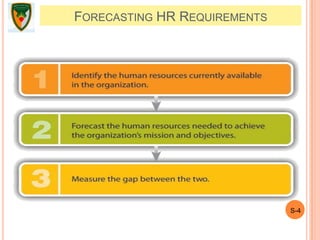
FORECASTING HR REQUIREMENTS
S-4
FORECASTING HR REQUIREMENTS
S-5
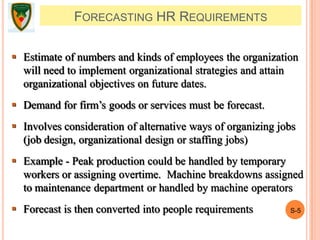
 Estimate of numbers and kinds of employees the organization
will need to implement organizational strategies and attain
organizational objectives on future dates.
 Demand for firm’s goods or services must be forecast.
 Involves consideration of alternative ways of organizing jobs
(job design, organizational design or staffing jobs)
 Example - Peak production could be handled by temporary
workers or assigning overtime. Machine breakdowns assigned
to maintenance department or handled by machine operators
 Forecast is then converted into people requirements
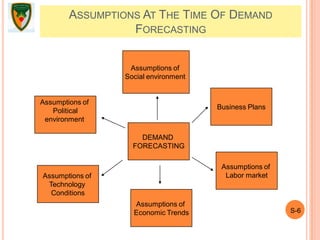
ASSUMPTIONS AT THE TIME OF DEMAND
FORECASTING
S-6
DEMAND
FORECASTING
Assumptions of
Political
environment
Assumptions of
Social environment
Business Plans
Assumptions of
Technology
Conditions
Assumptions of
Labor market
Assumptions of
Economic Trends
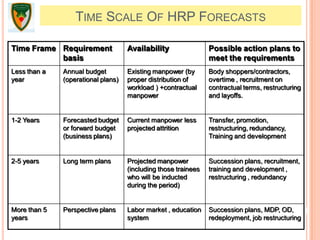
TIME SCALE OF HRP FORECASTS
Time Frame Requirement
basis
Availability Possible action plans to
meet the requirements
Less than a
year
Annual budget
(operational plans)
Existing manpower (by
proper distribution of
workload ) +contractual
manpower
Body shoppers/contractors,
overtime , recruitment on
contractual terms, restructuring
and layoffs.
1-2 Years Forecasted budget
or forward budget
(business plans)
Current manpower less
projected attrition
Transfer, promotion,
restructuring, redundancy,
Training and development
2-5 years Long term plans Projected manpower
(including those trainees
who will be inducted
during the period)
Succession plans, recruitment,
training and development ,
restructuring , redundancy
More than 5
years
Perspective plans Labor market , education
system
Succession plans, MDP, OD,
redeployment, job restructuring
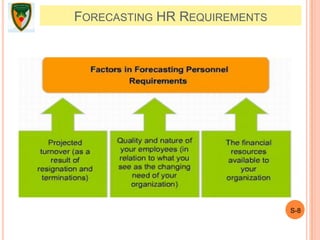
FORECASTING HR REQUIREMENTS
S-8
S-9
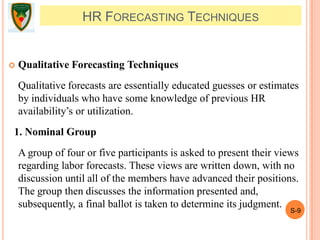
 Qualitative Forecasting Techniques
Qualitative forecasts are essentially educated guesses or estimates
by individuals who have some knowledge of previous HR
availability’s or utilization.
1. Nominal Group
A group of four or five participants is asked to present their views
regarding labor forecasts. These views are written down, with no
discussion until all of the members have advanced their positions.
The group then discusses the information presented and,
subsequently, a final ballot is taken to determine its judgment.
HR FORECASTING TECHNIQUES
S-10
HR FORECASTING TECHNIQUES
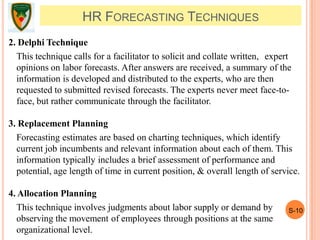
2. Delphi Technique
This technique calls for a facilitator to solicit and collate written, expert
opinions on labor forecasts. After answers are received, a summary of the
information is developed and distributed to the experts, who are then
requested to submitted revised forecasts. The experts never meet face-to-
face, but rather communicate through the facilitator.
3. Replacement Planning
Forecasting estimates are based on charting techniques, which identify
current job incumbents and relevant information about each of them. This
information typically includes a brief assessment of performance and
potential, age length of time in current position, & overall length of service.
4. Allocation Planning
This technique involves judgments about labor supply or demand by
observing the movement of employees through positions at the same
organizational level.
S-11
HR FORECASTING TECHNIQUES
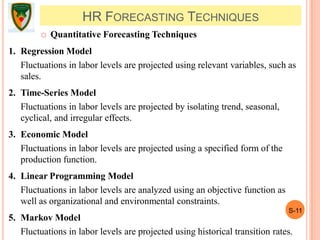
1. Regression Model
Fluctuations in labor levels are projected using relevant variables, such as
sales.
2. Time-Series Model
Fluctuations in labor levels are projected by isolating trend, seasonal,
cyclical, and irregular effects.
3. Economic Model
Fluctuations in labor levels are projected using a specified form of the
production function.
4. Linear Programming Model
Fluctuations in labor levels are analyzed using an objective function as
well as organizational and environmental constraints.
5. Markov Model
Fluctuations in labor levels are projected using historical transition rates.
o Quantitative Forecasting Techniques
S-12
HUMAN RESOURCE SUPPLY & DEMAND
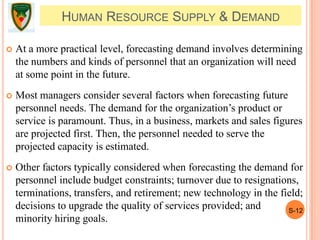
 At a more practical level, forecasting demand involves determining
the numbers and kinds of personnel that an organization will need
at some point in the future.
 Most managers consider several factors when forecasting future
personnel needs. The demand for the organization’s product or
service is paramount. Thus, in a business, markets and sales figures
are projected first. Then, the personnel needed to serve the
projected capacity is estimated.
 Other factors typically considered when forecasting the demand for
personnel include budget constraints; turnover due to resignations,
terminations, transfers, and retirement; new technology in the field;
decisions to upgrade the quality of services provided; and
minority hiring goals.
S-13
HUMAN RESOURCE SUPPLY & DEMAND
 Forecasting supply involves determining what personnel will be
available. The two sources are internal and external: people already
employed by the firm and those outside the organization.
 Factors managers typically consider when forecasting the supply of
personnel include promoting employees from within the
organization; identifying employees willing and able to be trained;
availability of required talent in local, regional, and national labor
markets; competition for talent within the field; population trends.
 Internal sources of employees to fill projected vacancies must be
monitored. This is facilitated by the use of the human resource
audit, or the systematic inventory of the qualifications of exis-
ting personnel.
S-14
HUMAN RESOURCE SUPPLY & DEMAND
o There are three important elements to consider in order to success-
fully forecast labor demand and supply: identifying stakeholders who
will be involved, determining the appropriate planning horizon, and
defining the internal and external labor force.
o The HRP team should include all relevant stakeholders across
multiple functional areas and organizational levels. Explicitly
developing a team for the HRP process helps ensure success of the
strategies within the plan and holds those who are not meeting the
goals accountable.
o Similar to the development of an organizational strategy, a human
resources strategy must have a horizon or timeline. The appropriate
planning horizon is a judgment about how far into the future
predictions can be made, taking into consideration acceptable
levels of operational, organizational, and environmental uncertainties.
S-15
HUMAN RESOURCE SUPPLY & DEMAND
o When assessing the current HR situation, it is important to define
who is included in the internal labor force. A fatal flaw in the HR
planning process is conducting a human resources audit on a
limited or non-representative sample of employees. When
determining which persons should be considered employees, a
good measure is those who perform the work or provide services
within the company under the control or supervision of the
organization’s management team.
o The external labor force refers to potential sources of human
resources outside of an organization that can affect the future
supply of employees. Evaluation of the external labor force relies
on labor market estimates based on regional and global econo-
mic, environmental, and demographic changes.
S-16
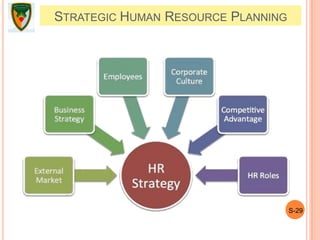
STRATEGIC HUMAN RESOURCE PLANNING
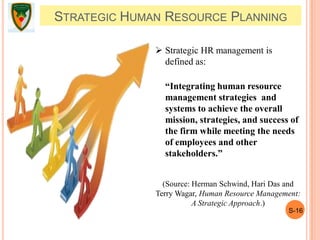
 Strategic HR management is
defined as:
“Integrating human resource
management strategies and
systems to achieve the overall
mission, strategies, and success of
the firm while meeting the needs
of employees and other
stakeholders.”
(Source: Herman Schwind, Hari Das and
Terry Wagar, Human Resource Management:
A Strategic Approach.)
S-17
STRATEGIC HUMAN RESOURCE PLANNING
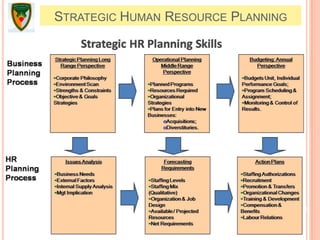
 Strategic HR planning is an important component of
strategic HR management. It links HR management
directly to the strategic plan of your organization.
 Most mid- to large sized organizations have a strategic
plan that guides them in successfully meeting their
missions.
 Organizations routinely complete financial plans to
ensure they achieve organizational goals and while
workforce plans are not as common, they are just as
important.
S-18
STRATEGIC HUMAN RESOURCE PLANNING
 Even a small organization with as few as 10 staff can
develop a strategic plan to guide decisions about the
future.
 Based on the strategic plan, your organization can
develop a strategic HR plan that will allow you to make
HR management decisions now to support the future
direction of the organization.
 Strategic HR planning is also important from a
budgetary point of view so that you can factor the costs
of recruitment, training, etc. into your organization's
operating budget.
S-19
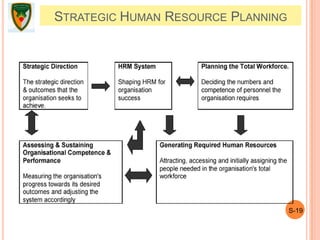
STRATEGIC HUMAN RESOURCE PLANNING
S-20
STRATEGIC HUMAN RESOURCE PLANNING
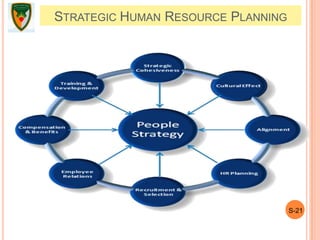
 HR strategy should aim to capture “the people elements”
of what an organization is hoping to achieve in medium
to long term, i.e -
 Right people in right place
 Right mix of skill
 Employees display the right attitudes and behaviors.
 Employees are develop in right way.
S-21
STRATEGIC HUMAN RESOURCE PLANNING
S-22
STRATEGIC HUMAN RESOURCE PLANNING
The overall purpose of strategic HR planning is to:
• Ensure adequate human resources to meet the strategic goals and
operational plans of your organization - the right people with the
right skills at the right time
• Keep up with social, economic, legislative and technological trends
that impact on human resources in your area and in the sector
• Remain flexible so that your organization can manage change if the
future is different than anticipated
Strategic HR planning predicts the future HR management needs of
the organization after analyzing the organization's current human
resources, the external labor market and the future HR environ-
ment that the organization will be operating in.
S-23
STRATEGIC HUMAN RESOURCE PLANNING
S-24
THE STRATEGIC HR PROCESS
The strategic HR planning process has four steps:
 Assessing the current HR capacity
 Forecasting HR requirements
 Gap analysis
 Developing HR strategies to support organiza-
tional strategies
S-25
THE STRATEGIC HR PROCESS
1. Assessing current HR capacity
• Based on the organization's strategic plan, the first step in the
strategic HR planning process is to assess the current HR
capacity of the organization. The knowledge, skills and abilities
of your current staff need to be identified. This can be done by
developing a skills inventory for each employee.
• The skills inventory should go beyond the skills needed for the
particular position. List all skills each employee has
demonstrated. For example, recreational or volunteer activities
may involve special skills that could be relevant to the
organization. Education levels and certificates or additional
training should also be included.
S-26
THE STRATEGIC HR PROCESS
2. Forecasting HR requirements
• The next step is to forecast HR needs for the future based on the
strategic goals of the organization. Realistic forecasting of human
resources involves estimating both demand and supply. Questions
to be answered include:
 How many staff will be required to achieve the strategic goals
of the organization?
 What jobs will need to be filled?
 What skill sets will people need?
 When forecasting demands for HR, you must also assess the
challenges that you will have in meeting your staffing need
based on the external environment.
S-27
THE STRATEGIC HR PROCESS
3. Gap analysis
• The next step is to determine the gap between where your organization
wants to be in the future and where you are now. The gap analysis includes
identifying the number of staff and the skills and abilities required in the
future in comparison to the current situation. You should also look at all
your organization's HR management practices to identify practices that
could be improved or new practices needed to support the organization's
capacity to move forward. Questions to be answered include:
 What new jobs will we need?
 What new skills will be required?
 Do our present employees have the required skills?
 Are employees currently in positions that use their strengths?
 Do we have enough managers/supervisors?
 Are current HR management practices adequate for future needs?
S-28
THE STRATEGIC HR PROCESS
4. Developing HR strategies to support organizational
strategies
• There are five HR strategies for meeting your organiza-
tion's needs in the future:
 Restructuring strategies
 Training and development strategies
 Recruitment strategies
 Outsourcing strategies
 Collaboration strategies
S-29
STRATEGIC HUMAN RESOURCE PLANNING
S-30
PREPARATION OF THE JOB ANALYSIS
Job Analysis – Defined
Job analysis is a systematic approach to defining the job role,
description, requirements, responsibilities, evaluation, etc. It helps in
finding out required level of education, skills, knowledge, training,
etc for the job position. It also depicts the job worth i.e. measurable
effectiveness of the job and contribution of job to the organization.
Thus, it effectively contributes to setting up the compensation
package for the job position.
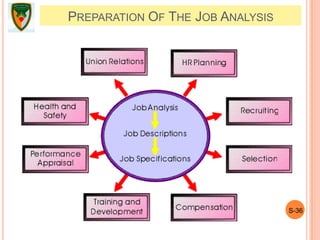
Importance of Job Analysis
Job analysis helps in analyzing the resources and establishing the
strategies to accomplish the business goals and strategic objectives. It
forms the basis for demand-supply analysis, recruitments,
compensation management, and training need assessment and
performance appraisal.
S-31
PREPARATION OF THE JOB ANALYSIS
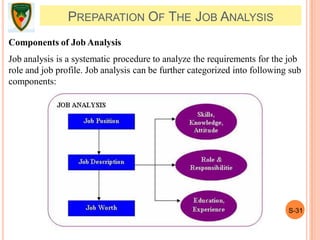
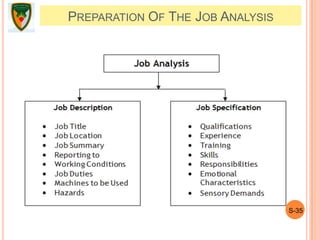
Components of Job Analysis
Job analysis is a systematic procedure to analyze the requirements for the job
role and job profile. Job analysis can be further categorized into following sub
components:
S-32
PREPARATION OF THE JOB ANALYSIS
Job Position
Job position refers to the designation of the job and
employee in the organization. Job position forms an
important part of the compensation strategy as it
determines the level of the job in the organization. For
example management level employees receive greater
pay scale than non-managerial employees. The non-
monetary benefits offered to two different levels in the
organization also vary.
S-33
PREPARATION OF THE JOB ANALYSIS
Job Description
Job description refers the requirements an organization
looks for a particular job position. It states the key skill
requirements, the level of experience needed, level of
education required, etc. It also describes the roles and
responsibilities attached with the job position. The roles
and responsibilities are key determinant factor in
estimating the level of experience, education, skill, etc
required for the job. It also helps in benchmarking the
performance standards.
S-34
PREPARATION OF THE JOB ANALYSIS
Job Worth
Job Worth refers to estimating the job worthiness i.e. how
much the job contributes to the organization. It is also
known as job evaluation. Job description is used to
analyze the job worthiness. It is also known as job
evaluation. Roles and responsibilities helps in
determining the outcome from the job profile. Once it is
determined that how much the job is worth, it becomes
easy to define the compensation strategy for the position.
S-35
PREPARATION OF THE JOB ANALYSIS
S-36
PREPARATION OF THE JOB ANALYSIS
S-37
PREPARATION OF THE JOB ANALYSIS
Therefore, job analysis forms an integral part
in the formulation of compensation strategy
of an organization. Organizations should
conduct the job analysis in a systematic at
regular intervals. Job analysis can be used for
setting up the compensation packages, for
reviewing employees’ performance with the
standard level of performance, determining
the training needs for employees who are
lacking certain skills.
THE
END

Unit 1 human resource planning

  • 1.
    MANAGING HUMAN RESOURCE MBA, Fall2014 Unit 1: Human Resource Planning Course Instructor: B. G. Bhattacharya
  • 2.
    HUMAN RESOURCE PLANNING S-1 Human Resource is the most important aspect of botheration in any organization. It is rightly said as the “life blood” of an enterprise.  No matter how technologically advanced an organization tries to be, ultimately it is the human resource which need to operate and monitor all systems.  It is, therefore, of immense importance to PLAN the human resource – right from hiring the right people, to making arrangements for their career development, to deciding on their package, to properly appraise their work.
  • 3.
    FORECASTING AS APART OF HR PLANNING S-2 DEMAND FORECASTING SUPPLY FORECASTING Determine organizational objectives Demand forecast for each objective Aggregate demand forecast Does aggregate supply meet aggregate demand? Go to feasibility analysis steps Choose human resource programs External programs •Recruiting •External selection •Executive exchange Internal programs •Promotion •Transfer •Career planning •Training •Turnover control Internal supply forecast External supply forecast Aggregate supply forecast No Yes
  • 4.
    CAUSES OF DEMANDFOR HUMAN RESOURCES S-3  Economic developments  Social- political-legal challenges  Technological challenges  Competitors  Strategic plan  Budgets  Sales & production forecasts  New ventures  Organizational & job design  Retirements  Resignations  Terminations  Deaths  Leaves of absence External Organizational Workforce
  • 5.
  • 6.
    FORECASTING HR REQUIREMENTS S-5 Estimate of numbers and kinds of employees the organization will need to implement organizational strategies and attain organizational objectives on future dates.  Demand for firm’s goods or services must be forecast.  Involves consideration of alternative ways of organizing jobs (job design, organizational design or staffing jobs)  Example - Peak production could be handled by temporary workers or assigning overtime. Machine breakdowns assigned to maintenance department or handled by machine operators  Forecast is then converted into people requirements
  • 7.
    ASSUMPTIONS AT THETIME OF DEMAND FORECASTING S-6 DEMAND FORECASTING Assumptions of Political environment Assumptions of Social environment Business Plans Assumptions of Technology Conditions Assumptions of Labor market Assumptions of Economic Trends
  • 8.
    TIME SCALE OFHRP FORECASTS Time Frame Requirement basis Availability Possible action plans to meet the requirements Less than a year Annual budget (operational plans) Existing manpower (by proper distribution of workload ) +contractual manpower Body shoppers/contractors, overtime , recruitment on contractual terms, restructuring and layoffs. 1-2 Years Forecasted budget or forward budget (business plans) Current manpower less projected attrition Transfer, promotion, restructuring, redundancy, Training and development 2-5 years Long term plans Projected manpower (including those trainees who will be inducted during the period) Succession plans, recruitment, training and development , restructuring , redundancy More than 5 years Perspective plans Labor market , education system Succession plans, MDP, OD, redeployment, job restructuring
  • 9.
  • 10.
    S-9  Qualitative ForecastingTechniques Qualitative forecasts are essentially educated guesses or estimates by individuals who have some knowledge of previous HR availability’s or utilization. 1. Nominal Group A group of four or five participants is asked to present their views regarding labor forecasts. These views are written down, with no discussion until all of the members have advanced their positions. The group then discusses the information presented and, subsequently, a final ballot is taken to determine its judgment. HR FORECASTING TECHNIQUES
  • 11.
    S-10 HR FORECASTING TECHNIQUES 2.Delphi Technique This technique calls for a facilitator to solicit and collate written, expert opinions on labor forecasts. After answers are received, a summary of the information is developed and distributed to the experts, who are then requested to submitted revised forecasts. The experts never meet face-to- face, but rather communicate through the facilitator. 3. Replacement Planning Forecasting estimates are based on charting techniques, which identify current job incumbents and relevant information about each of them. This information typically includes a brief assessment of performance and potential, age length of time in current position, & overall length of service. 4. Allocation Planning This technique involves judgments about labor supply or demand by observing the movement of employees through positions at the same organizational level.
  • 12.
    S-11 HR FORECASTING TECHNIQUES 1.Regression Model Fluctuations in labor levels are projected using relevant variables, such as sales. 2. Time-Series Model Fluctuations in labor levels are projected by isolating trend, seasonal, cyclical, and irregular effects. 3. Economic Model Fluctuations in labor levels are projected using a specified form of the production function. 4. Linear Programming Model Fluctuations in labor levels are analyzed using an objective function as well as organizational and environmental constraints. 5. Markov Model Fluctuations in labor levels are projected using historical transition rates. o Quantitative Forecasting Techniques
  • 13.
    S-12 HUMAN RESOURCE SUPPLY& DEMAND  At a more practical level, forecasting demand involves determining the numbers and kinds of personnel that an organization will need at some point in the future.  Most managers consider several factors when forecasting future personnel needs. The demand for the organization’s product or service is paramount. Thus, in a business, markets and sales figures are projected first. Then, the personnel needed to serve the projected capacity is estimated.  Other factors typically considered when forecasting the demand for personnel include budget constraints; turnover due to resignations, terminations, transfers, and retirement; new technology in the field; decisions to upgrade the quality of services provided; and minority hiring goals.
  • 14.
    S-13 HUMAN RESOURCE SUPPLY& DEMAND  Forecasting supply involves determining what personnel will be available. The two sources are internal and external: people already employed by the firm and those outside the organization.  Factors managers typically consider when forecasting the supply of personnel include promoting employees from within the organization; identifying employees willing and able to be trained; availability of required talent in local, regional, and national labor markets; competition for talent within the field; population trends.  Internal sources of employees to fill projected vacancies must be monitored. This is facilitated by the use of the human resource audit, or the systematic inventory of the qualifications of exis- ting personnel.
  • 15.
    S-14 HUMAN RESOURCE SUPPLY& DEMAND o There are three important elements to consider in order to success- fully forecast labor demand and supply: identifying stakeholders who will be involved, determining the appropriate planning horizon, and defining the internal and external labor force. o The HRP team should include all relevant stakeholders across multiple functional areas and organizational levels. Explicitly developing a team for the HRP process helps ensure success of the strategies within the plan and holds those who are not meeting the goals accountable. o Similar to the development of an organizational strategy, a human resources strategy must have a horizon or timeline. The appropriate planning horizon is a judgment about how far into the future predictions can be made, taking into consideration acceptable levels of operational, organizational, and environmental uncertainties.
  • 16.
    S-15 HUMAN RESOURCE SUPPLY& DEMAND o When assessing the current HR situation, it is important to define who is included in the internal labor force. A fatal flaw in the HR planning process is conducting a human resources audit on a limited or non-representative sample of employees. When determining which persons should be considered employees, a good measure is those who perform the work or provide services within the company under the control or supervision of the organization’s management team. o The external labor force refers to potential sources of human resources outside of an organization that can affect the future supply of employees. Evaluation of the external labor force relies on labor market estimates based on regional and global econo- mic, environmental, and demographic changes.
  • 17.
    S-16 STRATEGIC HUMAN RESOURCEPLANNING  Strategic HR management is defined as: “Integrating human resource management strategies and systems to achieve the overall mission, strategies, and success of the firm while meeting the needs of employees and other stakeholders.” (Source: Herman Schwind, Hari Das and Terry Wagar, Human Resource Management: A Strategic Approach.)
  • 18.
    S-17 STRATEGIC HUMAN RESOURCEPLANNING  Strategic HR planning is an important component of strategic HR management. It links HR management directly to the strategic plan of your organization.  Most mid- to large sized organizations have a strategic plan that guides them in successfully meeting their missions.  Organizations routinely complete financial plans to ensure they achieve organizational goals and while workforce plans are not as common, they are just as important.
  • 19.
    S-18 STRATEGIC HUMAN RESOURCEPLANNING  Even a small organization with as few as 10 staff can develop a strategic plan to guide decisions about the future.  Based on the strategic plan, your organization can develop a strategic HR plan that will allow you to make HR management decisions now to support the future direction of the organization.  Strategic HR planning is also important from a budgetary point of view so that you can factor the costs of recruitment, training, etc. into your organization's operating budget.
  • 20.
  • 21.
    S-20 STRATEGIC HUMAN RESOURCEPLANNING  HR strategy should aim to capture “the people elements” of what an organization is hoping to achieve in medium to long term, i.e -  Right people in right place  Right mix of skill  Employees display the right attitudes and behaviors.  Employees are develop in right way.
  • 22.
  • 23.
    S-22 STRATEGIC HUMAN RESOURCEPLANNING The overall purpose of strategic HR planning is to: • Ensure adequate human resources to meet the strategic goals and operational plans of your organization - the right people with the right skills at the right time • Keep up with social, economic, legislative and technological trends that impact on human resources in your area and in the sector • Remain flexible so that your organization can manage change if the future is different than anticipated Strategic HR planning predicts the future HR management needs of the organization after analyzing the organization's current human resources, the external labor market and the future HR environ- ment that the organization will be operating in.
  • 24.
  • 25.
    S-24 THE STRATEGIC HRPROCESS The strategic HR planning process has four steps:  Assessing the current HR capacity  Forecasting HR requirements  Gap analysis  Developing HR strategies to support organiza- tional strategies
  • 26.
    S-25 THE STRATEGIC HRPROCESS 1. Assessing current HR capacity • Based on the organization's strategic plan, the first step in the strategic HR planning process is to assess the current HR capacity of the organization. The knowledge, skills and abilities of your current staff need to be identified. This can be done by developing a skills inventory for each employee. • The skills inventory should go beyond the skills needed for the particular position. List all skills each employee has demonstrated. For example, recreational or volunteer activities may involve special skills that could be relevant to the organization. Education levels and certificates or additional training should also be included.
  • 27.
    S-26 THE STRATEGIC HRPROCESS 2. Forecasting HR requirements • The next step is to forecast HR needs for the future based on the strategic goals of the organization. Realistic forecasting of human resources involves estimating both demand and supply. Questions to be answered include:  How many staff will be required to achieve the strategic goals of the organization?  What jobs will need to be filled?  What skill sets will people need?  When forecasting demands for HR, you must also assess the challenges that you will have in meeting your staffing need based on the external environment.
  • 28.
    S-27 THE STRATEGIC HRPROCESS 3. Gap analysis • The next step is to determine the gap between where your organization wants to be in the future and where you are now. The gap analysis includes identifying the number of staff and the skills and abilities required in the future in comparison to the current situation. You should also look at all your organization's HR management practices to identify practices that could be improved or new practices needed to support the organization's capacity to move forward. Questions to be answered include:  What new jobs will we need?  What new skills will be required?  Do our present employees have the required skills?  Are employees currently in positions that use their strengths?  Do we have enough managers/supervisors?  Are current HR management practices adequate for future needs?
  • 29.
    S-28 THE STRATEGIC HRPROCESS 4. Developing HR strategies to support organizational strategies • There are five HR strategies for meeting your organiza- tion's needs in the future:  Restructuring strategies  Training and development strategies  Recruitment strategies  Outsourcing strategies  Collaboration strategies
  • 30.
  • 31.
    S-30 PREPARATION OF THEJOB ANALYSIS Job Analysis – Defined Job analysis is a systematic approach to defining the job role, description, requirements, responsibilities, evaluation, etc. It helps in finding out required level of education, skills, knowledge, training, etc for the job position. It also depicts the job worth i.e. measurable effectiveness of the job and contribution of job to the organization. Thus, it effectively contributes to setting up the compensation package for the job position. Importance of Job Analysis Job analysis helps in analyzing the resources and establishing the strategies to accomplish the business goals and strategic objectives. It forms the basis for demand-supply analysis, recruitments, compensation management, and training need assessment and performance appraisal.
  • 32.
    S-31 PREPARATION OF THEJOB ANALYSIS Components of Job Analysis Job analysis is a systematic procedure to analyze the requirements for the job role and job profile. Job analysis can be further categorized into following sub components:
  • 33.
    S-32 PREPARATION OF THEJOB ANALYSIS Job Position Job position refers to the designation of the job and employee in the organization. Job position forms an important part of the compensation strategy as it determines the level of the job in the organization. For example management level employees receive greater pay scale than non-managerial employees. The non- monetary benefits offered to two different levels in the organization also vary.
  • 34.
    S-33 PREPARATION OF THEJOB ANALYSIS Job Description Job description refers the requirements an organization looks for a particular job position. It states the key skill requirements, the level of experience needed, level of education required, etc. It also describes the roles and responsibilities attached with the job position. The roles and responsibilities are key determinant factor in estimating the level of experience, education, skill, etc required for the job. It also helps in benchmarking the performance standards.
  • 35.
    S-34 PREPARATION OF THEJOB ANALYSIS Job Worth Job Worth refers to estimating the job worthiness i.e. how much the job contributes to the organization. It is also known as job evaluation. Job description is used to analyze the job worthiness. It is also known as job evaluation. Roles and responsibilities helps in determining the outcome from the job profile. Once it is determined that how much the job is worth, it becomes easy to define the compensation strategy for the position.
  • 36.
  • 37.
  • 38.
    S-37 PREPARATION OF THEJOB ANALYSIS Therefore, job analysis forms an integral part in the formulation of compensation strategy of an organization. Organizations should conduct the job analysis in a systematic at regular intervals. Job analysis can be used for setting up the compensation packages, for reviewing employees’ performance with the standard level of performance, determining the training needs for employees who are lacking certain skills.
  • 39.