By- group II
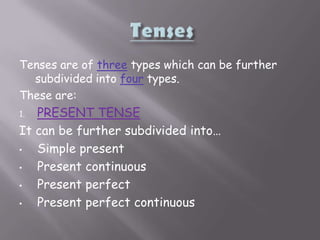
Tenses are of three types which can be further
  subdivided into four types.
These are:
1. PRESENT TENSE
It can be further subdivided into…
•  Simple present
•  Present continuous
•  Present perfect
•  Present perfect continuous
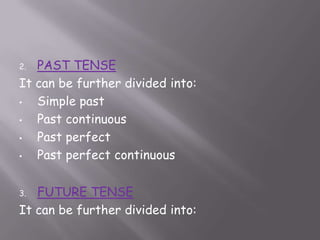
2. PAST TENSE
It can be further divided into:
•  Simple past
•  Past continuous
•  Past perfect
•  Past perfect continuous

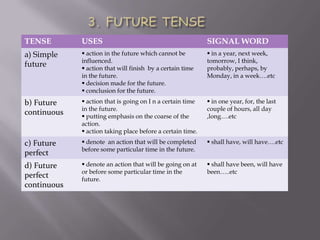
3. FUTURE TENSE
It can be further divided into:
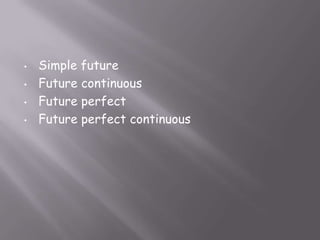
•   Simple future
•   Future continuous
•   Future perfect
•   Future perfect continuous
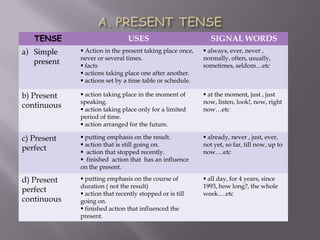
TENSE                       USES                          SIGNAL WORDS
a) Simple     Action in the present taking place once,    always, ever, never ,
             never or several times.                      normally, often, usually,
   present    facts                                      sometimes, seldom…etc
              actions taking place one after another.
              actions set by a time table or schedule.

b) Present    action taking place in the moment of        at the moment, just , just
             speaking.                                    now, listen, look!, now, right
continuous    action taking place only for a limited     now…etc
             period of time.
              action arranged for the future.

c) Present    putting emphasis on the result.             already, never , just, ever,
              action that is still going on.             not yet, so far, till now, up to
perfect       action that stopped recently.              now….etc
              finished action that has an influence
             on the present.

d) Present    putting emphasis on the course of           all day, for 4 years, since
             duration ( not the result)                   1993, how long?, the whole
perfect       action that recently stopped or is till    week….etc
continuous   going on.
              finished action that influenced the
             present.
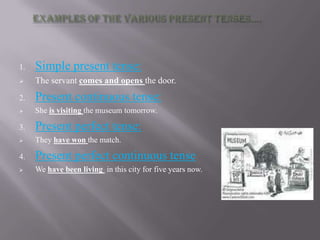
1.   Simple present tense:
    The servant comes and opens the door.
2.   Present continuous tense:
    She is visiting the museum tomorrow.

3.   Present perfect tense:
    They have won the match.

4.   Present perfect continuous tense
    We have been living in this city for five years now.
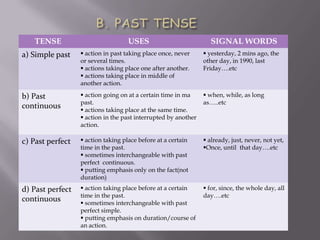
TENSE                            USES                           SIGNAL WORDS
a) Simple past     action in past taking place once, never      yesterday, 2 mins ago, the
                  or several times.                             other day, in 1990, last
                   actions taking place one after another.     Friday….etc
                   actions taking place in middle of
                  another action.

b) Past            action going on at a certain time in ma      when, while, as long
                  past.                                         as…..etc
continuous         actions taking place at the same time.
                   action in the past interrupted by another
                  action.

c) Past perfect    action taking place before at a certain      already, just, never, not yet,
                  time in the past.                             Once, until that day….etc
                   sometimes interchangeable with past
                  perfect continuous.
                   putting emphasis only on the fact(not
                  duration)
d) Past perfect    action taking place before at a certain      for, since, the whole day, all
                  time in the past.                             day….etc
continuous         sometimes interchangeable with past
                  perfect simple.
                   putting emphasis on duration/course of
                  an action.
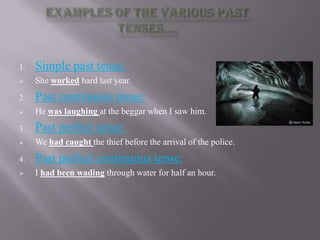
1.   Simple past tense:
    She worked hard last year.
2.   Past continuous tense:
    He was laughing at the beggar when I saw him.
3.   Past perfect tense:
    We had caught the thief before the arrival of the police.
4.   Past perfect continuous tense:
    I had been wading through water for half an hour.
TENSE        USES                                           SIGNAL WORD
a) Simple     action in the future which cannot be          in a year, next week,
             influenced.                                    tomorrow, I think,
future        action that will finish by a certain time    probably, perhaps, by
             in the future.                                 Monday, in a week….etc
              decision made for the future.
              conclusion for the future.
b) Future     action that is going on I n a certain time    in one year, for, the last
             in the future.                                 couple of hours, all day
continuous    putting emphasis on the coarse of the        ,long….etc
             action.
              action taking place before a certain time.
c) Future     denote an action that will be completed       shall have, will have….etc
             before some particular time in the future.
perfect
d) Future     denote an action that will be going on at     shall have been, will have
             or before some particular time in the          been…..etc
perfect      future.
continuous
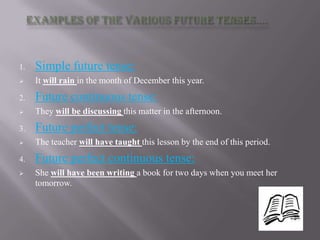
1.   Simple future tense:
    It will rain in the month of December this year.
2.   Future continuous tense:
    They will be discussing this matter in the afternoon.
3.   Future perfect tense:
    The teacher will have taught this lesson by the end of this period.
4.   Future perfect continuous tense:
    She will have been writing a book for two days when you meet her
     tomorrow.
Tenses

Tenses

  • 1.
  • 2.
    Tenses are ofthree types which can be further subdivided into four types. These are: 1. PRESENT TENSE It can be further subdivided into… • Simple present • Present continuous • Present perfect • Present perfect continuous
  • 3.
    2. PAST TENSE Itcan be further divided into: • Simple past • Past continuous • Past perfect • Past perfect continuous 3. FUTURE TENSE It can be further divided into:
  • 4.
    Simple future • Future continuous • Future perfect • Future perfect continuous
  • 5.
    TENSE USES SIGNAL WORDS a) Simple  Action in the present taking place once,  always, ever, never , never or several times. normally, often, usually, present  facts sometimes, seldom…etc  actions taking place one after another.  actions set by a time table or schedule. b) Present  action taking place in the moment of  at the moment, just , just speaking. now, listen, look!, now, right continuous  action taking place only for a limited now…etc period of time.  action arranged for the future. c) Present  putting emphasis on the result.  already, never , just, ever,  action that is still going on. not yet, so far, till now, up to perfect  action that stopped recently. now….etc  finished action that has an influence on the present. d) Present  putting emphasis on the course of  all day, for 4 years, since duration ( not the result) 1993, how long?, the whole perfect  action that recently stopped or is till week….etc continuous going on.  finished action that influenced the present.
  • 6.
    1. Simple present tense:  The servant comes and opens the door. 2. Present continuous tense:  She is visiting the museum tomorrow. 3. Present perfect tense:  They have won the match. 4. Present perfect continuous tense  We have been living in this city for five years now.
  • 7.
    TENSE USES SIGNAL WORDS a) Simple past  action in past taking place once, never  yesterday, 2 mins ago, the or several times. other day, in 1990, last  actions taking place one after another. Friday….etc  actions taking place in middle of another action. b) Past  action going on at a certain time in ma  when, while, as long past. as…..etc continuous  actions taking place at the same time.  action in the past interrupted by another action. c) Past perfect  action taking place before at a certain  already, just, never, not yet, time in the past. Once, until that day….etc  sometimes interchangeable with past perfect continuous.  putting emphasis only on the fact(not duration) d) Past perfect  action taking place before at a certain  for, since, the whole day, all time in the past. day….etc continuous  sometimes interchangeable with past perfect simple.  putting emphasis on duration/course of an action.
  • 8.
    1. Simple past tense:  She worked hard last year. 2. Past continuous tense:  He was laughing at the beggar when I saw him. 3. Past perfect tense:  We had caught the thief before the arrival of the police. 4. Past perfect continuous tense:  I had been wading through water for half an hour.
  • 9.
    TENSE USES SIGNAL WORD a) Simple  action in the future which cannot be  in a year, next week, influenced. tomorrow, I think, future  action that will finish by a certain time probably, perhaps, by in the future. Monday, in a week….etc  decision made for the future.  conclusion for the future. b) Future  action that is going on I n a certain time  in one year, for, the last in the future. couple of hours, all day continuous  putting emphasis on the coarse of the ,long….etc action.  action taking place before a certain time. c) Future  denote an action that will be completed  shall have, will have….etc before some particular time in the future. perfect d) Future  denote an action that will be going on at  shall have been, will have or before some particular time in the been…..etc perfect future. continuous
  • 10.
    1. Simple future tense:  It will rain in the month of December this year. 2. Future continuous tense:  They will be discussing this matter in the afternoon. 3. Future perfect tense:  The teacher will have taught this lesson by the end of this period. 4. Future perfect continuous tense:  She will have been writing a book for two days when you meet her tomorrow.