Past Simple - Present Perfect

 Present Perfect Continuous
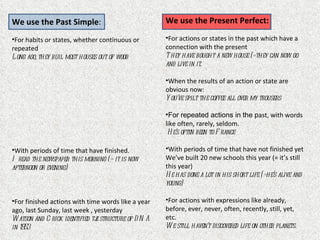
We use the Past Simple:                               We use the Present Perfect:

•For habits or states, whether continuous or          •For actions or states in the past which have a
repeated                                              connection with the present
L ong ago, they buil most houses out of wood          T hey have bought a new house (=they can now go
                                                      and live in it.

                                                      •When the results of an action or state are
                                                      obvious now:
                                                      Y ou’ve spilt the coffee all over my trousers

                                                      •For repeated actions in the past, with words
                                                      like often, rarely, seldom.
                                                       H e’s often been to F rance

•With periods of time that have finished.             •With periods of time that have not finished yet
I read the newspaper this morning (= it is now        We’ve built 20 new schools this year (= it’s still
afternoon or evening)                                 this year)
                                                      H e has done a lot in his short life (=he’s alive and
                                                      young)

•For finished actions with time words like a year     •For actions with expressions like already,
ago, last Sunday, last week , yesterday               before, ever, never, often, recently, still, yet,
W atson and C rick identified tj structure of D N A
                               e                      etc.
in 1953                                               W e still haven’t discovered life on other planets.
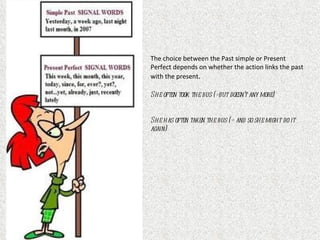
The choice between the Past simple or Present
Perfect depends on whether the action links the past
with the present.

She often took the bus (=but doesn’t any more)


She has often taken the bus (= and so she might do it
again)
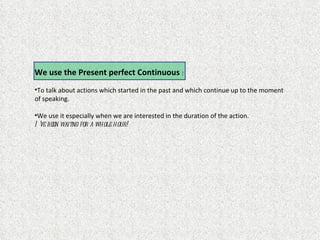
We use the Present perfect Continuous :
•To talk about actions which started in the past and which continue up to the moment
of speaking.

•We use it especially when we are interested in the duration of the action.
I ’ve been waitng for a whole hour!
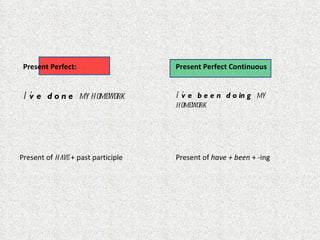
Present Perfect:                   Present Perfect Continuous


 I ’v e d o n e my homework         I ’v e b e e n d o in g my
                                    homework


Present of have + past participle   Present of have + been + -ing
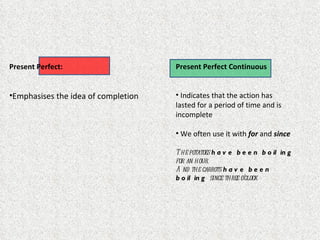
Present Perfect:                     Present Perfect Continuous


•Emphasises the idea of completion   • Indicates that the action has
                                     lasted for a period of time and is
                                     incomplete

                                     • We often use it with for and since

                                     T he potatoes h a v e b e e n b o il in g
                                     for an hour.
                                     A nd the carrots h a v e b e e n
                                     b o il in g since three o’clock

Present Perfect Simple and Continuous - Simple Past

  • 1.
    Past Simple -Present Perfect Present Perfect Continuous
  • 2.
    We use thePast Simple: We use the Present Perfect: •For habits or states, whether continuous or •For actions or states in the past which have a repeated connection with the present L ong ago, they buil most houses out of wood T hey have bought a new house (=they can now go and live in it. •When the results of an action or state are obvious now: Y ou’ve spilt the coffee all over my trousers •For repeated actions in the past, with words like often, rarely, seldom. H e’s often been to F rance •With periods of time that have finished. •With periods of time that have not finished yet I read the newspaper this morning (= it is now We’ve built 20 new schools this year (= it’s still afternoon or evening) this year) H e has done a lot in his short life (=he’s alive and young) •For finished actions with time words like a year •For actions with expressions like already, ago, last Sunday, last week , yesterday before, ever, never, often, recently, still, yet, W atson and C rick identified tj structure of D N A e etc. in 1953 W e still haven’t discovered life on other planets.
  • 3.
    The choice betweenthe Past simple or Present Perfect depends on whether the action links the past with the present. She often took the bus (=but doesn’t any more) She has often taken the bus (= and so she might do it again)
  • 4.
    We use thePresent perfect Continuous : •To talk about actions which started in the past and which continue up to the moment of speaking. •We use it especially when we are interested in the duration of the action. I ’ve been waitng for a whole hour!
  • 5.
    Present Perfect: Present Perfect Continuous I ’v e d o n e my homework I ’v e b e e n d o in g my homework Present of have + past participle Present of have + been + -ing
  • 6.
    Present Perfect: Present Perfect Continuous •Emphasises the idea of completion • Indicates that the action has lasted for a period of time and is incomplete • We often use it with for and since T he potatoes h a v e b e e n b o il in g for an hour. A nd the carrots h a v e b e e n b o il in g since three o’clock